
The popular advice is to make Candy Cane Kush “sweeter.” That usually produces a flat confectionery note, buries the Kush structure, and leaves the cartridge tasting more artificial as the volatile mint fraction fades. The core formulation problem is mechanical: cooling mint top notes must stay distinct while heavy Kush terpenes remain dissolved and perceptible in high-THC distillate.
Candy Cane Kush works best as a strain-inspired terpene blend for vape cartridges when the formulator treats it as a layered sensory system, not a single flavor. Limonene supplies lift, myrcene and beta-caryophyllene establish weight, and supporting compounds shape the creamy, cooling finish. The commercial target is repeatability from the first draw to the last, without phase separation, harshness, or a mint note that flashes off during processing.
Commercial Relevance of the Candy Cane Kush Terpene Profile
Sweet-mint cannabis profiles aren't commercially dead. The current interest in savory, gassy, and funky aromas creates room for contrast, but it doesn't eliminate demand for familiar dessert profiles. Recent trend coverage describes consumers moving toward savory or more offensive aromas in 2026, while also discussing growing interest in cannabis-derived terpenes through 2035 as formulators seek strain-matching aromas and targeted sensory outcomes (Cannigma's cannabis trend coverage). That is a positioning shift, not proof that candy-forward products have no place.
For a brand owner, Candy Cane Kush can serve as a recognizable seasonal anchor. Cooling mint, creamy vanilla, and a sweet finish translate naturally into winter-oriented cartridge concepts, but the profile still needs enough Kush depth to avoid reading like a confectionery flavor with cannabis added afterward. The product should feel deliberately formulated, not merely sweetened.
A useful sensory reference is confectionery balance itself. Products such as Rip Van wafer treats show how mint, cream, wafer, and cocoa-style notes can be arranged without allowing one note to dominate the entire experience. That comparison is valuable for product teams because the target isn't “maximum sweetness.” It's controlled contrast between coolness, creaminess, and a grounded finish.
Where the margin comes from
The profile differentiates a cart menu crowded with citrus, pine, and generic Kush expressions. A well-built Candy Cane Kush terpene profile for vape carts can support:
- Seasonal launches: Mint and vanilla create an immediate winter cue without requiring a literal candy flavor.
- Premium sensory positioning: A layered profile gives the finished oil more definition than a broad sweet note.
- Portfolio contrast: The cooling dessert character can sit beside gas, fruit, and citrus products without competing on the same sensory territory.
- Repeatable flavor architecture: Isolate mapping makes it possible to adjust brightness or depth without rebuilding the entire formula.
The trade-off is that mint is unforgiving. Too much top-note intensity creates a medicinal or toothpaste-like impression, while too little leaves the distillate heavy and indistinct. The commercial opportunity depends on controlling that tension across filling, storage, and use.
Genetic Lineage and Sensory Drivers for Formulation
Candy Cane Kush is commonly described as an indica hybrid from AK-47, Mango, and White Widow, with related autoflower lines often cited at 70 to 85 days from seed to harvest (Weedmaps' Candy Cane Kush reference). That background points to a commercially selected hybrid rather than a single, tightly standardized chemical profile. For formulation teams, the name is a starting hypothesis, not a substitute for batch data.
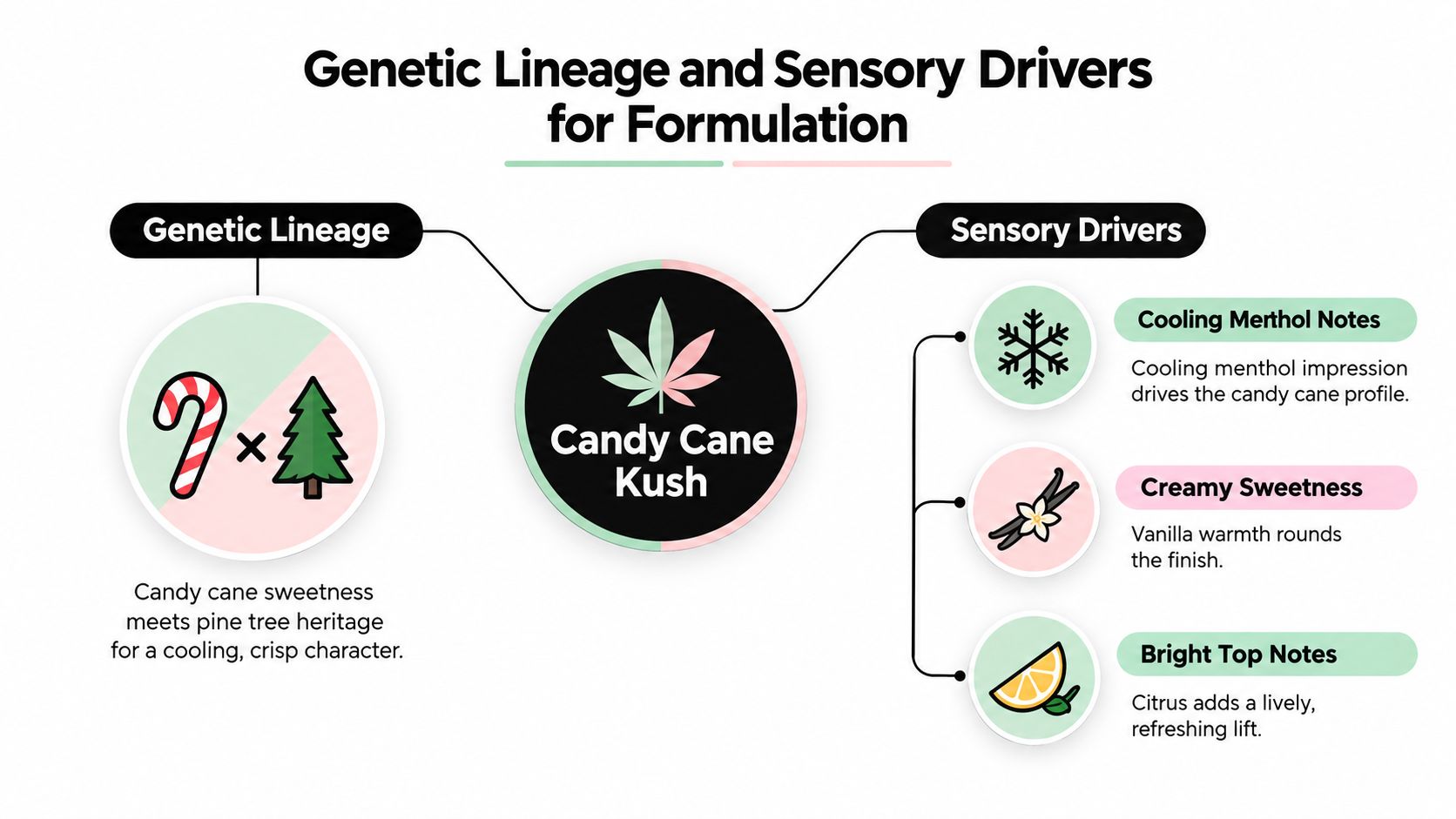
The Candy Cane family is also associated with the AK-47 x Mango x White Widow recipe, while related Kandy Kush lines became visible during the late-2000s medical cannabis era on the U.S. West Coast. Commercial listings for related products cite THC values from 20% to 30%, including material listed at 22% THC and about 2% CBD (EarthMed's coverage of candy strains). Those figures describe market positioning, not a guaranteed composition for every product using the name.
The sensory bridge between fruit and Kush
The practical target is a cooling dessert profile that can survive high-THC distillate without losing its mint top-note or separating from the heavier Kush base. Strain-profile coverage connects Candy Kush-style aroma with cooling, creamy vanilla, and sweet mint, supported by myrcene, limonene, and beta-caryophyllene (Joint Commerce's Candy Kush formulation guide). Limonene supplies lift, myrcene adds weight, and beta-caryophyllene contributes spice. Together, they keep mint from turning medicinal while giving the finish enough density.
Mint is volatile and exposes poor balance quickly. An aggressive top note can read as toothpaste or camphor after storage, while an oversized Kush base can flatten the opening and make the cartridge taste heavy. The formulation therefore needs a controlled relationship between fast-evaporating mint impressions and slower, resinous base terpenes. Sensory checks should cover the first draw, the warmed cartridge, and the retained flavor after use.
Cultivation and post-harvest handling can shift the result substantially. One guide notes variation linked to those conditions, while other listings describe mint and vanilla without comparable laboratory data (Joint Commerce's Candy Cane strain guide). Treat the cultivar name as a sensory specification with chemical markers, then verify each input with terpene analysis and a controlled reference sample.
For a broader botanical comparison, teams can browse In House Genetics seeds. Review the Candy Kush strain archive before treating the family name as a chemical identity.
Deconstructing the Terpene Stack for Vape Cartridges
A reliable Candy Cane Kush formulation starts with a mechanical layer model. The top must arrive quickly but not dominate, the middle should create the mint-vanilla identity, and the base needs enough mass to keep the profile connected to Kush and high-THC distillate.
The named cultivar reference lists limonene, beta-caryophyllene, myrcene, linalool, alpha-humulene, beta-pinene, alpha-pinene, fenchol, alpha-terpineol, and ocimene. It describes the clone as dominant in delta-limonene, beta-caryophyllene, and beta-myrcene (Hendrx Farm's Candy Cane cultivar reference). That gives a useful target stack, but not a universal recipe. Suppliers, phenotypes, and processing histories can produce different relative intensities.
Layer the isolates by sensory job
| Volatility Layer | Primary Isolate | Sensory Contribution | Formulation Role |
|---|---|---|---|
| Top | Delta-limonene | Bright citrus lift | Keeps mint from reading medicinal and opens the first draw |
| Top | Beta-pinene and ocimene | Fresh, green aromatic edge | Adds air and prevents a dense, one-note opening |
| Mid | Linalool | Soft floral creaminess | Rounds the mint and smooths the transition into the base |
| Mid | Alpha-terpineol and fenchol | Cooling, clean, lightly woody nuance | Builds the winter-style cooling impression without relying on a single mint cue |
| Base | Beta-myrcene | Heavy, earthy, resinous body | Anchors the profile and supports the distillate's weight |
| Base | Beta-caryophyllene | Pepper, spice, dry Kush depth | Prevents vanilla and mint from becoming confectionery only |
| Base | Alpha-humulene | Dry herbal and woody structure | Extends the finish and reinforces the mature cannabis character |
Don't treat the table as permission to dose every isolate aggressively. Limonene is the corrective brightener, not the entire top note. Beta-caryophyllene should supply structure rather than a pepper-forward flavor, and myrcene should create body without making the finished oil feel dull.
Formulators often get the supporting compounds wrong. Linalool, fenchol, and alpha-terpineol work best as small architectural adjustments because their value lies in smoothing transitions. If they become obvious individual notes, the blend loses the clean mint-vanilla impression and starts to smell like a collection of isolates.
Formulation rule: Build the base first, add the cooling architecture second, then use the citrus fraction to restore lift.
A practical development sequence is to prepare separate base, mid, and top concentrates, evaluate each against the same distillate matrix, and only then combine them. This approach makes it easier to identify whether a harsh finish comes from excessive limonene, an overbuilt pepper note, or a mint-supporting fraction that is too exposed. Teams wanting broader terpene background can discover cannabis terpenes before selecting the isolates that match their target.
Pre-Formulated Blends Versus Custom Isolate Stacks
The decision is not just about convenience. It determines who owns the burden of sensory correction, batch documentation, and scale-up risk.
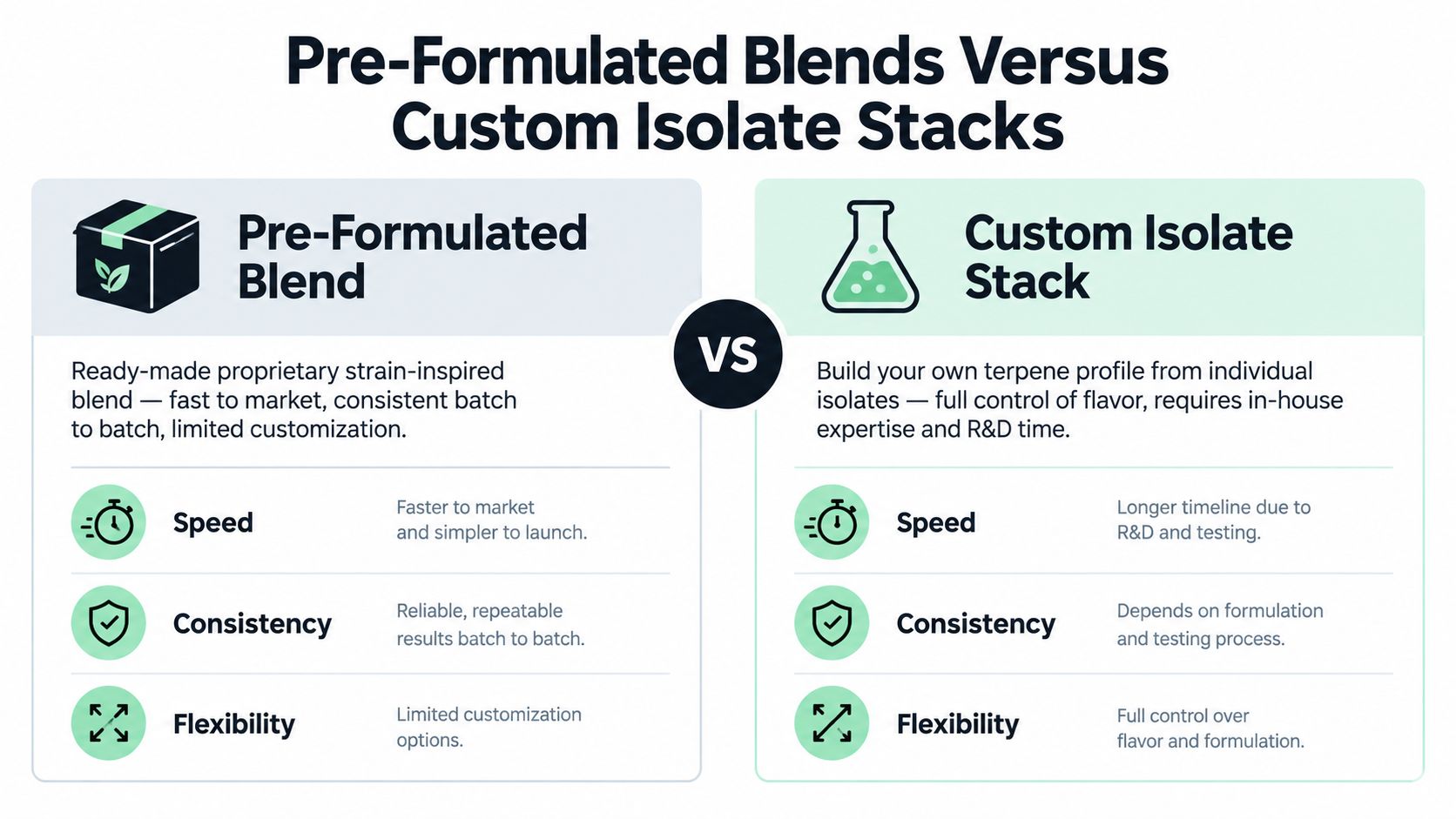
A pre-formulated strain-inspired terpene blend is usually the efficient route when the launch requires a recognizable profile with limited internal development time. A supplier describes Candy Cane Kush as a proprietary terpene blend with cooling, creamy vanilla, and sweet mint notes (True Terpenes' Candy Kush COA). That type of product can shorten bench work because the primary sensory relationship has already been assembled.
A custom isolate stack makes more sense when the brand has a house style, a defined distillate matrix, or a need to control how much mint survives heating. Custom work lets the formulator reduce limonene, increase beta-caryophyllene, or soften the cooling fraction without changing the entire identity. It also requires more stability testing, documentation, and sensory calibration.
Choose by development constraint
| Decision factor | Pre-formulated blend | Custom isolate stack |
|---|---|---|
| Speed | Faster route to a defined sensory trial | Requires staged screening and adjustment |
| Consistency | Depends on supplier lot control and documentation | Depends on internal weighing, mixing, and release controls |
| Flexibility | Limited to the blend's existing balance | Full control over mint, citrus, cream, and Kush depth |
| Best fit | Seasonal or rapid SKU development | Proprietary profile engineering and long-term platform work |
A catalog reference such as Elevated Strains can also illustrate how a brand may organize flavor-focused profiles, but it isn't a substitute for a Candy Cane Kush target or a batch-specific validation plan. Whichever path you choose, document the distillate source, terpene lot, sensory target, and filling conditions. The article how to use terpene isolates is a practical reference for teams building that internal process.
Mixing Protocols and Homogenization for Distillate
Mint and vanilla fractions are volatile, while winterized distillate is highly viscous. If the oil is too cold, the blend may not disperse completely. If it's too hot or exposed to excessive agitation, the light aromatic fraction can escape before filling.
Use the following sequence as a starting formulation guide for distillate, then validate it against your equipment and local manufacturing requirements.
A controlled addition sequence
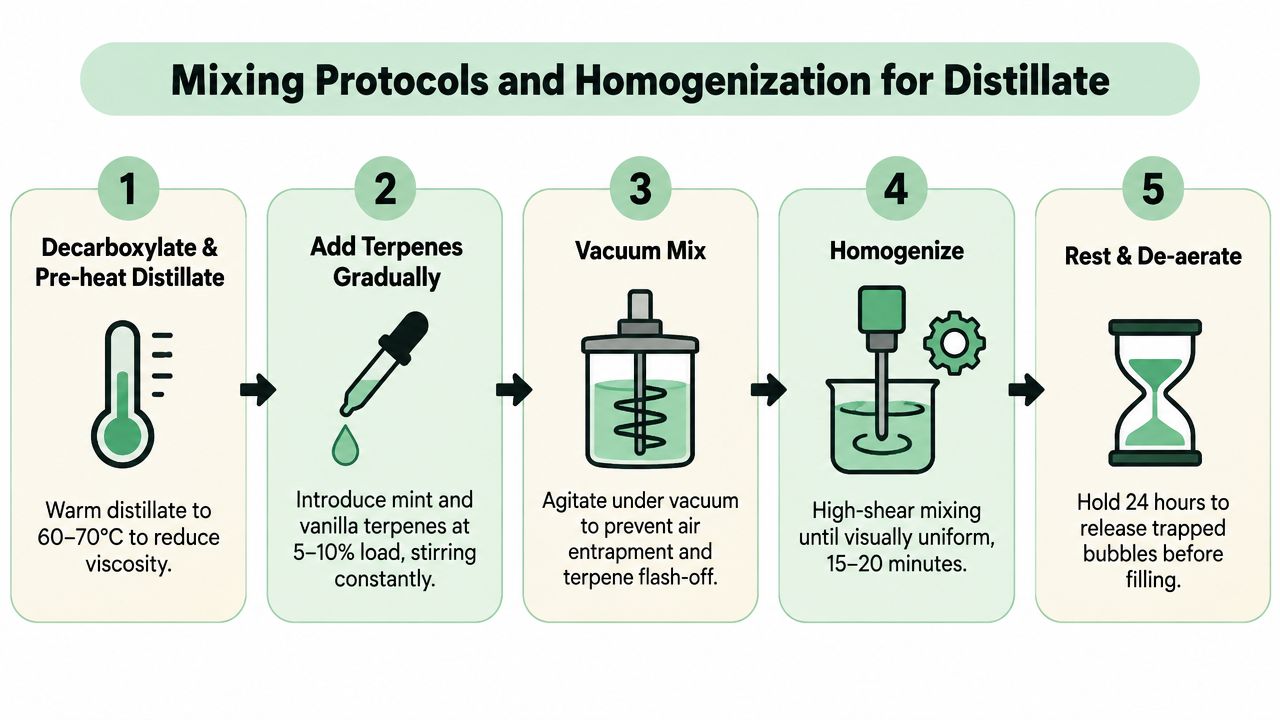
Preheat the distillate gently. Bring the distillate to 60 to 70°C to reduce viscosity, following the process conditions shown in the required mixing workflow infographic. Avoid extending heat exposure beyond what the batch requires, especially once volatile isolates are present.
Prepare the terpene phase separately. Combine the heavier base fraction first, including myrcene and beta-caryophyllene. Add the supporting mid-note materials next. Keep the most volatile top-note fraction, particularly limonene, for the final part of the terpene premix.
Add the terpene phase gradually. The workflow specifies a 5% to 10% load as a process reference (Gold Coast Terpenes mixing workflow infographic). The exact finished concentration still needs to be established through formulation, sensory, and compliance testing. Add slowly while maintaining constant mixing rather than dumping the entire terpene phase into one location.
Homogenize without stripping the top notes
Vacuum mixing can reduce air entrapment, but the vacuum profile must be gentle enough to avoid pulling volatile aromatics from the blend. High-shear homogenization should continue until the oil is visually uniform. The workflow specifies 15 to 20 minutes for that stage and a 24-hour rest before filling (Gold Coast Terpenes mixing workflow infographic).
Because the terpene-rich phase can redistribute during rest, sample from the top, middle, and bottom of the vessel if your quality system supports that approach. Look for haze, rings, droplets, or viscosity differences. A clean visual appearance doesn't prove molecular uniformity, but visible separation is an immediate failure signal.
Low-shear blending protects the profile during addition. Homogenization finishes the job after the oil has already been dispersed.
The practical objective is not just a smooth tank. It's a cartridge that delivers the same sensory order at the beginning and end of use. The distillate and terpene mixing guide can support SOP development, but each facility should qualify its own vessel geometry, impeller, vacuum conditions, and hold time.
Hardware Pairing and Consumer Use Cases
Hardware can expose a weak formulation faster than a bench test. A Candy Cane Kush blend may smell balanced in a vial, then become overly minty at the coil, lose its vanilla body, or leak if the oil and intake system aren't matched.
Myrcene contributes substantial base weight, but it shouldn't be treated as a guaranteed viscosity-control solution. Final viscosity depends on the distillate, terpene load, temperature history, and hardware geometry. Validate the finished oil in the actual cartridge rather than assuming that a sensory blend will behave the same way in a beaker.
Match the device to the oil
Ceramic hardware can preserve a clean flavor presentation, but pore structure, intake design, and operating temperature still control delivery. A cartridge with excessive feed capacity may flood when the oil warms, while a restrictive path can overheat the aromatic fraction and make the mint seem sharper than it was in the tank.
Use a hardware screen that compares:
- Leak resistance: Check the assembled unit after fill, rest, transport simulation, and temperature cycling.
- Draw consistency: Compare the first, middle, and final portions of the cartridge rather than approving only a fresh fill.
- Flavor order: Confirm that citrus lift appears before mint, and that the Kush base remains after the cooling note.
- Coil compatibility: Record the ceramic construction, intake geometry, and operating conditions for every approved hardware configuration.
Position the product honestly
Candy Cane Kush is best suited to evening-oriented, wind-down positioning when the brand uses the profile's indica-leaning identity as a sensory cue rather than a medical promise. Avoid claims about treating insomnia, pain, anxiety, or any other condition. The defensible message is about cooling dessert aroma, Kush depth, and a deliberately relaxing sensory direction.
The strongest consumer use case is not broad “sweet cannabis.” It's a product with a clear expectation: a cool opening, creamy middle, and grounded finish. If the hardware turns that sequence into hot mint followed by bland oil, the formulation and device have failed together.
Quality Control and Sourcing Verification
A convincing aroma doesn't compensate for incomplete raw-material documentation. For cannabis product formulation, every terpene lot should have traceability, relevant contaminant testing, and a clear statement of what the blend does and doesn't contain.
Don't accept a generic specification sheet as a complete COA. Confirm the laboratory documentation, botanical or natural source information, lot identity, and testing scope before the material enters production. The quality control testing guide provides a useful framework for organizing that review.
Release the profile only after verification
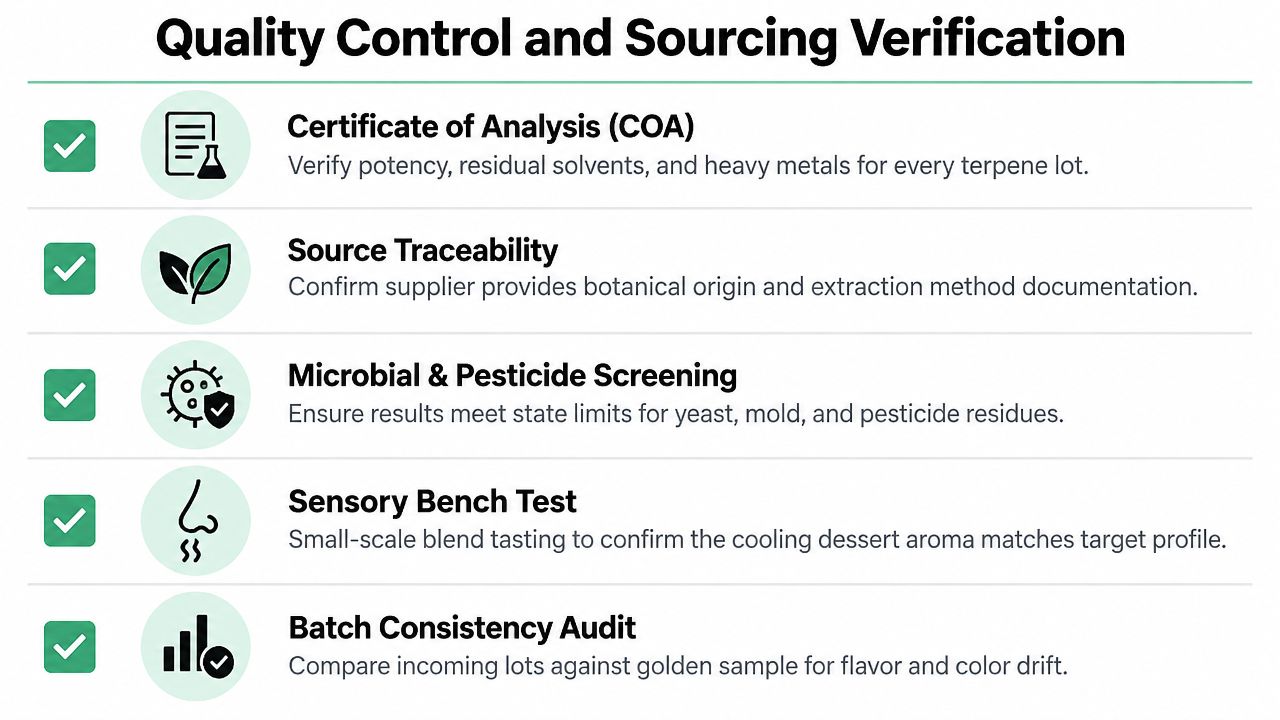
- COA review: Verify the lot identity, composition, residual-solvent results, and heavy-metal results. Confirm the document belongs to the material received.
- Source traceability: Record botanical origin and extraction method, not just the supplier name.
- Contaminant screening: Check microbial and pesticide results against the applicable state requirements for your market.
- Sensory bench test: Compare a small blend against the approved cooling-dessert reference and record mint, vanilla, citrus, pepper, and Kush intensity separately.
- Finished-batch audit: Test for visible separation, color drift, draw consistency, and sensory change after the defined hold and stability periods.
For inhalable products, the blend should be THC-free and free of VG, PG, PEG, and MCT when that is part of your product specification. Lab-verified, diluent-free sourcing reduces ambiguity, but it doesn't remove the need to test the finished cartridge. The release decision belongs to the complete product, not the terpene bottle alone.
Gold Coast Terpenes supplies 100% natural terpene blends, strain-specific profiles, and isolated compounds for cartridges, concentrates, and formulation work, including components such as limonene, myrcene, and beta-caryophyllene. For a Candy Cane Kush development program, review the available profiles, isolates, safety documents, and formulation resources, then visit Gold Coast Terpenes to select materials that fit your distillate, hardware, and quality-control requirements.