
A distributor asks for the safety data sheets covering your terpene-infused distillate, and the request looks simple until you open the document library. One blend has an old MSDS, another has no current supplier information, and a third uses a product name that no longer matches the cartridge label. The formulation may be technically sound, but the paperwork can't support a shipment, customer approval, or workplace review.
For cannabis extractors, vape manufacturers, and brand owners, safety data sheet requirements are part of the product system, not an administrative afterthought. A terpene profile for vape cartridges must be supported by documentation that reflects the actual ingredients, classification, handling conditions, and market where the product will be supplied. The operational challenge is keeping that information current across the United States, Canada, and the European Union.
Why Terpene Formulators Cannot Ignore SDS Compliance
The distributor doesn't usually want an SDS because the terpene blend is interesting. They want it because their own receiving, safety, and compliance teams need a reliable technical document before they approve the product. If the SDS is missing, incomplete, or inconsistent with the label, the buyer may pause onboarding while your team reconstructs the formulation history.
That delay can affect more than a single order. A rejected shipment, a blocked wholesale account, or an inspection finding can expose weaknesses in supplier qualification and hazard communication. OSHA's Hazard Communication Standard is built around communicating chemical hazards to downstream users, and the history of OSHA's SDS transition shows why the modern format replaced older, less predictable MSDS practices.
Practical rule: Treat every commercial terpene blend as a controlled document, even when the blend is used only as a flavor component in a finished cannabis product.
An SDS gives downstream personnel information about identification, hazards, composition, first aid, firefighting, accidental releases, handling, storage, exposure controls, physical properties, toxicology, disposal, transport, and regulatory considerations. It also gives your own team a defensible record of how the product was evaluated.
A strain-inspired terpene blend for distillate can change when an isolate is substituted, a concentration band moves, a supplier revises its raw-material SDS, or new hazard information becomes available. The document must follow the product. A static file saved in a shared folder won't do that.
For a practical overview of why these documents matter in commercial terpene operations, review this safety data sheet importance guide. The key point is straightforward: if you sell ingredients to another business, your SDS library is part of your sales infrastructure and your compliance program.
The 16-Section SDS Format Explained for Terpene Products
A terpene blend can pass through several hands before anyone checks its SDS. A formulator changes an isolate, a Canadian customer requests a different document, or an EU distributor identifies a missing field. The practical problem is keeping one controlled record accurate across products, suppliers, and jurisdictions.
The modern SDS follows a standardized 16-section structure aligned with the UN Globally Harmonized System, or GHS. OSHA's HCS 2012 rule requires manufacturers and importers to provide compliant SDSs and labels to downstream users, while the HCS 2012 standard text sets out the required communication framework.
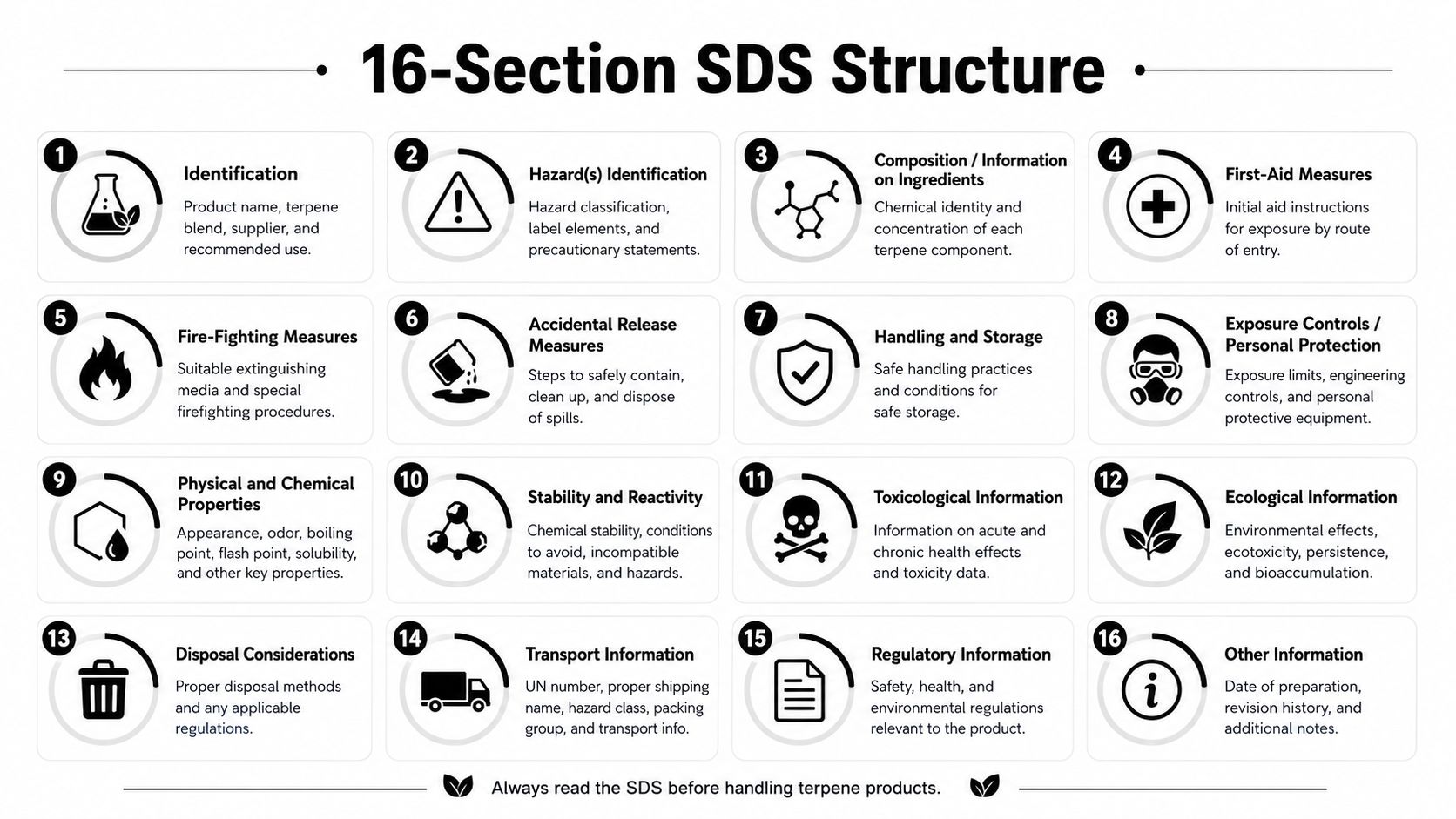
Sections one through eight
- Identification: Name the terpene isolate or blend, recommended use, restrictions, supplier, contact details, and emergency contact information. The product identifier should match the commercial label, formulation record, and shipment paperwork.
- Hazard identification: State the classification, pictograms, signal word, hazard statements, precautionary statements, and relevant unclassified hazards.
- Composition and ingredient information: Identify substances, ingredients, impurities, and stabilizing additives that contribute to the blend's classification. A limonene isolate requires a different composition record from a complex strain-inspired blend.
- First aid measures: Cover inhalation, skin and eye contact, ingestion, symptoms, and immediate medical guidance.
- Firefighting measures: Describe suitable extinguishing methods, chemical-specific hazards, and firefighter protective equipment.
- Accidental release measures: Explain containment, cleanup, emergency procedures, and personal protection for spills.
- Handling and storage: Address safe handling, hygiene, storage conditions, incompatibilities, and prevention of environmental release.
- Exposure controls and personal protection: Provide applicable exposure information, engineering controls, and PPE guidance.
Sections nine through 16
- Physical and chemical properties records appearance, odor, flammability characteristics, vapor pressure, solubility, viscosity, and other relevant properties.
- Stability and reactivity addresses hazardous reactions, conditions to avoid, incompatible materials, and decomposition products.
- Toxicological information covers routes of exposure, symptoms, acute and chronic effects, toxicity information, and carcinogenicity data where applicable.
- Ecological information addresses environmental hazards.
- Disposal considerations supports safe disposal or reclamation decisions.
- Transport information records shipping-related information and precautions.
- Regulatory information captures applicable safety, health, and environmental requirements.
- Other information records preparation and revision dates, changes, and supporting notes.
OSHA includes Sections 12 through 15 for GHS consistency, although other agencies oversee those subjects. The Federal Register interpretation of SDS content explains that the document must capture relevant risk data, not merely identify the product.
Every subsection needs a clear entry. If a field does not apply, state that directly instead of leaving a blank that an auditor may treat as an omission. Teams selling across the US, Canada, and EU should also record the revision basis and verify that the same blend has not been issued with conflicting regional information.
The following video can help teams visualize the role of the standardized document in chemical hazard communication.
GHS Hazard Classification for Terpene Isolates and Blends
A terpene SDS begins with the hazard profile of the material, not with the desired flavor outcome. A pure isolate and a finished blend may share a sensory role, but their classifications depend on the individual substance properties, concentration, and mixture rules.
Limonene, myrcene, and beta-caryophyllene should each be evaluated from current raw-material documentation and applicable classification data. A formulator shouldn't copy a hazard statement from one isolate into a blend without checking whether the final composition changes the classification. The same caution applies when a flavor-forward profile is rebuilt with different suppliers or concentration bands.
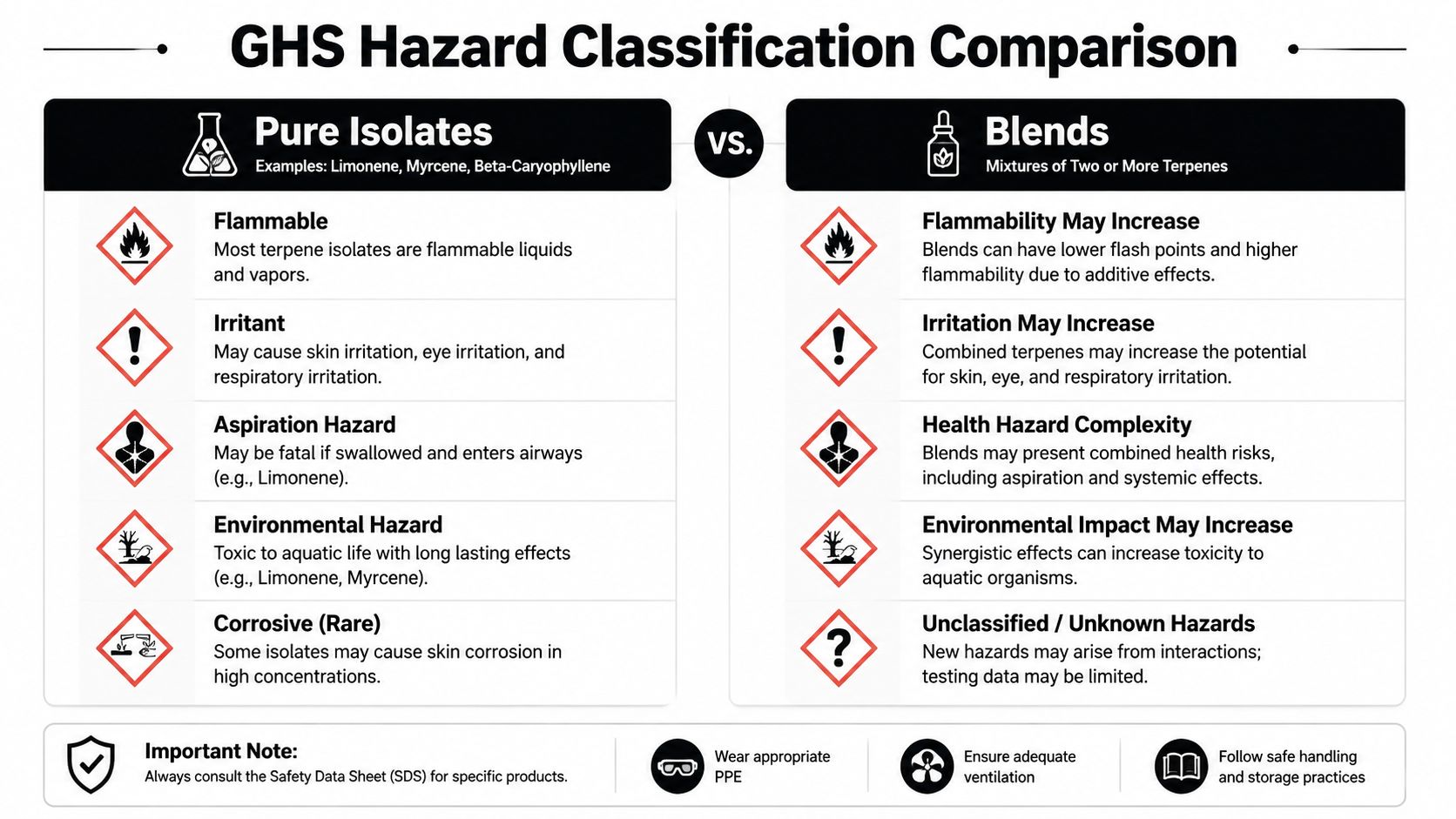
Isolates and mixtures require different reviews
For an isolate, the evaluation focuses on the substance's own hazard information, identity, physical properties, toxicology, and environmental data. For a blend, the author must assess every relevant ingredient and apply the mixture classification method required for the target jurisdiction. Concentration thresholds and cut-off values can determine whether a hazard category, pictogram, signal word, or statement applies.
That makes proprietary formulation work particularly sensitive. A strain-inspired terpene blend may contain several ingredients that each contribute to irritation, flammability, or environmental classification. The final SDS must reflect the mixture, not just list the most familiar ingredient.
Classification should be reproducible. If another qualified reviewer can't follow the ingredient data and concentration logic, the SDS is not ready for approval.
Keep the supporting calculation record with the formulation version. The SDS should state the resulting classification and relevant label elements, while the technical file preserves the reasoning behind it. A single-isolate reference such as this SDS for limonene can be useful as source material, but it isn't a substitute for evaluating a custom blend.
Under-classification can leave workers and downstream manufacturers without appropriate warnings. Over-classification can create unnecessary handling requirements and confuse buyers who compare your SDS with the product's actual composition. The workable approach is disciplined review, documented inputs, and a clear connection between ingredient data and the finished blend.
Jurisdictional Differences Between US Canada and EU Requirements
The same terpene blend may need different document controls depending on where it's supplied. The United States, Canada, and the EU share a GHS-based foundation, but they don't create one universal compliance file that automatically satisfies every market.
In the United States, OSHA's Hazard Communication Standard requires the structured SDS format and enforces the required content in Sections 1 through 11 and Section 16. Sections 12 through 15 are included for GHS consistency, while their subject matter is handled by other agencies. Canada uses WHMIS and the amended Hazardous Products Regulations, with its own supplier and language obligations. EU supply follows REACH and CLP, where SDS duties can extend beyond products formally classified as hazardous.
| Jurisdiction | Enforced sections | Revision timeline | Special requirements |
|---|---|---|---|
| United States | Sections 1 through 11 and 16 under OSHA | Revise when significant new hazard information becomes available | Use the required structured format and align SDS information with labels |
| Canada | WHMIS and the amended Hazardous Products Regulations | Transition obligations reached full compliance after December 14, 2025 | Prepare documentation and labels for Canadian supplier obligations, including applicable bilingual requirements |
| European Union | REACH and CLP requirements for applicable substances and mixtures | Maintain classification and supply-chain information as conditions change | SDSs may be required for certain non-classified substances and mixtures, with market-appropriate language |
A US supplier shipping to a Canadian extractor shouldn't assume an English SDS will meet the customer's needs. An EU distributor may request an SDS for a product that the supplier regarded as non-hazardous under a North American review. Those are not customer-service quirks. They're signs that the supplier needs a market-specific document strategy.
A product reference such as Elevated Strains can sit within a commercial catalog, but the SDS identifier still needs to map to the actual blend and intended use. Product naming, language, classification, and revision control should be reviewed together.
Use a cross-market safety documentation resource as a starting point, then have the responsible compliance professional verify the rules for each destination and supply-chain role.
When Non-Hazardous Terpene Products Still Require an SDS
“Not classified as hazardous” doesn't always mean “no SDS needed.” That assumption is one of the more persistent gaps in terpene documentation because formulators often assess only the finished mixture's headline classification and overlook ingredient-level triggers.
Under the EU REACH system, an SDS must be supplied without request for substances or mixtures classified as hazardous under CLP. The obligation can also apply to certain non-classified substances, including PBT or vPvB substances and substances on the Candidate List of SVHCs. For some non-hazardous mixtures containing specified hazardous substances, downstream users or distributors can request an SDS. These rules are summarized by ECHA's safety data sheet guidance.
The practical question isn't only whether the final bottle carries a hazard pictogram. It is whether the formulation contains ingredients, concentration bands, or regulatory characteristics that trigger a supply-chain document obligation.
Request-based duties still matter
A downstream user may need an SDS to evaluate workplace handling, storage, emergency response, or internal approval. If your team answers that the product is “mild” without checking the applicable trigger, you may create a commercial and compliance problem.
The UK approach also matters for exporters. Suppliers must send a data sheet when a dangerous substance is first ordered, when the formulation changes, or when the customer asks for one, as described in the DGUV REACH information on SDS duties. A blend can therefore require controlled documentation even when the immediate sales team doesn't view it as a high-hazard material.
Maintain ingredient concentration bands and classification records for every blend. Track changes to Candidate List status, supplier classifications, and workplace exposure information. That workflow is more reliable than deciding document requirements anew each time a customer asks.
Authoring and Maintaining SDSs for Custom Terpene Blends
A terpene blend can change after the first SDS is approved. A new isolate supplier, revised concentration range, stabilizer, or target market may alter the classification or required wording. Start with formulation control: record the exact blend version, ingredients, permitted concentrations, supplier inputs, and intended US, Canadian, or EU market.
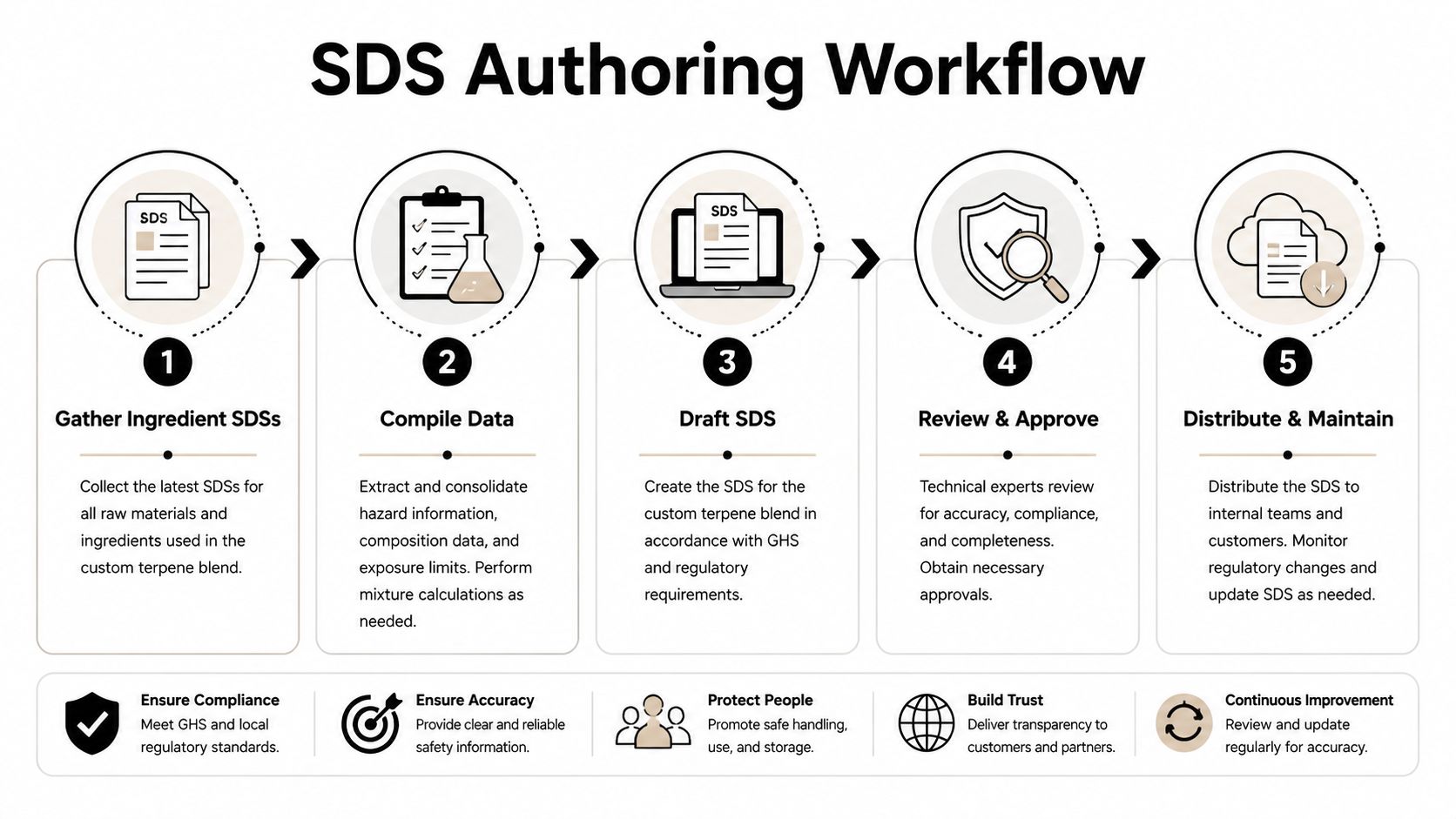
A workable authoring sequence
The workflow begins with current SDSs for each isolate, diluent, additive, impurity, and stabilizer that could affect classification. Record the supplier, document date, product identifier, and market coverage. Then reconcile those inputs against the approved formula. Supplier technical names, internal codes, and label names must point to the same material.
Draft all 16 sections with product-specific information. Do not leave fields blank. If information is irrelevant or unavailable, state that appropriately rather than omitting it. A second qualified reviewer should then test the classification, composition, emergency contacts, physical properties, transport information, language, label elements, and revision history. Unsupported assumptions are a common audit weakness.
After approval, distribute the current version to customers, employees, distributors, and internal systems. Retire superseded copies while preserving the audit trail. A safety data sheet management resource can help organize version control across those recipients.
A proprietary blend still requires responsible hazard disclosure. Use permitted concentration ranges where appropriate, document the trade-secret basis, and define the required disclosure process. The SDS must communicate the hazards downstream users need to control.
EU REACH Annex II gives Section 16 a specific review role for mixtures. It requires the classification method and a list of relevant hazard and precautionary statements, including full wording when those statements do not appear elsewhere. The REACH Annex II Section 16 guidance helps reviewers confirm that the document explains how the classification was reached, rather than displaying only the result.
Store the approved SDS with its formulation version, label artwork, raw-material records, and market variant. That traceability lets the team show which document applied to each blend and jurisdiction when an auditor asks.
Connecting SDS Classification to Product Label Elements
The SDS and the product label are two expressions of the same hazard evaluation. Section 2 establishes the classification and associated label elements. The label then communicates the relevant pictograms, signal word, hazard statements, and precautionary statements on the container or packaging.
For terpene products, a classification review may lead to a flame pictogram for a flammability hazard, an exclamation mark for certain irritation hazards, or an environment pictogram for applicable aquatic hazards. The correct elements depend on the classification of the actual isolate or blend. Don't select icons because they appear on a supplier's older label or because they seem generally appropriate.
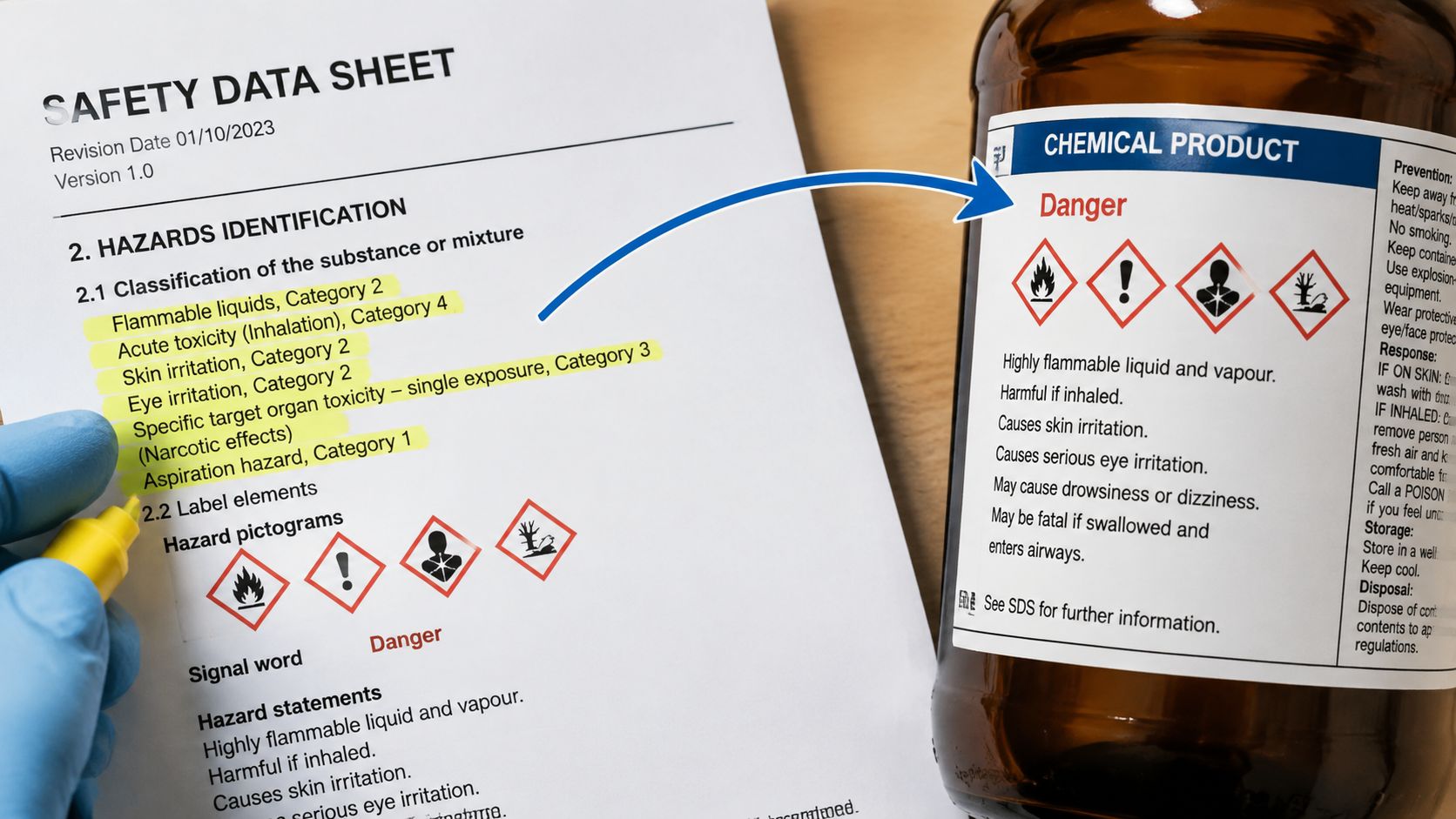
The label review should start with Section 2
Compare the product identifier first. A cart formulation may have an internal development name, a production name, and a retail name, but the SDS and label need a clear connection. Then compare the hazard classification, pictograms, signal word, statements, and precautionary language.
“Danger” and “Warning” aren't interchangeable design choices. The signal word follows the applicable hazard classification, and the label shouldn't soften or intensify the communication independently of the SDS.
Common failures include:
- Outdated pictograms: Artwork retains symbols from an earlier classification after the blend changes.
- Missing precautions: The label includes a hazard statement but omits handling, storage, or response language required by the classification.
- Name mismatches: The label identifies a flavor name while the SDS uses an unrelated internal code.
- Formula drift: Production changes the ratio of limonene, myrcene, beta-caryophyllene, or other components without triggering a document review.
- Market mismatch: One label and SDS pair is reused across markets without checking local requirements.
Run the label and SDS review as one approval step. A technically correct SDS paired with an outdated label still creates a hazard communication gap.
SDS Compliance Checklist for Terpene Suppliers and Formulators
A useful audit asks whether the document is complete, accurate, current, accessible, and connected to the product being shipped. Start with the library, not with the last customer complaint.
Document and formulation checks
- Confirm the identifier: Product name, internal code, recommended use, supplier details, and emergency contact information should point to the same commercial material.
- Review all sections: Confirm that the full 16-section structure is present and that no subsection is empty. The EU OSHwiki SDS summary specifically notes the importance of complete section coverage.
- Match composition: Compare Section 3 with the approved formula, including relevant impurities, additives, and concentration ranges.
- Recheck classification: Verify that the mixture classification follows the current ingredient inputs and applicable cut-off values.
- Inspect physical data: For isolates and blends, review flash point, flammability information, appearance, odor, vapor pressure, solubility, and other applicable properties.
- Align labels: Section 2 should match the label's product identifier, pictograms, signal word, hazard statements, and precautionary statements.
Maintenance and distribution checks
- Check revision control: Record preparation and revision dates, document changes, approvers, and superseded versions.
- Monitor suppliers: Request updated raw-material SDSs when supplier products or hazard information change.
- Control markets: Maintain the language, format, and regulatory variant needed for each destination.
- Test retrieval: Have a staff member locate the current SDS without relying on one person's inbox or local computer.
- Preserve history: Retain prior versions and the reason for each revision according to your quality system and applicable obligations.
Audit test: Pick one finished terpene blend and trace it from formula, to raw-material SDSs, to approved SDS, to label, to shipment record. Any break in that chain deserves investigation.
This checklist works for strain-inspired blends, isolates, terpene products for distillate, and flavor systems used in vape cartridge manufacturing. It also exposes a common weakness: teams often verify whether a document exists, but not whether it describes the exact product in the customer's hands.
The 2024-2026 Regulatory Changes Impacting SDS Maintenance
Recent updates reinforce a point that many older compliance articles miss: SDS work is ongoing. OSHA's updated Hazard Communication Standard requires the 16-section format and specifies mandatory content in Sections 1 through 11 and Section 16. U.S. guidance also states that an SDS must be revised within 90 days after the supplier learns significant new hazard information, as shown in OSHA Appendix D.
That revision expectation changes the operating model for terpene suppliers. A new supplier SDS, revised classification, newly identified physical hazard, or material change in a blend can require action even when the product name and intended use remain unchanged.
Canada adds a completed transition milestone
Canada completed its three-year transition under the amended Hazardous Products Regulations on December 14, 2025, and Health Canada now requires hazardous products to fully comply with those amended requirements. Health Canada also notes that some claimants may be asked to provide revised SDSs and labels after the transition. The Canadian transition information should be checked by suppliers serving that market.
The commercial burden is version control. A US document, a Canadian document, and an EU document may share technical source data while requiring different language, regulatory statements, or supply-chain handling. Saving one master PDF and renaming it for each market is not a control system.
Build triggers into change management:
- Supplier change: Hold release until raw-material documentation is reviewed.
- Formula change: Recalculate classification and inspect labels.
- New hazard information: Start the applicable revision clock.
- Market change: Confirm the destination-specific document and language.
- Regulatory update: Review affected SKUs instead of waiting for a customer complaint.
The strongest programs assign ownership, maintain a revision register, and make SDS approval part of formulation release. That approach costs administrative time, but it prevents the larger burden of reconstructing compliance after a shipment is blocked.
Common SDS Mistakes Terpene Suppliers Make and How to Avoid Them
A cartridge brand submits a blend for distributor approval. The formula is current, but the SDS still carries the previous product name. Section 3 uses broad language that doesn't match the approved ingredient record, and the label displays different hazard elements from Section 2. The distributor doesn't need to prove that the blend is unsafe. The inconsistencies are enough to send the file back.
The first mistake is treating a complete-looking PDF as a compliant SDS. A document can have 16 headings and still fail if fields are blank, the composition is stale, the classification method is missing, or the emergency information is wrong. The fix is a controlled review against the formula and the market, not a visual check of page count.
Another recurring problem is copying an isolate document into a blend file. Limonene, myrcene, and beta-caryophyllene may each have source information, but a mixture needs its own classification assessment. The solution is to retain the ingredient evidence and document how the final blend was evaluated.
Errors that surface during customer review
- Empty subsections: State that information isn't applicable or available where appropriate, rather than leaving unexplained blanks.
- Formula changes without revisions: Make SDS review a required step in change control.
- Label inconsistency: Compare Section 2 with the final approved artwork before release.
- Market overreach: Don't assume a US SDS automatically satisfies Canadian or EU supply requirements.
- Uncontrolled copies: Give distributors and employees access to the current version while preserving superseded records.
- English-only delivery: Check destination language obligations before accepting a cross-border order.
One supplier may describe a product as “non-hazardous” and stop there. A stronger supplier checks whether ingredient thresholds, downstream requests, or market rules still require an SDS. That distinction demonstrates operational maturity to buyers who qualify vendors based on documentation as well as formulation quality.
The practical advantage is credibility. When a distributor asks for an SDS, you can provide the correct market version, confirm its relationship to the label, and trace it to the formulation record instead of beginning an emergency document rebuild.
Gold Coast Terpenes supplies 100% natural terpene blends, strain-specific profiles, and isolated compounds for cartridges, concentrates, and product formulation, with safety documents and formulation resources available for commercial teams. Visit Gold Coast Terpenes to review terpene options and supporting tools before your next blend, distillate, or vape cartridge release.