
Most advice on Lime Sorbet strain effects starts with a shortcut: call the profile uplifting, then add “sleepy” as a footnote. That framing fails product developers because the same lime-forward concept can produce a bright head note, a calm finish, or an unexpectedly heavy experience depending on cannabinoid exposure, tolerance, delivery format, and terpene balance.
For vape cartridges and distillate, the commercial problem is sharper. A natural flower profile is a complex chemotype, while an engineered cartridge may use selected isolates, botanical lime materials, high-THC distillate, and a deliberately shaped top note. Replicating the sensory and functional balance requires more than adding limonene until the oil smells citrusy.
Beyond the Uplifting vs Sleepy Binary
Lime Sorbet isn't reliably “uplifting” or “sleepy.” Consumer-reported data show a mixed pattern, with sleepy, relaxed, and euphoric among the dominant effects, while users also report anxiety-related negatives and dry eyes. The same strain database reports that 33% of users say it helps with anxiety, 27% with stress, and 25% with depression (Leafly's Lime Sorbet profile). Those figures describe user reports, not a controlled prediction for every batch.
That variation matters in formulation. A citrus top note can make an oil feel mentally bright at first, while myrcene and beta-caryophyllene can soften the finish. A high-dose or high-THC cartridge may then feel more body-heavy than the aroma suggests. Tolerance changes the interpretation again. A formulation that feels functional to an experienced user can feel sedating, distracting, or uncomfortable to a lower-tolerance user.
Why the label doesn't predict the experience
Consumption method changes the shape of the experience. Flower carries a broader plant-derived matrix, while distillate cartridges often deliver a more concentrated and immediate expression of THC with a narrower, engineered terpene architecture. Reintroduced terpenes can make the first inhalation taste more vivid without reproducing every minor constituent found in the plant.
Formulation rule: Treat “uplift” and “relaxation” as separate design targets, not opposite labels.
The practical lesson is to define the intended effect before selecting the blend. A daytime Lime Sorbet-inspired cartridge may prioritize lime brightness, crispness, and a controlled body note. An evening version may keep the same citrus identity but increase the grounding layer. The most useful discussion of indica and sativa terpene distinctions is therefore functional rather than taxonomic. For developers, the name is a starting point. The COA, terpene ratio, cannabinoid matrix, and delivery system determine what the customer experiences.
Terpene Markers Driving Citrus and Dessert Notes
Natural Lime Sorbet flower rarely feels like lime aroma alone. Its recognizable profile depends on a bright citrus opening, a soft dessert impression, and enough earthy structure to keep the experience from becoming thin or one-dimensional. Engineered distillate can reproduce those sensory layers, but a terpene-forward blend may make the first inhalation sharper and the body effect less nuanced.
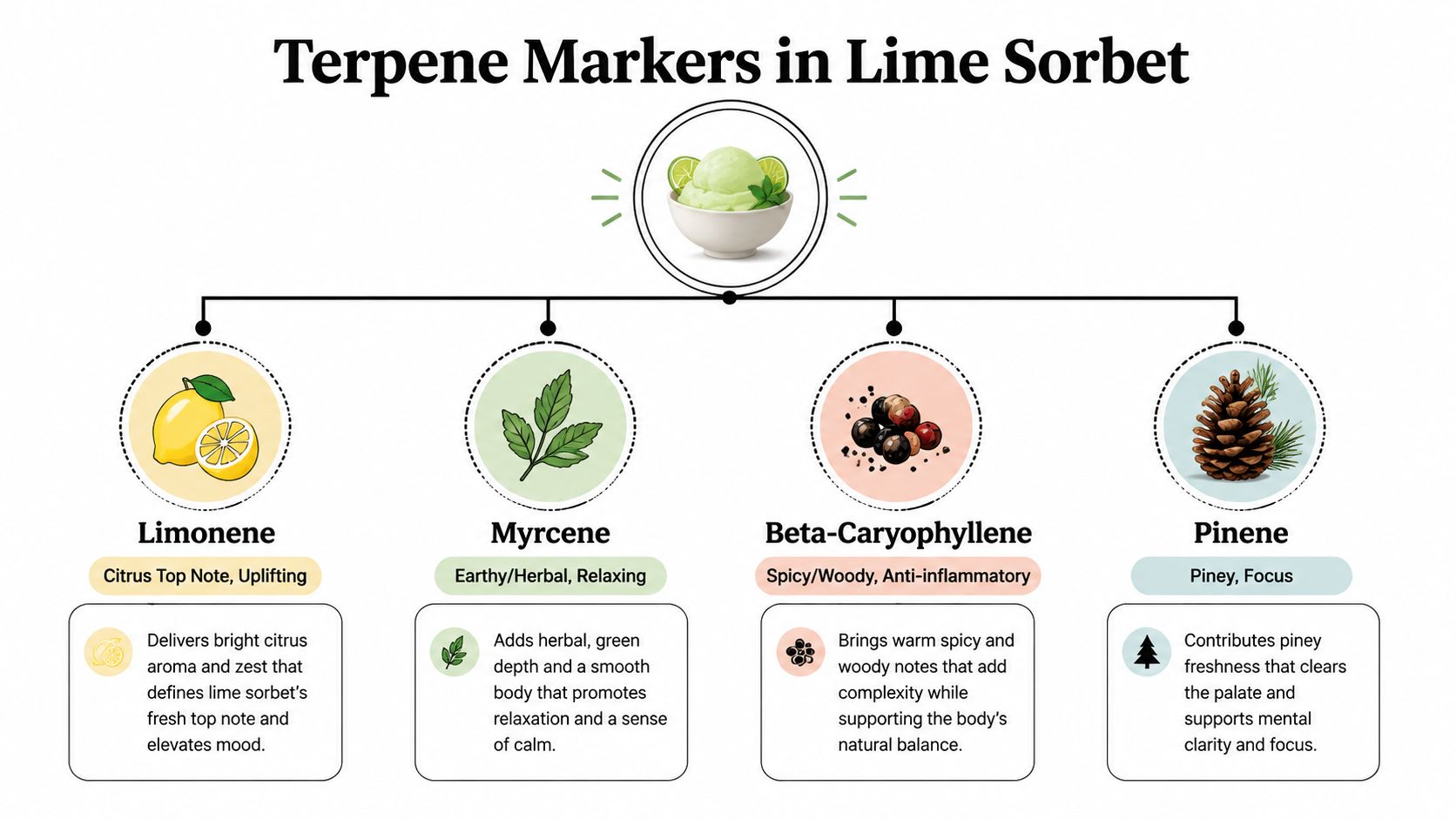
Limonene supplies the immediate lime and lemon character. In formulation terms, it functions as a top note, arriving quickly and dominating the first aromatic impression. Excess limonene can make the profile feel harsh or peel-like when softer mid and base materials do not support it. Independent cannabis terpene profile guidance describes limonene in uplifting sensory terms and discusses possible 5-HT1A-mediated anxiolytic activity. Treat those points as design hypotheses, not medical claims or guaranteed outcomes.
Assigning top, mid, and base roles
Myrcene supplies body and a mid-to-base layer. Its earthy, herbal character rounds sharp citrus and can make the finish feel more relaxed. Too much suppresses the clean sorbet quality and leaves the cartridge muddy.
Beta-caryophyllene adds pepper, spice, and dry wood. It gives the blend structure after the lime note fades, so the flavor does not read like candy alone. Its grounding impression remains sensory, not a therapeutic promise.
Pinene contributes pine, freshness, and a crisp green edge. In engineered oil, too much pinene can communicate clarity more strongly than the softer balance found in flower. One Lime Sorbet distillate breakdown lists alpha-pinene at 4.67%, alongside beta-pinene, delta-limonene, and beta-caryophyllene (Lime Sorbet distillate breakdown).
A practical sensory map is:
- Top: limonene, lime oil, and citral for zest.
- Middle: pinene and beta-pinene for crisp green lift.
- Base: myrcene and beta-caryophyllene for body, spice, and persistence.
Use a d-limonene formulation guide to evaluate limonene within the complete blend, rather than maximizing the isolate.
The Science Behind Lime Sorbet's Calming Effects
The most relevant evidence for citrus-forward THC products comes from a 2024 Johns Hopkins-led human study. Vaporized d-limonene alone did not differ from placebo, but the combination of 30 mg THC and 15 mg d-limonene significantly reduced participant ratings of “anxious/nervous” and “paranoid” compared with 30 mg THC alone (the Lime Sorbet strain guide discussing the study).
That result doesn't mean limonene is a standalone anti-anxiety ingredient, and it doesn't prove that every Lime Sorbet product will feel calm. The study tested a controlled combination in healthy adult cannabis users. It does, however, support a more useful formulation hypothesis: a terpene can alter the acute subjective response to THC without reducing every THC effect.
The researchers reported that the reduction increased with limonene dose. They also reported that limonene didn't blunt THC's other subjective, cognitive, or physiological effects. For product developers, this distinction matters. The objective isn't necessarily to make a cartridge weak or emotionally flat. It may be to preserve the desired THC experience while reducing the likelihood that a bright, high-intensity profile feels edgy.
What the study means for a Lime Sorbet blend
Lime-leaning cultivars are often associated with limonene-rich aromas, so the finding gives scientific context to user reports that combine citrus brightness with a smoother emotional finish. The evidence supports an entourage-type interaction, but it doesn't establish a universal commercial ratio for Lime Sorbet replication.
A controlled study also doesn't replace finished-product testing. Distillate composition, terpene source, inhalation behavior, device temperature, and batch consistency all affect exposure. A botanical limonene isolate in a distillate cartridge isn't equivalent to flower containing limonene plus a broader plant matrix.
Evidence boundary: Use the human study to justify testing limonene alongside THC, not to promise anxiety relief or a predictable therapeutic result.
For technical teams, the right workflow is comparative. Hold the distillate and device constant, then compare a limonene-led blend with a balanced blend containing myrcene and beta-caryophyllene. Record aroma, harshness, onset character, and finish through trained sensory review. A practical primer on how terpenes affect the brain can support internal education, but finished claims still need to stay within the evidence and applicable regulations.
Formulating Lime Sorbet for Vape Cartridges and Distillate
A convincing Lime Sorbet cartridge is not built by maximizing lime aroma. Start with the sensory target, then set the functional balance around it. Independent strain summaries describe lime and citrus chemotypes with total terpene content around 1.5% to 3.0% and limonene commonly in the 0.5% to 1.2% range (lime-forward strain formulation data). These are plant-profile references, not a required cartridge formula. Distillate, hardware, terpene source, and final loading all change how the blend is perceived.
Use limonene as the identity marker, myrcene to build body, and beta-caryophyllene for peppery structure. Add pinene only when the target needs a greener, sharper finish. The ranges below provide development references rather than guaranteed effect thresholds.
Lime Sorbet terpene formulation ranges
| Terpene | Role | Typical Range (% by weight) |
|---|---|---|
| Limonene | Lime and citrus top note, bright opening | 0.5% to 1.2% |
| Myrcene | Earthy, herbal body and softer finish | Balance according to target profile |
| Beta-caryophyllene | Peppery mid-to-base structure | Balance according to target profile |
| Pinene | Crisp pine, green freshness, clearer sensory finish | Use selectively |
| Total terpene content | Overall aromatic intensity in lime/citrus chemotypes | 1.5% to 3.0% |
Limonene can dominate perception even when it is not the largest ingredient by mass. A thin or overly stimulating blend often needs a stronger body layer, not more lime material. Increase myrcene cautiously. It can smooth the finish, while excessive myrcene can cover the dessert character and reduce definition.
Use citral to shape the lime character
Citral gives the formulator a direct control point for lime identity. Commercial guidance identifies the geranial-to-neral ratio as the primary control for citrus character and recommends starting citral at 0.5% to 2% by weight of the total blend (Lime Sorbet flavor formulation guidance). Build a small ladder within that range, then evaluate vapor performance rather than judging the liquid aroma alone.
A strong lime nose does not confirm authenticity. Lime oil and citral can reproduce the opening while producing a hollow or harsh finish if the middle and base notes are underdeveloped. Review distillate mixing guidance before scaling. Test viscosity, homogeneity, hardware compatibility, and sensory stability in the actual oil and cartridge system.
Natural Flower vs Engineered Terpene Profiles
Natural Lime Sorbet flower and an engineered Lime Sorbet cartridge are different formulation targets. Flower presents a wider, cultivar-dependent chemical profile shaped by cultivation, curing, extraction, and storage. A cartridge can target selected sensory markers with greater consistency, but its character may come from terpene reintroduction rather than the original plant.
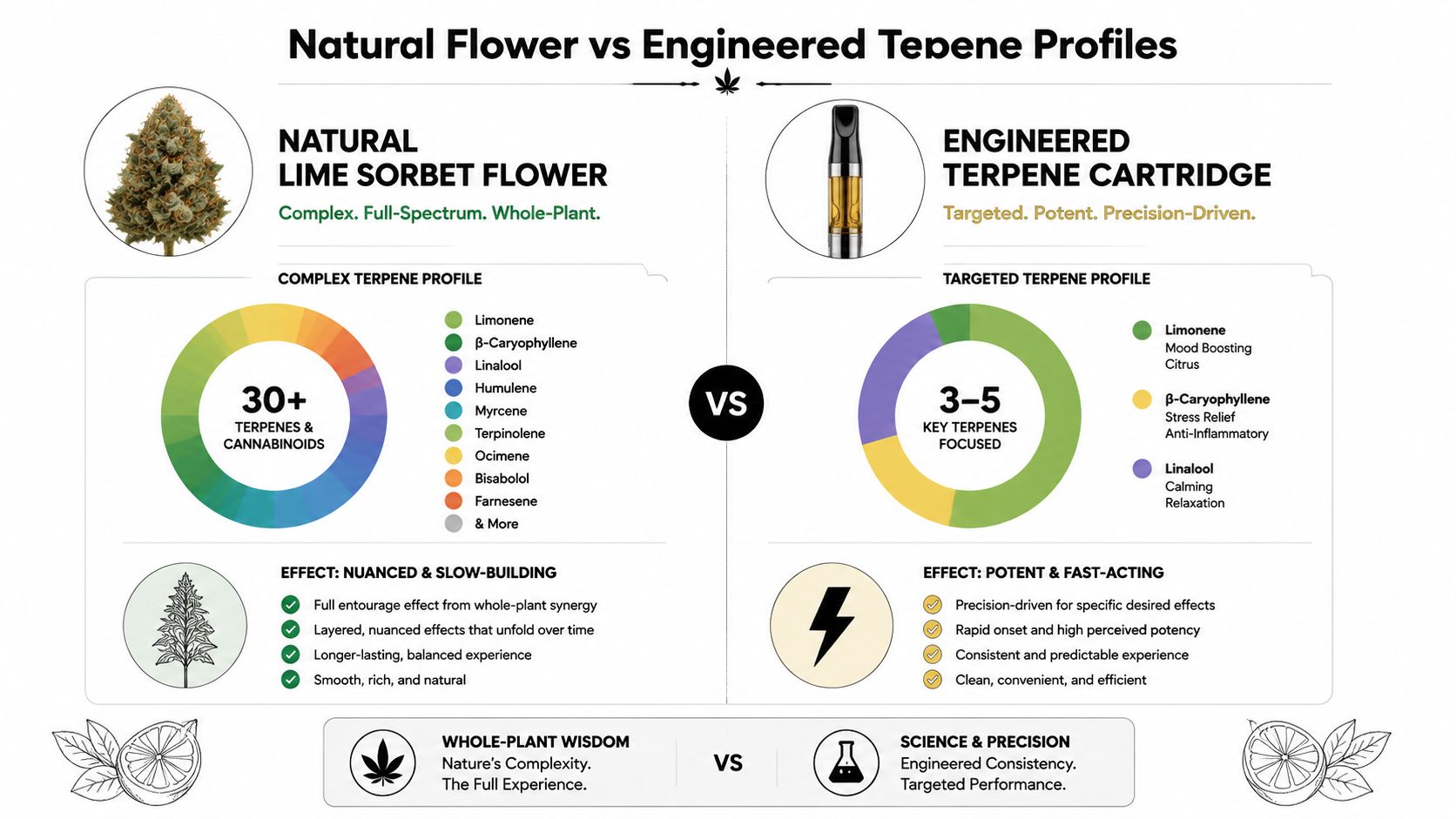
A natural flower batch may open with lime zest and cream, develop peppery depth, and move gradually toward body relaxation. A distillate cartridge can make the lime opening more repeatable, yet the effect may feel faster, more concentrated, or more linear because selected markers are emphasized and the distillate contains a high cannabinoid concentration. That difference matters when replicating the strain's balance rather than its label.
Why engineered carts diverge
One commercial Lime Sorbet-flavored distillate reports 6.18% total terpenes, including alpha-pinene at 4.67%, beta-pinene at 0.52%, delta-limonene at 0.37%, and beta-caryophyllene at 0.21% (the product composition breakdown). That ratio places pinene ahead of limonene and therefore pushes the sensory profile toward crisp freshness. The product copy frames the mood as “Lift,” with clarity and alertness. That positioning does not establish how natural Lime Sorbet flower affects users.
A separate formulation uses alpha pinene, beta caryophyllene, beta pinene, and lime oil, showing how pine, spice, and peel character can be layered instead of relying on one citrus isolate (Lime Sorbet terpene formulation example). The method can improve flavor accuracy, but it also creates a naming risk. Customers may interpret “Lime Sorbet” as cultivar replication when the product is a brand-specific terpene construction.
Commercial reality: “Lime Sorbet” can describe a flower chemotype, an extract, or an engineered flavor direction. These are different specifications.
Document the target before blending. State whether the goal is flower replication, sensory replication, or a mood-positioned cartridge. Compare the finished oil with a reference sample, then record the top-three terpene markers, total terpene load, cannabinoid content, and hardware behavior.
Real-World Formulation Scenario
A product team wants a Lime Sorbet-inspired cartridge that opens with lime zest, retains a clean green edge, and ends with measured body relaxation. The target is not a single breeder cut. It is a repeatable strain-inspired terpene blend for vape cartridges, documented well enough for controlled bench adjustments.
The first bench blend uses limonene as the main citrus marker, with lime oil adding a less isolated peel character. Alpha-pinene and beta-pinene supply freshness, while beta-caryophyllene adds dry pepper. Myrcene shapes the body, but its level must stay controlled. Too much can flatten the citrus lift and push the finish toward sedation, unlike the more balanced effect associated with natural flower.

A practical bench sequence
Set the reference. Define the target as lime peel, creamy citrus, green freshness, pepper, and soft earth. Smell the liquid blend, then evaluate the vaporized finish. Heating can expose harshness or dryness hidden in the initial aroma.
Build the citrus opening. Combine limonene with lime oil, then use citral to sharpen or redirect the lime impression. The geranial-to-neral balance can move the profile from sharper green peel toward rounder citrus. Begin citral trials at 0.5% to 2% by weight of the total blend, then judge the result in the finished oil rather than in the terpene concentrate alone. Formulation guidance for citral can help structure those trials (citral formulation guidance).
Add the green layer. Use alpha-pinene and beta-pinene for freshness, but monitor their combined impact. If pine dominates the cartridge, reduce pinene before raising limonene. More citrus will not reliably correct an overbuilt green note.
Tune the base. Beta-caryophyllene provides spice, and myrcene supplies body. Adjust them for a gradual transition from bright opening to grounded finish. If vapor loses clarity, the base is masking the top notes.
Test in hardware. Evaluate the equilibrated oil in the intended cartridge. Compare early and later draws, since coil temperature and wicking can shift which notes dominate.
Record the target markers, blend ratios, total terpene load, cannabinoid content, and hardware observations for each batch. This separates sensory replication from effect claims. A formulation may be described as bright, rounded, crisp, or grounded without promising a predictable medical or psychological outcome. Comparing limonene-led and pinene-forward versions also reveals whether the engineered profile preserves Lime Sorbet's citrus lift while retaining controlled body relaxation.
Precision Blending for Authentic Strain Replication
Authentic replication depends on controlling variables that strain names hide. A natural Lime Sorbet flower sample can vary in terpene balance, while an engineered cartridge can vary through isolate purity, botanical source, distillate composition, mixing order, and hardware. Without a documented target, “strain accurate” usually means “recognizably lime flavored,” which isn't enough for a repeatable commercial product.
Lab verification should cover identity, purity, and carrier composition. For teams developing cartridges, THC-free terpenes without VG, PG, PEG, or MCT can simplify the formulation brief and keep the terpene blend separate from common diluent systems. The manufacturer still needs to confirm compatibility with its own distillate, cartridge materials, thermal profile, and regulatory requirements.
Build a repeatable development system
Use a terpene calculator to convert target percentages into batch weights, then record every adjustment against a retained sample. This prevents sensory decisions from becoming undocumented bench folklore. A mixing guide also helps standardize incorporation, equilibration, and sampling practices across operators.
Selective enhancement can be more effective than adding every available citrus compound. A modest lime top note, a defined pinene accent, and a measured myrcene-caryophyllene base will usually communicate more clearly than an overloaded blend. Rare or exotic terpenes can also support nuanced fruit and dessert directions when the objective is a strain-inspired profile rather than a literal single-isolate flavor.
Gold Coast Terpenes' Elevated Strains line is one catalog example of a flavor-oriented terpene option. Its relevance here is methodological: formulators can evaluate a named profile as a starting component, then verify the actual composition and performance in their own oil and device system.
Development standard: Match the reference in the vapor path, document the chemistry, and make effect language subordinate to measured formulation data.
The strongest Lime Sorbet formulation isn't the one with the loudest lime aroma. It's the one that preserves citrus definition, gives the vapor a credible dessert backbone, and delivers the same sensory sequence from batch to batch. That requires controlled inputs, lab-verified materials, structured sensory review, and a willingness to reject a blend that smells right in the bottle but fails in the cartridge.
Gold Coast Terpenes offers natural terpene blends, strain-specific profiles, and isolated compounds for cartridges, concentrates, and cannabis product formulation. Visit Gold Coast Terpenes to review formulation tools and terpene options for building a more consistent Lime Sorbet-inspired distillate or vape cartridge.