
Blue Dream remains a useful formulation benchmark because its commercial identity depends on a recognizable berry, pine, and spice architecture, not a strain name. One California market source reports that it once represented roughly 10% to 15% of flower sales in the state and describes it as a top-selling cultivar across legal U.S. markets through much of the 2010s. The reported market history and laboratory profile help explain why product teams still need to understand what is a Blue Dream terpene profile when developing distillate, vape cartridges, and strain-inspired terpene blends.
For formulators, the practical question isn't whether a batch carries the label. It's whether the finished oil delivers the expected sensory sequence, sweet berry first, fresh pine through the middle, and restrained peppery depth underneath. That sequence depends on terpene balance, isolate quality, carrier compatibility, mixing conditions, and finished-product testing.
Why Blue Dream Remains a Formulation Benchmark in 2026
Blue Dream remains a useful benchmark because its identity is distinctive and adaptable. Product teams can use it as a reference for flower, pre-roll flavor, distillate, or vape cartridges without losing the core sensory direction. The profile is widely traced to Santa Cruz, California, with documented appearances around 2003 in the state's early medical cannabis scene. Industry histories generally describe its lineage as Blueberry crossed with a Haze, often Super Silver Haze, which helps explain the pairing of sweet fruit with an energetic cerebral character. Blue Dream's documented origin, lineage, and market spread places its wider expansion in the mid-2000s, followed by broad visibility in seed catalogs and cannabis culture by 2008.
That history has a direct commercial effect. Familiar profiles reduce the education burden for a new SKU because retailers and returning customers already carry an expectation for the aroma. The formulation problem is preserving that expectation after the original flower matrix has been removed.
Recognition creates a higher consistency standard
A new flavor can establish its identity over time. Blue Dream typically arrives with one already attached. If one batch tastes softly fruity while another becomes sharp, pine-heavy, or generically sweet, buyers familiar with the benchmark will detect the change quickly.
A strain-inspired terpene blend should therefore function as a sensory specification, not a decorative flavor additive. There is no single universal recipe. Phenotype, cultivation conditions, extraction method, isolate purity, carrier choice, and test sample can all shift the result. Set an acceptable relationship among the dominant notes, then verify that relationship in the finished oil rather than treating a reference flower's analytical profile as an immutable formula.
Practical rule: The target isn't exact analytical matching. Preserve the sensory relationship between berry and pine in the finished cartridge.
Brands choosing between a proprietary profile and an established reference can use this comparison of strains with sensory profiles similar to Blue Dream to define adjacent flavor directions. The purpose is not to make every product interchangeable. It is to identify which attributes make Blue Dream recognizable enough to justify controlled replication.
Why the profile works across formats
Flower presents terpenes alongside plant compounds that affect texture and aroma. Distillate provides a cleaner, less forgiving substrate. Excessive sweetness can become cloying, sharp top notes can become harsh, and a blend that seems balanced in a vial can flatten after dilution or cartridge filling.
Blue Dream is valuable as a development exercise for that reason. Replicating its sensory fingerprint requires control of top, mid, and base notes, along with attention to terpene volatility, dilution, hardware behavior, isolate quality, and batch-to-batch material variation. A ratio that works in a small prototype may require adjustment for the final oil and device. The same formulation discipline applies to other classic profiles, including fruit-forward hybrids and pine-led sativa-style blends.
Deconstructing the Blue Dream Terpene Architecture
A Blue Dream reconstitution starts with terpene architecture, not a flavor label. The commonly reported dominant stack is myrcene, alpha-pinene, and beta-caryophyllene, supported by limonene, ocimene, and linalool. One independent guide places total terpene concentration in well-grown flower at 1.2% to 2.2% by dry weight, with myrcene around 0.5% to 1.0%, alpha-pinene around 0.2% to 0.5%, and beta-caryophyllene around 0.2% to 0.4%. The compound-level profile and sensory roles help define the relative architecture before it is translated into a distillate blend.
A separate analysis reports average total terpene content of about 2.5% by weight, or 25 mg/g, with myrcene at 40% to 50% of total terpenes, pinene at 15% to 20%, caryophyllene at 10% to 15%, and limonene at 5% to 10%. A ratio-based terpene profile analysis is useful for setting relative proportions, while reported strain terpene profiles provide additional context for comparing analytical patterns. Neither source should be treated as a universal identity standard.
| Terpene | Concentration Range | Sensory Role | Formulation Priority |
|---|---|---|---|
| Myrcene | 0.5% to 1.0% in one flower profile, or 40% to 50% of total terpenes in a ratio guide | Sweet, fruity, berry-like base | Highest |
| Alpha-pinene | 0.2% to 0.5% in one flower profile, or 15% to 20% of total terpenes in a ratio guide | Pine, resin, sharp green lift | High |
| Beta-caryophyllene | 0.2% to 0.4% in one flower profile, or 10% to 15% of total terpenes in a ratio guide | Peppery spice and dry depth | High |
| Limonene | 5% to 10% of total terpenes in one ratio guide | Citrus brightness | Supporting |
| Ocimene and linalool | Smaller amounts in reported profiles | Fresh and floral nuance | Low, phenotype-dependent |
Reading the notes as a formulation system
Myrcene supplies the broad base and much of the sweet berry impression. Pinene prevents that base from becoming syrupy, adding the brisk pine lift that makes the cartridge read as botanical. Caryophyllene contributes peppery depth and dryness, keeping the profile away from a candy-like finish.
Batch variability limits the value of copying a strain name alone. One tested sample reported total terpene content around 0.77%, with myrcene near 0.35% and alpha-pinene near 0.33%. The discussion of sample variability shows why the production target should be the berry-to-pine relationship, followed by verification of the actual material.
A formulation-oriented source also reports 1.5% to 2.5% total terpene content in quality flower. That range describes flower context, not an automatic loading rate for finished vape oil. The profile discussion from a terpene-focused producer is useful for understanding the architecture before setting a product-specific concentration for distillate and hardware.
Building a Blue Dream-Inspired Terpene Blend from Isolates
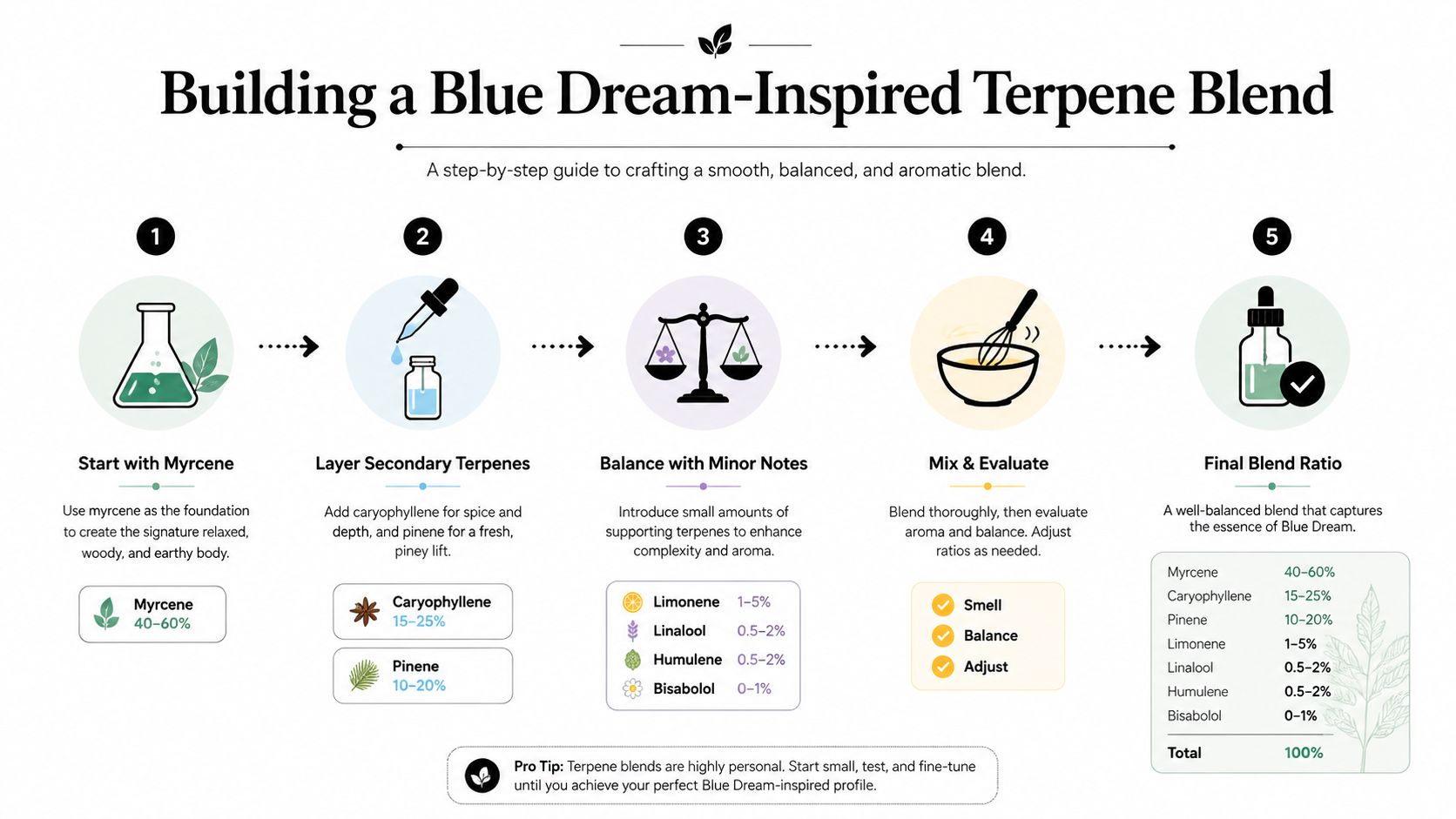
Building a Blue Dream-inspired blend from isolates requires a controlled sequence. Myrcene establishes the berry body, followed by alpha-pinene and beta-caryophyllene for the pine and spice framework. Minor accents belong at the end, after the core already reads clearly in the intended distillate matrix.
A practical isolate sequence
Set the base with myrcene. Use 40% to 50% of the terpene fraction as an initial design reference, not a fixed final formula. Myrcene should provide the fruit body before sharper materials enter the blend.
Layer alpha-pinene carefully. A starting range of 15% to 20% of total terpenes supplies the pine direction. Dose it gradually during evaluation. Pinene can dominate quickly, particularly in a thin, low-viscosity carrier.
Build the middle and lower register with beta-caryophyllene. The reported 10% to 15% range provides a practical development boundary. Caryophyllene should contribute pepper and dryness without making the finished oil spice-forward.
Add minor accents last. Limonene may sit around 5% to 10% of total terpenes in one reported ratio system. Treat linalool and ocimene as restrained supporting materials that brighten or soften the profile without displacing the berry-pine identity.
Evaluate the complete blend in the actual matrix. A vial can smell accurate while the same formula shifts after dilution into distillate. Test the finished blend in the intended oil and hardware before approval.
The guide to using terpene isolates supports weighing, blending, and evaluation setup. Weigh by mass, record every addition, and retain a reference sample of the approved blend.
Adjusting for production reality
Carrier viscosity affects aroma release and dispersion. A viscous distillate may require more mixing time, while a thinner system can expose volatile top notes immediately. A flat base should not be corrected by adding pinene first. Return to the myrcene foundation, then rebuild the upper notes.
Small-batch development should compare several nearby ratios rather than one supposedly perfect formula. Reported ranges vary because Blue Dream is not a single fixed chemical recipe. A controlled sensory target beats false precision, especially when the finished product must remain recognizable after scale-up.
Strain-Specific Blends Versus Custom Isolate Formulations
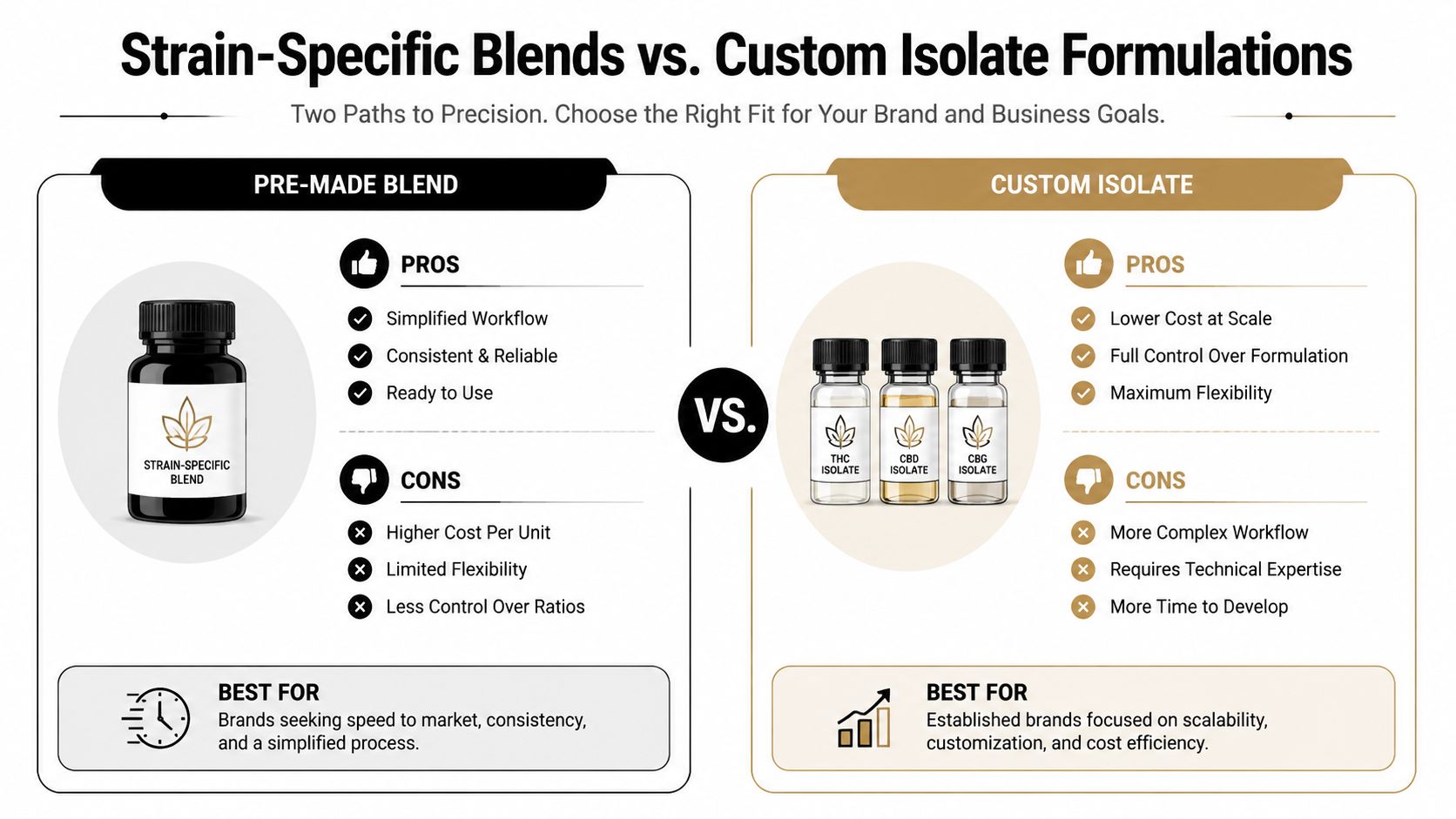
Choosing between a pre-made strain-specific blend and a custom isolate formulation depends on the target SKU, development timeline, and in-house analytical capacity. A pre-made blend reduces purchasing and weighing work. A custom formulation gives tighter control over Blue Dream's berry, pine, citrus, spice, and floral balance, while requiring stronger specifications, batch records, and sensory checks.
Use a pre-made blend when speed matters
A strain-specific blend fits a new SKU that needs a recognizable profile without establishing an internal flavor laboratory. It reduces the raw-material count, simplifies the order of addition, and gives a contract manufacturer one defined component to dose. For a fast launch, that shorter workflow may matter more than fine control over individual terpene ratios.
The trade-off is supplier interpretation. The finished profile may place more weight on sweetness, pine, citrus, or spice than your retained Blue Dream reference. That approach suits a generalized market target, but it is a poor match for a benchmark requiring a specific berry-to-pine relationship or a tightly controlled top-note response.
A catalog example is premium strain-specific profiles. It shows how strain-oriented profiles can be organized for product development. The listing does not establish that different strain names share the same chemical composition.
Build from isolates when the profile is proprietary
Custom isolate work earns its added complexity when the brand has a retained reference sample, a defined sensory panel, or a product line requiring a distinctive interpretation. The formulator can compensate for the distillate's background odor, match a lab-tested reference, and adjust the blend for cartridge hardware that makes upper notes more prominent.
Every isolate adds an incoming-material specification, storage requirement, and weighing point that must be controlled. The team also needs more bench evaluations before the formula is stable enough for manufacturing. That effort is justified when sensory identity and repeatability carry more value than purchasing simplicity.
Use this decision filter:
- Fast launch: Select a pre-made blend when timeline and workflow simplicity outweigh fine control.
- Distinctive signature: Select isolates when the brand needs a proprietary sensory identity.
- Repeatable reference: Use either approach with a retained standard and documented evaluation method.
- Scale economics: Custom blending may become more practical as production expands, but compare material pricing, labor, testing, and waste.
The video below supports team training on strain-inspired profile development.
Integrating Blue Dream Terpenes into Distillate and Vape Cartridges
Distillate and vape cartridges demand a terpene profile that satisfies two constraints simultaneously: aroma fidelity and hardware compatibility. The oil must move through the cartridge without separation, leakage, excessive harshness, or poor wick performance. Replicating Blue Dream therefore requires testing the aromatic blend in the actual delivery system, not only in a vial.
A common development window is 5% to 15% terpene content by weight, depending on desired intensity and hardware compatibility. The practical guide to blending distillate with terpenes provides a starting point, not a universal specification. Distillate composition, cartridge construction, oil viscosity, and jurisdictional requirements still determine the approved formula.
Mix for uniformity, not just speed
Warm the distillate only enough to lower viscosity and support incorporation. Excessive heat can strip volatile components, especially sharp top-note materials such as pinene. The cartridge may then smell flatter than the blend measured before processing.
Use a controlled sequence:
- Preblend the terpene components before adding them to the bulk oil. This limits local concentration spikes and makes the aromatic fraction easier to inspect.
- Bring the distillate to a workable viscosity with a validated process. High heat should not replace proper mixing.
- Add the terpene blend gradually while maintaining uniform agitation.
- Sample after equilibration, then inspect aroma, clarity, and physical appearance.
- Fill representative cartridges and assess draw resistance, seepage, vapor character, and wick behavior before approving the run.
Avoid the two common loading errors
Over-terping can create harsh vapor, suppress the berry impression, and place additional stress on cartridge components. Under-terping produces a muted product that may seem acceptable in a vial but lose definition after aerosolization. Changing the total percentage alone will not correct a missing or excessive note.
Pinene-heavy systems often need less aggressive top-note loading than expected. If the oil tastes medicinal or solvent-like, reduce the sharp fraction and rebuild the myrcene-supported body instead of adding more citrus. If the profile feels sugary and indistinct, a measured adjustment to pinene and caryophyllene can restore structure.
Approve the inclusion level only when it delivers the intended sensory result in the selected hardware. Record blend percentage, mixing temperature, agitation conditions, hold time, fill conditions, and cartridge model for every approved batch. These records make sensory drift easier to trace when the same formula behaves differently across distillate lots or hardware revisions.
Lab Testing and Quality Control for Consistent Batch Delivery
A Blue Dream-inspired product needs more than a good bench sample. It needs a documented chain from incoming terpene material to finished cartridge. The name creates a sensory expectation, so quality control should verify both what was added and what remains in the final product.
Test the inputs and the finished oil
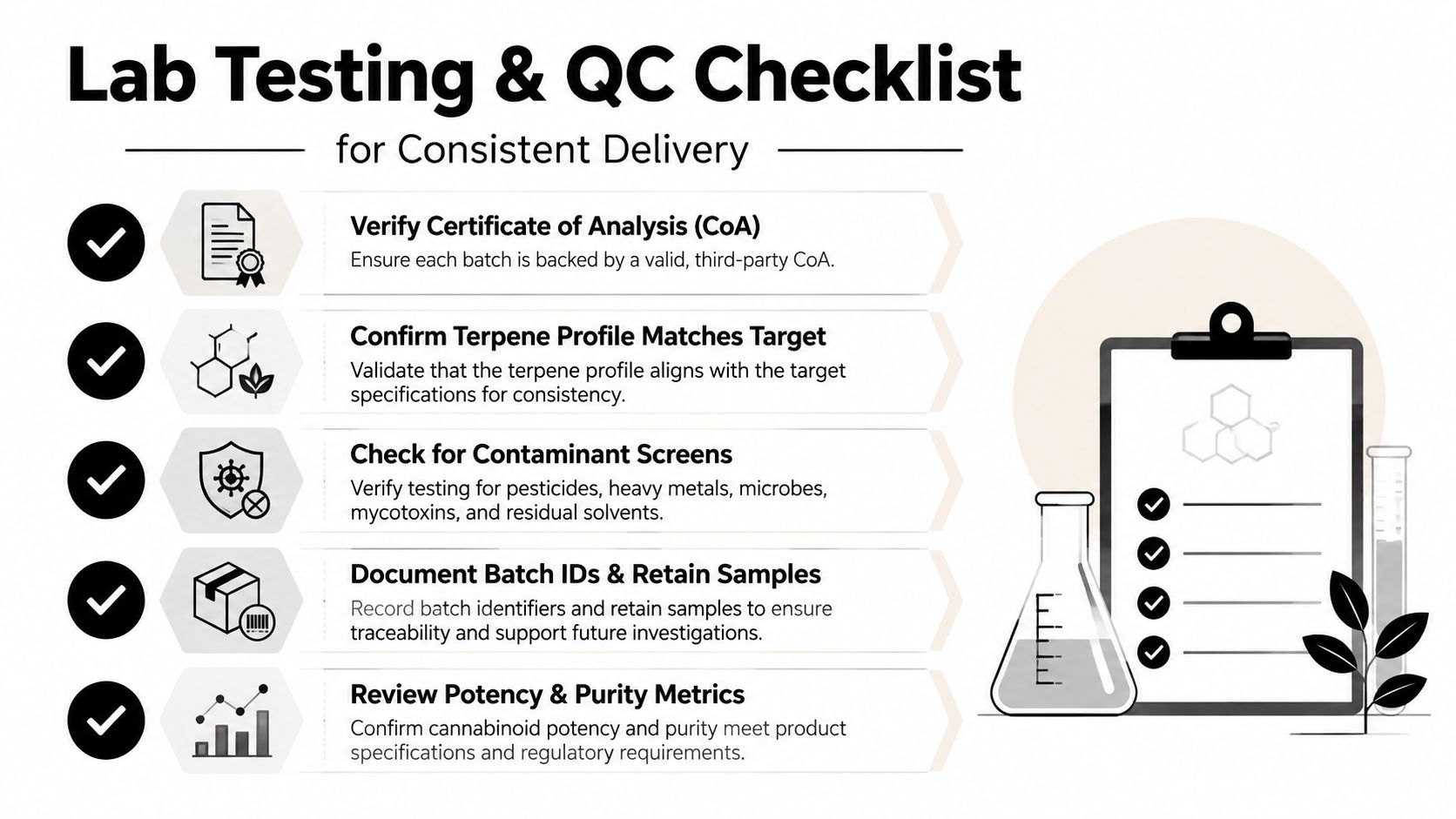
Incoming terpene materials should arrive with a current certificate of analysis that identifies the material and provides relevant purity and contaminant information. The finished product should then be tested to confirm that the intended terpene pattern survived dilution, heating, mixing, filling, and storage.
A useful quality file includes:
- Certificate of analysis: Confirm identity, purity, and applicable safety screens for each incoming material.
- Target profile: Record the intended relationship among myrcene, pinene, caryophyllene, limonene, and minor notes.
- Finished-product result: Compare the final terpene data with the approved formulation and sensory standard.
- Batch traceability: Tie raw-material lots, blend records, distillate lots, and cartridge fills to one batch identifier.
- Retained samples: Keep reference material for later comparison when a retailer or customer reports a sensory shift.
Define variance before production
Don't wait for a failed batch to decide what variation is acceptable. Establish internal limits for the dominant terpene relationship and define which sensory changes require investigation. Those limits should reflect the product's approved reference, the analytical method, and the variability of the raw materials.
A lab result isn't meaningful in isolation. A total terpene value can look acceptable while the profile has lost its pine lift or gained too much peppery depth. Pair quantitative testing with a controlled sensory review, using the same sample preparation, panel conditions, and reference standard each time.
Quality control also protects communication. Retailers and downstream manufacturing partners can work more effectively when they receive a clear specification rather than a strain name with no analytical definition. For a benchmark profile, that documentation becomes part of the product's commercial value.
Scaling Blue Dream Formulations from Prototype to Production
Scale-up fails when teams copy the recipe without copying the process. A gram-scale blend appears balanced because the operator adds materials slowly, mixes thoroughly, and evaluates it immediately. Production equipment, raw-material lots, hold times, and filling conditions can change that result even when the written formula is identical.
Start with a controlled master specification. Identify each terpene, its target proportion within the aromatic blend, its intended inclusion level in the oil, the addition order, mixing conditions, sampling points, and packaging requirements. The document must work for an internal team or contract manufacturer without relying on undocumented bench habits.
Protect the sensory identity during expansion
Source isolates against consistent specifications and qualify replacements before production. Myrcene, alpha-pinene, and beta-caryophyllene are not interchangeable from a sensory standpoint. Purity, odor quality, and minor constituents can shift the finished profile even when the formula percentages remain unchanged.
Use checkpoints throughout the run:
- Raw-material release: Verify documentation and lot identity before weighing.
- Blend inspection: Evaluate the completed aromatic fraction before dilution.
- Bulk-oil sample: Check uniformity after incorporation into distillate.
- Filled-unit review: Test representative cartridges for aroma, draw, leakage, and vapor character.
- Retained comparison: Compare production samples with the approved reference over time.
Market feedback should guide iteration without erasing the core identity. If customers consistently describe a batch as too sweet, adjust the supporting balance rather than abandoning the berry foundation. If the pine note disappears in the finished cartridge, investigate volatility and processing before increasing the dose.
A Blue Dream profile also teaches a transferable formulation discipline. Separate name recognition from chemical reality, define sensory priorities, manage variability, and document the process well enough to reproduce it. Those capabilities support profiles beyond one classic cultivar.
Gold Coast Terpenes supplies strain-specific blends and isolated compounds for distillate, cartridges, concentrates, and cannabis product formulation, including myrcene, limonene, and beta-caryophyllene. Review the formulation materials and terpene options at Gold Coast Terpenes, then use the approved reference profile and lab process to develop a Blue Dream-inspired product with repeatable sensory control.