
A production team has a Limoncello Haze distillate, a familiar citrus terpene blend, and a cartridge launch scheduled around a specific sensory promise. The blend smells excellent in the bottle. After dilution, however, the lemon top disappears, the middle becomes soapy, and the finished cart tastes flat. The problem isn't necessarily poor raw material. It may be that the formula was built around a strain name instead of a reproducible aromatic target.
For formulators, the Limoncello Haze strain should be treated as a variable phenotype family, not a fixed flavor standard. Published listings connect it with lemon-forward Haze genetics, but reported chemistry shifts across cuts and batches. A useful formulation target must therefore define its top, mid, and base notes, then verify how those notes survive distillate dilution, hardware heating, storage, and repeated pulls.
Why the Limoncello Haze Profile Matters
A production team can have a citrus-Haze blend that smells convincing in a vial yet produces a weak lemon opening in the finished cart. Volatile top notes may recede during mixing, filling, storage, or coil activation, leaving an artificial sweetness or a flat finish. A citrus-Haze product earns its commercial value through aromatic carry-through into the delivery format.
Formulators should treat Limoncello Haze strain as a variable phenotype family rather than a fixed flavor standard. The name suggests a direction, while the batch COA, sensory reference, and hardware evaluation establish the working specification. Published descriptions provide a starting point, but they cannot define the exact terpene outcome of every cut or extraction lot.
The profile also needs to function across formats. A blend can behave differently in a 510 cartridge, an all-in-one device, and a high-terpene concentrate because residence time, heat exposure, airflow, and perceived intensity change with each system. A formula that performs in a glass vial still requires dilution checks, device testing, and storage review before production release.
Limonene-forward references, including a guide to high-limonene strains, help establish the expected citrus direction. Limoncello Haze is commonly described as a 75% sativa and 25% indica hybrid, with one widely cited listing identifying Lemon Ice crossed with Super Silver Haze (Limoncello Haze strain information). Public listings place some expressions at 18% to 21% THC, while related products have shown higher laboratory results. Those figures do not define a universal potency or terpene profile.
For a strain-inspired blend, set three formulation targets: a recognizable lemon top note, a Haze-associated middle, and heavier base material for persistence. Limonene alone may lack depth, so the blend should balance sensory identity with dilution stability, hardware compatibility, documentation, and cost.
Genetics and Lineage Context
Limoncello Haze functions better as a phenotype family than as a fixed flavor standard. One widely cited lineage lists Lemon Ice × Super Silver Haze. Another describes a related Lemonchello Haze line involving Super Lemon Haze, Amnesia, and UK Cheese. A separate market listing names Lemon Ice and XTRM Super Silver Haze. These records show that breeder and market names can represent different genetic backgrounds, as documented in the Limoncello Haze product COA.
For formulation, treat lineage as a direction rather than a guaranteed chemical specification. A sharp, terpinolene-led Haze cut calls for a different middle note than flower or extract carrying sweet lemon, pepper, or a softer dessert character. A limonene-heavy recipe risks flattening the herbal character associated with the Haze side of the profile. The production lot, not the cultivar name alone, should determine the final adjustment.
Potency reports also vary. Public listings cite expressions reaching up to 21% THC, while related market products have laboratory documentation showing about 25.937% total THC. Those figures do not establish a universal standard for the cultivar. They reinforce the need to identify the actual cut, extraction lot, and analytical profile before setting a cartridge or concentrate specification.
Common lineage signals and formulation implications
| Lineage Signal | Market Descriptor | Formulation Implication |
|---|---|---|
| Lemon Ice | Bright lemon and citrus-forward | Establish a recognizable lemon top note, then check whether dilution makes it sharp or one-dimensional. |
| Super Silver Haze | Classic Haze, herbal, terpene-rich | Retain a terpinolene or related herbal middle so the blend remains distinct from generic lemon. |
| Super Lemon Haze | Citrus-Haze reference point | Use it for sensory comparison, not as evidence that every Limoncello Haze batch shares its chemistry. |
| Limoncello or Lemonchello naming | Lemon dessert or candy association | Choose between lemon oil, sweet confection, and drier peel as the intended top-note direction. |
The working specification should name a specific phenotype or sensory reference. For carts, distillate, and concentrates, that reference can then guide modular top, middle, and base adjustments. The top may carry lemon brightness, the middle can preserve Haze movement, and the base should provide persistence without obscuring the citrus opening.
A fixed bottle cannot represent every legitimate interpretation of the name. A modular, strain-inspired blend gives the production team room to correct lot variation while preserving a defined sensory target.
For comparison, review this Lemon Haze reference and keep the actual production lot as the controlling reference.
Comparing Limoncello and Haze Chemistry
A production batch can miss the target in two predictable ways. Limonene may dominate until the formula reads as simple lemon, or herbal and pine notes may become so prominent that the Limoncello identity recedes. Published chemistry helps set an initial direction, while lot testing determines the final adjustment. The available data support a working model. They do not yet establish a certified chemotype.
Limoncello Haze is commonly described as limonene-forward, with terpinolene, beta-caryophyllene, and myrcene as frequent supporting terpenes. A broader Limoncello-style reference reports limonene at 0.5% to 1.2%, beta-caryophyllene at 0.3% to 0.9%, and myrcene at 0.2% to 0.8% by weight. Linalool, humulene, and ocimene also appear in supporting amounts (Limoncello Haze terpene reference).
Related Haze chemistry points toward a different balance. A Super Lemon Haze profile lists terpinolene at 31%, ocimene at 20.5%, limonene at 13.3%, myrcene at 10.5%, and beta-caryophyllene at 9.3% of the listed terpene composition (Super Lemon Haze terpene profile). For formulation, that comparison supports a terpinolene-led citrus-herbal middle when a batch needs clearer Haze character, while limonene remains the primary candidate for a weak lemon opening.
Terpene ranges across citrus-Haze cultivars
| Terpene | Limoncello, reported | Lemon Haze, reported | Super Lemon Haze, reported | Confidence |
|---|---|---|---|---|
| Limonene | 0.5% to 1.2% by weight in a Limoncello-style reference | Commonly described as prominent | 13.3% of the listed terpene composition | Moderate direction, weak universal standard |
| Terpinolene | Frequently reported as supporting or co-dominant | Commonly associated with Haze chemistry | 31% of the listed terpene composition | Useful Haze marker, cut-dependent |
| Beta-caryophyllene | 0.3% to 0.9% by weight in a Limoncello-style reference | Common supporting terpene | 9.3% of the listed terpene composition | Useful for structure and spice |
| Myrcene | 0.2% to 0.8% by weight in a Limoncello-style reference | Common supporting terpene | 10.5% of the listed terpene composition | Useful for body, but can soften brightness |
| Ocimene | 0.1% to 0.4% in the Limoncello-style reference | Supporting compound in related Haze profiles | 20.5% of the listed terpene composition | Valuable when the cut needs lift and freshness |
| Linalool or humulene | 0.1% to 0.4% in the Limoncello-style reference | Supporting or trace direction | Not established by the cited panel | Use only when the sensory reference supports it |
These panels are directional, not interchangeable specifications. Cultivar, harvest, extraction method, and reporting convention can change the apparent dominant compounds. Recent guides describe Limoncello Haze expressions around 20% to 28% THC and terpene totals around 1.5% to 3.0%, while also noting variation among samples (Limoncello Haze chemistry guide).
For compound-level aroma context, consult this terpene chemistry guide. In production, translate the comparison into controlled corrections: increase the limonene direction when the lemon top note is weak, add terpinolene when the Haze middle is absent, and use caryophyllene or myrcene sparingly when the concentrate or distillate lacks body. Because Limoncello Haze behaves as a variable phenotype family, the lot's analytical panel and approved sensory reference should control the final ratio.
Building the Terpene Note Structure
A repeatable formulation begins by separating the profile into top, mid, and base notes. This isn't just a sensory description. It gives the production team a way to diagnose why a blend loses impact after dilution or changes character in a cartridge.
Top notes establish recognition
Limonene usually carries the first lemon impression. It provides the recognizable citrus direction, but an isolate-heavy limonene build can smell narrow, sharp, or generic. A small citrus modifier such as valencene, or a restrained beta-pinene fraction, can add peel, pith, or lift without turning the formula into a separate fruit profile.
Terpinolene and ocimene can also contribute to the initial sense of movement. The related Super Lemon Haze panel cited earlier shows how strongly these compounds can shape a Haze-family interpretation. Because lighter monoterpenes are volatile, evaluate the blend after it has been diluted into the actual oil and stored under the intended conditions, not only immediately after compounding.
Mid notes carry the Haze identity
The middle should prevent the profile from becoming lemon candy without structure. Terpinolene is the most direct starting point for a fresh, herbal Haze direction. Alpha-pinene can sharpen the green and pine aspect, while linalool or geraniol may soften the transition when the target cut has a floral edge.
A formula doesn't need every possible terpene. Adding compounds because they appear on a reference panel can create muddiness. Select the middle by comparing the blend against the flower, resin, or frozen sensory standard that defines the SKU.
Base notes preserve shape
Myrcene, beta-caryophyllene, and a restrained amount of humulene or cedrene can give the volatile citrus layer more persistence. These heavier supporting materials don't replace the top note. They help keep it from feeling disconnected once the oil is heated and inhaled.
| Note Tier | Primary Terpenes | Functional Role | Approx. Share of Total Terpene Load |
|---|---|---|---|
| Top | Limonene, valencene, beta-pinene, ocimene | Establish lemon recognition and opening brightness | Set from the batch reference, not a universal percentage |
| Mid | Terpinolene, alpha-pinene, linalool, geraniol | Supply Haze herbal, pine, and optional floral character | Adjust until the Haze note is present without masking lemon |
| Base | Myrcene, beta-caryophyllene, humulene, cedrene | Add body, warmth, and persistence | Keep subordinate to the citrus and Haze structure |
I don't recommend treating sesquiterpenes as a cure for excessive volatility. They can add depth, but too much base material can make a bright profile feel dull or woody. The correct ratio depends on the extract, hardware, and target cut.
Validation checkpoint: Evaluate the first pull, the middle pulls, and the late-session pulls at the intended device setting. A formula that only works on the first draw isn't stable enough for release.
Use a terpene flavor chart to map candidate compounds, then confirm the result with sensory review and final analytical testing. Keep every adjustment traceable to a note tier so the team knows whether it corrected recognition, transition, or persistence.
Choosing Blends and Isolated Terpenes
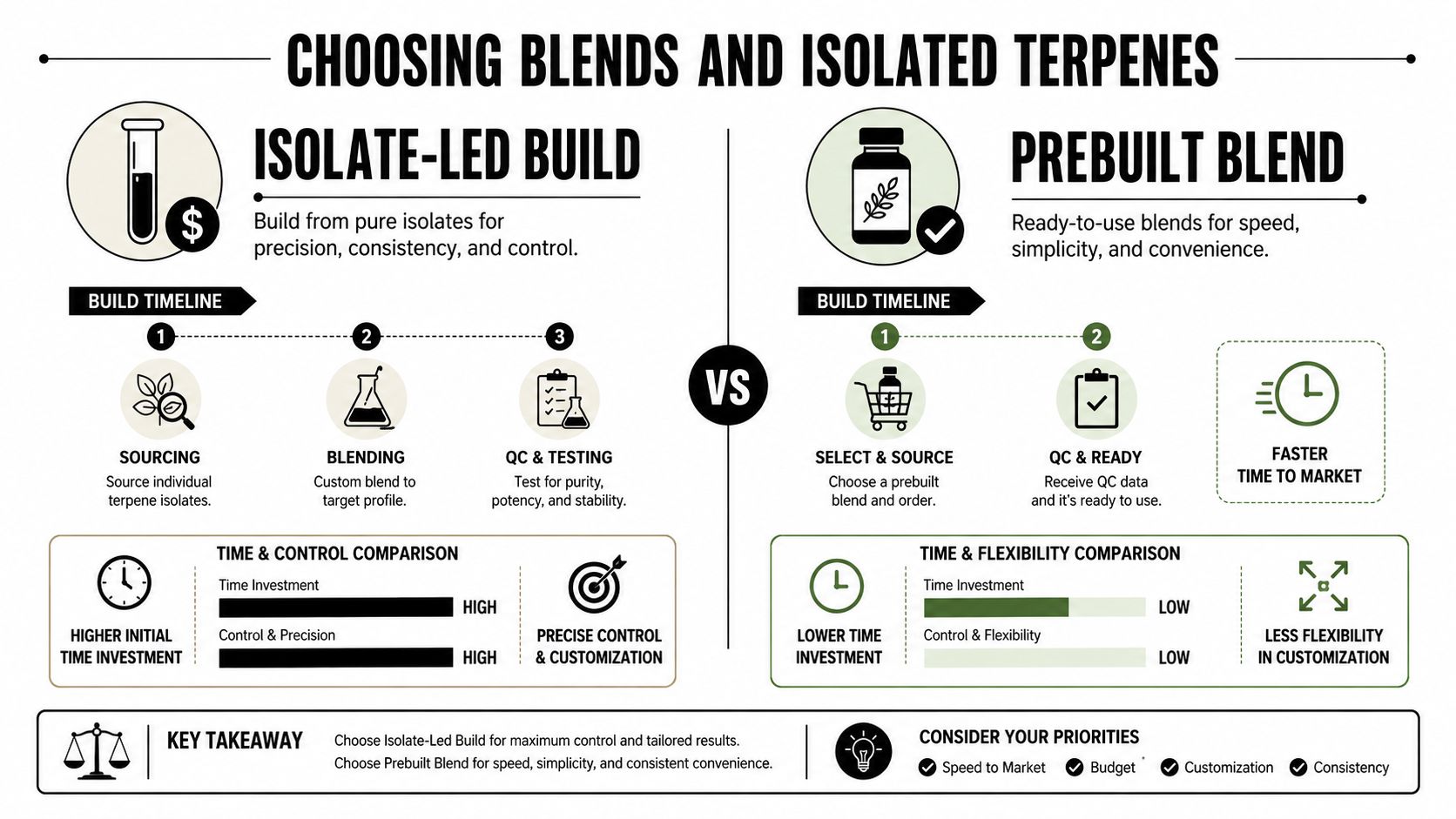
A cartridge team working with Limoncello Haze may receive oil that reads sharply lemon-forward in one lot and more herbal or woody in another. That variability makes blend selection a production decision. A prebuilt Haze-style blend can shorten development and simplify purchasing, while an isolate-led matrix gives tighter control over the top, mid, and base notes needed for a repeatable phenotype-inspired profile.
Prebuilt blends suit broad positioning, consistent source material, and fast scale-up. They reduce the number of raw-material specifications and simplify inventory. Their limitation is fit. Many citrus blends rely heavily on limonene for immediate lemon recognition, while their terpinolene, caryophyllene, or supporting materials may not match the specific Limoncello Haze cut.
An isolate-led build requires more bench evaluation, but it helps correct a defined mismatch. Add selective terpinolene when lemon becomes cleaner-like and loses Haze character. Use valencene to widen a narrow citrus opening. Introduce beta-caryophyllene when the profile lacks warmth or structure. Myrcene can provide body, although an excessive contribution may soften the crispness required in the finished oil. These corrections should be judged against the extract's native chemistry, not applied as a fixed strain recipe.
Operational trade-offs
| Decision Factor | Isolate-Led Build | Prebuilt Blend |
|---|---|---|
| Development time | Longer, because each component and ratio needs evaluation | Faster starting point |
| Flavor control | High, with precise top-to-base adjustment | Moderate, dependent on the supplier's design |
| Purchasing | More individual materials to qualify | Fewer components to manage |
| Batch variability | Can be controlled with tight specifications | Depends on blend consistency and supplier documentation |
| Regulatory records | Requires documentation for each isolate | Requires complete documentation for the finished blend |
| Best use | Reference replication and phenotype-specific products | Fast scale-up and broad strain-inspired positioning |
Compare cost per gram at the intended production volume, not only the bottle price. A prebuilt product may lower labor and development risk. Isolates may reduce waste when a small correction keeps a batch within its reference profile. Availability also affects the decision. If one isolate is difficult to source consistently, a qualified blend with documented substitutions may be more practical than a theoretically precise formula that cannot be replenished.
Gold Coast Terpenes offers strain-specific blends and isolated compounds that can function as a starting point or as modular inputs. Request current COAs, ingredient specifications, applicable allergen information, and documentation supporting the intended market from any supplier. Keep the selected option tied to a written sensory reference and lot-specific acceptance criteria.
Formulating Cartridges and Concentrates
A Limoncello Haze batch can perform well in distillate and fail in live resin if the same terpene formula is applied without checking the extract's native profile. Treat the strain name as a phenotype reference, then map the correction to the format. Top notes restore lemon and citrus lift, mid notes preserve the herbal Haze character, and base notes add pepper, wood, or persistence without masking the extract.
Distillate usually presents the widest correction range, but over-formulation remains the main risk. A volatile lemon top note may smell strong during mixing, then become harsh or thin after filling. Add only enough to restore the intended opening, and reassess the mid and base notes after the oil has equilibrated. Terpenes cannot correct a weak base oil, poor storage, or incompatible hardware.
Live resin and other aromatic concentrates may already contain substantial native chemistry. A complete commercial blend can cover that identity, so selective correction often gives better control. Review viscosity at the same time. Terpene additions change flow, filling behavior, saturation, and how the material reaches the heating surface.
Format-specific checkpoints
| Format | Typical Terpene Load | Hardware Fit | Key Sensory Check |
|---|---|---|---|
| Distillate cartridge | Set by the validated product specification and legal limits | Confirm compatibility with the selected 510 or all-in-one system | Lemon recognition should remain present after equilibration and repeated pulls |
| Live resin cartridge | Usually limited by the extract's native terpene intensity and viscosity needs | Ceramic systems often require separate flow and saturation validation | Native resin character should remain distinct from the added Haze structure |
| High-terpene concentrate | Defined by the concentrate's own composition and intended texture | Hardware may not apply, but storage and handling still affect volatility | Top notes should remain clear without an overly sharp finish |
Test the actual cartridge rather than relying on a viscosity cup. CCELL and ceramic systems differ in saturation, airflow, heat transfer, and residual oil behavior. Wick hardware can produce a different flavor curve from ceramic hardware at the same nominal device setting, so a voltage range validated on one platform does not automatically transfer to another.
Cold storage raises viscosity and can delay saturation. Warm storage can accelerate volatile loss. Validate filling, settling, and draw performance under the conditions used in the facility and distribution chain. Inspect for leaking, clogging, muted flavor, and harshness before approving the formula.
For each production run, inspect the first fifty carts as a defined sensory checkpoint. Sample from the beginning, middle, and end, then record whether the lemon top note, Haze middle, and pepper or woody base remain consistent. Keep the vocabulary fixed. Terms such as lemon peel, herbal Haze, pepper warmth, and woody persistence produce more useful records than ratings such as “good” or “strong.”
Testing Safety and Production Controls
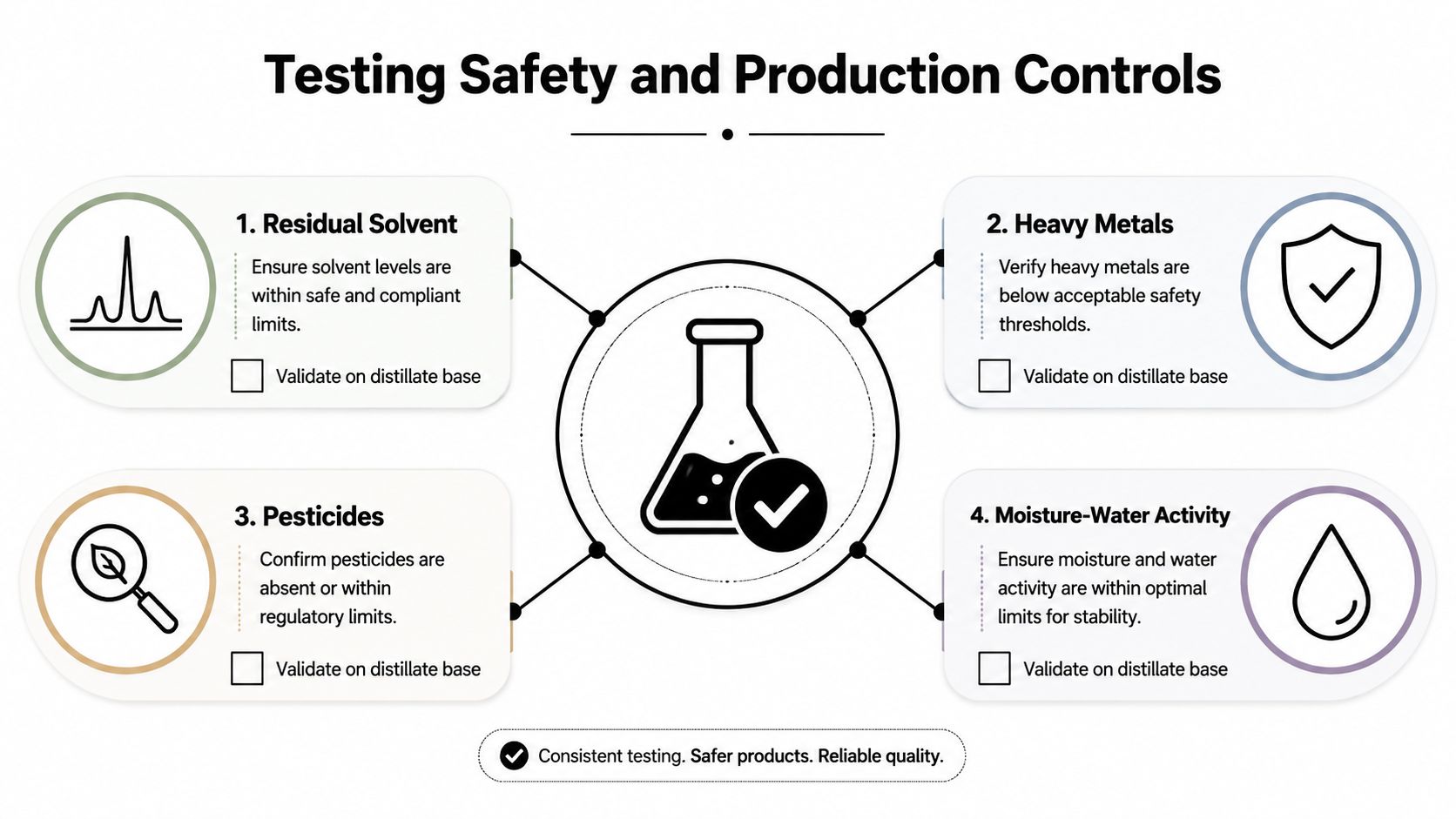
Flavor accuracy starts with a clean, characterized base. Before adding terpenes, confirm residual solvents, heavy metals, pesticides, and moisture or water activity in the distillate or concentrate. A terpene blend can't correct a contaminated or poorly controlled starting material, and adding aroma before base testing makes it harder to identify the source of an off-specification result.
Cartridge compatibility requires its own gate. Screen hardware for leachables and extractables during initial qualification and after supplier changes. Verify that the selected cannabis-derived excipients or diluents match the approved formulation, viscosity target, and applicable legal requirements. Don't assume that a material is suitable because it fills smoothly in a small bench sample.
A release workflow that protects the sensory target
- Characterize the base. Record the extract lot, analytical results, viscosity, and native sensory profile before terpene addition.
- Control the addition. Confirm the mass or volume of each component and calculate the final total terpene load from the actual batch record.
- Verify the chemistry. Use GC-FID or GC-MS to confirm the final blend's total and major peak ratios against the approved target.
- Test the delivery system. Fill the intended hardware and assess draw behavior, leakage, clogging, heating, and flavor across the production run.
- Compare against a frozen reference. Use documented descriptors and retain samples so each lot is judged against the same sensory standard.
- Close deviations. Record corrective actions for off-profile results, including whether the cause was raw material, mixing, storage, filling, or hardware.
Retention samples should stay connected to the SKU, extract lot, terpene lot, hardware lot, and certificate-of-analysis chain. Stability records should track the same sensory descriptors used during release. This creates a defensible link between the intended citrus-Haze profile and the finished product's performance over time.
Release standard: Analytical compliance and sensory fidelity are separate gates. Passing one doesn't prove the other.
Final Formulation Strategy
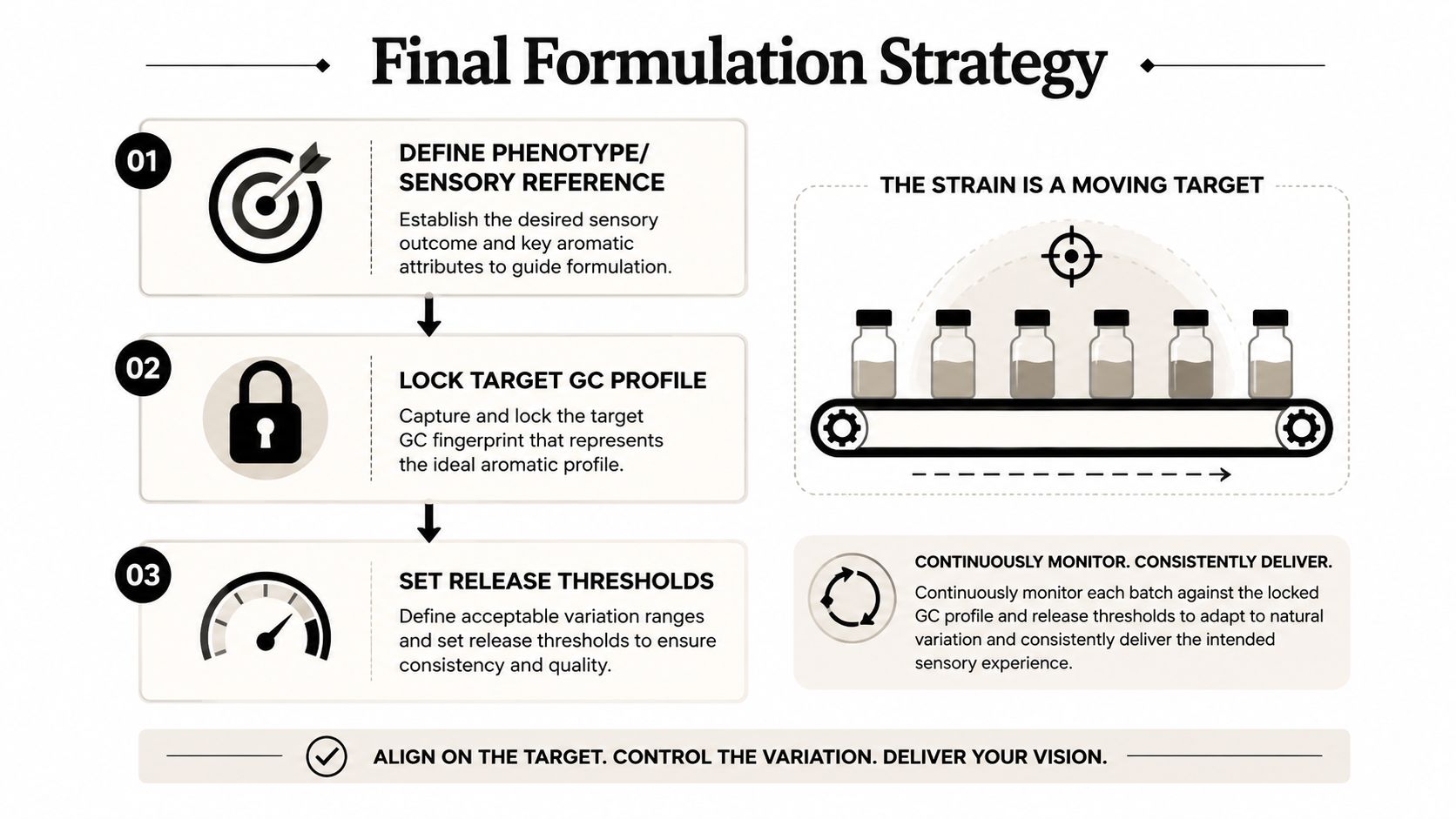
One bottle can't define Limoncello Haze. The available lineage and chemistry reports show a moving target, with different breeders, cuts, and batches producing different balances of lemon, Haze herbal notes, spice, and body.
Build each product line around a documented phenotype or sensory reference. Then lock a target GC profile with tolerable variance windows, select an isolate-led matrix or qualified prebuilt blend, and test the formula in the final delivery system.
Use this sequence:
- Define the genetic and sensory target. Name the cut, reference extract, or approved aroma standard.
- Build the terpene architecture. Set the citrus top, Haze middle, and stabilizing base.
- Validate the delivery format. Run a bench pilot, confirm hardware compatibility, and apply analytical and sensory release gates.
That sequence keeps the product defensible and reproducible. It also prevents a common commercial mistake, treating a compelling strain label as if it were a complete formulation specification.
Gold Coast Terpenes supplies strain-specific blends and isolated compounds for vape cartridges, concentrates, and cannabis product formulation, with product documentation and formulation tools available for development work. Visit Gold Coast Terpenes to review terpene options for a Limoncello Haze-inspired profile and select components for your next validated pilot.