
You're probably staring at a distillate that tastes flat, or a blueberry concept that reads right on paper and falls apart in hardware. That's the core problem with Blueberry Yum Yum dessert as a formulation target, it isn't just “blueberry,” it's a layered, chilled dessert format that has to survive blending, storage, and a hot pull without losing its jammy identity.
The Blueberry Yum Yum Dessert Format and Why Formulators Care
The original dessert structure is built like a stack, not a single flavor event. A pressed crumb crust, a cream-cheese layer, and a blueberry topping create the kind of modular profile that translates cleanly into flavor work, especially when the finished product has to hold together in a cartridge or concentrate matrix. That format is why this dessert keeps showing up as a revived favorite in home kitchens and old-school potluck contexts, not as a novelty, but as a durable Southern no-bake template that people already recognize as familiar and make-ahead friendly. Southernbite's writeup on Blueberry Yum Yum calls it “a variation on a recipe that has been around for years”, and that matters because formulators are rarely chasing a one-off recipe. They're chasing an archetype.
For brand teams, the value is practical. A layered dessert profile gives you a clear mapping from food logic to terpene logic, crust becomes the baked base, cream cheese becomes the soft mid-palate, blueberry filling becomes the front-loaded fruit hit, and whipped topping becomes the airy finish. That makes the profile easier to brief, easier to QC, and easier to reproduce across batches.
Practical rule: if the customer's first impression is “blueberry,” but the finish disappears before the second half of the draw, the blend is too top-heavy and the dessert identity will collapse.
The commercial reason this matters is consumer recall. Blueberry desserts already have strong menu presence, with blueberries appearing on one in four menus overall and growing 12% over the prior four years and 93% over 14 years in Datassential and USHBC menu research, while dessert-and-snack showed 73.3% penetration with 3% one-year growth and 9% four-year growth (Datassential Reports). That puts a blueberry dessert profile inside a mainstream, proven flavor lane, not a speculative one. If you want a terpene profile that sounds familiar, reads regional, and still survives hardware, this is a strong target.
A useful framing resource for this kind of profile work is Terpenes in Weed, because the same note-structure logic applies whether you're building a fruit hybrid, a dessert cart, or a custom extract brief.
Top, Mid, and Base Note Roles in a Dessert Profile
A dessert profile only works when the volatility ladder is balanced. Top notes hit first, mid notes carry the body, and base notes keep the finish from going hollow during a 2 to 3 second pull. If you overload the top, the first puff smells bright and the rest tastes thin. If you overload the base, the cart gets muddy and the blueberry identity gets buried before the user notices the fruit.
How the three tiers behave in a pull
Top notes should flash immediately and then taper. In cartridge work, that means the opening impression lands fast, usually in the first part of the inhale, then recedes as the mid notes take over. Mid notes need enough persistence to survive the full pull and bridge the gap between fruit and cream. Base notes should not dominate the nose on the first draw, they should anchor the aftertaste so the blend still reads as a dessert when the top lifts away.
The useful way to think about this is volatility, not poetry. The highest-volatility compounds create the immediate blueberry and whipped-cream lift, the intermediate compounds create jam and creamy body, and the lowest-volatility compounds mimic baked crust or buttery finish. That's why a cart that is all limonene and linalool can smell lively for a second and then fall apart, while a cart loaded too hard with earthy base material can feel dark and flat.
A good dessert cart doesn't smell like a fruit bowl. It smells like fruit first, cream second, crust last.
For vape development, the load window matters. On a short pull, the top tier is what users notice first, but the mid tier is what makes them call it “blueberry dessert” instead of “sweet.” The base tier keeps the finish from evaporating into air. The wrong balance has predictable failures, too much top note can read harsh or solvent-like, too much mid note can blur into generic berry, and too much base note can turn the whole blend into baked wood.
The control chart below helps keep those tiers distinct, and a practical loading reference is Terpene Flavor Chart.
Terpenes Driving the Blueberry Dessert Aroma
The blueberry dessert effect comes from a terpene mix that behaves like a layered aroma system, not a single note. Controlled blueberry volatile work identified 106 volatile organic compounds, and the key floral-sweet profile was tied to eight terpenoid volatiles, including p-cymene, myrtenal, linalool, L-carvenol, geranyl acetone, geranyl acetate, D-limonene, and β-myrcene (PubMed study). That's the useful takeaway for formulators, blueberry aroma is terpene-rich, and the dessert impression depends on how those volatiles are staged.
Linalool gives the blend its floral, sweet-berry lift. Geraniol and citronellol are useful for the ripe, cooked-fruit side of the profile, especially when you want the blueberry to feel more like compote than candy. Beta-caryophyllene is the warm backbone that reads as baked crust or browned edges. Alpha-pinene and beta-pinene keep the profile from turning syrupy, because a little bright lift preserves definition. Valencene and nerolidol can add woody, creamy depth that supports the cream-cheese layer without making the profile feel floral in the wrong way.
The chemistry also changes with handling. Blueberry aroma expression shifts with fruit maturity and storage, and extended cold storage can reduce concentrations and odor activity values before partial recovery as temperature changes, which tells you the blueberry note is volatile and matrix-sensitive (PMC volatile analysis). In formulation terms, the dessert character needs protection from oxidation and overheat loss, especially in cartridges.
| Terpene | Volatility Tier | Dessert Layer Represented |
|---|---|---|
| Linalool | Top | Blueberry lift, floral sweetness |
| D-limonene | Top | Bright fruit peel, initial pop |
| Alpha-pinene | Top to mid | Airy lift, profile definition |
| Beta-pinene | Top to mid | Freshness, structure |
| Geraniol | Mid | Jammy berry body |
| Citronellol | Mid | Cooked-fruit roundness |
| Beta-caryophyllene | Mid to base | Baked crust warmth |
| Nerolidol | Base | Creamy depth, soft finish |
| Valencene | Base | Woody sweetness, dessert tail |
A supporting profile reference for this kind of fruit-dessert work is Blueberry Terpene Profile, especially if you're trying to translate a berry dessert into a repeatable blend brief.
Building a Starting Ratio for the Profile
A junior formulator needs a starting point that can be mixed, tested, and adjusted. For a Blueberry Yum Yum dessert profile, the anchor blend should favor body first, then lift. That means 30% myrcene, 25% beta-caryophyllene, 15% alpha-pinene, 10% beta-pinene, 8% limonene, 5% linalool, 4% humulene, and 3% geraniol, all expressed as a percentage of the total terpene blend.
How each anchor functions
Myrcene carries the jammy, ripe fruit body. It gives the blend weight, which helps the blueberry read as cooked rather than thin. Beta-caryophyllene adds the crust warmth and keeps the dessert from feeling like fruit candy. Alpha-pinene and beta-pinene keep the first impression bright and prevent the profile from collapsing into heavy sweetness. Limonene delivers the sharp front lift, while linalool softens the berry edge so it doesn't feel aggressive. Humulene adds dry structure at the tail, and geraniol reinforces the cooked-fruit impression.
| Terpene | Base Anchor % | Lift Variant % | Body Variant % |
|---|---|---|---|
| Myrcene | 30% | lower | higher |
| Beta-Caryophyllene | 25% | same | same |
| Alpha-Pinene | 15% | same | lower |
| Beta-Pinene | 10% | same | lower |
| Limonene | 8% | higher | lower |
| Linalool | 5% | same | same |
| Humulene | 4% | same | higher |
| Geraniol | 3% | same | same |
If the brief wants more sparkle in the first 1.5 seconds, shift toward the lift variant by raising limonene and trimming myrcene. That increases the initial blueberry brightness, but it can also make the mid-palate feel thinner if pushed too far. If the brief needs a longer 4 to 6 second mid-palate, move toward the body variant by increasing humulene and reducing pinene. That makes the cart feel fuller and more baked, but it will dull the fruit top if you overshoot.
Formulation note: don't adjust every terpene at once. Move one axis, re-test, then decide whether the profile needs more front lift or more dessert weight.
For ratio work, the most useful operational tool is Mixing Ratios Calculator, because it keeps small revisions from turning into unplanned resets.
Loading the Profile Into Cartridges and Distillate
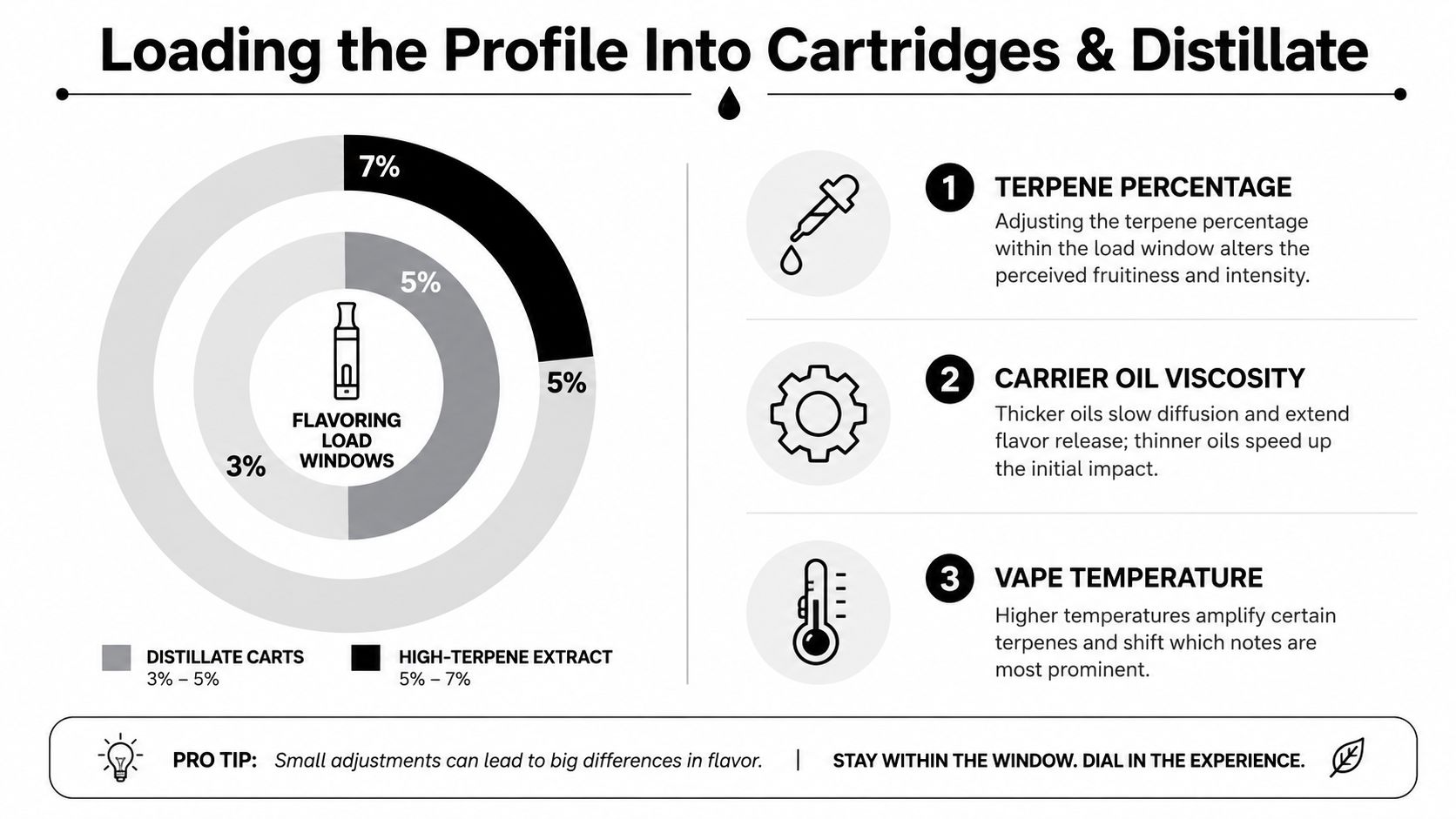
The cartridge target changes the math. A 3% to 5% flavoring load is a practical window for distillate carts, while 5% to 7% fits high-terpene live resin-style systems better because the matrix can carry more aromatic weight before it turns harsh. The reason isn't just flavor intensity. It's viscosity, carrier behavior, and how much volatile headspace the oil can tolerate before the blend starts separating or scorching.
What changes the flavor in hardware
Distillate viscosity is a major driver of perceived sweetness. A more viscous oil holds aromatics differently than a lighter one, so the same terpene blend can feel softer or sharper depending on the base. Coil temperature matters too, especially on 1.6 to 2.4 ohm ceramic hardware at 3.2 to 3.8V, because hotter delivery emphasizes the top note and can strip away the creamy middle faster than most brands expect. Potency above 85% also shifts the read, because high cannabinoid load can flatten aroma unless the terpene blend is strong enough to reintroduce contrast.
A useful dilution checkpoint is simple. 100 g of distillate at 90% potency will usually absorb roughly 4 to 5 g of terpene blend before viscosity starts to break, which is why small test batches matter before you scale a cart fill. Overdo limonene and you'll get heat stress on lower-resistance setups. Push humulene too high and the blueberry top note gets muted.
| Load Type | Practical Flavoring Window | Best Use |
|---|---|---|
| Distillate cart | 3% to 5% | Clean fruit-dessert profile, tighter hardware control |
| High-terpene extract | 5% to 7% | Fuller aroma, more body, more headspace tolerance |
Known failure modes are consistent. Limonene above 1.2% of total load can scorch at sub-ohm temperatures, and humulene above 0.6% can muddy the blueberry top note. If the cart starts tasting like citrus cleaner or dry wood instead of dessert, the top-to-base ratio is off and the hardware is exposing the mistake faster than the bench sample did.
One catalog example that fits this kind of tuning work is Elevated Strains, which is one of the product pages brands may use when they're comparing flavor-hybrid positioning against custom blends.
Isolate Pairings That Strengthen the Dessert Character
Isolates should fill gaps, not rebuild the whole blend. The blueberry dessert target already has fruit body and crust structure from the anchor ratio, so isolate additions need to be surgical. The goal is to sharpen the first impression, round the finish, or restore baked realism without pushing the profile into cleaner, brighter, or soapier territory.
Pairings that add value
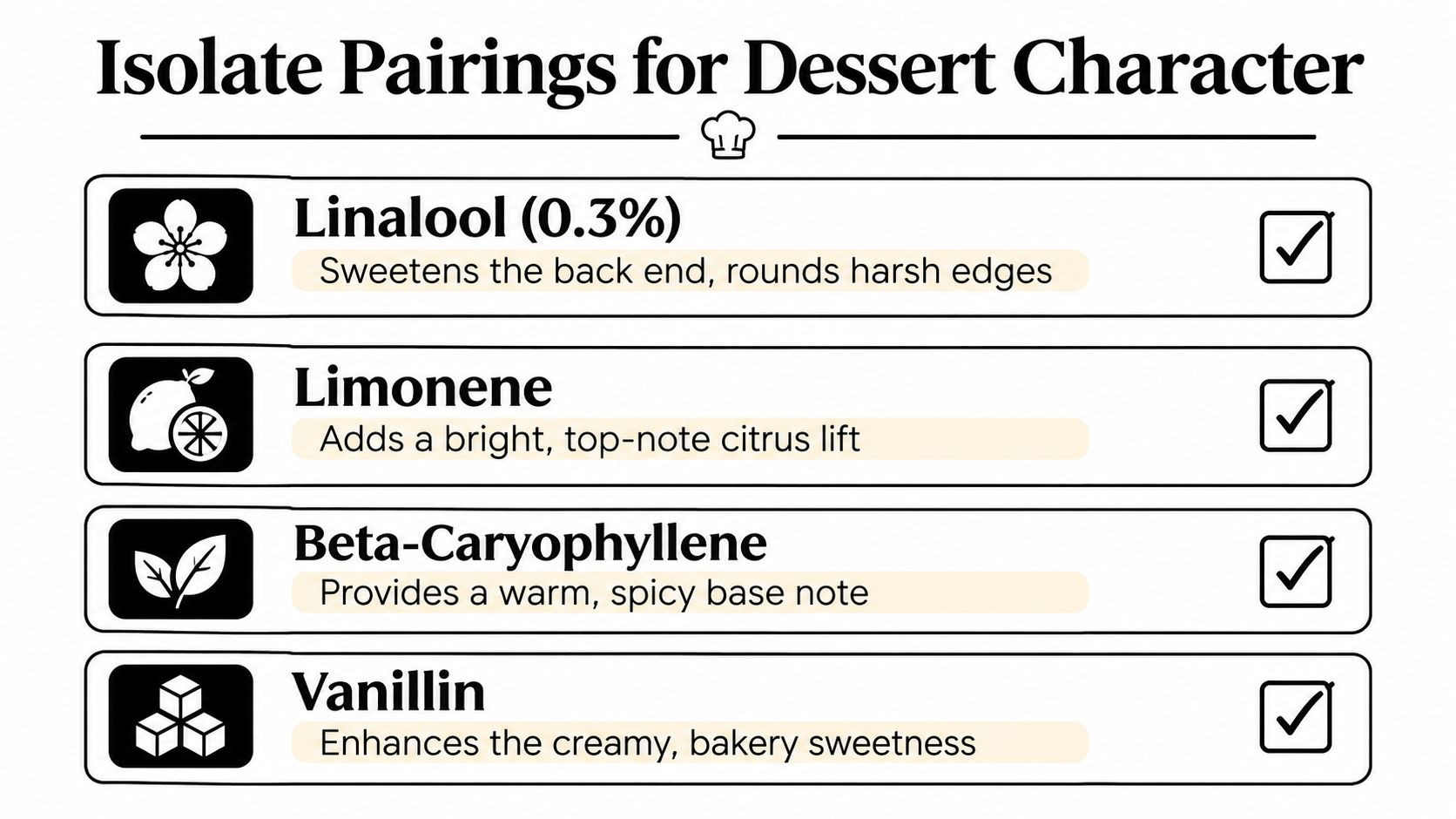
Linalool at 0.3% of total load sweetens the back end and rounds myrcene's heavier edges. Keep it under 0.6%, because it starts reading soapy when the dose gets too high. d-Limonene at 0.5% gives the front note a brighter peel lift, but above 1.2% it can shift toward lemon-scent cleaner instead of dessert fruit. Beta-caryophyllene, even if it's already in the anchor, can be boosted to 1.0% of total load when the crust needs more graham warmth. Humulene at 0.4% adds a baked-finish tone and can help the profile last longer without making the fruit sweeter.
Cis-3-hexenol at 0.05% max is a useful realism tool. At that level, it can push a fresher fruit impression into the blueberry top without announcing itself as green leaf. Over that ceiling, the note can read unripe and pull the profile away from dessert.
| Isolate | Suggested Load | Role in the Profile |
|---|---|---|
| Linalool | 0.3% | Sweetens the back end, softens rough edges |
| d-Limonene | 0.5% | Brightens the opening fruit note |
| Beta-Caryophyllene | up to 1.0% | Adds crust warmth and spice depth |
| Humulene | 0.4% | Supports a baked finish |
| Cis-3-Hexenol | 0.05% max | Adds fresh-fruit realism |
Compliance rationale: each isolate has a defined sensory job, a ceiling, and a failure mode. That makes the addition defensible in a formulation review because the blend is being adjusted by role, not by taste drift.
For product teams that want an isolate-led formulation conversation, the practical question is always the same, what gap is still open after the base blend is mixed. A clean terpene line can outperform a crowded one.
Lab Testing, Stability, and Production Discipline
The blueberry dessert profile only works if it stays where you built it. The compounds that should sit on a GC-FID panel are myrcene, beta-caryophyllene, alpha-pinene, linalool, limonene, and any added isolates. If analyte drift stays within your internal spec, the batch can stay in release review, but if it starts moving hard enough that the blend no longer matches the target, it needs a re-blend instead of a push to fill.
Batch control that keeps flavor intact
Accelerated stability is the fastest way to catch obvious drift. 40°C for 14 days is a practical proxy when you're pressure-testing a six-month shelf claim, and it will usually expose the blends that lose top-note brightness too quickly. Real-time storage at 4°C helps flag crystallization risk in batches that lean heavy on linalool-rich or other low-temperature-sensitive components. Matrix handling matters just as much as chemistry, so use nitrogen-blanketed mixing, move product through amber glass or stainless transfer vessels, and keep lids sealed tightly to reduce oxidation risk in limonene- and terpinolene-containing drums.
A few checks should happen before the batch leaves the bench. Verify the terpene Certificate of Analysis, confirm the final oil still passes light-exposure and water-activity checks appropriate to your finished format, and document any odor or color shift during hold. In production, the failures are usually procedural, not conceptual.
- Monitor the panel: myrcene, beta-caryophyllene, alpha-pinene, linalool, limonene, plus any isolate additions.
- Re-blend, don't release: if the profile drifts enough that the blueberry top no longer matches the target.
- Protect the matrix: nitrogen blanket, tight seals, and inert transfer vessels reduce oxidation losses.
- Check finished carts: look for light exposure damage, flavor flattening, and instability after fill.
The discipline here is simple. If the bulk drum smells right but the finished cart doesn't, something in temperature, exposure, or transfer changed the profile on the way through production. Catch it before it becomes a customer-facing lot.
Gold Coast Terpenes supplies 100% natural terpene blends, isolates, and formulation tools that fit this kind of dessert-profile work, including custom tuning for carts and concentrates. If you're building a blueberry dessert brief, start with the ratio logic above, compare it against your hardware, and visit Gold Coast Terpenes to review blending options, guides, and formulation resources that can support your next run.