
You're standing over a bench with three terpene isolates, a kilogram of winterized distillate, and a production deadline. A pre-balanced strain-inspired terpene blend would give you a starting point, but isolates leave every formulation decision in your hands. One extra fraction can turn a bright profile harsh, make a cartridge too thin, or disappear during storage.
That's the challenge in how to use terpene isolates. The work isn't finished when the aroma smells right in a beaker. You need a repeatable ratio, a hardware-compatible viscosity, controlled handling, and a quality-control loop that checks the formula after blending and after storage.
Why Isolates Demand a Different Formulation Mindset
A pre-balanced profile functions like a ready-made architecture. The supplier has already combined top, mid, and base notes, so your task is mainly to validate the blend in your carrier and hardware. An isolate is raw stock. It gives you control, but it also transfers responsibility for the finished sensory structure, stability, and process behavior to your bench.
Historically, terpene isolation developed from methods such as hydrodistillation and silica-gel chromatography, while modern work has expanded into encapsulation and formulation because concentrated isolates can degrade under oxygen, heat, and light. The evolution from separation toward precision blending explains why isolates now matter in commercial workflows involving flavor, fragrance, cartridges, and concentrates. The terpene isolation and stability guide provides useful background on that progression.
Three decisions change immediately
Dosing becomes mass accounting. A dropper gives you an approximation. A formulation needs milligrams per gram, batch records, and a clear distinction between terpene mass and finished-batch mass. Isolated terpenes are typically treated as concentrated additives, and independent guidance commonly recommends diluting them to about 1% to 5% w/w in a carrier, with some safety guidance capping finished-formula use at no more than 10% by weight for extracts, oils, and concentrates (concentration and storage guidance).
Viscosity becomes a formula variable. You can't rely on the feel of one distillate batch to predict how another will wick. Each isolate changes the blend's flow behavior, and the result must be checked in the intended cartridge rather than judged only in a glass vessel.
Failure modes move upstream. Harshness, flooding, leakage, aroma drift, and profile loss may originate in the isolate ratio, addition order, mixing, or storage. The supplier's COA still matters, but it can't rescue a formula that was dosed by drops or blended unevenly.
Practical rule: Treat an isolate project as a controlled blending process from the first weighing. The cartridge is the final test system, not the place where you discover your ratio.
Start with a target sensory profile, define the hardware, and choose the total load before opening the bottles. Keep isolates in tightly sealed containers away from oxygen, heat, and light. Cool, dark storage protects consistency, but you still need to validate the blend after mixing and storage because concentrated terpenes can change in both aroma and performance.
Matching Each Isolate to Its Note Role
Assign a note role before you calculate a formula. This prevents the common mistake of choosing isolates only because their individual aromas are attractive, then discovering that every component strikes at the same point in the finished vapor.
Limonene usually works as a top note. Its citrus character arrives quickly and gives the first aromatic impression. Myrcene can provide a heavier herbal-musky foundation, while beta-caryophyllene contributes a spicy-woody middle that connects sharper citrus or pine notes to a denser base.
The vapor-point values below are formulation reference values, not a complete prediction of cartridge behavior. Hardware temperature, airflow, distillate composition, and the presence of other volatile compounds all affect what reaches the user.
Isolate Reference Roles and Properties
| Isolate | Note Role | Vapor Point (°C) | Sensory Timing | Blend Function |
|---|---|---|---|---|
| Limonene | Top | About 140 to 150 | Fast strike | Adds bright citrus lift and an immediate opening note |
| Myrcene | Base | About 130 | Early, rounded, lingering | Builds herbal-musky body and anchors the profile |
| Beta-caryophyllene | Mid | About 160 | Slower, persistent | Bridges sharp top notes and heavier base character |
| Linalool | Mid | Not specified | Soft, rounded | Smooths harder edges with a floral direction |
| Pinene | Upper top | Not specified | Quick, sharp | Adds pine-like lift and definition |
Use this grid as a design tool, not as a fixed recipe. A limonene-forward profile may need a stronger base to prevent the opening from feeling hollow. A myrcene-heavy profile may need a sharper upper note to avoid sounding muted. Beta-caryophyllene can add useful structure, but its spicy character can dominate when the formula is already dense.
Your next step is to pull the isolate documentation before measuring. Review purity, residual solvents, and specific gravity on each COA or specification sheet. Purity affects how much active isolate you're adding, residual solvents can change handling and safety decisions, and specific gravity becomes essential if your process uses volume instead of mass. For additional isolate selection context, compare the three popular terpene isolates guide.
Turning Flower Ratios into a Finished Formula
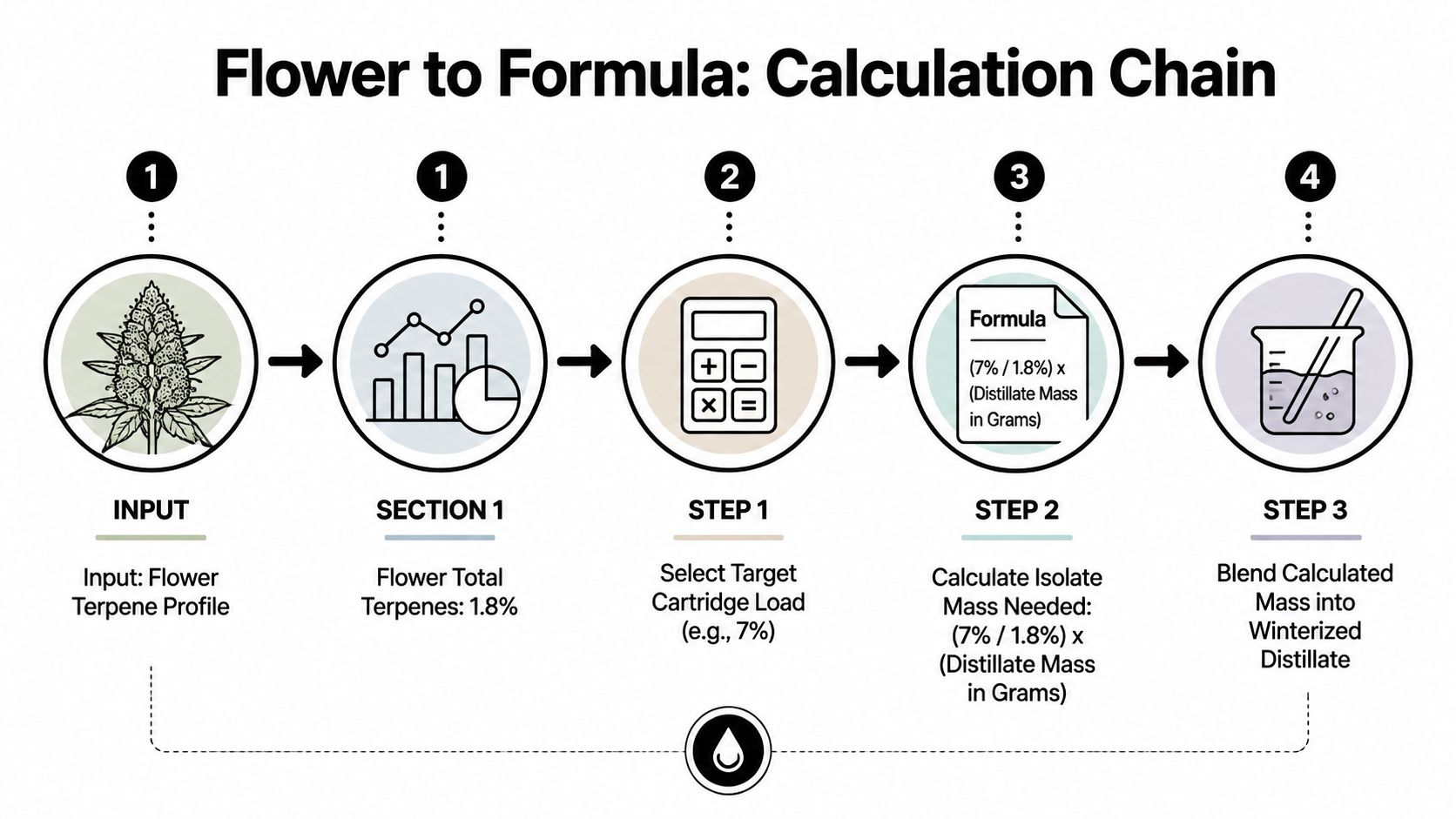
A flower profile gives you relative composition. It doesn't automatically give you a finished cartridge formula. To replicate the profile, convert the reported terpene percentages into ratios, then scale those ratios to the total terpene load you've selected for the distillate.
Use this example:
- Flower total terpenes: 1.8%
- Myrcene: 30% of the terpene fraction
- Limonene: 25%
- Caryophyllene: 20%
- Pinene: 15%
- Linalool: 10%
- Distillate batch: 1 g
- Target finished terpene load: 7%
For a practical formulation calculation based on distillate mass, a 7% target load on 1 g of distillate equals 70 mg of terpene isolates. Allocate that total according to the flower profile:
- Myrcene: 30% of 70 mg = 21 mg
- Limonene: 25% of 70 mg = 17.5 mg
- Caryophyllene: 20% of 70 mg = 14 mg
- Pinene: 15% of 70 mg = 10.5 mg
- Linalool: 10% of 70 mg = 7 mg
This is a relative replication model. The original flower's 1.8% total terpene result describes the source profile, while the 7% target describes your finished distillate addition. You're preserving the relationship among isolates, not reproducing the original concentration.
Copy-ready spreadsheet structure
Set up columns like this:
| Column | Entry |
|---|---|
| A | Isolate name |
| B | Flower profile percentage |
| C | Total terpene mass |
| D | Isolate mass required |
| E | COA purity |
| F | Corrected isolate mass |
The core formula is:
Isolate mass = total terpene mass × profile percentage
If you correct for purity, use:
Corrected isolate mass = required isolate mass ÷ purity as a decimal
For a target load that overshoots aroma, reduce the total terpene mass first, then recalculate every isolate while preserving the same ratios. For example, if the original target is 70 mg and you decide to cut the load to a lower working target, multiply 70 mg by the new target divided by the original target. Then apply each profile percentage to that revised total. The mixing ratios calculator can reduce arithmetic errors, but your batch record should still show the inputs and formulas.
Weigh isolates on a milligram scale. Drops aren't a formulation unit.
Never confuse a percentage of distillate weight with a percentage of finished weight. At a 7% addition based on 1 g of distillate, the 70 mg is calculated against the distillate input. If you define 7% as a percentage of the finished mixture, the required mass is different. Choose one convention, document it, and use it consistently across formulas and production records.
If you're comparing a custom calculation with a catalog flavor, Elevated Strains is one available flavor reference, but it shouldn't be treated as a substitute for a measured isolate ratio.
Blending Isolates into Winterized Distillate
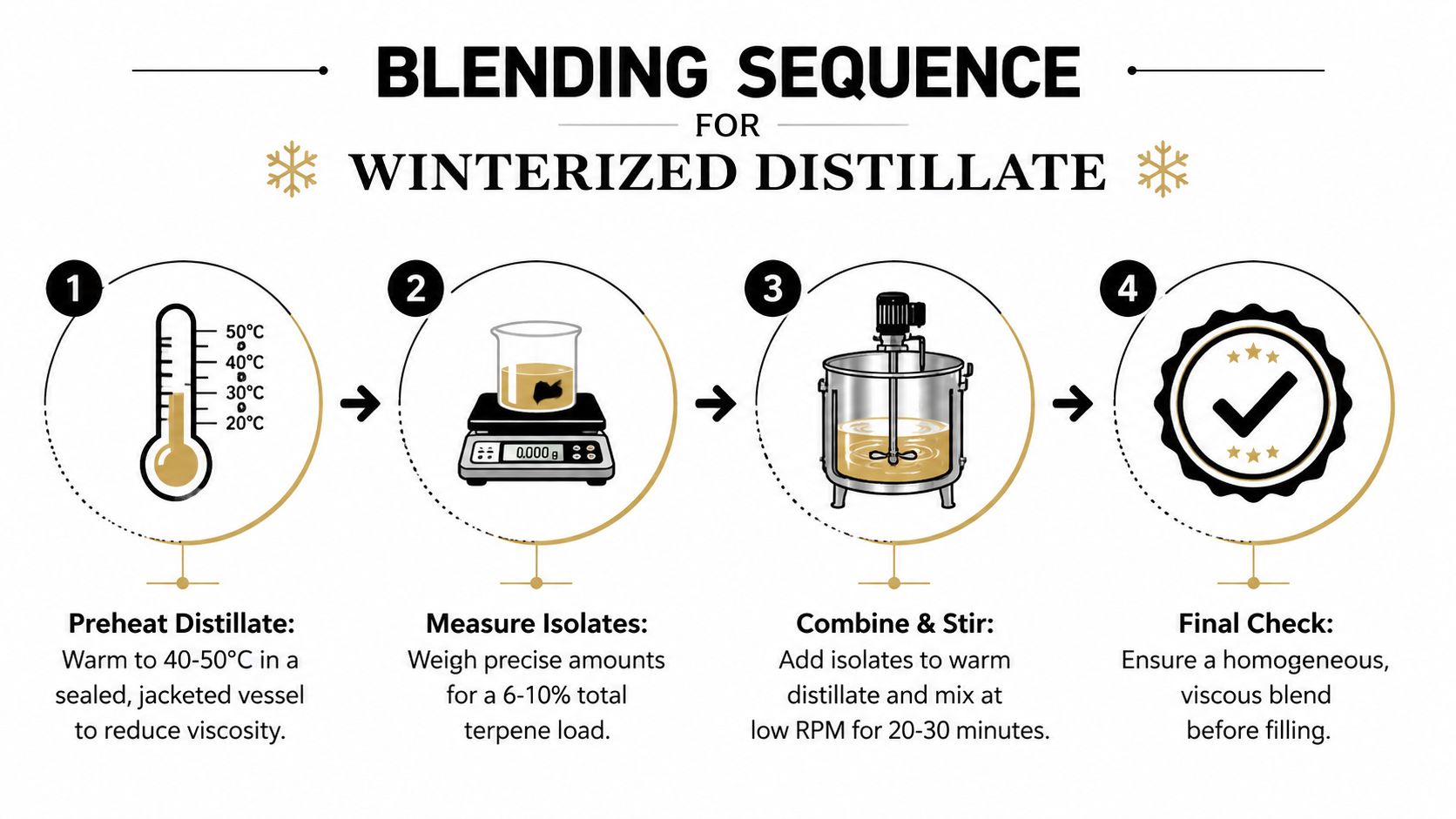
A winterized distillate can look ready in the beaker and still contain unmixed isolate pockets. Start with controlled heat, measured additions, and an endpoint based on uniformity rather than a timer. Use a sealed jacketed vessel, warming the distillate to 40°C to 50°C. This lowers viscosity while limiting unnecessary loss of lighter fractions. Keep the vessel controlled and avoid open flame or direct high heat.
Measure every isolate before charging the vessel. Add the base note, beta-caryophyllene, first, then the mid-note, myrcene, and finish with the top-note, limonene. Introducing the lighter fraction last reduces its exposure to heat during incorporation.
A controlled blending sequence
Prepare the vessel. Confirm that the jacket, stirrer, thermometer, and container are clean and dry. Seal the vessel where practical to limit oxygen exchange and volatile loss.
Warm the distillate. Bring the winterized distillate into the 40°C to 50°C range. Vape formulation guidance describes warming distillate to 100°F to 120°F before terpene addition. For isolate-heavy work, stay near the lower part of the working range unless your process validation supports otherwise.
Add by role. Introduce beta-caryophyllene, then myrcene, then limonene. Feed each isolate slowly into the moving distillate. Avoid dropping the full charge into one spot, where it can form a concentrated pocket that takes longer to disperse.
Mix until uniform. Use a magnetic or overhead stirrer at 400 to 600 rpm for 15 to 20 minutes, or continue until the mixture returns to optical clarity. A distillate mixing guide describes 5 to 10 minutes as a minimum mixing period, so treat time as a process input, not the release criterion. The batch is ready for the next check only when streaks, haze, and visible separation are absent.
A jacketed beaker provides close temperature control and makes small-batch observation straightforward. A sonication bath may improve dispersion, but it can introduce heat that is harder to localize. A planetary centrifugal mixer can produce repeatable incorporation at production scale, provided fill volumes and the mixing program are validated. Choose equipment that holds temperature, shear, and mixing time consistently from batch to batch.
A 100 g micro-batch
At an 8% terpene load calculated against 100 g of distillate, the isolate blend requires 8 g total. Using the profile proportions from the worked example:
- Myrcene, 30%: 2.4 g
- Limonene, 25%: 2 g
- Beta-caryophyllene, 20%: 1.6 g
- Pinene, 15%: 1.2 g
- Linalool, 10%: 0.8 g
Expect a temporary color or clarity shift while the isolates disperse. Do not fill while streaks, haze, or separation remain visible. Hold the batch until its appearance is uniform, then take a sample for sensory and hardware checks. A short rest can show whether the blend stays homogeneous, but validated fill timing should decide release, not bench appearance alone.
Diluents and Hardware Compatibility
A blend can look uniform in a beaker, pass an aroma check, and still feed poorly in a cartridge. Diluents change flow, evaporation, and flavor carry. Hardware then adds inlet geometry, coil design, wick material, and operating temperature to the result. The finished formula, not a carrier-only surrogate, must be tested.
Treat every diluent as a formulation choice rather than a generic viscosity fix. MCT oil may thin distillate while changing its carrier profile. PG and VG produce different flow and sensory behavior. PEG 400 and triethyl citrate bring separate compatibility, inhalation, and regulatory questions. Confirm that each ingredient is suitable for the intended application and jurisdiction before production.
Do not assign viscosity figures to MCT oil, PG, VG, PEG 400, or triethyl citrate at 5% to 10% addition without verified measurements. Record viscosity from the finished formula instead of relying on assumed values. A universal wicking cutoff is just as unreliable. Test the actual isolate blend in the selected hardware.
What to evaluate before filling
Coil resistance matters. A formula that feeds correctly through one cartridge can flood or starve another. Compare resistance options, inlet geometry, and heating behavior with the finished blend. A resistance value by itself does not predict performance.
Inlet diameter matters. Larger flow paths may handle thicker formulas more readily, but the suitable specification depends on cartridge design and terpene load. Approve a diameter only after testing the complete formulation.
Wick material changes the result. Ceramic and cotton systems can respond differently to limonene-forward blends, especially when the formula is thin or volatile. Run fill, soak, draw, and leakage checks before approving a component change.
Cold storage can expose composition problems. Beta-caryophyllene-heavy blends may crystallize in cold conditions, while myrcene-heavy formulas can remain more fluid at room temperature. If a batch clouds or thickens, warm it gradually, inspect it, and confirm whether the change reverses before filling. A formula that recovers visually may still need a fresh hardware check.
Diluent and Hardware Compatibility for Isolate-Loaded Distillate
| Diluent | Viscosity at 5% to 10% | Best Coil Type | Risk Notes |
|---|---|---|---|
| MCT oil | Measure in the finished formula | Validate with the selected ceramic or cotton system | Can alter carrier behavior and may not suit every inhalation application |
| PG | Measure in the finished formula | Hardware-specific validation required | Can change throat character and flavor carry |
| VG | Measure in the finished formula | Hardware-specific validation required | May behave poorly in systems not designed for thicker carriers |
| PEG 400 | Measure in the finished formula | Hardware-specific validation required | Requires ingredient, inhalation, and regulatory review |
| Triethyl citrate | Measure in the finished formula | Hardware-specific validation required | Requires matrix compatibility and finished-product review |
For cartridge development, professional guidance places total terpene loading at 5% to 15% by weight, with 6% to 10% described as a balanced working target in one formulation workflow (cartridge loading guidance). Other professional guidance describes 5% to 8% as a distillate sweet spot and recommends adjusting the final percentage to viscosity and hardware performance (vape application guidance). Use these ranges only as starting points. Release the formula after it passes flow, soak, draw, leakage, and storage checks in the intended device.
Testing Before, During, and After Storage
Quality control should run as a loop. A formula that passes a visual inspection immediately after blending can still drift in aroma, viscosity, or oxidation during storage. Isolated terpenes are especially sensitive to oxygen, heat, and light, which is why the finished blend needs its own stability record rather than relying only on raw-isolate documentation.
Stage one is pre-blend control
Review each isolate COA for purity and residual solvents, and confirm the identity of the material before weighing. Check distillate moisture with Karl Fischer titration, using below 0.5% as the specified target in this workflow. Also measure the blank distillate's baseline terpene content so the calculation distinguishes native material from the isolates you're adding.
Record batch IDs, container condition, storage history, mass, specific gravity where relevant, and the formula convention. If the blank already contains a measurable terpene fraction, adding the planned isolate mass without accounting for that baseline can push the finished profile away from target.
Stage two catches blend defects
After mixing, pull a 1 g sample for potency verification against the calculated load. The specified acceptance target is within ±0.3% of the calculated load. Pair the result with an aroma panel against a reference standard and inspect the sample for haze, separation, streaking, or color drift.
A clear beaker is not proof of a finished cartridge formula. The sample needs to agree with the calculation, the reference aroma, and the hardware behavior.
Fill a controlled test set before approving the batch. Check flow, fill consistency, leakage, soak behavior, and vapor performance in the intended cartridge or pod. If the formula behaves differently across hardware, hold the change as a hardware compatibility issue rather than averaging the results into a vague pass.
Stage three measures aging
Retest retained samples after 7, 14, and 30 days at 25°C and 4°C. Measure terpene retention, oxidation markers including peroxide value, and viscosity. The supplied workflow calls for a batch hold when peroxide exceeds 10 meq/kg, viscosity shifts beyond 15%, or the aroma panel moves by more than 2 points on a 10-point scale.
| Stage | Test | Target / Threshold | Hold Trigger |
|---|---|---|---|
| Pre-blend | Isolate COA, purity, residual solvents, moisture, blank terpene baseline | Moisture below 0.5% | Missing identity or documentation, moisture at or above target |
| Post-blend | Potency, aroma panel, appearance, fill behavior | Potency within ±0.3% of calculated load | Potency outside target, haze, separation, or unacceptable hardware behavior |
| Post-storage | Retention, peroxide value, viscosity, aroma panel | Stable against the approved reference | Peroxide above 10 meq/kg, viscosity shift beyond 15%, or aroma delta above 2/10 |
A peroxide failure points toward oxygen exposure, reactive headspace, or inadequate storage control. A viscosity failure suggests composition drift, crystallization, or a carrier interaction. An aroma-panel failure can indicate oxidation, volatile loss, or an incorrect ratio that only becomes obvious after the blend equilibrates.
Fixing Flat, Harsh, or Fading Profiles
A blend can smell correct in the vial and fail after dilution, filling, or a cartridge draw. Diagnose the defect in the state where it appears. Start with the batch record, then compare the finished blend, hardware, stored sample, and approved reference.
Troubleshooting Matrix for Terpene-Isolate Profiles
| Defect | Primary Check | Secondary Check | Tertiary Check | Fix Direction |
|---|---|---|---|---|
| Flat profile | Top-note level and addition loss | Mid-note overload, especially myrcene or linalool | Hardware temperature and airflow | Restore upper-note definition, then retest the complete blend |
| Harsh hit | Total load and draw behavior | Beta-caryophyllene-heavy ratio | Carrier compatibility and localized overconcentration | Reduce the dominant fraction or total load, remix, and validate in hardware |
| Fading aroma | Storage temperature and oxygen exposure | Container headspace and opening frequency | Terpene retention and oxidation markers | Improve sealing and storage, then reformulate only after identifying the loss mechanism |
A flat profile usually means the top note was lost during processing or masked by the mid notes. In one worked example, a 7% formula tasted flat at week zero because the limonene-to-linalool ratio was 4:1. Changing it to 5:2 lifted the top note in that example. Treat the change as a starting hypothesis, not a pass. Retest the finished distillate in the intended hardware.
Harshness may result from excessive total load, a peppery beta-caryophyllene-heavy ratio, incomplete mixing, or a carrier that changes draw behavior. Do not cover the defect with another aromatic isolate. Reduce the dominant fraction or total load, make one controlled change, document it, and compare the revised blend with the original reference.
Fading aroma points to oxidation, volatile loss, repeated opening, or poor storage control. A review of terpene nanosystems examines nanostructured encapsulation for reducing degradation in isolated terpenes and essential oils, supporting tight oxygen and storage controls. Formulations tested in hardware may show different aerosol chemistry compared with distillate alone. Consult your jurisdiction's emissions guidance before finalizing a profile, and keep flavor approval tied to hardware validation.
Re-test the complete blend, never the raw isolate, before adjusting the formula.
Gold Coast Terpenes supplies isolated compounds and terpene blends for cartridges, concentrates, and cannabis product formulation. Its formulation resources and terpene options can support either a measured custom ratio or a pre-balanced reference profile. Confirm aroma, viscosity, and hardware fit with a small documented batch before scaling.