
A lab sends over a COA marked Black Scotti. Your reference flower is labeled Black Biscotti. One sample smells like creamy cookie dough and fuel, while another leans sharply toward citrus, musk, or pepper. The formulation team asks for a single terpene blend, but the name itself doesn't identify a single standardized chemical target.
That problem reaches beyond naming. If a cartridge is sold around a dessert-hybrid identity, an inconsistent aroma can weaken repeat purchasing and make batch-to-batch quality difficult to defend. For formulators, the practical task is to separate the reliable aromatic signals from the variable ones, then build a blend that performs consistently in distillate and concentrate matrices. The broader Biscotti family is discussed in this Biscotti cookie profile reference, but Black Biscotti requires more disciplined interpretation.
Why Black Biscotti Demands a Formulator's Attention
A brand owner may receive three inputs under nearly the same name: Black Biscotti flower, Black Scotti distillate, and a breeder-specific Black Biscotti cut. Treating those materials as interchangeable is a production mistake. The available market descriptions disagree on whether the name refers to a Biscotti and Zhit cross, a dark-fruit selection, or a broader phenotype family, which makes breeder records and batch COAs more important than the label alone (JointCommerce naming analysis).
The commercial consequence is straightforward. A customer expecting sweet bakery notes, dark fruit, and OG-style fuel won't experience the same product if the blend is dominated by bright citrus or a thin herbal note. A cartridge can remain technically compliant while still missing the sensory promise attached to its name.
Treat the name as a sensory brief
The most useful approach is to define Black Biscotti by its recurring aromatic structure rather than by an assumed universal pedigree. Across Biscotti-family references, β-caryophyllene, limonene, and myrcene repeatedly appear as important components, with humulene and linalool often contributing support (Biscotti terpene lineage guide).
That doesn't mean every batch should be copied numerically. Licensed-lab and menu-derived reports place Black Biscotti phenotypes around 1.5% to 3.0% total terpenes by weight, with boutique examples occasionally exceeding 3.5% (Black Biscotti terpene guide). Those values describe flower, not a finished cartridge formula. They help establish intensity and hierarchy, but they don't replace sensory evaluation in the target oil.
Practical rule: Use the cultivar name to define the intended experience, then use the COA to identify which phenotype you actually received.
A repeatable strain-inspired blend should therefore preserve the tension between cream and gas, dark fruit and earth, and sweetness and pepper. If a formulation only reproduces cookie sweetness, it will read as a generic bakery profile. If it only reproduces fuel, it loses the distinctive dessert identity.
Lineage and Phenotype Selection Behind the Profile
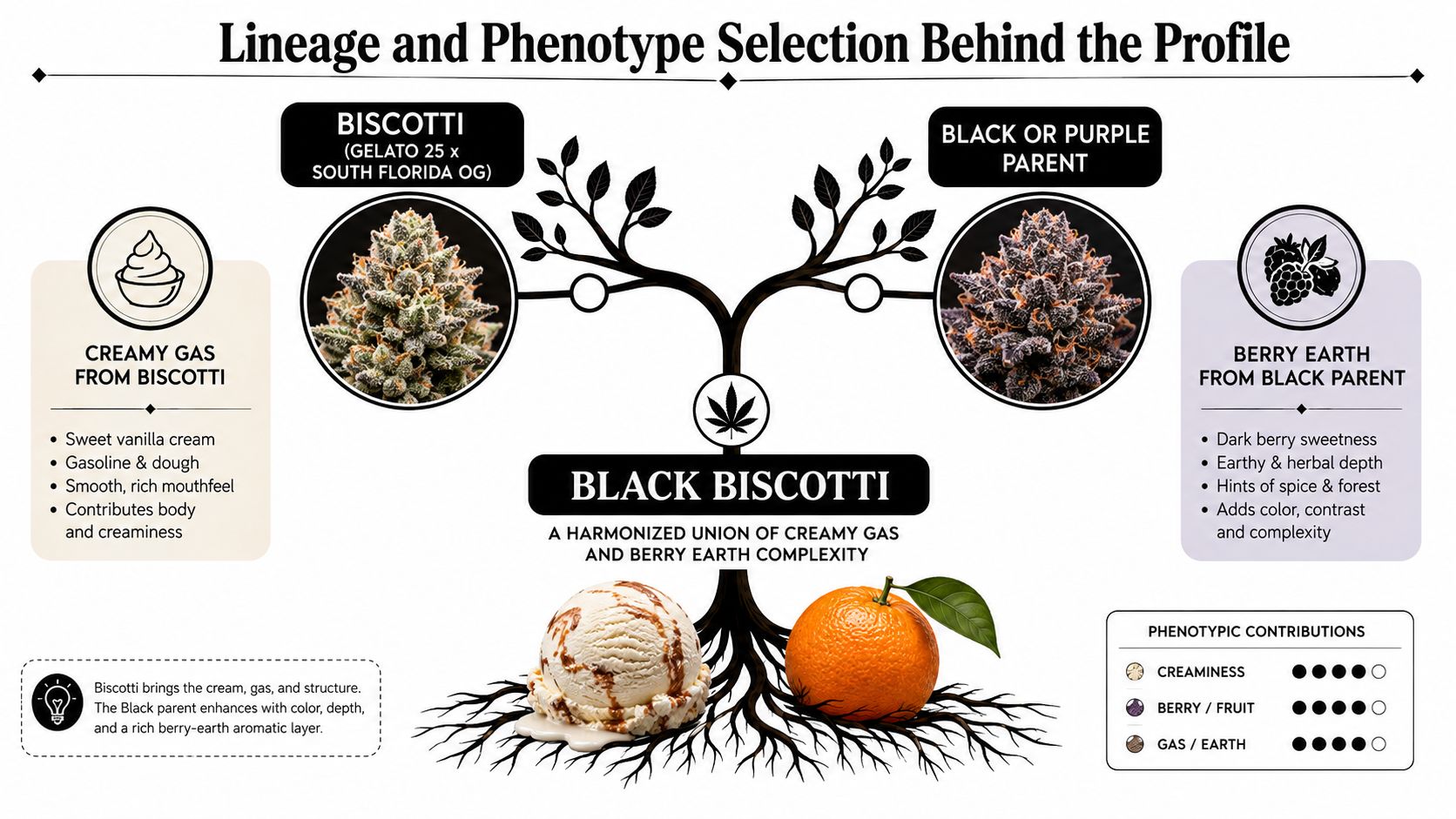
Black Biscotti appears to be a phenotype-driven offshoot of the Biscotti family, rather than a long-established standalone cultivar with one universally accepted breeding record. The commonly cited Biscotti pedigree is Gelato #25 crossed with South Florida OG, and Black Biscotti is generally described as a darker selection within or adjacent to that family (Elephant Garden lineage discussion).
That background creates a useful formulation hypothesis. Gelato-era genetics help explain the creamy, sweet, confectionary direction, while South Florida OG contributes the earthy, fuel-forward backbone. The “black” designation appears to reflect selection for darker, anthocyanin-heavy phenotypes and deeper fruit expression, but the exact contributing parent can vary by breeder and market.
What remains consistent across phenotypes
A formulator shouldn't chase every reported note as if it were mandatory. The more reliable aromatic through-lines are:
- Bakery sweetness: Cookie dough, toasted sugar, and nut-like impressions establish the Biscotti identity.
- Dark fruit depth: Plum, berry, and grape-skin suggestions distinguish the darker phenotype direction from standard cookie profiles.
- Fuel and earth: OG-adjacent notes keep the blend from becoming candy-like.
- Pepper and dry wood: Caryophyllene and humulene provide structure and prevent the top notes from dominating.
- Soft floral lift: Linalool can round the midrange without turning the profile into lavender.
Phenotype selection changes how those layers appear. One flower may express a richer dough and floral center. Another may push pepper, earth, and fuel. A third may show more citrus lift because limonene is relatively prominent. That spread explains why no single COA should be treated as the definitive Black Biscotti formula.
The production implication is important: build a reference window, not a rigid identity claim. Record the source cultivar, harvest batch, cure condition, dominant terpenes, and sensory descriptors before choosing isolates. A related dessert profile, such as Elevated Strains, can help a team think in terms of flavor architecture, but it shouldn't be used as proof of Black Biscotti lineage.
For a broader framework on evaluating aromatic expression before committing to a cultivar, see this guide to selecting cannabis by terpene profile.
Core Terpene Stack and Note Architecture
A useful Black Biscotti formulation starts with note hierarchy, not a flat list of ingredients. The flower data supports an aromatic structure led by caryophyllene, limonene, and myrcene, with humulene and linalool providing supporting depth. Across reported Black Biscotti phenotypes, caryophyllene commonly measures around 0.4% to 0.8% and limonene around 0.3% to 0.6% of flower weight (reported terpene ranges).
The following architecture is best treated as a sensory mapping tool, not a validated finished-product recipe. The provided Black Biscotti data supports ranges for total terpenes and selected flower terpenes, but it doesn't verify the much higher isolate percentages sometimes assigned to individual blend components. A formulation team should therefore use these layers to organize trials and then verify the final blend analytically.
| Note Layer | Terpene | Typical Range (%) | Aromatic Contribution |
|---|---|---|---|
| Top | Limonene | 0.3 to 0.6 in reported flower | Citrus lift and sweet brightness |
| Top | Alpha-pinene | Not standardized in the available Black Biscotti data | Dry pine and sharper aromatic definition |
| Mid | β-caryophyllene | 0.4 to 0.8 in reported flower | Pepper, spice, and fuel-supporting warmth |
| Mid | Humulene | Reported as a supporting Biscotti-family terpene | Dry wood, earth, and structure |
| Mid | Linalool | Reported as a supporting terpene | Soft floral and creamy sweetness |
| Base | Myrcene | Reported as a core Biscotti-family terpene | Musk, earth, and weight |
| Base | Ocimene | Present in some darker-fruit descriptions | Herbal-citrus tail and lift |
How to read the profile in a cartridge
Limonene supplies the opening impression, but it shouldn't carry the whole blend. Caryophyllene gives the profile its peppered center, while myrcene and humulene hold the darker base in place. Linalool is valuable as a bridge because it can connect bakery sweetness to floral and fruit nuances without making the profile overtly perfumed.
The desired result is not maximum intensity from every component. A blend can test strongly and still taste flat if one note masks the others. In practice, the formulation team should adjust one family at a time, first the base, then the midrange, then the top. Keep a sensory record that distinguishes first pull, warmed-cart aroma, and finish, because volatile top notes often present differently across those stages.
Building a Strain-Inspired Terpene Blend From Isolates
Start with a clean target matrix and a confirmed source profile. Before mixing, record the distillate or concentrate's viscosity, color, odor, and existing terpene content. If the base oil already carries limonene or caryophyllene, adding a full-strength isolate blend without accounting for those native compounds can push the finished product away from the reference.
The available data doesn't establish validated starting percentages for an isolate reconstruction, so use qualitative sequencing and small controlled adjustments rather than invented precision. A practical bench workflow looks like this:
Establish the base. Begin with myrcene and caryophyllene as the structural pair. Myrcene supplies weight and earthy musk, while caryophyllene adds the peppered fuel note that keeps the bakery character from becoming soft or artificial.
Build the center. Add humulene and linalool in restrained amounts. Humulene supports dry wood and earth, while linalool can create a creamy floral bridge. If the blend starts smelling like perfume, reduce linalool before increasing the heavier components.
Add the lift. Introduce limonene gradually, then evaluate whether alpha-pinene or another dry top-note material is necessary. Limonene should open the profile, not erase the dark fruit and spice beneath it.
Evaluate minor depth. Trace-level materials such as fenchol, bisabolol, and suitable esters may help separate a rounded cookie profile from a generic sweet blend. Treat them as finishing tools, not primary ingredients, and confirm regulatory suitability for the intended product.
| Terpene Isolate | Role | Starting % Range | Notes |
|---|---|---|---|
| Myrcene | Base foundation | Validate by bench trial | Adds earthy weight and musk |
| β-caryophyllene | Base and mid support | Validate by bench trial | Supplies pepper and structural warmth |
| Humulene | Dry midrange | Validate by bench trial | Prevents excessive sweetness |
| Linalool | Creamy floral bridge | Validate by bench trial | Use cautiously to avoid a perfumed finish |
| Limonene | Top lift | Validate by bench trial | Excess can turn the profile citrus-dominant |
| Minor isolates and esters | Depth accents | Trace evaluation only | Confirm compatibility and compliance |
Mixing discipline matters
Use compatible, documented raw materials. Botanical-derived and cannabis-derived terpenes can produce different sensory impressions even when the named compound is the same, because minor constituents and impurities affect the final aroma. Storage also matters. Oxygen, heat, light, and repeated headspace exposure can dull delicate notes or create stale off-notes.
For isolate handling and material-selection fundamentals, consult this terpene isolation guide. In the lab, weigh each component separately, premix the terpene phase before adding it to the oil, and use controlled agitation rather than aggressive aeration. Prepare a small bench sample, let it rest for 48 hours before final sensory evaluation, and compare it with the reference under the same temperature and hardware conditions.
Don't judge the blend immediately after mixing. Early aroma can overstate bright compounds and underrepresent the integrated cookie, earth, and fuel relationship that develops during rest.
Formulating for Distillate Carts Versus Concentrates
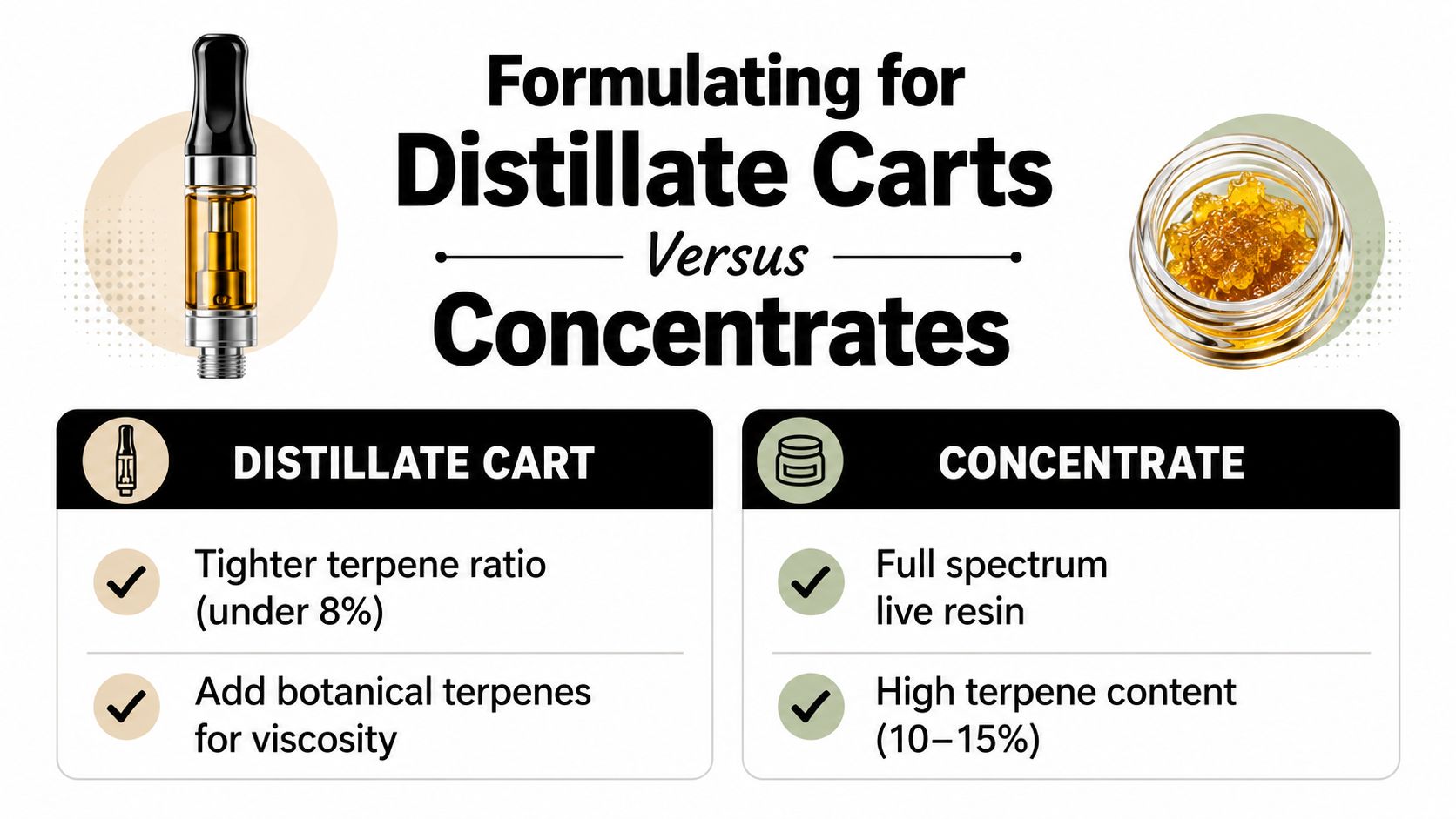
The same Black Biscotti aromatic target behaves differently in a distillate cartridge and a concentrate. Distillate carts need a tighter terpene load, because added aroma compounds affect viscosity, wicking, coil behavior, and throat sensation. Concentrates can support a fuller aromatic expression, but the product still needs stability and a controlled sensory release.
The supplied formulation brief identifies 5% to 8% by weight as a typical distillate-cart terpene range and 8% to 12% for concentrate-style applications. Those are product-development targets, not guarantees. The correct level depends on the oil, hardware, terpene source, and regulatory requirements, so confirm performance with the actual cartridge and fill process.
Distillate cart priorities
For a cartridge, preserve the profile while protecting flow. Caryophyllene and humulene contribute valuable pepper and wood, but increasing heavy, less volatile materials without checking the matrix can produce uneven movement through the reservoir or create instability during cold storage. A cutting-agent-free approach should rely on compatible distillate, measured terpene addition, controlled warming, and hardware testing rather than using VG, PG, PEG, or MCT to force viscosity changes.
A 1 ml or 2 ml cartridge should be evaluated for initial draw, sustained draw, reservoir movement, leakage, and flavor change over the fill's life. The cartridge isn't a neutral delivery system. Ceramic composition, airflow, coil temperature, and oil residence time all influence whether the first impression remains citrus-forward or develops the intended fuel and dessert balance. The practical workflow for oil preparation is covered in this guide to mixing distillate with terpenes.
Concentrate priorities
A live resin-style concentrate may retain more native aromatic complexity, which means the added blend should support rather than overwrite the extract. A high terpene load can make top notes vivid, but excessive addition may reduce the sense of full-spectrum depth and make the product taste formulated rather than cultivar-led.
Use the same reference language for both formats, then define format-specific acceptance criteria. The cart should deliver clean, repeatable wicking and a stable flavor arc. The concentrate should preserve layered aroma and avoid a sharp solvent-like edge.
Common Mistakes That Flatten Dessert-Hybrid Profiles
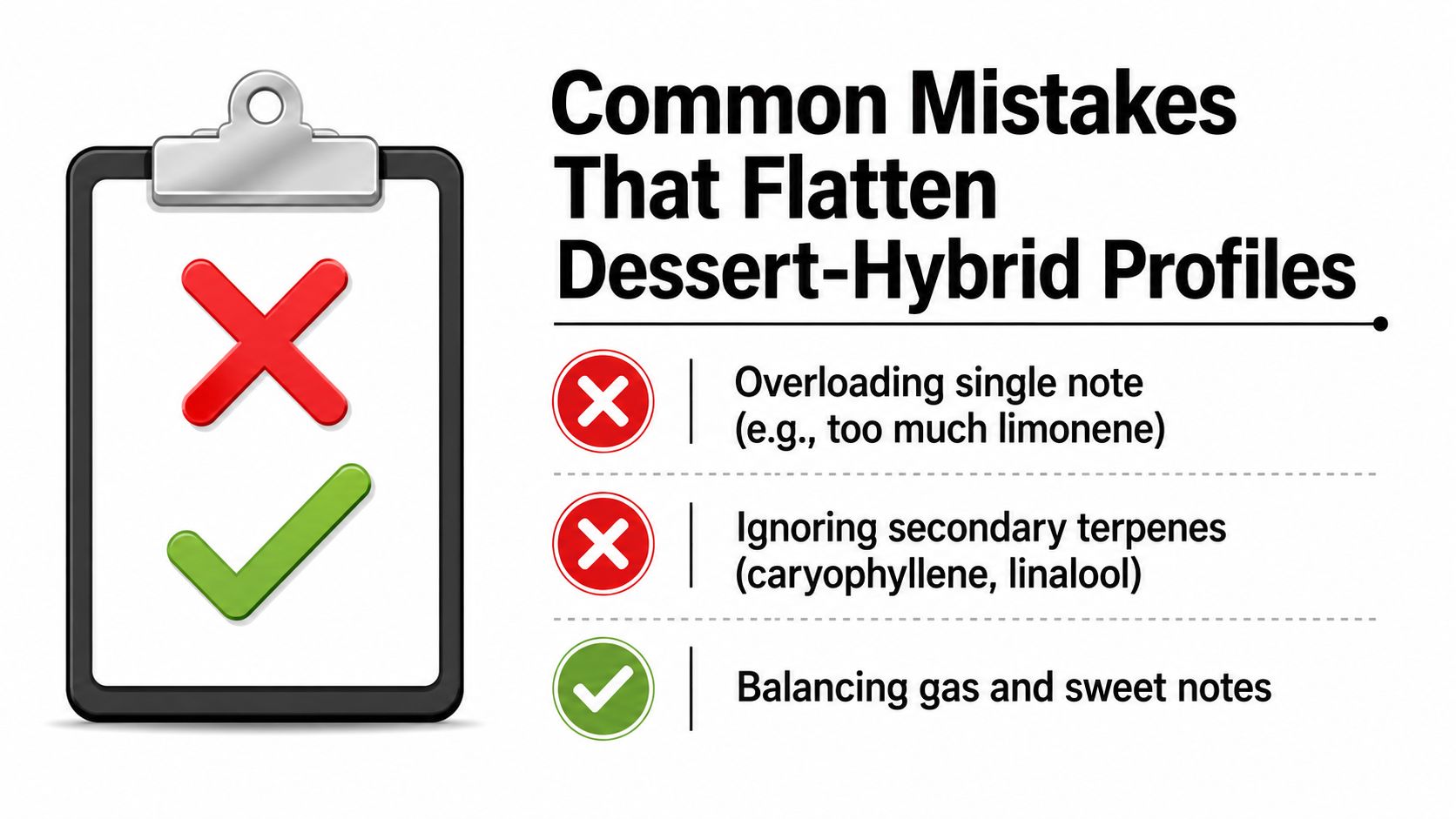
The most common error is assuming that a recognizable ingredient can stand in for the whole cultivar. Limonene can make a blend immediately bright, but too much can turn a dark cookie-and-fuel profile into a one-dimensional citrus product. The fix is simple in principle, reduce the top note and rebuild the caryophyllene, myrcene, humulene, and linalool relationship through controlled trials.
Where teams usually lose complexity
- They underbuild the pepper backbone. Without enough caryophyllene character, sweetness can taste synthetic and the fuel note disappears. Compare the reformulated sample against the reference after the blend has rested, not immediately after mixing.
- They ignore minor aromatics. Trace esters and minor terpenes can add baked-goods depth, but they need careful dosing and compatibility checks. Don't use them to compensate for a missing base.
- They mix too aggressively. High-shear handling can introduce air and create inconsistent sensory evaluation. Use controlled agitation and confirm uniformity through samples drawn from different points in the vessel.
- They evaluate only the first draw. A cartridge can open with bright citrus and finish with flat earth, or do the reverse. Test the first pull, warmed performance, and late-session finish.
- They use tired raw materials. Oxidized isolates may introduce stale, pine-like, or solvent-adjacent notes that cover delicate midrange aromas. Maintain lot records, protect containers from heat and light, and reject material that fails its odor check.
A dessert profile isn't defined by sweetness alone. It needs contrast, and contrast comes from pepper, earth, fuel, and controlled brightness.
Build a short sensory checkpoint into every revision. Ask the panel to score bakery, fruit, citrus, pepper, earth, fuel, and finish separately, then record one overall similarity judgment. That method shows whether the blend improved as a whole or merely became louder.
Testing and Scaling Your Black Biscotti Formulation
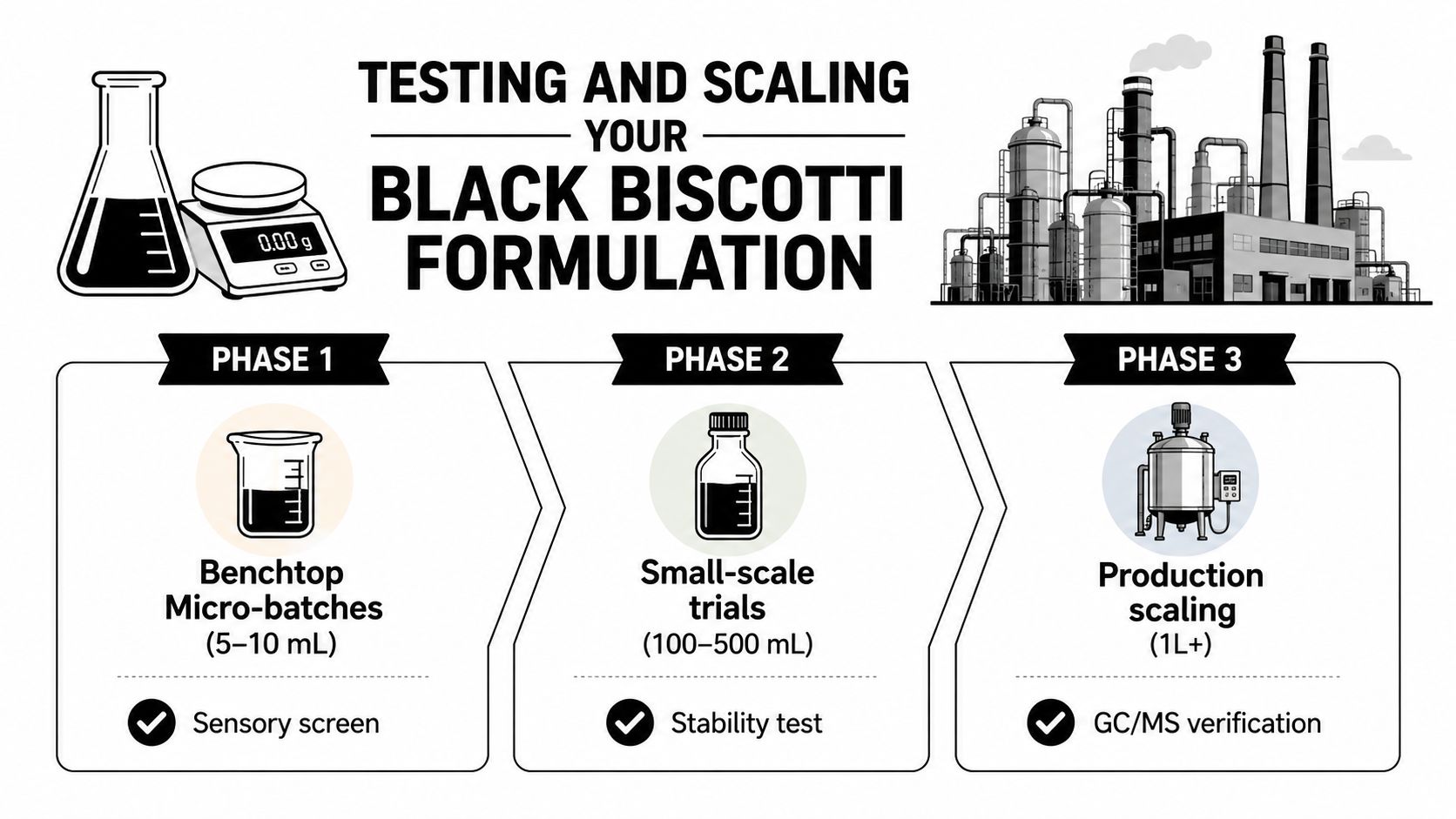
A reliable formulation earns approval in stages. Begin with 5 to 10 mL benchtop micro-batches, using them for sensory screening and compatibility checks. Once the blend behaves as intended, move to 100 to 500 mL pilot runs to test mixing, homogeneity, viscosity, and fill behavior under production-like conditions. The final phase is full-scale manufacturing, where the process must reproduce the sensory target rather than just match a worksheet.
Build evidence at each phase
GC-MS verification should accompany each meaningful scale change, especially when the formulation depends on volatile top notes such as limonene. Analytical results confirm composition, while sensory panels determine whether the composition still communicates the intended Black Biscotti character in the finished matrix.
Stress testing should include temperature cycling between 4°C and 40°C to expose separation, crystallization, or changes in flow before release. Test filled cartridges, not only bulk oil, because hardware can reveal problems that remain invisible in a mixing vessel.
A blind triangle test is useful when comparing a new blend against reference flower, an approved internal standard, or a competing cartridge. Panelists should identify the odd sample and describe the difference using controlled vocabulary. That gives the brand a defensible sensory record instead of relying on a single formulator's memory.
Document what production changes
Keep batch records for raw-material lots, addition order, mixing time, temperature exposure, rest period, fill conditions, and final analytical results. The supplied scale-up plan uses ±2% for major terpenes and ±0.5% for minor terpenes as example deviation thresholds, but your quality team should confirm whether those limits fit the analytical method and product specification.
Supplier discussions should cover lot consistency, documentation, lead times, and minimum order quantities before volume increases. A blend that works at bench scale can become difficult to reproduce when raw-material lots change or when a larger vessel alters mixing efficiency. Approve the process only after the sensory result, analytical profile, stability data, and cartridge performance agree.
Gold Coast Terpenes supplies natural terpene blends, strain-specific profiles, and isolated compounds for cartridges, concentrates, and cannabis product formulation, with lab-verified, THC-free materials and formulation resources such as safety documents and a mixing calculator. Visit Gold Coast Terpenes to review options for building and testing a repeatable Black Biscotti-inspired profile.