
A formulator receives a brief for a candy-forward cartridge, pulls a limonene-heavy reference, and expects the Zkittlez character to appear immediately. The first aroma check smells bright, sharp, and almost one-dimensional. The fruit is present, but the relaxed finish that makes the profile recognizable is missing.
That failure is common because Zkittlez strain effects are described in retail language, while a product developer needs chemistry, ratios, and repeatable sensory targets. Zkittlez has no strain-specific clinical trials, so reported effects come primarily from consumer reports and dispensary-style descriptions rather than controlled human studies, as summarized in this Zkittlez strain review. For formulation work, that doesn't make the reports useless. It means they must be treated as an observed effect pattern, then checked against batch-level terpene data.
Why Zkittlez Strain Effects Belong in Your Formulation Notebook
A Zkittlez cartridge can smell sweet on first draw and still miss the cultivar's recognizable effect impression. The bench problem is usually an overbuilt citrus top note with too little floral, peppery, earthy, or fruity structure underneath. Limonene can supply the immediate lift, but it cannot carry the entire sensory arc.
COA-style reporting shows why the strain name is not a fixed specification. Across multiple batches, one independent review reported recurring linalool, beta-caryophyllene, and myrcene contributions of roughly 0.28–0.52% linalool, 0.31–0.48% beta-caryophyllene, and 0.19–0.36% myrcene, alongside the broader Zkittlez profile, according to Seennabis' COA-based Zkittlez review. Those values are useful as formulation reference points, not as a universal recipe.
A separate sample in that review measured about 23% THC and showed a different terpene distribution: myrcene at 30%, limonene at 20%, caryophyllene at 15%, and linalool at 12% of the listed terpene profile. Phenotype, cultivation, extraction, and testing conditions can shift the dominant note while retaining a recognizable candy-fruit direction. For carts and distillate, compare the complete COA with sensory results instead of copying one headline terpene.
Effects are formulation clues, not medical claims
Consumer reports commonly describe Zkittlez as a clear-headed or mildly euphoric opening followed by body relaxation, with limited strong sedation at moderate doses, as documented in the Weedpedia profile. Treat that description as a sensory brief. The top should feel bright and immediate, the middle should add floral and peppery definition, and the base should provide a rounded finish without turning muddy.
Reported THC ranges also vary. One market summary places the cultivar around 15–23%, while another reports 16–23%, with some related Zkittlez-type selections testing higher, according to the same Weedpedia profile. These figures describe reported potency, not a target for a terpene blend, and they do not establish a clinical relationship between a particular terpene and a particular effect.
Bench rule: If the first aroma check is all citrus, the blend is probably missing the compounds that carry Zkittlez's calm, rounded finish.
Record the sensory arc in the notebook: opening brightness, the point where body presence emerges, fruit persistence, and whether the finish reads floral, peppery, earthy, or overly sedating. Pair those observations with batch-level COA data. That record gives product developers a workable top-, mid-, and base-note target when replicating the profile in a vape cartridge or building a strain-inspired blend for distillate.
The Reported Effect Curve and What It Means for Formulators
The practical Zkittlez effect curve has three phases: an early lift, a fuller middle, and a gradual calming tail. Independent strain guidance places inhalation onset at roughly 2–5 minutes, peak effects around 30–45 minutes, and the taper over approximately 1–4 hours, depending on dose and tolerance, as reported by Breeders Collective. These timelines describe reported experience, not a guaranteed pharmacological schedule.
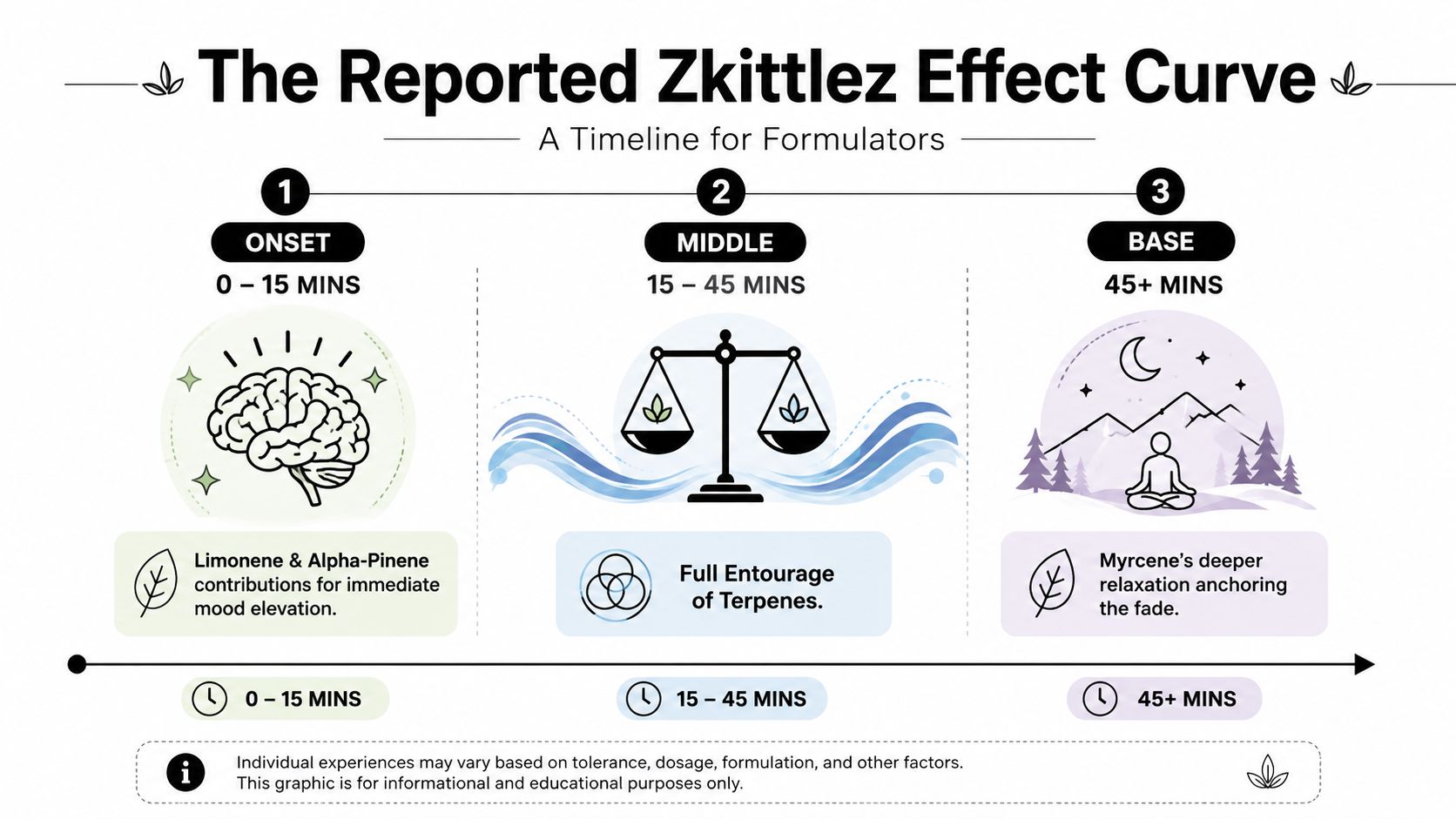
Onset
The first phase should feel bright without becoming aggressive. Limonene is the obvious top-note contributor because it supplies citrus energy and helps the profile read as immediately fruity. Alpha-pinene may add lift and aromatic definition where it appears in the source material, but it shouldn't be treated as a guaranteed dominant Zkittlez marker. The correct formulation question is whether the opening feels clear and candy-bright, not whether one isolate is pushed as high as possible.
Overbuilding limonene often creates a harsh, lemon-peel impression that overwhelms the fruit body. A better approach is to use limonene as the leading top note, then leave room for floral and peppery materials to appear quickly after the initial inhale.
Middle
The middle is where the profile stops behaving like a simple citrus blend. Myrcene and linalool help create the softer, more weighted body impression associated with many Zkittlez reports, while beta-caryophyllene contributes peppery structure and a grounded aromatic center. The Elevated Strains catalog is one example of a strain-oriented flavor reference a developer might review when comparing adjacent profiles, but it shouldn't be treated as a Zkittlez specification.
Taper
The final phase should fade into calm rather than collapse into a heavy, muddy finish. Caryophyllene and humulene can support the slower, drier, more grounded portion of the aroma, while myrcene determines how deep the body impression feels. Adjust the relative balance rather than assuming that adding more of every relaxing-associated terpene will improve fidelity.
Comparing Published Terpene Profiles for Zkittlez Batches
A formulator reviewing Zkittlez for a cart may see three different stories: a retail description led by citrus, a database profile weighted toward myrcene, and a COA reporting limonene in mg/g. Those records can all carry the same strain name without representing the same sensory result.
One published profile lists about 23% THC and assigns 30% myrcene, 20% limonene, 15% caryophyllene, 12% linalool, 7% ocimene, 6% terpinolene, 5% pinene, and 5% humulene, as reported by Seennabis. That distribution suggests a broad, weighted aroma rather than a simple citrus-forward formula.
COAs show why the numbers need context. The Finger Lakes Hydro Zkittlez COA lists 3.50 mg/g limonene, 2.10 mg/g beta-caryophyllene, 0.94 mg/g beta-myrcene, and 0.59 mg/g alpha-humulene. The Raw Garden Zkittlez test reports 5.1452% total terpenoids, including 23.877 mg/g limonene, 6.510 mg/g myrcene, and 3.930 mg/g linalool.
| Terpene | Batch A, published COA | Batch B, separate test |
|---|---|---|
| Limonene | 3.50 mg/g | 23.877 mg/g |
| Beta-caryophyllene | 2.10 mg/g | Not listed |
| Myrcene | 0.94 mg/g beta-myrcene | 6.510 mg/g |
| Linalool | Not listed | 3.930 mg/g |
| Alpha-humulene | 0.59 mg/g | Not listed |
This is not a controlled comparison. The samples and reporting contexts differ, so the table cannot define a single Zkittlez phenotype. Use it to set a working band and identify compounds worth checking, not to copy one certificate into a finished formula.
Data discipline: Source multiple certificates, identify recurring compounds, and record which batch produced the desired aroma. Don't chase a single published number.
The terpene strain profile guide provides a useful way to connect reported effects with aromatic roles. For product development, confirm that interpretation against your own COA, sensory panel, and hardware test. Humulene, ocimene, terpinolene, and pinene may shift freshness, dryness, floral complexity, or perceived weight even when the front-label name remains Zkittlez.
Top, Mid, and Base Notes Across the Zkittlez Terpene Stack
A reliable strain-inspired terpene blend starts with aroma architecture. Assigning compounds to top, mid, and base roles helps a formulator avoid the common mistake of adding every isolate at once and judging the result only by its opening smell.
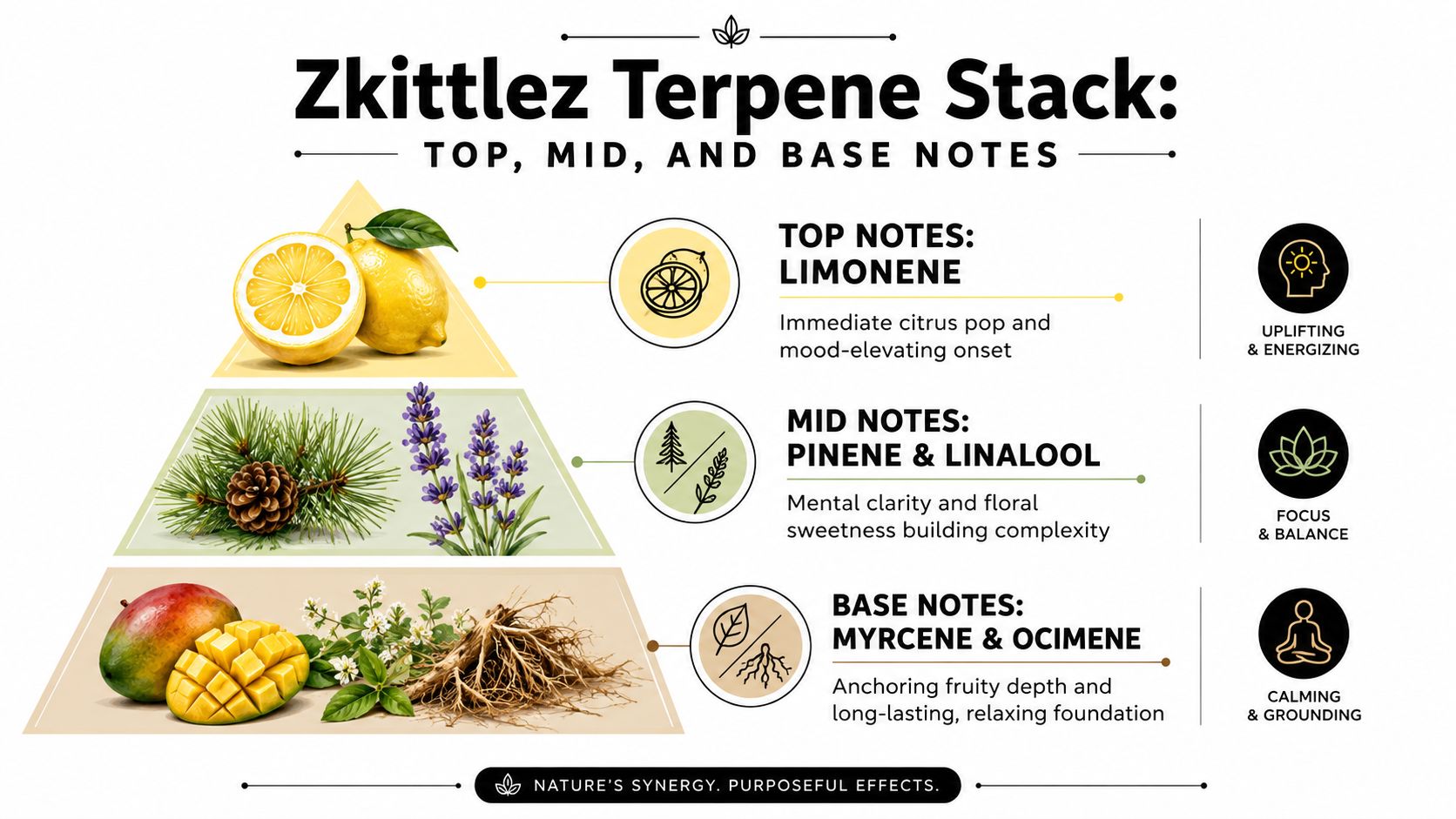
Top notes create recognition
Limonene provides the immediate citrus flash that makes the profile feel lively. It's usually the first compound a customer or sensory panel notices in a vape, but it shouldn't carry the entire identity. Alpha-pinene can sharpen the aromatic outline where it's present, while small amounts of other bright materials may help the fruit read as more dimensional.
For a cartridge, top notes can appear disproportionately strong after filling because the headspace exposes the most volatile aromatics first. Evaluate the blend after it has equilibrated, then repeat the check after hardware storage. A top note that smells perfect in a vial may become piercing after vaporization.
Mid notes keep the fruit from becoming candy syrup
Beta-caryophyllene supplies peppery, dry structure. Linalool adds a floral softness that connects citrus to the deeper body of the blend. Pinene can contribute herbal definition, but excessive pinene may pull the profile toward pine cleaner instead of fruit.
These materials do more than decorate the aroma. They control the transition from the first inhale to the broader sensory impression. A Zkittlez formulation with no mid-note structure often tastes sweet at first and empty immediately afterward. The terpene flavor chart can help organize these sensory roles before you start bench blending.
Base notes determine the finish
Myrcene gives the blend a heavier, fruit-earth foundation, while ocimene can support a softer fruity lift and help extend the impression of sweetness. Humulene adds a dry, woody layer, and caryophyllene can remain present as the profile settles. The exact balance varies across batches, which is why the Abstrax Zkittlez terpene profile is best read as a role-based reference rather than a universal COA.
Build the base first, then add the mid notes, and finish with the top notes. This order makes it easier to identify whether the problem is a missing foundation or an overbuilt opening. For vape liquids and distillate additions, keep all changes within your validated safety, compatibility, and regulatory specifications. Sensory similarity never overrides those controls.
Translating Lab Numbers into Cartridge and Distillate Targets
COA values become useful only after you define what they mean for the finished oil. A result in mg/g describes the tested material. It doesn't automatically tell you how much isolated terpene to add to a distillate, and it shouldn't be copied directly into a cartridge formula.
One Zkittlez-related cartridge report lists 30.78 mg/g total terpenes, equivalent to 3.078%, with 17.10 mg/g beta-caryophyllene and 4.87 mg/g alpha-humulene, according to the Watermelon Zkittlez cartridge report. That result demonstrates terpene density, but it doesn't establish a finished-oil inclusion rate for every cartridge platform.
Read the units before you blend
The conversion is straightforward in principle. 1 mg/g equals 0.1% by mass, because one gram contains one thousand milligrams and one percent represents ten milligrams per gram. Use the tested concentration as a reference, then calculate the mass of each isolate required to reach your validated finished-product target.
| Terpene | COA range or example reported value | Target inclusion |
|---|---|---|
| Limonene | 3.50 mg/g in one COA, 23.877 mg/g in another test | Set by your validated sensory and compliance specification |
| Beta-caryophyllene | 2.10 mg/g in one COA, 17.10 mg/g in a Watermelon Zkittlez cartridge report | Set by the desired peppery mid and grounded finish |
| Myrcene | 0.94 mg/g in one COA, 6.510 mg/g in another test | Set by the desired body depth and stability result |
| Linalool | 3.930 mg/g in one compliance test | Set by floral softness and finished-oil validation |
| Total terpenes | 30.78 mg/g in one cartridge report, 5.1452% in another test | Stay within product, hardware, and regulatory specifications |
The table intentionally leaves target inclusion as a specification rather than an invented percentage. The verified data shows that published batches vary materially, so a universal target would create false confidence.
Check the finished oil, not the archetype
High-limonene material may deliver a sharper throat sensation than the strain summary suggests. If the finished cart separates, crystallizes, leaks, or produces an unpleasant vapor profile, the blend isn't commercially ready regardless of how accurate the name sounds. Test viscosity, homogeneity, thermal behavior, and emitted flavor in the actual hardware.
Use the lab report interpretation guide to organize COA review, then confirm the final blend with a finished-product test. Label claims should reflect the actual blended composition and applicable requirements, not an assumed Zkittlez archetype.
Building a Zkittlez-Inspired Blend Step by Step
Start with a neutral distillate or other approved carrier whose own aroma won't compete with the target. Record the starting material, lot, cannabinoid profile, viscosity, and sensory condition before adding terpenes. A strong base material can hide formulation errors, while a neutral one makes the architecture easier to evaluate.
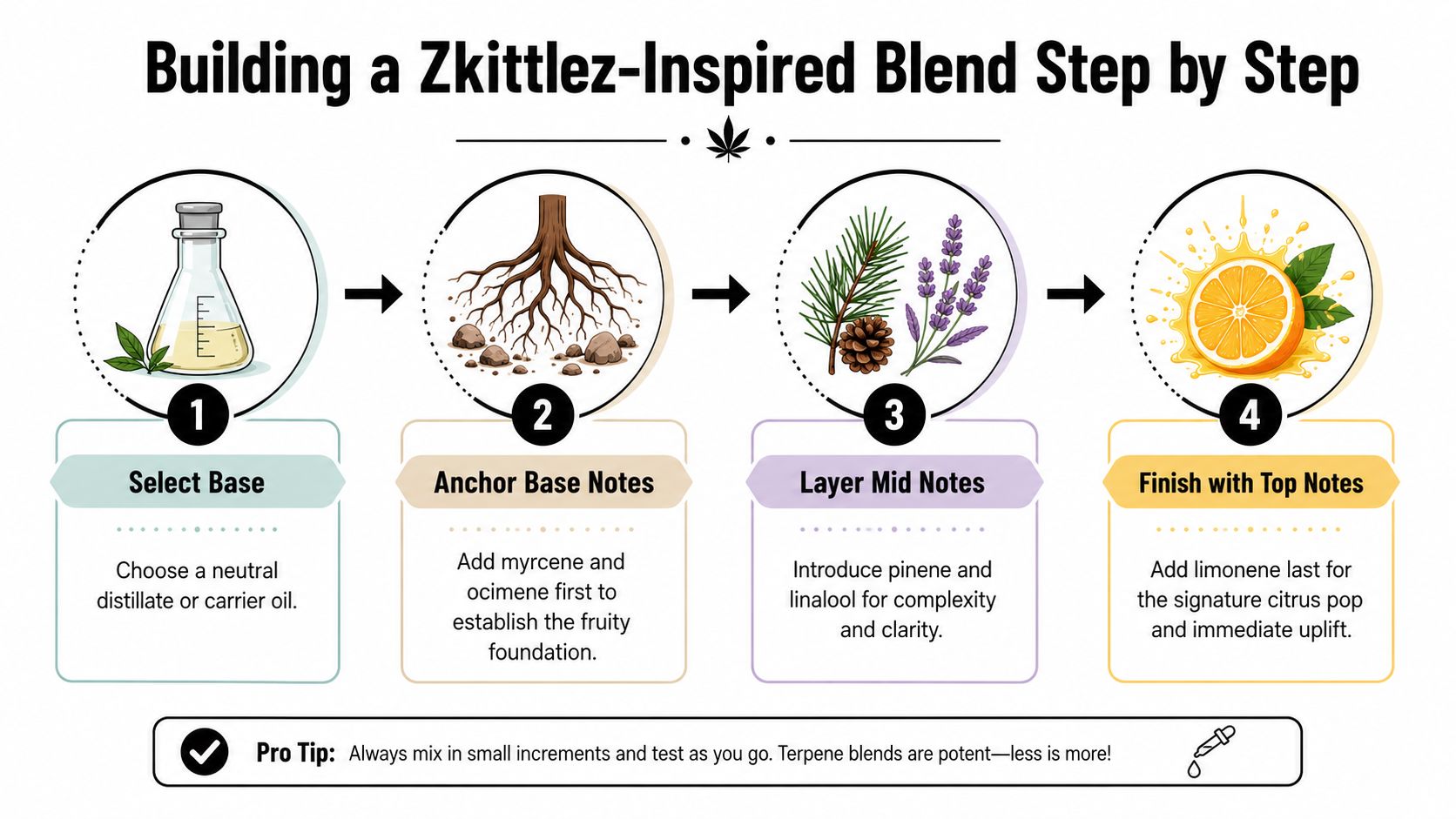
Build from the foundation upward
Select the base. Use a compatible, neutral distillate or carrier and establish the finished oil mass before calculating additions.
Anchor the fruit. Add myrcene and ocimene first. Myrcene gives the profile weight, while ocimene can keep the foundation from becoming purely earthy. Mix thoroughly and allow the material to equilibrate before judging it.
Shape the middle. Add beta-caryophyllene and linalool, then evaluate the transition from fruit to body. Pinene can provide herbal clarity when the blend feels too soft, but use sensory feedback rather than assuming it belongs at a fixed level.
Finish with brightness. Add limonene last. This protects the top note from being buried and makes it easier to correct an overly sharp citrus result.
Validate in the format customers will use
Check the aroma at room temperature first. Then run a low-intensity vapor test in the intended cartridge, because heating can exaggerate citrus, mute floral notes, or reveal a harsh edge that isn't obvious in the vial. The mixing ratios calculator can support arithmetic, but it can't replace a finished-hardware test.
If the blend smells like lemon candy without depth, reduce the bright note and revisit the myrcene, linalool, and caryophyllene relationship. If it smells muddy, don't automatically remove all base material. First check whether the mid layer is too weak to connect the foundation with the top.
Adjustment protocol: Change one variable at a time, keep a retained sample, and record both the vial aroma and the vapor result.
Stability testing should cover the actual container and cartridge, with checks across the storage conditions required by your quality system. Compare aroma, color, viscosity, separation, leakage, and vapor performance against a retained reference. A blend that matches on day one but loses its fruit top note in storage isn't a repeatable SKU.
Daytime Function Versus Couch-Lock How to Modulate the Effect
Calling Zkittlez a nighttime-only profile oversimplifies the reported experience. Consumer descriptions commonly place a clear or mildly euphoric opening before body relaxation, and one independent review describes the profile as manageable during the day while noting that red eyes and mild heaviness can remain common, as reported by Budpedia's Zkittlez review. Those observations are subjective and don't justify medical or performance claims.
For product developers, the useful distinction is architectural. A formulation with a stronger bright top and restrained heavy base tends to communicate more lift and clarity. A formulation with a deeper myrcene and linalool presence tends to communicate more softness and physical weight. Neither result is guaranteed by the terpene name alone.
| Terpene | Daytime target | Nighttime target | Effect shift |
|---|---|---|---|
| Limonene | Forward bright note within validated limits | More restrained citrus | More or less immediate aromatic lift |
| Pinene | Clear herbal support | Lower emphasis if the profile feels too sharp | More clarity versus softer depth |
| Linalool | Controlled floral bridge | More prominent calming floral layer | Lighter transition versus heavier calm |
| Myrcene | Kept below the level that muddies the finish | Increased only within validated specifications | Functional body feel versus deeper relaxation |
| Beta-caryophyllene | Balanced mid-note structure | Fuller peppery foundation | Dry complexity versus grounded finish |
Don't use an invented threshold such as a fixed myrcene percentage to predict couch-lock. The verified COA data itself shows that Zkittlez-related samples vary, and the available evidence doesn't establish a clinical dose-response rule. Minor cannabinoids such as CBG or CBN may also be considered by formulators, but the supplied evidence doesn't provide validated sub-1% targets or prove a specific interaction with this terpene stack.
The better practice is to steer the same base recipe by adjusting a small number of compounds, then evaluating the result in the finished device. Pull back excessive limonene if the vapor is sharp, reduce myrcene or linalool if the profile becomes dull, and add structure through caryophyllene or a measured pinene contribution when the blend loses definition. Product language should describe flavor and intended sensory positioning without promising alertness, sleep, anxiety relief, pain relief, or any other medical outcome.
Turning a Zkittlez Profile Into a Repeatable SKU
A bench blend becomes a commercial product only when its identity survives raw-material changes, filling, storage, and repeated use. Start by defining a sensory fingerprint that includes the opening citrus impression, the candy-fruit body, the floral or peppery bridge, and the grounded finish. Retain a reference sample and compare every production lot against it.
Control the chemistry
Source isolates and terpene fractions with documented identity and lot information. Cannabis-derived and botanical-derived materials may create different expectations around provenance, aroma, and labeling, so record the source rather than treating them as interchangeable. Verify the finished blend with the testing cadence required by your quality system, using chromatographic data to catch drift before filling.
A triangle test can help determine whether a new lot is perceptibly different from the reference. Present one reference and two coded samples, then record whether trained evaluators can distinguish the odd sample. The test is more useful when the panel evaluates both room-temperature aroma and vapor performance.
Design for the cartridge
Hardware changes the sensory result. Ceramic and wick-based systems can expose different amounts of the volatile top notes, alter residence time, and change how quickly the fruit impression fades. Run the same oil through the intended hardware, at the intended operating range, before approving the profile.
Packaging and labeling should communicate the actual blend and the intended sensory experience. Avoid relying on outdated indica or sativa shorthand as a substitute for composition. The commercial advantage of a Zkittlez-inspired SKU comes from a recognizable flavor fingerprint and consistent performance, not from repeating a loose effect category.
A useful production record should include:
- Raw-material identity: Supplier, lot, source, and COA.
- Blend specification: Each component, addition order, and allowable range.
- Process controls: Mixing conditions, equilibration time, filling conditions, and hardware.
- Release checks: Appearance, homogeneity, aroma, vapor evaluation, and finished-product testing.
- Reference comparison: Retained sample results and documented sensory deviations.
That framework turns a strain name into an auditable product specification. It also gives the brand a defensible way to explain why one batch remains candy-forward and rounded while another needs adjustment before release.
Gold Coast Terpenes supplies natural terpene blends, strain-specific profiles, and isolated compounds for cartridges, concentrates, and cannabis product formulation. Visit Gold Coast Terpenes to review formulation components and practical resources for building a more consistent Zkittlez-inspired vape or distillate profile.