
A lead formulator drops a Jamaican Dream cart brief onto the bench with one line that looks simple: build the strain character at a 1% total-terpene target against a distillate base. The first trial smells bright in the vial, then loses its pine lift after filling. The second keeps the citrus but turns thin and pepper-heavy under the device's operating profile.
That failure usually starts before the blend is mixed. Jamaican Dream needs to be treated as a defined sensory system, not as a seed-catalog name copied into a flavor sheet. The working notes below translate the available cannabinoid and terpene data into decisions for strain-inspired terpene blends, distillate back-blending, and vape cartridge development.
Why the Jamaican Dream Profile Matters in Formulation
Jamaican Dream was created by Eva Seeds after the breeder selected cannabis seeds from Jamaica during a 2007 breeding trip. Eva Seeds markets the cultivar as 90% sativa and 10% indica, tied to Jamaican landrace genetics, while independent listings describe it as a high-energy, sativa-leaning profile with commercial THC commonly reported around 18% to 20% in seed catalogs. Those figures describe the cultivar's market identity, but they don't provide a finished cartridge recipe. The bench still has to preserve the aroma hierarchy after extraction, dilution, filling, storage, and inhalation. Eva Seeds' Jamaican Dream background is useful for lineage context, not as a substitute for a batch-specific chromatogram.
Establish the operating envelope first
Start by writing the constraints into the batch record before selecting isolates:
- Terpene target: Use a defined inclusion window, such as the 1% distillate brief, and calculate every ingredient against the final batch mass.
- Hardware ceiling: Treat the device's voltage, coil behavior, and wick temperature as formulation variables. A blend that survives a vial test may not survive a hot ramp.
- Viscosity: The oil must move through the cartridge without forcing excessive heat, while remaining homogeneous during storage.
- Shelf checkpoints: Compare the initial aroma with post-fill and retained samples after storage. A Jamaican Dream formulation that loses pinene is no longer meeting the intended profile.
The early risk is pinene volatility. The planning notes for this profile place pinene's boiling point at approximately 155°C, so a naïve high-heat setup can strip the immediate pine note during a ceramic ramp. The exact coil temperature depends on hardware, oil flow, airflow, and power delivery, which is why voltage alone can't validate preservation.
Practical rule: Design the aroma blend around the lowest thermal load that delivers acceptable vapor, then validate the result in the actual cartridge rather than relying on a heated plate or vial sniff.
The profile matters commercially because it occupies a recognizable tropical-citrus shelf position while retaining a caryophyllene-led spicy foundation. That combination gives the formulator room to rebalance the blend with isolates, but it also makes the top notes easy to lose if the process prioritizes viscosity or rapid filling over volatility control. A useful strain terpene profile guide can support the screening stage, but the final release decision should come from the product's own analytical and sensory records.
The Cannabinoid Backdrop Behind the Aroma
The cannabinoid scaffold determines how much sensory work the terpene fraction must perform. Jamaican Dream is reported across independent references at approximately 15.0% to 21.0% THC, with some lab-observed reports closer to 18% to 24%. Those ranges are not interchangeable. A seed-catalog description, an independent strain listing, and a batch certificate may represent different materials, cultivation conditions, or analytical methods. Use them as context, then anchor production math to the actual extract certificate. The independent Jamaican Dream potency guide discusses the reported range and the associated formulation relevance.
The available data also includes a measured flower review reporting 16.75% to 20% THC and 0.28% to 0.66% CBD, with 1.00% total terpenes in that sample. That sample is especially useful because it connects cannabinoid and terpene observations in one reference, but it still shouldn't be treated as a universal specification for every Jamaican Dream lot. The Jamaican Dream laboratory review provides that separate benchmark.
| Matrix | THC / THCA Range | CBD Range | Minor Cannabinoids | Formulation Implication |
|---|---|---|---|---|
| Commercial flower references | 15.0% to 21.0% THC, with some reports at 18% to 24% | Reported values vary | Batch dependent | Use the lot certificate for extract calculations |
| Reviewed flower sample | 16.75% to 20% THC | 0.28% to 0.66% CBD | Not established in the supplied benchmark | The aroma is not explained by THC alone |
| Jamaican Dream CBD derivative | THC at 5% to 8% | CBD at 10% to 16% | Not specified | A distinct breeding outcome, not a substitute for the original chemotype |
The CBD-rich derivative shows why cannabinoid context must stay separate from aroma replication. Eva Seeds reports that Jamaican Dream CBD crosses Jamaican Dream with Only CBD and produces a 1:2 THC-to-CBD ratio, with 5% to 8% THC and 10% to 16% CBD. Its reported yields are approximately 450 to 550 grams per square meter indoors and 700 grams to 1 kilogram per plant outdoors, but those cultivation figures don't define the terpene load of a cartridge. Eva Seeds' Jamaican Dream CBD reference is the appropriate source for that derivative.
For product work, distinguish the cannabinoid target from the aromatic target. A high-THC distillate may provide a clean sensory blank, while a flower-derived or live-resin material brings native compounds that can shift the blend's final balance. Keep the terpenes and cannabinoids formulation guide nearby when documenting how the extract matrix affects the finished profile. If the team is comparing strain-inspired directions, Elevated Strains is one example of a separate flavor reference, not a Jamaican Dream specification.
Mapping the Lab-Verified Terpene Hierarchy
Two types of terpene evidence are useful here. One source reports individual concentrations in milligrams per gram, including beta-caryophyllene at 5.1 mg/g, beta-myrcene at 6.8 mg/g, alpha-pinene at 5.0 mg/g, and alpha-humulene at 1.1 mg/g. A peer-reviewed cannabis chemotype dataset identifies Jamaican Dream as caryophyllene-dominant, with caryophyllene at 28.35% of total terpenes and terpenoids and alpha-pinene at 22.13%. These panels shouldn't be averaged into a false universal formula. They show which notes recur and where cultivar expression can move. The terpene profile reference provides both the individual compound summary and the chemotype context.
Read consensus as hierarchy, not as a certificate
The reliable conclusion is qualitative first: caryophyllene leads, pinene supplies a prominent lift, myrcene adds body, and humulene, limonene, linalool, and related compounds act as supporting notes. The caryophyllene percentage is reported at 28.35% in the chemotype dataset, while the broader plan for comparison places the caryophyllene-led portion around 28% to 35% of total terpene mass. Treat that as a reference hierarchy, not a release specification for a new batch.
| Terpene | Lab Panel A (% of total) | Lab Panel B (% of total) | Consensus Range | Role in Blend |
|---|---|---|---|---|
| Beta-caryophyllene | 28.35% | Not reported in the same format | Caryophyllene-led | Spicy, woody anchor |
| Alpha-pinene | 22.13% | 5.0 mg/g | Prominent, variable | Pine lift and freshness |
| Beta-myrcene | Not reported as a percentage | 6.8 mg/g | Supporting body | Earthy, soft fruit depth |
| Alpha-humulene | Not reported as a percentage | 1.1 mg/g | Supporting accent | Dry wood and hop-like depth |
| Limonene | Profiled as present | Not quantified in the supplied panel | Supporting accent | Citrus brightness |
| Linalool | Profiled as present | Not quantified in the supplied panel | Supporting accent | Floral smoothing |
Pinene deserves special handling because its position changes more visibly between the available presentations. That variation justifies an isolate callout in a manufacturing blend. Botanical ratios can reproduce the general family, but they may not deliver enough alpha-pinene or beta-pinene to survive the device profile, especially after the blend is exposed to heat.
A practical blend sheet should classify compounds by function. Notes below roughly 3% of total terpene mass are better treated as accents than as load-bearing architecture. The lab report interpretation resource is useful when deciding whether a low-level detection belongs in the recipe, the sensory description, or only the analytical record.
Decoding the Sensory Notes From Top to Base
A Jamaican Dream-inspired blend should be built as a volatility ladder. The first impression comes from fast-moving monoterpenes, the middle depends on compounds that provide body, and the finish needs heavier sesquiterpenes that remain after the bright opening has passed. This structure matters more in a cartridge than in a jar because the oil experiences mixing, filling, storage, wick delivery, and repeated heating.
Top notes need protection
Alpha-pinene and limonene form the immediate pine-citrus lift. The planning range places both below 160°C in boiling-point context, which makes them useful for opening aroma but vulnerable during aggressive processing. Pinene loss accelerates sharply above 180°C wick temperatures, so a device can produce a flat, peppery result even when the unheated oil smells correct.
| Terpene | Boiling Point (°C) | Aroma Tier |
|---|---|---|
| Alpha-pinene | Below 160 | Top |
| Limonene | Below 160 | Top |
| Beta-myrcene | Mid-volatility range | Mid |
| Ocimene | Mid-volatility range | Mid |
| Beta-caryophyllene | Above 160 | Base |
| Humulene | Above 160 | Base |
The table gives the formulator a decision framework, but it doesn't replace thermal mapping. Published boiling points describe pure compounds under defined conditions. A cartridge coil doesn't behave like a simple boiling flask, and wick temperature can exceed the measured oil temperature at the heating interface.
Mid and base notes carry the identity
Myrcene gives the blend its softer earthy-fruity body. Ocimene can provide a lighter green-fruit lift, although it shouldn't be allowed to dominate a caryophyllene-led Jamaican Dream direction. Beta-caryophyllene supplies pepper, warm wood, and persistence, while humulene reinforces the dry, woody finish. Independent references also list beta-pinene, terpinolene, linalool, and nerolidol in the broader profile, so a complete recreation may need small supporting accents rather than a four-isolate approximation. The Jamaican Dream compound palette is a useful starting reference for those secondary notes.
For a first formulation pass, use 1% total terpenes in distillate as the stated brief. A practical screening blend can assign 40% of the terpene fraction to beta-caryophyllene, 25% to pinene, 20% to myrcene, and 15% to limonene. At a 1% total inclusion, that corresponds to 0.40% beta-caryophyllene, 0.25% pinene, 0.20% myrcene, and 0.15% limonene in the finished oil. These values are a bench starting point, not a claim about the native flower ratio.
Live-resin carts need a separate screen because the matrix already carries native aroma. Use a 0.8% to 1.2% total-terpene window for initial trials, then adjust from the measured native terpene content and sensory result. Don't force a distillate recipe into live resin. The former needs a clean rebuild, while the latter needs controlled correction.
Building a Jamaican Dream-Inspired Blend Step by Step
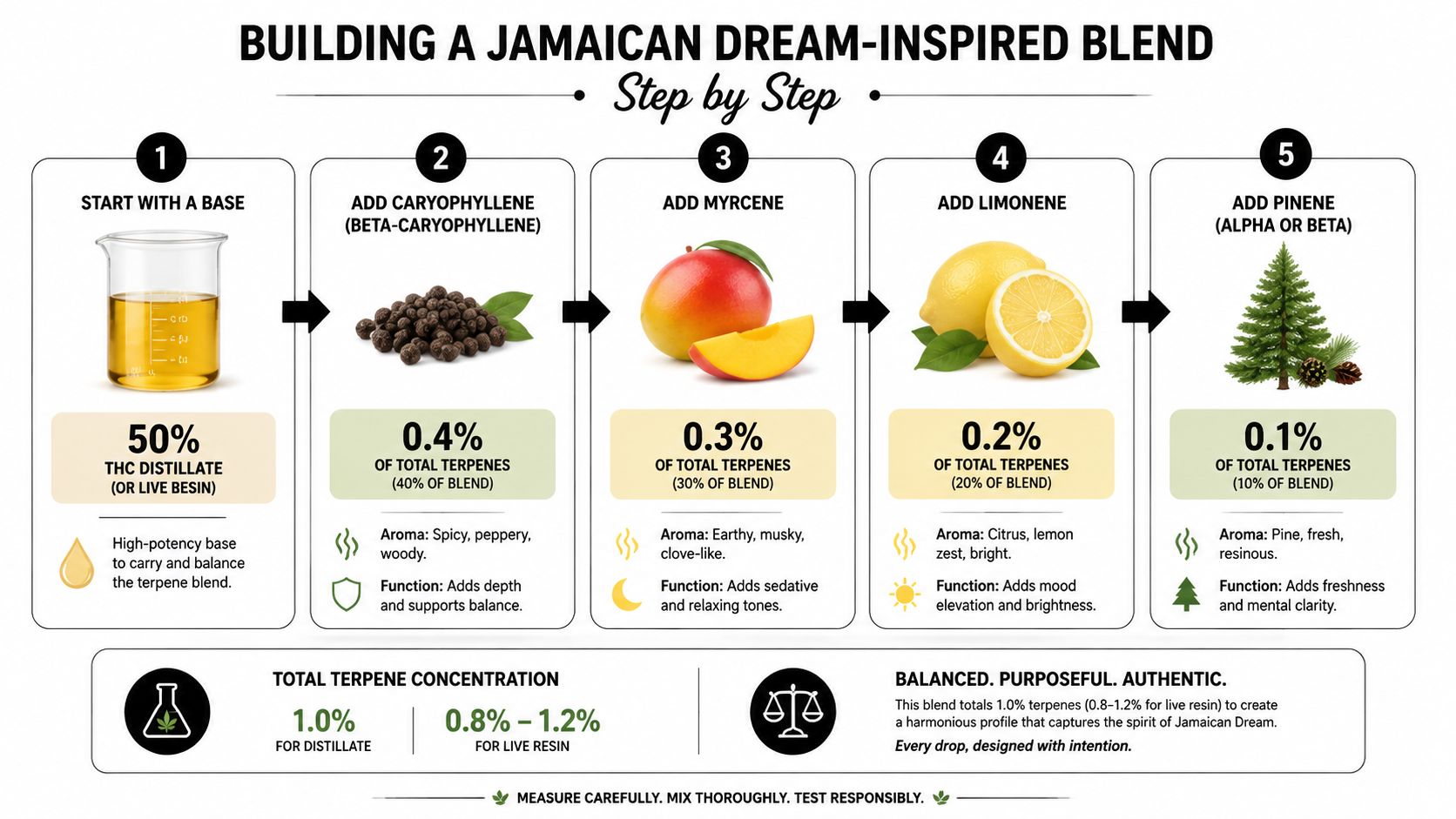
The recipe should begin with the final oil target, not with a vial of isolated compounds. For a distillate brief, set total added terpenes at 1% of the finished formulation. For live resin carts, screen 0.8% to 1.2%, because native terpenes and resin composition can change the amount of correction required.
Set the formula by role
Use this starting distribution for a strain-inspired terpene blend for distillate:
- Anchor with beta-caryophyllene at 40% of the terpene fraction. At a 1% total inclusion rate, this contributes 0.40% of the finished oil. It establishes the peppery, woody base before the volatile notes are added.
- Add pinene at 25%. At the same total inclusion, this contributes 0.25%. Use an alpha-pinene or beta-pinene isolate according to the target chromatogram, rather than assuming a botanical blend contains the needed isomer balance.
- Build body with myrcene at 20%. This contributes 0.20% of the finished oil and prevents the profile from reading as sharp citrus over a bare distillate background.
- Finish with limonene at 15%. This contributes 0.15% and supplies the citrus brightness associated with the brief.
The visual asset supplied for this workflow presents a different illustrative allocation, 40% beta-caryophyllene, 30% myrcene, 20% limonene, and 10% pinene. Treat that as a separate sensory variant rather than combining it with the working recipe above. The two versions answer different questions. The first preserves a more prominent pinene lift, while the second makes the finished blend rounder and less top-note dependent.
Choose the matrix deliberately
For distillate back-blending, a 1:10 starting dilute ratio with a food-grade carrier such as C12-C14 triglycerides can be used as a solubility screen. Confirm the carrier's regulatory suitability for the intended inhalation product before use, and check for clouding, separation, and viscosity drift. A carrier can improve handling while muting aroma, so a clear oil isn't enough to approve the formula.
Botanical terpenes can supply a broad sensory direction, but they may not provide the caryophyllene precision required for this profile. If the botanical blend loses perceived warmth, increase pinene by 5% relative to the terpene fraction, then reassess the full balance rather than adding heat or more total terpene. Cannabis-derived terpenes can better support strain replication, but the decision should be based on the required chemical match and batch economics, not on the label alone.
Mix slowly at ambient temperature whenever possible. If the distillate needs warming for incorporation, keep the blend around 35°C to 40°C during addition and never above 40°C for the low-shear mixing step described here. Add the volatile fraction late, use gentle agitation, and fill promptly after homogeneity is confirmed.
Hardware, Diluent, and Heat Decisions for Carts
Hardware can erase a good formula. Jamaican Dream's caryophyllene-heavy foundation needs enough thermal energy to vaporize cleanly, while its pinene and limonene top notes need protection from excessive heat. Ceramic systems are generally the more defensible starting point for this brief because they can support a controlled, even heating profile. Cotton wick systems deserve stricter testing because localized overheating can char the wick and accelerate oxidation of volatile compounds above 200°C, as specified in the formulation brief.
Match hardware to the aroma ladder
A ceramic cartridge isn't automatically safe. Test the actual assembly with the final oil, monitor draw behavior, and compare the first pull with later pulls. High-power devices above 4.0V can scorch pinene and limonene quickly, collapsing the top-note structure. A working screening range of 3.3V to 3.8V is more appropriate for stable vaporization across the sensory range, subject to hardware validation.
Diluent selection creates a second trade-off. MCT oil can soften the spicy edge of caryophyllene, while propylene glycol or polyethylene glycol 400 can transmit a sharper terpene impression but change viscosity and handling. Don't choose a diluent only because it makes the oil flow. Evaluate flavor transmission, compatibility, regulatory requirements, aerosol behavior, and long-term separation together. The cart formulation guide can be used alongside the cartridge manufacturer's specifications.
A bench SOP should include these controls:
- Storage: Keep terpene stocks protected from light, oxygen, and unnecessary temperature cycling.
- Mixing order: Bring the base to the minimum temperature needed for incorporation, add the terpene fraction late, and avoid high-shear mixing.
- Temperature ceiling: Keep the working blend below the defined process limit, then record actual temperature rather than relying on a nominal heater setting.
- Hardware screen: Compare ceramic and wick assemblies at the same oil composition, with identical draw and power conditions.
- Analytical release: Confirm the final terpene pattern against the target chromatogram and record any meaningful loss in pinene or limonene.
Cannabis-derived inputs may be preferable when the product brief requires closer strain replication. Botanical inputs can still work when the target is a sensory family, provided the formulator pins the critical compounds with isolates and validates the result in the finished hardware. If a team needs THC-free, PG-free, PEG-free, and MCT-free terpene components for screening, Gold Coast Terpenes supplies natural blends, strain-specific profiles, isolated compounds, and formulation resources for cartridges and concentrates. Use the supplier's batch documentation and your own incoming-material testing before approval.
Bench Checklist for Stable, Repeatable Batches
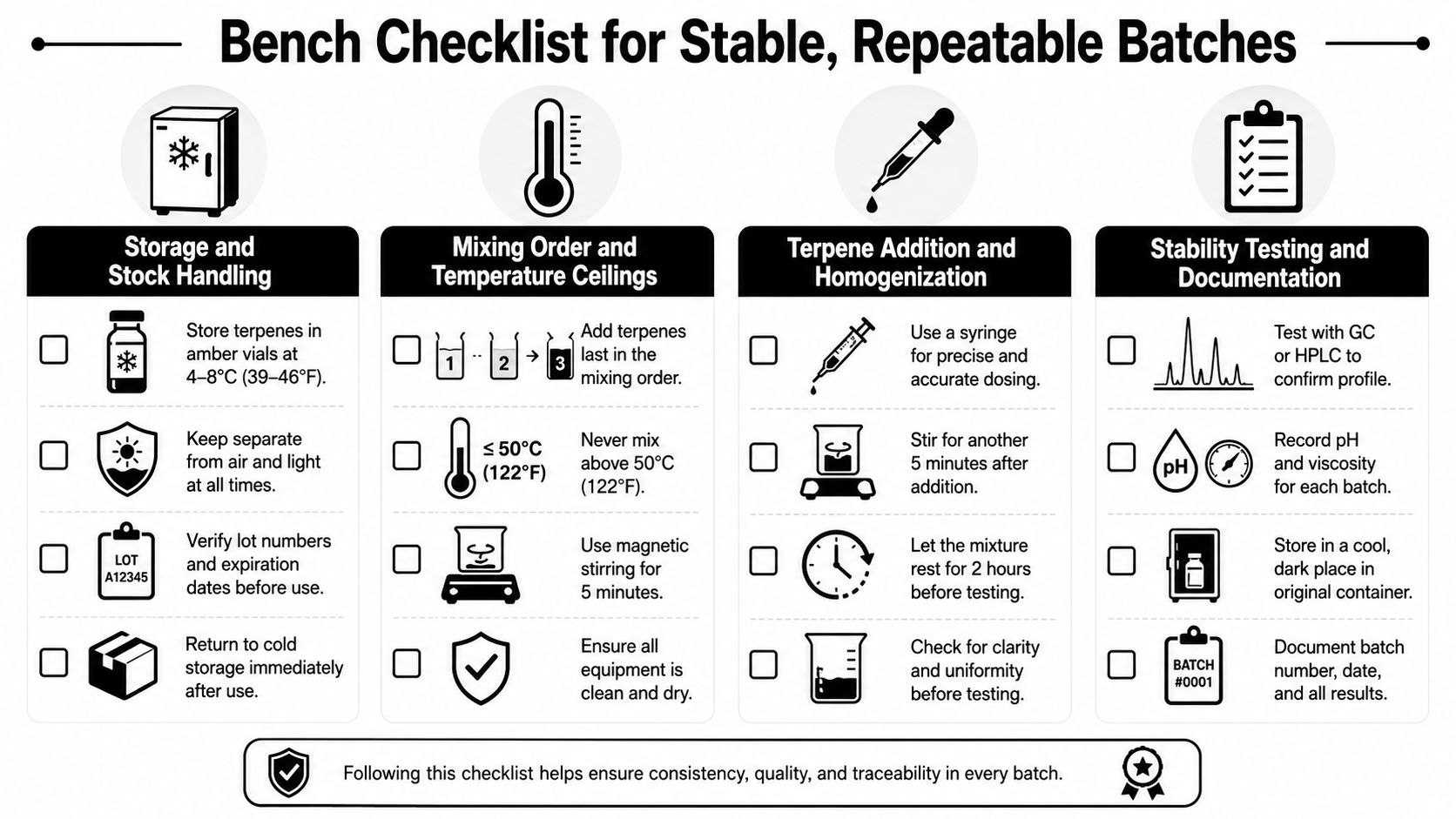
A repeatable Jamaican Dream formulation depends on controls that survive handoff from the bench to production. Paste the following structure into the batch record and adapt it to the site's validated process.
Storage and stock handling
- Protect the stock: Store isolates in amber glass with PTFE-lined caps below 10°C.
- Reduce oxygen exposure: Use a nitrogen headspace after opening and keep bottles closed between additions.
- Track the opening event: Retest opened stock within a 30-day window after first puncture.
- Verify identity: Record lot number, expiration date, supplier documentation, and receiving inspection.
Mixing order and temperature ceilings
Add the terpene fraction to distillate at 35°C to 40°C, never above 60°C. Add terpenes last, mix gently, and avoid prolonged exposure to heat. This cold-mix approach protects the volatile top notes identified in the profile work.
Terpene addition and homogenization
Use a calibrated syringe or gravimetric method for dosing. Stir gently for 5 minutes, allow the mixture to rest for 2 hours, then inspect for clouding, separation, or visible particulates before filling.
Hardware loading and verification
Use a hot-fill plate ceiling of 220°C to 240°C only when the equipment and oil path have been validated for that condition. Complete purge cycles, allow 24 hours of post-fill equilibration, then perform leak testing.
The release record should include:
- GC-FID confirmation: Compare the finished terpene pattern with the target chromatogram.
- Viscosity: Record the result at the defined test temperature.
- Color stability: Check retained samples at week one and week four.
- Deviation control: Log batch number, suspected cause, affected units, corrective action, and disposition for every out-of-spec result.
The useful mental model is simple: caryophyllene carries the identity, myrcene supplies body, pinene and limonene create the opening, and hardware determines whether that opening survives. Once this profile is locked, apply the same hierarchy method to the next strain, but rebuild the volatility and matrix assumptions from its own data.
Gold Coast Terpenes supplies strain-specific terpene blends, isolated compounds such as limonene, myrcene, and beta-caryophyllene, and practical formulation tools for cartridges and concentrates. Review the available components and formulation resources at Gold Coast Terpenes, then request the documentation needed to screen a Jamaican Dream-inspired blend against your own target chromatogram.