
You've got a profile that smells excellent on a blotter strip. It's floral, sweet, and almost candied. Then the same blend goes into a cartridge at the planned level, and the draw comes across as harsh, soapy, or overly perfumed. That disconnect is where most linalool formulation problems begin.
The phrase linalool terpene taste sounds simple, but linalool doesn't behave like a single-note flavoring. Its perception changes with concentration, carrier matrix, stereochemistry, competing terpenes, storage, and vaporization conditions. For formulators working on a strain-inspired terpene blend, those variables matter more than the familiar “lavender-like” shorthand.
Why Linalool's Taste Is Harder to Pin Down Than Its Aroma
A blotter strip gives you an orthonasal read. You're evaluating volatile material moving through the air toward the nose. A cartridge gives you a retronasal and oral experience, where the same compound is released from a heated oil matrix and encountered alongside distillate character, hardware effects, and other volatile compounds.
That's why a linalool-heavy blend can smell soft and floral before filling, yet taste soapy or cosmetic after vaporization. The result isn't necessarily a bad raw material. It often means the profile was judged in the wrong environment.
Linalool's sensory descriptors are broad. Sensory research characterizes it as floral, citrus-like, sweet, soapy, lemon-like, woody, and spicy, while a structure-odor study measured odor thresholds from 0.6 to 79 in its test set, with a median of 4.9 for the tabled compounds in the published sensory research. That range helps explain why a small adjustment can change the finished impression materially.
The carrier changes the signal
Distillate, live resin, and other extract bases don't dilute linalool. They change how it is released and what competes with it. A lipid-rich distillate can soften some aromatic edges during storage, while a thin, highly refined base may leave a floral compound more exposed during the pull. Residual volatile material in a less-refined extract can mask or redirect the note.
Hardware adds another variable. Coil temperature, wick or ceramic behavior, airflow, and contact with cartridge components can alter which compounds reach the palate first. The same nominal concentration can therefore appear muted in one device and dominant in another.
Bench rule: If the blotter and cartridge disagree, trust the warm-cart evaluation for the final flavor decision.
A useful reference is this guide to sensing terpene aromas and flavors, particularly when your team needs a shared vocabulary. The practical point is straightforward. Linalool may smell like lavender on paper, but its taste profile for vape cartridges must be judged in the finished oil and delivery system.
The Sensory Profile Decoded
Linalool is easiest to formulate when you stop treating “floral” as the entire answer. PubChem describes its taste at 30 ppm as “floral, woody, sweet,” with a green, spicy tropical nuance in its compound entry. That descriptor stack gives a better working model than the usual lavender label.
Floral and sweet
The floral character usually leads the first impression. Depending on the source and its accompanying compounds, it can suggest lavender, petitgrain, soft blossoms, candy, or ripe fruit. The sweet side can feel rounded and almost jam-like, but it isn't the same as adding a dedicated fruity ester or a bright citrus terpene.
For a strain-inspired terpene blend, floral and sweet linalool works best as a bridge. It can soften a sharp top note and make a fruit accord feel more continuous from the first inhale into the finish. Too much, however, can turn a clean fruit profile into something perfumed.
The linalool essential oil formulation guide is useful background for understanding why botanical source and surrounding aroma compounds matter. Linalool's identity is never isolated from the chemical neighborhood that carries it.
Citrus and woody impressions
The citrus impression provides lift, but it's gentler than the direct brightness of limonene. Use linalool when a blend needs a rounded citrus-floral middle rather than a sharper lemon opening. Its woody side gives the profile persistence and can help connect bright top notes with heavier base notes.
A food-flavor reference places linalool among heart notes, describing it as floral-woody and sweet-herbal, which supports its role between top and base architecture in its note-classification discussion. In a cartridge, that often means the citrus arrives first, linalool fills the middle, and earthier compounds remain through the finish.
Spicy and matrix-sensitive
The spicy character is usually less obvious in isolation than in a blend. Pairings with warmer, peppery materials can make linalool seem more herbal or clove-adjacent. Carrier polarity, pH in applicable food systems, and storage age can also shift the balance between clean floral, woody, and stale or oxidized impressions.
Formulators should document descriptors at three points: raw blend, rested oil, and warm-cart draw. That sequence separates the intended linalool character from changes introduced by the matrix or device.
How Dose and Concentration Reshape the Flavor
PubChem lists linalool's taste at 30 ppm as floral, woody, and sweet in its sensory description, while formulation guidance places it within a 0.2% to 1.5% recommended range in this terpene flavor chart. Treat both figures as starting points, not a universal recipe. The final base, delivery temperature, and surrounding terpenes can move the practical threshold substantially.
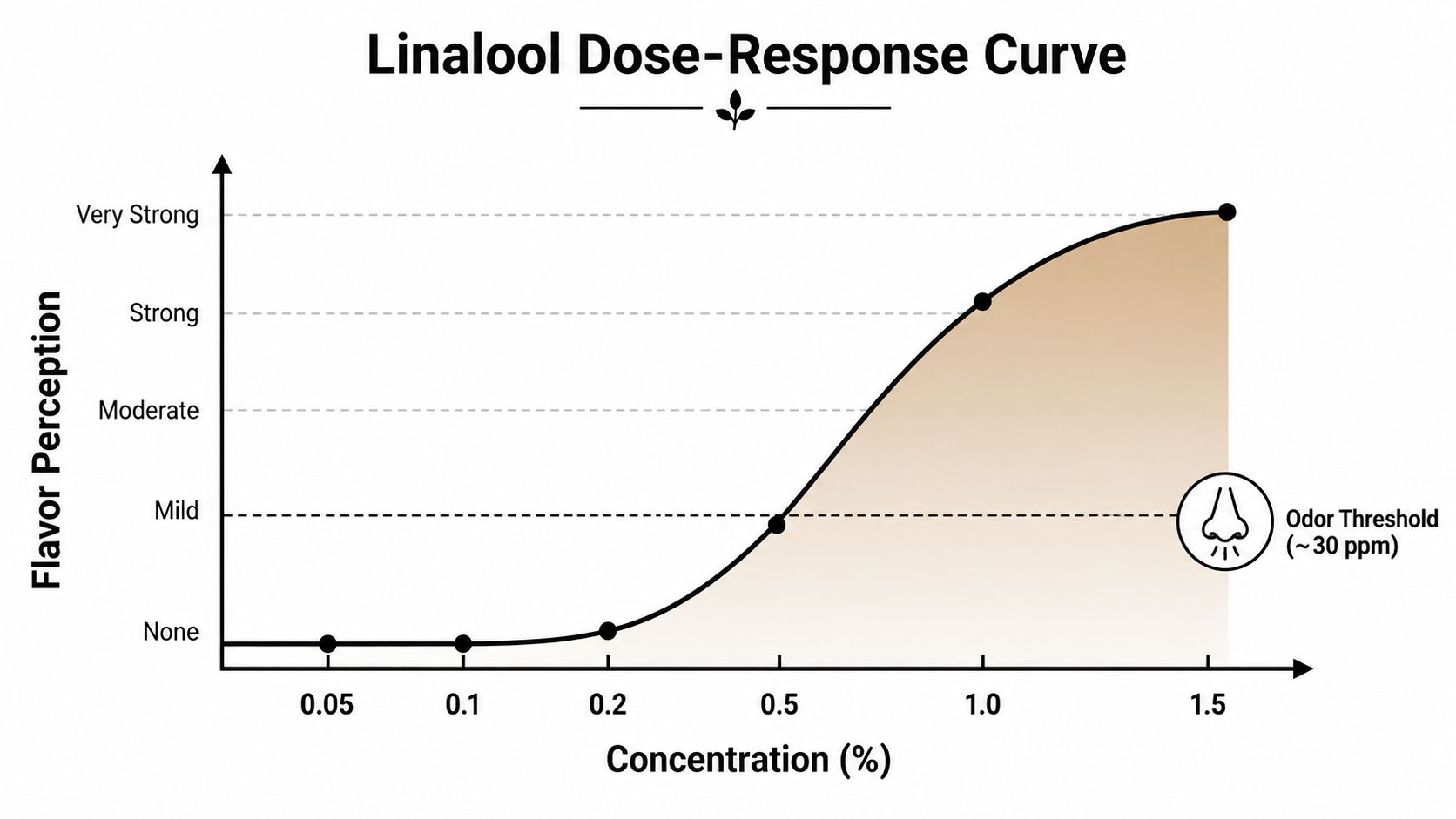
At a sub-threshold addition, roughly 0.05% to 0.1% in a finished blend, linalool may soften the profile without reading as floral. That range can smooth a fruit-forward formula when a recognizable lavender note would distract from the target. Confirm it in the finished matrix. A cartridge can expose a trace that remains quiet in a vial, while a dense terpene background can hide it.
Between roughly 0.3% and 0.6%, linalool is more likely to present as a clean floral middle note. It can lift fruit and round sharp citrus, although the result depends on the base and on the linalool enantiomer. Different enantiomer balances can shift perception toward brighter, sweeter, or more herbal impressions at the same nominal concentration. Above 1%, perfume, soap, or cosmetic sweetness may emerge, particularly in refined distillate with little native terpene mass.
A controlled bench sequence
Use staged additions rather than one large jump.
- Start with a control. Reserve an unflavored portion of the finished base for direct comparison.
- Add in 0.25% increments. Record concentration by weight and hold every other variable constant.
- Use a panel of three. Three trained internal evaluators can show whether a change is consistent or reflects one person's preference.
- Evaluate two delivery modes. Run a vapor-bag assessment or equivalent controlled vapor test, then confirm with a cartridge pull.
- Document the failure point. Record when fruit flattens, soapiness appears, or the finish turns harsh.
A terpene mixing calculator and ratio guide handles blend arithmetic, not sensory validation. The vial confirms the ratio. Warm-cart testing confirms whether the flavor survives delivery.
How Linalool Behaves Across Different Formulations
Nominal dose doesn't tell you how linalool will taste. The surrounding extract determines how much attention the terpene receives and how long it remains perceptible.
| Matrix | Typical linalool impression | Main formulation issue |
|---|---|---|
| Distillate cartridge | Cleaner floral lift, sometimes sharper perfume | Low native competition can expose excess linalool |
| Live resin cartridge | More integrated or muted floral contribution | Native terpenes can mask the added note |
| High-terpene extract | Strong opening followed by faster fade | Volatile competition and vaporization order can shorten persistence |
In a refined distillate cart, linalool often has room to define the middle of the profile. That can be helpful when you're building a floral-fruit target from a neutral base. It can also make overdosing obvious. A level that seems restrained in a vial may become soapy once the oil is heated and inhaled.
Live resin changes the equation. Native myrcene, pinene, caryophyllene, and other volatiles create a dense background. Linalool may still add lift, but its identity can become less obvious. This muted contribution isn't necessarily a weakness. It may be exactly what you want when the goal is to support the extract's existing character rather than replace it.
High-terpene concentrates create a different problem. When many volatile compounds compete for attention, linalool can appear strongly on the first draw and fade quickly afterward. Viscosity, airflow, and the device's heating behavior affect which notes vaporize first. A formula that looks balanced by liquid measurement may not remain balanced during repeated pulls.
Practical comparison: Distillate reveals linalool. Live resin integrates it. A high-terpene concentrate may expose it briefly, then let louder notes take over.
For product development, compare profiles engineered for refined distillate with profiles intended for fuller-spectrum applications. The high-linalool strain profile guide can help teams identify the type of floral architecture they're trying to reproduce, but the finished matrix still determines the result.
Pairing Linalool With Other Terpenes
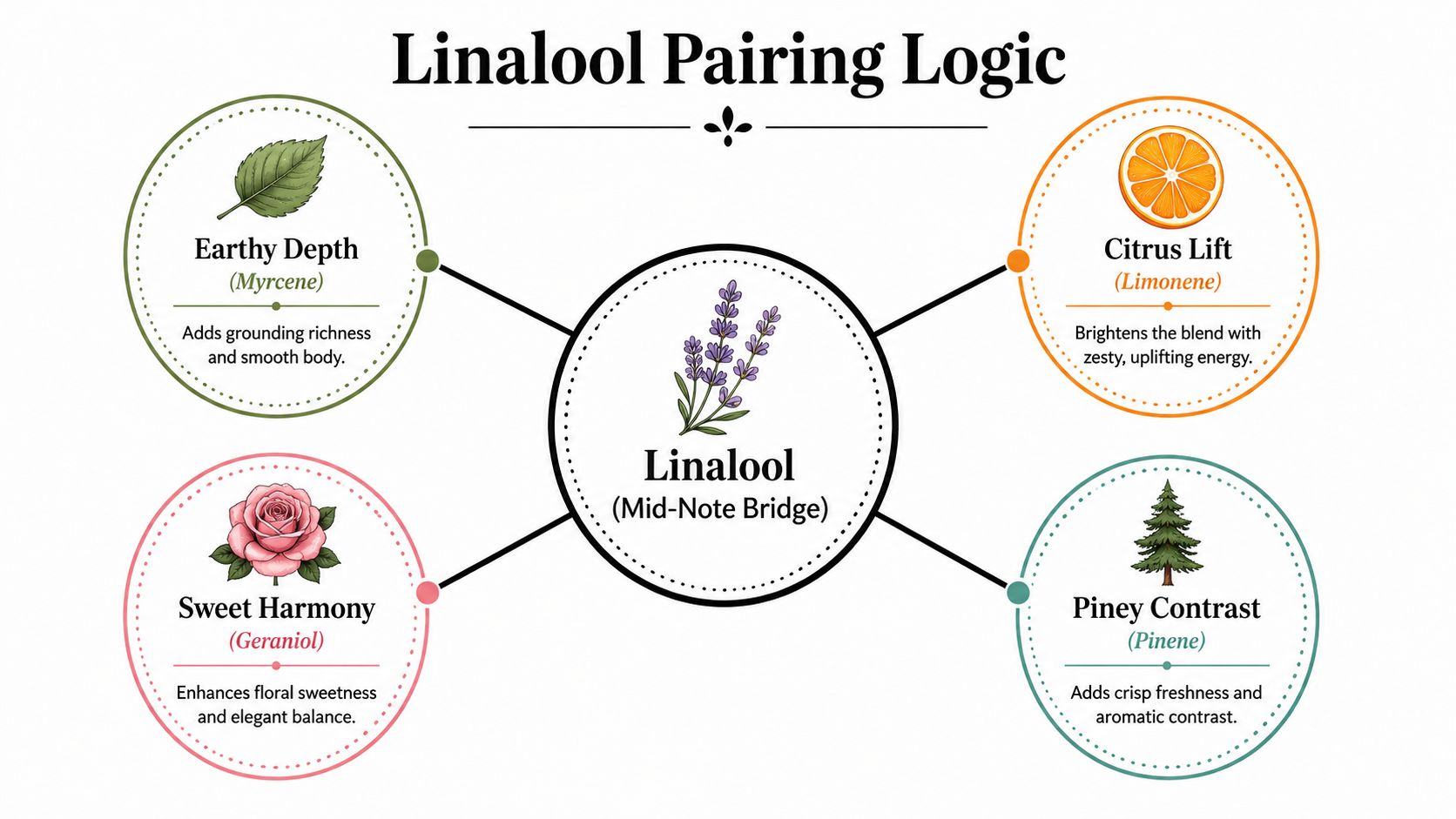
Linalool works most reliably as a mid-note bridge. It connects bright top notes with earthy, woody, or spicy base notes. Making it the loudest ingredient usually creates a floral profile that feels disconnected from the intended strain translation.
Build the blend around the target
Myrcene adds earthy depth. This pairing produces a fuller body and a darker finish. It's useful for a Granddaddy Purple-style direction, where linalool can soften the earthy weight without making the profile purely floral.
Limonene supplies citrus lift. Limonene takes the opening higher and brighter, while linalool fills the transition into the body. Keep linalool subordinate if the target depends on a crisp citrus first impression. Too much floral weight can blur the distinction between citrus and sweet perfume.
Beta-caryophyllene provides spicy grounding. This combination gives linalool a warmer, more structured finish. It can suit a Do-Si-Dos-style direction, where floral sweetness needs support from spice and wood rather than additional brightness.
Ocimene creates sweet herbal lift. Ocimene can make linalool feel more open and green. Use the pair when the target needs airy sweetness instead of dense lavender.
As a starting design rule, linalool should rarely lead above 30% of the total terpene load in a balanced blend. That's a formulation heuristic, not a sensory law, and the final ratio must be confirmed in the chosen matrix. A Lavender-style profile may tolerate more floral emphasis than a citrus-led profile, while a Do-Si-Dos direction generally benefits from stronger grounding.
Ratio principle: Decide which terpene owns the opening, which one owns the finish, and let linalool connect them.
Pre-built strain-inspired blends can speed early trials, while isolated compounds are better when you need to move the floral bridge without changing the rest of the accord.
The Soothing Association and What Stability Data Shows
Linalool's reputation for calm derives primarily from its lavender association. Lavender cues can create expectations of softness or relaxation, especially among consumers familiar with personal care, fragrance, or household products. That expectation is a sensory and cultural association. It does not support marketing a cartridge as a sedative or therapeutic product.
Keep the claim boundary clear. Describe the profile as floral, soft, herbal, or lavender-like, and avoid promising a medical outcome from those descriptors.
For formulators, stability deserves more attention than the calming narrative. Linalool can oxidize, producing linalool oxides and hydroperoxides with different sensory and safety considerations. A 2025 study found that terpene hydroperoxides derived from linalool induced lipid peroxidation in a biomimetic system as reported in the indexed study. The result does not establish what will happen in a finished cartridge, yet it supports tighter control of storage, packaging, and aged-product assessment.
What degradation can look like
Fresh linalool may read as floral, sweet, citrus-like, woody, or herbal. With age, that clean profile can shift toward bitterness, stale sharpness, oxidized herbal character, or rancid notes. Heating may make the change easier to detect than a room-temperature vial evaluation.
Use handling practices that reduce unnecessary exposure:
- Minimize oxygen exposure. Control headspace and limit repeated opening.
- Protect from light and heat. Store finished oils under conditions that slow oxidation.
- Track lot and age. Keep records that connect sensory changes with the raw-material lot.
- Test aged carts. Compare a stored unit with a fresh control using identical hardware and draw conditions.
- Investigate off-aromas. Do not mask an oxidized profile by adding fresh linalool. Identify the source first.
Evaluate the formula, package, and handling process together when aroma changes during storage. A stable floral profile is a quality-control result, not a marketing adjective. The practical target is consistency across fresh material, stored oil, and heated vapor, since the matrix and delivery conditions can expose degradation at different points.
Common Misconceptions Formulators Should Drop
The first misconception is that linalool equals lavender, and lavender equals calm. That shortcut is convenient for marketing, but it collapses several different sensory variables into one phrase. Linalool can be floral and lavender-like, yet it can also be citrus-like, sweet, woody, soapy, lemon-like, or spicy in sensory research.
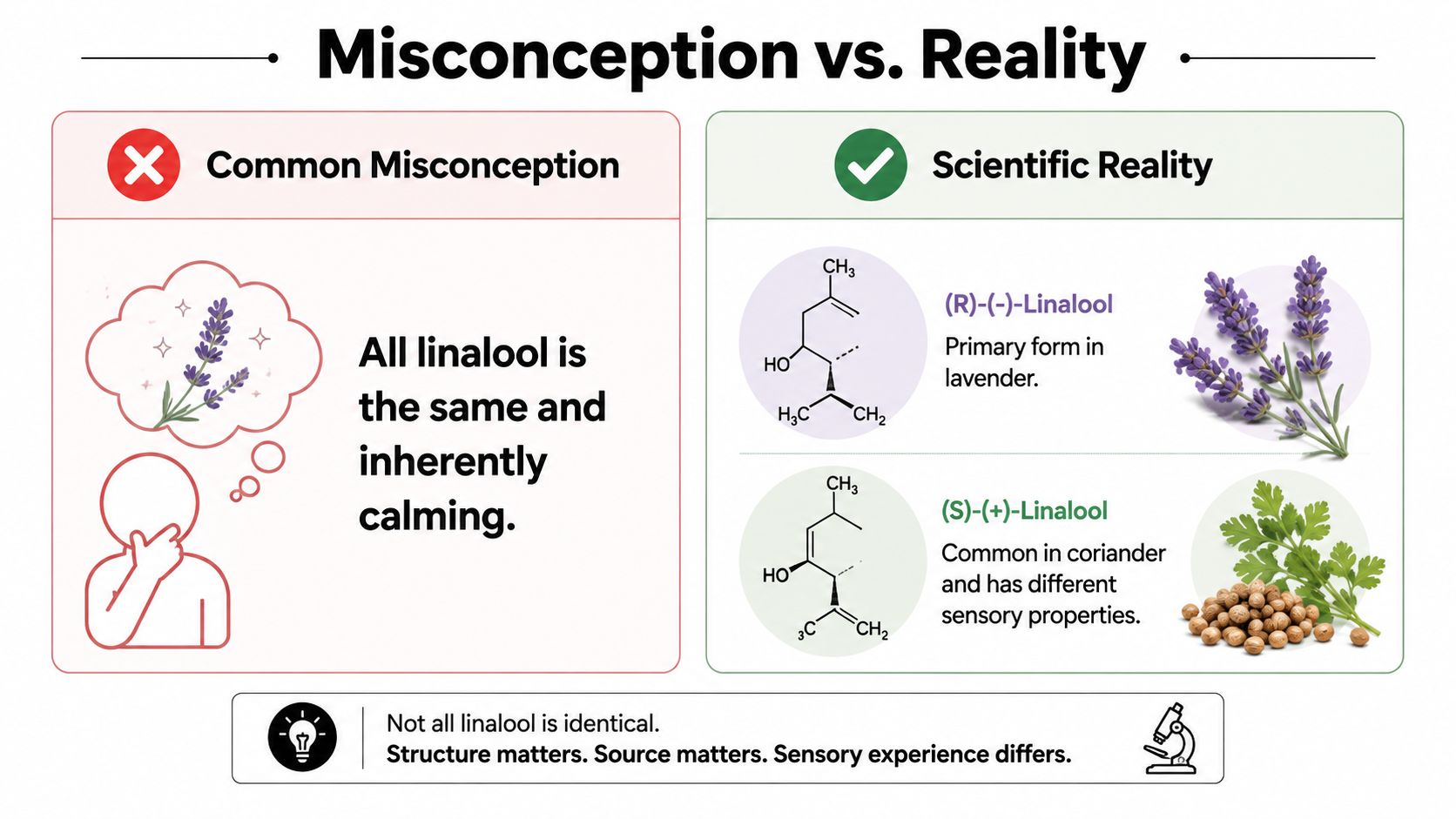
The second misconception is that all linalool behaves the same. Linalool has two enantiomeric forms with distinct odor profiles and thresholds. The (S)-(+)-form is described as sweet, floral, and petitgrain-like, with an odor threshold of 7.4 ppb, while the (R)-(-)-form is described as woody and lavender-like, with a threshold of 0.8 ppb in the cited compound overview. Source material and purification therefore matter.
Three assumptions that cause failed revisions
- “More floral will create more soothing.” Increasing a floral note can instead flatten citrus, suppress fruit definition, or create cosmetic sweetness. Sensory intensity isn't a reliable proxy for a desired consumer response.
- “The same level works in every base.” Independent sensory literature reports a threshold of 0.001 mg/L in water and 3.85 mg/L in alkane solution, demonstrating how strongly the carrier can change perception in the matrix-threshold study.
- “Natural means automatically safe and stable.” Natural linalool can still oxidize. Its byproducts may shift the aroma toward bitter, herbal, stale, or slightly plastic territory, so raw-material identity doesn't remove the need for stability controls.
A live resin cart may buffer a floral note through native terpene mass. A thin distillate can expose the same addition as perfume. That difference is why rebalancing should follow sensory evidence from the actual product, not the language used on the source material.
A Practical Mixing Workflow and Where to Source Profiles
Start by writing the sensory target before opening a terpene bottle. Choose whether the formula should be citrus-led, floral-bridged, or fully floral. That decision determines whether linalool supports another terpene or becomes a primary identity note.
A same-day bench workflow
- Define the target. Write three to five sensory descriptors and identify the note that must lead.
- Select the base profile. Choose either an isolated linalool material for precise control or a complete strain-inspired profile when speed and broader architecture matter.
- Start conservatively. For distillate trials, begin between 0.2% and 0.5% by weight, using the formulation guidance for distillate products as a reference in this terpene flavor chart.
- Prepare a small test batch. A 10 to 20 g batch gives you enough material for repeated checks without committing a production volume.
- Stage and evaluate. Add in controlled increments, record the pull temperature, and compare a sniff strip with a warm-cart draw.
- Rest before deciding. Let the blend rest for 24 hours, then repeat the sniff and draw evaluation before scaling.
Document the lot number, percentage added, carrier, hardware, pull conditions, and sensory changes. Record the first appearance of soapiness, perfume, harshness, flattening, or loss of fruit. Those notes become more useful than a simple pass or fail because they show where the profile moved off target.
If you need a ready-made flavor reference, Elevated Strains is one catalog option to compare during profile development. An isolated linalool material makes more sense when the base already has the right top and bottom notes and only needs a controlled floral bridge.
Final check: Approve the formula only after the rested oil and the intended cartridge hardware deliver the same target impression.
Gold Coast Terpenes offers natural terpene blends, strain-specific profiles, and isolated compounds for cartridges, concentrates, and cannabis product formulation. Visit Gold Coast Terpenes to compare profile options and source linalool components for your next distillate or vape cartridge trial.