
One published Acapulco Gold vape report lists 6.315% total terpenes, including 3.129% D,L-limonene, according to the laboratory report for that Acapulco Gold vape%20DFC-ACAGOL-120525%20251215.pdf). Gold Coast Terpenes makes 100% natural terpene blends extracted from fresh plants, not cannabis-derived ones. A formulator can use botanical inputs to approximate a measured batch range. Start with the batch data: match its ratios, not just the Acapulco Gold name.
Which Terpenes Set the Terpene Profile for Acapulco Gold Blends?
An Acapulco Gold terpene profile is a batch-derived range, not a fixed formula. Choose three to five markers from a target batch, set an acceptable range for each, and keep the total terpene load within the batch's reported range.
Gold Coast Terpenes was founded by a former pharmaceutical chemist. Its products contain no THC and are legal worldwide. Those facts inform sourcing, but the target formula still comes from the reference batch's certificate of analysis.
Why the name can't set the target
Published profiles can vary by breeder, harvest, processing, and test batch. The TerpTrace profile for Acapulco Gold reports one batch at 30.6% total THC and 2.2% total terpenes.
A strain-inspired terpene blend for distillate can drift if it relies on a generic strain description. Define the target with measurable ratios, calculate additions against the target oil mass, and validate the finished oil with potency and terpene testing.
Practical rule: If a marker isn't on your target COA, it isn't mandatory, even if strain descriptions mention it frequently.
Reported ranges to work from
Treat the table as a record of variation, not a recipe. Limonene leads in some reported batches and sits near the bottom in others. Ocimene ranges from a minor component to a more prominent one.
Acapulco Gold terpene values across published batch data
| Terpene | Reported share range | Source batch type |
|---|---|---|
| Limonene | 0.071% to 3.129% | Concentrate COA to vape report |
| Myrcene | 0.38% to 1.035% | Connecticut COA to vape report |
| Linalool | 0.21% to 0.850% | Connecticut COA to vape report |
| Alpha-pinene | 0.17% to 0.32% | Aggregated COAs to Connecticut COA |
| Beta-pinene | 0.17% to 0.36% | Connecticut COA to aggregated COAs |
| Beta-caryophyllene | 0.76% mean | Aggregated COAs |
| Total ocimene | 0.16% to 1.08% | Aggregated COAs to Connecticut COA |
| Humulene | 0.25% mean | Aggregated COAs |
| Alpha-bisabolol | 0.021% to 0.19% | Concentrate COA to aggregated COAs |
| Total terpenes | 2.2% to 6.315% | Single batch to vape report |
Before weighing, record the required markers and the target total range. Without a reference batch, you have a flavor concept, not a batch-derived Acapulco Gold profile.
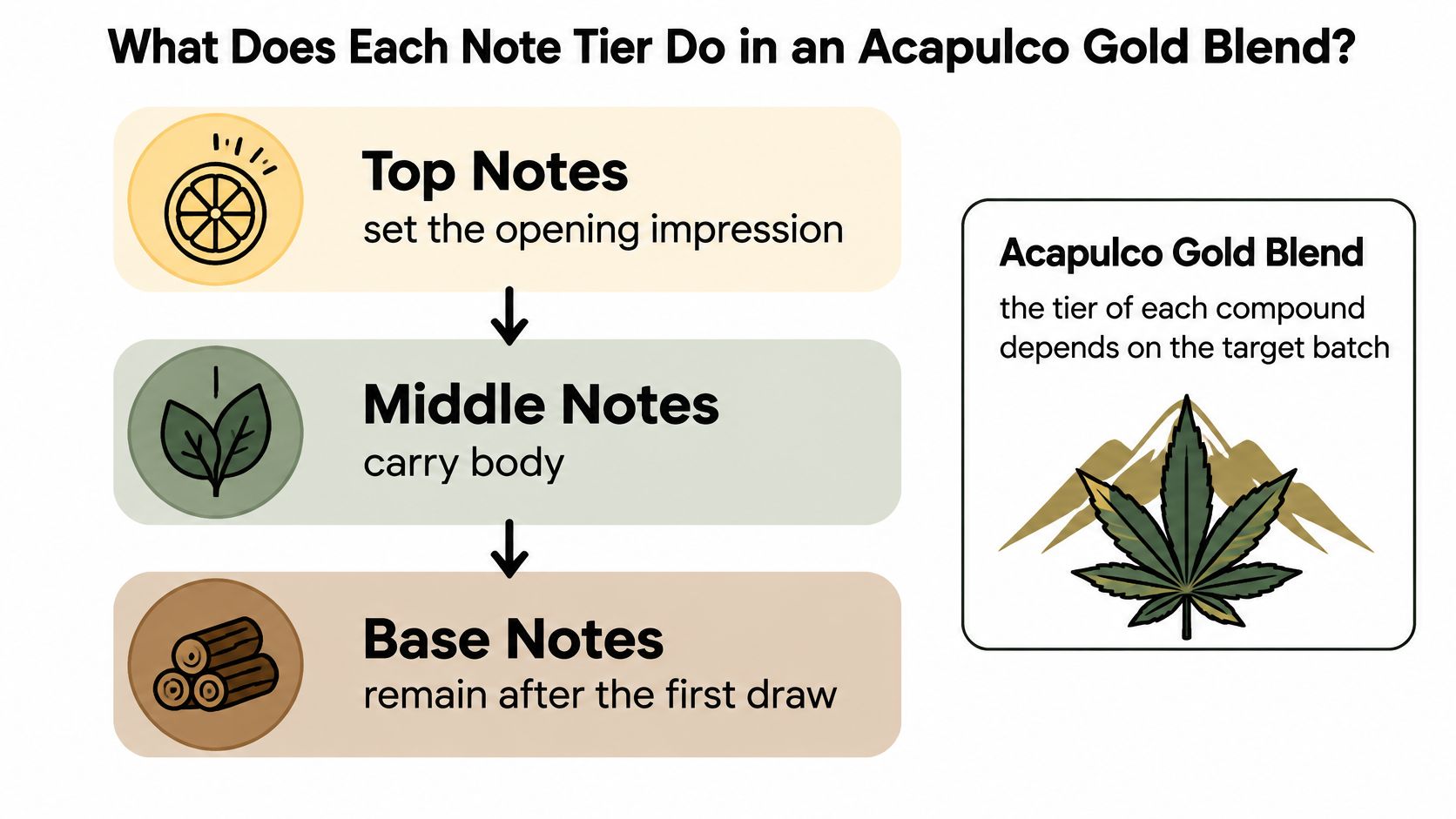
What Does Each Note Tier Do in an Acapulco Gold Blend?
The same terpene can play a different role from batch to batch. Top notes shape the opening, middle notes carry body, and base notes persist after the first draw. The target batch determines the balance, not a fixed hierarchy.
The commonly reported profile combines citrus, pepper, and pine. The Abstrax Acapulco Gold product profile describes d-limonene's lemon-like top notes, beta-caryophyllene's peppery, clove-like character, and beta-pinene's fresh coniferous note.
Top, middle, and base in practice
Top tier compounds tend to register first. Limonene, ocimene, and beta-pinene can create a citrus-and-pine opening. When ocimene is prominent in the batch, the opening may read sweeter and greener.
Middle tier compounds give the profile body. Myrcene contributes herbal character, while linalool adds floral softness. Some batch profiles show linalool outweighing limonene, so a template built around a dominant citrus note can miss the batch's softer finish.
Base tier compounds persist as brighter notes fade. Beta-caryophyllene contributes pepper and clove, while humulene can support a drier, woody close. Build the citrus and pine opening first, then adjust caryophyllene in small increments to keep pepper from taking over.
Acapulco Gold note tiers and batch ranges
| Tier | Compounds | Reported range | Sensory role |
|---|---|---|---|
| Top | Limonene, ocimene, beta-pinene | Limonene 0.071% to 3.129%, ocimene 0.16% to 1.08%, beta-pinene 0.17% to 0.36% | Citrus and pine opening |
| Middle | Myrcene, linalool | Myrcene 0.38% to 1.035%, linalool 0.21% to 0.850% | Herbal body and floral softness |
| Base | Beta-caryophyllene, humulene | Caryophyllene 0.76% mean, humulene 0.25% mean | Pepper, clove, and dry woody finish |
Use the terpene flavor chart to compare sensory roles before assigning tiers. Then place each marker according to its contribution in the target batch. Some profiles list myrcene and humulene among their lead compounds, so a fixed tier order can misrepresent the blend.
Recheck the balance after dilution, filling, and storage. Heat, oxygen, and repeated headspace exposure can shift perceived balance even when the initial blend is well matched.
How Do I Build a Blend From a Batch Certificate?
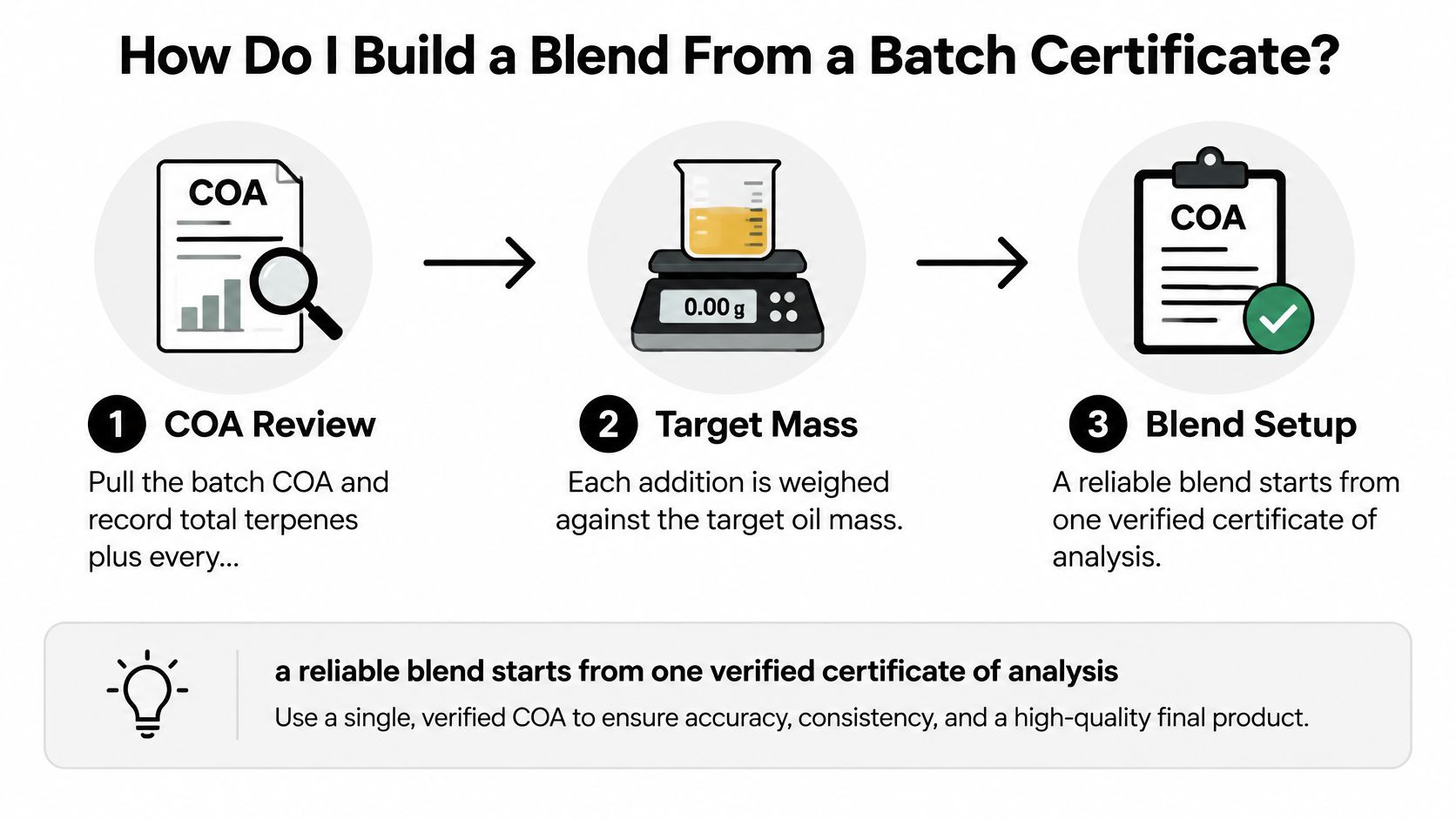
A reliable blend starts from one verified certificate of analysis, and each addition is weighed against the target oil mass. If you change the reference COA mid-project, restart the math.
The build sequence
Pull the batch COA. Record total terpenes plus every marker above 0.1%, since minor compounds decide the finish. Use the COA certificate of analysis guide if your team reads COAs inconsistently. A missing minor marker is a common reason a blend smells right on paper and wrong in the cart.
Convert markers to oil-mass percentages. Percentages carry across batch sizes, drop counts don't. Write each marker as a share of finished oil, not as a share of the terpene blend alone, or your scale-up math will break.
Assign each marker a tier. This forces you to decide what opens, what carries body, and what persists. If two top-note compounds compete, you'll see the conflict before you blend.
Calculate grams per batch. Build a spreadsheet with target oil mass, marker percentage, and grams for every addition. Gold Coast Terpenes offers a Mixing Calculator as a resource, which helps when you're converting percentages for a pilot run. Confirm the summed load stays inside the COA total.
Blend small and weigh everything. Weigh viscous terpenes by mass on a calibrated scale. Measuring by volume is the usual slip here, because viscosity and temperature change what a syringe delivers.
Compare after fill and storage. Test the filled unit, not just the bench oil, at the interval your product will ship. Heat and headspace can move the opening even when total load hasn't changed.
A worked example
Say you're replicating flavor of Acapulco Gold from a vape COA with a target near 6.3% total terpenes. If limonene sits near 3.1%, it's about half the load, so set the citrus opening first and build middle and base additions around it. Don't average that batch with a linalool-led concentrate and expect either profile to survive.
Weigh by mass, record by percentage, and retest the filled unit. Skipping any one of those turns a COA match into a guess.
Your pass rule is simple. Every mandatory marker lands inside its target range, and the total load matches the reference. If one marker misses, correct that marker and retest. Don't rebuild the whole blend to fix one number.
Which Formulation Mistakes Make a Blend Miss the Acapulco Gold Profile?
Four errors account for most missed blends, and each one is visible in batch data. Name the mistake, check the number that disproves it, then apply the correction.
A generic high-limonene template is the most common failure. Formulators assume citrus must lead because strain descriptions emphasize it. One concentrate batch contradicts that assumption directly, with linalool more than five times the limonene level.
Adding beta-caryophyllene by default is the second failure. Caryophyllene belongs in many Acapulco Gold descriptions, but a mean across batches isn't a specification for your batch. If your reference doesn't list it, adding it pushes the profile toward pepper your target never had.
Common blending mistakes and corrections
| Mistake | What batch data shows | Correction |
|---|---|---|
| Using a generic high-limonene template | Linalool 0.380% against limonene 0.071% in one concentrate COA | Weight linalool into the middle tier from the batch COA |
| Adding beta-caryophyllene by default | Mean 0.76% across aggregated COAs, varying by batch | Add caryophyllene only when the target batch lists it |
| Ignoring ocimene | Total ocimene 1.08% in a Connecticut COA | Treat ocimene as a top-note contributor |
| Treating the strain name as the target | Total terpenes from 2.2% to 6.315% across batches | Set the total terpene load from the COA |
What these errors cost you
Ignoring ocimene changes the first impression. At the Connecticut level, ocimene isn't a rounding error. It's a sweet, green, herbaceous contributor that competes with citrus for the opening, and leaving it out flattens the profile.
Treating the name as the target is broader and worse. A team that targets the Acapulco Gold strain instead of a batch can pick any total load inside a wide range and still claim a match. Buyers and lab results won't agree, because there's no defined target to pass against.
Check each correction against the reference COA before release. You're testing the batch you copied, not a description you read.
How Do I Scale the Blend for Distillate and Cartridges?
Scale only after the bench blend matches the target ratios in the finished oil. A blend that tastes balanced in a beaker can shift after filling, because the cartridge is part of the formulation.
Distillate first, then the filled unit
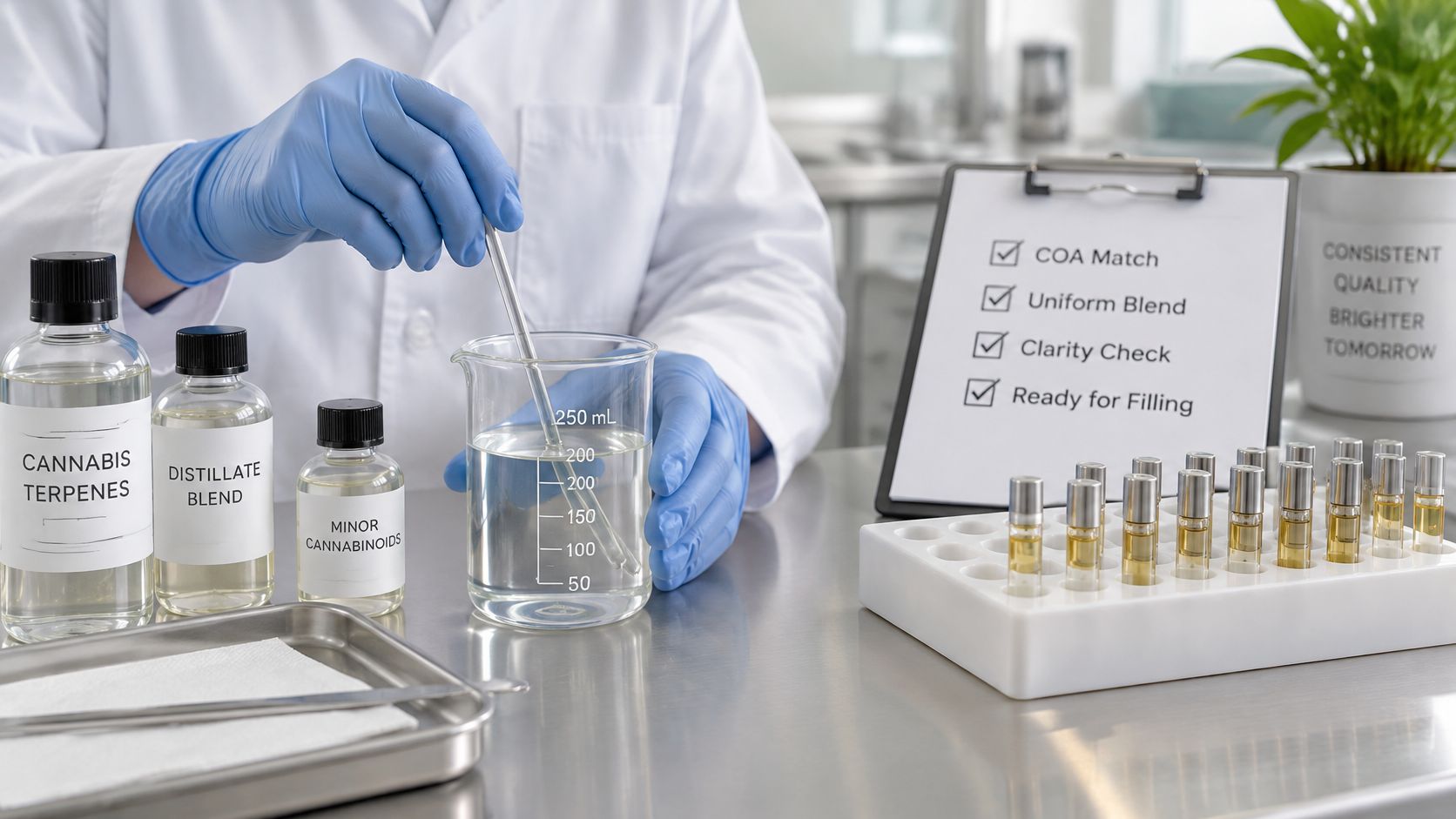
For a strain-inspired terpene blend for distillate, add terpenes to winterized oil at the chosen load and mix until uniform. Keep a retain sample, then assess it at the storage interval the product will ship at. The recipe-scaling guide explains the percentage math for changing batch size.
For cartridge formulations, evaluate the filled hardware too. Device heat, headspace oxygen, and repeated draws can shift the perceived balance, particularly in the top tier. If the opening dulls after storage, check for top-note loss before increasing the total terpene load.
Isolates, premade blends, or both
Gold Coast Terpenes offers terpene isolates including Alpha Pinene, Beta Caryophyllene, Limonene, Linalool, Myrcene, and Terpinolene. It offers over 50 strains, and its Select Strains selectively boost rare, exotic terpenes. A close premade profile can provide a starting point for correction.
- Use isolates when one marker drifts: Adjust linalool, pinene, or another single compound without rebuilding the blend.
- Use a premade strain blend when the whole profile is the target: This saves bench time when its ratio is close to the batch target.
- Combine both when a premade blend is close but not exact: Adjust one marker with an isolate, then retest the finished oil.
Before finalizing the bill of materials, check that the isolate and blend options match the formulation. At scale, track marker ranges, total terpene load, and the dominant-to-secondary ratio. If the ratio holds but the total drifts, correct dilution. If the total holds but the ratio drifts, adjust the blend. These require different corrections.
Scale rule: Don't raise total terpene load to fix a ratio problem. It makes the wrong profile louder.
What Do Botanical Labels and Inhalation Safety Mean for a Blend?
A botanical or natural label doesn't establish inhalation safety. It describes origin. Safety requires testing, conservative loading, and market-specific compliance checks.
The Washington State Liquor and Cannabis Board research brief on flavored cannabis vape products notes that terms such as natural, artificial, botanical, and synthetic flavoring lack consistent legal definitions and that the safety of inhaled terpenes remains incompletely characterized. Volatility and aerosolization data describe behavior during heating. They don't prove long-term health outcomes, and vaping can produce respiratory irritation.
A conservative framework
- Require a batch COA: Every lot should name each compound and its concentration, with botanical versus nature-identical labeling stated plainly.
- Test at low temperature: Evaluate the filled device under controlled, low-temperature conditions and document taste changes by device.
- Check each market: Permitted additives and inhalation standards vary by jurisdiction, even when the product name travels.
- Stay inside the tested range: Don't load above the range you've validated to chase stronger flavor.
- Keep claims narrow: Describe sensory profile and compliance only. Don't make effect or medical claims.
Gold Coast Terpenes makes 100% botanically derived blends, which tells a buyer about origin, not safety. Botanical versus cannabis-derived terpenes is a sourcing and labeling decision first. Cannabis-derived inputs carry different supply and regulatory constraints, while botanical inputs offer repeatable compound sourcing, but neither origin removes the need for inhalation validation.
When you choose a supplier, ask for a COA for every lot, documented origin, a labeled compound list, and stated lead times. The overview of whether terpenes are safe to vape gives your compliance team a starting point for those questions. A team that labels exact compounds and tested ranges can explain its product clearly to regulators and buyers.
What Must Be True Before Commercial Release?
A commercial release should match a named batch reference in its finished format. A pilot that misses the reference is not ready for release.
Go or no-go checklist
- Reference COA is named: Record the batch used as the profile reference.
- Mandatory markers pass: Keep each selected marker within its target range.
- Total load matches: Set the terpene load for the specific product formulation rather than defaulting to a house rate.
- Filled unit passes retest: Confirm the finished oil or cartridge still meets specifications after storage.
- Label is exact: List compounds accurately and omit effect claims.
- Sensory panel confirms the opening: Check that citrus, pepper, and pine appear in the order predicted by the tier map.
A failed check means the blend needs revision against the same reference COA. Changing references to make a batch pass can leave two production runs with different profiles under one label.
For sourcing, Gold Coast Terpenes offers botanically derived blends, and customers can call 929-356-6086. Its programs serve Distro, Shops & Independent Reps, Affiliates, and Manufacturers & Brands. Wholesale pricing is available on strain orders totaling over 64oz. Confirm the terms for the pilot quantity before placing an order.
Set the pilot size around the testing your team will conduct. Reserve enough material for both lab analysis and sensory review, then compare the finished product with the reference before approving the full run. A controlled pilot can identify a mismatch before it affects a larger production batch.
Frequently Asked Questions About Acapulco Gold Blends
Which marker should I correct first when a blend drifts?
Correct the COA marker furthest outside its target range, changing one compound at a time. Gold Coast Terpenes sells terpene isolates that can be used to adjust an individual marker. Retest the blend before changing another.
Is a premade blend enough for an Acapulco Gold distillate?
A premade blend is suitable when its ratios match your batch's target ranges. Gold Coast Terpenes offers strain blends and isolates, but a strain name alone does not establish a match. Confirm the fit against the batch COA and test the finished distillate.
Does a natural or botanical label prove a blend is safe to inhale?
No. A label describing a blend's origin does not establish inhalation safety. Use batch documentation, test the filled unit in its intended device, and check the requirements for the market where it will be sold. Keep label claims within what the product's testing supports.
Does Gold Coast Terpenes supply terpene blends for vape cartridges?
Gold Coast Terpenes sells 100% natural terpene blends extracted from fresh plants. Confirm that a blend fits the intended formulation using the batch COA and filled-unit testing. Hardware and oil viscosity also affect cartridge performance.
How do I choose between different terpene sources?
Compare documented origin, consistency between batches, labeling requirements, and COA details. Then validate the formulation in its intended device. Origin alone does not establish inhalation safety.
For sourcing, browse Gold Coast Terpenes' strain blends and isolates or call 929-356-6086. Use the batch COA to assess the profile, then confirm it in the filled unit before scaling production.