
A 2021 Bubba Kush HS-GC/MS certificate lists beta-caryophyllene at 9.788 mg/g, compared with 2.421 mg/g of beta-myrcene. The certificate makes caryophyllene the measured anchor in this sample. Gold Coast Terpenes supplies 100% natural terpene blends, making measured composition the useful bridge between a flower reference and a reproducible cartridge formulation.
For product developers, the practical target is a woody, spicy structure supported by controlled herbal, floral, and citrus accents. Starting with myrcene alone would miss the certificate's stronger caryophyllene presence.
What Terpene Profile Does Bubba Kush Have?
A useful Bubba Kush terpene profile for vape cartridges is caryophyllene-forward, with humulene, myrcene, and linalool supporting the main structure. The certificate below represents a specific sample, not a universal formula for everything sold under the cultivar name.
Read the certificate as a formulation reference
The certificate reports total terpenes of 19.775 mg/g, equivalent to 1.978% by mass. Its cinnamon, hops, clove, lavender, and floral descriptors give a more actionable sensory direction than a broad indica classification.
Bubba Kush terpene profile from a 2021 HS-GC/MS certificate
| Terpene | Role in blend | mg/g | % by mass |
|---|---|---|---|
| Beta-caryophyllene | Mid to base, spicy anchor | 9.788 | 0.9788% |
| Alpha-humulene | Base, woody and hoppy | 2.583 | 0.2583% |
| Beta-myrcene | Top, herbal lift | 2.421 | 0.2421% |
| Linalool | Mid, floral | 1.985 | 0.1985% |
| Alpha-bisabolol | Base, soft floral | 1.277 | 0.1277% |
| Limonene | Top, citrus | 0.879 | 0.0879% |
| Total terpenes | Full profile | 19.775 | 1.978% |
The individual mass percentages are unit conversions from the certificate's mg/g results. The total row represents the full reported profile, including constituents not individually listed in this shortened table.
Flower concentration and blend composition aren't interchangeable. A compound's percentage of the flower is different from its percentage of an isolated terpene blend, and both differ from its concentration in finished distillate.
For a formulation spreadsheet, keep those quantities in separate columns. Record the analytical concentration, calculate each constituent's share of the intended terpene fraction, and then calculate its contribution to the finished oil.
Match relationships before intensity
Begin with the relationship between caryophyllene and its supporting compounds. If the reference smells spicy and woody but the prototype smells predominantly herbal, increasing the entire terpene load won't correct the underlying balance.
Likewise, matching only the largest chromatographic peak won't reproduce the full aroma. Floral support can soften an otherwise blunt spice profile, while restrained citrus can make the opening recognizable without turning the product into a citrus-led SKU.
Practical rule: Match the constituent relationships first. Adjust overall intensity only after the diluted blend has the right character.
Keep an approved Gold Coast Terpenes reference lot alongside the development record, with its corresponding analytical documentation. Compare the finished oil against that retained reference rather than relying on a remembered bottle aroma.
Where Did Bubba Kush Come From and What Does the Name Guarantee?
Bubba Kush identifies a recognized cultivar and sensory tradition, not a standardized genetic certificate. Its documented history rests largely on breeder accounts, so the name can't guarantee the composition of a purchased lot.
According to the Royal Queen Seeds history of Bubba Kush, Matt “Bubba” Berger obtained seeds in New Orleans in 1993, reportedly rumored to be Northern Lights, and grew them in Gainesville, Florida. He selected a short, bushy phenotype, named it Bubba, and the plant was subsequently cloned and circulated.
The same account describes an accidental pollination involving Bubba and a Kush-related plant by 1996, while placing the recognized strain's emergence in 1997. The male parent remains disputed, with descriptions including OG Kush, an OG-related Kush, and an unknown Kush plant.
Turn the history into a purchasing specification
The cultivar later spread through California and became associated with dense, compact flowers and an indica-dominant identity. Those associations help explain recognition, but they aren't analytical acceptance criteria.
Say an extractor receives flower labeled Bubba Kush and a brand owner supplies a retained cartridge as the flavor standard. Both can legitimately belong to the same commercial naming tradition while presenting different formulation targets.
Resolve that difference before buying ingredients:
- Reference identity: Decide whether you're reproducing the incoming flower, an approved cartridge, or a documented strain-inspired interpretation.
- Analytical identity: Attach the relevant certificate and sample identifier to the development record.
- Commercial identity: Describe the finished product accurately without implying verified genetic continuity.
A cultivar name can guide the brief. It can't release a manufacturing batch.
For a Gold Coast Terpenes reference, document the lot identifier in the same way you'd document the distillate lot. That gives procurement, quality, and product development a common reference without asking the strain name to prove more than it can.
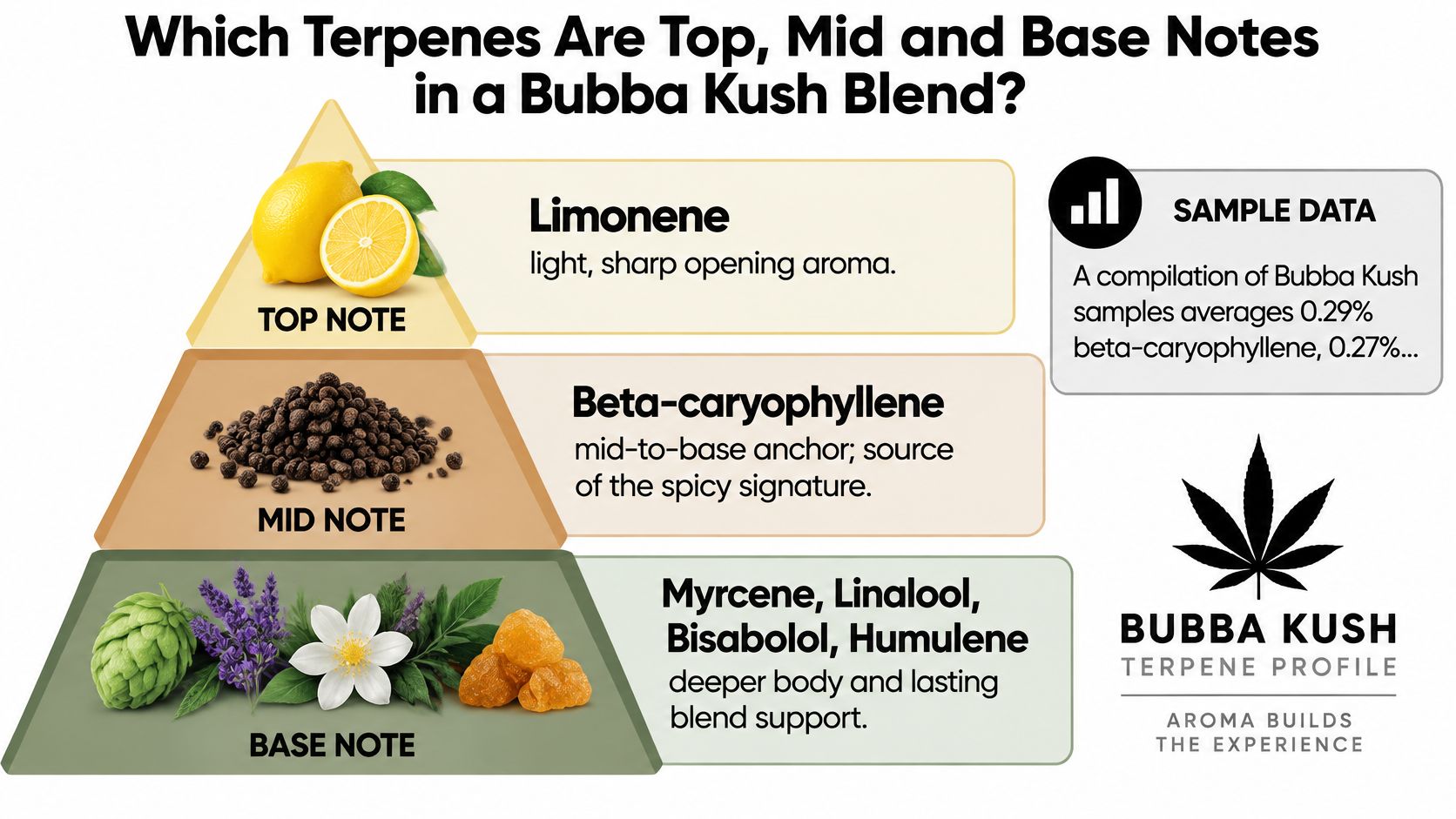
Which Terpenes Are Top, Mid and Base Notes in a Bubba Kush Blend?
Caryophyllene anchors the Bubba Kush profile; myrcene should not set the blend by default. Top, mid and base describe sensory roles, not fixed chemical categories. Use measured certificate values to set the starting ratios, then assess the mixture by smell and in the finished cartridge.
The Leafly comparison of Kush-family terpene profiles identifies Bubba Kush as caryophyllene-prominent. Published profiles vary, so the strain name alone cannot tell you which terpene leads a particular lot.
Assign roles by what reaches the nose
Use this hierarchy as a sensory starting point, then assess each material in the actual blend. Myrcene and linalool can add depth, while also contributing aspects that read in the opening or middle.
| Sensory layer | Working materials | What to evaluate |
|---|---|---|
| Top | Limonene and the lighter herbal aspect of myrcene | Citrus definition and herbal lift |
| Mid | Caryophyllene and linalool | Peppery body with integrated floral character |
| Base | Humulene, bisabolol, and persistent supporting notes | Woody, hoppy, soft-floral finish |
Set caryophyllene high enough to establish spice without burying the supporting notes. Too much can leave a one-dimensional pepper impression; too much limonene can pull the blend away from its intended earthy direction.
Humulene supports a woody, hoppy character. Bisabolol can add soft floral support, while linalool should integrate into the middle rather than read as a separate lavender-led flavor.
Treat coffee and cocoa as blend impressions
Spicy, peppery, earthy, woody, citrus-accented, and coffee- or cocoa-like are useful matching descriptors. They do not establish that any single listed terpene creates every aspect of the finished aroma.
Record each descriptor as absent, balanced, or excessive on a sensory sheet. Change a constituent only when the certificate target and the sensory result support the same adjustment.
Terpene composition alone does not establish a sleep, sedative, or medical outcome. Strain-specific clinical evidence is not a basis for promising one.
If the finished oil lacks a bright opening, do not automatically strengthen the base. Check whether supporting notes are underrepresented or whether the distillate and device are muting them.
How Do Storage and Batch Variation Change the Terpene Profile?
Storage changes the reference you're trying to reproduce, and different lots can require different blend ratios. A strain name doesn't freeze the chemistry at harvest or protect it during handling.
In an ACS Laboratory experiment on Bubba Kush hemp flower storage, flower kept with a terpene-preservation humidity system retained 30% more beta-myrcene, 20% more limonene, and 13.5% more total terpenes than conventionally stored flower. Alpha-humulene represented 18.79% of the reported terpene composition in the preserved sample.
Those are findings from that flower experiment, not a performance promise for bottled terpene blends. Their manufacturing relevance is that post-harvest handling can change the analytical reference before extraction even begins.
Separate lot differences from handling losses
A separate Bubba Kush flower laboratory report reports 2.36% beta-myrcene, 0.69% d-limonene, and 0.75% beta-caryophyllene. That is a materially different balance from a caryophyllene-led target, not a small adjustment around an immutable formula.
Don't average incompatible certificates and call the result authentic. Choose the sensory interpretation your SKU needs, then define acceptable compositional ranges around that approved reference.
- Incoming control: Retain supplier certificates, receipt dates, lot identifiers, and an unopened reference sample.
- Handling control: Limit heat, oxygen exposure, unnecessary transfers, and excessive container headspace.
- Storage control: Follow material-specific instructions and prevent moisture contamination.
- Release control: Evaluate the diluted oil after filling, not just the neat ingredient.
Gold Coast Terpenes publishes a guide to storing terpenes that can support the written handling procedure. Keep the procedure attached to the material specification so warehouse and production staff use the same controls.
Release criterion: Approve the aroma that survives mixing and filling, not the aroma that existed when the supplier opened the bottle.
If a prototype loses citrus definition during production, investigate handling before reformulating. Compensating with extra top notes can create an overly sharp fresh batch while leaving the underlying process problem unresolved.
How Much Terpene Load Works for Vape Cartridges?
A documented prototype benchmark is a THC-to-terpene ratio of 9:1, not a universal cartridge specification. A 2025 cannabis-concentrate vaping study used that ratio, equivalent to approximately 10% terpene content in the combined THC-and-terpene mixture.
That denominator matters. A laboratory mixture of THC and terpenes isn't automatically equivalent to a commercial distillate containing other constituents, so calculate the actual finished mixture by mass.
Use the benchmark as a test condition
A technical review of cannabis vaping liquids reports common terpene concentrations of 10–20% by weight, producing aerosols with approximately 2,500–5,000 ppm total terpenes. Those reported concentrations describe products discussed in the literature; they don't establish a safe range or justify maximizing flavor strength.
The review also discusses sensory irritation, airflow limitation, and inflammatory responses in animal studies at lower exposures. An in-vitro analysis identified linalool, dipentene, and citral as comparatively strong radical-generating flavorants, which supports testing emissions rather than relying on pleasant flavor as a safety indicator.
I would use the published benchmark only within a controlled development program, with qualified emissions testing and comparison conditions below and above the selected starting load. Higher-load conditions belong in laboratory evaluation, not automatic human sensory screening.
Choose the lowest load that passes the full specification
Track more than aroma intensity:
- Composition: Record the terpene fraction of the complete finished oil.
- Device behavior: Check wicking, leakage, airflow, and performance through use.
- Sensory fidelity: Evaluate whether the spicy, woody identity remains balanced.
- Emissions: Assess the actual oil-and-hardware combination under defined operating conditions.
- Stability: Check retained filled units for changes during storage.
Viscosity, coil design, device temperature, and the individual terpene mixture can change the result. A blend that works in one cartridge shouldn't move into another device without requalification.
Use the Gold Coast Terpenes distillate terpene-loading guide to support calculation and development planning. Select the lowest load that preserves the approved profile and passes the broader specification, not merely the load with the strongest aroma.
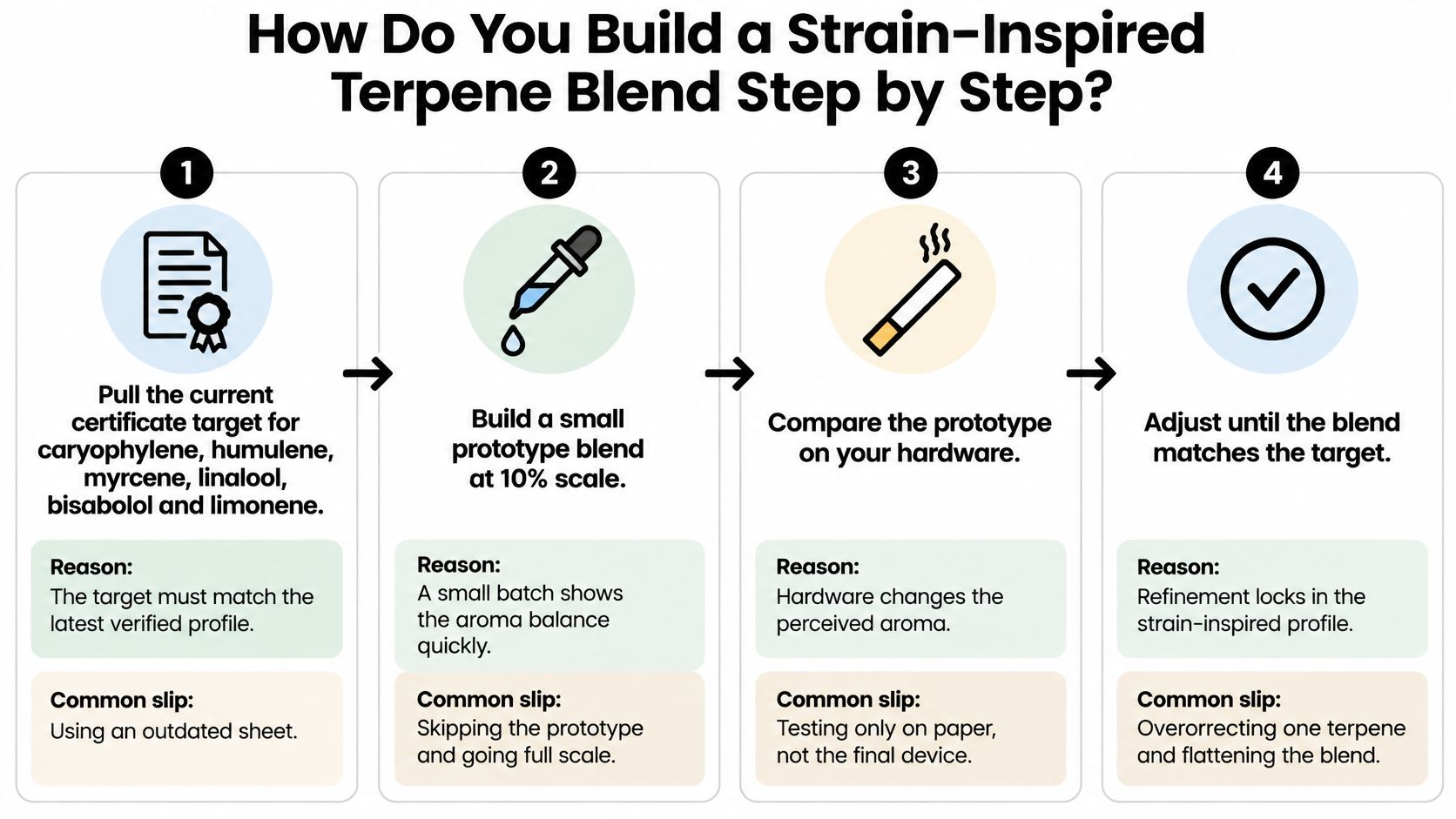
How Do You Build a Strain-Inspired Terpene Blend Step by Step?
Build from a current analytical target, establish the spicy and woody structure, then validate the diluted oil in its intended hardware. Keep a written mass balance so every adjustment remains reproducible.
Establish the composition
Pull the current certificate target. Enter caryophyllene, humulene, myrcene, linalool, bisabolol, and limonene into the batch worksheet, including units and lot identifiers. The target must match the reference in hand; the common slip is using an archived certificate because its filename looks familiar.
Set caryophyllene as the anchor. Scale humulene and bisabolol against that anchor to establish the spicy, woody foundation and soft finish. Don't let a strong citrus first impression determine the entire ratio.
Integrate linalool into the middle. Add its floral contribution after the principal structure is stable, then compare the result with the reference. Introducing it too early can encourage repeated corrections to compensate for an anchor ratio that was never settled.
Add limonene and myrcene to the chosen target. For a caryophyllene-forward interpretation, these support rather than dominate the structure. Don't inflate their weights to compensate for presumed storage losses that you haven't measured.
Use a suitable balance rather than counting drops. Different materials and dispensing tools won't deliver identical drop masses, so a drop-based recipe is a poor manufacturing record.
Validate the delivered mixture
Dilute to the selected working load and audit the calculation. Use a spreadsheet or the Gold Coast Terpenes mixing ratios calculator to reconcile terpene mass, distillate mass, and final batch mass. The common error is confusing addition relative to the starting distillate with percentage of the complete mixture.
Compare neat and diluted samples with the retained reference. Evaluate neat material using controlled wafting and appropriate handling precautions, then assess the diluted blend for shifts in balance. Don't approve a blend solely because the concentrated ingredient smells convincing.
Qualify the target hardware. Evaluate filled units for device performance and obtain appropriate aerosol testing before qualified sensory assessment. Oil appearance and bottle aroma can't reveal the full delivered profile, so skipping device testing leaves the principal application unverified.
Change one formulation variable at a time, and preserve the previous approved version.
Record the ingredient masses, mixing order, processing conditions, reference identifier, and observations for every prototype. Include a clear reason for each revision, such as reducing an excessive floral middle or restoring an underrepresented herbal opening.
The deliverable is a bench-ready prototype with a traceable formulation record, not just a vial that smells close. Quality staff should be able to reconstruct why the formula was chosen and which evidence supports its release.
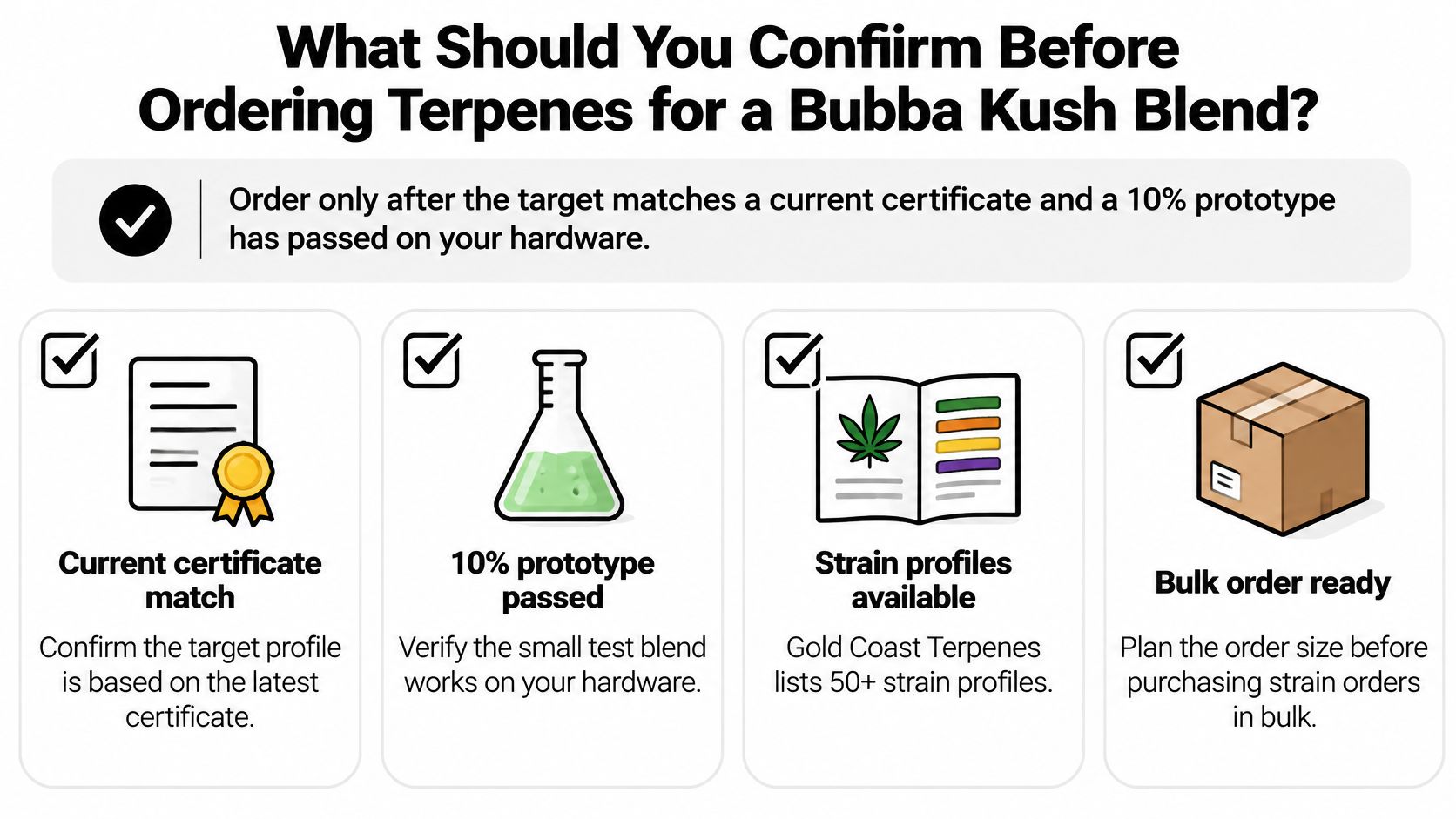
What Should You Confirm Before Ordering Terpenes for a Bubba Kush Blend?
Order after the reference, documentation, dilution plan, and hardware qualification agree. Procurement should buy against an approved specification rather than treating the strain name as the specification.
Compare suppliers on usable documentation
For botanical versus cannabis-derived terpenes, separate origin from composition. Botanical sourcing doesn't automatically make a blend inaccurate, and cannabis sourcing doesn't automatically make it match your chosen reference.
Confirm whether the supplier describes the material as botanically derived, cannabis-derived, or nature-identical. Don't use those terms interchangeably, and don't infer origin solely from a chromatogram.
When choosing a terpene supplier for distillate, compare:
- Lot documentation: A current certificate tied to the material shipped, with test scope and units clearly identified.
- Reference access: A sample suitable for comparison before committing to production inventory.
- Handling guidance: Storage, dilution, safety documents, and material compatibility information.
- Ordering terms: Written confirmation of MOQ, available lot size, lead time, and continuity arrangements.
- Claims support: Documents that substantiate origin, composition, and any proposed label statements.
The best terpene suppliers for vape brands are those whose documentation supports your quality system. A large catalog doesn't replace a usable certificate, and ingredient testing doesn't establish finished-aerosol safety.
Confirm the commercial terms before scaling
Gold Coast Terpenes offers 50+ strain profiles, allows customers to order multiple strains through bulk ordering, and provides wholesale pricing on strain orders totaling over 64 oz. All strains are highly concentrated and need proper dilution before use.
Use the Gold Coast Terpenes purchasing resource to plan the order, then confirm MOQ, lot allocation, and lead time in writing. Don't treat the wholesale threshold as an MOQ or assume that all selected profiles will ship from equivalent production lots.
Have regulatory staff review the finished formulation, ingredient disclosures, and intended market requirements. Avoid turning a sensory description into an unsupported health or effects claim.
Frequently asked questions
How do I read a COA for this profile?
Check the sample identity, units, total terpenes, and relative prominence of caryophyllene first. Then compare humulene, myrcene, limonene, and supporting constituents with your approved target rather than a generic strain description.
Is the published THC-to-terpene ratio a finished specification?
No, it’s a laboratory benchmark for controlled development. The finished specification must account for your distillate, device, emissions results, and stability requirements.
How should I investigate a storage-related flavor change?
Compare the affected material with a properly retained sample and review container openings, transfers, and storage conditions. For a Gold Coast Terpenes lot, include its identifier and handling record when requesting a technical review.
How do I choose a terpene supplier for distillate?
Compare current certificates, origin labeling, dilution guidance, and reference samples before purchase. Evaluate Gold Coast Terpenes against the same written acceptance criteria you apply to other ingredient suppliers.
Gold Coast Terpenes offers strain-specific blends and isolated compounds for developing a measured Bubba Kush-inspired profile. Visit Gold Coast Terpenes to discuss reference materials, review formulation resources, and plan a sample order before committing to production quantities.