
The common advice to copy a dominant-terpene list and add fruit flavor won't reliably reproduce Slurricane in a cartridge. Gold Coast Terpenes supplies botanically derived terpene blends, but a credible Slurricane strain-inspired terpene blend still starts with a defined flower reference, an oil specification, and a finished-cartridge acceptance test.
Slurricane is a sensory target, not a fixed chemical specification. For a product developer, that means separating the flavor you're trying to reproduce from the cannabinoid concentration, hardware behavior, and supplier documentation needed to manufacture it consistently.
Which Terpenes Define a Slurricane Blend and What Role Does Each Play?
Slurricane is a sensory target, not a fixed terpene recipe. A flower profile can guide the blend, but the batch certificate of analysis and finished-cartridge tests should determine the final ratio. Beta-caryophyllene can bring peppery structure, limonene adds citrus brightness, and myrcene contributes an earthy, herbal note.
Slurricane is generally associated with the Do-Si-Dos × Purple Punch lineage and classified as indica-leaning, according to the Graswiese strain reference. That provides a sensory direction, not a manufacturing formula.
Reported Slurricane terpenes by role
| Terpene | Blend role | Aroma direction | Reported level or share |
|---|---|---|---|
| β-Caryophyllene | Base | Peppery, warm spice | Approximately 0.28% to 0.43% in the Ascendancy Strains panel |
| Limonene | Top | Citrus brightness | Lower than caryophyllene in the Ascendancy Strains panel |
| Myrcene | Base | Earthy, herbal | Lower than caryophyllene in the Ascendancy Strains panel |
The Ascendancy Strains panel reports β-caryophyllene at approximately 0.28% to 0.43%, with limonene and myrcene below it. These values describe that panel, not a fixed target for every Slurricane batch.
Use the roles to control balance
The Burlington Dispensaries Slurricane spotlight also describes caryophyllene, limonene, and myrcene as part of the strain's terpene profile. For formulation, their practical value is the balance of spice, citrus brightness, and earthy weight.
For a caryophyllene-led reference, preserve the peppery finish before increasing the fruit impression. More limonene can brighten the blend, but too much citrus can pull it away from the intended profile. Myrcene can add herbal depth; excess can mute lighter notes.
Practical rule: Match the reference's balance before increasing its intensity.
Use the analytical profile alongside a sensory description. Then assess both in the intended oil and finished cartridge, since a flower reference alone cannot set the final ratio.
How Much Do Slurricane Lab Results Vary?
Reported Slurricane results differ enough to change both the cannabinoid specification and the dominant-terpene target. The batch certificate, rather than the cultivar name, should decide which version you're reproducing.
Slurricane potency and dominant terpene by source
The sample records summarized in the GES Labs document distinguish the following reported ranges and dominant constituents. These are reference records, not release specifications for an incoming production lot.
| Source | Reported THC range | Dominant terpene |
|---|---|---|
| Laboratory sample A | 21.3% to 28.8% | β-Caryophyllene at 0.68% |
| Laboratory sample B | 19.6% to 26.4% | Myrcene at 0.64% |
| Strain data source, claimed range | About 20% to 28% | Not identified in the cited range |
| Strain data source, one measured sample | About 16% | Not identified for that sample |
The important difference isn't that one record has more THC. The dominant terpene switches. A caryophyllene-led reconstruction and a myrcene-led reconstruction can share a strain name while producing different sensory priorities.
The Cannapot formulation-oriented strain reference identifies phenotype, cultivation conditions, harvest maturity, curing, and laboratory method as reasons reported values change. It also emphasizes measuring cannabinoid potency and total terpene concentration independently before blending.
Translate the certificate into a usable target
A certificate is only useful when the team agrees on what each field means. Record the sample identity, analytical units, reporting basis, and whether the terpene result describes flower, an extract, or a formulated blend.
Use the Gold Coast Terpenes lab-report interpretation guide to structure that review, then resolve missing fields with the laboratory before approving the reference.
- Confirm the sample: Tie the certificate to the actual retained material, not a similarly named harvest.
- Check the units: Don't compare a relative terpene share directly with a whole-sample concentration.
- Separate the specifications: Maintain distinct targets for cannabinoid potency, total terpenes, and terpene distribution.
- Record omissions: An unreported constituent isn't automatically absent.
Adding a strain-inspired blend can't correct a distillate's different cannabinoid concentration, oxidation state, or residual volatile content. If the base oil has a distracting background odor, extra terpenes may mask it during initial evaluation without producing a stable match.
Pull the certificate for every incoming source batch and compare its dominant-terpene order with the approved reference before setting the blend ratio. If the reference changes, document that as a target change rather than adjusting the production formula without notice.
Which Blend Approach Fits Your Product?
Choose flower-derived terpenes to follow a specific harvest, a strain-inspired blend to maintain a defined SKU flavor, or isolates to adjust individual notes. The best choice is the one your verification process can control.
Blend approaches compared for Slurricane flavor
| Approach | Best use | Main risk | Required check |
|---|---|---|---|
| Flower-derived terpene blend | Matching one specific harvest | Batch-to-batch variation | Batch certificate of analysis for each lot |
| Strain-inspired terpene blend | Consistent SKU flavor across production runs | Drift from the reference over time | Sensory review after dilution in the product |
| Isolated compound reconstruction | Adjusting one note, such as more caryophyllene | Missing lighter aromatics a standard panel does not capture | Full finished-product test |
A flower-derived blend makes sense when the product promise is tied to a particular harvest. Its advantage is reference relevance, not automatic consistency. Purchasing needs to reserve enough approved material for the intended run or accept that a replacement lot may need requalification.
A strain-inspired blend suits a brand that wants a repeatable flavor identity even when the cannabinoid oil changes suppliers. The trade-off is that the company must define its own approved version of Slurricane rather than imply an exact match to every flower carrying that name.
Isolates give the formulator precise control over individual adjustments. They're useful when a pilot needs a sharper pepper finish or less citrus, but they don't remove the need for sensory validation.
Compare suppliers against the manufacturing task
The PSO Oregon Slurricane listing describes parent-derived cookie and OG character alongside grape, berry, and dessert notes. That combination is a better matching brief than requesting a sweet berry flavor.
Supplier evaluation should connect that sensory brief to practical purchasing requirements:
- Lot documentation: Require traceable identity and purity information for the material being shipped.
- Reference profiles: Ask what analytical and sensory targets define the blend.
- Dilution guidance: Obtain application-specific handling information rather than treating neat aroma as a finished-product preview.
- Bulk terms: Establish order increments, replacement-lot procedures, and availability before approving a production schedule.
- Labeling fit: Confirm that the stated source and composition can be represented accurately in each intended market.
Don't choose the lowest-cost input before accounting for qualification work. A cheaper blend that needs repeated correction can create more development work than a well-documented blend that fits the target directly.
Choose the approach your team can verify, not the one with the most persuasive strain description.
For a recurring cartridge SKU, that usually means retaining an approved sensory reference and a finished-product control. For a harvest-specific release, it means preserving the connection between the named harvest, the terpene lot, and the final batch record.
How Do You Build a Slurricane Blend for Cartridges?
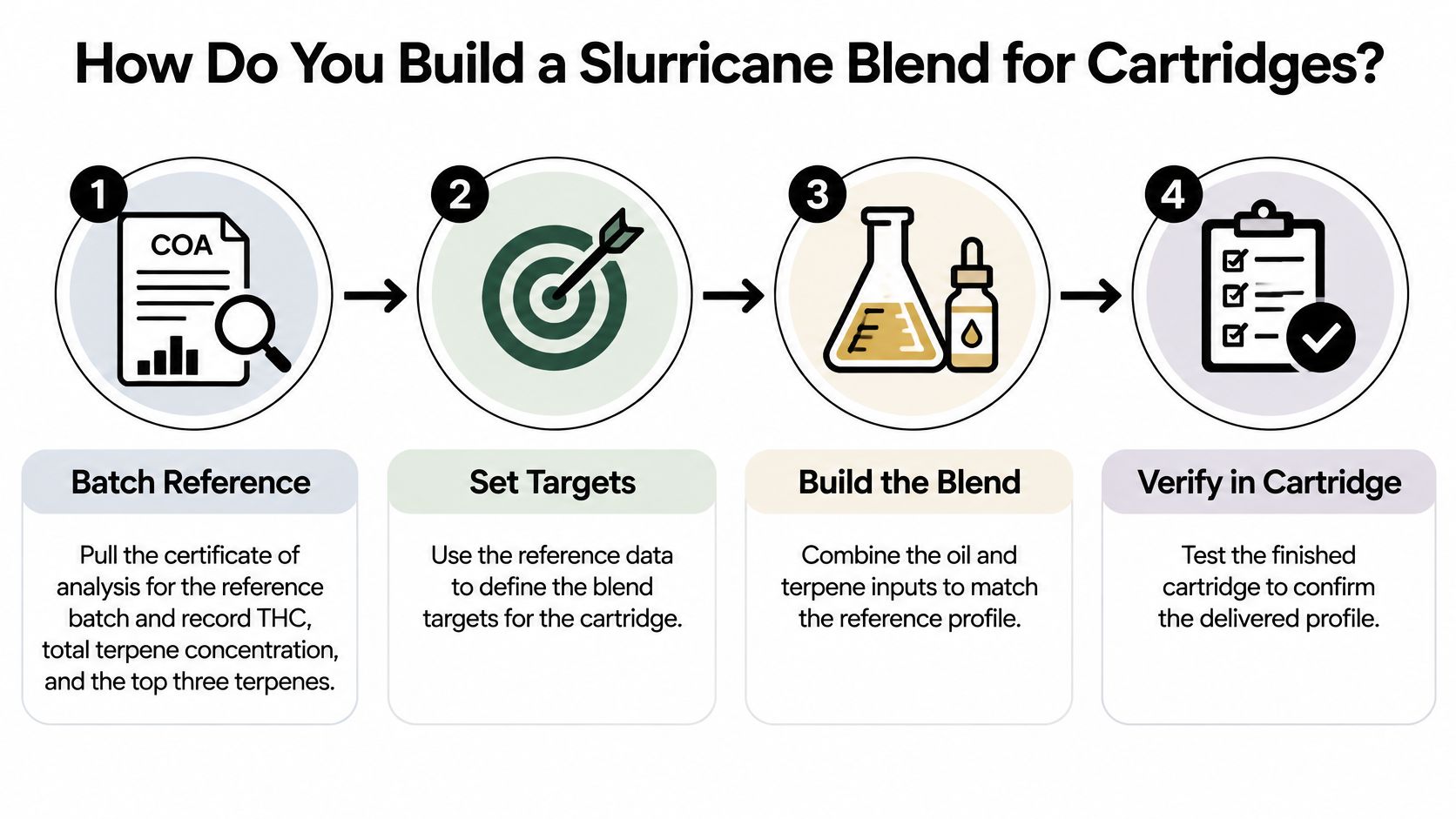
Build from an approved batch reference, then qualify the blend in the exact oil and hardware you'll sell. Don't select a terpene loading from a strain name or copy flower percentages directly into a cartridge formula.
The development sequence should connect reference selection to delivered performance.
Build a traceable pilot
Approve the reference batch. Pull its certificate and record THC, total terpene concentration, and the leading terpenes in order. Retain a physical reference where lawful and practical, because a spreadsheet alone can't preserve the sensory target.
Set the base relationship. Use caryophyllene and myrcene in the relationship supported by that reference. If you're developing a pepper-forward interpretation, keep caryophyllene leading or level with myrcene, but don't impose that relationship on a reference that clearly measures otherwise.
Add brightness without changing identity. Introduce limonene against the approved target and evaluate whether it lifts the fruit impression or becomes the main flavor. For a caryophyllene-led design, stop before the blend becomes citrus-first.
Place the secondary accents. Add linalool and alpha-humulene at documented reference shares when available. Where those measurements are missing, use a controlled sensory trial and label the resulting formula as your reconstruction rather than an analytically exact copy.
Dilute by recorded mass. Weigh the oil and terpene inputs on a suitable calibrated balance, record lot identifiers, and calculate the final mass fractions. Use a controlled mixing procedure that produces a uniform sample without unnecessary open-vessel exposure or heating.
Evaluate the blend in its matrix. Assess the diluted sample, seal the retained portion, and schedule its reassessment before starting the storage test. Record the container, storage conditions, and evaluation method so the comparison is repeatable.
Qualify the filled cartridge. Fill the intended hardware and evaluate sensory consistency and emissions under a defined test protocol, including repeated heating. Approval applies to that formulation and hardware combination, not automatically to another cartridge.
The Gold Coast Terpenes guide to mixing distillate with terpenes provides a useful handling reference when establishing the pilot procedure. Your batch record should still capture the actual equipment, mixing conditions, and material weights used.
Correct one variable at a time
If the pilot reads too citrus-forward, reduce limonene before adding more base notes to overpower it. If it tastes dull and earthy, investigate the myrcene balance and the oil background separately.
Keep an unchanged control beside each revised pilot. Otherwise, an apparently better result may reflect a different evaluation session rather than a better formulation.
Use the accompanying video as a visual supplement to the written mixing procedure, not as a substitute for your approved operating instructions.
A skipped measurement makes later troubleshooting harder. A traceable pilot lets the team identify whether an off-target cartridge came from the aromatic formula, the oil, the mixing operation, or the hardware.
Does Vaping Change the Slurricane Profile in a Cartridge?
Yes. Vaporization changes what the cartridge delivers, so matching the liquid's input profile doesn't establish a match to flower. Flavor fidelity and emissions need to be assessed together.
The peer-reviewed vaporization research available through PubMed Central describes monoterpenes evaporating before cannabinoids and reports that terpene addition increased carbonyl formation by up to ninefold under the tested conditions, without significantly changing aerosol mass production. That finding doesn't establish a universal multiplier for every cartridge, but it does rule out assuming that a stronger aromatic formulation is neutral from an emissions standpoint.
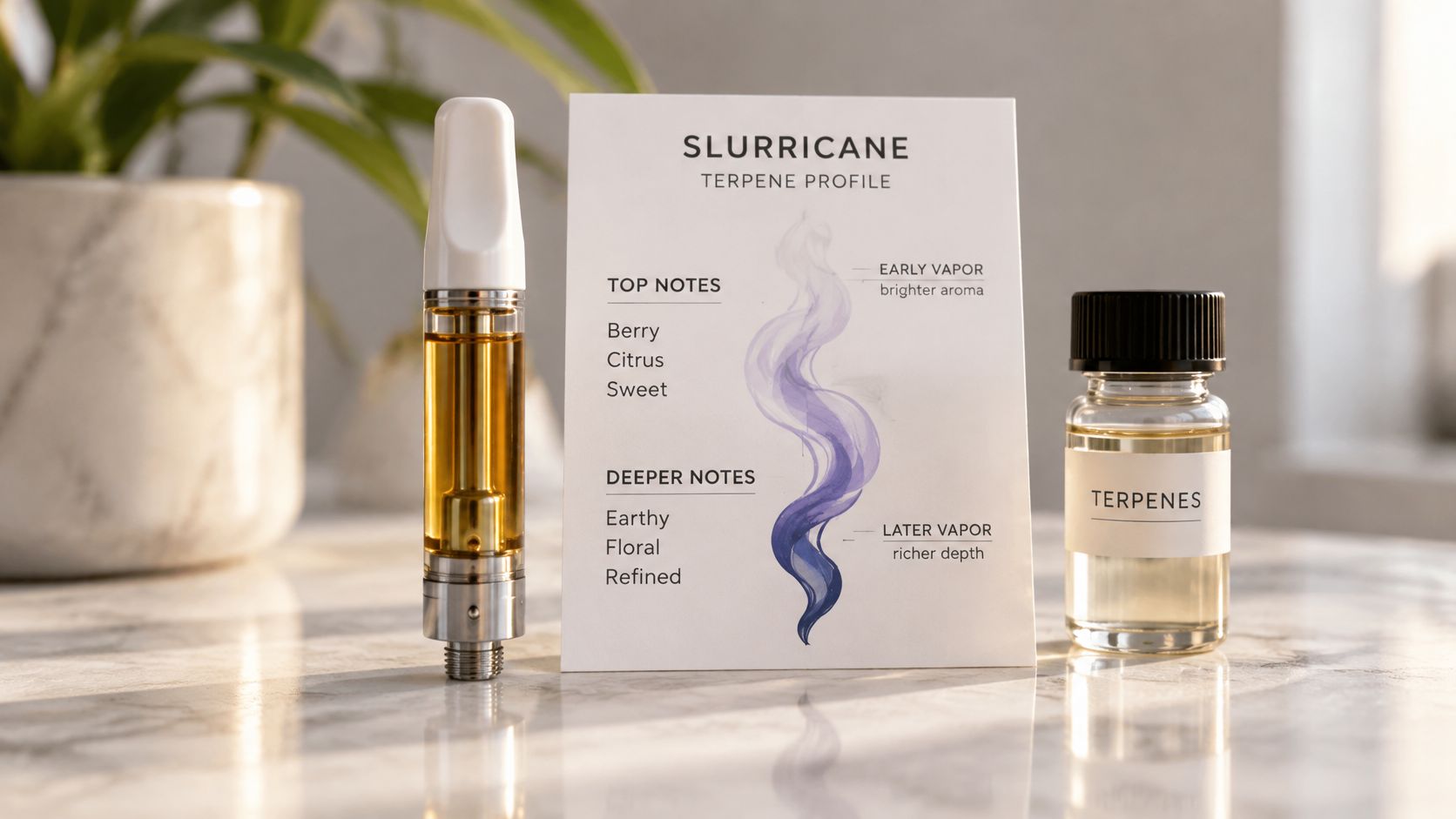
The information card is a useful reminder to keep profile identity and cartridge performance as separate approval questions.
Test the delivered product
Hardware temperature, repeated heating, and storage condition all belong in the qualification plan. A freshly filled cartridge evaluated at one operating condition isn't a complete picture of what the product will deliver during use.
The Gold Coast Terpenes vaping-temperature guide can help frame the hardware discussion, but don't convert a general temperature recommendation into a universal operating specification. Have the hardware supplier and testing laboratory define conditions appropriate to the actual device.
Use a release checklist that keeps composition and performance connected:
- Verify each input lot: Confirm identity, purity, origin, and traceability before blending.
- Test the finished formulation: Don't rely exclusively on certificates for the oil and terpene inputs.
- Assess the intended route: Have the laboratory evaluate the safety questions relevant to inhalation and the proposed formulation.
- Include storage and repeated heating: Compare sensory performance and relevant analytical results across the planned test conditions.
Keep the product claim sensory
A reconstructed flower aroma doesn't establish an equivalent pharmacological experience. The Terp Bros Slurricane reference highlights the uncertainty around predicting effects from strain identity and proposed cannabinoid-terpene synergy.
Describe the profile in terms you can evaluate: peppery finish, grape impression, floral softness, citrus balance, and consistency through the cartridge. Don't turn a measured terpene into a promise of sedation, anxiety relief, or another therapeutic outcome.
Release criterion: A recognizable aroma is necessary for flavor matching, but it isn't evidence of inhalation safety or a guaranteed effect.
When a cartridge performs well initially but loses its fruit character during the test sequence, don't automatically increase terpene loading. Investigate whether the problem is formulation balance, storage exposure, or hardware behavior before changing the recipe.
What Should Brands Verify About Botanical and Cannabis-Derived Terpenes Before Ordering?
Origin and composition are separate procurement questions. Botanical and cannabis-derived describe sourcing, while nature-identical describes a different aspect of a constituent's production or representation.
Gold Coast Terpenes describes its blends as 100% natural. Request lot documentation stating the origin of the material you intend to qualify rather than relying on a general brand statement.
Check the documents before the shipment
Use the guide to botanical-versus-cannabis-derived terpenes to frame the origin comparison. Neither origin category, by itself, establishes that a blend matches your target or suits the finished application.
- Lot-level certificate: Confirm that the certificate identifies the lot you'll receive and covers the relevant analyses.
- Origin statement: Establish whether the material is botanical, cannabis-derived, or requires another source description.
- Reference information: Request analytical and sensory details to compare a replacement lot with the approved material.
- Application guidance: Ask for handling, dilution, and safety documentation relevant to the intended development work.
- Commercial terms: Get the minimum order quantity, pack format, lead-time commitment, and bulk-order conditions in writing.
- Label review: Have the compliance reviewer approve source terminology and ingredient presentation before artwork goes to print.
Botanical and nature-identical are not interchangeable labels. Ask the supplier to define the constituents' manufacturing origin and provide the underlying documents for review.
Make procurement part of qualification
An MOQ affects development as well as purchasing. If the smallest order exceeds what the team can reasonably qualify and retain, a lower unit price may leave the company with unapproved inventory.
Ask for the MOQ by SKU and format. Sample formats, production packs, and customized blends may have different commercial requirements, so confirm the terms for the specific order.
Keep compliance approval separate from sensory approval. A flavor team may accept a reference match while a regulatory reviewer rejects a proposed source claim or label description.
The supplier comparison should produce a documented decision covering the material, its documentation, workable ordering terms, and an approved labeling approach. A supplier unable to document origin cannot support an origin claim, even if the sample's aroma matches.
Which Trial Order Should a Brand Place Next?
Order a trial quantity of a strain-inspired blend and qualify it in your product before committing to production inventory. If a Slurricane-specific profile isn't confirmed, establish availability before substituting another fruit-forward name.
Gold Coast Terpenes offers 50+ strain profiles, including Blackberry Kush, Forbidden Fruit, Piña Colada, Pink Lemonade, Rainbow Sherbet, and Vanilla Root Beer. Its premium strains are made by the Master Terpologists, who increase levels of certain rare and exotic terpenes to bring out fruity and flavorful nuances.
Those options can support an accent-comparison exercise, but they're not automatic substitutes for Slurricane. Blackberry Kush's blackberry, sweet, and fuel description may help evaluate a dark-fruit direction, while a dessert-named reference can help the team discuss the intended finish without claiming genetic or chemical equivalence.
Order for a decision, not a collection
Define the question each sample must answer before placing the order. A useful trial might determine whether the target needs more fruit definition, a softer middle, or a more persistent resinous finish.
- Name the target: Give the evaluator the approved sensory description and the reference identity.
- Control the matrix: Compare candidates in the same approved oil rather than across different base materials.
- Reserve retained material: Keep enough of each candidate to investigate later discrepancies.
- Set the scale-up gate: Require sensory acceptance and the relevant finished-cartridge testing before a production purchase.
Gold Coast Terpenes allows multiple strains in a bulk order, and wholesale pricing is available on strain orders totaling over 64oz. Use those terms after qualification, when the team knows which material it needs and can connect the purchase to a realistic production plan.
Buy enough material to answer the development question first. Buy production volume after the answer is documented.
Don't let a bulk threshold determine the formula. Procurement should scale an approved formulation, not pressure the development team to approve inventory already purchased.
What Else Do Formulators Ask Before Ordering?
Resolve trial pricing, application suitability, substitute references, and retest conditions before building the purchase order. These answers keep the trial focused on a production decision rather than an open-ended flavor search.
Are wholesale prices available for small trial orders?
Don’t assume a small trial receives wholesale pricing. Have Gold Coast Terpenes confirm the trial quotation and applicable order terms before you authorize the purchase.
Can these blends be evaluated for a CBD product?
Yes, a CBD brand can evaluate a blend for aroma and flavor in its intended formulation. Gold Coast Terpenes input documentation doesn’t replace finished-product testing or a market-specific review of ingredients, labeling, and claims.
What should stand in if a Slurricane profile isn’t available?
Use Forbidden Fruit or Blackberry Kush only as candidate fruit-accent references, not as confirmed Slurricane equivalents. Compare each diluted candidate against your own target and document any deliberate departure before naming the finished profile.
How long should a sealed trial blend wait before retesting?
Set the retest interval before storage using your development protocol, packaging, storage conditions, and the lot’s oxidation risk. Keep a retained control and record the actual conditions so the team can distinguish storage change from evaluation variability.
Gold Coast Terpenes offers strain-inspired blends and isolated compounds for developing a Slurricane-style cartridge profile. Visit Gold Coast Terpenes to discuss available reference options and a trial order, then qualify the selected blend in your oil and hardware before scaling.