
Copying a flower terpene percentage into distillate isn't a reliable way to reproduce MAC flavor in a cartridge. Gold Coast Terpenes, a supplier of natural terpene blends and isolates, gives formulators components for adjusting that flavor, but the target must be a tested reference batch, not the cultivar name alone.
Treat MAC as a sensory target: citrus on top, herbal weight through the middle, spice that lingers at the base. For a MAC strain-inspired terpene blend for vape cartridges, success means matching that citrus lift, herbal body, and spicy persistence after filling, storage, and heating. A convincing aroma in a mixing vessel is only the beginning.
Which Terpene Levels Define a MAC Strain Profile, and Does the Name Fix Them?
MAC doesn't have a fixed chemical specification. Gold Coast Terpenes isolates let formulators adjust individual compounds toward the reported reference values below, then refine the result against the actual oil and cartridge.
The table separates broader MAC-lineage benchmarks from individual reported tests. Those aren't interchangeable measurements: a range describes reported variability, while an individual result describes a particular tested expression.
Reported terpene levels in MAC-lineage flower
| Terpene | Reported level in MAC-lineage flower | Isolate to start from |
|---|---|---|
| Limonene | 0.4%–1.0%; one dataset 0.58% | Gold Coast Limonene isolate |
| Beta-Caryophyllene | 0.3%–0.9%; one dataset 0.22%, another MAC-related test 0.8% | Gold Coast Beta-Caryophyllene isolate |
| Myrcene | 0.5% in one MAC-related test | Gold Coast Myrcene isolate |
| Alpha-Pinene (combined pinene benchmark) | Combined pinene 0.1%–0.5%; alpha-pinene alone 0.17% in one dataset | Analytically specified alpha-pinene isolate |
| Linalool | 0.1%–0.17% across individual reported tests | Analytically specified linalool isolate |
| Humulene | 0.3% in one MAC-related test | Analytically specified humulene isolate |
| Ocimene | 0.3% in one MAC-related test | Ocimene isolate with documented composition |
| Total terpenes | 1.5%–3.0% by flower weight | Complete blend, not a single isolate |
The broader benchmarks, including total terpenes of 1.5%–3.0% by flower weight, occasional lots above 3.5%, limonene at 0.4%–1.0%, caryophyllene at 0.3%–0.9%, and combined pinene at 0.1%–0.5%, come from the Sigma Seeds Australia MAC-1 guide, which also describes MAC-1 as THC-dominant with CBD generally below 1%.
The individual values of 0.58% limonene, 0.22% beta-caryophyllene, 0.17% alpha-pinene, and 0.17% linalool appear in the Herbistry420 MAC profile. The separate GMO MAC, rather than universal MAC, fingerprint lists 0.8% beta-caryophyllene, 0.6% limonene, 0.5% myrcene, 0.3% humulene, 0.3% ocimene, and 0.1% linalool in the This Is Why I'm High GMO MAC profile.
THC percentage isn't a flavor specification. Limonene, caryophyllene, myrcene, pinene, linalool, and bisabolol are more useful aromatic targets than cannabinoid potency alone.
What the name actually identifies
MAC means Miracle Alien Cookies, combining Alien Cookies F2 with Miracle 15, which derives from Starfighter and Colombian Gold; MAC-1, known as Cap's Cut, is the recognized clone-only selection, while seed-grown MAC expressions can differ, as described by GreenState's MAC-1 lineage account.
Use limonene, myrcene, and beta-caryophyllene as practical adjustment points, not an automatic recipe. The strain terpene profile guide provides context for comparing named profiles.
Practical rule: Use the table as a starting fingerprint. Approve the target against a batch certificate of analysis and a retained reference sample.
What Top, Mid and Base Notes Do in a MAC Strain Blend
Top notes provide the first aromatic impression, mid notes provide body, and base notes provide persistence. These are useful sensory groupings, not rigid chemical categories or guarantees about what survives every cartridge.
Use the hierarchy to organize evaluations rather than treating every terpene percentage as equally important.
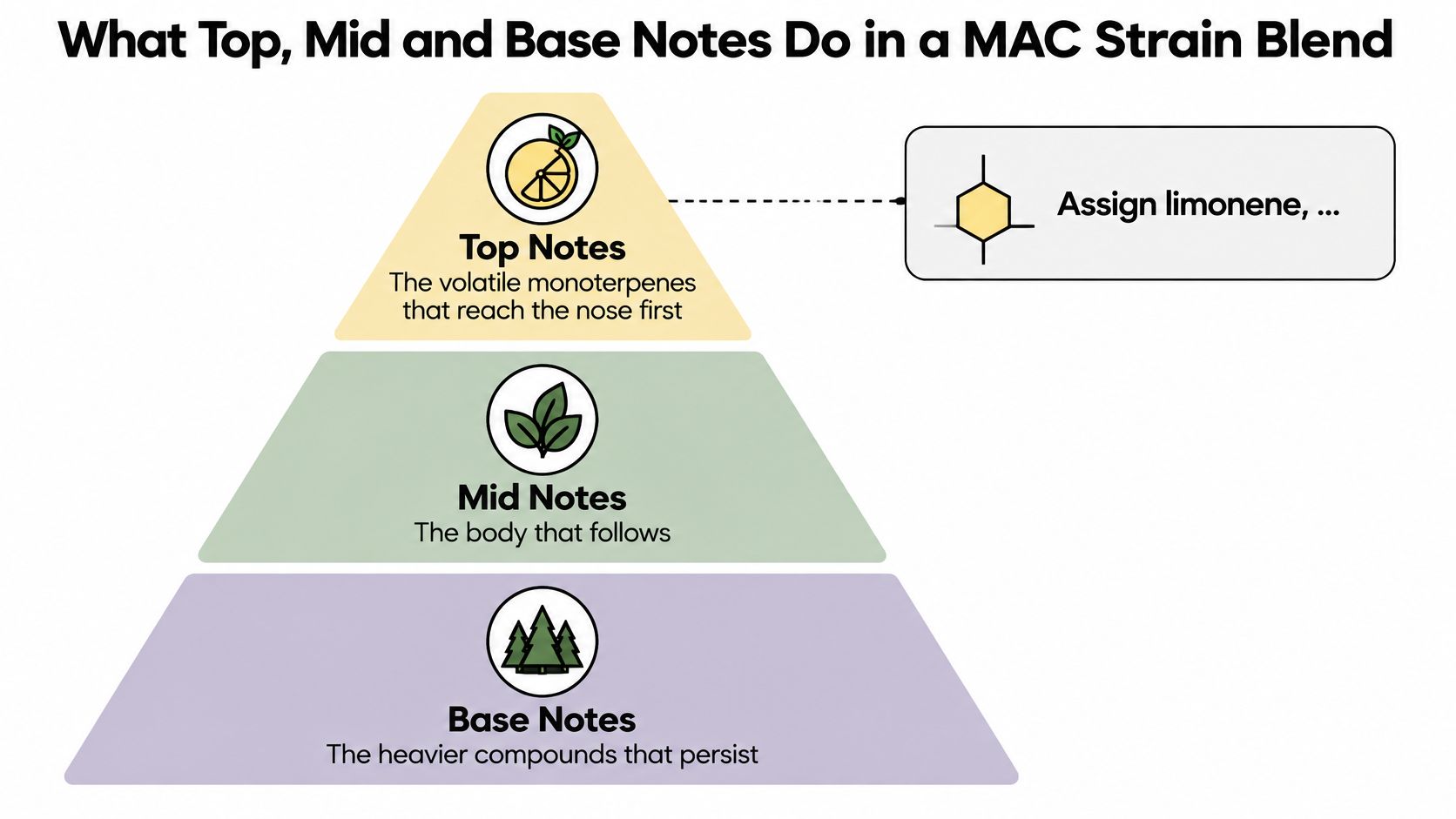
Terpene layers in a MAC strain blend
| Layer | Terpenes | Behavior under cartridge heat |
|---|---|---|
| Top | Limonene, alpha-pinene, ocimene | Volatile; reaches the nose first and is generally lost first |
| Mid | Myrcene, linalool | Body that follows the top notes |
| Base | Beta-caryophyllene, humulene | Heavier; tends to persist toward the end of cartridge life |
Alpha-pinene evaporates at approximately three times the rate of limonene at 20°C, and vapor pressure changes nonlinearly with temperature, according to a peer-reviewed review of cannabis aroma and terpene volatility. That means a small thermal change can alter the aroma delivered, even without changing the original recipe.
A static match in bulk oil can therefore produce a poor match during use. Preferential loss of bright monoterpenes can leave a peppery or woody impression where the reference had a clear citrus opening.
Evaluate the whole profile throughout use
Pay particular attention to the top layer at the beginning, the middle layer during sustained use, and the base near depletion. Still score every layer at every checkpoint; otherwise, an overly strong opening or premature earthy finish can escape detection.
Keep wick saturation, draw duration, storage headspace, and hardware settings consistent during comparisons. If those conditions change between candidates, the panel isn't evaluating formulation alone.
The accompanying video provides additional context for terpene blending.
Don't compensate for an unstable top layer by adding more citrus. First establish whether handling, storage, or the device is removing it.
How to Build a MAC Strain Blend for Distillate
Build the terpene concentrate and its final loading as separate specifications, then validate them together in the intended distillate. The concentrate determines aromatic balance; the loading determines how much of that balance enters the finished oil.
This workflow keeps flavor matching separate from viscosity correction and prevents a flower analysis from becoming an unvalidated cartridge recipe.
Define and weigh the formulation
Set the sensory target from the reference batch. Describe citrus brightness, herbal or earthy body, floral support, and dry peppery persistence, because a sensory specification gives the development team something actionable to match. Record unwanted characteristics too, such as sharp pine, excessive floral sweetness, or a lingering woody finish.
Decide total loading and internal ratio together. A GES Labs report comparing distillate and decarboxylated rosin products reports average total terpene content of approximately 20 mg/g in distillate products versus 68 mg/g in rosin products, illustrating why oil-specific calibration matters. These averages aren't recommended addition rates or evidence that either concentration is suitable for your device.
Specify dominance within the concentrate. For a caryophyllene-led reference, make beta-caryophyllene the largest fraction, followed by limonene and myrcene, because that ordering establishes a spicy structure with citrus lift and herbal body. Express each component as a percentage of the concentrate, not as an instruction to pour one ingredient first; use a different hierarchy when the selected reference supports it.
Weigh and document each component. Prepare the terpene concentrate at room temperature in compatible, closable vessels, because concentrated isolates make small weighing errors noticeable. Calculate component mass as concentrate mass × component mass fraction, and calculate added concentrate mass from the specified finished-batch mass and addition fraction; use a Mixing Calculator only after confirming whether it assumes weight or volume.
Transfer the target into the oil
Dilute into the intended distillate and evaluate filling behavior. Check homogeneity, viscosity, wicking, leakage, and hardware compatibility before production filling, because acceptable aroma doesn't establish acceptable device performance. If the oil needs warming, use the lowest validated handling temperature, then introduce volatile components after cooling to a workable temperature.
Assign a lot code and release record. Record the concentrate ratio, total addition, input lots, oil identity, certificate references, and filling conditions, because a successful pilot is reproducible only when the next operator can reconstruct it. Retain both bulk oil and filled cartridges for comparison.
The distillate and terpene mixing resource supports the handling workflow. A calculator can't determine a safe loading, compensate for undocumented purity, or approve an ingredient for inhalation.
Specify what's in the concentrate and how much concentrate enters the oil separately. Confusing those denominators produces avoidable formulation errors.
For isolate selection, request the current specifications for limonene, myrcene, and beta-caryophyllene. Add pinene, linalool, or humulene only when a controlled side-by-side comparison identifies a missing characteristic.
Why a MAC Strain Blend Drifts in Vape Cartridges
Cartridge drift is power-dependent as well as recipe-dependent. Test the complete oil-and-hardware system, because changing electrical power or airflow can change both aromatic delivery and thermal degradation.
Heated-concentrate work examined mixtures containing 12 volatile compounds across 100–500°C, while related aerosol findings connect degradation products with applied power; the OSTI record on heated cannabis terpenoid emissions supports testing thermal behavior rather than judging the unheated blend alone. That experimental range isn't a recommended operating range or a cartridge safety specification.
Cartridge drift symptoms, causes and fixes
Treat these as diagnostic hypotheses. A sensory symptom can identify where to investigate, but it doesn't identify an emission compound or prove a product is safe.
| Symptom | Likely cause | Fix |
|---|---|---|
| Bright citrus fades within weeks | Limonene loss from evaporation or oxidation | Store sealed and cool, then re-check top notes at set intervals |
| Harsh or burnt finish at high power | Base-heavy blend run at high coil power | Test at lower power, assess emissions and wicking, then consider reducing the heavier base share |
| Earthy profile appears late in the cartridge | Monoterpenes depleted before the base notes | Compare beginning, middle, and end-of-life samples |
| Batch-to-batch aroma shifts | Different source extract or phenotype | Compare each lot against the reference certificate and a retained sample |
| Weak top note right after filling | Monoterpene loss during dosing or fill heat | Dose volatile components after cooling to a workable temperature and re-check filling conditions |
Don't treat a lower-power sensory improvement as a substitute for analytical testing. A burnt impression can also warrant investigation of wick saturation, oil delivery, and hardware condition before changing the terpene ratio.
Build a repeatable cartridge test
Record actual electrical settings, airflow conditions, draw duration, and the cartridge model. Keep the oil lot and fill procedure constant while evaluating a formulation change, then test additional production lots once the candidate passes.
Use aerosol or emissions analysis alongside sensory evaluation. Ask the laboratory to define a suitable analytical panel and sampling method for the intended product and jurisdiction, rather than assuming a bulk-oil certificate covers heated emissions.
Evaluate freshly filled cartridges, stored retention samples, and cartridges at progressive depletion. Use coded samples and the same descriptive vocabulary so a brand preference doesn't influence the comparison.
Release criterion: A successful bench blend isn't proof of a finished-product match.
When the opening is accurate but the finish isn't, investigate depletion and device behavior before increasing total terpene loading. Adding more of everything can intensify the wrong characteristic without correcting the underlying loss.
Which Terpene Source Fits Your Label and Compliance Needs?
Botanical and cannabis-derived terpenes differ in provenance, labeling, and traceability. Choose the source category before approving the formula, then ensure the finished label describes what was added.
| Criterion | Botanical terpenes | Cannabis-derived terpenes |
|---|---|---|
| Source | Extracted from non-cannabis plant material | Extracted from cannabis flower or extract |
| Label wording | Botanical, as documented by the supplier | Cannabis-derived, supported by source-batch records |
| Testing evidence | Supplier specification sheet and certificate of analysis | Batch certificate of analysis plus applicable cannabis compliance testing |
| Traceability | Supplier lot number and specification | Cannabis batch ID and lot number |
| Nature-identical claim | Chemical identity doesn't by itself prove botanical origin; document botanical or synthetic manufacture separately | Chemical identity doesn't establish cannabis origin; document the source batch and label claim |
A strain-inspired terpene blend can reproduce selected aromatic features without being extracted from that cultivar. Don't describe a botanical recreation as cannabis-derived MAC terpenes because its chromatogram resembles a cannabis reference.
Keep a complete documentation package
- Supplier specification sheet: Record ingredient identity, composition, handling requirements, and relevant impurity specifications.
- Third-party certificate of analysis: Match the tested lot to the material received and check the methods and analytes covered.
- Input traceability: Retain lot numbers for every isolate, premixed blend, and cannabinoid input.
- Finished ingredient disclosure: Identify additions accurately rather than relying on a strain name.
- Market review: Document the flavor-additive, inhalation, and labeling requirements for each destination state or jurisdiction.
Gold Coast Terpenes provides terpene information for its products through SC Labs. That gives a brand a named laboratory reference to examine, but it doesn't replace finished-product testing or establish that every compliance analyte has been assessed.
California's UCLA characterization project for cannabis compounds is developing a reference dataset for naturally occurring cannabis flavor compounds. The practical implication is clear: keep evidence that distinguishes plant-origin aroma from added ingredients.
The botanical versus cannabis-derived terpene guide can support source-category decisions. Neither botanical origin nor cannabis origin automatically establishes suitability for a heated product.
Natural doesn't mean risk-free or permitted everywhere. Identity, concentration, heating conditions, exposure route, and local rules all matter, and a cultivar name isn't proof of provenance.
Choose a Terpene Supplier for Your MAC Strain Batch
Choose a supplier that identifies ingredients clearly, supports lot traceability, and explains its labeling and ordering terms. For a MAC-style project, the best supplier is the one that helps you reproduce the approved target, not the one with the longest strain list.
Gold Coast Terpenes offers 50+ strains across Indica, Sativa, and Hybrid categories. Its Strain Picker Pack lets buyers select three different profiles in 1.5ml or 3ml sizes, providing a practical format for side-by-side screening before committing to production quantities.
Wholesale pricing is available on strain orders totaling over 64oz. That is a wholesale-pricing threshold, not a stated minimum order quantity, so don't treat it as the smallest bulk order the company accepts.
Screen technical evidence before ordering volume
- Lot-level results: Establish which test report accompanies the material and whether it covers the purchased lot.
- Composition and carriers: Gold Coast Terpenes describes its terpenes as THC-free and free of VG, PG, PEG, and MCT; confirm that the relevant specification matches the chosen input.
- Adjustment components: Identify limonene, myrcene, and beta-caryophyllene by name rather than ordering an unidentified citrus or earthy additive.
- Pilot suitability: Plan enough material for oil preparation, cartridge filling, analytical samples, and retention samples.
- Written commercial terms: Obtain current pack quantities, minimum order requirements, bulk eligibility, and the applicable quote before placing the order.
The published sample format and wholesale threshold answer different buying questions. A sample pack supports screening; a bulk quotation should specify the material, packaging, and quantity needed for an approved production formula.
Compare against a defined reference
Use a citrus-led candidate, a more herbal candidate, and a spicy or woody candidate to establish which direction the reference requires. Don't assume catalog neighbors such as Blue Dream, OG Kush, or Green Crack are chemically nearest to MAC without composition and sensory comparison.
A Terpenes 101 guide can help purchasing and production teams use consistent compound names. The terpene company selection guide adds context for evaluating a supplier beyond the product name.
I would prioritize traceable inputs and a repeatable pilot over a discounted bulk purchase. A cheaper concentrate isn't cheaper if the finished cartridges fail flavor approval or require reformulation.
Order the sample set with the reference certificate and sensory descriptors already prepared. Scale only after the selected oil-and-hardware combination meets the finished-product acceptance criteria.
Frequently Asked Questions About MAC Strain Terpenes
Is there one official MAC terpene profile?
No, the reported values describe different tested expressions rather than an official universal recipe. Define the target with a sensory specification, a reference batch certificate of analysis, and a retained sample.
Can a MAC-style blend be used in a THC-free product?
Gold Coast Terpenes supplies THC-free terpenes without VG, PG, PEG, or MCT. The finished product still needs its own testing and label review, because an ingredient specification doesn’t establish the status of the complete formulation.
Which terpenes should be dosed first?
Start with the reference ratio, not an assumed addition sequence. Where processing requires warming, introduce volatile top-note components after the oil cools to a validated workable temperature, while ensuring complete mixing.
How long should a MAC blend be tested before scale-up?
Use a protocol that covers the beginning, middle, and end of cartridge life, plus the intended storage conditions. Repeat lot-acceptance checks when inputs change, and don’t substitute a fixed calendar period for finished-product validation.
Gold Coast Terpenes offers strain profiles and individual isolates for developing and adjusting a MAC-style flavor in distillate. Visit Gold Coast Terpenes to select pilot materials, then validate the blend in your intended cartridge before ordering production quantities.