
Copying a strain's advertised terpene percentages isn't a reliable way to replicate its flavor in a cartridge. Gold Coast Terpenes supplies botanically derived terpene blends and formulation resources, but turning a Glueberry name into a repeatable product still requires a measured reference, controlled blending, and verification in the finished device.
For a Glueberry strain-inspired terpene blend, treat the name as a hypothesis. Build a recognizable fruit-earth body, adjust spice and pine against a reference, and release the formulation only when its chemistry and heated sensory performance meet your acceptance criteria.
Which Terpenes Define the Glueberry Strain Profile?
Myrcene provides the working body, with beta-caryophyllene and pinene supporting the profile. For developers evaluating Gold Coast Terpenes alongside a target extract, those roles provide a useful comparison framework, not a finished recipe.
The Purple Rain Glueberry profile describes a Blueberry × GG4 cross led by myrcene, supported by beta-caryophyllene and pinene, with limonene, linalool, and humulene as additional contributors. That hierarchy is a defensible starting point for a terpene profile for cannabis product formulation, provided you confirm it against the actual material you're replicating.
Glueberry terpene roles and heat survival
The table separates aroma function from thermal evidence. An aroma descriptor doesn't establish how much of that compound will survive your cartridge's operating conditions.
| Terpene | Note position | Aroma character | Heat-survival evidence |
|---|---|---|---|
| Myrcene | Base body | Earthy, musky, ripe fruit | Quantified heating result discussed under vape heat |
| Beta-caryophyllene | Mid-base | Peppery, warm spice | No individual survival percentage established here |
| Pinene | Top | Sharp, coniferous | No individual survival percentage established here |
| Limonene | Top modifier | Citrus | No individual survival percentage established here |
| Linalool | Mid modifier | Floral | No individual survival percentage established here |
| Humulene | Mid modifier | Woody, hoppy | No individual survival percentage established here |
Confirm this architecture against the target extract's GC-MS results before assigning percentages. The note positions describe sensory jobs within a blend, not a universal ranking of boiling points or a guarantee of aerosol delivery.
Myrcene should establish the rounded, earthy foundation against which you judge the other additions. It can support a ripe-fruit impression, but myrcene alone isn't a complete blueberry flavor system. Trying to manufacture berry identity by increasing a single component can leave the blend heavier without making it more accurate.
Beta-caryophyllene supplies a peppery transition between the body and sharper notes. Pinene supplies contrast and definition, but an excessive pine top note can obscure the fruit-earth balance you're trying to preserve.
Use modifiers to correct a specific mismatch
Limonene, linalool, and humulene shouldn't enter the blend at equal volumes just because they appear on a profile list. Give each an explicit purpose: citrus lift, floral rounding, or woody depth.
Practical rule: Add a modifier only when you can name the sensory gap it should close.
The Gorilla Glue lineage guide provides context for the GG4 side of the target. Use lineage to choose references worth testing, not to infer a formula that hasn't been measured. Gold Coast Terpenes's Terpenes 101 resource can support terminology, while your analytical reference determines the actual blend.
Can One Glueberry Label Set a Fixed Formula?
No. Glueberry doesn't identify a single standardized chemotype, so the name can't set a cannabinoid specification or a terpene formula. Public descriptions distinguish a Blueberry × GG4 version from Glueberry OG, which adds OG Kush.
Published Glueberry figures by source
These are source-specific descriptions, not interchangeable measurements of the same production material. A blank cell means the cited source summary doesn't establish that value.
| Source (year) | Listing | THC | CBD | Flowering or maturity |
|---|---|---|---|---|
| Strain Report (2026) | Glueberry | 19–26% | 0.1–0.6% | |
| Crop King Seeds (2026) | Glueberry feminized | 15–20% | 0.50% | 8–9 weeks |
| Dutch Passion (2026) | Glueberry OG | 15–20% | 8–9 weeks | |
| Grow Good Bud (2026) | Glueberry OG | 22–26% | 84 days | |
| The Green Brand (2025) | Auto Glueberry OG | 70–80 days; up to 100 g per plant | ||
| Public dataset published by Highburg | Glueberry flower, 65 tests | Median 19.4%; middle 50% 17.9–21.3% |
The Strain Report and Crop King ranges are listing claims, not population averages. Likewise, the Dutch Passion and Grow Good Bud flowering descriptions shouldn't be averaged into a manufacturing assumption. Their disagreement establishes that the commercial descriptions aren't equivalent specifications.
The public flower-test dataset is a more useful benchmarking reference than a retailer's maximum potency claim, but it still doesn't define your incoming extract. Nor does its cannabinoid distribution establish a corresponding terpene distribution.
Turn the name into an incoming-material specification
Two extracts sold under the same label may need different adjustments to reach comparable aroma intensity. Residual native terpenes, extraction history, curing, and storage can change the starting material enough that a fixed addition produces inconsistent results.
Record total THC on a dry-weight basis, retain the batch certificate of analysis, and obtain the terpene chromatogram when available. Identify the reference lot, extraction format, analytical method, and sensory acceptance criteria in the development record.
Gold Coast Terpenes identifies SC Labs as the provider of its product terpene information. Use supplier documentation as an input to your comparison, not as a replacement for testing the finished formulation.
How Do You Build a Strain-Inspired Terpene Blend?
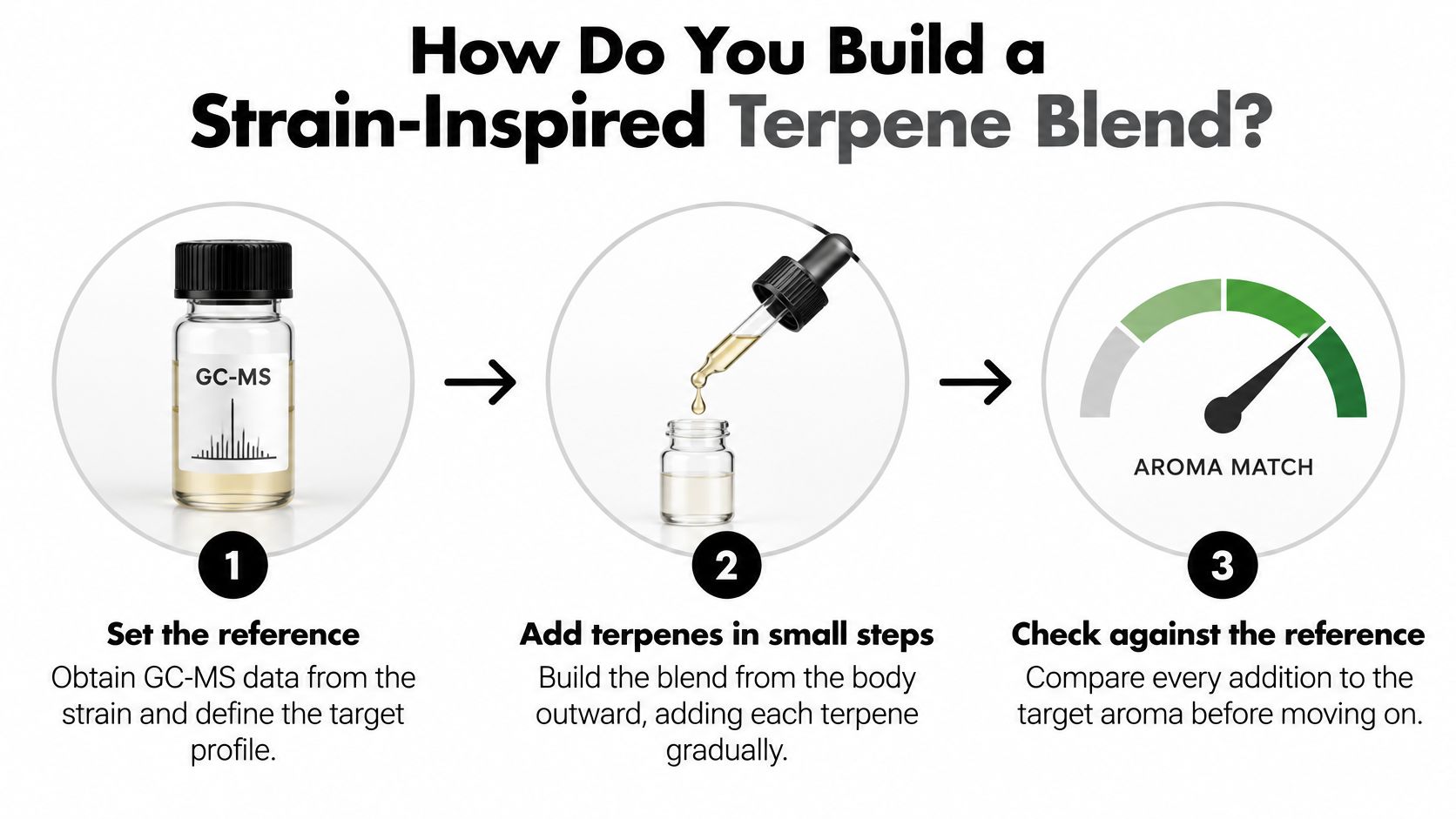
Build from the body outward, and compare each addition with a defined reference. Don't choose exact component percentages until you know whether you're matching flower aroma, an extract, or a finished aerosol.
The development sequence below keeps the reference central rather than letting the available ingredients dictate the target.
Build and document the bench trial
Set the reference. Obtain GC-MS data from the target extract or establish a validated sensory reference with a retained sample and written descriptors. The common mistake is accepting an informal description such as sweet and earthy as a measurable target; it leaves different evaluators matching different products.
Anchor the body with myrcene. Establish the earthy, musky, ripe-fruit foundation before adding the brighter components. Adding the body last makes it harder to judge whether the earlier additions are balanced or prominent in an incomplete mixture.
Introduce beta-caryophyllene gradually. Weigh small additions, mix thoroughly, and compare the peppery mid-base character with the reference using controlled aroma evaluation. Don't keep increasing spice to compensate for missing fruit definition, because those are different formulation problems.
Add pinene conservatively. Use it to sharpen the outline rather than turn the blend into a pine-forward profile. A conspicuous top note can make a bench sample seem more expressive while reducing its resemblance to the target.
Use modifiers as corrections. Add limonene, linalool, and humulene separately, evaluating each before making another change. If your bench protocol uses percentage-step additions, define the denominator explicitly: a change within the terpene concentrate is not the same as increasing total terpenes in the finished oil.
Dilute into the intended matrix. Gold Coast Terpenes's concentrated strains require proper dilution before use, and the Mixing Calculator supports the arithmetic. Calculate by mass and include native terpenes already present in the extract, rather than treating added blend and total terpene content as identical.
Verify chemistry and sensory performance. Compare the finished composition with the reference, then evaluate it in the intended hardware. A jar-only approval misses the changes introduced by heating, and an immediate evaluation can miss a balance that shifts after the mixture has rested.
Define a pass before scaling
Keep a worksheet that records ingredient identity, lot, weighed mass, addition order, mixing conditions, and observations. Retain both successful and rejected trials so the next developer can distinguish a deliberate adjustment from an accidental deviation.
A useful match survives comparison, rest, and repeat preparation. It doesn't just smell convincing immediately after mixing.
The blend is ready for a pilot batch when evaluators recognize the intended fruit, earth, spice, and pine relationship without a distracting modifier. If chemistry aligns but the sensory reference doesn't, investigate the missing aroma contributors instead of forcing the result through larger additions of the same ingredients.
How Does Vape Heat Change a Glueberry Blend, and Where Do Claims Stop?
Heating changes the balance of volatile compounds, so a passing tank aroma doesn't establish a passing cartridge. More volatile notes can be lost preferentially, while thermal degradation and hardware conditions introduce additional changes.
Use the cold-to-heated comparison as a development question, not an assumption that every note transfers intact.
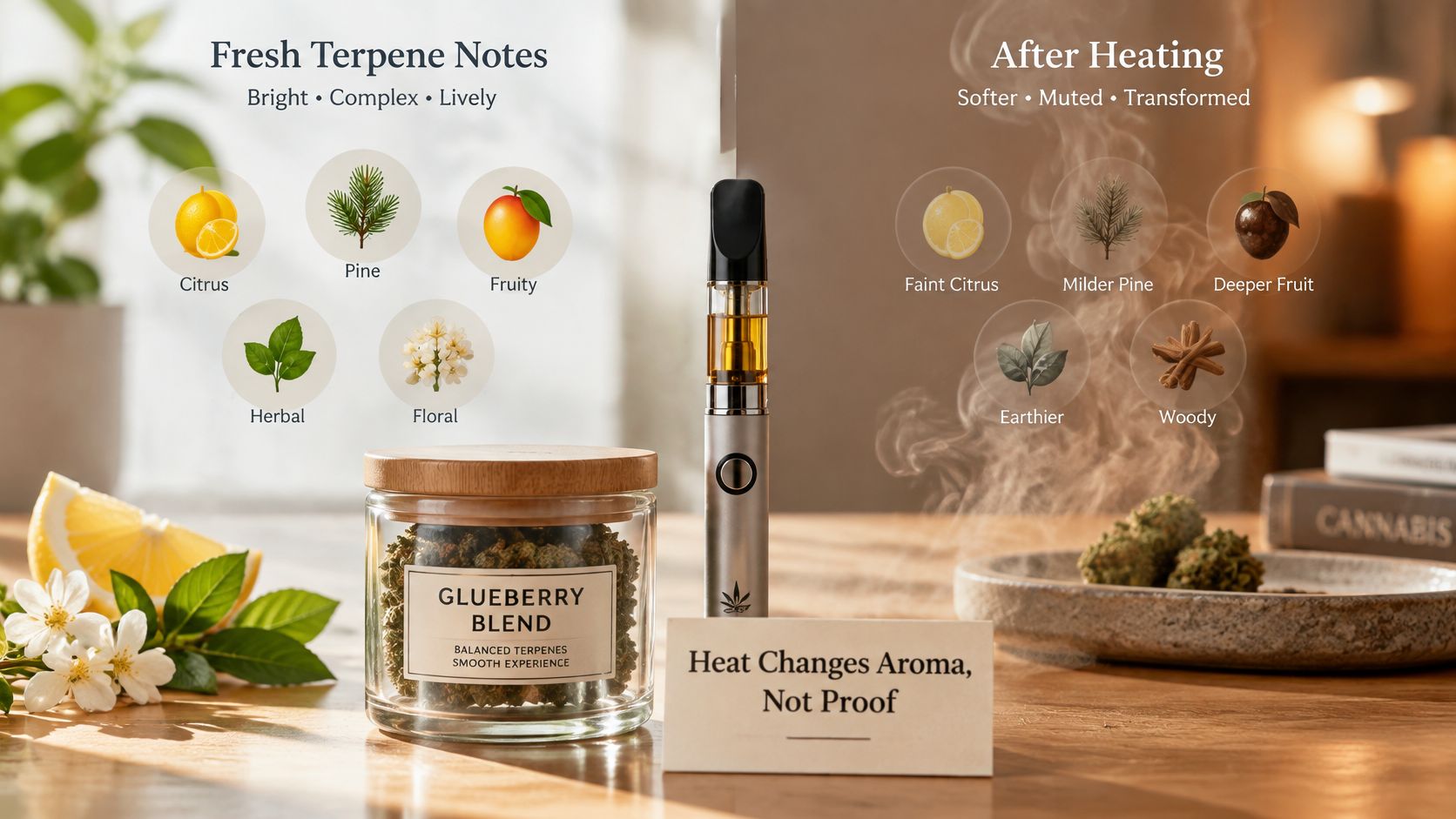
The heating study summarized by Entour's cartridge-terpene guide evaluated twelve cannabis terpenes between 100°C and 500°C, reporting approximately 97–98% survival for myrcene versus 11–28% for terpinolene at the higher temperatures tested. Those laboratory results support investigating a myrcene-led structural body, but they aren't cartridge-specific retention guarantees.
Beta-caryophyllene can support that body while top-note additions receive closer hardware evaluation. Don't assign it the myrcene survival figure, and don't treat a study's heating temperature as a recommended device setting.
Test the device, not just the liquid
Think of the cartridge as a small heat exchanger. Just as a sauce tastes different cold and hot, the liquid's initial aroma won't necessarily predict its heated sensory balance, although aerosol chemistry requires far more than a culinary comparison.
Use a consistent test sequence:
- Record the tank reference. Capture the unheated mixture's fruit, spice, pine, and floral balance.
- Fill the intended hardware. Keep the cartridge model and operating conditions identifiable.
- Measure aerosol performance. Test under expected use conditions with appropriate laboratory controls.
- Compare against the target. Use the same sensory descriptors and evaluation procedure.
- Adjust and repeat. Change the relevant component, rather than increasing the whole blend indiscriminately.
Gold Coast Terpenes's vaping-temperature guide provides operating context, but your hardware validation determines whether a formulation transfers successfully between devices.
The accompanying video is supplementary viewing, not a substitute for emissions testing.
Keep sensory claims separate from effect claims
A California-supported emissions study discussed in Gold Coast Terpenes's botanical-terpene resource tested delta-8-THC and delta-10-THC distillates containing 0%, 7.5%, and 15% terpene mixture by mass, reporting carbonyl-emission increases as high as ninefold under the tested conditions. That finding isn't a universal emissions estimate for other oils, but it rules out treating loading as merely a flavor or viscosity decision.
Describe the outcome as aroma notes resembling a reference. Don't convert that resemblance into promises of relaxation, focus, sleep, or medical benefit.
The appropriate verification package combines finished-batch GC-MS, heated aerosol testing, and a structured sensory panel. None replaces the others.
What Process Checkpoints Apply to Cartridge Batches?
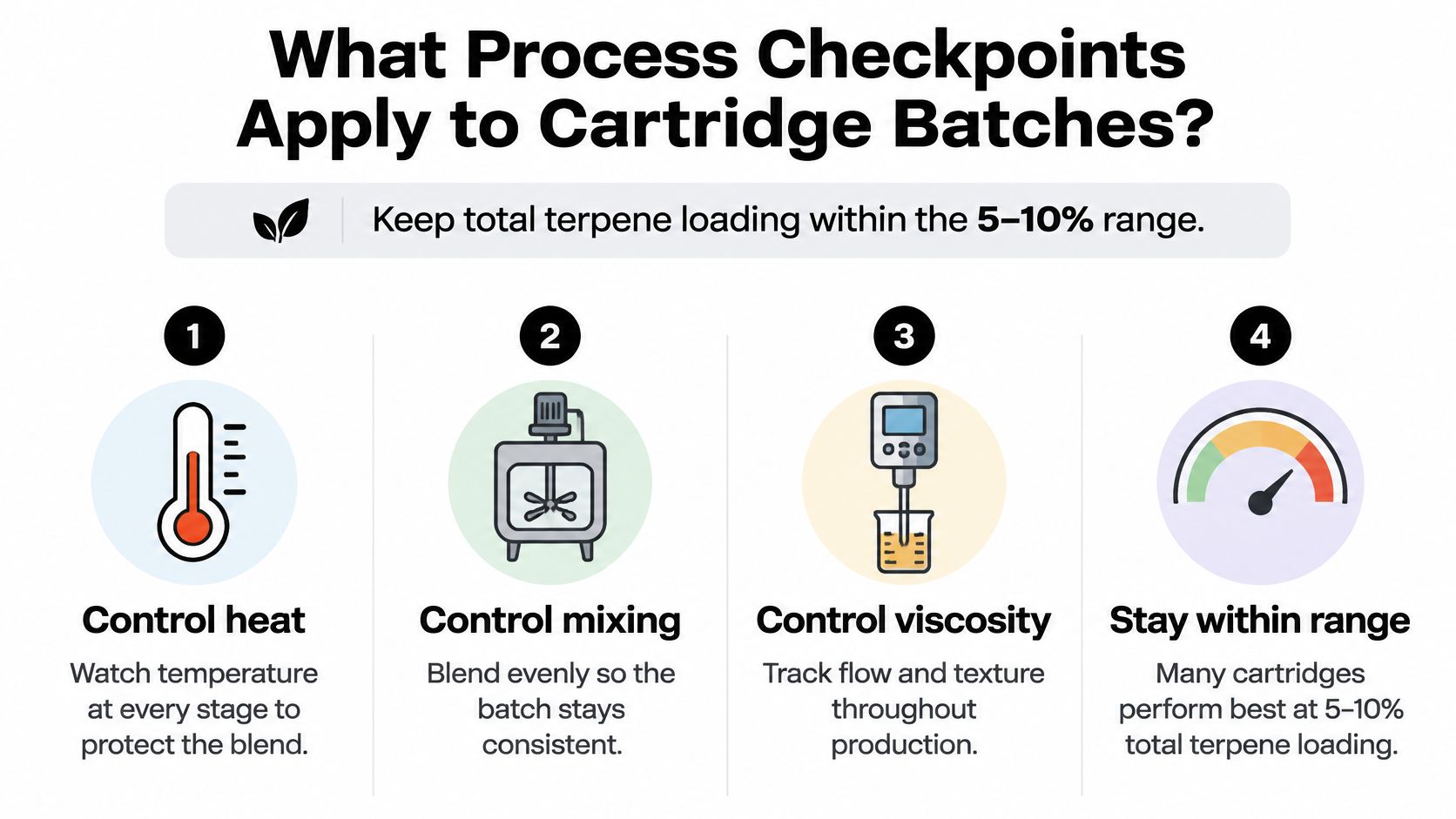
Approximately 5–10% total terpene loading is a published cartridge-development reference, not a universal release specification. Control heat, mixing, and viscosity, then establish the lowest loading that meets your sensory and hardware requirements.
The following checkpoints come from Barney's Farm's cartridge formulation guide. Treat them as starting conditions for process qualification rather than proof of inhalation safety or compatibility with every cartridge.
Cartridge batch process checkpoints
| Checkpoint | Reference value | Why it matters |
|---|---|---|
| Total terpene loading | 5–10% | Published range where cartridges commonly perform best |
| Initial distillate warming | 55–60°C | Supports mixing without unnecessary thermal exposure |
| Temperature control | ±2°C | Reduces process differences between runs |
| Homogenisation | About 30 minutes | Helps distribute the blend before filling |
| Cooling before fill | About 40°C | Establishes a controlled filling condition, subject to equipment requirements |
| Viscosity at 25°C | 150–400 cP | Published range compatible with many ceramic-cell designs |
| Terpene addition step | 1% increments | Helps reduce localized concentration differences |
| Nitrogen storage | −20°C | Reported to preserve more than 95% of initial terpene content for 12–18 months under optimal conditions |
The process priorities are temperature control, uniform mixing, and a verified final flow condition.
Run the process in a controlled order
Warm the distillate only enough to make it mixable, using a calibrated probe in the material rather than relying solely on the heater display. Keep vessels covered where the equipment permits, and avoid extended warm holding while operators wait for the filling line.
Introduce the terpene blend incrementally under mixing. Define each addition as a portion of the planned total, so operators don't accidentally interpret incremental dosing as permission to exceed the approved final loading.
Mechanical homogenisation needs a qualified endpoint. A uniform appearance is useful, but it doesn't demonstrate chemical uniformity; compare samples from different vessel locations when establishing the process.
Cool under controlled conditions before filling, and measure viscosity at the stated test temperature. A viscosity reading without its measurement temperature and method is difficult to reproduce and can mislead hardware selection.
Release checkpoint: A fillable oil isn't automatically a qualified cartridge formulation.
Store and retain a traceable reference
The cited cold-storage result applies under optimal conditions, not to every finished cartridge or opened container. Confirm container compatibility, headspace control, and handling procedures before adopting frozen storage, and allow sealed material to equilibrate before opening to limit condensation.
Close each batch record with actual loading, temperature history, mixing conditions, viscosity, homogeneity results, filling conditions, and storage location. Retain a representative sample so the next run can be compared with an identifiable production reference rather than an operator's memory.
How Do You Choose a Terpene Supplier for a Vape Brand?
Choose by documented sourcing, analytical support, and reproducibility, then evaluate commercial terms. A persuasive strain description won't compensate for unclear composition or inconsistent lots.
For botanical versus cannabis-derived terpenes, the sourcing distinction matters for procurement and labeling. It doesn't, by itself, establish which supplier will match your reference more accurately or produce a qualified aerosol.
Evaluate the supplier against the application
Get the sourcing category in writing. Distinguish botanically extracted, cannabis-derived, and nature-identical materials rather than using those descriptions interchangeably. Chemically matching molecules can still require different sourcing language on purchasing records and packaging.
Review batch documentation. Obtain a batch-specific certificate of analysis and request the chromatographic information needed for your comparison. Gold Coast Terpenes states that its terpenes are THC-free and free of VG, PG, PEG, and MCT, and identifies SC Labs as the provider of product terpene information; verify the documentation relevant to the material you're purchasing.
Identify the complete carrier system. Ask which carriers, solvents, or other ingredients are present rather than interpreting a terpene-forward description as a complete ingredient declaration. Carrier-free language also doesn't establish that the finished aerosol is safe.
Compare lots against your retained reference. Establish acceptable analytical and sensory differences before approving routine supply. A supplier's exact reproduction of its own blend is valuable only if that blend also meets your product's target.
Confirm commercial terms last. Obtain the minimum order quantity, lead time, available pack sizes, and bulk pricing in writing. Don't assume that a wholesale threshold is also a minimum order requirement.
The terpene-company selection guide provides additional procurement context. For vape, CBD, and cannabis brands, the best supplier is the one whose documented material fits the application and whose commercial terms support your production schedule.
Label the actual sourcing and ingredients accurately, and have the finished product reviewed against destination-market requirements. Avoid treating a supplier's ingredient statement as blanket approval for every formulation or jurisdiction.
What Do Formulators Ask Before Ordering Glueberry-Style Terpenes?
Resolve sampling, dilution, and target-definition questions before committing to production volume. These purchasing decisions should support a controlled development trial, not substitute for one.
Can I sample profiles before committing to volume?
Yes. The 3ml Strain Picker Pack from Gold Coast Terpenes lets customers select any three different terpene profiles from the catalog in 1.5ml or 3ml sizes. Use samples for controlled comparison and hardware evaluation before scaling.
How do larger orders work?
Gold Coast Terpenes accepts multiple strains in one order through its bulk ordering option. Wholesale pricing is available on strain orders totaling over 64oz; that threshold isn’t a stated minimum order quantity.
Do the concentrates need dilution before use?
Yes, all Gold Coast Terpenes strains are highly concentrated and need proper dilution before use. Calculate the intended working loading, account for the starting extract’s composition, and verify the finished mixture before filling.
Can a Glueberry label be ordered as a fixed formula?
No, the label alone doesn’t establish a fixed chemical target. When evaluating Gold Coast Terpenes for a Glueberry-inspired project, define the required composition and sensory reference before selecting a catalogue alternative or discussing a matching profile.
Gold Coast Terpenes offers strain-specific blends, isolated compounds, and sampling options for developing a measurable Glueberry-inspired profile. Visit Gold Coast Terpenes to compare available materials, select bench-trial samples, and plan a formulation around your reference extract and intended cartridge hardware.