
Buying another product labeled OG Skunk may not reproduce a previous batch. A strain name is a starting point, not a measurable specification. Gold Coast Terpenes supplies 100% botanically derived terpene blends. Define the target by its aroma and the compound ratios used to approach it, rather than relying on the label alone.
OG Skunk Aroma Targets and Why the Name Is Not a Specification
An OG Skunk label does not define a repeatable aroma. Treat it as a sensory brief: citrus brightness, pine, earthy spice, and a sharp skunk note. Gold Coast Terpenes offers strain-specific profiles, terpene blends, and isolated compounds for product formulation, including isolates that can help build a measurable aroma target.
A workable specification records the reference batch, compound ratios, loading in the finished matrix, and sensory results. Ratios alone are not enough: a blend can meet its target profile on paper yet smell different after dilution. Conversely, a batch that smells right but has drifting ratios may be difficult to reproduce.
Compounds by note role
| Compound | Note role | Aroma contribution | Basis |
|---|---|---|---|
| Limonene | Top | Citrus brightness | Top-note material |
| Alpha-Pinene | Top | Fresh pine edge | Top-note material |
| Alpha Phellandrene | Top | Peppermint with slight citrus | Product aroma description |
| Myrcene | Mid | Earthy, herbal bridge | Mid-note bridge |
| 3-Carene | Mid | Sweet, pungent, pine and cedar resin | Pine and cedar resin constituent |
| Beta-Caryophyllene | Base | Peppery, woody finish | Base-note anchor |
| Alpha-Humulene | Base | Woody, earthy anchor | Base-note anchor |
| Prenylated volatile sulfur compounds | Outside terpene roles | Sharp skunk note | Peer-reviewed GC-MS and sulfur chemiluminescence study |
Beta Pinene accounts for the familiar odor of cannabis, often associated with pine trees and turpentine. That pine impression can support the brief, but it does not define the full aroma. 3 Carene has a sweet, pungent odor and is a main constituent of pine and cedar resin, making it a useful link between the brighter opening and woody finish.
What the lineage does and doesn't tell you
OG Skunk is generally described as a cross of OG #18 and Skunk #1. The Weedpedia history of Skunk #1 traces the strain to late-1970s California, where David Watson combined Afghani genetics with Acapulco Gold and Colombian Gold before seed stock moved to the Netherlands by the early 1980s. That account gives a commonly reported heritage of approximately 25% Afghani, 25% Acapulco Gold, and 50% Colombian Gold, while noting that historical accounts differ on exact ratios.
A dispensary profile reports OG Skunk as approximately 60% sativa-dominant. That label does not specify an aroma recipe. A 2025 analysis summarized in coverage of 140 medicinal-cannabis flower samples found no statistically meaningful relationship between terpene profiles and sativa, indica, or hybrid labels.
Define the brief with compounds, ratios, and a sensory endpoint. Use lineage to explain the name, not to set the recipe.
Record each reference-batch concentration against its certificate of analysis, then select assay-controlled inputs against that baseline. Gold Coast Terpenes offers isolates and blends for building profiles; the reference batch remains the standard for evaluating whether a new lot matches.
Why Terpenes Alone Miss the Skunk Note
Terpenes build the citrus and earth framework, but the sharp skunk note comes from prenylated volatile sulfur compounds, not from terpenes. If you're replicating flavor of OG Skunk with a terpene-only blend, you'll get the structure around the funk without the funk itself.
The visual below maps the framework compounds a formulator can control with isolates.
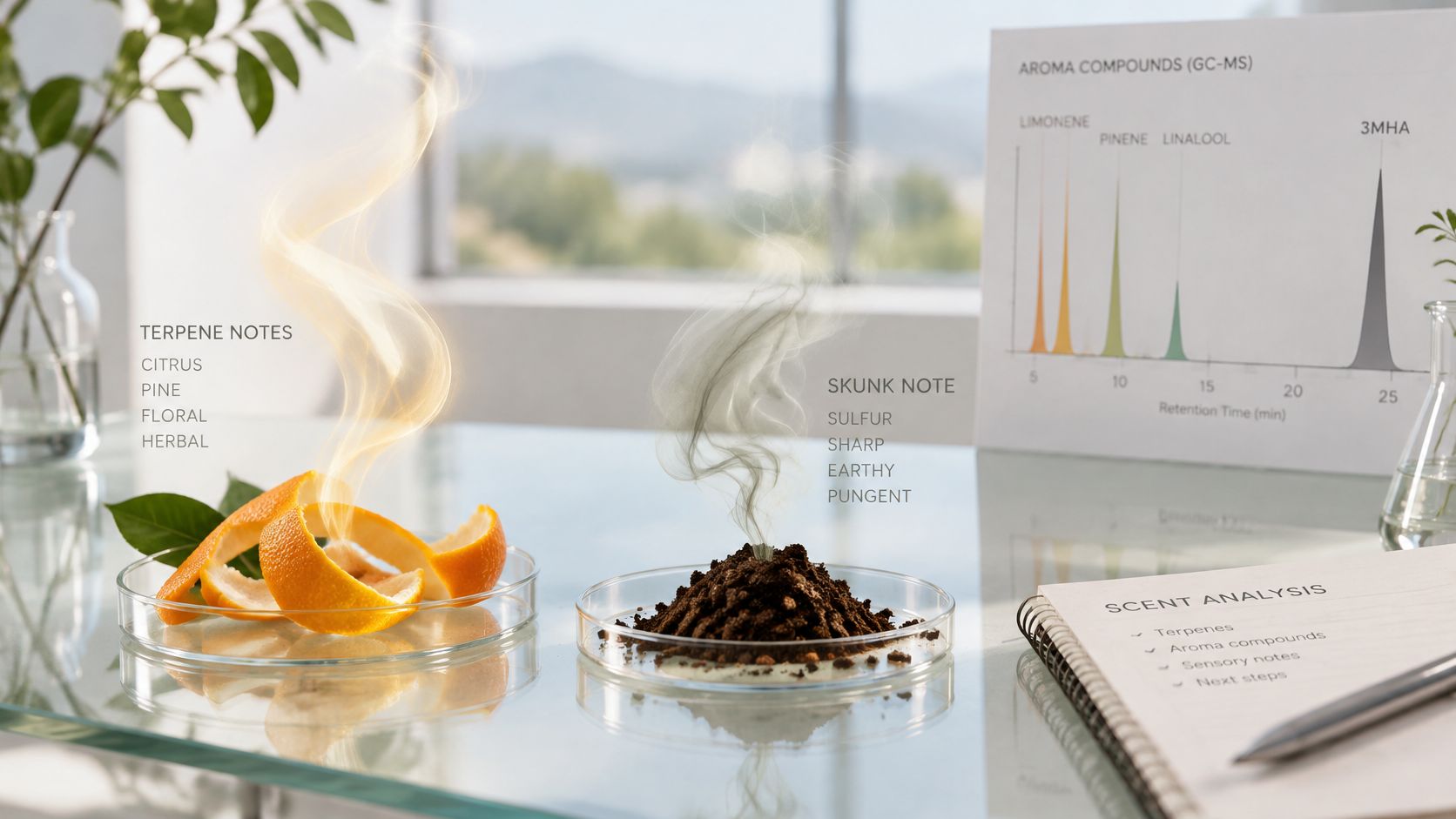
A peer-reviewed chemical investigation in ACS Omega used two-dimensional gas chromatography with mass spectrometry and sulfur chemiluminescence to identify prenylated volatile sulfur compounds alongside beta-myrcene, alpha- and beta-pinene, d-limonene, beta-caryophyllene, terpinolene, and humulene. Those sulfur odorants carry disproportionate sensory impact despite occurring at much lower concentrations than major terpenes. That's why a blend can test correctly on a terpene panel and still miss the brief.
The practical consequence is simple. Raising myrcene deepens the earthy body, and raising limonene lifts the citrus opening, but neither move recreates sulfurous sharpness. Push either one far enough and you distort the balance you're trying to protect, and excessive aromatic loading can also irritate users. Controlled dilution beats heavier loading every time.
Three separate targets
- Total terpene concentration: Sets overall intensity in the finished matrix and guards against harshness.
- Individual terpene ratios: Protect the citrus, pine, earth, and pepper balance against the reference batch.
- Sulfur-odor intensity: Scored separately by sensory panel, because a terpene panel won't capture it.
The short walkthrough below shows how those targets are checked in practice.
I would state this plainly to any client: terpene isolates can't guarantee the sulfur note. Gold Coast Terpenes isolates such as Limonene, Myrcene, and Beta-Caryophyllene let you dial each framework component separately, which is exactly what ratio control requires. The sulfur check stays a separate sensory validation step on the finished product, never an assumption carried over from the terpene certificate.
Botanical vs Cannabis-Derived Terpenes for Vape Brands
Botanically derived terpenes come from non-cannabis plant sources, cannabis-derived terpenes come from cannabis and carry cannabis-origin sourcing and compliance questions, and nature-identical compounds are chemically matched to plant molecules but produced by synthesis. For botanical vs. cannabis-derived terpenes, the category decides what your label can say and what documentation your compliance file needs.
Gold Coast Terpenes labels its blends botanically derived, which removes the cannabis-origin question from the label and from the buyer's file. That matters for vape brands selling across markets with different cannabis rules, because a botanical input doesn't drag the source plant's regulatory status into every new state or country review. It also simplifies flavor matching, since you're working from specified compounds rather than an agricultural extract that shifts with each harvest.
How the three categories differ in practice
- Botanical: Compounds sourced from non-cannabis plants. Label states botanical origin, and the file needs species or source documentation plus the lot certificate.
- Cannabis-derived: Compounds extracted from cannabis. Expect origin, licensing, and transport questions in each market, plus harvest-driven variation.
- Nature-identical: Synthesized molecules chemically matched to plant compounds. Consistent, but the label can't claim botanical sourcing.
For OG Skunk work, the citrus and earth framework comes from isolates, so the category of each isolate determines what the finished product can claim about its source. A single nature-identical input in an otherwise botanical blend changes the honest label copy for the whole SKU. Keep the three categories separate line by line, so a purchasing substitution never changes your claim.
Ask every supplier to state the category in writing for each lot, then compare that statement against the certificate of analysis before the lot enters production. The Gold Coast Terpenes comparison of cannabis-derived and botanically derived terpenes lays out the sourcing distinction buyers should confirm. If a supplier won't put the category on paper, that isn't a paperwork quibble. It's a labeling risk you'll own at retail.
How to Build a Top, Mid and Base Blend
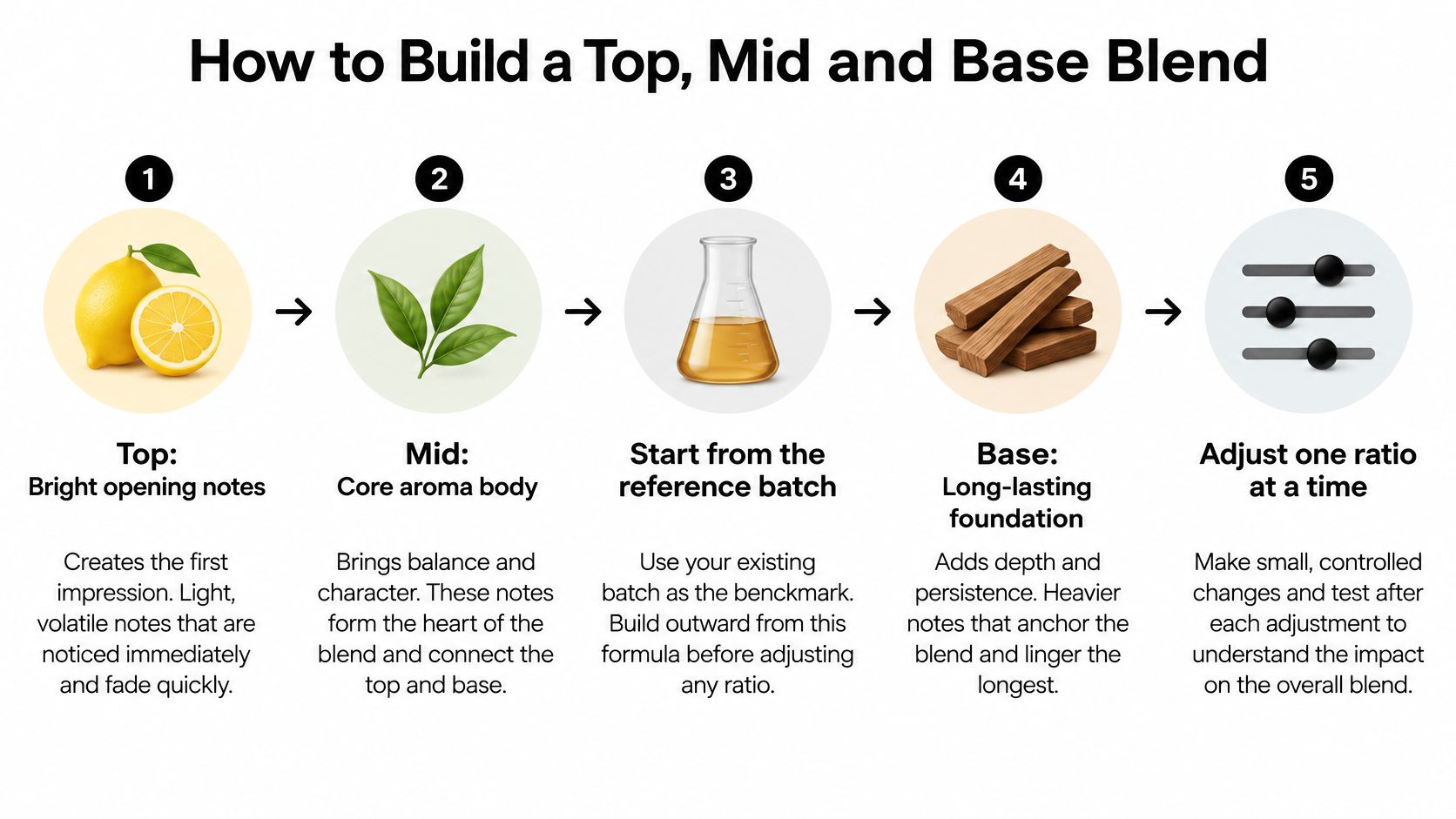
OG Skunk is easier to formulate when you assign each compound a role before adjusting the ratios. Start with the aroma target, then build its citrus, pine, and earthy framework around the sulfur-driven skunk note.
Limonene and alpha-pinene tend to contribute lighter top notes, while myrcene can bridge the opening and middle. Beta-caryophyllene and alpha-humulene are heavier base anchors. These roles guide the blend, but they do not define a universal recipe.
Build sequence
- Set the target brief. List the compounds and their intended roles from your aroma target. A strain name alone does not specify the ratios or the balance you want.
- Use a reference profile. Record the compound ratios you intend to reproduce. OG-labeled profiles can differ, so a specific reference gives the formulation a defined target.
- Assign roles. Use citrus and pine for the opening, myrcene and 3-carene as supporting notes, and caryophyllene and humulene as base anchors. A heavier anchor cannot compensate for a weak opening.
- Weigh isolates against their certificates. Account for assay values rather than relying only on nominal label concentrations. Different assay values can shift the finished balance, especially in a prominent top note.
- Set the working load in the target matrix. Dilute into the winterized distillate or cartridge oil for the product. The matrix can change perceived intensity, so assess the blend there rather than relying on its neat aroma.
- Adjust one variable at a time. Change a single ratio, reassess the aroma, and record the result. Changing multiple ratios together makes it difficult to identify which adjustment improved the balance.
Working rule: Assess the blend after storage as well as when fresh. A citrus-led opening can change over time, shifting its balance against the heavier notes.
The Gold Coast Terpenes guide to mixing terpene strains offers a starting point for blend construction, and the brand offers isolates including Limonene, Myrcene, and Beta-Caryophyllene. Set the working load for the specific matrix and reference rather than treating it as a generic recipe.
Testing Blends in Distillate and Cartridges
Every finished lot gets five checks, and each check gets a recorded value measured against the reference batch. A lot that isn't compared to the reference isn't tested, it's just sampled.
The reason is variation in the source material itself. A Cannaseuse review of OG-labeled cannabis notes that analyses repeatedly identify myrcene, limonene, and beta-caryophyllene, but their relative concentrations vary substantially between samples. So your reference batch and its GC-MS panel become the specification, and the terpene profile for OG Skunk in production means matching that panel lot after lot.
Required batch tests
| Test | What It Verifies | Record Per Lot |
|---|---|---|
| GC-MS terpene panel | Individual terpene ratios | Compound list and percentages |
| Sensory check after dilution | Skunk and citrus balance in the matrix | Score against the target brief |
| Separation check | Stability in distillate or cartridge | Visual result at set time and temperature |
| Oxidation over storage | Aroma drift over time | Re-test at fixed intervals |
| Sulfur-odor intensity | Skunk note strength | Sensory rating against reference |
The sensory check must happen after dilution into the target matrix, not on the neat blend. Distillate mutes some volatiles and carries others, so neat-blend scores predict shelf performance poorly. Test the product your customer will vaporize, in the hardware you'll ship it in.
Oxidation is the slow failure often overlooked during testing. Store filled units at your set conditions, retest at fixed intervals, and compare both the panel and the sensory score to the reference, because top-note loss shows up in the nose before it looks dramatic on paper. Separation in distillate appears sooner. A blend that clouds or layers at your set time and temperature won't deliver a consistent first draw, no matter how good the panel looks.
Terpene information for Gold Coast Terpenes products is provided by SC Labs, and its terpenes for cartridges are SC Lab-tested, so your team can compare supplier certificates directly against your own GC-MS results. The Gold Coast Terpenes overview of terpene testing explains what those panels report. Gold Coast Terpenes products are also legal worldwide and contain no THC, which keeps the testing conversation on flavor and stability rather than cannabinoid compliance.
Hold one hard rule: no lot ships without a certificate that matches the reference ratios within the tolerance your team set before production started.
How to Choose a Supplier and Confirm a Reference Batch
Judge a supplier on documentation and repeatability, and confirm a reference batch before any bulk order. No bulk order goes out before the reference passes in your matrix.
Price comparisons mislead here. A cheaper blend that drifts between lots costs you reformulation time, rejected fills, and a flavor your repeat buyers notice. Documentation is what converts a sample you liked into a SKU you can reproduce, which is the whole commercial point of formulating a strain-inspired profile.
Supplier checklist
| Criterion | Why It Matters | Evidence to Request |
|---|---|---|
| Certificate of analysis per lot | Lot data repeats a flavor | GC-MS terpene data per lot |
| Named third-party lab | Independent verification | Lab name on each certificate |
| Isolate vs blend disclosure | Sets dilution control | Written composition statement |
| Lot-to-lot match to reference | Keeps replication stable | Lot certificate against reference batch |
| THC content and legal status | Market access | Certificate and market statement |
| Labeling for target market | Compliance | Label copy for review |
| Minimum order quantity | Pilot budget | Written quote before pilot order |
| Flavor-matching support | Matrix fit | Pilot data in distillate or cartridge |
Gold Coast Terpenes publishes SC Lab-tested terpene information, and buyers still compare its certificates against their own GC-MS results. That double check isn't distrust. It's how you confirm your lab and the supplier's lab read the same sample the same way before tolerances are written into a supply agreement. Gold Coast Terpenes also runs programs for Distro, Shops & Independent Reps, Affiliates, and Manufacturers & Brands, and offers free shipping on all orders above $100, which matters when you're budgeting pilot lots.
Reference batch steps
- Send your target compound list and ratios. Request a certificate for the sample lot itself, not a generic product certificate.
- Compare the certificate with your GC-MS data. Resolve gaps now, while the order is still a sample.
- Run a pilot in the intended matrix. Score it against the brief in distillate or a filled cartridge.
- Test one storage cycle. Confirm the aroma holds before you commit packaging and launch dates.
- Record the passing batch as the lot standard. Place the production order only after it passes.
Start with samples rather than a bulk commitment, as the Gold Coast Terpenes terpene samples page describes. To discuss sample lots and minimum order quantities for a pilot, call Gold Coast Terpenes at 929-356-6086.
Frequently Asked Questions About OG Skunk Formulation
Does an OG Skunk label guarantee a specific aroma?
No. The name alone does not specify compound ratios or a consistent aroma target. Define the profile by compounds, ratios, and a reference batch, then assess each lot against that specification.
Can terpenes alone reproduce the skunk note?
No. Terpenes can build the citrus, pine, earth, and pepper framework, while the sharp skunk note is sulfur-driven. Check that character separately in the finished product.
Are Gold Coast Terpenes products legal and THC-free?
Gold Coast Terpenes describes its products as legal worldwide and THC-free. Its cartridge terpenes are SC Lab-tested.
What's the difference between botanical and cannabis-derived labeling?
Botanical terpenes come from non-cannabis plants; cannabis-derived terpenes come from cannabis. The distinction can affect labeling and compliance requirements in a given market. Ask any supplier, including Gold Coast Terpenes, to state in writing whether each blend is botanically derived, cannabis-derived, or nature-identical, because that category determines what your label can say.
What should I confirm before a bulk order?
Use a sample lot to check the blend in your intended matrix and through a storage cycle. Confirm the minimum order quantity and required documentation with the supplier before committing, since terms can differ by product.
For an OG Skunk brief, specify the terpene-driven citrus and earth framework separately from the sulfur-driven skunk note. Gold Coast Terpenes offers natural terpene blends and isolates for cartridges, concentrates, and product formulation. Visit Gold Coast Terpenes to explore its products.