
The Pineapple Chunk terpene profile on most public charts is shopping copy, not a formula. Copy one into a distillate batch and you get a blend that smells fine in a vial and disappoints in vapor. Gold Coast Terpenes supplies 100% botanically derived blends rather than cannabis-derived ones, which lets you set ratios deliberately instead of approximating a cultivar's chemistry. Treat the strain name as a sensory target, define a testable ratio, then validate it in aerosol on the hardware you ship before you scale.
Which Terpenes Define a Pineapple Chunk Profile?
Myrcene, terpinolene, and limonene define most public descriptions, with beta-pinene, beta-caryophyllene, humulene, and linalool appearing in some profiles. Gold Coast Terpenes sells both strain blends and isolates of limonene, myrcene, and beta-caryophyllene, so you can set the ratios yourself instead of accepting whatever a pre-mixed bottle contains.
That core holds up across public references. The Cannabis Training University Pineapple Chunk page links the cultivar to myrcene, terpinolene, and limonene, describing myrcene as earthy and musky, terpinolene as fresh, herbal, piney, or floral, and limonene as citrus brightness. Together they explain the sweet tropical fruit over earthy, skunky, and cheese-like undertones that formulators keep chasing.
Why the choice matters beyond aroma
Terpene selection drives more than scent. Raising or cutting a volatile top note also shifts viscosity and dosing behavior in a distillate blend, which changes how oil wicks, how a cartridge draws, and whether it leaks in transit. A blend that smells right in a vial can still fail mechanically.
No public source gives an authoritative percentage for these terpenes, so build by role, not by copied ratios.
Core terpenes in a Pineapple Chunk strain-inspired blend
| Terpene | Aroma descriptor | Typical note position | Role in a Pineapple Chunk blend |
|---|---|---|---|
| Terpinolene | Fresh, herbal, piney, floral | Top to mid | Leads the tropical, herbal opening |
| Limonene | Bright citrus | Top | Adds citrus lift to the pineapple accord |
| Beta-pinene | Pine, turpentine-like | Top | Adds the sharp resinous edge of cannabis aroma |
| Beta-caryophyllene | Peppery, woody | Mid | Adds spice behind the fruit |
| Linalool | Floral | Mid | Optional floral lift that softens sharp edges |
| Myrcene | Earthy, musky | Base | Adds depth and the earthy, skunky undertone |
| Humulene | Woody, earthy | Base | Leading terpene in some public profiles, anchors the base |
Use the table as a starting checklist when you review Gold Coast Terpenes terpene product pages and terpene guides for a formulation guide approach. Then pull the batch certificate before you scale. A lot can name terpinolene as the dominant compound while the retail label leads with myrcene, and a blend built from the label lands flat in the cartridge: less tropical lift, more muddy base. Read the COA's top terpene, match it against your target ratio, and record the batch number you validated so the next lot gets compared against the same numbers.
Why Do Pineapple Chunk Terpene Profiles Disagree?
Three public sources, three different lead terpenes. One lists myrcene and humulene at the top, another puts terpinolene first with myrcene and limonene behind it, and others describe pineapple, earthy, cheese and skunk aromas with no quantitative lab work published at all, as the Royal King Seeds Pineapple Chunk listing shows. A strain name is a marketing label, not a specification you can hand to a blending bench.
Lineage explains the direction and nothing more. Barney's Farm bred the cultivar in Amsterdam from Pineapple crossed with Cheese and Skunk #1, which points to tropical fruit sitting over a pungent base. That tells you to lean on terpinolene and myrcene. It tells you nothing about what a specific lot contains.
Two mechanics drive most of the disagreement. Aroma descriptors come from human noses at different thresholds, so "cheese" on one page and "skunk" on another may describe the same material. Chemotype also segregates within a seed line, so two growers running the same cross can end up with different dominant terpenes and a different terpene-to-cannabinoid balance.
Reported Pineapple Chunk potency and yield by source
| Source (2026) | Reported THC | Other reported values | Formulation use |
|---|---|---|---|
| Leafly | 19% | 1% CBG | Strain page, not batch data |
| Barney's Farm | 28% | 550-650 g/m² indoor yield | Breeder listing |
| Seedsman | 25% or more | 450-600 g/m² indoor yield | Retailer listing |
| Hytiva | 16%-26% average range | No other value stated | Range across sources |
| The Highway | No THC value stated | 1-5% CBD, 450-600 g/m² indoor yield | Grower reference |
The 16% to 28% spread across those five listings is the argument in one line. Each figure describes one grower's best plant under that grower's conditions, not a target your cartridge has to hit. Genetics and phenotype, light and substrate, cure length, storage, extraction solvent and batch age all pull the finished oil away from any published number, and a single tested sample can sit well outside the whole range.
For formulation, treat those figures as a rough potency band and nothing finer. Pull a batch-specific certificate of analysis for the material going into the cart, then use the strain terpene profiles archive to line up candidate aroma targets against it. Matching an aroma profile does not reproduce cannabinoid content, and no terpene blend reproduces an effect.
How Do Top, Mid and Base Notes Shape the Blend?
Top notes set the first impression, mid notes carry the body, and base notes anchor the blend and decide whether it still reads as the target on the last draw. Structure your terpene profile for a cartridge around that sequence, not around a single dominant compound.
The pyramid below shows how the three layers stack in a finished blend.
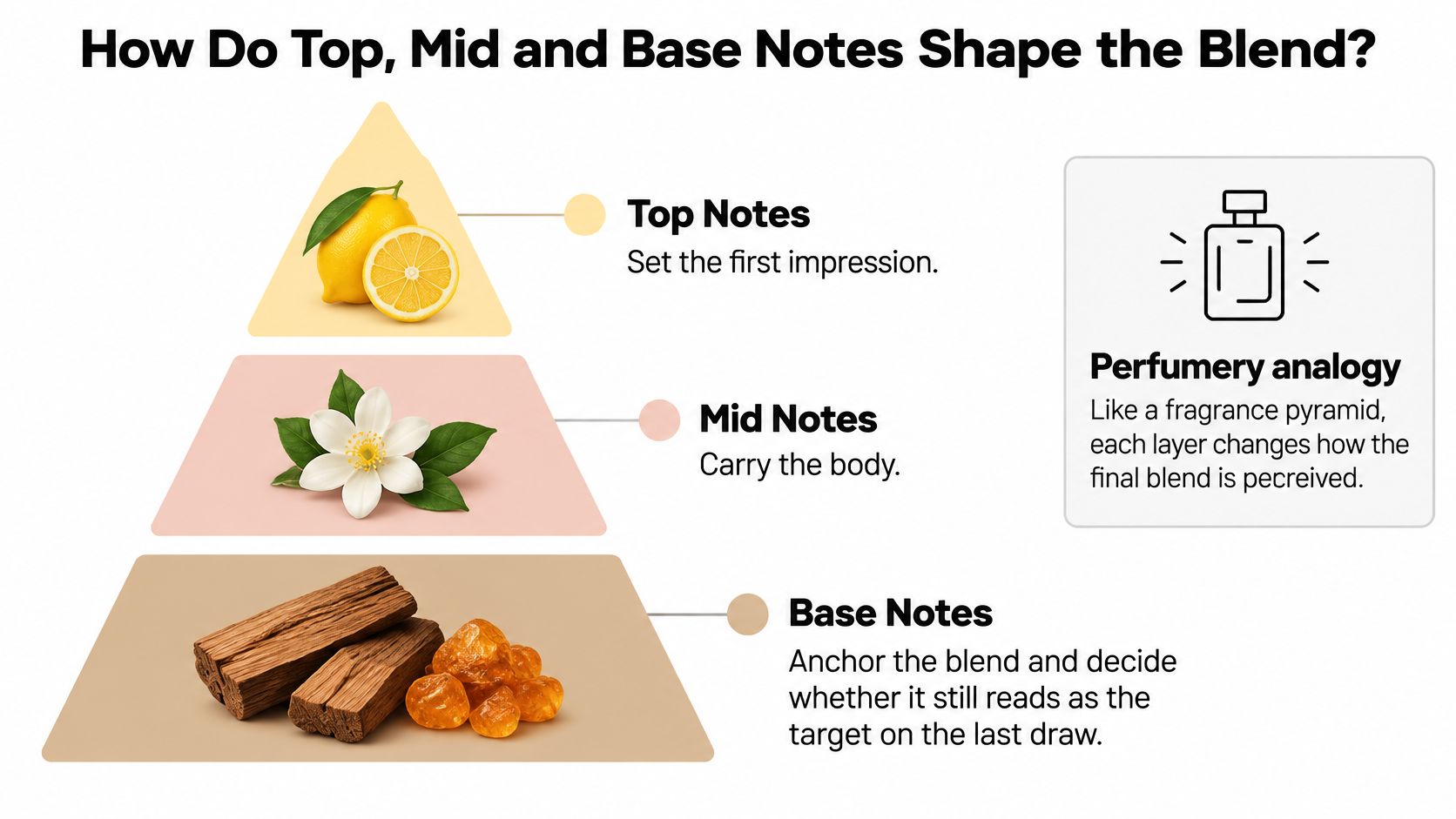
Think of it as a chord. The melody sits on top, the harmony fills the middle, and the bass line holds everything underneath. Remove the bass and the chord is recognizable for a moment, then thin.
In a vape distillate, the most volatile terpenes leave first. A blend built only from top notes tastes bright at the start and flat by the end of the cartridge, because there's nothing heavier left to carry the target character.
Top notes sell the first draw, while base notes decide whether the flavor still reads as the target by the last draw.
Map Pineapple Chunk onto that sequence. Terpinolene and limonene sit in the top, beta-caryophyllene and linalool in the mid, and myrcene and humulene in the base, a layout that's easier to check against the terpene flavor chart than against prose descriptions.
The video below walks through how layered notes behave when a blend is built in stages.
The common failure is predictable. A formulator adds a bright citrus accord, tests only the first pull, and misses that the earthy base has dropped out. Check each stage in the intended hardware before adding the next note, then apply the build order and benchmark in the cartridge section below.
How to Formulate a Pineapple Chunk Blend for Vape Cartridges
Cannabis-concentrate research used a 9:1 THC-to-terpene ratio, roughly 10% terpenes in the cannabinoid-plus-terpene mass, as a practical model because it produced material that was neither too viscous nor too fluid; the same study notes that excessive terpene loading can make concentrate too fluid and cause leakage from a vape pen, per the PMC cannabis-concentrate vaping study. Treat 10% as a working starting load derived from that ratio, then adjust for your distillate and hardware.
Treat the benchmark as a starting ratio. Flavor comes from note balance, and the build order is how you turn that ratio into a testable Pineapple Chunk blend.
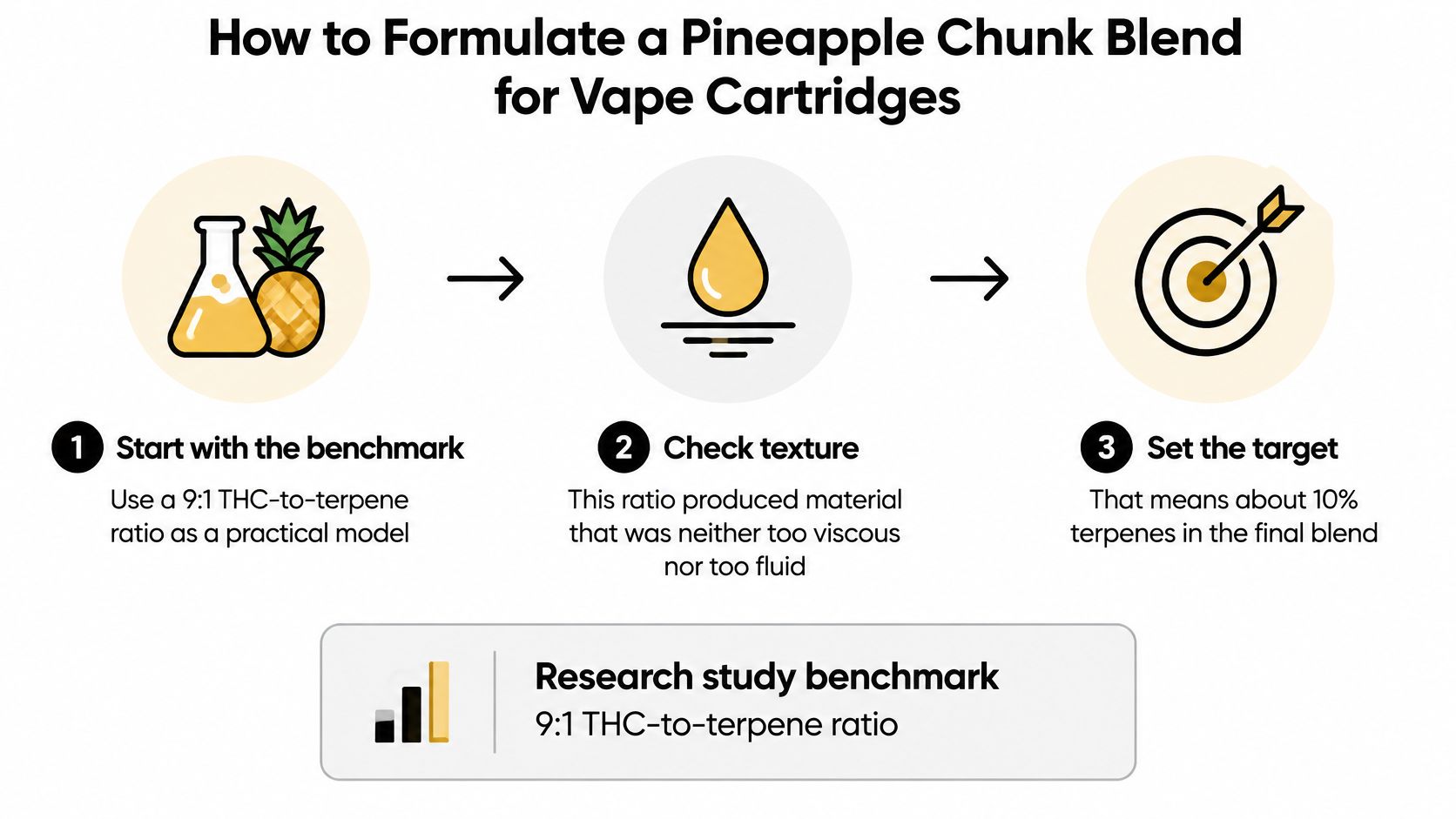
The build, step by step
Read the baseline first. Check the distillate's cannabinoid and terpene baseline on its certificate of analysis before adding anything. Skipping this means you're formulating against an unknown starting oil.
Set the first trial load. Put total terpenes at about 10% of the cannabinoid-plus-terpene mass for trial one. The Mixing Calculator on the Gold Coast Terpenes site handles the arithmetic, and the how to use terpenes guide covers the working method.
Build the base first. Add myrcene and humulene before anything volatile, so the earthy foundation is set and measurable. If you build the top first, you'll keep chasing brightness to cover a missing base.
Add the mid notes. Bring in beta-caryophyllene and linalool for peppery body and optional floral lift. Keep linalool restrained, since a heavy hand pushes the profile toward generic floral and away from tropical fruit.
Finish with the top accord. Add terpinolene and limonene, with a small share of beta-pinene for the resinous edge. Too much limonene can thin the oil and raise leak risk, so change it in small increments.
Mix at a controlled temperature. Blend into the distillate at a set temperature and log it. Two lots can look identical on paper while a missing fill-temperature record hides the difference.
Rest the blend, then judge it. Let the mix rest before evaluating against the target sensory brief. A flat base often shows up only after the top notes settle.
Fill test cartridges. Check viscosity and leak rate in the actual hardware, stored in the orientation you'll ship. A blend that holds in a jar can still weep through a coil assembly.
Trial discipline: A leak can come from terpene load, top-accord share, or hardware. Hold two of those fixed on each run so the cause is identifiable.
Records that make the blend repeatable
For every lot, log terpene percentage, fill temperature, storage conditions, cartridge orientation, and leak rate. Gold Coast Terpenes offers over 50 strains of terpenes across Indica, Sativa, and Hybrid categories, so matching a target like this one is a selection and ratio problem, not a sourcing problem. Start at the benchmark, hold the load fixed, and adjust the note balance until the aerosol reads right. Before scaling, run the blend in the cartridge you will ship and judge the aerosol, not just the oil.
Does the Aerosol Match the Oil You Tested?
A passing oil test does not prove the delivered flavor. The liquid profile and the inhaled aerosol profile can differ, and they diverge for reasons you can measure rather than guess at.
A published analytical study detected more than 100 terpenes and natural extracts, 19 cannabinoids, and additives including vitamin E acetate, polyethylene glycols, and medium-chain triglycerides in cannabis vape oils, and found that vaporizing can produce additional terpenes and minor cannabinoids, according to the PMC analytical study of cannabis vape oils. Its commonly observed terpene set included caryophyllene, D-limonene, alpha-humulene, linalool, and terpinolene, which overlaps directly with this target.
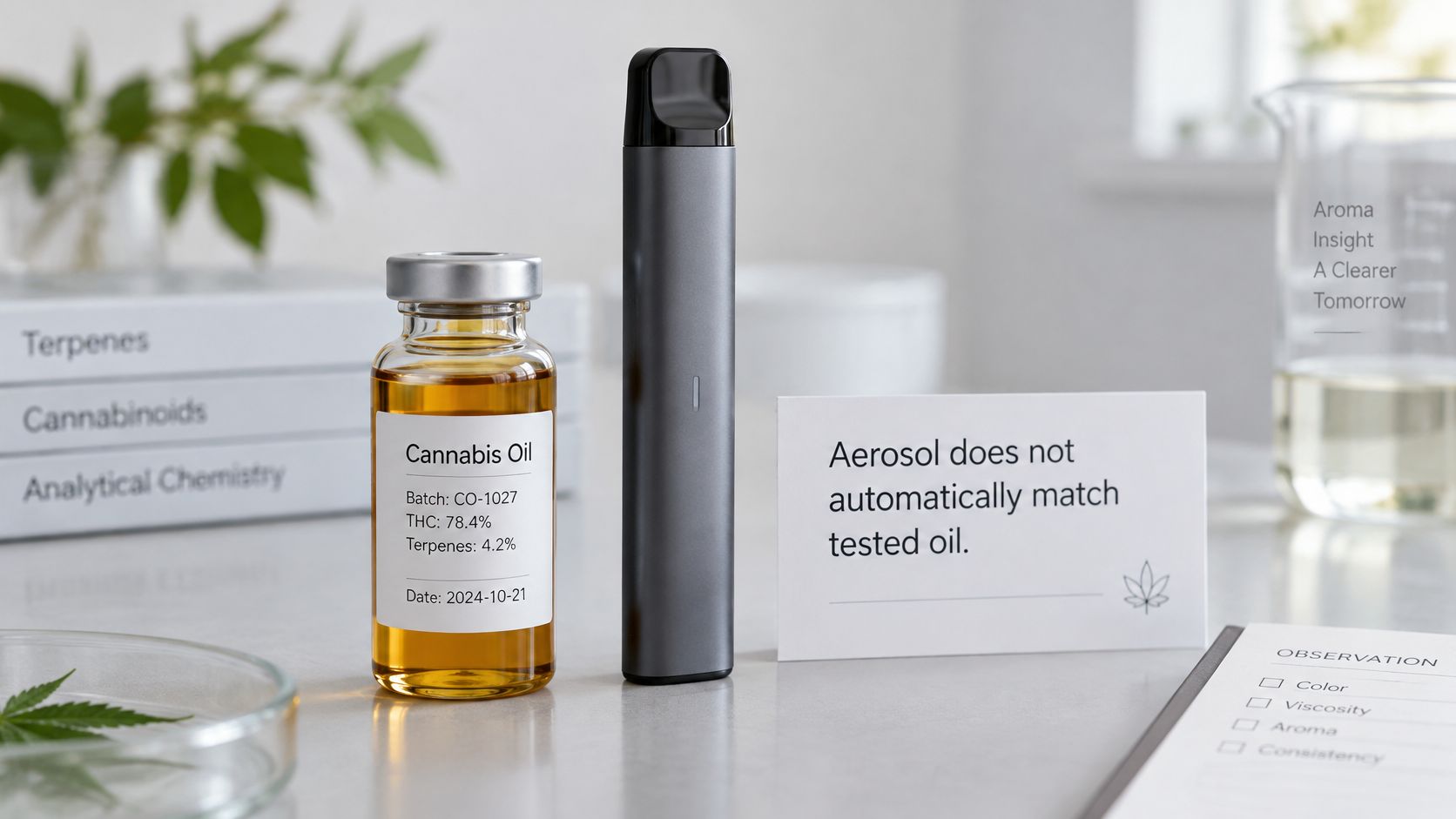
The bench that produces usable numbers pairs oil and aerosol checks on the same lot. Run GC-MS on the blended oil, then generate aerosol on the cartridge you intend to ship and capture what comes off the coil. Two chromatograms from the same batch tell you how much of the top accord survived the heater.
Why heating changes the answer
Degradation outcomes depend on terpene composition, heating method, power, and device configuration, not composition alone. A review summarized in the Terps USA PG and PEG vaping safety whitepaper reports that increased beta-myrcene during dabbing was linked to more hazardous products, while tested cartridge mixtures showed lower degradation with higher myrcene. Read those two findings together and the lesson is device-specific: the same molecule behaves differently under a nail and under a coil.
Coil temperature, residence time, and oxygen exposure all act on the same oil differently across devices. A blend tuned on one cartridge can read muted or harsh on another with a different resistance. That is why a profile that scores well in the jar and poorly in the aerosol usually needs note-balance work, not a higher terpene load.
Validation checklist
- Finished oil analysis: Run GC-MS on the blended oil before filling.
- Aerosol testing: Generate aerosol on the intended hardware, not a stand-in device.
- Power range coverage: Test across the coil resistance and wattage range you'll ship.
- Sensory panel: Judge the aerosol, not the oil, against the brief.
- Mechanical checks: Confirm viscosity and leak rate after filling.
- Storage retest: Repeat key checks after storage to catch drift.
Changing a hardware supplier or the terpene concentration is reason enough to repeat the aerosol step. Gold Coast Terpenes supplies lab-verified blends that can be tested on your intended hardware, and its terpene guides set out the check protocols to follow.
How Do You Choose a Terpene Supplier for a Compliant Pineapple Chunk SKU?
Choose a supplier that issues a certificate of analysis for the exact lot you will fill, covering the terpene panel, cannabinoid panel and residual-solvent results, with testing confirmed at fill stage. For a Pineapple Chunk SKU, the strain name does not settle the label category. The terpene source does.
Settle the label category first
Botanical versus cannabis-derived terpenes is the first decision, and it has to be settled in writing before artwork starts. Nature-identical compounds and single isolates are separate categories again, with different wording.
Terpene source categories and the label wording to confirm
| Category | Origin | Label to confirm in writing |
|---|---|---|
| Botanically derived blend | Extracted from non-cannabis plant material | Botanical terpene blend |
| Nature-identical compound | Synthesized to match a natural molecule | Nature-identical, stated per compound |
| Isolate | Single purified compound | Isolate, named compound and purity stated on the certificate |
Gold Coast Terpenes supplies lab-verified, THC-free blends that are free of VG, PG, PEG and MCT. Those carriers change how a vape oil behaves under heat, so keep them out of the spec. Confirm per product whether you are buying a botanical blend, a nature-identical compound or an isolate, and keep that wording consistent from certificate to carton.
Run the potency math on the finished matrix
Use the applicable THCA-to-THC conversion to calculate potential total THC, then verify it in the finished product after blending and filling. A certificate that limits its findings to the tested sample and batch is the right model for a Pineapple Chunk SKU. It tells you what the lab saw, not what the strain name promises. Apply the same limit to every supplier you shortlist.
Send this request list unchanged
- Lot certificate: The certificate for the exact lot you will receive, with sample ID and test date.
- Cultivar source: Documented origin for the profile.
- Cannabinoid and terpene panels: Both panels, not a summary value.
- Residual-solvent results: Reported for the finished blend.
- Fill-stage test: Confirmation on the filled matrix.
- Written MOQ per SKU: Stated before you commit to scale-up.
- State requirements: Written confirmation before shipping.
When comparing terpene suppliers for vape brands, score each one against that list using the where to buy terpenes guide. The certificate locks the input. It does not prove the received lot matches the aerosol you approved, so retest the lot on your cartridge before you scale. A supplier who cannot produce lot paperwork cannot support a compliant Pineapple Chunk SKU.
Start With a Trial Set Before Committing to a Batch
Reworking a filled batch is the expensive mistake in this workflow. A three-vial trial is not, and it settles the same question before you spend on scale.
Gold Coast Terpenes offers a 3ml Strain Picker Pack that lets customers select any three different terpene profiles from the catalog in 1.5ml or 3ml sizes, with listed use cases of terpene testing, custom vape or tincture formulation, and comparing Indica vs. Sativa effects. That maps onto a three-way trial. Confirm size and availability on the product page before ordering.
Run a three-way test
Hold the distillate constant and vary one note at a time: a terpinolene-led top, a limonene-led top, and a myrcene-led base, each diluted to the benchmark ratio settled in the formulation section. All strains are highly concentrated and need to be properly diluted before use. Neat terpenes scorch on the coil and tell you nothing about the delivered aerosol.
Score the trials on three points:
- First draw to last draw: the sensory brief should hold through the cart, not just at the head.
- Viscosity in the test hardware: no leaking and no dry hits at the wattage you ship at.
- Aerosol at shipping wattage: the flavor in the vapor matches the profile you signed off in the vial.
Terpenes 101 covers dilution practice, and the Mixing Calculator converts a target percentage into grams before you pour.
The catalog also lists Elevated Strains, profiles built by the Master Terpologists around higher levels of rare and exotic terpenes. Read those notes when your target needs fruit and dessert nuance a standard profile will not carry.
Order the trial set, run all three checks, and pick the variant that survives them before you commit to batch volume. A month of chart comparison will not settle what one aerosol test on your own device does.
Pineapple Chunk Formulation FAQs
Are Gold Coast Terpenes blends botanically derived or nature-identical?
Gold Coast Terpenes blends are botanically derived and not cannabis-derived. Confirm the label category per product, since isolates and nature-identical compounds carry different wording.
Does a blend need a new aerosol test if the terpene percentage changes?
Yes. Changing concentration or hardware repeats the aerosol step, because either change can alter the delivered profile. Retest on the intended device at the shipping power range.
Can these blends be used in tinctures as well as distillate?
The blends are free of VG, PG, PEG, and MCT, so you select the carrier for terpenes for distillate or tincture use yourself. Run a small trial to confirm how the blend behaves in that carrier before committing.
Do isolates replace a full Pineapple Chunk profile?
No. Isolates such as Limonene, Myrcene, and Beta-Caryophyllene let you adjust a single note, while a strain target needs a complete profile across top, mid and base notes. Use isolates to sharpen a blend, not to stand in for the full profile.
What should a Pineapple Chunk trial record include?
Record the lot ID, dilution, hardware, shipping wattage, first-draw and last-draw sensory notes, and the aerosol result. That record is what makes the next batch repeatable rather than a fresh guess.
Gold Coast Terpenes supplies botanically derived, THC-free blends and isolates for distillate and cartridge work, with trial packs sized for bench testing before scale-up. Use the benchmark and aerosol check from this guide to turn a strain name into a repeatable SKU. Visit Gold Coast Terpenes to select trial profiles and start a Pineapple Chunk blend for cannabis product formulation.