
A peer-reviewed cannabis-product analysis counted 224 510-thread cartridges versus eight Pax pods, illustrating the reach of replaceable hardware in that market sample, according to the published product analysis. Gold Coast Terpenes supplies 100% botanically derived terpene blends and isolates, so a formulation can start from an identified botanical input. A familiar connector still does not guarantee that the finished cartridge will reproduce the intended flavor.
For developers building 510 cartridges around distillate, the useful distinction is compatibility versus performance. Fit, filling behavior, terpene loading, thermal delivery, and metal exposure are separate variables. Each one can pass on its own and still fail in combination, which is why the assembled cartridge, not the spec sheet, is the true test of a build.
What Is a 510 Cartridge and Why Does It Matter?
A 510 cartridge is a replaceable consumable whose one fixed attribute is its screw-thread connection; capacity, oil type and brand all vary from one SKU to the next. Gold Coast Terpenes supplies botanical rather than cannabis-derived blends, so the formulation starts from a clearly identified botanical input, and the cartridge itself decides how that input reaches the aerosol. Two cartridges from different suppliers can share the thread and behave nothing alike at the same fill volume.
The connector uses about a 0.5-millimeter thread pitch and roughly ten turns, as described in Ganjapreneur's cartridge explainer. That interface separates the replaceable oil cartridge from its rechargeable power source, which lets a developer ship an oil SKU without supplying a new battery with every replacement.
In 2025, 510-threaded hardware accounted for 91.3% of U.S. vapor-pen sales, according to Headset's cannabis industry analysis. A large installed base of compatible batteries narrows the qualification problem to the devices your buyers own.
Separate the formulation from the delivery system
A purchasing specification should carry the blend and the hardware on separate lines. Put aroma target and ingredient identity on one; put cartridge dimensions, center-pin geometry, resistance and airflow on the other, then qualify battery behavior against the assembled unit. A blend that reads cleanly in a tincture can flatten inside a cartridge body with a tighter feed opening and a different heater.
The shop lists 127 products in total across strain profiles and isolates, and each one still needs qualifying against a specific cartridge body and battery. A lab-tested terpene input covers the ingredient; it does not replace jurisdiction-specific review of the finished cannabis product, its labeling, or its hardware.
Practical rule: A shared thread establishes a connection standard. Flavor accuracy belongs to the finished oil, cartridge, and battery combination.
Which Compatibility Specs Must Match Before Filling?
| Spec | Working reference | Why it matters | Failure when ignored |
|---|---|---|---|
| 510 thread | About 0.5 mm pitch, about 10 turns | Sets the mechanical seat on the battery | Cartridge won't seat or connect |
| Outer width | Wider than 11.5 mm may not fit some concealed batteries | Fits inside concealed battery housings | Cartridge won't fit or sits proud |
| Center pin length | Must match the battery contact pin | Completes electrical contact | Nonstandard pin prevents contact |
| Battery voltage | Use the validated cartridge operating range within the battery's available presets | Controls how fast oil heats | Excess voltage burns oil and damages the cartridge |
| Oil viscosity | Qualify the finished blend against the cartridge's feed openings and heater | Governs wicking and flow | Thick oil clogs or performs harshly on mismatched batteries |
These specifications must match before production filling because mechanical seating, electrical contact, and oil delivery are separate requirements. A cartridge can pass one and fail another.
The thread reference describes the mechanical interface; it says nothing about the surrounding battery enclosure. A technical battery buyer's checklist warns that cartridges wider than 11.5 mm may not fit some concealed batteries, nonstandard pins can prevent contact, and excessive voltage can cause burnt flavor and cartridge damage.
Center-pin length matters because a cartridge that screws down still needs reliable contact without excessive tightening. Battery voltage matters because the available presets must overlap the cartridge's validated operating conditions. Oil viscosity matters because a formulation must replenish the heater during use, not merely flow through the filling needle.
Make the pre-fill check measurable
Use calipers for cartridge diameter and overall dimensions. Compare the center-pin arrangement and resistance specification with the intended battery documentation, and inspect the assembled fit without forcing the cartridge into place.
- Measure a sample cartridge. Check the actual supplied hardware rather than relying entirely on a drawing.
- Confirm battery operation safely. Use a properly filled, saturated test cartridge at a conservative supported setting. Never dry-fire empty production hardware.
- Record the pairing. Capture cartridge lot, battery model, setting, contact behavior, airflow, and any enclosure interference.
The guide to vape cartridge thread types helps distinguish connector formats during procurement. For production approval, keep a signed compatibility record tied to the actual hardware lot.
Don't solve intermittent contact by overtightening. Reject or investigate the pairing instead. A passing fit test proves the connection, not the flavor profile.
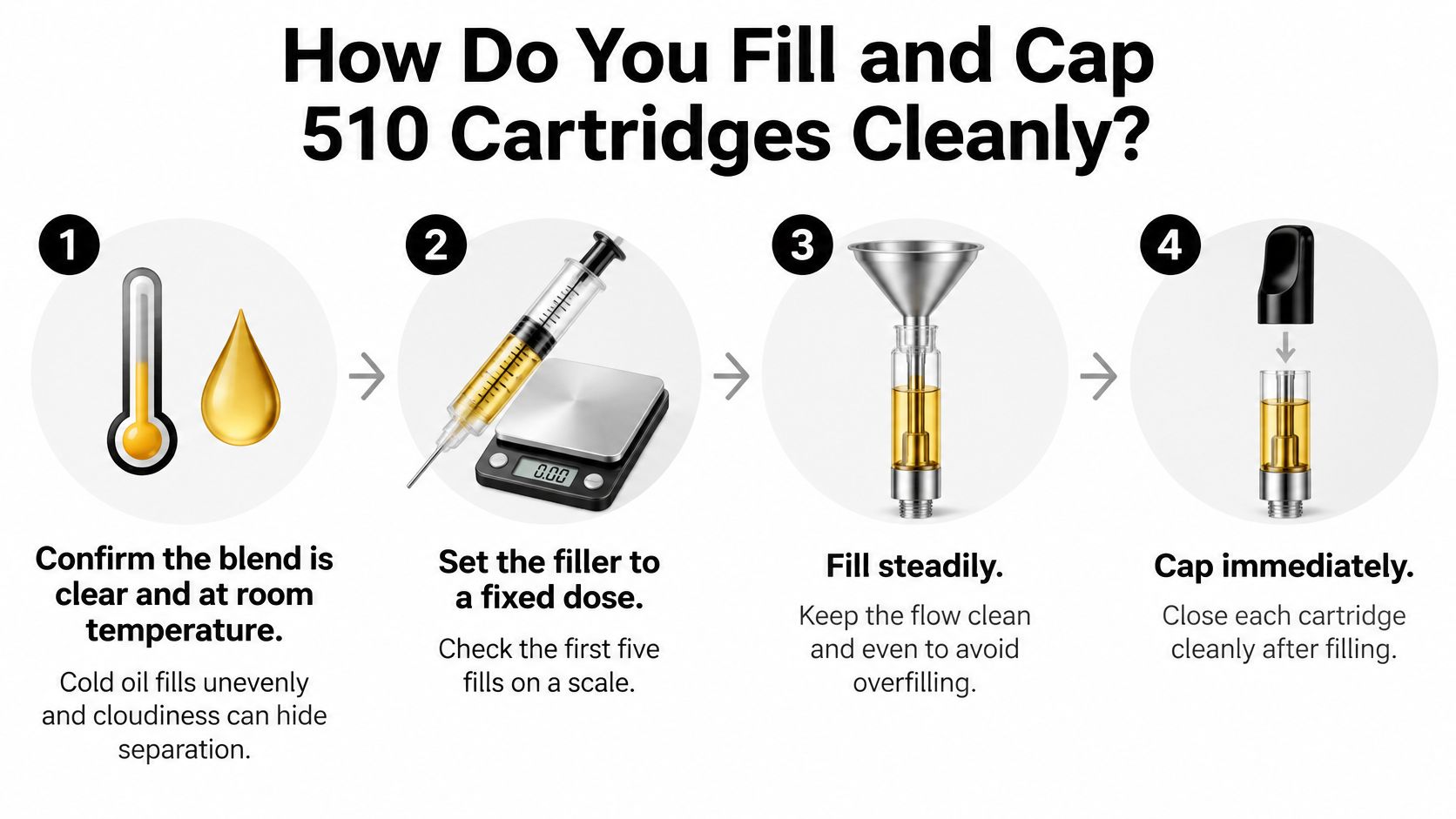
How Do You Fill and Cap 510 Cartridges Cleanly?
Fill a homogeneous, conditioned blend with a calibrated dispenser, keep oil out of the airway, and cap using the hardware supplier's validated procedure. Clean filling depends on controlling the oil, dispenser, cartridge, and closure together.
Use the process visual as a workstation reminder, not a substitute for the lot-specific SOP.
Control the fill before increasing throughput
Inspect and condition the blend. Confirm clarity and homogeneity at room temperature before establishing the validated filling condition; viscous distillate may require controlled warming. A common avoidable mistake is filling straight from a cold drum, which can produce inconsistent delivery and visible air pockets.
Set a fixed dose and verify net mass. Tare empty hardware and weigh the first five fills as an initial process check, then continue checks at defined intervals. Even a small mass drift changes the amount of product delivered per cartridge, so define acceptance limits before starting.
Fill from the lower tank region upward. Position the dispensing tip within the reservoir without obstructing the center airway, and withdraw it as the oil rises. Steady flow gives displaced air a path out and reduces pockets that can interrupt wetting.
Keep the connection and mouthpiece clean. Remove external residue with a clean, lint-free cloth without pushing debris into intake openings. Oil on threads makes inspection harder and can prevent a clean mechanical seat.
Cap with the correct fixture. Use the required press or closure tool, keeping the cap square and within the validated capping window. Inspect alignment and seal integrity under light; a hand check alone doesn't establish that an internal seal is intact.
Assign traceability immediately. Label units or their controlled trays with the batch number and fill date, maintaining the link to oil and hardware lots. Don't leave identification until packaging, when visually identical batches can become mixed.
Hold before packing. Keep filled units in the validated orientation for the rest period established in the SOP. Release them only after the required wetting and leak inspections pass.
Keep hygiene separate from cosmetic cleanup
A wiped exterior isn't evidence of a controlled filling process. Protect open reservoirs, use compatible contact materials, segregate rejected hardware, and document dispenser cleaning between formulations.
The contamination-prevention guide is useful for establishing handling controls around the filler. Avoid introducing cleaning residues while trying to remove visible oil.
Use the filling demonstration alongside the hardware instructions when training operators.
Don't compensate for a cold, poorly flowing blend by forcing the dispenser. Establish a repeatable conditioning window first, then verify fill mass and closure performance within it.
How Do You Maintain Filled 510 Cartridges After Capping?
Capping closes the hardware, and the 510 thread proves fit. Shelf stability is a separate result, and post-release maintenance depends on holding the filled unit in the condition that was approved. Store capped cartridges upright, cool, dark, and free of compression. Packaging has to preserve orientation and keep closures from carrying load in transit. A carton that lets units lie sideways or stack on their tips can turn a passing lot into a leak complaint before first use.
Stability checks should track the same attributes used at release: appearance, airflow, leak condition, and electrical contact. Cloudiness, separation, darkening, or rising draw resistance after storage points to a formulation or seal problem. Treat those changes as investigation triggers. Raising terpene loading to cover a flavor shift can mask a closure failure and increase irritation risk at the same time. Set the review interval from the intended shelf life, and inspect more frequently in the first weeks after release. Document temperature excursions and any packaging change that could alter closure compression.
Complaint investigation needs a clear path from the returned unit to the released lot. Record the storage condition, battery pairing, and operating setting reported by the customer, then compare the unit against the release reference. For a Gold Coast Terpenes blend, tie the complaint to the released lot and the storage history as well as the filler run. Photograph the unit and packaging before disassembly, then preserve the oil and hardware identifiers. A leak complaint calls for a closure-compression and transport-orientation check. A clog or weak pull calls for airflow obstruction, oil condition, battery contact, and operating-setting checks before the blend is blamed. Quarantine repeated failures so hardware defects stay separate from unsuitable formulations.
Post-release storage records should be specific enough to reconstruct the unit's exposure: location, orientation, and duration at each stage. A vague warehouse entry cannot separate a formulation that aged poorly from a carton that crushed closures. Define who can release, quarantine, or reject a lot. Operators need an explicit escalation route when cartridges look acceptable but fail airflow or electrical checks.
How Do Top, Middle and Base Notes Work at 5-15% Loading?
Top notes come from the most volatile molecules, middle notes from components with intermediate persistence, and base notes from the least volatile materials. Hong Kong Baptist University's aroma chemistry guide describes that volatility-based structure, and it gives formulators a clean way to organize a strain-inspired terpene blend.
The tiers are working sensory roles. Concentration and neighboring molecules change how each one reads, so evaluate the complete chord.
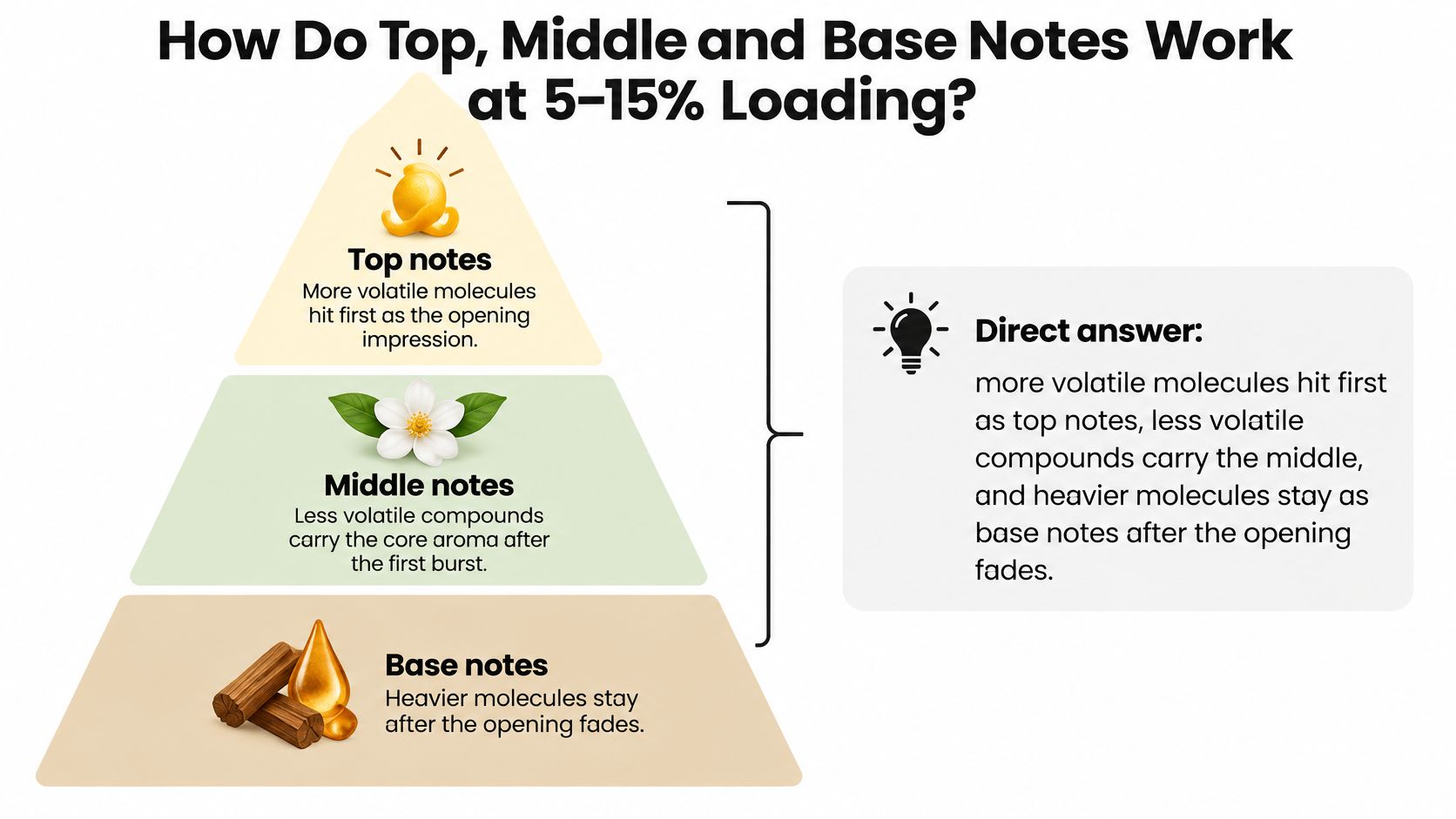
| Role | Behavior | Examples | Formulation effect |
|---|---|---|---|
| Top note | Higher volatility, perceived first | Limonene, terpinolene | Bright opening that fades if unsupported |
| Middle note | Intermediate persistence, carries the core | Linalool, myrcene | Body and continuity |
| Base note | Lower volatility, persists after the opening | Beta-caryophyllene | Longer, woody or spicy finish |
| Loading | 5-15% of final vape oil | Set against distillate, viscosity, and hardware | Excessive loading can taste sharp or irritating |
A 5-15% range of the final formulation appears in the cannabis-industry terpene reference hosted by Colorado State University, with excessive concentrations potentially producing sharp or irritating sensory effects. Use it as a development range and confirm suitability for the intended application.
Test a chord rather than maximizing intensity
For a controlled development comparison, trial 5%, 10%, and 15% on the same qualified hardware, subject to ingredient documentation and your safety review. Specify whether your calculation uses mass or volume, and keep the base consistent between batches.
Change one aroma tier at a time. If the opening is accurate but disappears too quickly, investigate the middle and finish before increasing the entire blend.
Use the terpene flavor chart to translate a sensory brief into candidate components. Familiar Blue Dream or OG Kush targets need a defined reference. A fruit or dessert brief may justify a look at the exotic fruit and dessert profiles from Gold Coast Terpenes, which the brand describes as selectively enhancing rarer terpenes. Use that option to sharpen a profile brief; any increase in total loading still needs validation on the finished cartridge.
For a fruit-forward chord, begin with a restrained citrus opening, build a fruit-and-floral middle, and support it with a light woody base. The useful result is recognizable continuity through the delivered aroma. A strong bottle sniff can mislead. A shared 510 thread proves the cartridge will fit. It says nothing about how a 5% or 15% load will read once the coil heats it.
How Does Heat Change the Flavor a Cartridge Delivers?
Heat changes aerosol composition, so a blend that matches the target in the bottle may not match it when delivered. A laboratory study of cannabis vape oils heated 12 samples to 200°C and found more terpene species and substantially higher terpene concentrations in vapor than in unheated liquid; vapor generated at 150°C showed higher terpene and lower cannabinoid amounts.
Those results aren't a universal battery-setting recommendation. They establish that delivery conditions can shift the balance developers are trying to replicate.
Reported vaping-device temperatures span approximately 100–300°C, while controlled experiments found monoterpene oxidation even at 100–200°C, according to a thermal-desorption GC/MS investigation. Preserving an opening note therefore requires evaluating chemical change as well as sensory intensity.
Compare actual delivery conditions
Run the finished formulation at conservative, intermediate, and upper supported settings within the qualified hardware range. Don't translate a voltage preset directly into a claimed coil temperature without measurement.
- Record the electrical condition. Capture battery model, setting, cartridge resistance, and activation behavior.
- Standardize the puff protocol. Hold duration, airflow, and recovery conditions consistent across comparisons.
- Score against a reference. Assess opening, body, finish, target similarity, and harshness using predefined descriptors.
- Compare chemistry where available. Submit aerosol or post-heating samples alongside the original oil rather than relying solely on bottle composition.
The optimal vaping temperature guide can support protocol planning, but the actual pairing still needs validation.
A setpoint isn't a measured heater temperature
A thermography study of commercial 1-gram CCELL 510 cartridges measured coil temperatures from approximately 238°C to 642°C during simulated puffs. Battery control, airflow, oil saturation, and construction are therefore relevant test variables, not background details.
Development judgement: Keep the device setting beside every flavor score. Otherwise, a hardware change can be mistaken for a formulation improvement.
If top notes decline while the finish remains, investigate thermal exposure before rebuilding the chord. A profile is replicated only when the intended delivery system reproduces the reference consistently.
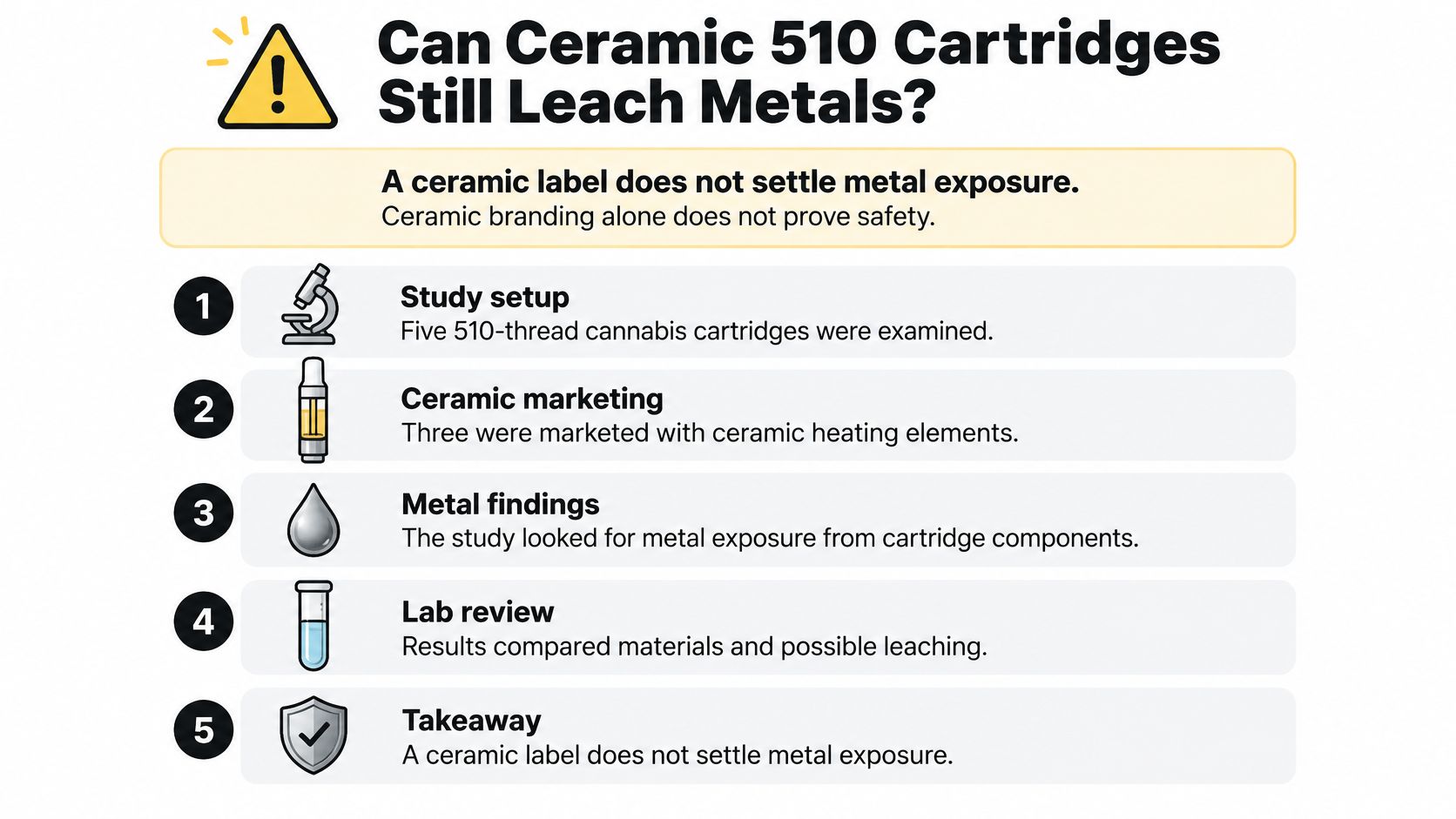
Can Ceramic 510 Cartridges Still Leach Metals?
Yes. A ceramic label doesn't settle metal exposure. Cartridge assemblies contain materials beyond the ceramic element, and the finished aerosol needs its own assessment.
A Scientific Reports study of five 510-thread cannabis cartridges included three marketed with ceramic heating elements; aerosol from every tested sample contained nickel and zinc particles, chromium appeared in 80%, and cobalt, lead, and tin particles appeared in up to half of the cartridges. These findings concern the tested products, not a measured failure rate for every ceramic cartridge.
Inspect the whole fluid and aerosol pathway
Ask the hardware supplier for material disclosure covering the reservoir, seals, heater assembly, joining materials, and exposed metal surfaces. Distinguish oil-contact components from downstream aerosol-path components instead of treating every contact as equivalent.
Formulation chemistry, storage, operating temperature, and device design can affect dissolution and transfer. A hardware qualification performed with a different liquid may not answer the questions raised by your finished oil.
Take a defined evidence list into the supplier discussion:
- Lot identity. Require records connecting the supplied hardware to its material specifications and manufacturing lot.
- Extractables and leachables. Qualify hardware lots using appropriate methods and realistic contact conditions.
- Pathway inspection. Examine the complete assembly, including exposed surfaces and joining points.
- Aerosol testing. Use the intended battery settings and puff profile, with an appropriately qualified laboratory.
- Retained assemblies. Keep filled samples linked to formulation, hardware, and storage records.
Read the certificate for what it actually covers
Gold Coast Terpenes' terpenes for cartridges are SC Lab-tested. That ingredient-side evidence belongs in the technical file, but it doesn't establish the metal contribution of the assembled cartridge.
Read each certificate for sample identity, batch match, test date, analytical scope, reporting limits, and laboratory information. A report on a terpene blend, a distillate, and an aerosol answers different questions.
Independent finished-vape safety guidance also distinguishes testing the extract from evaluating the assembled device. Keep those evidence streams alongside each other, with explicit acceptance criteria and a release decision.
Don't accept ceramic, premium, or a nominal capacity as a material specification. Require documentation that identifies what was tested and how closely it represents the product you'll sell.
How Do You Start a Blend Trial Before a Production Run?
Forty dollars buys a usable comparison. The Coast Pack ships 3 ml per strain, 9 ml total, enough to run several profiles through the same hardware and heating protocol before anyone commits to a production lot. The 3ml Strain Picker Pack takes the same logic further, letting you select any three catalog profiles in 1.5 ml or 3 ml sizes. Its listed uses are terpene testing, custom vape or tincture formulation, and comparing Indica versus Sativa effects. Treat that last one as a description of the profiles on offer, not a forecast of how a finished cartridge will perform physiologically.
Make the scale decision explicit
- Choose contrasting candidates. Pick profiles with a stated sensory reason for inclusion rather than three different names, and hold the target loading constant for the first comparison.
- Pass hardware checks first. Trial material is limited, so don't fill a cartridge that hasn't cleared dimensional, electrical, and airflow qualification. A shared 510 thread confirms fit, nothing more.
- Compare bottle and aerosol. Run every candidate through the same heating protocol with the same reference descriptors, because a blend that reads well undiluted can flatten or turn harsh once the coil sees it.
- Select for delivered balance. Advance the candidate that keeps the intended opening, body, and finish on the assembled unit without a harshness penalty at the top of the puff.
- Release scale-up conditionally. Require assembled-unit results alongside ingredient and oil documentation before batch size increases. Ingredient testing and device performance are separate evidence streams.
The Mixing Calculator keeps batch arithmetic consistent across candidates, and Terpenes 101 gives a shared vocabulary when several people are scoring the same samples. Verify the calculation basis, then have a second operator check the batch sheet before anything is dispensed. Arithmetic errors at trial scale are cheap; the same error at production scale is a lost lot.
Bulk ordering lets you combine multiple strains in a single order, which is convenient once a profile has earned a place in the lineup. Confirm sample quantities, wholesale minimum order quantities, bulk increments, documentation, and change-control expectations with the supplier before approving anything, and don't read a sample-pack size as evidence of a wholesale MOQ.
The trial exists to produce one of two outcomes: a candidate that holds its balance on your cartridge and battery, or a documented reason to stop before the run. Anything that doesn't settle that question is a cost with no return.
Frequently Asked Questions About 510 Cartridges
Which materials touch the oil in a 510 cartridge?
A useful component-level material map names every material in the oil and aerosol path: tank resin, seals, wick, coil or ceramic heater, adhesives, coatings, and any exposed metal. It should also list supplier, grade, lot, and the maximum contact temperature each part sees. That map tells you what the oil touches. It does not by itself prove flavor performance or leak resistance, so pair it with finished-cartridge checks.
Should a vape brand choose botanical or cannabis-derived terpenes?
Choose by the sensory target, sourcing constraints, documentation, and permitted labeling. Botanical, cannabis-derived, and nature-identical are different provenance descriptions, and each carries its own supply and compliance questions. Test the candidate in the same base oil and hardware before treating any of them as equivalent.
Is an oil certificate enough before sale?
An oil certificate describes the submitted oil sample and the tests performed on it. It does not cover the assembled cartridge: heater contact, seal exposure, fill volume, storage, and aerosol output need their own qualification. Keep oil documentation, hardware material declarations, and finished-unit results in the same release file so a passing oil test is not mistaken for a passing cartridge.
How many profiles should a developer trial?
Start with a small set that represents distinct routes to the same flavor brief. Gold Coast Terpenes offers familiar strain-inspired and enhanced fruit or dessert directions, but each candidate still needs the same controlled comparison against the target loading, heating protocol, and descriptor set.
What fails when voltage is used to clear a clog?
Increasing voltage can overheat oil without correcting restricted airflow or poor feeding. Find the obstruction first, then check formulation condition and electrical contact. Extra heat is not a routine repair for a clogged cartridge.
Gold Coast Terpenes offers SC Lab-tested botanical blends for developing flavor-accurate distillate and vape-cartridge formulations. Visit Gold Coast Terpenes to select trial profiles and build a documented comparison on the cartridge and battery you intend to ship.