
A Trainwreck strain blend is a sensory target, not a chemical specification. Published Trainwreck data puts terpinolene at 0.54% in an aggregated profile, which is one reason the name on the label cannot carry a purchase order on its own, according to The Cannigma's Trainwreck profile. Gold Coast Terpenes sells 50+ strain profiles alongside single isolates, so a formulator can hit a target ratio without a cannabis-derived input. For a Trainwreck-style blend headed into vape cartridges, the purchasing decision starts with measurable markers, a reference sample, and the finished product's intended use.
Which Terpenes Define the Trainwreck Strain Profile?
Terpinolene leads the published Trainwreck panel at 1.30%, followed by beta-caryophyllene at 0.72%, beta-myrcene at 0.49%, and limonene at 0.42%, according to the CannMenus Trainwreck laboratory summary. Those four compounds give a formulator the clearest starting points for a Trainwreck-style blend.
Gold Coast Terpenes supplies 100% natural terpene blends for cartridges, concentrates, and formulation work. Treat Trainwreck as a sensory reference with measurable terpene markers. Match that aromatic reference within your own base, device, and dilution rate.
Trainwreck terpene targets by formulation role
| Terpene | Formulation role | Reported COA dataset mean |
|---|---|---|
| Terpinolene | Top note, primary green, piney, and floral signature | 1.30% |
| Limonene | Top note, perceived freshness | 0.42% |
| Ocimene | Top note, freshness support | Not reported |
| Alpha- and beta-pinene | Top note, pine lift | Not reported |
| Beta-caryophyllene | Mid note, dry peppery spice | 0.72% |
| Beta-myrcene | Base note, earthy body | 0.49% |
| Linalool and humulene | Minor support, floral and woody tone | Not reported |
Reported means in the third column come from the CannMenus Trainwreck laboratory summary. That summary does not provide means for ocimene, alpha- and beta-pinene, linalool, or humulene.
These are reported sample concentrations. A concentrated terpene premix needs its own limits because published sample data reflects flower or product testing, not a manufacturing specification. Published summaries do not establish manufacturing tolerances. Genetics, cultivation, curing, extraction, sampling, and laboratory methods can contribute to differences between published profiles.
Translate composition into sensory roles
Use top, mid, and base notes as practical blending language. Terpinolene should establish the recognizable green-pine opening. Limonene should brighten it without turning the profile into generic citrus. Caryophyllene supplies dry structure, while myrcene adds earthy body.
The minor contributors need a different treatment. Include ocimene, pinene, linalool, and humulene in analytical comparisons when available. Skip numerical targets where the summary has none.
Practical rule: Start with a terpinolene-led reference envelope. Set narrower production limits through pilot testing. Published endpoints are not automatically acceptable release limits.
Gold Coast Terpenes cartridge terpenes are SC Lab-tested. Compare the relevant report with your own batch measurements after dilution and aging. Approving a blend from its name or undiluted aroma leaves the batch unchecked.
Why a Strain Name Cannot Confirm a Batch Match
The Trainwreck name identifies a cultivar history and market category, not fixed chemistry. A purchase specification needs a batch COA and sensory reference because a familiar name doesn't establish chemical equivalence.
A review of strain-name reliability describes a 2018 analysis of 122 samples across 30 commonly named strains that found meaningful genetic and chemical variation within shared names, alongside a 2023 PLOS ONE analysis of more than 90,000 samples reporting virtually no consistent relationship between strain names and composition across sources, as summarized by This Is Why I'm High.
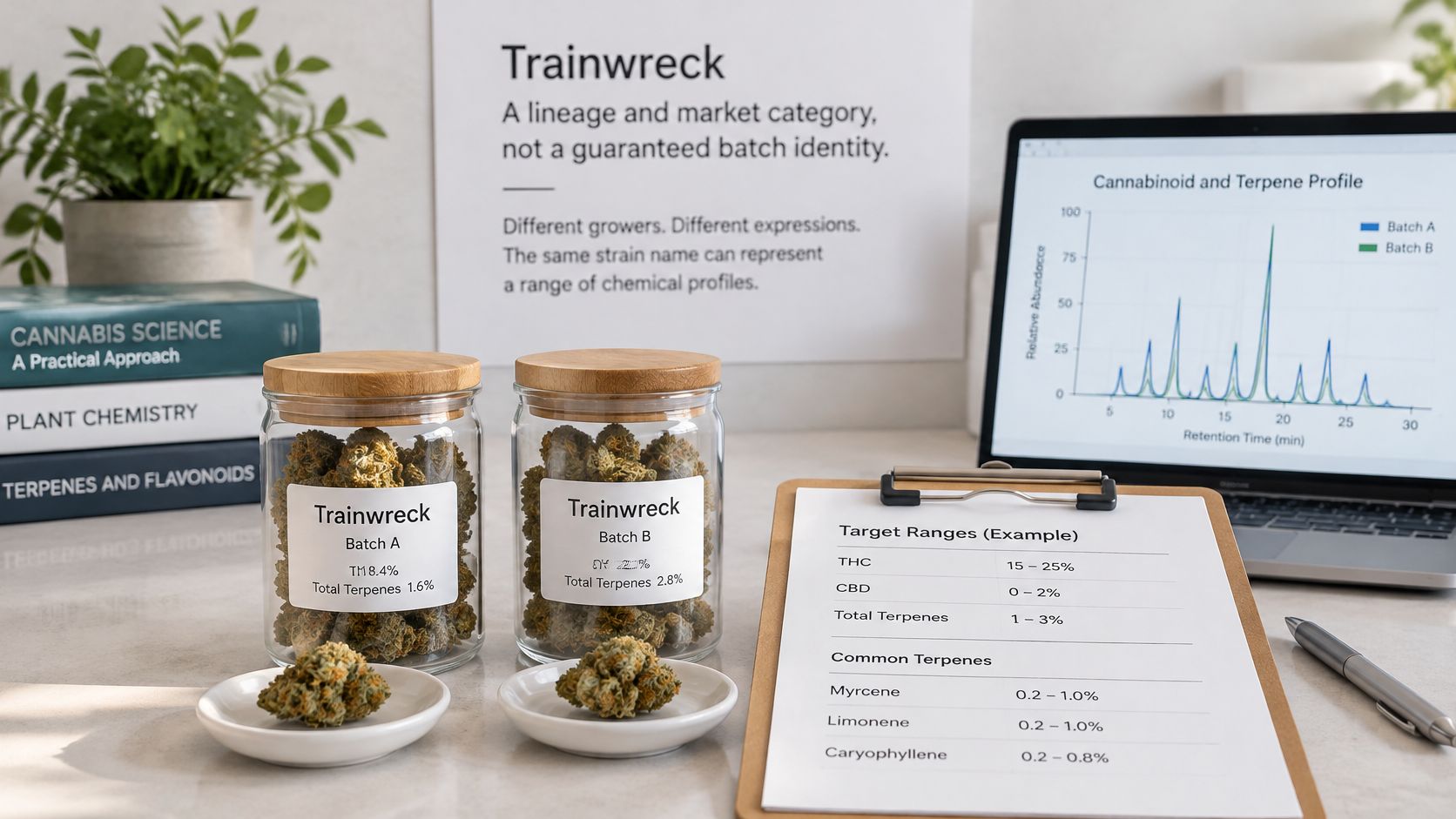
Potency illustrates the same problem. Entour's Trainwreck profile places commonly reported panels at approximately 16% to 21% THC, with CBD generally below 0.5%, while noting variation between cuts, growing conditions, and laboratories. Those figures describe reported products, not a cannabinoid specification for a botanical terpene blend.
What a useful reference COA contains
Before comparing suppliers or trial blends, check the following:
- Total cannabinoids: Establish what matrix you're comparing and whether cannabinoid composition could affect finished-product positioning.
- Dominant terpenes: Identify the actual leading compounds rather than assuming the expected hierarchy.
- Minor terpenes: Keep detectable supporting compounds in the comparison instead of reducing identity to the largest peak.
- Harvest and test dates: Record sample age and testing chronology so unlike materials aren't treated as equivalent.
- Laboratory method: Compare the analyte panel, reporting basis, and detection limits where available.
A chromatographic match and an aroma match answer different questions. A report can confirm selected compounds while missing odor-active constituents outside the laboratory's panel; sensory evaluation can identify a mismatch without identifying its chemical cause.
Use the strain terpene profiles resource to develop candidate references, then attach the selected batch report to the purchasing brief. Gold Coast Terpenes describes its blending approach as consistent and precise, but your acceptance decision still needs written, measurable criteria.
Treat Trainwreck as a sensory reference, not a guaranteed chemovar. Write the brief against an approved batch, not an online description.
How to Build a Trainwreck-Style Blend Step by Step
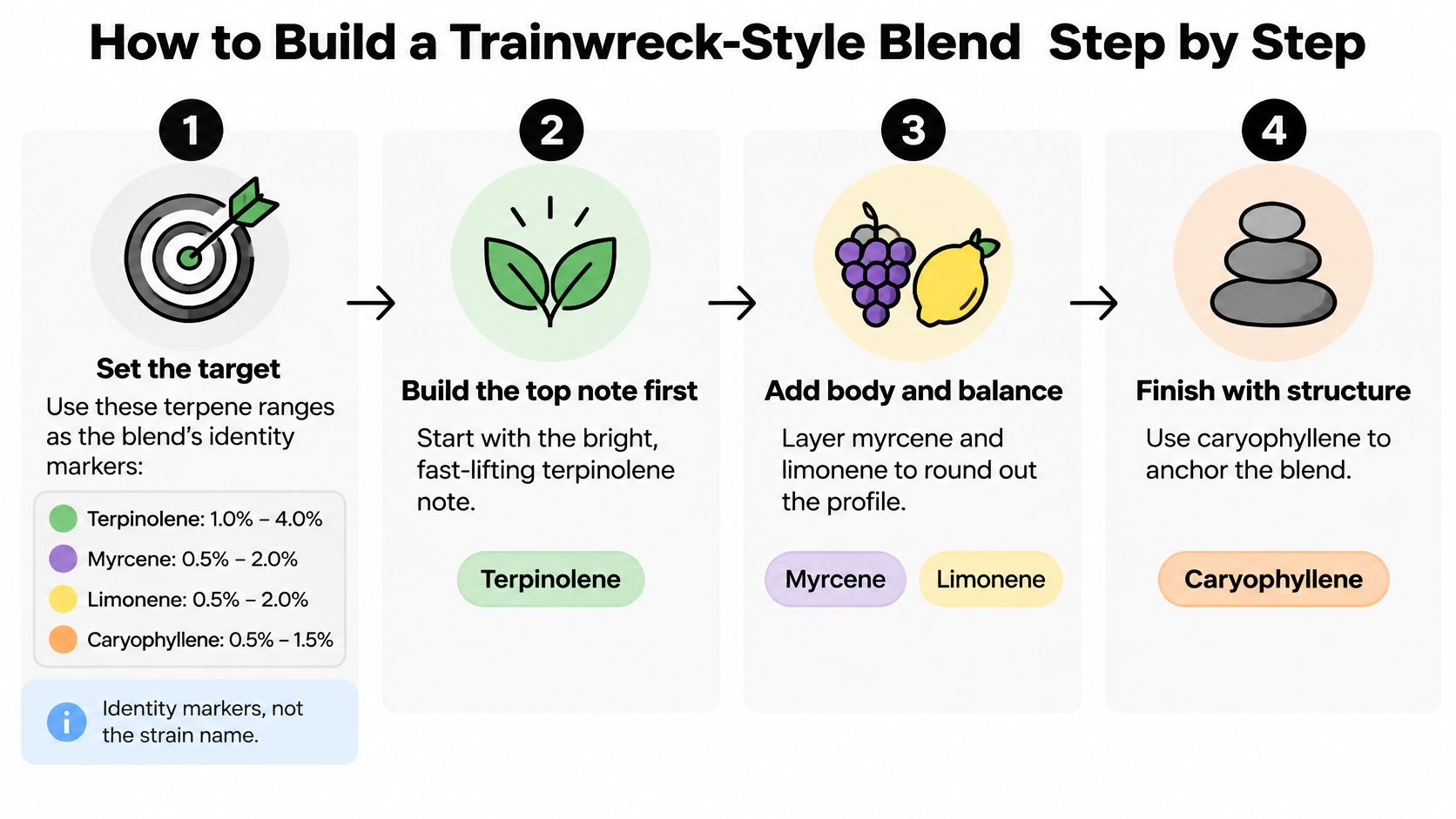
Build the blend around approved identity markers, then adjust it in the actual production matrix. A balanced concentrate isn't automatically a balanced cartridge formulation, so dilution and controlled comparisons belong inside development, not after it.
Establish the aromatic structure
Set the target before weighing ingredients. Write provisional ranges for terpinolene, myrcene, limonene, and caryophyllene using an approved reference and published profiles as context. Specify whether each value describes the premix or finished formulation, because confusing those reporting bases produces unusable batch instructions.
Build the top note first. Establish terpinolene as the main signal, then introduce lower contributions of limonene and pinene to tune freshness and pine lift. Don't correct a weak opening by adding every bright-smelling ingredient at once, because you'll lose the ability to identify which adjustment worked.
Add mid and base notes deliberately. Introduce caryophyllene for dry spice and myrcene for earthy body, checking that the opening remains recognizable. Adding a heavy earthy component before establishing the top note can make it harder to judge the pine signal and encourage unnecessary correction.
Validate the diluted expression
Calculate and document dilution. Gold Coast Terpenes strains are highly concentrated and need proper dilution before use; use the Mixing Calculator to plan the addition and record the finished loading in the batch sheet. Keep the calculation basis explicit, and don't interchange mass and volume without accounting for density.
Run a small trial in the intended base. Compare the diluted blend with the reference using consistent containers, sample amounts, temperatures, and evaluation timing. Smelling only the concentrated premix is a common mistake because it doesn't establish how the finished matrix will present the profile.
Change one variable and retest. Record the adjustment, prepare a fresh comparison, and retain the previous version until the decision is complete. Changing the terpene balance and overall loading together prevents you from knowing whether the improvement came from composition or intensity.
Use a consistent mixing procedure and document ingredient lot numbers, addition order, mixing conditions, and evaluation dates. Otherwise, a successful trial may be difficult to reproduce even when the ingredient weights are correct.
A successful trial matches the reference's opening, body, and finish after the same aging period used in production. An appealing fresh blend alone isn't a production approval.
For distillate, keep the base lot fixed while comparing aromatic revisions. If the base changes during development, evaluate it separately before attributing the sensory difference to the terpene blend.
Why Terpinolene Alone Misses the Trainwreck Aroma
A 2023 chemical and sensory study of cannabis aroma included Trainwreck as its only terpinolene-rich variety and found it had the lowest chemical similarity to the other tested varieties. That result fits a practical problem: terpinolene can supply the pine, floral, and herbal frame, yet the full Trainwreck impression also depends on minor volatiles and on how the blend presents after dilution.
The study identified unusually high cherry propanol in that Trainwreck sample and noted the absence of several flavorants, including sulfur-containing volatile compounds and n-propyl hexanoate, that were associated with higher aroma scores in other varieties. The result is one sample-level observation, useful as a prompt to inspect trace volatiles in your reference material. Forcing sulfur notes into every recreation overreads the finding, and a standard terpene panel can leave part of the sensory identity unexplained.
Diagnose the missing note before adding ingredients
Evaluate the diluted blend in a defined order:
- Opening: Confirm pine and floral lift without an overly citrus-led first impression.
- Middle: Check that herbal body connects the opening to the earthy and peppery components.
- Finish: Decide whether the reference's fruit tone is reproduced, intentionally excluded, or still unresolved.
For a separate fruit-led comparison, the Apple Fritter page in Gold Coast Terpenes' fruit-led hybrid range shows how the Master Terpologists boost selected rare and exotic terpenes to bring out fruity and flavorful nuances. Treat that page as a sensory reference outside the Trainwreck brief.
Adding minor volatiles can improve resemblance, but each addition expands ingredient qualification and stability work. A component that helps the fresh aroma may become distracting after dilution or aging. Set a batch-level terpene target and compare it against the COA range before you widen the formula; that keeps the Trainwreck name tied to a sensory reference rather than a chemical specification.
Specify the boundary: State which notes the product is designed to match and which it deliberately leaves out.
For a commercial brief, “terpinolene-led pine and herbal profile with restrained fruit” is more actionable than “authentic Trainwreck.” It gives development, purchasing, and quality teams the same sensory objective without promising complete chemical replication.
Does Heating Change Safety for Trainwreck Cartridges
Yes. A cartridge formulation must be evaluated under heating conditions, not approved because its ingredients smell pleasant or resemble familiar food flavors.
An Entour review of terpene cartridge safety describes a study in which researchers heated pure myrcene, limonene, and linalool under dabbing conditions and detected degradation products including methacrolein, methyl vinyl ketone, and 3-methylfuran. That finding identifies a reason to investigate thermal behavior; it doesn't quantify emissions from your cartridge or establish that all hardware performs alike.
Myrcene and limonene may play supporting sensory roles in a Trainwreck formulation, but they still require scrutiny. The lead aromatic marker isn't the only ingredient that matters during heating.
Validate the formulation and hardware together
- Characterize heating conditions: Document the intended device, operating settings, and test conditions. Don't substitute an unrelated heating setup for the intended hardware.
- Control terpene loading: Use a justified loading rather than increasing concentration until the aroma becomes unmistakable. Stronger flavor isn't a safety criterion.
- Assess finished aerosol: Evaluate the actual formulation in its intended delivery system, not just the unheated oil.
- Investigate degradation: Have a qualified laboratory develop an appropriate testing approach for the complete blend and relevant thermal products.
- Record the evidence: Keep methods, reports, operating conditions, and deviations with the development and release files.
A study of isolated ingredients provides hazard information, while finished-product testing addresses the formulation being sold. Neither an ingredient COA nor a pleasant sensory result replaces that work.
The terpene vaping safety resource can support development discussions, but the compliance file needs product-specific evidence. Moving a strain-inspired terpene blend for distillate into a cartridge is a separate validation decision.
A compliance reviewer should be able to identify the hardware tested, the permitted loading, the laboratory methods, and the finished-product results. If the formulation or hardware changes, document whether those changes require additional assessment rather than assuming the previous approval still applies.
Which QC Checks Make a Trainwreck Blend Release-Ready
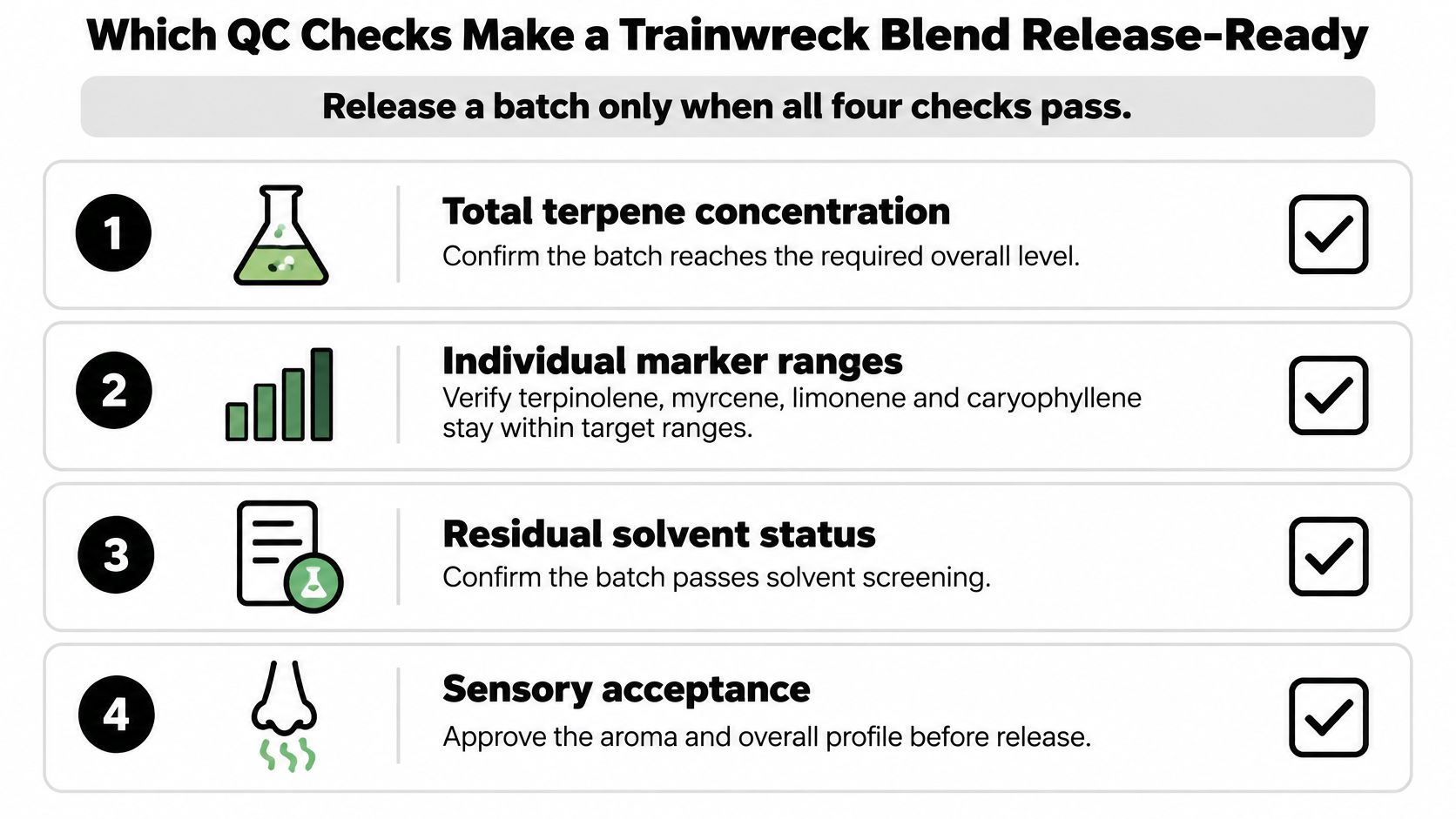
Release a batch only when total terpene concentration, individual marker ranges, residual-solvent status, and sensory acceptance meet the approved specification. Keep a retained sample so the release decision remains traceable after shipment.
Build the release record around evidence
Confirm total terpene concentration. Compare the finished formulation with its approved loading and analytical specification. A correct ingredient addition does not by itself establish the concentration measured after processing. Record the calculated loading and the measured result side by side.
Check the identity markers. Review terpinolene, myrcene, limonene, caryophyllene, and pinene against the limits established during development. Define how nondetects and results below quantification limits are handled before a borderline batch appears.
Confirm residual-solvent status. Review the relevant laboratory panel against the requirements applicable to the product and market. Keep the report attached to the lot record instead of relying on a general supplier assurance.
Approve sensory performance after dilution and aging. Evaluate the specified matrix at the agreed time point against the retained reference. Record descriptors and the acceptance decision, not just a vague pass notation.
Log the retained sample. Identify its lot, container, storage conditions, and retention location. The sample should correspond to the material approved.
A target envelope should come from the approved reference, analytical capability, pilot results, and sensory acceptance. Published profile differences can justify investigating that envelope, but a published value that makes a batch pass is not a specification.
Gold Coast Terpenes states that its cartridge terpenes are SC Lab-tested and that product terpene information is provided by SC Labs. Request the lot report that matches the supplied material and attach it to the release record. The earlier reference qualification sets what that report must cover; the release decision needs the report tied to this batch.
Release discipline: Record each result beside its acceptance criterion, with the report identifier and reviewer's decision.
Maintain an exception process for out-of-specification results. Do not change the target to accommodate an unexpected batch without investigation. Examine the cause, document the disposition, and approve any specification change through the quality process.
Which Supplier Terms Should You Lock In Before You Order?
Use Trainwreck as a sensory reference and write the purchase specification around batch-level terpene targets, COA ranges, and the commercial terms that govern repeat supply. That framing keeps the strain name useful without pretending it is a chemical recipe. A supplier who can support your release process is more useful than one with the closest strain name.
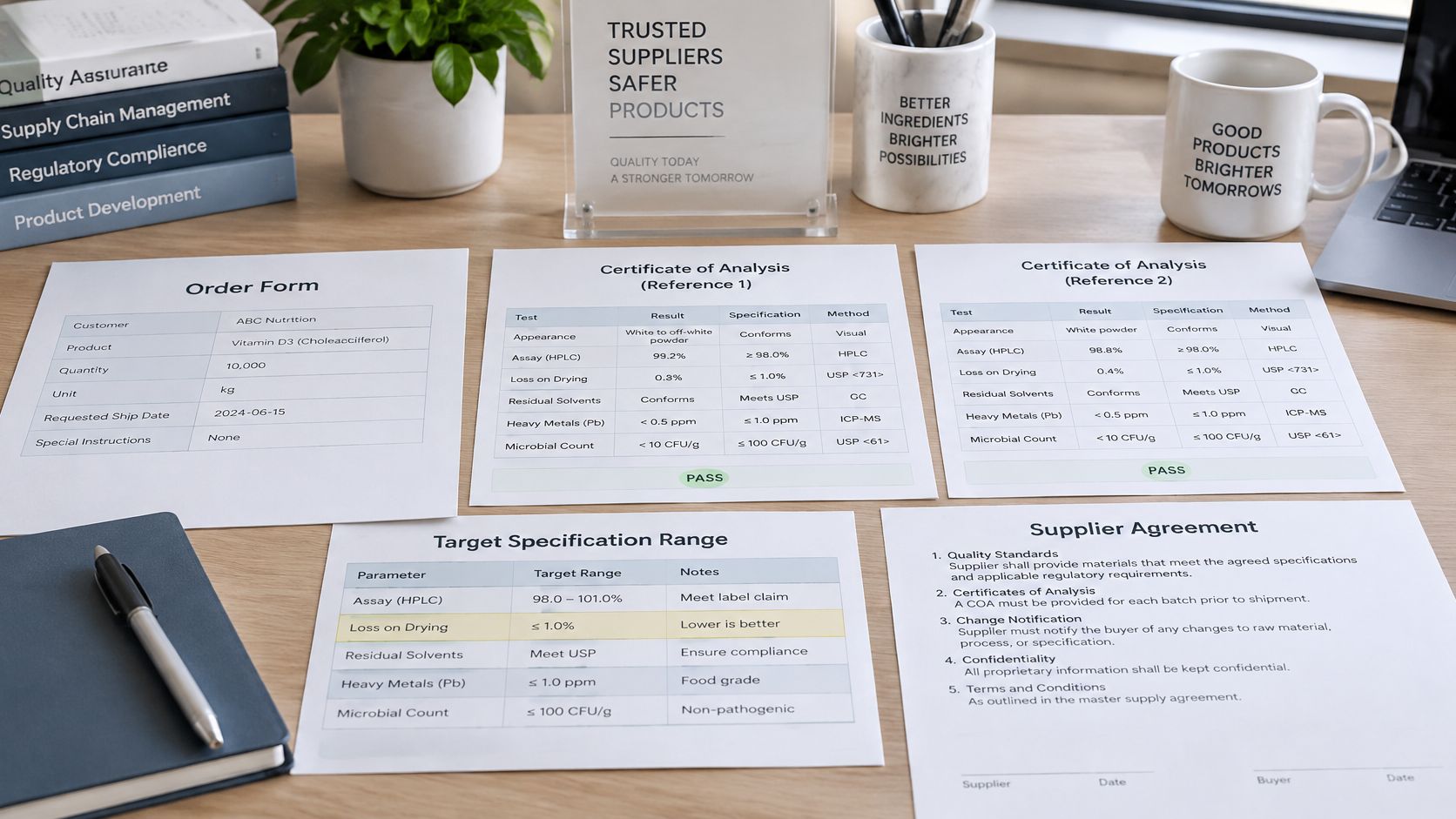
Start with the approved profile and the acceptance ranges attached to it. A sample should reach you with documentation that ties the material to the report, the method, and the lot you will evaluate. I would put sample identity and report coverage at the top of the qualification file because a flavor match alone will not resolve a paperwork gap.
Supplier terms to compare before ordering a Trainwreck-style blend
| Term | What to request | Why it matters |
|---|---|---|
| Derivation | Botanically derived versus cannabis-derived statement, plus disclosure of any nature-identical ingredients | Supports accurate ingredient-origin labeling and compliance review |
| Lab data | SC Lab report for each supplied lot, with sample identification and analyte coverage | Lets you compare supplied material against release ranges |
| Catalog depth | Documented reference profiles and samples suitable for side-by-side evaluation | Gives reference profiles to test against |
| Order terms | MOQ and wholesale pricing above 64oz in writing | Establishes pilot and production purchasing costs |
Compare origin separately from flavor accuracy
Botanical versus cannabis-derived describes origin. Sensory quality needs its own evaluation against the approved reference. Ask the supplier to distinguish naturally sourced botanical ingredients from nature-identical ingredients in the documentation, then review labeling implications with compliance. A strain-inspired name can imply cannabis extraction, so confirm finished-product claims before artwork is approved.
Gold Coast Terpenes supports bulk ordering of multiple strains, and wholesale pricing is available on strain orders totaling over 64oz. Confirm the minimum order quantity, quote, sample terms, and documentation package in writing. Do not infer MOQ from the wholesale threshold.
Use the terpene purchasing guide to organize supplier comparison, then measure each candidate against your own specification. Ask how changes to ingredients, analytical methods, or reference profiles will be communicated before you accept repeat-order terms.
Choose a single reference profile, set acceptance ranges, and request a sample. Scale only after the diluted pilot passes sensory, analytical, and application-specific checks. The order terms should make those steps repeatable for every batch you buy.
What Do Formulators Ask About Trainwreck Terpene Blends?
A Trainwreck blend has two specifications: the sensory reference buyers recognize and the COA range a batch must hit. Treating the name as a chemical spec is how a formula passes assay and still smells wrong.
How do you translate a reference COA into a pilot dilution target?
Start with the reference profile's reported range for each major terpene, then convert those percentages to the concentration used in the finished base. A target expressed on the neat blend becomes a different number once the blend is diluted at the intended use rate. Set the pilot target in the units your lab will measure, and keep the conversion visible in the batch record. Gold Coast Terpenes supplies SC Lab-tested terpene information, which gives a starting reference for that conversion.
How wide should the acceptance range be for a Trainwreck-style blend?
Wide enough to absorb normal analytical and botanical variation, narrow enough to catch a sensory miss. For most minor odor-active compounds, a tight range around the reference mean is less useful than a range tied to the finished dilution. The major peaks can vary more before the aroma shifts; the minor peaks often decide whether the green, piney, floral note reads correctly.
What belongs in a pilot batch record when the aroma misses?
Record the reference profile, the lot numbers, the dilution rate, the measured terpene percentages, and the sensory note that failed. State whether the miss is a missing top note, an excess solvent note, or a flat finish. That record lets the next trial change one variable instead of rebuilding the whole formula.
When should a formulator reject a lot despite a passing terpene assay?
Reject it when the lot meets the numeric range but fails the approved sensory reference at the intended dilution. The assay confirms composition, not finished aroma. Keep the sensory reference and the COA range as separate release gates, and document which gate failed. That distinction matters more than a single dominant terpene matching a published Trainwreck profile.
Gold Coast Terpenes offers 50+ strain profiles, isolates, and bulk ordering for formulators building a defined Trainwreck-style target. Visit Gold Coast Terpenes to select a reference profile, request the laboratory documentation, and run a diluted pilot before scaling.