
Most advice on White Widow terpenes starts with the wrong assumption, that there's one fixed flavor target to copy. In production, that mindset causes avoidable misses, because the label often hides a family of related chemotypes rather than a single, locked profile. For formulators, the better question is simple, which White Widow are you trying to match?
That matters because the strain's documented profile is stable enough to be recognizable, but variable enough to demand choices. Leafly describes White Widow as a Brazilian sativa x South Indian indica hybrid, with a 60% sativa / 40% indica split, and multiple references place THC commonly in the 18% to 25% range, with modern grows often clustering around 20% to 22%. Its terpene reputation is just as important as the cannabinoid load, because the same references repeatedly point to myrcene, caryophyllene, and pinene as the core aromatic drivers, which is why the profile still matters in extract formulation and cart work. Leafly's White Widow reference profile
Why White Widow Terpene Profiles Vary More Than You Think
White Widow often gets treated as if it has one fixed flavor signature, but that is not how supply behaves in production. The sourcing reality is broader. One guide places total terpene content at 1.2% to 2.5% by weight, while beta-caryophyllene can sit anywhere from 0.2% to 0.6% in sampled material. That spread is wide enough to shift how the flower presents in a cart, a distillate blend, or a branded strain replica. Joint Commerce's detailed strain analysis
The market label is broader than the chemistry
Buyers often ask for White Widow terpenes, but what they usually need is a defined sensory outcome. Some lots skew earthy and spicy, others read pine-forward, and some feel flatter unless the blend is built with care. That is why a single White Widow-style formula can miss flower from another supplier, even when both products carry the same strain name.
Practical rule: do not approve a White Widow target until you know whether the finish should be myrcene-led, caryophyllene-led, or pinene-led.
Cultivation choices and phenotype selection can move the chemistry enough that two White Widow samples do not behave like interchangeable inputs. The Dutch pedigree from the early 1990s is part of the identity, but the expression changes by market and by grower. The same strain name can carry different sensory expectations, and formulators who ignore that variation usually end up correcting with extra top-note work or a heavy base that flattens the profile. Gold Coast Terpenes article on environmental factors and flavor
Why this matters before blending starts
The formulation mistake is choosing a ratio before defining the target profile. If the brief calls for flower-like realism, the source material needs to be identified as heavier on earthy depth, sharper pine, or peppered spice. That decision changes the rest of the build, from top-note brightness to how much base character survives after dilution into neutral distillate.
Environmental conditions also matter because they shape how terpene expression comes through in the finished material, which is why the same cultivar can smell and taste different from one lot to the next. That variation is not noise. It is the part of the job that determines whether the final product reads as true-to-type or merely strain-adjacent.
For commercial teams, the takeaway is straightforward. White Widow terpenes are a target family, not a single molecule map, and production gets cleaner once the team accepts that. The best brief is not “make White Widow.” It is “make this White Widow.”
Core Terpene Chemistry and Sensory Roles
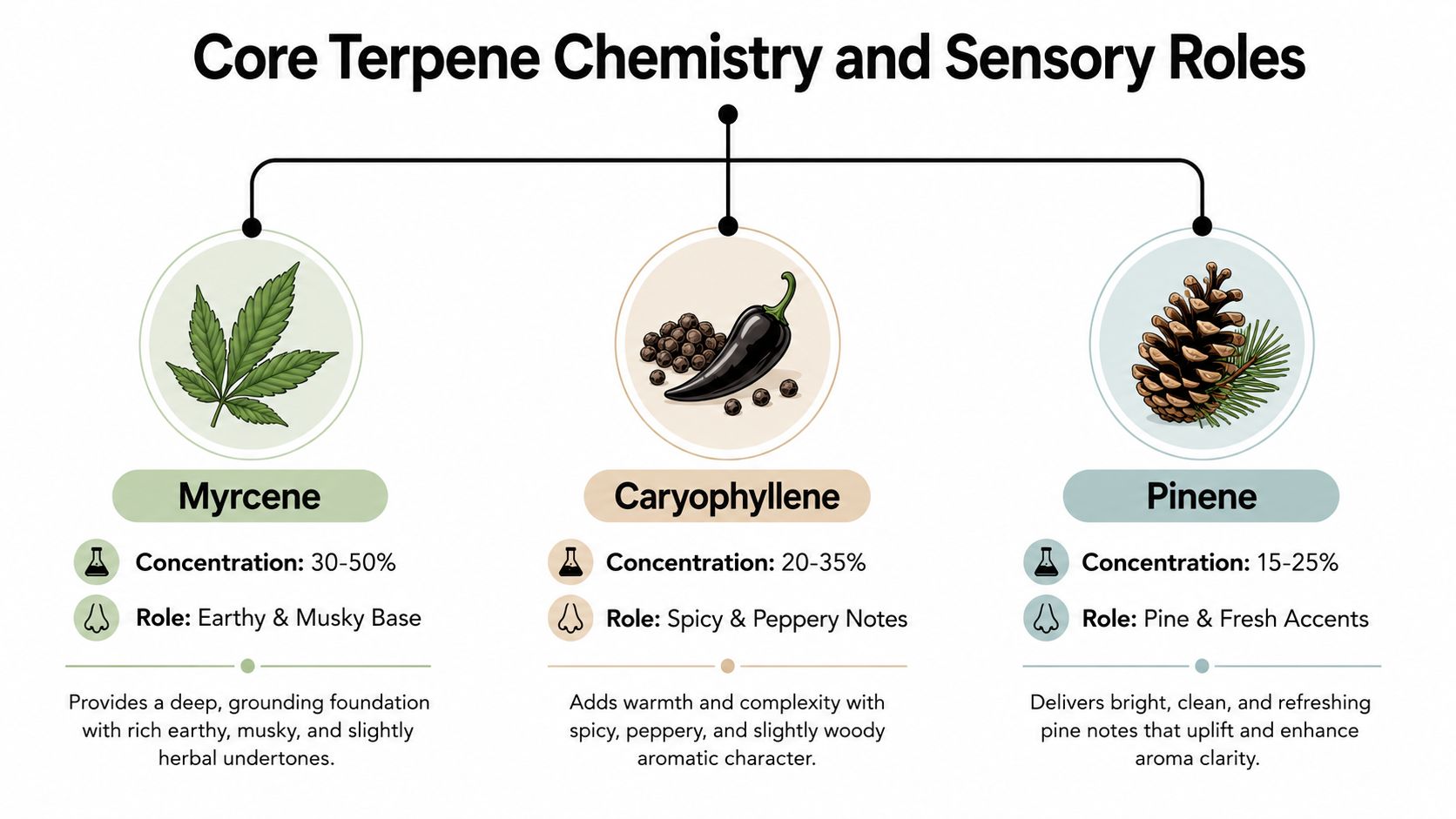
White Widow chemistry is more useful than the legend attached to the name. Across references, the profile keeps circling back to myrcene, caryophyllene, and pinene, with myrcene usually carrying the heaviest sensory load and the other two shaping the outline. Some profiles place myrcene near the center of the blend, which matches the strain's earthy, musky character and its slower, more grounded finish. StrainWeaver's White Widow profile
Top note, mid note, base note
A finished White Widow blend behaves like a structured fragrance. Pinene usually presents first as a sharp pine opening. Caryophyllene sits in the middle with pepper and spice, while myrcene holds the base with herbal, musky, earthy depth.
That sequence matters in cartridges. Underweight pinene makes the first pull feel flat. Too much caryophyllene pushes the blend dry and pepper-led. Excess myrcene can bury lift and make the formula feel heavy before the consumer has time to register the profile. Good Grades NYC's White Widow strain notes
What the concentration ranges tell us
Published terpene summaries point to total terpene content of 1.2% to 2.5% by weight, with beta-caryophyllene around 0.2% to 0.6% and alpha plus beta pinene together around 0.2% to 0.5%. Another laboratory-oriented summary places myrcene and caryophyllene each around 0.2% to 0.5% in analyzed samples. Those bands matter because they show the profile is not a fixed recipe, it is a repeatable framework with room for expression differences. Joint Commerce's full strain profile
A myrcene-heavy White Widow blend usually reads fuller, deeper, and more herbal. That helps when the brief calls for dense classic character, but it can also mute the bright top note that makes the strain recognizable on first inhale.
Gold Coast Terpenes on terpene chemistry
Why the ratios matter in product design
For formulators, the practical job is to preserve the earth, pine, and spice hierarchy while adjusting intensity for the base oil. White Widow's aroma reputation was built on a strong flower matrix, so the terpene system has to stay legible even when the carrier is neutral or highly refined. If the recipe loses that structure, the product stops reading as White Widow and starts reading as a generic hybrid with pine notes. TerpBros NYC White Widow formulation notes
Three White Widow Terpene Variations and When to Use Each
There isn't one White Widow blend that solves every brief. In the market, I usually see three useful formulations emerge, one myrcene-forward, one caryophyllene-forward, and one pinene-forward. Each version can be valid if the target outcome is clearly defined and the base oil supports it.
Gold Coast Terpenes high-terpene strains article
| White Widow Terpene Variation Comparison | Dominant Terpene | Sensory Profile | Best For |
|---|---|---|---|
| Myrcene-forward | Myrcene | Earthy, musky, herbal, heavier finish | Relaxation-leaning cartridges, richer evening products |
| Caryophyllene-forward | Caryophyllene | Spicy, peppery, deeper mid-palate | Balanced hybrid positioning, classic strain replicas |
| Pinene-forward | Pinene | Bright pine, sharper first pull, fresher lift | Daytime-functional cartridges, brighter brand positioning |
Choosing the version that fits the brief
A myrcene-forward White Widow style works best when the brand wants deeper herbal weight and a softer landing. It's the easiest version to make feel familiar to consumers who associate the strain with old-school funk and rounded earthiness.
A caryophyllene-forward version is usually the safest commercial compromise. It preserves spice, keeps the blend recognizably classic, and gives marketing teams a profile that can be described as balanced without sounding vague. That makes it a good fit when the product has to sit between “legacy” and “modern hybrid.”
A pinene-forward profile is the one I reach for when the brief needs brightness. It's the cleanest path to a sharper opening and a more daylight-friendly read, especially in a neutral distillate where the terpene blend has to do more of the branding work.
Decision rule: if the base oil is thin and highly refined, a stronger structural terpene like caryophyllene usually carries the profile better than an overly myrcene-heavy blend.
What does not work
What usually fails is trying to make all three versions at once. That creates a busy profile without a clear identity. If the top note is too bright, the base disappears. If the base is too thick, the cart feels muted. If the spice sits too high, the profile can feel dry and one-dimensional. The winning formula is the one that commits to a hierarchy and keeps it consistent from first pull to aftertaste.
Formulation Protocols for Cartridges and Concentrates
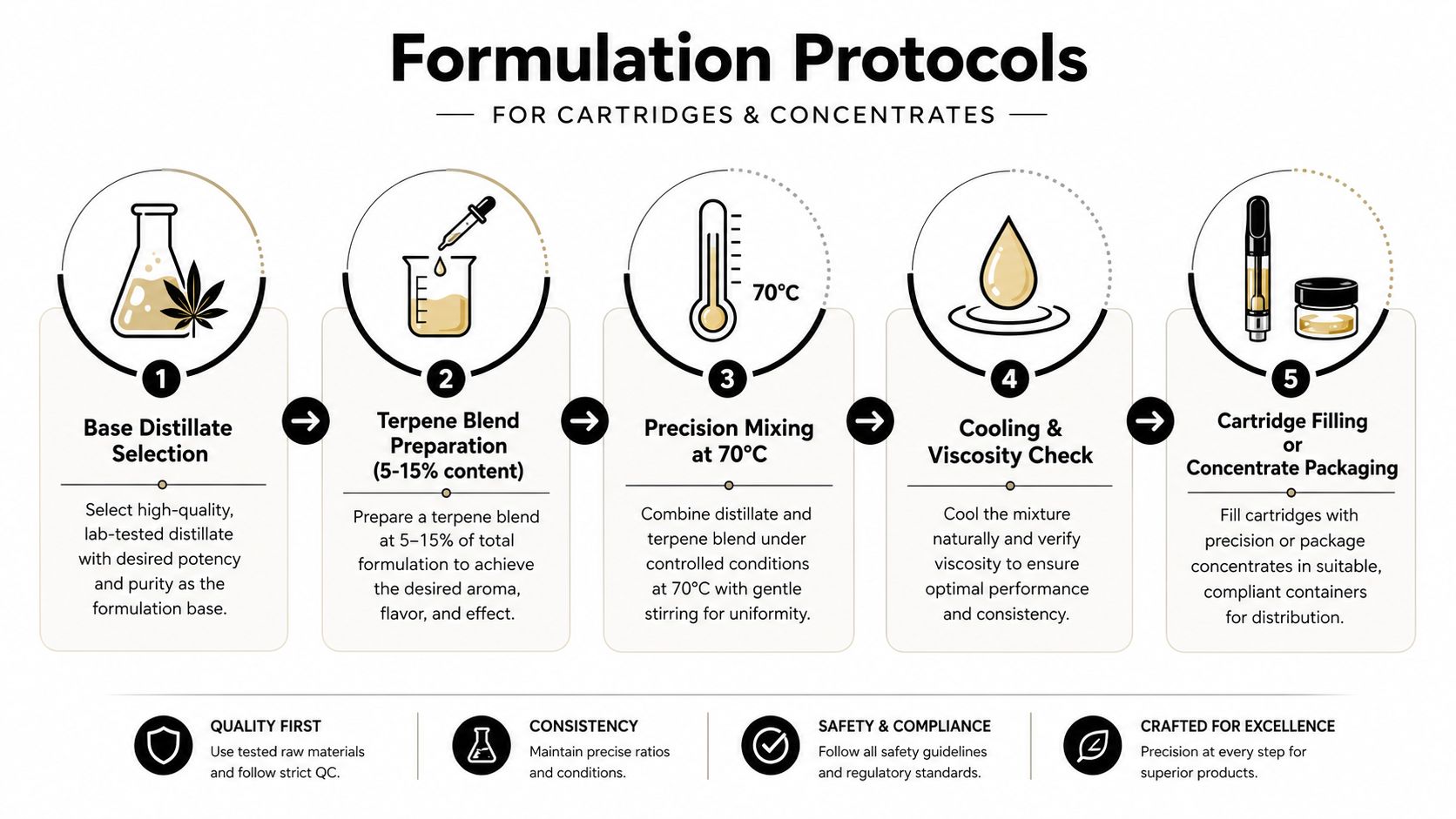
The White Widow profile has to stay readable in a real production matrix, not just on paper. For vape cartridges and distillate-based concentrates, the work starts with the base oil, because viscosity and flavor load determine how hard the terpene system has to work. The most useful target is usually a terpene content in the 5% to 15% range, depending on the base oil and the final sensory goal. Gold Coast Terpenes how-to-use terpenes resource
A practical mixing sequence
Start by warming the distillate until it flows cleanly, then add the terpene blend slowly while mixing. In the shop, the goal is not aggressive agitation, it's complete homogenization without stripping volatility. If you dump terpenes into cold, stubborn oil, you get streaking, separation, and a finished cart that tastes uneven from the first puff to the last.
A workable small-batch process looks like this.
- Select the base oil carefully. Neutral or heavily refined oil needs more aromatic structure than a terpene-rich input does.
- Pre-blend the terpenes. Build the White Widow ratio before it ever touches the oil.
- Warm the distillate. Enough heat to reduce viscosity, not enough to cook the top notes.
- Mix until visually uniform. The blend should look consistent, not layered.
- Cool and check flow. The final oil should move cleanly before filling.
What to protect during production
White Widow's pine-earth-spice identity is the thing to preserve. If the distillate is too neutral, the terpene blend has to carry both flavor and brand recognition, which means the ratios can't be timid. If the oil is already expressive, you can use a lighter hand and let the base contribute some of the character.
Winterized inputs need extra attention because they can hold flavor differently from a cleaner oil matrix. Separation often shows up first in the cart hardware, not in the tank, so the blend needs to be checked after cooling, not just right after mixing. A formulation that looks perfect in the beaker can still drift once it settles in a cartridge shell.
Why scale changes the answer
Small batches let you correct by smell and texture. Commercial runs need repeatability, documented sequence, and a strict review of how the blend behaves in the filling line. The right White Widow terpene profile for production is the one that stays coherent after storage, transport, and consumer use, not just the one that smells strongest in the lab beaker.
Balancing Functional Effects in Modern Hybrid Positioning
White Widow is increasingly framed as a social-to-relaxed or uplifted yet calm strain, and that positioning makes sense when you look at the chemistry rather than the legend. The profile's repeated appearance of myrcene, caryophyllene, and pinene lines up with a blend that can feel relaxing without being purely sedating. One recent guide also places White Widow at 18% to 25% THC with CBG at 1.2%+, which shows how modern branding has shifted toward balanced hybrid use cases. Hometown Hero's strain spotlight
Chemistry, not mythology
The cleanest read is that the effect cue comes from the full composition, not one terpene doing all the work. Myrcene supports the softening finish. Caryophyllene brings a spicy, grounded middle. Pinene helps keep the opening brighter and more functional.
That's why the same strain can be marketed differently depending on the ratio emphasis. A pinene-leaning White Widow profile can sit comfortably in a daytime product. A myrcene-heavy version can better support evening positioning. A caryophyllene-centered version often lands in the middle, which is where a lot of hybrid SKUs want to live.
Practical rule: don't promise a sensation the chemistry can't support. The blend should reinforce the product story, not fight it.
What buyers are really asking for
When a brand asks whether White Widow is calming, what they usually want is a functional product brief. They want to know whether the terpene profile should read bright and alert, smooth and balanced, or soft and winding down. That's a formulation question, not a strain-lore question.
The most useful way to answer it is to choose the interaction between terpene ratios and cannabinoid intensity deliberately. High-THC distillate can make a bright terpene blend feel sharper. A heavier, earthier profile can round that out. If the brand wants a smoother hybrid message, caryophyllene often becomes the bridge between clarity and relaxation.
How to position without overclaiming
Marketing teams often overreach because they want simple labels. The formula performs better when the message is more precise. Pine-forward means brighter. Spice-forward means deeper. Earth-forward means fuller and calmer. That language keeps the brand credible and gives the product a sensory anchor consumers can recognize.
Quality Control and Troubleshooting Common Issues
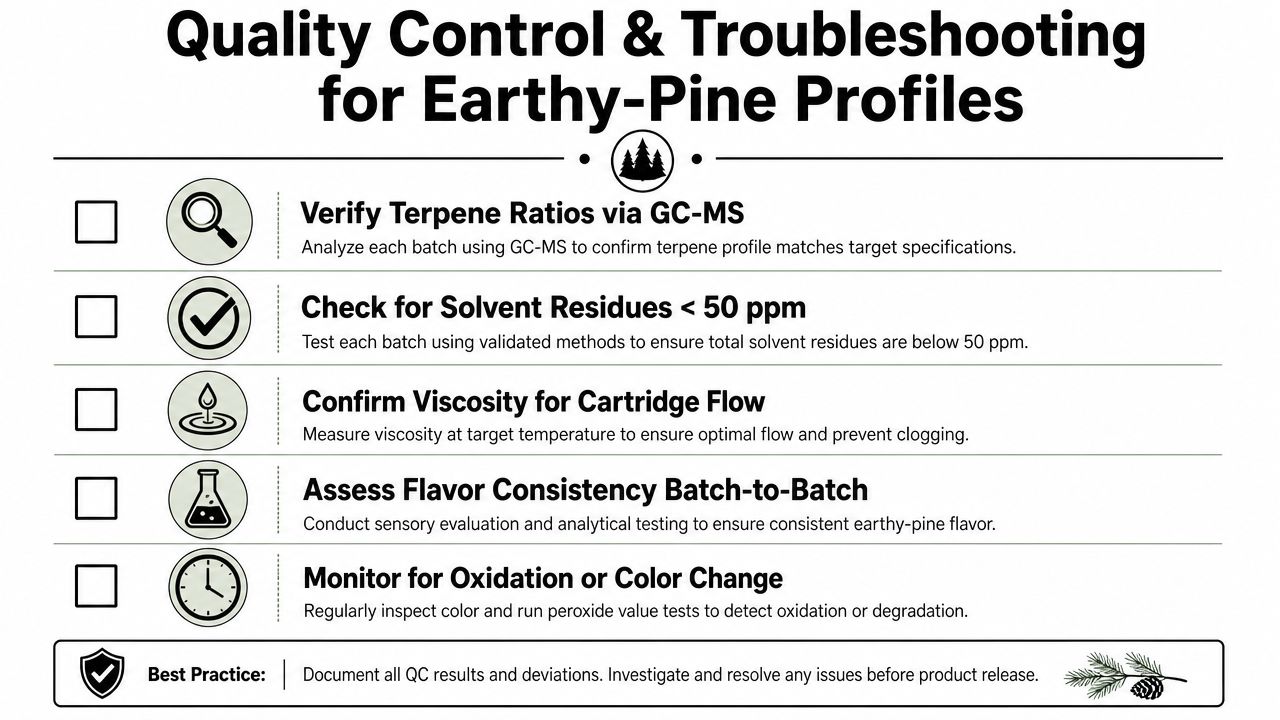
White Widow-style profiles punish sloppy QC because the aroma stack is easy to drift. A blend that smells right on day one can lose definition if storage, oxidation, or hardware choices aren't controlled. The practical way to manage that risk is to verify the profile by GC-MS, document batch variation, and watch the finished product after fill, not just before it leaves the mixer. Gold Coast Terpenes quality-control article
What to check first
- Verify terpene ratios via GC-MS. Confirm that the profile still matches the target myrcene, caryophyllene, and pinene balance.
- Check for solvent residues. Make sure the input meets your internal release standards before blending.
- Confirm viscosity for cartridge flow. A blend that's too thick or too thin will change user experience.
- Assess flavor consistency batch to batch. Don't trust one good batch as proof the process is stable.
- Monitor for oxidation or color change. Pinene is especially worth watching because top-note drift shows up early.
Store finished terpene blends in cool, dark, nitrogen-flushed containers whenever possible. That reduces the chance of aroma loss and slows the kind of oxidation that flattens pine brightness. If a source batch comes in a little different from spec, adjust the formula to the new input instead of forcing the old ratio onto a new chemistry.
Common failures and what they usually mean
If the cart tastes piney at first and then collapses into earth, the top note is probably underprotected. If the product smells spice-heavy but feels flat, the base may be too weak to carry the profile. If separation shows up after fill, the issue is usually process discipline or oil compatibility, not just the terpene blend itself.
The supplier relationship matters here too. Ask for certificates of analysis, keep internal batch notes, and treat consistency as a process, not a promise. That's how you keep a White Widow profile recognizable across production runs instead of merely close.
Real-World Product Development Scenarios
A premium cartridge on dispensary shelves needs a profile that reads instantly, so I'd usually start with a caryophyllene-forward White Widow version and tune the pinene upward only if the first pull feels too muted. The reason is simple, carts have to communicate identity fast, and a balanced mid-note survives neutral distillate better than a delicate top-note that vanishes after fill. The validation step is sensory, not just analytical, because the blend has to taste like White Widow in the hardware the customer uses.
A bulk concentrate for wholesale is a different problem. Here, production efficiency matters more, so a myrcene-forward structure can work if the base oil already brings enough clarity. I'd keep the formula tighter, reduce unnecessary top-note complexity, and focus on consistency across lots instead of chasing a flashy opening that won't survive scale.
A custom brand brief usually asks for something harder, a profile that feels recognizable but not generic. That's where a pinene-forward version can separate the SKU from the crowd without losing the White Widow identity. The best output comes from a tight loop between formulator, production lead, and marketing team so everyone agrees on whether the product should read bright, classic, or grounded.

If you're building a White Widow-inspired cart, concentrate, or custom hybrid SKU, Gold Coast Terpenes can help you match the right sensory target with a stable, production-ready profile. Visit Gold Coast Terpenes to compare strain-specific blends, terpene isolates, and formulation resources before you lock your next batch.