
You're already doing the hard part. The product is live, the wholesale sheet is built, and now someone on your team is asking whether an affiliate channel can bring in more distributors, more niche publishers, or a few solid reps without adding another salaried headcount.
That's exactly where wholesale affiliate programs earn their keep, because they sit between pure wholesale and classic paid media. The merchant keeps the checkout, fulfillment, and support. The partner sends tracked traffic and gets paid only when that referral turns into a real conversion, which is why the channel is structured around outcomes instead of upfront spend, as outlined in the wholesale affiliate model.
The opportunity is larger than many assume. Industry estimates put the global affiliate marketing market at $17.0 billion+ in 2025 with a forecast of $36.9 billion by 2030, and 81% of brands worldwide reported an active affiliate program in 2026, up from 68% in 2021 (affiliate market statistics). For cannabis and hemp operators, that means affiliate partnerships aren't a side experiment anymore. They're part of mainstream distribution logic.
What Wholesale Affiliate Programs Actually Are
A vape cartridge brand usually reaches this point after the wholesale team has already been handling reps and inbound account requests. Then a few publishers, educators, or niche operators start sending buyers who look qualified, but who do not need to hold inventory or become the seller of record.
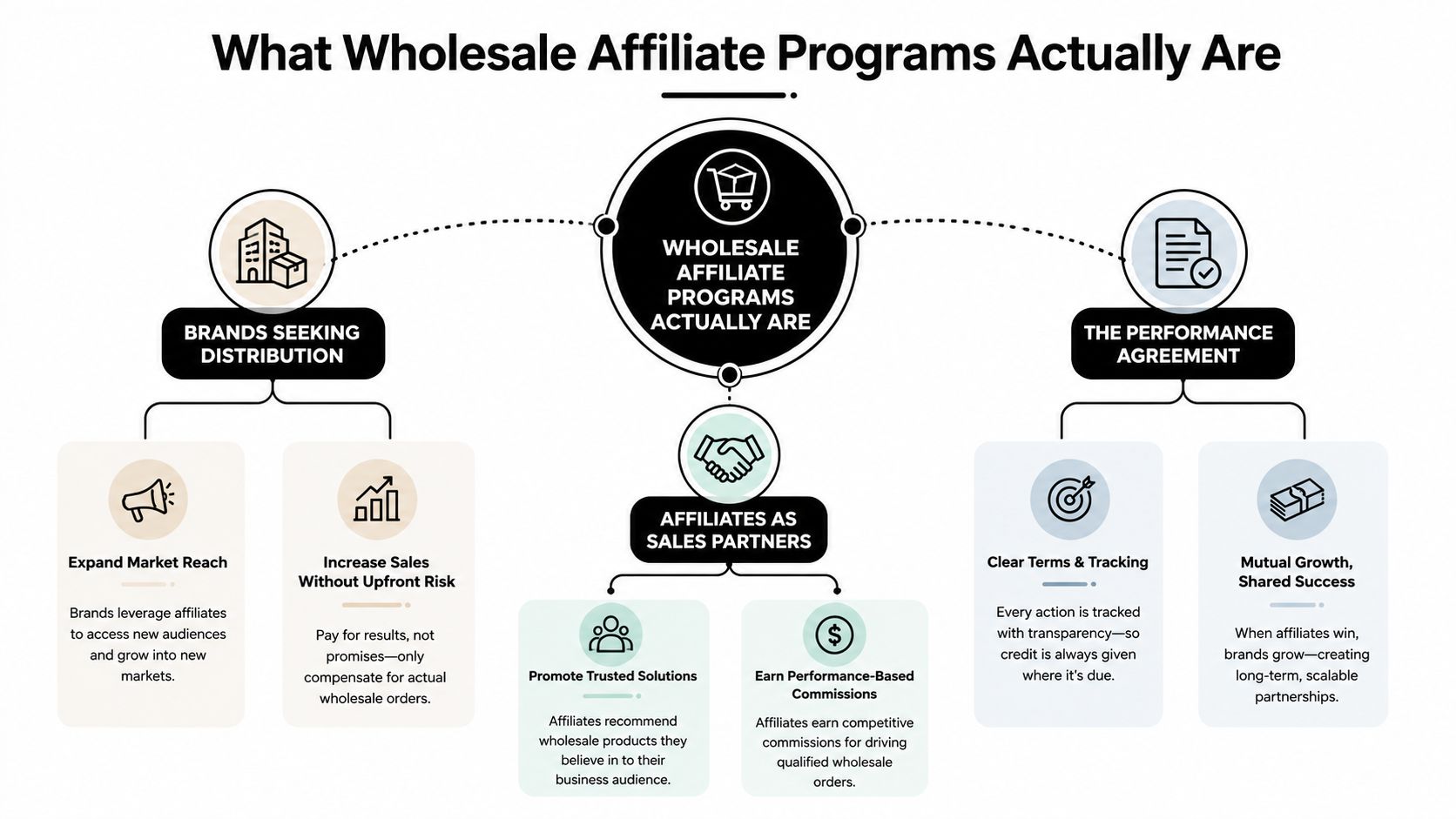
A wholesale affiliate program is a performance-based acquisition channel. The affiliate is the referring publisher, not the seller. The customer lands on the merchant's site, checks out there, and the affiliate earns a commission only if the tracked referral converts. The merchant still handles fulfillment, support, and order management, which keeps the operational burden on one side of the relationship.
What makes it different from resale or distribution
Control is the dividing line. A distributor buys to resell, and a reseller may set pricing or handle customer service, but an affiliate does not own inventory and does not become the merchant of record. That structure matters in cannabis and hemp because it keeps the commercial and compliance workload in one place.
The channel usually attracts three kinds of partners. Some are niche content publishers with trade audiences. Some are independent sales reps who can refer qualified accounts. Some are creators or operators with an audience that already trusts their recommendations.
Practical rule: if the partner cannot send traffic that still makes sense after a policy review, the relationship is probably too loose for a regulated category.
For a brand, the value is straightforward. You get an acquisition channel tied to outcomes, not impressions. For the affiliate, the pitch is just as direct. They do not touch the product, manage fulfillment, or carry inventory risk.
If you want a broader framing of how the model is described in the wholesale world, the program structure overview gives the basic setup. A closer look at the affiliate marketing success overview shows why the same logic keeps showing up in growth discussions.
How Commissions and Tracking Really Work
A wholesale affiliate page can make the payout look simple. The work sits behind that number, in the attribution window, the payout threshold, and the holdback policy. Those terms decide whether the program still makes sense after refunds, support time, and compliance review.
The mechanics behind the payout
Wholesale programs usually run on a flat, tiered, revenue-share, or hybrid commission model. The right structure follows margin, order size, and how much review the merchant wants before paying out. Shopify's commission and payout guidance recommends setting commission after checking product margins, then choosing a cookie window and payment threshold that still leave room for positive unit economics.
A longer cookie window matters on wholesale orders because buyers often compare specs, wait for approval, or return later through another channel. A 30-day cookie is often stronger than a 24-hour window for that kind of buying cycle. Monthly payouts with a $50-$100 threshold and a 30-60 day holdback are common because they give the merchant time to absorb refunds and chargebacks before commission is released.
| Lever | Typical Range | What It Changes |
|---|---|---|
| Commission structure | Flat, tiered, revenue-share, hybrid | Changes partner motivation and margin exposure |
| Cookie window | Often 30 days, sometimes shorter | Changes how much delayed buying you capture |
| Payment threshold | Often $50-$100 | Changes payout frequency and admin load |
| Holdback period | Often 30-60 days | Changes refund and chargeback protection |
The math is easier to see in a simple order example. If average order value is $125, a commission rate of 9.2% creates a very different payout burden than a 5% program, especially once holdback and returns are included. That is why commission discussions need to sit next to performance benchmarks and market commission rates, not beside them as separate topics.
The payout is only real after the refund window closes.
A wholesale operator also has to think about what the affiliate can promote. In cannabis and hemp, claims, audience fit, and channel placement matter as much as the rate itself. An affiliate who sends qualified traffic with clean messaging is far more useful than one who chases volume with copy that creates compliance cleanup later. For a working rate comparison, this affiliate program commission rates reference is a useful point of reference.
Benefits and Tradeoffs for Brands and Affiliates
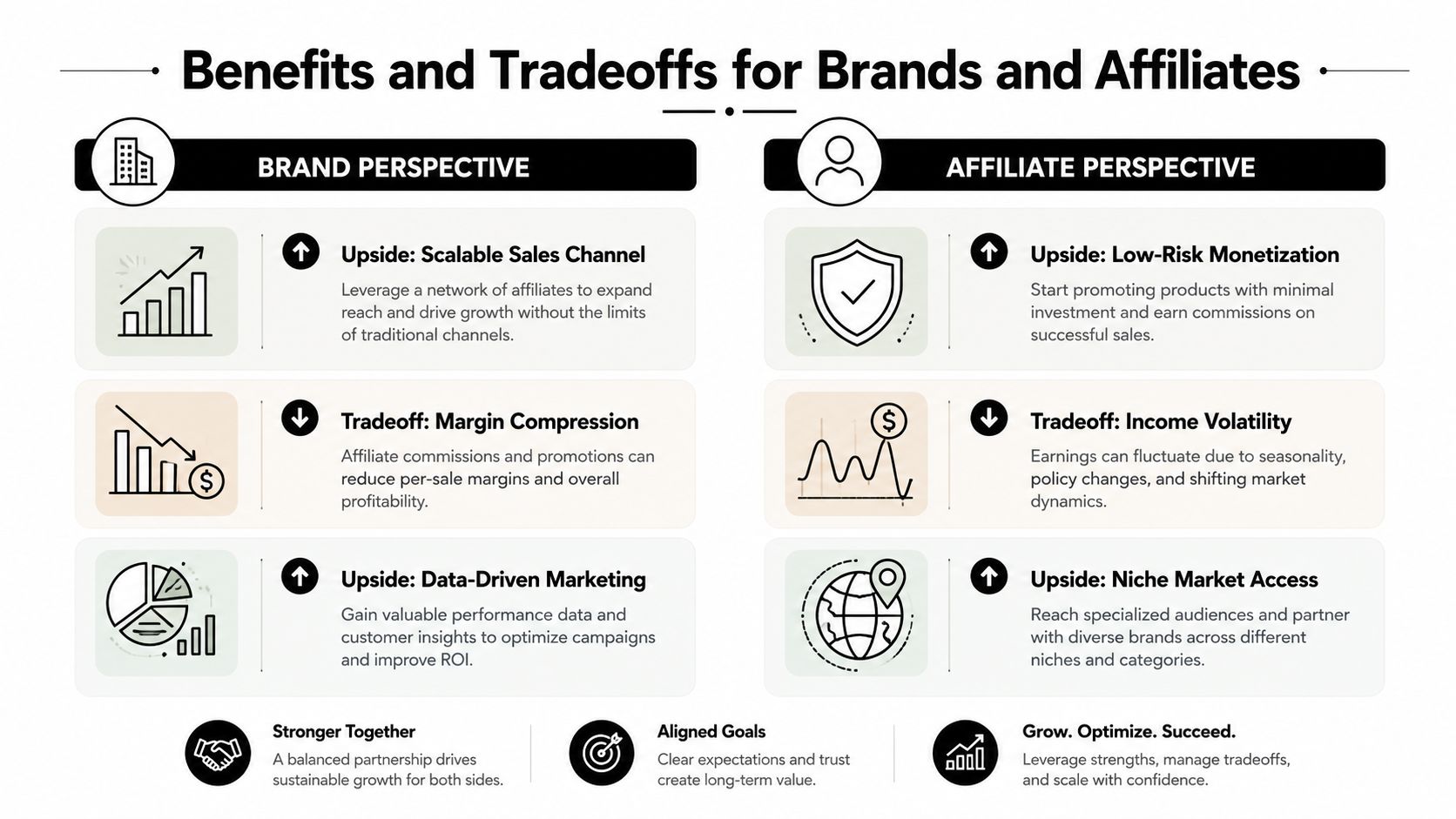
The attraction on the brand side is obvious. You can buy sales outcomes without paying upfront media cost, which makes the channel feel safer than a broad paid campaign. You also reach niche publishers and trade-connected operators that a normal ad account may never find.
Brand-side upside and friction
The upside is performance-based acquisition. That lowers the risk of paying for traffic that never converts, which is one reason affiliate programs are mainstream across major markets, not fringe experiments (market adoption data).
The tradeoff is margin compression and program management. Every affiliate you onboard creates tracking, support, payout, and compliance overhead. In regulated categories, the bigger risk is off-message promotion. A partner can generate sales and still create brand drift if their copy leans into claims the merchant would never approve.
Affiliate-side upside and friction
For the affiliate, the channel is attractive because it's low-risk monetization. They don't carry inventory, don't ship orders, and don't manage customer support. They can also build durable content assets that keep referring traffic over time.
The hard part is that income isn't fully under their control. Delayed payouts, merchant-side tracking integrity, and concentrated earnings are real problems. The performance data is blunt here, because the top 10% of affiliates drive 70% of total revenue and average retention sits at 65%, which tells you how dependent the channel can become on a small number of strong partners (affiliate performance benchmarks).
That concentration cuts both ways. For brands, a few serious partners can carry a lot of volume. For affiliates, a few programs can account for a large share of monthly revenue, which makes them vulnerable if terms change or a merchant pauses the offer.
The cleanest way to think about it is this. Brands are buying scalable referrals with controlled spend. Affiliates are trading reach and content for a delayed, conditional payout. Neither side should enter the relationship assuming the other side carries the risk.
The Economics Most Wholesale Articles Skip
A higher commission does not automatically make a better program. Wholesale affiliate economics live in the margin, the return rate, the payout timing, and whether the customer comes back after the first order. Generic affiliate content usually stops at the headline rate, which is the wrong place to stop.
Why the headline rate can mislead
A program can post an attractive percentage and still lose money on the back end. Order size, refund behavior, and fee structure all affect whether the referral is worth paying for. In wholesale, that matters more than the public rate because one bad assumption can wipe out the margin on the first order and the repeat order behind it.
A wholesale partner with repeat buyers can justify a lower commission if the basket is healthy and the customer keeps ordering. A consumer-style offer with a higher percentage can still underperform if the basket is small and refunds eat into the net. That is why the commission rate has to be measured against gross margin and contribution margin, not against another brand's posted number.
Why concentration risk matters
Affiliate revenue often sits with a small group of partners, so the dashboard can look broader than the business really is. If one partner stops sending traffic, the program may still look active while its most meaningful volume drops away. That is a quiet operational risk, especially in wholesale where a few accounts can carry a lot of monthly revenue.
Operational takeaway: if one partner goes dark, the program can still look healthy in the dashboard and lose most of its meaningful volume.
Payout mechanics shape that risk too. A holdback period protects the merchant from refunds and chargebacks, but it also slows cash flow for affiliates who are used to faster settlement. A monthly payout floor can cut admin work, yet it can frustrate smaller partners who need quicker turnover. The stronger programs balance acquisition goals with net margin that survives returns, holds, and delayed payment cycles.
Break-even math should come before aggressive commission promises. A practical break-even point calculation resource helps teams test whether a tiered payout still leaves room for fulfillment, refunds, and margin protection before they recruit harder.
For cannabis and hemp, that math matters even more because compliance friction can reduce the usable traffic pool. If the promo channel is narrow, the program has to earn back its costs through repeat purchases, not just first-click conversions.
Compliance and Promotion Rules for Cannabis and Hemp
Cannabis and hemp affiliate programs fail for reasons that have nothing to do with traffic quality. They fail because the copy, landing page, or disclosure language crosses a platform line before the channel has time to compound.
Where generic affiliate advice breaks down
The problem isn't whether a partner can drive clicks. The problem is whether they can promote the offer without getting an account restricted on Meta, rejected on Google, or flagged by email and creator platforms. Existing wholesale-affiliate advice often stops at “choose a niche” or “get approved,” but it doesn't answer the question, which is where the offer can be promoted safely and what claims will trigger review issues (policy gap analysis).
In practice, that means the program terms need to define more than commission. They need to define disclosure language, claim boundaries, and landing-page structure. If a partner is talking about regulated categories, therapeutic effects, or intoxication, the content risk changes fast. The brand has to decide what it will allow before it lets affiliates publish.
What safer promotion looks like
FTC-style disclosure expectations are straightforward in principle. If someone earns a commission, that relationship should be disclosed clearly in the promotional content. The harder part is making the disclosure feel native without burying it in the body copy.
Safer language for terpene and formulation offers usually stays on product attributes, sourcing, and sensory use. For distillate or hardware offers, the copy should focus on compatibility, production efficiency, and product specifications. It should not drift into medical language or experiential claims that a reviewer could read as a problem.
Keep the offer in the lane of product description, sourcing, and use case. Don't let a partner turn it into a promise.
Practical examples help. A terpene offer can be framed as “strain-inspired flavor support for formulation teams.” A distillate offer can be positioned as “a component for product development and flavor accuracy.” Hardware can be described as “compatibility-focused cartridge components for manufacturing workflows.” Those are promotional shapes, not guarantees, and that distinction matters in cannabis and hemp.
The brand should also require landing pages that can stand on their own. If the ad is thin but the landing page is vague, the platform review problem doesn't disappear. It just moves one click downstream.
An Evaluation Checklist Before You Sign Up
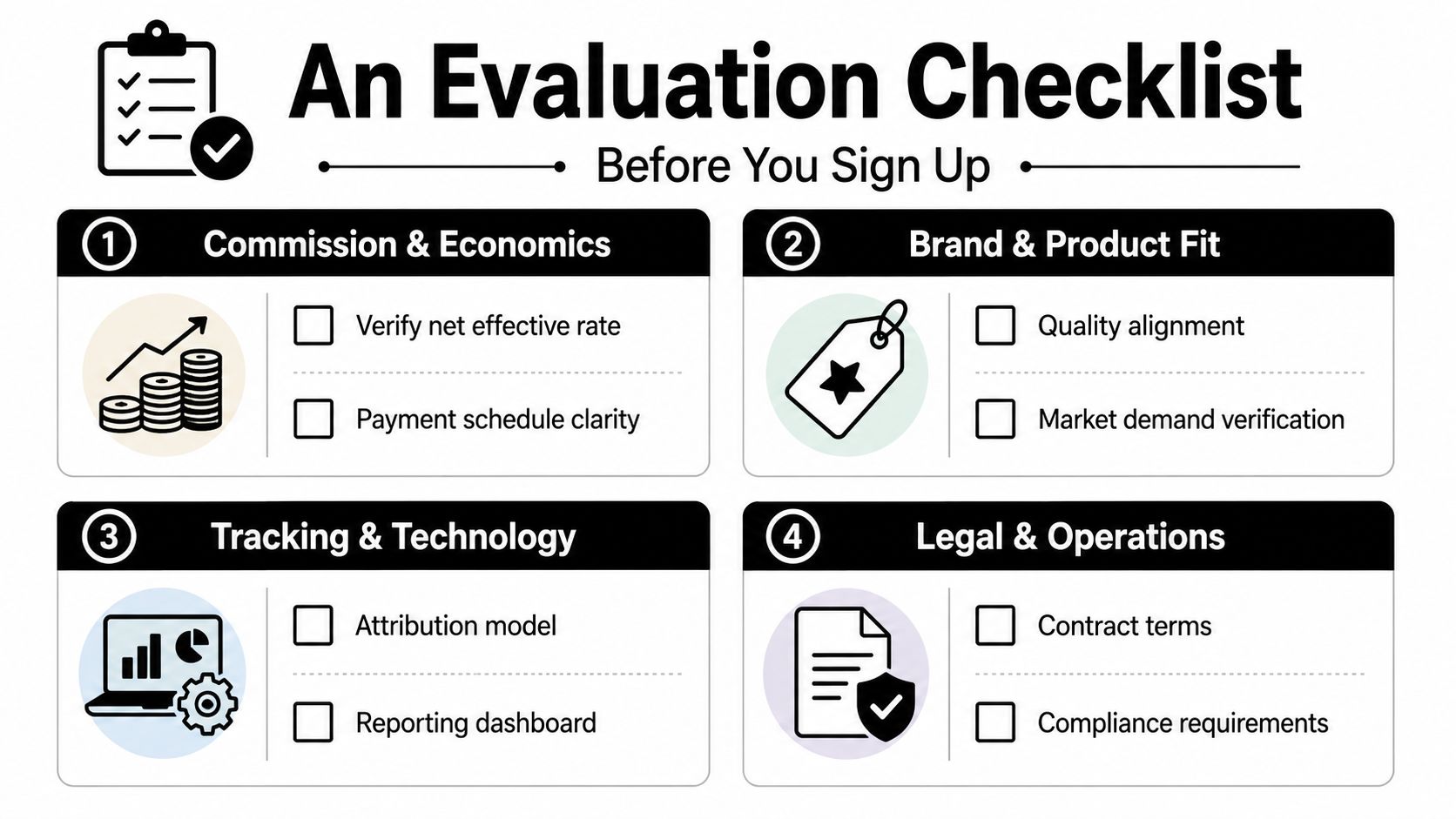
You can sort most candidate programs in one sitting if you ask the right questions. The goal isn't to build a scoring model. The goal is to decide whether the offer is worth a deeper conversation.
Commission and economics
- Verify net effective rate. Is the rate still attractive after returns, fees, and holdback?
- Check payment schedule clarity. Are threshold and payout timing written plainly, or buried in platform jargon?
Tracking and attribution
- Confirm the attribution model. Do cookie terms, attribution windows, and cross-device behavior fit your sales cycle?
- Inspect the reporting dashboard. Can you see clicks, conversions, and payout status without chasing support?
Brand and product fit
- Match quality expectations. Would this offer still make sense if a customer or reviewer landed on it cold?
- Check demand fit. Is the product something a serious buyer would place in a wholesale or formulation workflow?
Legal and operations
- Read the contract terms. Are disclosure rules, claim limits, and content restrictions spelled out?
- Review compliance requirements. Can the program survive platform review without making the partner guess?
That last point is where a lot of programs slip. If the rules are only implied, affiliates will either avoid the offer or publish risky copy. A strong wholesale affiliate program makes the guardrails visible before anyone starts promoting.
How Gold Coast Terpenes' Program Fits These Best Practices
Gold Coast Terpenes is a good fit for this framework because its positioning is built around product formulation rather than consumer hype. The brand serves vape cartridge manufacturers, extractors, formulators, and wholesale buyers, which is exactly the audience that benefits from a performance-based partner channel instead of broad retail-style promotion.
The product story also maps cleanly to compliance expectations. Its lab-verified, THC-free terpene blends and SC Lab-tested positioning give affiliates a concrete compliance anchor, which is important when promotion has to survive review on different platforms. That makes the program easier to describe in plain product language, especially for terms tied to flavor accuracy, strain-inspired profiles, and manufacturing use cases.
The operational fit matters too. Gold Coast Terpenes offers wholesale, affiliate, and bulk pathways, so the channel doesn't exist in isolation from the rest of the buying journey. That lines up with the economics above, where a merchant needs to think about commission, order value, and repeat purchasing together instead of treating the affiliate program as a separate silo.
For affiliates and trade partners, the practical question is whether the program structure supports the way considered purchases happen. If the offer page, reporting, and partner terms are aligned, the channel can work as a real B2B acquisition path rather than a one-off referral feed. If you want to review the partner setup directly, start at the Gold Coast Terpenes affiliate area.
If you're building terpene-driven products or evaluating a wholesale partner channel, Gold Coast Terpenes gives you a formulation-first option with wholesale, affiliate, and bulk support. Visit Gold Coast Terpenes to review the program and see whether it fits your sourcing, compliance, and margin requirements.