
You can have a clean COA, a convincing strain name, and still end up with a cart that tastes thin, muddy, or flat. That happens most often with dessert profiles, because the label promises a flavor story, but the actual outcome depends on terpene ratio, heat stability, and how the hardware treats the blend once it leaves the tank. The Zkittlez Runtz strain is a good example of that gap, because it sits in a family that became commercially important for candy-forward aroma, yet the same name can still produce very different sensory results batch to batch.
For formulators, that makes the name less useful than the chemistry. A better way to work is to treat Zkittlez Runtz as a phenotype target, then build the profile in layers, test it in your cartridge platform, and correct the weak points with isolates instead of chasing the label. That approach matters in premium exotic SKUs, where buyers expect a recognizable candy profile and reject anything that reads as generic fruit or harsh gas. The sourcing path also matters, so I keep the procurement side in view from the start with a practical reference like Terpenes in Weed.
Why Zkittlez Runtz Is a Formulation Problem, Not Just a Strain Name
A formulator looking at a Zkittlez Runtz COA usually has two documents in front of them, one is the lab sheet, the other is a blank flavor wheel. The gap between those two pages is where most failures happen. The flower name promises candy, fruit, and balance, but the cart only delivers that if the terpene stack survives processing and matches the hardware.
What the label does and does not tell you
The lineage sits inside a commercially important family because Runtz is widely described as a 50% indica, 50% sativa hybrid created from Zkittlez × Gelato on the strain reference used here, and Zkittlez itself is commonly reported in the high-teens to mid-20s THC range, with many commercial batches between 18% and 24% THC on the same reference family page (AllBud Runtz strain reference). That is useful context, but it is not a production spec. Once a distillate base strips away the original flower aroma, the formulator has to rebuild the sensory identity from the outside in.
Practical rule: the strain name is a starting hypothesis, not a finished recipe.
That matters because premium exotic shelves are crowded. A cart only earns repeat purchases when the flavor reads clearly on the first pull, the middle of the session, and the last puff. If the top note collapses too fast, the product feels cheap even when the distillate is clean.
The most reliable way to think about Zkittlez Runtz for cannabis product formulation is as a ratio problem, not a cultivar souvenir. The name tells you the broad candy-fruit direction. The terpene balance tells you whether the batch will land bright, creamy, peppery, or muted after heat is applied. I use that mindset before I ever worry about branding copy or SKU names.
Genetics and Reported Lab Metrics for the Zkittlez Runtz Strain
A jar can carry the Zkittlez Runtz name and still behave like a different product once it leaves flower form. The parentage points to the Zkittlez × Gelato family, and strain references keep Runtz in the balanced hybrid lane, often described around 50/50. A separate listing places Zkittlez Runtz at about 25% THC in market-facing descriptions (Weedmaps Zkittlez Runtz). That is enough to explain why the strain gets attention in premium flower and extracted formats, but it does not tell a formulator how the finished vape will taste.
Why the flower number is not the cart number
Flower potency gives you a ceiling, not a cartridge spec. Once extraction strips away the native flower aroma, the sensory job starts over. A distillate base can still carry a strong cannabinoid load, but the profile goes flat unless the sweet, citrus, spice, and creamy edges are rebuilt with intent.
The broader Runtz family sits in a high-intensity potency bracket. Third-party references in the verified data place Runtz around 24% average THC, with typical lab ranges of 19% to 29% THC, and some tested batches reported around 27% to 28% total THC with over 30% total cannabinoids. That kind of range explains the market position, but it also creates a real trade-off. The stronger the potency story, the less room there is for a weak flavor rebuild to hide in the final product.
A useful terpene education resource is Gold Coast Terpenes' general terpene guide, especially if you are translating flower references into blend development. It helps a team separate strain branding from actual terpene behavior, which is the part that matters once heat and hardware enter the equation.
Why phenotype drift changes the brief
The same name can lean candy-forward in one cut and heavier in another. Verified strain references describe variation in parentage, effects, and terpene emphasis rather than one stable chemotype. That is the core risk for formulation work. One batch may read bright and social, another may come across creamier, earthier, or more peppered depending on the cut, cure, and phenotype selection.
A practical brief starts with the source material, not the marketing copy. Identify whether the input leans toward a bright candy cart, a deeper dessert cart, or a heavier spice-leaning version, then build the terpene system to match that target.
Terpene Profile Blueprint and Top-Mid-Base Note Structure
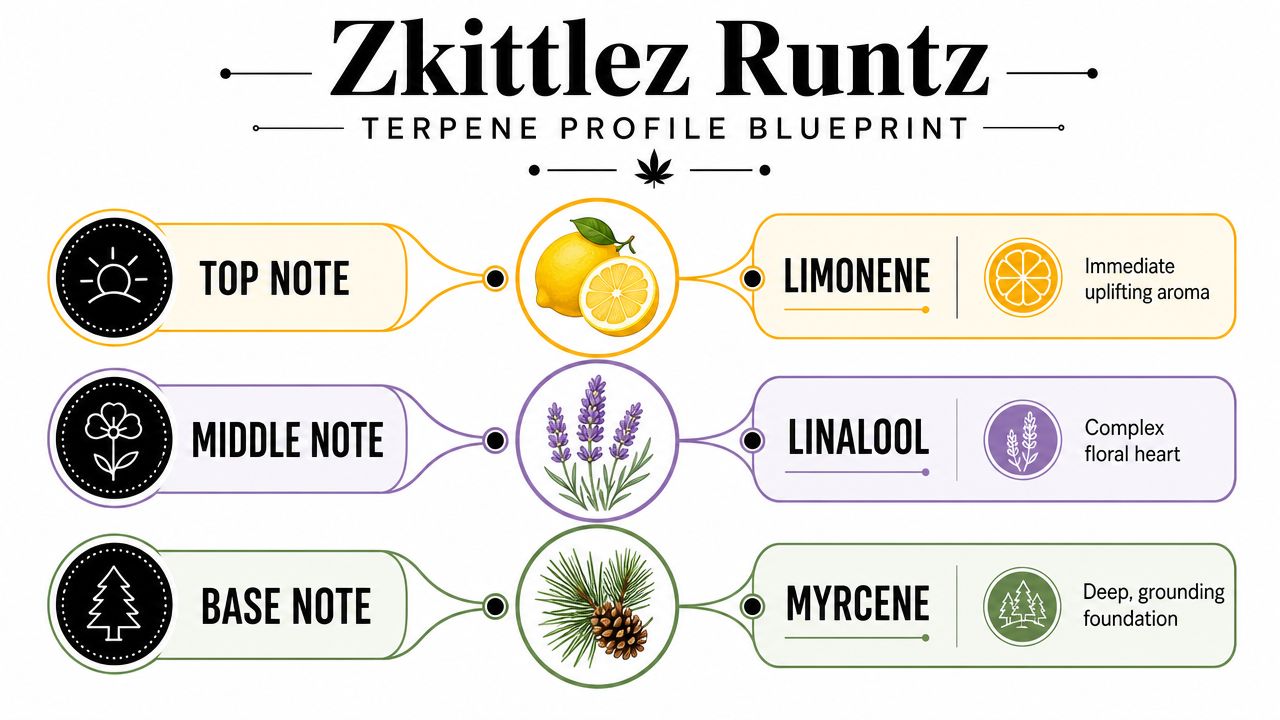
The best way to rebuild Zkittlez Runtz is to treat it like a three-layer dessert, not a single syrup. If the top note is too light, the cart feels hollow. If the base is too heavy, the candy character disappears under spice and earth. The family references in the verified data consistently point to myrcene, limonene, caryophyllene, and linalool, with myrcene and pinene appearing in lab reports as well, so the target profile should preserve that same sweet-spice architecture (CannaPio Runtz vs Zkittlez).
A workable top, mid, and base map
The top note should lead with limonene, supported by a smaller linalool accent. In formulation terms, I'd start with limonene at 35% to 45% of the terpene phase, and linalool at 8% to 14%. That gives you the first impression the market expects, bright citrus and a soft floral lift, without turning the profile perfumey.
The mid note should carry the fruit-candy bridge. Here, terpinolene can sit as a small accent if your source material supports it, but I'd keep it modest, usually 3% to 7%, because too much pushes the profile toward generic sweet haze instead of candy fruit. The rest of the mid zone comes from the interaction between the top and base notes, not from piling in more sweetness.
The base note should anchor with beta-caryophyllene and myrcene, often split near evenly. For a starting target, I'd place beta-caryophyllene at 22% to 30% and myrcene at 12% to 20% of the terpene phase. That leaves room for the layered finish that makes the strain recognizable in vapor, especially after the first few pulls.
A candy cart that works is usually built like a good pastry. The bright layer comes first, the filling sits in the middle, and the finish has to hold shape when heat hits it.
The verified data also notes that Runtz-leaning chemotypes can show a near-equal balance between monoterpenes and sesquiterpenes. In practical terms, that means you need enough bright top-note material to read as candy, but enough heavier material to keep the finish from feeling thin. If you overbuild the top, the profile evaporates fast. If you overbuild the base, it starts tasting like spice paste instead of dessert.
Heat stability and what survives the pull
Lower voltage preserves the volatile top notes better, especially limonene and linalool. Once voltage climbs too far, those lighter compounds burn off early and the user is left with a flatter caryophyllene-heavy finish. That is why I never treat a candy profile as a single-temperature product. The first pull and the fifth pull are not the same sensory event.
For procurement, a strain and isolate catalog like Gold Coast Terpenes strains and isolates is useful because it lets a team source the profile as a blend first, then trim it with individual compounds instead of starting from scratch.
Strain-Inspired Terpene Blend Recipe for Product Formulation
A starting recipe has to be realistic enough to scale and simple enough to audit. For a Zkittlez Runtz strain-inspired terpene blend for distillate, I start with a total terpene phase built around the dominant families below, then test it against the target hardware before locking the spec. The blend below is a relative starting point, not a fixed rule, and the name only gives you a flavor direction, not a guaranteed terpene map.
| Role | Terpene | Relative % | Notes |
|---|---|---|---|
| Top note | Limonene | 40% | Bright citrus lift, supports the candy opening |
| Top note | Linalool | 10% | Soft floral edge, keeps the profile from feeling sharp |
| Mid note | Terpinolene | 5% | Optional accent, only if the source batch supports it |
| Base note | Beta-Caryophyllene | 25% | Sweet-spice backbone, adds finish and structure |
| Base note | Myrcene | 15% | Grounds the profile, keeps the candy from floating away |
| Accent | Pinene | 5% | Use lightly if the goal is a cleaner, brighter finish |
How to dose it into a base
Against distillate, a practical starting load is often in the 2% to 5% total terpene range before viscosity or coil-fouling starts becoming a problem. I treat that as the working ceiling, then adjust by hardware rather than by taste alone. If the cart is too thin, cut back. If the flavor is weak, correct the ratio first instead of pushing the total load higher.
The fastest path is to begin with a matching vendor profile and then trim it with individual compounds where the batch needs correction. A catalog page like Runtz strain terpenes gives a team a profile that already sits in the right aromatic neighborhood. From there, limonene can lift the opening, beta-caryophyllene can tighten the finish, and myrcene can add body if the blend feels too airy.
A practical load calculation
If you're making 1 liter of finished oil and targeting a 3% total terpene load, you're adding 30 grams of terpenes into the base. In that 30 grams, the blend above translates to 12 g limonene, 3 g linalool, 1.5 g terpinolene, 7.5 g beta-caryophyllene, 4.5 g myrcene, and 1.5 g pinene. That gives you a bench-scale target you can weigh, test, and revise in the next pilot run.
Start with the minimum terpene load that still gives you a readable first pull. Most mistakes come from overflavoring a cart to compensate for a weak base.
For the actual blending math, I use the Mixing Calculator instead of doing every conversion by hand. It keeps the percentages and batch size aligned, which matters when you move from bench samples into production.
Building Vape Cartridges That Taste Like the Flower
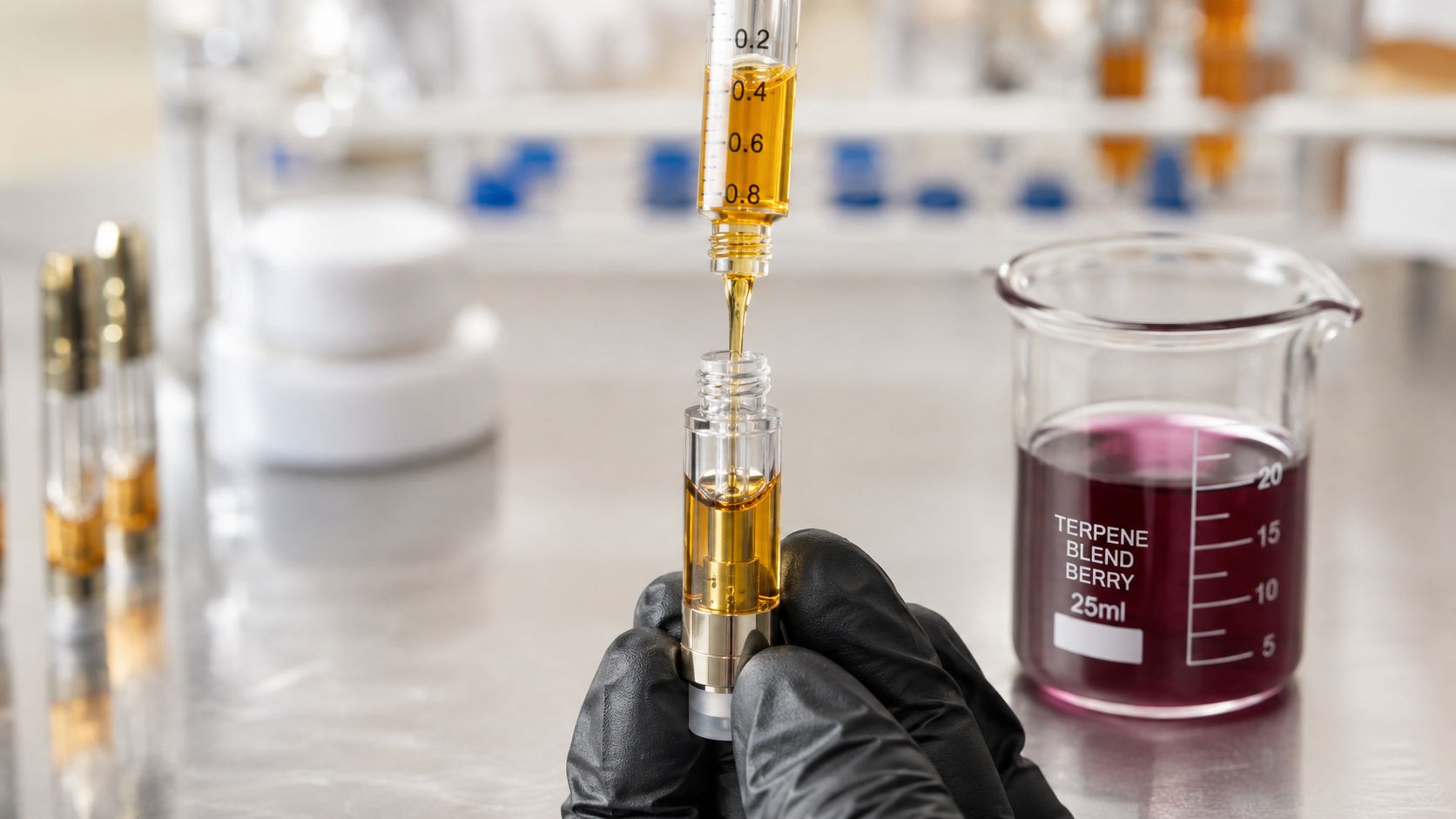
The same blend can feel elegant in one cart and rough in another because hardware changes the way the terpene stack is expressed. A 0.5 mL ceramic cart and a 1.0 mL CCELL-style cart don't behave the same way, even at the same flavor load, because wick architecture, fill density, and airflow all affect how fast the top notes are delivered. That is why for vape cartridges the recipe has to be married to the device, not just the oil.
Hardware and voltage choices
Ceramic wicks usually handle terpene-rich oils more gracefully than cotton when the goal is clean flavor retention. Cotton can work, but it tends to show stress sooner if the blend is too volatile or the voltage is too high. For a candy profile like Zkittlez Runtz, I keep the first test window in the lower-voltage band so the limonene and linalool aren't stripped off immediately.
A good working range is a small puff volume, then a short rest between hits so the wick can re-saturate. Push too quickly and the top notes collapse faster than the base can support them. Push past 3.6 V and the profile usually turns flatter, with the caryophyllene side becoming more obvious while the candy opening falls away.
Clean inputs matter more than heavy additives
For compatibility, a THC-free terpene solution that is VG, PG, PEG, and MCT-free is the safer direction when you want a clean distillate workflow. Those carrier choices can affect viscosity, coil loading, and how the flavor blooms on the first pull. A clean input also makes it easier to judge whether the problem is the formula or the hardware.
The practical workflow is simple. Blend your distillate, bring the terpene load into the 2% to 5% zone, fill one pilot batch, then run it through the exact device you plan to sell. If the opening is bright but the finish is harsh, lower voltage or trim the terpene load. If the profile reads dull, correct the top-note balance before adding more total flavor.
For technique references, How to Use Terpenes is a useful process resource, especially when you're training new production staff or setting a house SOP.
Phenotype Drift, Batch Consistency, and SKU Differentiation
A good recipe does not solve a bad batch definition. Two products labeled Zkittlez Runtz can taste different because the breeder cut, phenotype selection, drying time, and cure all shift the terpene ratios before the oil ever hits your bench. The verified data explicitly notes that pages describe varying parentage, effects, and terpene emphasis rather than one stable chemotype, and that is the root of the problem.
A QC pass that actually protects the SKU
If I'm building a repeatable SKU, I pull a representative COA, normalize the major terpenes against my target ratio, and then adjust with isolates. I do not chase the strain name. I chase the sensory target. That distinction matters when the same label shows up with slightly different chemistry from one supplier or harvest to the next.
A brand launching in three states may receive three distillate lots that all carry the same cultivar story but different terpene balance. One lot might be brighter and more social in feel, another deeper and heavier, another somewhere in between. Rather than rebrand each one, the production team should define an internal target for the top, mid, and base notes, then keep the finished SKU inside that band by small adjustments at compounding.
What to tell the sales team
The label is not the spec. The ratio is the spec. If the incoming oil is heavier than expected, lower the myrcene and caryophyllene correction before pushing more limonene on top. If the batch is too thin, add structure in the base rather than layering more candy aroma on a weak backbone.
If your team cannot describe the flavor by ratio, they are still selling a name, not a product.
That is the difference between one-off formulation and a real manufacturing standard. A stable SKU is built from repeatable inputs, a defined terpene target, and a consistent device test. Anything less leaves the outcome to chance.
Comparing Zkittlez Runtz to Related Dessert and Fuel Profiles
The useful comparison is not “which strain is stronger.” It's which blend solves the formulation brief. Zkittlez Runtz sits in the dessert-fruit lane, while a fuel-dominant profile leans sharp, heavier, and more resinous. The difference is visible in the top note first, then in the base.

Dessert family versus fuel family
Against Zkittlez, Runtz, or a more Gelato-leaning blend, Zkittlez Runtz keeps the candy note but needs enough base to avoid becoming one-dimensional. Zkittlez tends to give the fruit sweetness, Runtz adds creamy funk, and a Gelato-leaning version usually sits between sweetness and body. That is why the cart should not be built from limonene alone.
A fuel-dominant profile needs a different balance. It usually wants more myrcene and a narrower, less floral top. In that lane, linalool becomes a minor accent instead of a supporting actor. If you try to force that same structure onto Zkittlez Runtz, the profile loses its dessert identity.
The internal reference point for this family is Zkittlez strain terpenes, which is useful when you're deciding whether to push the fruit side or preserve more spice in the final cart.
What changes in the blend
For Zkittlez Runtz for distillate, the winning move is usually to protect the bright opening and then keep a clean, sweet-spice finish. For a fuel profile, I would do the opposite, bring the base forward and shorten the sweet top. That is the lever set, and it's why the same additive strategy won't work across every SKU.
The final choice comes down to market positioning. Dessert customers want recognition on the first puff. Fuel customers expect depth and bite. Zkittlez Runtz lives in the first camp, but only if the blend is built to stay there.
Procurement Checklist, Safety, and Legal Considerations
Procurement is where this profile either becomes a clean sellable input or a compliance headache. I'd verify lab-verified and SC Lab-tested inputs, a carrier profile that is free of VG, PG, PEG, and MCT, and published COAs for any isolates that get added to the blend. Packaging should also be fit for resale and handled in line with your state's inhalation rules, because acceptable ingredients and labeling expectations still vary by jurisdiction.
A practical sourcing stack is simple. Check the COA first. Confirm the carrier. Verify the concentration. Then make sure the supplier can support the exact batch size you need without changing the formulation behind your back. Gold Coast Terpenes also positions its terpene inputs as legal worldwide and supports wholesale, affiliate, and bulk purchasing, which can matter when a manufacturing team needs consistent sourcing rather than one-off retail orders.
Child-resistant packaging and clean documentation are not optional if the product is moving through retail. Undisclosed diluents, mislabeled concentration, and unsupported ingredient claims are the fastest ways to fail an audit. Before the next production run, verify the input COA, confirm the terpene ratio target, test the oil in the exact hardware you'll ship, and make sure your packaging and ingredient list match the state you're selling into.
If you're building a Zkittlez Runtz strain-inspired terpene blend for vape cartridges or distillate, Gold Coast Terpenes offers strain-specific profiles, isolates, and formulation tools that fit that workflow. If you want to pressure-test a candy profile, compare ratios, and source clean inputs for your next pilot run, visit Gold Coast Terpenes and start from the blend that matches your hardware, not just your label.