
You already know the problem. A strain starts moving in carts and disposables, buyers ask for that exact flavor profile, and the first few attempts come out either too candy-forward or too muddy on the finish. The hard part isn't getting a fruit note into distillate. The hard part is building the full arc so the inhale opens sweet and bright, then settles into the darker cannabis character that makes the profile believable.
That's where the Watermelon Zlushie strain matters for commercial formulation. It sits in the category that looks simple from the outside and punishes shortcuts in the lab. If you overbuild the fruit, it reads generic. If you push the heavier notes too early, you lose the watermelon identity entirely. A useful formulation has to preserve the transition, not just the aroma.
Replicating In-Demand Strain Profiles

Fast-moving strain-inspired SKUs usually fail for one reason. The team treats replication like flavor matching, when it's really a structure problem. With the Watermelon Zlushie strain, the structure is what buyers notice first and what poor blends miss first.
Barney's Farm describes the cultivar as an indica-dominant hybrid at 55% indica and 45% sativa, with THC consistently reaching up to 28%, and dominant terpenes Myrcene, Caryophyllene, and Limonene forming the base of its sweet watermelon aroma and fruity taste in its Watermelon Zkittlez cultivar description. For a formulator, that matters less as a consumer talking point and more as a blueprint. The profile already tells you where the weight sits. It isn't a thin candy profile. It needs fruit on top, but it also needs body.
A workable process starts with three questions:
- What must hit first: The opening has to read as juicy fruit, not citrus cleaner, not hard candy.
- What carries the center: The middle needs enough body to keep the profile from collapsing after the first draw.
- What stays behind: The finish has to lean earthy and kush-like without turning sharp or dry.
That's why teams developing a terpene profile for vape cartridges need to treat this as layered sensory engineering. You're not copying one note. You're arranging volatility, density, and persistence.
Practical rule: If the first sensory impression and the exhale impression feel disconnected, the blend isn't finished, even if both notes smell good on paper.
For formulators working through other high-expression cultivars, the same discipline shows up in replicating high terpene strains. The Watermelon Zlushie strain is a strong example because it forces clean decisions on note stacking, isolate selection, and hardware fit.
Deconstructing the Watermelon Zlushie Terpene Map
The profile only makes sense when you break it into a sequence. On a bench sample, the opening should feel bright and sweet. Then the sweetness should narrow into something slightly greener and deeper. The finish should land with earthy, peppery, resinous weight.
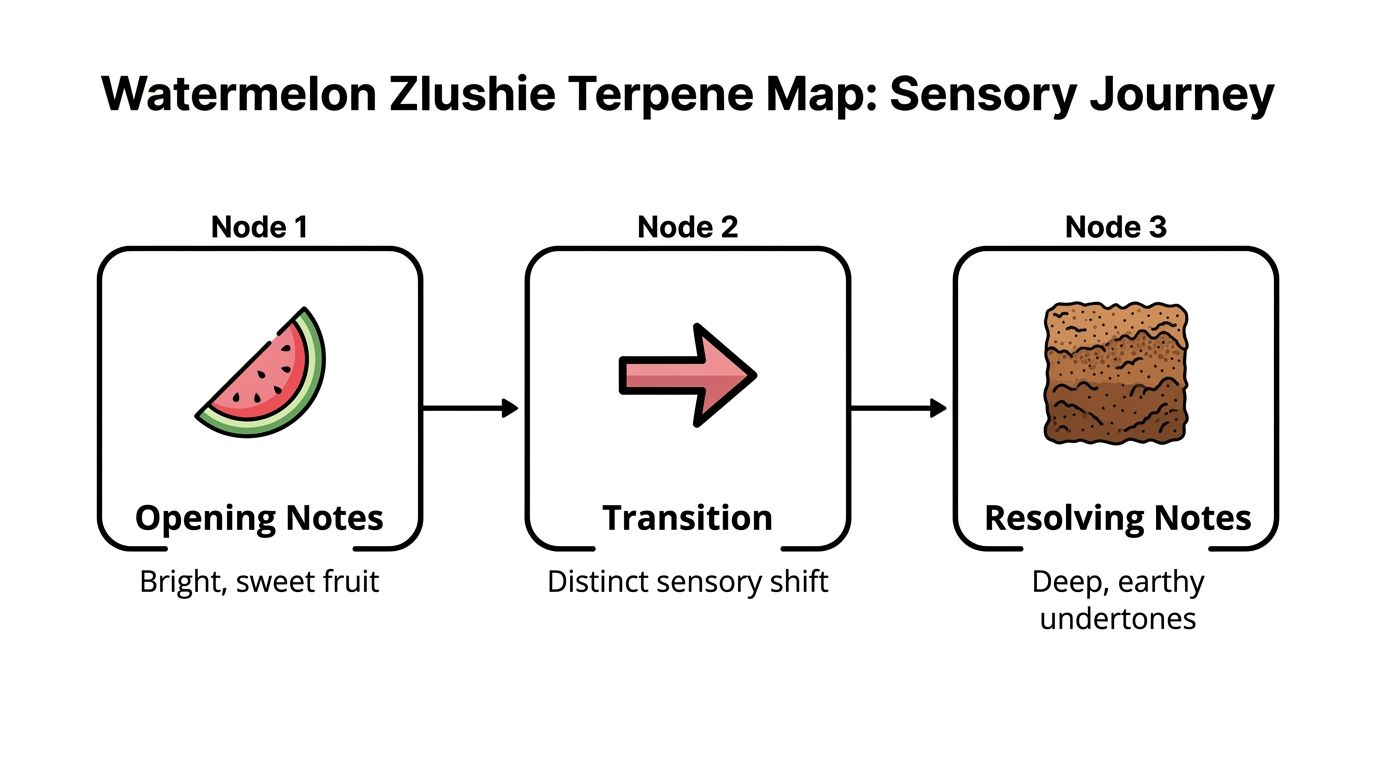
True Terpenes lists the dominant profile as Limonene at 0.7–0.8%, Caryophyllene at 0.6%, and Myrcene at 0.8%, noting that this combination is critical to the “sweet fruit-to-dank kush” sensory transition in vape cartridges in its Watermelon Zlushie cultivar profile. That's the useful technical takeaway. The profile isn't just fruity. It's transitional.
Top notes that create the first impression
Limonene drives the lift. In this profile, it shouldn't read as obvious lemon. It acts more like a brightness engine that makes the watermelon and candy-adjacent fruit notes feel wet, fresh, and immediate. If Limonene is too exposed, the blend feels generic and detached from the cultivar.
Top notes need room, but not too much room. In a cart, they flash quickly, especially with hotter hardware. That means the opening sweetness has to be supported by something just beneath it, or it disappears into a flat exhale.
Mid notes that keep the fruit believable
The middle is where many formulations lose authenticity. A realistic strain-inspired terpene blend for this profile needs a bridge note that prevents a hard drop from sweet fruit into resin. Caryophyllene helps here, even though many formulators think of it only as a base-heavy terpene.
Used correctly, it adds a dry, spicy contour that cuts sweetness and gives the profile cannabis realism. It also stops the inhale from feeling syrupy. If your first trials smell good in the bottle but feel hollow in vapor, the middle probably isn't doing enough.
The best versions don't smell like watermelon candy. They move from juicy fruit into something recognizably botanical and dense.
Base notes that deliver the kush finish
Myrcene does most of the grounding. It gives the blend that humid, earthy, musky density that stays on the palate after the brighter notes burn off. In Watermelon Zlushie, the base shouldn't dominate the opening, but it must be obvious by the end of the draw.
A useful way to think about the stack:
| Note layer | Main terpene driver | What it should do |
|---|---|---|
| Top | Limonene | Lift sweetness and create the juicy entry |
| Mid | Caryophyllene | Add structure, dryness, and cannabis realism |
| Base | Myrcene | Build the earthy, dank finish |
If you're comparing this with adjacent profiles, the Watermelon Z strain overview is a useful reference point for how closely related fruit-forward kush profiles can diverge once the base notes come forward.
Essential Terpenes for Your Formulation
A commercial blend for this profile doesn't need a huge ingredient list. It needs the right core materials, used with restraint. Most failed attempts come from adding too many decorative notes before the backbone is stable.
The non-negotiable three
Limonene is the top-note driver. In a formulation guide for the Watermelon Zlushie strain, this is the isolate that shapes the opening and gives the blend its clean lift. It's easiest to overuse because it smells attractive in raw form. In vapor, too much pushes the profile away from ripe fruit and into a sharper citrus edge. For isolate-specific context, Limonene is the kind of building block formulators use when they need to sharpen the front end without reworking the whole blend.
Beta-Caryophyllene handles two jobs at once. It trims sweetness, and it adds a peppery botanical frame that keeps the fruit from reading synthetic. In this profile, that role is critical. Without it, the blend often smells fine in a cold sample but loses strain credibility once aerosolized.
Myrcene is the anchor. It gives depth, moisture, and the heavier green-earth impression that creates the back half of the experience. It also helps pull fruit notes closer to the cannabis side of the spectrum instead of the confection side.
The supporting notes that keep it from feeling flat
Secondary terpenes are where experienced formulators separate a passable cart from a repeat-order SKU. You don't need many, but you usually need something to round the transition.
- Linalool: Useful in trace amounts when the middle feels harsh or too angular. It can soften the bridge between sweet top notes and earthy finish.
- Alpha-Pinene: Helpful when the exhale feels heavy without enough definition. It can add a cleaner resin edge.
- Fruit-supporting blend components: These aren't there to announce themselves. They're there to keep the watermelon impression from disappearing as soon as the cart heats.
What works and what usually doesn't
Some choices consistently improve this profile. Others usually cause rework.
- What works: Building from Myrcene, Caryophyllene, and Limonene first, then adjusting support notes in very small changes.
- What doesn't: Starting with a broad candy-fruit blend and trying to “cannabis it up” afterward.
- What works: Evaluating both cold aroma and heated vapor before locking the profile.
- What doesn't: Judging the blend only from bottle smell.
For a broader reference on isolate function and sensory behavior, exploring common terpenes and their benefits is a helpful technical guide. The key point here is simple. This profile rewards discipline. Three core terpenes carry the identity. Everything else should support the transition, not compete with it.
A Practical Formulation Guide for Watermelon Zlushie
Bench work goes faster when you start with a ratio map instead of free-pouring from memory. For a strain-inspired terpene blend for distillate, the first version should be simple enough to diagnose. If the blend misses, you want to know why immediately.
Starting blend architecture
Use this as a baseline for the terpene blend itself, then evaluate how it behaves in your specific cannabinoid base and hardware.
Watermelon Zlushie Starting Formulation Ratios
| Terpene Isolate | Role | Percentage in Blend |
|---|---|---|
| Limonene | Top note lift and juicy fruit opening | 32% |
| Beta-Caryophyllene | Mid-note structure and peppery cannabis body | 24% |
| Myrcene | Base note depth and earthy kush finish | 30% |
| Linalool | Softening support note for transition | 8% |
| Alpha-Pinene | Resinous definition on the exhale | 6% |
This is a practical starting point, not a final answer. In a neutral distillate, this stack tends to preserve the fruit opening while still leaving room for the deeper finish. In a louder base extract, you may need to protect the fruit top notes more aggressively through slight adjustments to support materials rather than increasing Limonene.
Bench note: If your first trial smells accurate in concentrate form but loses the dank finish in vapor, the issue is usually note balance, not total terpene presence.
How to adjust for base and hardware
Not every distillate carries flavor the same way. Residual native compounds in the base can either help this profile or fight it.
A few common scenarios:
Neutral distillate base
This is the easiest starting point. The fruit notes stay readable, and the earthy finish comes from your blend rather than competing residue.Earthy or sulfur-leaning base
Don't answer that by adding more Caryophyllene too early. That often creates a dry, harsh result. It's usually better to refine the top-to-mid transition so the fruit survives longer.Hotter hardware
Stronger heat tends to blow through top notes quickly. That can make a good blend seem underbuilt on fruit. Before changing the formula dramatically, test on cooler hardware to determine whether the issue is composition or delivery.Ceramic systems with muted output
These often need a profile with a little more front-end clarity. That doesn't mean turning the blend into citrus. It means preserving the bright entry while keeping the base intact.
Process discipline matters as much as recipe
Write down every trial. Record the base material, hardware type, fill temperature, and sensory notes at fresh fill and after rest. If you skip documentation, you'll repeat the same mistake under a new label.
For scaling calculations, a Mixing Calculator is useful because tiny ratio changes become meaningful once you leave bench volume. The profile itself is forgiving enough to iterate, but not forgiving enough to eyeball.
Mixing Techniques and Dilution Best Practices
A strong formula can still fail in production if the physical mixing is sloppy. The Watermelon Zlushie strain profile depends on volatile top notes and heavier supporting components staying integrated. If the blend isn't homogenous, one batch tastes bright and the next tastes flat.
How to combine the blend with distillate
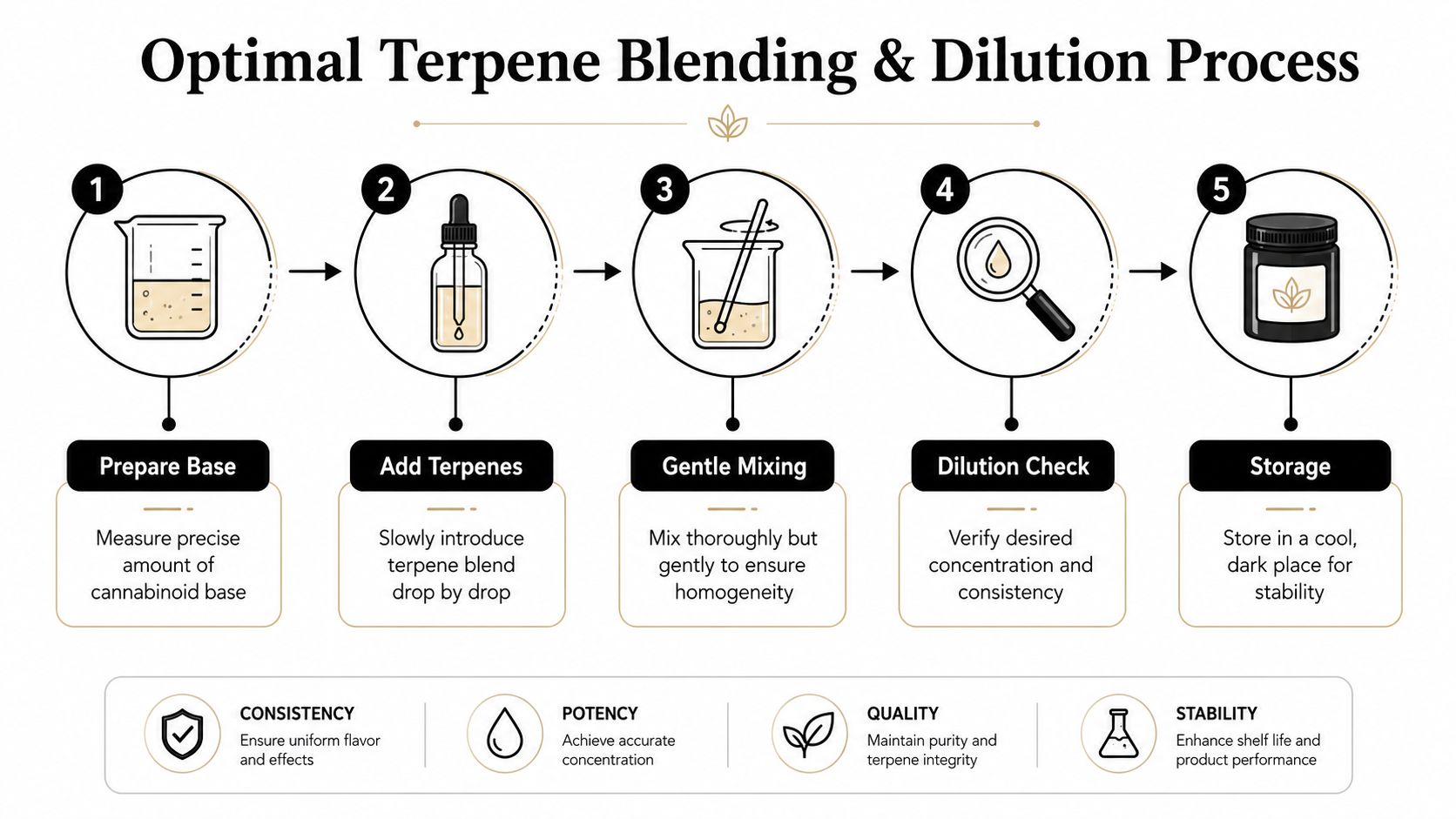
Work with a warmed base, not an overheated one. Gentle heat lowers viscosity enough for clean incorporation and better dispersion, while preserving fragile top notes. When operators rush this stage with excessive heat, the first thing they sacrifice is the bright fruit opening they were trying to protect.
A dependable workflow looks like this:
- Prepare the base: Warm the distillate only enough to flow and mix evenly.
- Add slowly: Introduce the terpene blend in a controlled stream rather than dumping it in all at once.
- Mix continuously: Use consistent agitation so heavy and light components distribute fully.
- Rest before judging: Freshly mixed material often smells disjointed compared with the same material after a short sealed rest.
Dilution choices for vape cartridges
For formulating for vape cartridges, the target isn't just flavor. You also need stable viscosity, acceptable wicking, and no sharpness on repeated draws. That's why total terpene loading should be approached as a balancing variable, not a branding statement.
Start conservatively, then test. If flavor is muted, the answer may be more total terpene content, but it may also be hardware mismatch, poor homogenization, or a base that's carrying too much of its own residual profile. Changing all three variables at once wastes time.
A blend that seems weak in one cartridge can feel overbuilt in another. Hardware can distort your conclusion if you don't control the test setup.
Common execution errors
A few problems show up repeatedly in production:
| Problem | Likely cause | Better response |
|---|---|---|
| Fruit note disappears fast | Heat too high or hardware too aggressive | Lower process stress and retest on different hardware |
| Finish feels disjointed | Incomplete mixing | Increase mixing consistency and allow rest time |
| Blend tastes sharp | Overexposed top notes or poor balance | Revisit the mid-layer before increasing sweetness |
Teams dialing in consistency for cartridges often run into the same physical issues covered in how to thin distillate for cartridges. The important point is that process choices affect flavor perception. In this profile, they affect it a lot.
Quality Control and Troubleshooting Your Blend
The final blend isn't finished when the math is done. It's finished when the filled hardware delivers the same sensory story every time. That requires quality control that's specific enough to catch profile drift before the batch leaves your facility.
What to evaluate after mixing
Cold aroma matters, but it isn't enough. For the Watermelon Zlushie strain profile, the real test is whether the inhale, mid-palate, and exhale remain connected once the blend is in hardware.
A practical QC pass should include:
- Sensory check in concentrate form: Confirm the fruit note is present without smelling detached from the cannabis base.
- Filled-device evaluation: Test on the exact cartridge or disposable platform intended for production.
- Aged sample review: Recheck after rest to see whether the blend integrates or drifts.
- Batch notes: Record what changed, even when the change seems minor.
Diagnosing common profile failures
Troubleshooting gets easier when you stop treating “off flavor” as one problem. Different failures point to different causes.
If the blend feels too peppery or dry, the middle is probably crowding the profile. Caryophyllene may be too forward, or the fruit support may be too thin to carry the opening. If the watermelon impression is weak, don't automatically force more brightness. Sometimes the issue is that the base is masking the top and the transition needs smoothing instead of amplification.
If the profile separates over time, review process before recipe. Incomplete homogenization can make a good formula look unstable. If the blend muted in hardware, test whether the base extract is overpowering the profile. Formulators often blame the terpene blend when the underlying issue is residual flavor from the extract or a device that burns through the opening too quickly.
Operator habit that saves batches: Change one variable at a time. If you adjust the blend, the fill process, and the hardware in the same round, you won't know what fixed the problem.
Documentation creates repeatability
The commercial value of a profile like this isn't just that it tastes right once. It's that your team can reproduce it under production pressure. Write down source lot information, blend date, mixing conditions, rest time, fill conditions, and hardware used for evaluation.
That discipline is what turns a good bench sample into a SKU you can trust. Without it, the Watermelon Zlushie strain becomes another profile that looked sharp in development and drifted as soon as volume increased.
If you're building a terpene profile for the Watermelon Zlushie strain, or need isolates and strain-inspired blends that are suitable for carts, concentrates, and commercial formulation work, Gold Coast Terpenes is worth a look. Their catalog includes strain profiles, isolated compounds, and practical formulation resources that help teams move from bench concept to repeatable production.