
You already know the feeling. The biomass tests well, the crude looks clean enough, but the first cartridge pilot comes back flat. The aroma opens too narrow, the mid-notes disappear under heat, and the batch that should have matched your flagship profile lands somewhere generic.
That usually isn't a strain problem. It's a process-control problem.
Extraction and formulation are often treated as separate departments with separate goals. Extraction pushes for recovery. Formulation tries to rebuild character afterward. In practice, high-fidelity vape development depends on joining those two jobs. If the extraction run destroys or muddies the aromatic fraction, the formulator has to overcompensate later, and the final product rarely tastes native.
CO2 extraction cannabis workflows solve that problem when the operator uses them as a precision tool, not just a bulk recovery method. The advantage is not only that CO2 can pull cannabinoids. It's that pressure, temperature, residence time, and staged collection let you decide what you want first, what you want later, and what you don't want in the tank at all.
For cartridge programs, strain-inspired terpene blends for vape cartridges, and terpene profile for distillate rebuilds, that control matters more than headline yield. A formulator needs a clean cannabinoid base, a protected volatile fraction, and a repeatable path back to a finished sensory profile. That's where CO2 earns its keep.
Introduction A Formulators Guide to Precision Extraction
A common production failure looks small at first. One lot of distillate fills and tests fine, but the finished carts come off dull. The top note is muted, the body feels broad but undefined, and the flavor drifts farther from the target every time you try to adjust it. The extraction team says the run was normal. The formulation team adds more terpenes. The result still feels assembled rather than true to cultivar character.
That happens when the process is built around quantity before selectivity.
For product teams working on replicating flavor of recognizable cultivar expressions, extraction can't stop at “get the oil out.” The commercial objective is sharper. You need a process that separates delicate aromatic material before the heavier fraction starts crowding it, and you need enough control to rebuild the profile in a way that survives cartridge hardware.
Operational reality: If your terpene strategy starts after distillation, you're already recovering from a loss.
CO2 gives formulators a better hand to play. It lets the extraction lead tune solvency instead of accepting a one-speed wash. That means you can preserve a lighter aromatic cut, collect a cannabinoid-rich main body, and decide later whether to reintroduce native fractions or use a strain-inspired terpene blend for cannabis product formulation to tighten consistency.
Where the value shows up
For manufacturers, the payoff isn't abstract. Precision extraction supports the work that drives sell-through in premium vapor products:
- Flavor accuracy: A preserved early fraction gives the formulator real top notes instead of a flat aromatic shell.
- Batch consistency: Controlled fractionation reduces the guessing that creeps in when every lot needs a different rebuild.
- Cleaner formulation decisions: When the base oil is better defined, it's easier to choose whether you're formulating for distillate, live-style sensory mimicry, or a custom terpene profile for vape cartridges.
- Brand differentiation: Distinctive aroma and repeatability are harder to copy than potency alone.
The strongest CO2 programs don't separate science from product design. They build extraction around the finished SKU.
The Core Science of CO2 Extraction Technology
A CO2 extractor gives the operator one advantage that matters more than the marketing language around it. Solvent strength can be tuned during the run. That changes what dissolves, when it dissolves, and how cleanly those fractions can be separated for later formulation work.
CO2 reaches its supercritical state at 31.1°C and 73.8 bar. Above that threshold, it carries gas-like diffusivity with liquid-like density. In practice, cannabis systems are run across a wider operating range so the team can shift selectivity instead of chasing one generic crude.

Why formulators should care about phase behavior
Phase behavior decides whether the extractor pulls a light aromatic cut, a broader cannabinoid fraction, or too much wax and heavier oil along with both. Pressure raises density. Temperature can either improve mass transfer or reduce density, depending on where the run is set. Good operators do not treat those variables independently. They adjust them together because the combination determines selectivity.
CO2 can function in three useful states during cannabis processing:
- Gas phase: high mobility, minimal solvency
- Liquid under pressure: stronger solvency, narrower penetration
- Supercritical fluid: dense enough to dissolve target compounds while still penetrating packed biomass efficiently
For a formulator building vape oils, that matters because the first cut often decides how much work the formulation team must do later. A clean aromatic fraction preserves more native character. A blunt, high-solvency pass usually gives more cleanup and fewer options.
What the machine is doing
The system compresses CO2, brings it to the target temperature, pushes it through the packed vessel, and then drops pressure through one or more separators. As density falls, dissolved compounds come out in sequence. That sequencing is where the process earns its keep.
A well-configured setup can collect lighter volatiles early, hold the main cannabinoid fraction in a separate collection step, and keep the heavier tail from contaminating both. That is the operational basis behind isolation of terpenes, and it is why extraction settings show up later as flavor accuracy, cartridge stability, and fewer corrective blending decisions.
CO2 earns its place in a serious lab because pressure and temperature give the extraction team control over selectivity.
Recovery is only one metric
High recovery looks good on a batch record. It does not guarantee a better feedstock for vape or distillate programs.
The trade-off is straightforward. Pushing density and residence time harder can increase total pull, but it can also drag in more compounds that flatten aroma, darken the oil, or force more downstream refinement. In commercial terms, yield can improve while usable flavor value drops.
Process engineers and extraction teams often rely on design-of-experiments work to map those trade-offs before locking an SOP. Reviews of supercritical fluid extraction research, including technical material summarized by the National Center for Biotechnology Information, describe the same principle across botanical systems. Pressure, temperature, flow rate, and time shift both yield and selectivity. For cannabis, that means the best run conditions depend on whether the target is terpene preservation, cannabinoid throughput, or a feedstock designed for controlled re-formulation.
Supercritical vs Subcritical A Formulators Choice
Formulators often hear this framed as a simple either-or choice. It isn't. In production, subcritical and supercritical CO2 are different tools for different product goals. The best operators use both modes as part of one strategy.

What each mode does well
Subcritical runs stay gentler. That makes them useful when the target is a narrow aromatic fraction and the operator wants to disturb volatile compounds as little as possible. For formulation teams working on strain-inspired terpene blend development, this is the pass that can preserve the identity of the material before the heavier pull begins.
Supercritical runs are the workhorse. They're better suited to pulling the main cannabinoid load and building the clean base that a distillate or cartridge program needs. If your end goal is a stable oil for post-processing and controlled reintroduction, this is usually where the volume of usable extract comes from.
The commercial choice behind the technical choice
The key question isn't “Which method is better?” It's “What are you making?”
| Decision point | Supercritical CO2 | Subcritical CO2 |
|---|---|---|
| Best fit | Cannabinoid-forward base oil | Terpene-first aromatic capture |
| Main value | Broad extraction strength | Gentle selectivity |
| Typical downstream use | Distillate feedstock, main extract body | Native terpene fraction, flavor rebuild input |
| Risk if overused | Pulling heavier compounds you may not want | Leaving too much cannabinoid value behind |
A team chasing throughput alone usually leans hard into supercritical settings. A team building premium carts around flavor fidelity usually starts slower, captures the early aromatic cut, then shifts conditions for the main extraction pass.
Production rule: Don't ask one pass to do two conflicting jobs.
That's why good CO2 extraction cannabis workflows are staged. The subcritical pass protects value that's easy to lose and hard to recreate naturally. The supercritical pass gives the formulator the body of the oil.
For a broader process perspective, the evolution of terpene extraction techniques helps frame why terpene-first thinking has become central to premium vapor development.
When one mode fails the product brief
If you run everything aggressively from the start, you'll often get an extract that works analytically but underdelivers sensorially. If you stay too gentle for too long, you may protect aroma but underbuild the cannabinoid fraction needed for production efficiency.
That's why the strongest operators think in sequence. First preserve what's volatile. Then extract what's valuable in bulk. Then formulate with intent.
CO2 vs Ethanol and Hydrocarbon Extraction Methods
Brand owners usually don't choose extraction methods based on chemistry alone. They choose based on what kind of product they want to ship, how much cleanup they can tolerate, and how much process control they need before formulation begins.
For replicating flavor of recognizable cultivar profiles in cartridges, the central question is selectivity. Can the method produce a base that still leaves room for precise aromatic rebuilding, or does it create a broad crude that needs heavy correction later?
Comparison of Cannabis Extraction Methods
| Metric | CO2 Extraction | Ethanol Extraction | Hydrocarbon Extraction (BHO/PHO) |
|---|---|---|---|
| Solvent behavior | Tunable with pressure and temperature | Broad solvent action | Selective for aromatic and resinous compounds |
| Best commercial use | Precision extraction for terpene retention and clean cannabinoid fractionation | High-throughput crude production and broad-spectrum pulls | Aroma-forward concentrate styles and terpene-rich extracts |
| Selectivity control | High. Operators can adjust process stages to target fractions | Lower. It tends to pull broadly | High in practice, but tied closely to solvent handling and post-processing discipline |
| Post-processing burden | Moderate, depending on target output | Often heavier because broad extraction can bring more unwanted material | Product-dependent |
| Safety profile in facility planning | Non-flammable solvent, but high-pressure operation demands disciplined engineering | Flammable solvent handling | Flammable solvent handling |
| Fit for terpene profile for vape cartridges | Strong when staged fractionation is built into SOPs | Usable, but often needs more reconstruction | Strong for certain product styles, especially when aroma capture is the priority |
| Flavor rebuild flexibility | High, because cleaner fractions are easier to reassemble | Lower if the crude is too broad or dark | Often strong, depending on extract style and intended finish |
Where CO2 wins
CO2 stands out when the product team wants a cannabinoid base that doesn't lock the formulator into heavy corrective blending. That matters in formulating for distillate because every extra cleanup step can flatten or distort what little native character remains.
It also helps when manufacturing needs repeatability. Pressure and temperature are process levers. Teams can document them, repeat them, and tie them to fraction outcomes with more precision than broad-soak workflows.
Where ethanol still makes sense
Ethanol remains useful when the goal is broad extraction and bulk throughput. If the business model depends on producing crude for deep refinement, ethanol may fit the operation. The trade-off is that broad extraction can create more work downstream, especially if flavor accuracy matters later.
That's the divide many formulation teams underestimate. You can absolutely make finished products from ethanol-derived material. It's just often a rebuild-heavy path rather than a preservation-first path.
Where hydrocarbons fit
Hydrocarbon methods are often chosen when aromatic richness is a product priority. Many operators value them for concentrate styles where expressive flavor is central. The trade-off sits in facility design, solvent handling, and process safety requirements.
Better extraction isn't the method with the loudest reputation. It's the one that creates the fewest avoidable problems for the SKU you actually want to sell.
If your commercial target is cartridge consistency, a cleaner and more controllable starting point usually matters more than chasing one universal “best” solvent. Teams evaluating those trade-offs in detail should review solvent extraction methods through the lens of end-product architecture, not extractor preference.
Formulating for Terpene Retention with CO2 Extraction
CO2 thus becomes more than an extraction method. It becomes a formulation strategy.
Most content on CO2 talks about yield or purity. That's useful, but it misses the harder commercial problem: how to preserve or rebuild a terpene profile for vape cartridges that tastes intentional instead of approximate. The answer is staged fractionation, disciplined collection, and selective reintroduction.
A practical visual helps before getting into the workflow.
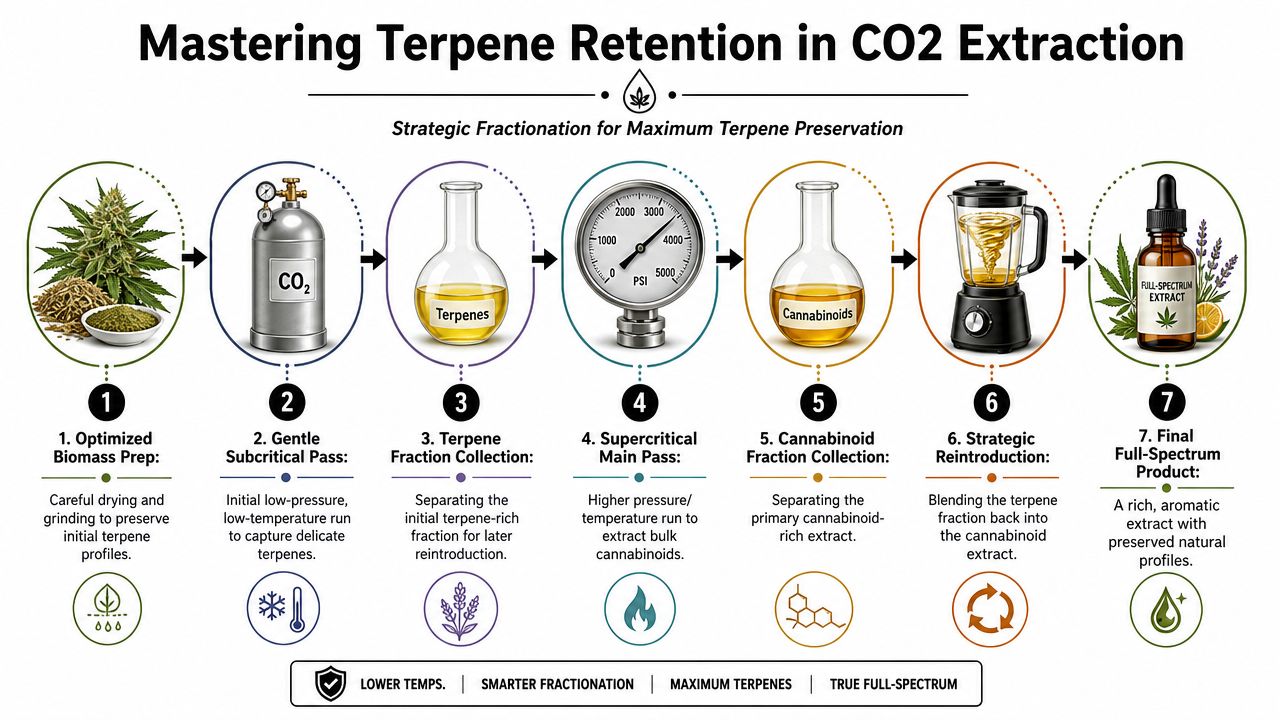
Dual-stage extraction for profile control
The most useful operational data for terpene retention comes from dual-stage CO2 extraction. As described in this ACS Laboratory processing guide, operators can isolate terpenes at 800–1,000 PSI and below 87°F, then extract cannabinoids at 3,000–3,500 PSI and 150–170°F. That split is what makes high-fidelity aromatic capture possible.
That matters because the volatile fraction and the main cannabinoid fraction don't want the same treatment. If you ask them to share one aggressive run, the heavy pull tends to dominate the extract and compress the aroma.
A second reference on strategic CO2 fractionation describes staged extraction as a low pressure and temperature start for volatile aromatics, then moderate escalation for mid-weight compounds, followed by supercritical conditions of at least 1,083 psi and above 88°F to extract waxes and fats. That sequence is useful because it shows the formulator where each cut belongs in the later rebuild.
How to think like a formulator during extraction
A useful profile framework is borrowed from fragrance and flavor work.
- Top notes: These are the most volatile compounds. They create the first impression and are easiest to lose during extraction and filling.
- Mid notes: These shape the recognizable body of the profile. If these drift, a cart stops feeling cultivar-specific.
- Base notes: These carry depth and linger. Too much base can make a profile feel muddy or heavy in vapor form.
The extraction lead should collect with those later roles in mind. The formulator shouldn't be handed “terpenes” as one vague bucket.
Treat terpene retention like note preservation, not just solvent recovery.
Here's the embedded walkthrough for teams that want a visual process reference before writing SOPs:
Reintroduction and strain replication
Once the cannabinoid fraction is cleaned and standardized, the aromatic rebuild begins. Sometimes that means reintroducing native fractions captured during the early pass. Sometimes it means using a strain-inspired terpene blend for cannabis product formulation to tighten consistency across lots when the source material doesn't behave the same way every time.
The trick is restraint. If the top note is weak, many teams dump in more citrus or floral material and call it fixed. What they've usually done is unbalance the profile. Better results come from building structure:
- Set the top note to define the opening.
- Use the mid-note layer to restore cultivar identity.
- Add base-note support carefully so the vapor doesn't turn heavy.
For manufacturers working on cartridge SKUs, that approach beats “flavor correction” because it starts with architecture, not compensation.
High Level Process and Quality Control Parameters
A CO2 room can look equipment-heavy, but the quality conversation comes down to a few controllable variables. The vessel holds biomass. The pump moves and compresses CO2. The heaters and chillers keep the solvent in the intended state. The separators decide what drops out, and when.
The operator's job is to connect those controls to the output the formulator needs.
The main levers that change the extract
Pressure, temperature, flow, and time don't act independently in real production. Change one and you often change the behavior of the others. That's why troubleshooting shouldn't stop at a single setting.
- Pressure: Raising it can strengthen extraction, but it can also broaden the pull and bring along heavier material.
- Temperature: It affects volatility and solvency. Push too hot at the wrong stage and delicate aromatic material won't survive in the way you want.
- Flow rate: This changes contact behavior through the column and affects how quickly fractions move.
- Time: More time can improve completeness, but past a point it can also reduce selectivity.
What quality control should actually watch
A useful CO2 SOP doesn't just record machine settings. It records the relationship between settings, collection fractions, sensory outcome, and final formulation performance. That gives the extraction lead and formulator a shared language.
For cartridge development, QC should pay attention to:
- Fraction appearance: Early aromatic cuts and later body fractions shouldn't be treated as interchangeable.
- Aroma character: A sensory check catches profile drift before the filling line does.
- Hardware behavior: A beautiful aromatic rebuild still fails if the oil won't wick properly.
- Batch notes: Small process deviations matter later when matching previous lots.
A practical formulation checkpoint comes after the extract is standardized. For cartridge flow behavior, this vape formulation guide states that high-viscosity liquid diamonds need about 10% terpene content by volume, standard distillate at 90%+ purity performs best at 7.5%, and low-viscosity oils need 5%. Those numbers are useful because they tie extraction output directly to the formulation window.
Your extraction team can hit potency and still hand formulation a problem. QC should judge the oil by how it performs in the final delivery system.
For teams building tighter release standards, quality assurance processes offer a useful model for documenting consistency from fraction collection through final blend validation.
What doesn't work
What fails most often is chasing recovery and assuming formulation can repair everything later. It can't. If the aromatic cut is lost, oxidized, or contaminated by a broad heavy pull, the blend may become acceptable, but it usually won't become precise.
The better habit is simple. Capture clean fractions. Document them clearly. Formulate from defined inputs.
Scaling Production and ROI Considerations
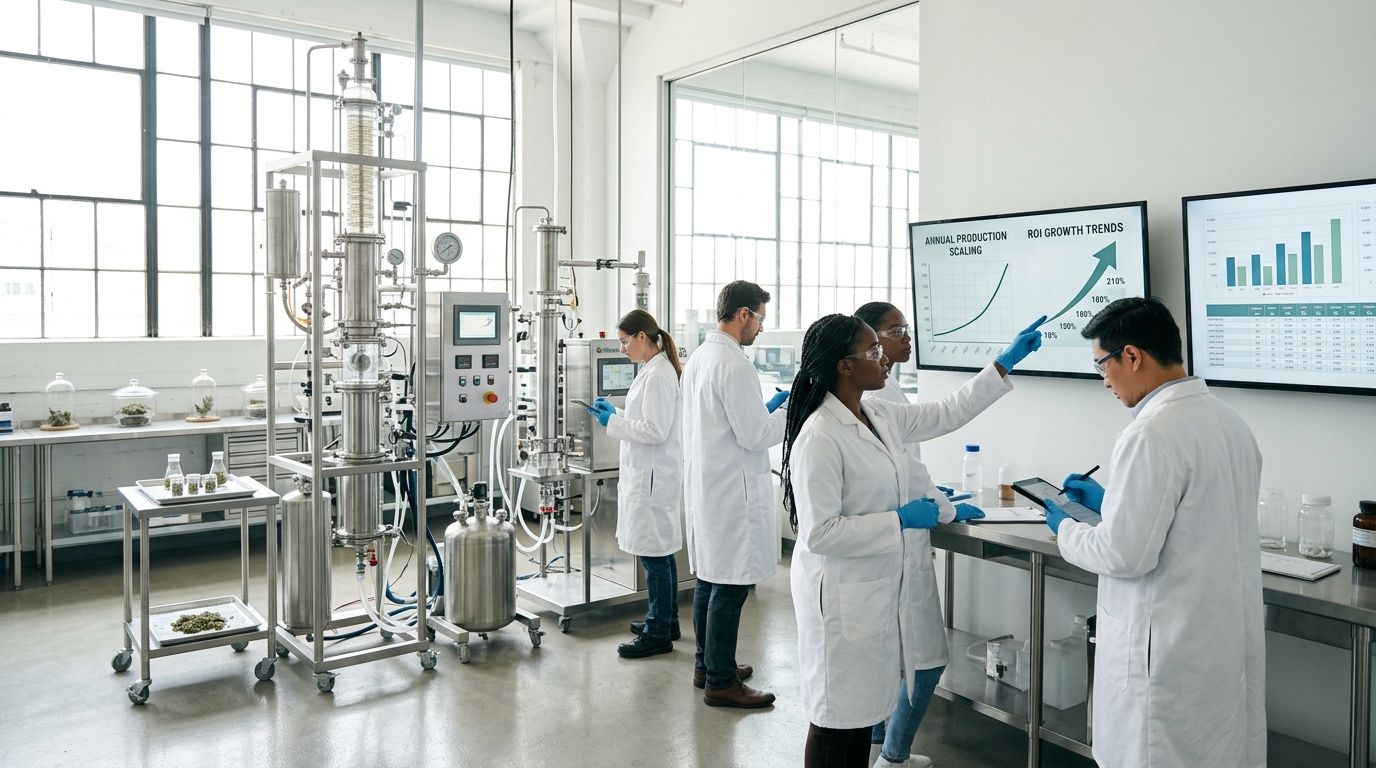
A CO2 line looks expensive until the first time a formulation team has to match a winning vape profile across larger production runs. At that point, the question shifts from extraction cost per kilo to how reliably the process delivers clean fractions that can be rebuilt into the same sensory profile, batch after batch.
The business case is strongest for operators selling finished products, not bulk crude. If revenue depends on repeatable cartridges, cultivar-specific terpene programs, and shorter development cycles, precise fractionation has direct commercial value.
The upfront commitment is real. CO2 systems require trained operators, validated SOPs, disciplined maintenance, and tight handoff between extraction and formulation. They also give a team more control over terpene capture and re-formulation than a process built around broad pulls and later correction.
Where ROI comes from
Return shows up in a few predictable places.
- More consistent SKUs: Stable fractions give formulators a narrower target to adjust around.
- Stronger premium positioning: A vape that tastes specific and repeatable holds value better than one sold on potency alone.
- Less redevelopment work: Defined aromatic inputs cut down on bench corrections during scale-up.
- Fewer losses in production: Cleaner, better-characterized extract streams reduce the number of batches that need heavy blending to become sellable.
I look at ROI through the formulation room, not just the extractor. If the terpene cut arrives clean, documented, and reproducible, the team can spend its time tuning vapor performance and sensory accuracy instead of repairing a muddy base oil.
Scale changes the terpene problem. Small pilot blends can tolerate a little intuition. Commercial runs cannot. As this terpene blending guide notes, myrcene is commonly kept at 2–8%, limonene at 2–6%, and linalool below 3–4% in strain-inspired blends. Those ranges matter because larger batches amplify imbalance fast. A profile that feels bright and believable at pilot scale can become flat, perfumey, or top-heavy once the same formula is built across production volume.
That is why scaling a CO2 program is not just a throughput decision. It is a control decision. Teams that preserve light volatiles early, keep heavier fractions separate, and document how each cut behaves in the final vape oil usually build a better margin over time.
A good CO2 operation does more than produce extract. It gives manufacturing a repeatable library of inputs for high-fidelity vape and distillate products.
If you're building terpene profile for vape cartridges, formulating for distillate, or replicating flavor of specific cultivar expressions at production scale, Gold Coast Terpenes offers strain-specific blends, isolated compounds, and formulation tools that fit real manufacturing workflows. Their catalog supports cartridge development, concentrate refinement, and commercial terpene rebuilding with profiles designed for consistency, flavor accuracy, and repeatable product performance.