
When a flavor profile like Vanilla Cake gains market traction, it represents more than a popular strain—it's a proven formulation blueprint. Its commercial success stems from a masterful blend of creamy, dessert-like sweetness with bright, sophisticated notes, making it an ideal model for developing new vape cartridges, distillates, and other cannabis products.
The value of this profile lies in its complex sensory experience, which leverages familiar "cake" genetics to create a reliable and sought-after flavor. For formulators, understanding its architecture is key to replicating its success.
Decoding the Vanilla Cake Profile for Product Formulation
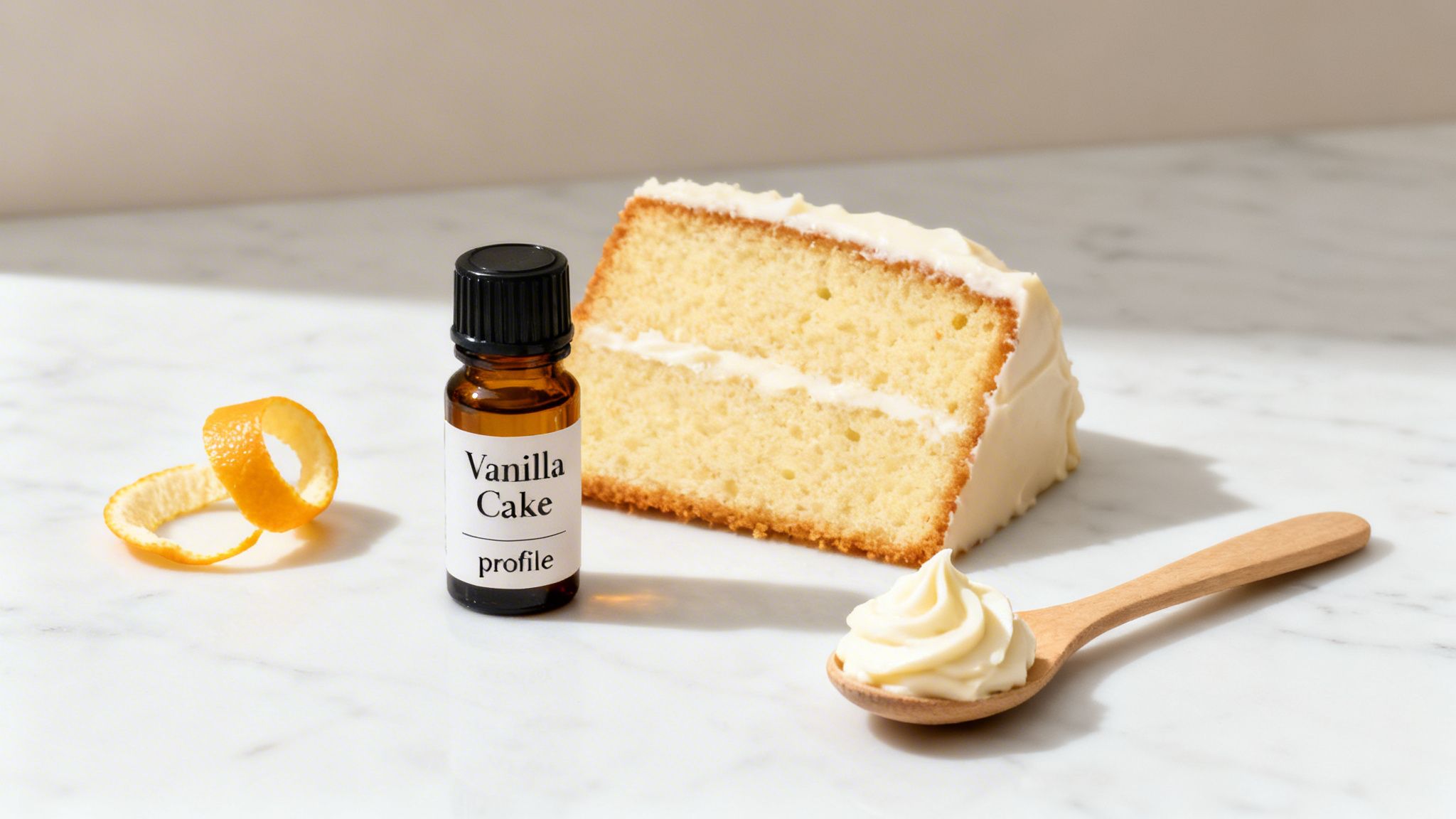
Before attempting replication, it's essential to understand why this profile resonates in the market. For product developers, the Vanilla Cake terpene profile is a strategic asset. Its popularity is tied directly to the legendary "Cake" genetic family, a consistent top-seller. Replicating this profile allows formulators to create products with built-in market appeal.
The key to its success is its layered flavor construction. It is not a monolithic vanilla note but a carefully balanced structure of distinct sensory elements.
Key Sensory Drivers
The profile's efficacy is driven by three key components working in concert:
- Creamy Vanilla Base: This is the core of the profile, providing the comforting, sweet character that anchors the dessert experience.
- Bright Citrus Mid-Notes: A subtle hint of citrus, primarily from limonene, cuts through the richness. This addition prevents the flavor from becoming heavy or cloying.
- Subtle Spice Finish: A touch of warm spice, often delivered by caryophyllene, adds a layer of depth and sophistication that provides a memorable finish.
The versatility of the Vanilla Cake profile is a significant advantage. It delivers a sophisticated dessert flavor without being overwhelming, making it a perfect fit for vape cartridges, distillates, and edibles where a nuanced taste is required.
Understanding these components is the first step toward a successful formulation. This guide deconstructs the Vanilla Cake profile not as another flavor, but as a market-tested formula to help develop winning products. Mastering its composition enables the creation of vape and distillate offerings that meet the precise demands of today's market.
As you dive into replicating this profile, it can also be helpful to browse other popular terpene strain profiles to understand broader market trends and flavor architectures.
Deconstructing the Vanilla Cake Terpene Profile for Vape Cartridges
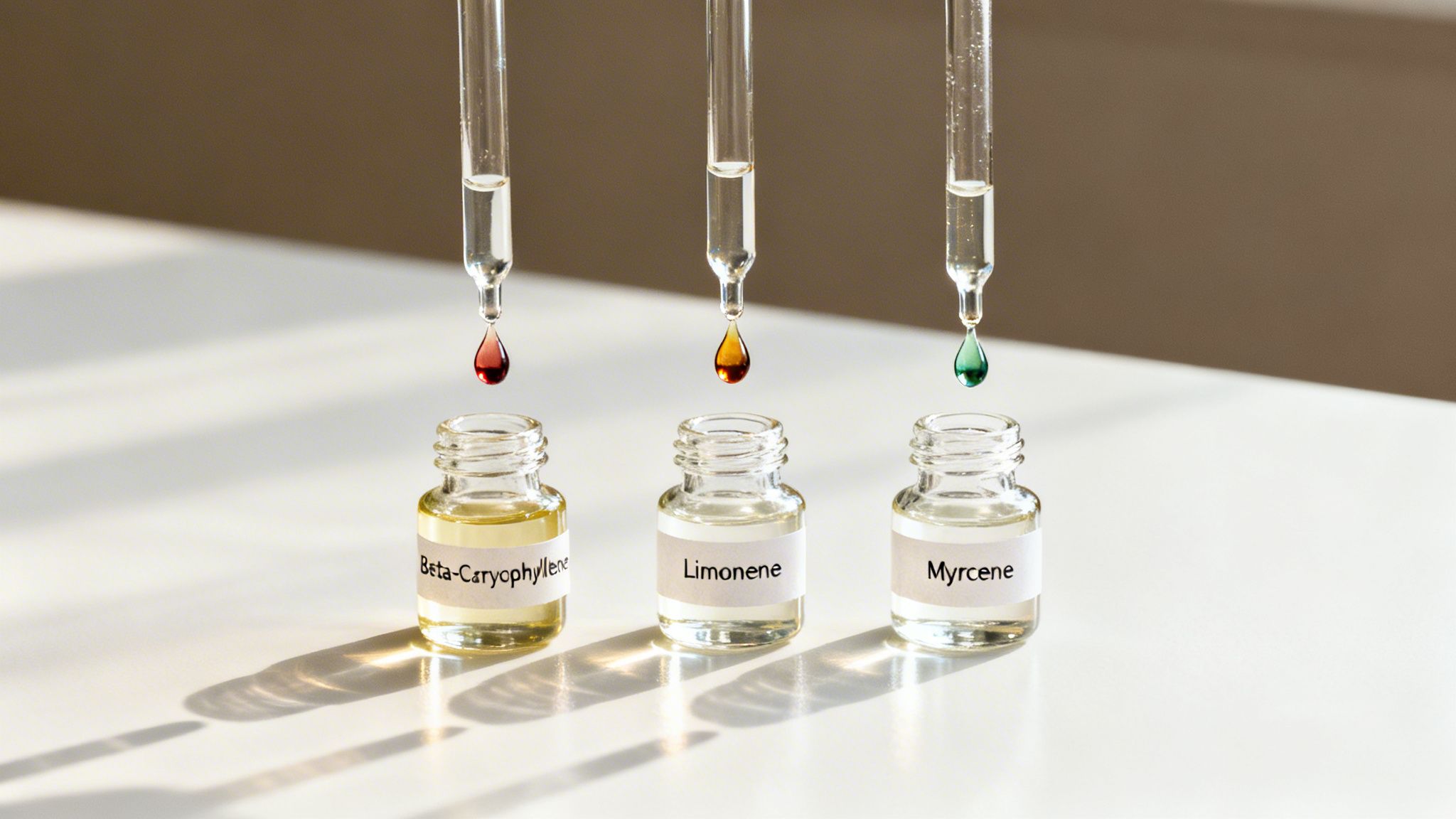
To accurately replicate the Vanilla Cake strain-inspired terpene blend, a formulator must approach the task with architectural precision. Before mixing isolates, it's critical to understand the function of each dominant terpene within the greater sensory structure. This is not about combining flavors; it's about building a layered, stable profile that performs reliably in a finished product like a vape cartridge.
The core of this profile is built on three key isolates: Beta-Caryophyllene, Limonene, and Myrcene. Each contributes a distinct aromatic function and is classified as a base, middle, or top note. Achieving the correct interaction between them is the secret to a balanced and authentic formulation.
Core Components of the Vanilla Cake Terpene Profile
To master the blend, it is essential to understand how the primary isolates function together. This table breaks down the primary terpenes in the Vanilla Cake profile, detailing their aromatic contribution and classification as top, middle, or base notes.
| Terpene Isolate | Aromatic Contribution | Note Classification | Typical Concentration |
|---|---|---|---|
| Beta-Caryophyllene | Warm, peppery, woody spice | Base Note | ~0.60% |
| Limonene | Bright, zesty citrus | Middle Note | ~0.45% |
| Myrcene | Ripe fruit, earthy musk | Top Note | ~0.15% |
Understanding these roles is the first step in building a blend that is not only flavorful but also structurally sound from an aromatic standpoint.
Beta-Caryophyllene: The Spicy Foundation (Base Note)
Every stable blend requires an anchor. In the Vanilla Cake profile, that anchor is Beta-Caryophyllene. As the primary base note, it provides the warm, peppery, and slightly woody undertone that gives the profile its depth and structure. Without this foundation, the lighter, sweeter notes would lack support and dissipate quickly.
Functionally, Beta-Caryophyllene acts as the structural element holding the more delicate flavors. Due to its low volatility, its spicy character persists, creating a sophisticated finish that enhances the overall sensory experience.
Limonene: The Bright Mid-Note
Next, Limonene serves as the crucial mid-note. It cuts through the creamy sweetness with a vibrant, zesty citrus character. This is essential for balance, as it prevents the profile from becoming overly heavy or cloying. It lifts the entire blend, injecting a bright energy that animates the flavor.
The classic pairing of peppery caryophyllene and zesty limonene, combined with vanilla elements, is what makes the Vanilla Cake profile ideal for creating 100% natural, carrier-free blends. It’s a perfect solution for enhancing cartridges with complex fruit-dessert terpenes.
Myrcene: The Fruity Top Note
Finally, Myrcene functions as a key top note. It contributes a subtle fruity and earthy character that is essential for rounding out the profile. It serves as the bridge between the spicy base and the citrus middle, adding a hint of mango-like sweetness that complements the vanilla.
Myrcene is a more volatile compound, meaning it is one of the first aromas perceived. Controlling its concentration is critical for establishing the initial impression and making the product authentic and inviting from the first use. To dive deeper into its role in formulation, see our guides to terpene isolates.
Fine-Tuning the Flavor with Secondary Terpenes
Achieving the correct ratio of primary terpenes like Beta-Caryophyllene and Limonene provides the foundational structure of the Vanilla Cake profile. However, true authenticity and complexity are derived from the precise application of minor terpenes. These secondary isolates are what transform a generic sweet blend into a multi-layered experience that accurately replicates the target vanilla cake flavor.
Think of it in terms of chemical engineering. The primary terpenes are your main reactants. The secondary terpenes are the catalysts and minor reagents that guide the reaction to its intended outcome—they are used in small quantities but are critical for creating the signature flavor. Without them, the blend will feel incomplete and fail to meet market expectations.
Linalool: The Key to a "Frosting" Character
One of the most important secondary isolates is Linalool. On its own, it has a soft, floral aroma. While not overtly creamy, when blended with the vanilla and spicy base notes, it creates a smooth, rich sensation that mimics the mouthfeel and aroma of frosting.
Linalool functions as a bridge. It smooths the sharp citrus edges from Limonene and connects the spicy base with the sweet top notes. This is what generates the distinct “vanilla frosting” character instead of a simple sugary taste.
Mastering the application of Linalool is what distinguishes a standard blend from a premium one. For formulators serious about replicating this profile, Linalool is not optional.
Humulene and Pinene: Adding Balance and Complexity
A well-formulated profile requires balance. An exclusively sweet profile becomes cloying and one-dimensional. Terpenes like Humulene and Pinene provide necessary contrast.
- Humulene: A close relative of Beta-Caryophyllene, Humulene introduces a subtle earthy, hoppy, and woody note. It grounds the profile, adding a touch of maturity that prevents it from tasting artificial.
- Pinene: Used in even smaller amounts, Pinene adds a crisp, clean hint of pine. This bright top note cuts through the richness and prevents the blend from feeling overly dense. It works in synergy with Limonene to provide lift, contributing to a "freshly baked" aromatic quality.
Perfecting the ratio of these minor terpenes is where technical skill becomes critical. Every compound, regardless of its concentration, serves a specific function. A precise balance creates an authentic and memorable Vanilla Cake experience that will be instantly recognizable.
A Step-by-Step Guide to Formulating Your Blend
This section outlines a practical, repeatable process for building a Vanilla Cake-inspired terpene blend from individual isolates. The methodology requires precision, patience, and a systematic approach to layering flavors.
The commercial appeal of dessert profiles is well-documented. Vanilla Cake’s success is directly linked to the dessert strain trend that began in the late 2010s, largely driven by Wedding Cake genetics. The "Cake" family became a top-seller in markets worldwide. Replicating this profile allows formulators to tap into a flavor category with proven consumer demand.
Establishing Your Foundational Ratio
The first step is building the base. This is the most critical stage of the formulation process. It involves establishing the correct ratio between your primary base note, Beta-Caryophyllene, and your primary mid-note, Limonene. This combination creates the fundamental structure upon which all other aromatic notes will be built.
A validated starting point is a 3:2 ratio of Beta-Caryophyllene to Limonene.
For example, if these two terpenes are to constitute 1% of your final product mass, you would use approximately 0.6% Beta-Caryophyllene and 0.4% Limonene. This balance provides the warm, spicy foundation without overpowering the bright citrus notes from the Limonene.
Formulation Pro-Tip: Approach terpene blending like chemical synthesis. You establish your foundational reactants before introducing catalysts and minor agents. Start with base notes and build upward. It is far easier to titrate a volatile top note than it is to correct an over-concentrated base.
Once this foundation is set and thoroughly mixed, you can begin layering in the other terpenes to add complexity and achieve the signature creamy finish.
Layering Secondary and Tertiary Isolates
With your foundation established, it is time to add nuance. This is where minor isolates like Linalool, Humulene, and Pinene are introduced. The key is to add them sequentially, mixing thoroughly after each addition to observe their impact on the overall profile.
This flowchart illustrates the step-by-step process for layering these secondary terpenes onto your base.
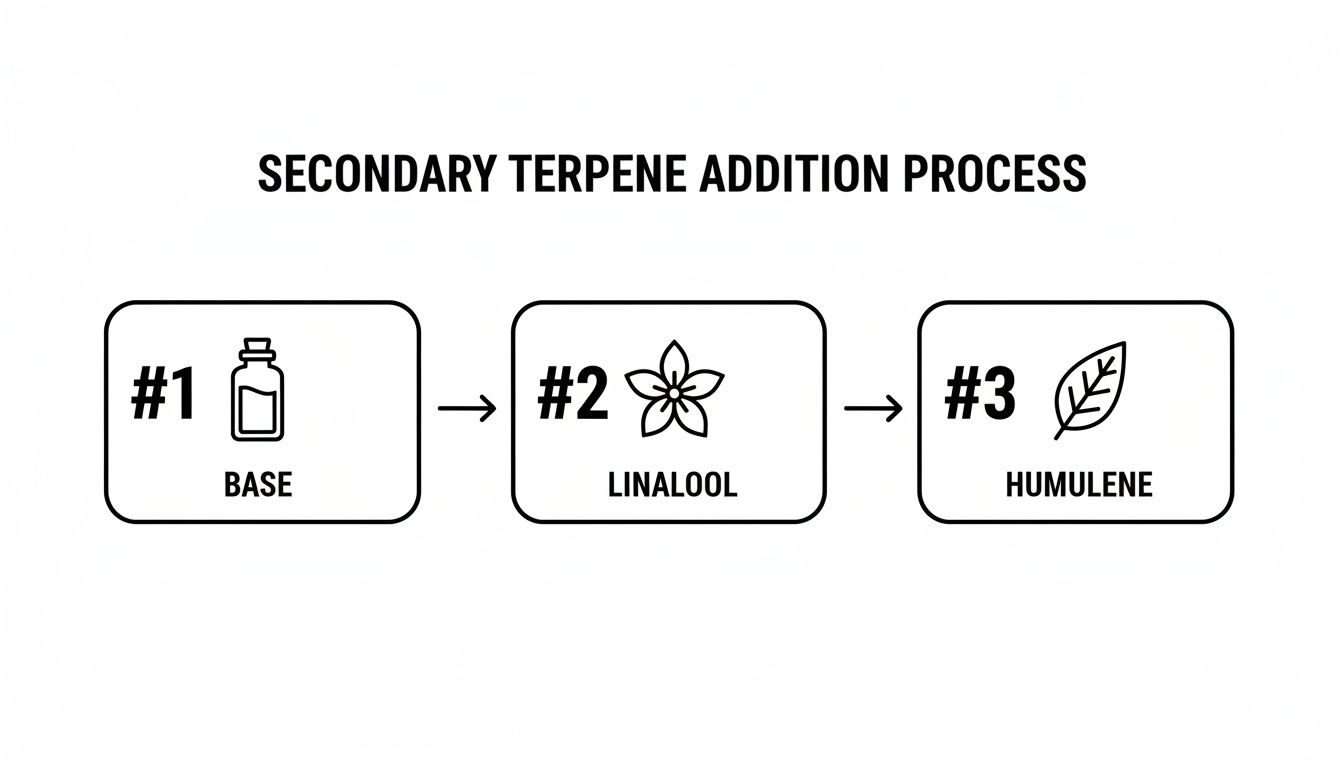
As shown, the process is logical: begin with the base, then carefully introduce Linalool for creamy sweetness, and finally Humulene for earthy balance.
A recommended sequence is as follows:
- Introduce Linalool: Start with a precise amount—approximately 0.05% of your total volume. Linalool is potent; its floral notes are intended to complement, not dominate. This addition produces the "frosting" effect.
- Add Humulene: After the Linalool is incorporated, add Humulene at a similar concentration, around 0.05%. Its woody, earthy notes will ground the sweetness and prevent the profile from becoming one-dimensional.
- Finish with Pinene (Optional): If the blend feels too heavy, a minute amount of Pinene (less than 0.02%) can add a final, clean top note.
Document every measurement meticulously. Precision is the only way to ensure repeatability. For assistance with calculations, especially when scaling to different batch sizes, refer to our guide on mixing terpenes with a calculator. This systematic approach ensures that you can confidently scale your validated Vanilla Cake formula for production.
Optimizing Your Blend for Distillate and Vape Hardware
Developing an authentic terpene blend is a significant achievement, but the formulation is incomplete until it performs flawlessly in the final product. A superior formulation can fail if it is not optimized for the physical properties of distillate and the constraints of modern vape hardware. Such failures can negatively impact brand reputation.
When adding your Vanilla Cake terpene blend for distillate, you must consider technical parameters such as viscosity, heat stability, and homogenization. The final product must be fluid enough to wick properly in contemporary cartridges yet viscous enough to prevent leakage. This requires precise process control and accurate measurements.
The original Vanilla Cake cannabis cultivar—a balanced hybrid of East Coast Sour Diesel (ECSD) and Sundae Brunch—is popular in the dessert strain category. More details on its genetics can be found on Growdiaries.com. The challenge for formulators is capturing that flavor in a vape product, which means mitigating common hardware-related issues.
Avoiding Common Formulation Pitfalls
Even a perfect blend can be compromised by simple errors during final mixing. Overlooking these details can lead to flavor degradation, product separation, or an inconsistent user experience.
To maintain formulation integrity, be mindful of these critical issues:
- Improper Heating: Overheating the distillate and terpene mixture will volatilize delicate top notes like Myrcene and D-Limonene. The result is a muted, burnt, or off-flavor. Gentle, controlled heating is essential.
- Terpene Separation: Inadequate mixing is a common error. Over time, terpenes can separate from the cannabinoid oil, leading to inconsistent flavor delivery and poor cartridge performance.
- Incorrect Viscosity: This is a primary cause of product failure. If the oil is too thick, it will not saturate the wick, resulting in dry, burnt hits. If it is too thin, it will cause cartridge leakage and product loss.
The objective is consistency. The end-user must experience the same rich, complex Vanilla Cake flavor from the first activation to the last. This requires a process that is both precise and repeatable across all production batches.
Best Practices for Mixing and Stability
To ensure your flavor profile delivers a smooth, reliable experience, a robust final mixing process is necessary.
Begin by gently warming your distillate to reduce its viscosity, closely monitoring the temperature. Do not exceed 140°F (60°C). This temperature is sufficient for workability while preserving fragile terpenes.
Slowly add your Vanilla Cake terpene blend while stirring continuously. A magnetic stirrer is the ideal tool for this, as it ensures a perfectly homogenized mixture without introducing air. Stir for a minimum of 15-20 minutes to ensure complete integration of terpenes into the distillate.
After mixing, allow the blend to rest and cool before filling cartridges. This rest period helps stabilize the mixture and allows any entrapped air bubbles to dissipate, resulting in a more consistent and professional final product.
Common Questions from Formulators
Mastering a complex, layered profile like that needed for replicating the flavor of Vanilla Cake is a technical challenge. Achieving a precise balance of creamy, sweet, and spicy notes often requires iterative refinement. This section addresses common issues formulators encounter when developing this dessert-style blend.
What is the Optimal Terpene Percentage for a Distillate Cartridge?
For most standard distillate vape cartridges, a starting concentration between 5% and 7% terpenes by weight is recommended. This range typically provides a robust Vanilla Cake flavor without being overpowering or causing hardware complications.
This is not a rigid rule. Higher concentrations, up to 10%, may be achievable with high-performance ceramic coils designed to handle lower viscosity oils. However, the best practice is to start with a lower concentration and titrate upward. Formulate small test batches to evaluate flavor and performance before finalizing the concentration. Exceeding 10% significantly increases the risk of a harsh flavor and cartridge leakage.
How Do I Enhance the "Frosting" Notes?
This is a critical aspect of differentiating a standard formulation from a premium one. The authentic, creamy frosting note is achieved through the strategic use of supporting isolates, not the primary terpenes.
The key ingredient is typically Linalool. While floral in isolation, a small, precise addition to the blend interacts with the other components to create a soft sweetness that is perceived as "creamy." This rounds out sharper notes and contributes to the signature frosting character. Experimentation with other trace flavor modifiers is possible, but they must be validated for inhalation safety and complete miscibility.
My Blend Tastes Overly Peppery. What is the Cause?
An aggressive spicy or peppery note indicates that the Beta-Caryophyllene concentration is too high. As a heavy, potent molecule, it can easily dominate other terpenes if its ratio is not carefully controlled.
If a formulation is too peppery, the first corrective step is to reduce its percentage by 10% to 15%. Concurrently, slightly increase the concentrations of Limonene and Myrcene to lift the profile and restore balance with brighter citrus and fruit notes.
Before adjusting the formula, verify your mixing process. Incomplete homogenization can create "hot spots" of caryophyllene, leading to a harsh, inconsistent flavor that can compromise an entire batch. Proper mixing is as critical as a correct formula.
Can This Profile Be Used in Products Other Than Vapes?
Yes. The Vanilla Cake profile is highly versatile and performs well in a variety of applications beyond vape cartridges. It is an excellent choice for flavoring:
- Tinctures
- Edibles
- Topicals
- Concentrates like wax or shatter
It is crucial to note that the required concentration will vary significantly depending on the product matrix. For edibles, usage levels are typically much lower, often under 1%, compared to vape formulations. Always conduct thorough R&D to determine the optimal and safe usage level for each specific application.
Ready to develop a standout product with a perfectly balanced dessert profile? Gold Coast Terpenes provides all the lab-verified, pure isolates and strain-inspired terpene blends required to accurately replicate the Vanilla Cake flavor.