
Pink Lemonade is a commercially significant flavor profile known for its blend of sharp citrus and sweet berry. This profile is a direct result of its genetics, making it a valuable target for formulators creating vape cartridges, distillates, and other cannabis products.
For cannabis product manufacturers, understanding the chemical blueprint of the Pink Lemonade profile is critical for replicating its popular characteristics and achieving consistent, marketable results. This guide provides a technical breakdown for successful formulation.
Why the Pink Lemonade Profile is a Formulation Asset
For product formulators, the Pink Lemonade profile offers a masterclass in building a winning flavor. Its appeal is the direct result of a strategic genetic cross that delivers an experience consumers actively seek. This is more than a pleasant aroma—it’s a reliable blueprint for creating products with strong market performance.
The profile's value lies in its balance. Many citrus-heavy formulations can be harsh or one-dimensional. Pink Lemonade, however, balances zesty top notes with soft, fruity sweetness and a subtle earthy finish. This layered complexity is a key differentiator for brands in a competitive marketplace.
The Genetic Blueprint for Commercial Replication
To accurately replicate the Pink Lemonade profile, one must understand its lineage: a cross between Lemon Skunk and Purple Kush. First gaining traction around 2013-2015, its popularity grew in competitive markets due to its distinct flavor. By 2020, as consumer demand for vibrant, sativa-leaning profiles increased, it became a market staple. The history and genetics are documented by sources like Mary Jane's Garden.
This genetic mix provides a clear roadmap for formulation:
- From Lemon Skunk: This parent contributes the bright, unmistakable zing of citrus. Lemon Skunk passes down the high concentration of specific terpenes that define Pink Lemonade's initial aromatic impact.
- From Purple Kush: This parent adds crucial depth. It introduces subtle sweetness and earthy, berry-like undertones that prevent the citrus from being overwhelming and round out the flavor architecture.
Analyzing the lineage provides a clear objective. The goal is not merely to create a "lemon" flavor. It is to precisely recreate the interplay between citrus, berry, and earth that defines the authentic Pink Lemonade profile.
Achieving accurate replication demands a data-driven approach based on the specific terpenes and their precise ratios. Moving from approximation to methodical formulation allows for the delivery of the authentic Pink Lemonade experience consistently. This guide provides the technical framework to master this profitable profile for cannabis product formulation.
Decoding the Pink Lemonade Terpene Blueprint for Formulation
To successfully replicate the Pink Lemonade profile in a commercial product, a simple ingredient list is insufficient. A chemical blueprint is required. This involves deconstructing the profile into its core aromatic components—top, middle, and base notes—to understand their synergistic function.
At its core, the profile is a balance of citrus, spice, and earth. The genetics dictate this structure: Lemon Skunk contributes its bright, zesty character, while Purple Kush provides a deep, earthy foundation.
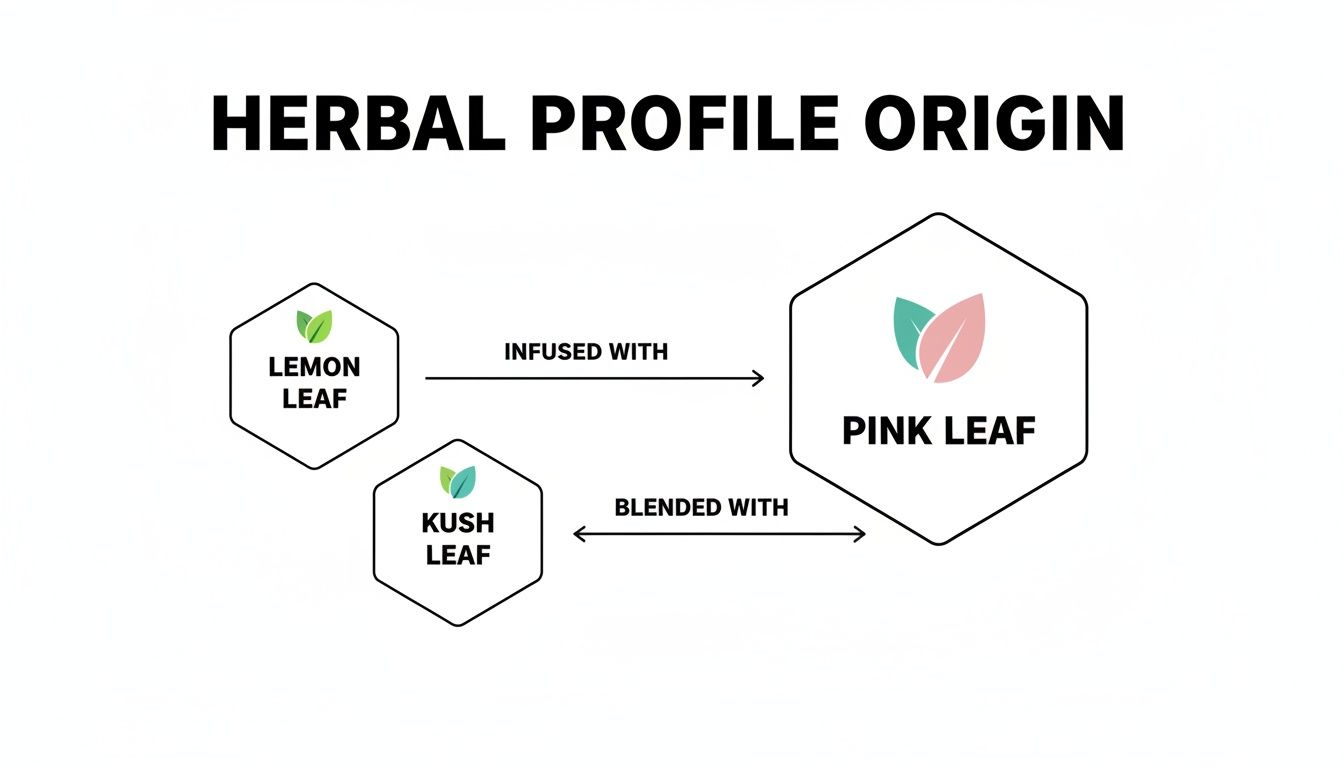
This diagram illustrates that Pink Lemonade is a direct inheritance of its parentage, blending key characteristics into a distinct new profile.
The Bright Citrus Opener: Limonene as a Top Note
The initial aromatic impact of Pink Lemonade is a zesty punch derived from Limonene. As the dominant top note, Limonene drives the bright, citrusy aroma. In most lab analyses, Limonene constitutes a significant portion of the profile, often between 40-50% of the total terpene content.
This terpene provides the profile's introduction. A common formulation error is over-reliance on Limonene, which can result in a flat, one-dimensional product reminiscent of artificial cleaning agents. The key is to use this citrus base as a starting point and build complexity upon it.
The Heart of the Profile: Beta-Caryophyllene and Myrcene as Mid-Notes
To prevent citrus dominance, robust mid-notes are necessary to add depth and round out the profile. In Pink Lemonade, this role is filled by Beta-Caryophyllene and Myrcene.
- Beta-Caryophyllene: This terpene introduces a warm, peppery spice. It serves as a counterpoint to the sharp Limonene, cutting through the acidity and lending a more sophisticated, full-bodied character.
- Myrcene: With its subtly sweet, earthy, and fruity notes, Myrcene acts as a bridge. It connects the sharp citrus top notes with the deeper, earthier base, adding a soft, herbal quality that contributes to a more natural and complete profile.
These two terpenes are the heart of the blend, transforming it from a simple citrus flavor into a complex, herbal lemonade profile. The function of mid-notes can be observed across various terpene strain profiles.
The following table provides a typical breakdown for formulation.
Pink Lemonade Terpene Profile Breakdown for Formulation
| Terpene | Typical % Range | Role in Formulation (Aroma/Flavor Note) |
|---|---|---|
| Limonene | 40% – 50% | Top Note: Bright, zesty lemon and sharp citrus peel |
| Beta-Caryophyllene | 10% – 15% | Mid-Note: Warm, peppery spice with a hint of clove |
| Myrcene | 8% – 12% | Mid-Note: Sweet, earthy musk with subtle fruity notes |
| Humulene | 5% – 10% | Base Note: Hoppy, woody, and earthy undertones |
This table serves as a solid starting point for any formulator looking to replicate the authentic Pink Lemonade flavor for distillate or other products.
The Finishing Touch: Humulene as the Base Note
Every well-constructed profile requires a solid base note to anchor the other components. For Pink Lemonade, that anchor is Humulene. Its aroma is commonly associated with hops in beer.
Humulene adds subtle woody, earthy, and hoppy notes that provide a foundation for the brighter terpenes. While not the most prominent terpene, its absence would result in a profile lacking a satisfying, full-bodied finish. It is the final component that completes the sensory experience.
Replicating the Flavor of Pink Lemonade for Distillate
With the terpene blueprint established, the next step is practical application. The objective is to accurately replicate the signature Pink Lemonade flavor in products like vape cartridges and concentrates to meet consumer expectations for authenticity.
Formulators have two primary pathways: building the profile from individual terpene isolates or utilizing a professionally crafted, strain-inspired terpene blend. The choice depends on production goals, resources, and the desired level of customization.
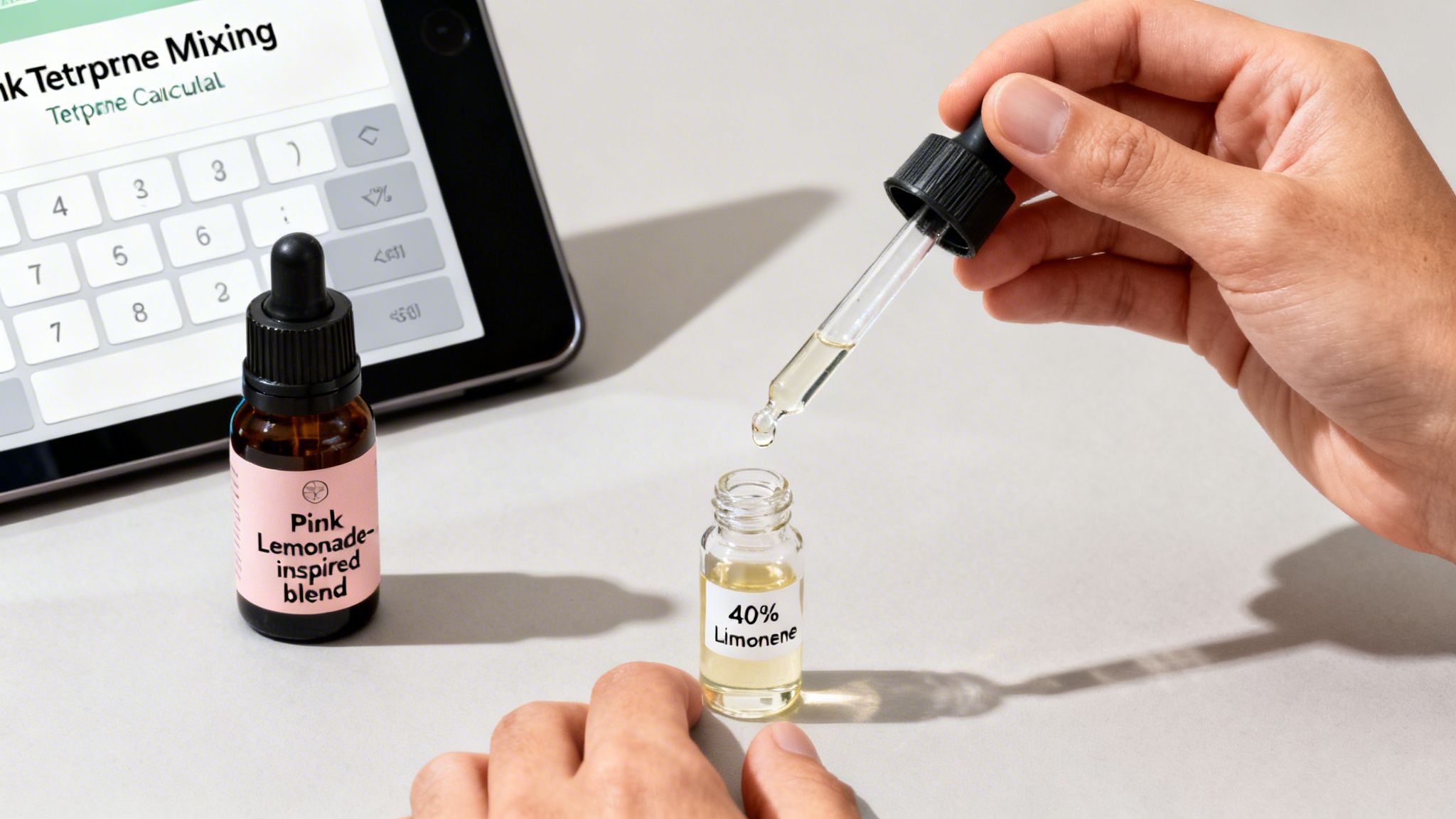
Formulating with Terpene Isolates for Granular Control
For formulators requiring maximum control over the final profile, building from scratch with isolates is the preferred method. This approach allows for precise adjustments to match a specific cultivar's analysis or to create a unique variant that becomes a brand signature.
This method requires a strong understanding of terpene interactions, as minor miscalculations can significantly alter the final profile.
A reliable starting point is essential. Based on typical lab analyses for Pink Lemonade, here is a baseline for initial test batches:
- Establish a Limonene base: Begin with approximately 40% Limonene to set the bright, zesty citrus top note.
- Layer in mid-notes: Introduce 15% Beta-Caryophyllene for peppery spice and 10% Myrcene for earthy sweetness.
- Incorporate minor terpenes: Add other key terpenes like Humulene at lower concentrations, typically between 2-5% each, to complete the profile.
This method allows the formulator to fine-tune the blend. For instance, increasing Beta-Caryophyllene can enhance spiciness, while a slight increase in Myrcene can amplify the herbal qualities.
Using a Pink Lemonade Strain-Inspired Terpene Blend for Consistency
The alternative is to use a pre-formulated Pink Lemonade strain-inspired terpene blend. This is the more efficient path for brands prioritizing consistency, scalability, and speed to market. A high-quality blend from a reputable supplier means the intensive R&D—sourcing, testing, and balancing—is already complete.
The primary advantage here is reliability. A lab-tested, ready-to-use solution consistently delivers the authentic Pink Lemonade flavor, batch after batch, eliminating R&D overhead. This significantly reduces production time and the risk of costly formulation errors.
This approach is particularly beneficial for larger-scale operations where maintaining product uniformity across thousands of units is critical. It streamlines processes from inventory management to quality control. You can explore how different profiles are constructed in our library of terpene formulation guides.
Avoiding Common Formulation Hurdles
Formulating with a citrus-heavy profile like Pink Lemonade presents unique challenges. The most common error is creating a product with an artificial, cleaner-like lemon aroma.
This typically occurs when Limonene overpowers all other components. Authenticity is derived from complexity, not intensity. The subtle spicy and earthy notes from Beta-Caryophyllene, Myrcene, and Humulene are essential for grounding the citrus and creating a rich, believable flavor.
To avoid this "lemon pledge" effect:
- Conduct pilot tests. Always test blends in small batches with your specific concentrate base before committing to large-scale production.
- Utilize sensory analysis. Lab data provides a map, but human sensory evaluation confirms the desired experiential outcome.
- Employ incremental adjustments. It is easier to add more of a terpene than to remove it. Begin with conservative ratios and adjust upwards as needed.
By selecting the appropriate formulation path and carefully balancing ratios, you can consistently capture the commercially successful Pink Lemonade flavor.
Formulating Pink Lemonade for Vape Cartridges
Translating a well-designed terpene profile like Pink Lemonade into a high-performance vape cartridge requires careful attention to the interplay between flavor, viscosity, and hardware. The high Limonene content presents both opportunities for excellent flavor and challenges related to formulation stability.
The primary objective is a smooth, flavorful, and reliable cartridge. A poor formulation can lead to costly issues such as clogging, leakage, harshness, or flavor degradation, negatively impacting brand reputation.
Dialing in Viscosity for Optimal Hardware Performance
Your base extract, whether THC or CBD distillate, is typically too viscous to function effectively in modern vape hardware. Terpenes act as natural diluents, reducing the oil's viscosity to a level suitable for wicking and vaporization. The high Limonene content in the Pink Lemonade profile is particularly effective for this purpose.
The key is achieving the correct balance. Oil that is too thin will leak and flood the atomizer. Oil that is too thick will lead to poor wicking, resulting in dry, burnt hits.
- Ceramic Coil Cartridges: These can handle slightly thicker oils. A lower terpene percentage, typically in the 5-6% range, is often sufficient. This maintains high concentrate potency while ensuring proper function.
- Wick-Based Cartridges: Older hardware designs with wicks require a thinner oil to prevent clogging. A slightly higher concentration, around 7-8%, may be necessary to ensure consistent flow to the heating element.
Always validate your final formulation with the specific hardware you intend to use. A pilot run can identify potential issues before full-scale production, saving significant time and resources.
Achieving Flavor Accuracy Without Over-Concentration
For a Pink Lemonade vape formulation, the optimal terpene concentration is generally between 5% and 8% by weight. Exceeding 10% is rarely advisable, as it can result in a harsh, chemical-like flavor and cause throat irritation.
The goal is not the strongest flavor, but the most authentic one. The appeal of Pink Lemonade lies in the interplay between bright citrus and subtle earthy, spicy undertones. Over-saturating the blend with terpenes destroys this complexity.
The high Limonene content (over 40% of the terpene fraction) is key to the signature citrus note. This top note interacts well with mid-notes like myrcene and beta-caryophyllene, which can be adjusted to modulate the profile. Breeder information on the strain's genetic potential can be found by those who wish to explore the breeder's notes and lineage here.
Best Practices for Mixing and Homogenization
Proper mixing is critical for a consistent product. An inhomogeneous mixture can create "hot spots" of high terpene concentration, leading to an inconsistent user experience where one puff is smooth and the next is harsh.
Follow this standard operating procedure for reliable results:
- Gently Heat the Distillate: Warm your cannabinoid concentrate to lower its viscosity, facilitating easier mixing. Avoid excessive heat, which can degrade cannabinoids and terpenes.
- Measure with Precision: Use a calibrated scale for all components. Our terpene mixing calculator can help ensure accurate ratios.
- Mix Thoroughly: Add the terpenes to the warmed oil and use a magnetic stirrer or overhead mixer to achieve a completely homogenous, transparent solution.
- Allow the Mixture to Settle: Let the final blend rest before filling cartridges. This allows any introduced air bubbles to dissipate, preventing inaccurate fills and ensuring consistency.
Adhering to these guidelines will enable the production of a Pink Lemonade vape cartridge that delivers exceptional flavor and consistent, high-quality performance.
Quality Control for a Consistent Pink Lemonade Formulation
Achieving the correct Pink Lemonade profile in a single batch is one thing; replicating it consistently across thousands of units is the hallmark of a professional manufacturing operation. Consistency is the foundation of brand trust and customer loyalty.
A rigorous quality control (QC) process is non-negotiable for any serious manufacturer. It is the essential safeguard against batch variation, customer complaints, and potential regulatory issues.
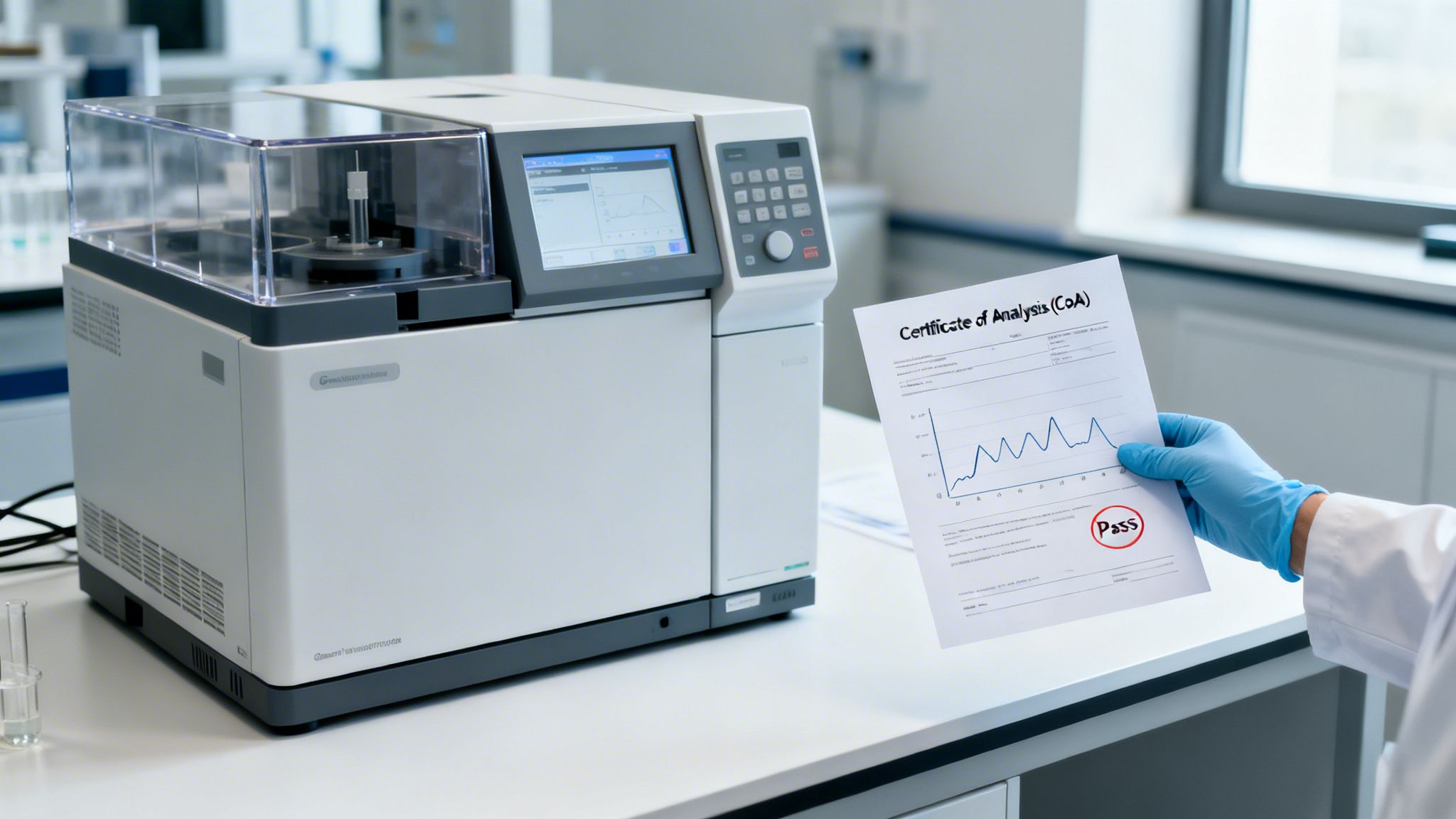
Start with Documentation: Certificates of Analysis
Quality control begins before any formulation takes place. Every terpene isolate or blend used in production must be accompanied by a Certificate of Analysis (CoA) from an accredited third-party laboratory. This document provides critical information about the material's identity, purity, and safety.
A comprehensive CoA is the first line of defense and should clearly detail:
- Purity and Identity: Confirms that the terpene is as advertised and specifies its exact purity percentage.
- Safety Screening: Verifies that the material is free from contaminants such as pesticides, heavy metals, residual solvents, and microbial life.
Never formulate with raw materials that lack a clean, current CoA. Partnering with a supplier who provides transparent, batch-specific lab results is fundamental to producing a safe and high-quality end product.
In-House Verification: Testing Your Final Blend
Once you have sourced clean ingredients and formulated your product, you must verify that you have hit your target profile. The industry-standard tool for this is Gas Chromatography (GC).
GC analysis provides a precise chemical fingerprint of your final product, separating and identifying each terpene. It is the only way to quantitatively confirm that you achieved the target 40-50% Limonene concentration and that the ratios of Beta-Caryophyllene, Myrcene, and other minor terpenes are correct. GC analysis transforms formulation from an art into a repeatable science.
The Final Check: Sensory Panels
While analytical instruments provide objective data, they cannot fully capture the subjective human experience of aroma and flavor. The final, critical QC step is the sensory panel.
A sensory panel consists of trained evaluators who assess the product's organoleptic properties. They can identify subtle nuances that instrumentation might miss, confirming that the bright, zesty lemon top note is properly balanced by the sweet, earthy background notes. This panel is the ultimate check to ensure the chemical data translates into the authentic Pink Lemonade experience.
By combining verifiable CoAs for raw materials, precise GC testing for in-process and finished goods, and qualitative feedback from a sensory panel, you establish a closed-loop quality system. This is how you guarantee that every Pink Lemonade product you ship is safe, consistent, and delivers the exact experience your customers expect. For a deeper understanding of the raw materials, you can explore our range of pure terpene isolates.
Executing Your Pink Lemonade Formulation with Gold Coast Terpenes
This guide has provided a technical deep dive into the Pink Lemonade profile, from its terpene architecture to the practical challenges of consistent replication. For any formulator, success hinges on three pillars: flavor accuracy, batch-to-batch reliability, and uncompromising quality. These are the cornerstones of a brand that commands customer loyalty.
Overcoming these formulation hurdles requires a partner who understands the demands of commercial production. At Gold Coast Terpenes, our processes are built around providing the high-purity, precision-engineered building blocks your products require.
Your Blueprint for a Perfect Pink Lemonade Formulation
We offer two distinct pathways for mastering the Pink Lemonade profile, each designed to meet different production needs while delivering the same high-quality outcome.
- Strain-Inspired Blends: For manufacturers prioritizing consistency and efficiency, our pre-formulated Pink Lemonade strain-inspired terpene blend is the ideal solution. We have performed the intensive R&D to craft and lab-verify a blend that delivers the authentic, multi-layered Pink Lemonade experience directly from the bottle, ensuring product uniformity.
- Pure Terpene Isolates: For formulators seeking maximum creative control, our individual isolates provide the necessary tools. You can procure pure Limonene, Beta-Caryophyllene, Myrcene, and other key components to construct your own unique version of the profile, confident in the purity and precision of each ingredient.
The objective is not approximation—it is precise replication. Whether you choose a ready-to-use blend for efficiency or individual isolates for customization, our terpenes provide the clean, verified foundation necessary for success.
From Technical Guide to Finished Product
This guide has provided the technical roadmap. With high-quality, lab-tested terpenes, you can bypass common issues like artificial aftertastes and inconsistent batches, allowing you to focus on creating a superior product that stands out in a competitive market.
To see how a professionally engineered profile can streamline your workflow, explore our perfectly balanced Pink Lemonade Elevated Strain Terpene Blend. We are committed to providing formulators with the tools and confidence required to create exceptional products that capture the authentic character of this sought-after profile.
Common Questions: A Pink Lemonade Formulation Guide
When formulating with a bright, citrus-forward profile like Pink Lemonade, several practical questions frequently arise. Here are answers to some common technical queries.
What is the optimal terpene percentage for vape cartridges?
For most distillate-based vape cartridges, the recommended concentration for a Pink Lemonade strain-inspired terpene blend is between 5% and 8% by weight.
A starting point of 5% is a reliable baseline, allowing the signature sweet and citrus notes to be expressed without harshness. Exceeding 10% is generally not advised, as it can create a sharp throat sensation and potentially compromise cartridge hardware over time. Best practice is to conduct small-batch testing to determine the ideal ratio for your specific extract and hardware configuration.
How do I prevent a formulation from tasting artificial?
The "lemon cleaner" issue typically arises from an over-reliance on a single terpene, most often Limonene. While Limonene is the dominant component in the Pink Lemonade profile, it requires the support of other terpenes to create an authentic flavor.
Balance is the key to authenticity. The supporting terpenes create a natural, well-rounded experience. Mid-notes like Beta-Caryophyllene and Myrcene introduce spice and earthiness, while base notes like Humulene add a woody depth that grounds the profile. This complexity is what distinguishes a craft formulation from an artificial-tasting one.
The Takeaway: Authentic flavor is achieved not by maximizing a single note, but by creating a complete chord. Minor terpenes are as critical as dominant ones for crafting an experience that mirrors the original flower.
Can this terpene profile be used in other cannabis product formulations?
Yes. The Pink Lemonade profile is highly versatile and effective in a wide range of cannabis product formulations. It is an excellent choice for enhancing the flavor and aroma of concentrates such as shatter, wax, and live resin.
It can also be incorporated into edibles (ensure adherence to all food-grade safety standards), tinctures, and topicals. The concentration must be adjusted based on the specific product matrix and desired sensory impact.
Ready to perfect your next product line? Explore the professionally crafted terpene solutions from Gold Coast Terpenes and discover how our lab-verified blends and isolates can elevate your formulations. Shop our full collection today.