
The Cream Cake profile is a powerful tool for product formulation, derived from a cross of Wedding Cake and Gelato #33. For formulators, this strain's genetic lineage is a blueprint for a rich, dessert-like flavor that aligns perfectly with market demand for sweet, indulgent profiles. The commercial appeal is straightforward: it delivers a consistent, vanilla-forward flavor that performs exceptionally well in a variety of product bases.
Breaking Down the Cream Cake Profile for Product Development
As a formulator, it's essential to look beyond consumer trends and analyze the aromatic blueprint of a strain. The Cream Cake profile isn't just a popular name; it's a specific chemical signature that can be reverse-engineered for scalable production. The objective is not simply to mimic the profile but to capture its essence with analytical precision for applications in vape cartridges, edibles, tinctures, and other infused products.
To achieve this, one must deconstruct the components that define the Cream Cake profile. This requires a deep dive into its chemical makeup, specifically its unique terpene signature.
Why This Profile Is a Game-Changer in Formulation
Mastering the Cream Cake terpene profile allows a brand to deliver a consistent, high-quality sensory experience with every batch, a key factor in building customer loyalty. In a market saturated with generic fruit flavors, a well-executed dessert profile stands out and can capture significant market share.
Success hinges on a precise understanding of the terpenes that create its creamy, sweet, and subtly earthy aroma. By isolating and blending these compounds correctly, you can develop a strain-inspired terpene blend that integrates seamlessly into any base, from high-terpene extract to refined THC distillate or CBD isolate.
The core challenge for any formulator is translating a complex botanical profile into a stable, marketable product. With the Cream Cake profile, the key is balancing rich, creamy base notes with lighter, sweet top notes to create an authentic, layered experience that avoids an artificial character.
A Roadmap for Authentic Replication
Achieving an accurate replication requires more than combining the most dominant terpenes. It is a methodical process of building the flavor layer by layer, respecting the synergistic interplay between all aromatic compounds. An effective Cream Cake formulation guide must be built on these fundamentals:
- Genetic Contribution: Understand how Wedding Cake provides the signature vanilla and peppery spice, while Gelato #33 contributes a sweet, fruity complexity.
- Aromatic Synergy: Analyze how primary, secondary, and tertiary terpenes interact to produce the final, distinct aroma.
- Commercial Viability: Ensure the final blend is stable, effective, and compliant for scalable production.
This guide serves as a technical blueprint for deconstructing this profile, providing the necessary data to build it from the ground up for a premium commercial product.
Unpacking the Terpene Blueprint of Cream Cake
To successfully develop a Cream Cake strain-inspired terpene blend, you must first analyze its aromatic DNA. The process is analogous to a flavor chemist engineering a new concentrate, where each component is layered with precision. The Cream Cake profile's iconic creamy, sweet, and lightly spiced character is primarily driven by a specific trio of terpenes working in concert.
Each terpene contributes a specific aromatic note that builds the final sensory experience. For formulators, achieving an authentic vanilla cake character begins with the dominant isolates: Beta-Caryophyllene, Limonene, and Linalool. The precise ratio is critical not only for flavor but also for modulating the overall experience in formulated products like vapes and concentrates, a topic detailed in this comprehensive strain guide for formulators.
This flowchart breaks down how Cream Cake's genetics translate to its dessert-like qualities and, ultimately, its application in commercial products.
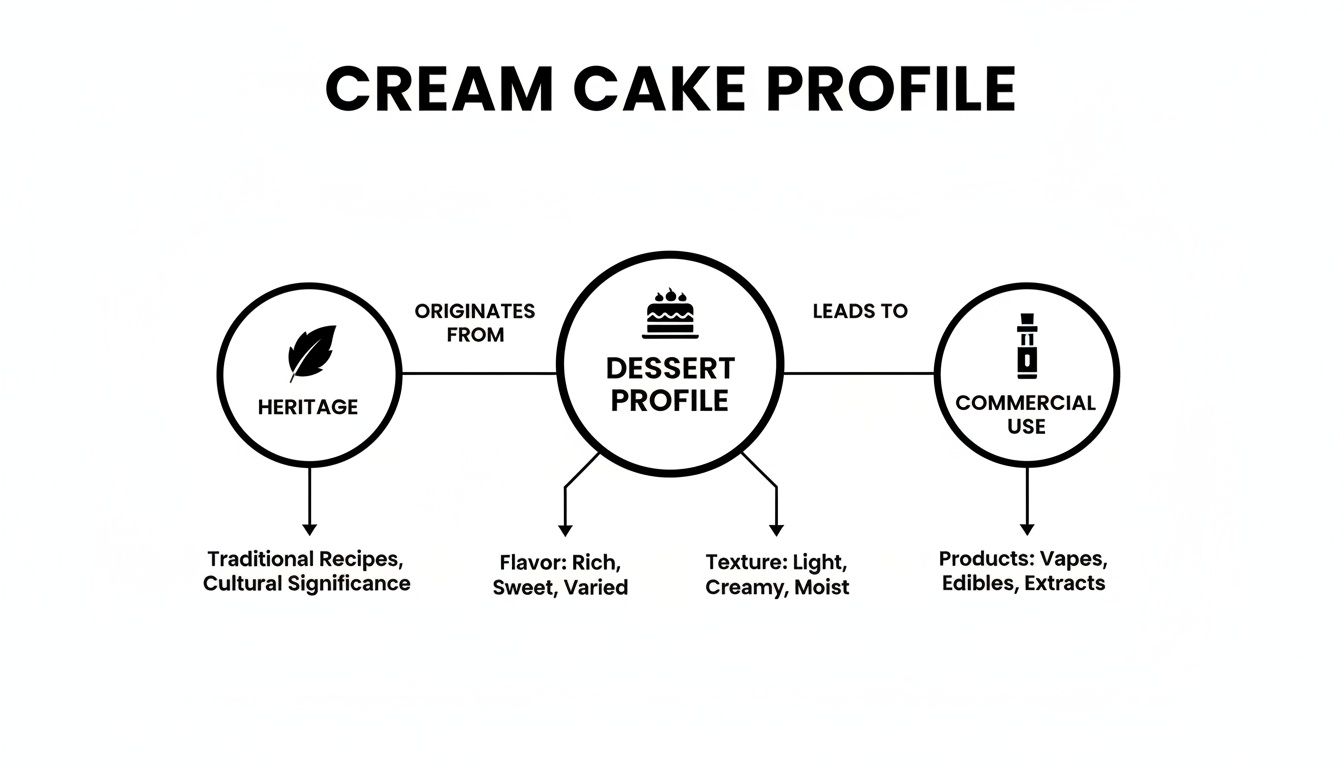
This illustrates the direct line from genetic heritage to marketable characteristics, underscoring why a firm grasp of its terpene structure is essential for product success.
The Aromatic Architecture: Base, Mid, and Top Notes
Constructing a terpene profile is a technical exercise in flavor chemistry, requiring a balance of base, mid, and top notes to create a full-bodied aromatic profile. In Cream Cake, three key terpenes fulfill these roles, and their precise balance is paramount.
The following table outlines the primary terpenes and their functional roles within the blend.
Cream Cake Primary Terpene Breakdown
| Terpene | Aromatic Contribution | Estimated Percentage Range | Note Classification |
|---|---|---|---|
| Beta-Caryophyllene | Warm, spicy, peppery, clove-like | 30% – 40% | Base Note |
| Limonene | Sweet, bright citrus, lemon zest | 20% – 30% | Mid Note |
| Linalool | Floral, sweet, lavender, hints of vanilla | 10% – 15% | Top Note |
Beta-Caryophyllene provides the heavy, spicy foundation, Limonene adds a sweet and zesty lift, and Linalool contributes a delicate floral sweetness. This synergy is what defines the Cream Cake profile.
Beta-Caryophyllene: The Spicy Foundation (Base Note)
At the foundation of the Cream Cake profile is Beta-Caryophyllene. As the base note, it provides the structural anchor for the entire blend. It imparts the warm, spicy, and peppery scent characteristic of baked goods, adding a crucial depth that prevents the profile from becoming overly sweet.
Functionally, Beta-Caryophyllene acts as the structural agent in the flavor profile, providing warmth and complexity. An incorrect concentration can result in a flat, one-dimensional product. Examine this foundational isolate on our Beta-Caryophyllene product page.
Limonene: The Zesty Lift (Mid Note)
Layered on top of the spicy base is Limonene, functioning as the primary mid note. It cuts through the richness with a bright, sweet citrus aroma, analogous to lemon zest in a vanilla glaze. This element prevents the profile from becoming too heavy and introduces a touch of freshness.
Limonene’s role is to provide a vibrant counterpoint to the deeper, spicier notes of Caryophyllene. It is the component that makes the Cream Cake profile feel both decadent and surprisingly light.
For formulators, the interplay between Beta-Caryophyllene and Limonene is critical. An excess of Caryophyllene shifts the profile toward a generic spice blend, while too much Limonene will overpower the delicate vanilla creaminess. Precision in this ratio is essential.
Linalool: The Sweet Finish (Top Note)
The final aromatic flourish comes from Linalool. As the top note, it adds a soft, sweet, and floral character with hints of vanilla and lavender. This is the initial aromatic impression.
If Caryophyllene is the foundational structure, Linalool is the vanilla extract—a subtle but indispensable component. As one of the more volatile terpenes, it is perceived first, making it crucial for creating an authentic, inviting aroma at the point of sale.
Understanding how these three key isolates interact provides the blueprint for replicating the flavor of Cream Cake in any product application. For more direct support, our terpene formulation guides are an excellent technical resource.
Formulating the Cream Cake Terpene Profile for Vape Cartridges
Successfully translating the Cream Cake profile into a vape cartridge requires more than simply adding terpenes to a base oil; it demands precision engineering. The goal is to achieve authentic flavor expression without compromising the stability or performance of the distillate. This section provides a practical guide on how to formulate a Cream Cake profile for vape cartridges, covering mixing ratios and common pitfalls.
First, a thorough analysis of your base material is required. The starting cannabinoid concentrate—whether it's THC, CBD, or Delta-8 distillate—serves as the formulation canvas. A highly refined, flavorless distillate allows the Cream Cake profile to express itself fully, whereas a less-refined extract may introduce its own aromatic notes that must be accounted for.
Achieving the correct balance is paramount. Excessive terpene concentration can lead to a harsh, unpleasant vapor and may cause phase separation in the oil. Insufficient concentration will result in a weak, underwhelming flavor that fails to deliver the signature creamy notes.
Determining Optimal Mixing Ratios
For most standard distillates, a starting point for a Cream Cake terpene blend is between 5% and 7% by weight. This range typically yields a robust, true-to-strain flavor without overpowering the cannabinoid base. However, this is not a universal rule; adjustments are often necessary.
Consider the following variables when dialing in your exact percentage:
- Distillate Viscosity: Highly viscous, winterized distillates may require a higher terpene ratio—up to 7-8%—to achieve the optimal viscosity for proper wicking in most cartridge hardware.
- Hardware Specifications: Cartridge technology varies. Modern ceramic coils can handle slightly thicker oils and deliver clean flavor, while older wick-style cartridges often require a thinner oil (and thus a higher terpene percentage) to prevent clogging.
- Target Flavor Intensity: For a subtle, nuanced flavor profile, remain at the lower end of the range (approx. 5%). For a product line that prioritizes bold, forward flavor, ratios closer to 8% may be appropriate. Proceed with caution and incremental testing.
The optimal terpene concentration maximizes flavor delivery while ensuring a smooth, non-irritating vapor. Always conduct small-scale batch testing before committing to a full production run. A minor adjustment of 0.5% can be the difference between a successful product and a failed batch.
Step-by-Step Mixing Protocol for Homogenization
A consistent, fully homogenized product is non-negotiable for brand integrity. Inconsistent mixing leads to cartridges with flavor "hot spots," poor performance, and customer complaints. Follow this protocol to ensure batch-to-batch consistency when replicating the flavor of Cream Cake.
- Gently Heat Distillate: Carefully heat the distillate to reduce its viscosity for easier handling. A target temperature range is 100-140°F (38-60°C). Avoid excessive heat, which can degrade cannabinoids and volatile terpenes.
- Precise Measurement: Use a calibrated digital scale to accurately measure both the distillate and the terpene blend. Add the Cream Cake terpenes to the warmed distillate.
- Thorough Mixing: Stir the blend gently but completely until no visible streaks or separation remain. A magnetic stirrer is the industry standard for ensuring full homogenization. Maintain mixing for several minutes.
- Allow Degassing: Before filling cartridges, let the mixture rest. This allows any micro-bubbles introduced during mixing to dissipate.
This process ensures a stable, uniform oil that delivers the authentic Cream Cake flavor consistently. For assistance with calculations, our terpene mixing calculator is a valuable tool for ensuring ratio accuracy.
Advanced Formulation: Customizing the Cream Cake Profile
Mastering the base Cream Cake profile is a significant technical achievement. For advanced formulators, however, it represents a starting point for innovation. The key to market differentiation lies in the art of customization.
A pre-formulated blend serves as a consistent and reliable foundation. By strategically introducing specific terpene isolates, formulators can modify and enhance this base profile, creating proprietary products that are difficult to replicate.
This approach elevates a brand from simply replicating the flavor of Cream Cake to innovating with it. A single, solid profile can become the foundation for an entire product line tailored to diverse consumer preferences.
Creating Signature Blends with Terpene Isolates
This process is analogous to a master perfumer modifying a classic accord. The original profile remains recognizable, but the addition of specific aromatic compounds makes it unique. By adding small, precisely measured amounts of terpene isolates, you can push the Cream Cake profile in new directions.
Here are several application examples using our Cream Cake strain-inspired terpene blend as a base:
Lemon Cream Cake: To amplify the existing citrus notes for a brighter profile, a small addition of Limonene isolate is effective. Adding just 0.5% to 1.0% more Limonene to the base blend creates a sharp, sweet lemon-curd flavor that balances the inherent creaminess.
Lavender Vanilla Cake: To emphasize a more sophisticated, floral aroma, Linalool is the target isolate. A minimal addition, around 0.3% to 0.5%, is sufficient to amplify the soft, sweet lavender undertones, resulting in a boutique finish.
Spiced Cream Cake: For a warmer, seasonal variant, build upon the profile’s spicy foundation. Increasing the Beta-Caryophyllene concentration by approximately 0.5% will intensify the peppery, clove-like notes, imparting a distinct baked-goods character.
When customizing with isolates, precision is key. A shift of as little as 0.1% can significantly alter the final aromatic and flavor profile. Always start with small test batches, maintain meticulous documentation, and use sensory analysis as the final arbiter.
How Flavor Variants Expand a Product Line
Developing these unique variations is an efficient strategy for attracting new consumer segments without the R&D overhead of creating a new profile from scratch. Each flavor variant appeals to a different preference, expanding market reach with each new SKU.
A consumer who appreciates your standard Cream Cake vape is a prime target for a "Berry Cream Cake" variant, developed by introducing trace amounts of Myrcene and other fruity isolates.
This strategy demonstrates the full potential of formulating with a Cream Cake profile for cannabis product formulation. You are not limited to a single flavor; you are leveraging a versatile platform for continuous innovation. Mastering the modification of a core blend enables rapid response to market trends, keeps the product line fresh, and builds significant brand equity.
Ensuring Formulation Consistency and Quality Control

Once the ideal Cream Cake formulation has been finalized, the critical challenge becomes ensuring batch-to-batch consistency. This is where rigorous quality control protocols become indispensable.
Consistency is a cornerstone of brand reputation. A consumer who purchases a Cream Cake vape expects the identical sensory experience every time. Any deviation, however minor, can erode the trust built with your customer base. A robust QC process is not optional; it is essential for building a sustainable brand.
Sourcing and Storing Terpene Blends
The quality of the final product is directly dependent on the quality of its constituent ingredients. Begin by sourcing high-purity, lab-tested terpenes from a supplier that provides a Certificate of Analysis (COA) for every batch. The COA provides critical data on purity and composition.
Proper storage of these raw materials is equally important. Terpenes are volatile aromatic compounds, and protecting your investment in a Cream Cake strain-inspired terpene blend is paramount.
- Maintain Cold Temperatures: Heat and light accelerate terpene degradation. Store terpenes in a cool, dark environment, such as a refrigerator, to prevent volatilization and preserve their aromatic integrity.
- Prevent Oxidation: Oxygen is a primary cause of degradation. Ensure all containers are sealed tightly. Amber glass bottles are the industry standard as they also block UV light.
Adhering to these storage protocols ensures that your terpenes remain stable and true-to-profile throughout their shelf life.
The Critical Role of Batch Testing
Despite meticulous process controls, final product testing is mandatory. It is the only way to verify repeatability and confirm that the end product meets precise flavor specifications.
Batch testing serves as the final quality checkpoint, identifying any process errors—such as improper mixing or ratio miscalculations—before the product reaches the market. This is how a reputation for reliability is built and maintained.
Market data underscores the importance of getting this right. In California, Cream Cake's parent, Wedding Cake, generated $15.7 million in flower sales, demonstrating the enormous demand for authentic dessert profiles. Capturing a share of this market requires unwavering quality. You can read more about the top-selling strains in California to understand the significance of these consumer trends.
Quality control is more than a compliance exercise. It is the practice of creating a product so reliably consistent that it becomes a go-to choice for consumers, eliminating purchasing hesitation.
Furthermore, maintain updated Safety Data Sheets (SDS) for all formulations. This demonstrates a commitment to safety and transparency, building trust with partners and end-users alike.
Common Technical Questions in Cream Cake Formulation
Even with a detailed protocol, formulators often encounter specific challenges when working with a nuanced profile like Cream Cake. This section addresses common technical questions with practical, data-driven solutions.
Why Did My Flavor Profile Degrade Post-Production?
A common issue is flavor degradation over time. The initial production batch meets all sensory targets, but after several weeks in storage, the rich, creamy flavor has diminished. This is almost always due to terpene degradation.
Terpenes are volatile organic compounds sensitive to environmental factors. Exposure to heat, light, and oxygen initiates oxidation and volatilization, altering the aromatic profile. To maintain the integrity of your Cream Cake profile, strict environmental controls are necessary.
Store both raw terpene blends and finished goods in a cool, dark environment. Ensure packaging is hermetically sealed with minimal headspace to reduce oxygen exposure. This fundamental step is critical for preserving flavor fidelity throughout the product's shelf life.
Is This Blend Compatible with Different Distillate Types?
Yes, the Cream Cake profile is versatile, but formulation adjustments are required based on the starting material. A highly refined, flavor-neutral THC or CBD distillate provides a "blank canvas," where a 5-7% terpene ratio is typically optimal.
However, when working with less-processed extracts, such as full-spectrum CO2 oil, the base material will have its own intrinsic flavor profile. In these cases, you may need to increase the terpene percentage, potentially to 8%, to ensure the Cream Cake notes are dominant. Conduct small-scale test batches to determine the ideal ratio for your specific cannabinoid base.
Technical Note: Viscosity must also be considered. Thicker base oils often require a higher terpene concentration not just for flavor, but to achieve the correct viscosity for optimal performance in modern vape hardware.
What Causes a Harsh or Chemical Taste in the Final Product?
A harsh, perfumey, or chemical-like off-note is a clear indicator of excessive terpene concentration. This is a frequent error in product development. Higher concentration does not equate to better flavor; oversaturation ruins the sensory experience.
When replicating the flavor of Cream Cake, adopt a methodical, incremental approach. Begin at a 5% concentration and increase in 0.5% increments, conducting sensory analysis at each stage. This process allows you to identify the precise point where the flavor is robust and authentic without becoming overpowering. The objective is a smooth, complex dessert profile, not an abrasive chemical note.
For additional support with calculations and ratios, our terpene formulation resources can provide valuable technical guidance.
Ready to develop a market-leading product with an authentic, creamy dessert profile? The Gold Coast Terpenes Cream Cake Strain Profile provides the ideal, lab-verified foundation for your next formulation. Shop our lab-verified Cream Cake blend today and taste the difference precision makes.