
When formulating a product to address nausea, the "indica vs. sativa" debate is an outdated framework. For product developers, extractors, and brand owners, the critical question is not about plant morphology but about chemical composition. The key to creating a reliable, effective product lies in understanding and leveraging specific cannabinoids and terpenes to achieve a targeted functional outcome.
The most effective strategy for formulators is to construct profiles that leverage the anti-nausea properties of THC and specific terpenes, particularly those often found in sativa-dominant and hybrid chemovars, such as Limonene. This approach allows for the creation of consistent, replicable, and commercially viable products.
Deconstructing The Indica Or Sativa Nausea Debate
Historically, the cannabis market relied on a simple binary: indica for sedation, sativa for energy. For professionals formulating precise vape cartridges, edibles, or concentrates, this model is insufficient and inconsistent. Modern product development has shifted to a chemovar-centric approach, focusing on the unique chemical profile of cannabinoids and terpenes to create functional formulations with predictable effects.
Instead of relying on ambiguous strain names, the objective is to engineer a product based on its chemical fingerprint. This data-driven methodology is the only way to ensure batch-to-batch consistency and replicable user experiences. While consumers might ask for "indica or sativa," the technical answer is found in the precise formulation of active compounds that deliver the desired effect. This begins with a high-THC base, supported by a carefully selected terpene profile known for its anti-nausea applications.
Shifting Focus From Strain To Compounds
The primary driver for nausea relief in cannabis formulations is tetrahydrocannabinol (THC). It interacts directly with CB1 receptors in the brain regions responsible for regulating nausea and vomiting reflexes. Consequently, a high-purity THC distillate serves as the ideal foundation for any serious anti-nausea formulation.
With the cannabinoid base established, the formulation's experiential qualities are shaped by terpenes. These aromatic compounds are not just flavorants; they modulate the overall effect.
- Limonene: A key top note often dominant in sativa-leaning profiles, it provides a bright, uplifting citrus aroma.
- Myrcene: The classic base note, delivering the grounding, herbal character typical of many indica profiles.
- Beta-Caryophyllene: A unique mid-note providing spicy, peppery aromas, notable for its interaction with CB2 receptors.
Mastering the blend of these isolates and profiles separates a generic product from a targeted, functional one. Formulators can delve deeper into the science behind specific terpene isolates for nausea to optimize their blend for maximum efficacy.
Key Formulation Variables For Nausea Relief Profiles
When engineering a profile, it is crucial to understand the function of each component. This table outlines the key compounds and their roles in an anti-nausea formulation.
| Compound Type | Role in Nausea-Focused Formulations | Formulation Strategy |
|---|---|---|
| THC | Primary active agent via CB1 receptor activation | Utilize a high-potency distillate base for core functionality. |
| Limonene | Uplifting aromatic character; potential mood elevation | Employ as a top note for sativa-dominant or hybrid daytime blends. |
| Myrcene | Grounding, earthy aroma; relaxing character | Use as a base note to anchor calming, evening-focused formulations. |
| Beta-Caryophyllene | Spicy mid-note; interacts with CB2 receptors | Incorporate as a mid/base note to add depth and functional synergy. |
This component-based approach enables formulators to construct targeted, consistent products, moving beyond the guesswork associated with traditional strain classifications. This shift is supported by market data indicating that consumers often report greater nausea relief from products labeled 'sativa' and 'hybrid'—profiles frequently rich in compounds like Limonene.
Formulating Terpene Profiles For Nausea Relief
The primary goal when creating a blend for nausea is twofold: it must be effective, and it must provide a pleasant sensory experience. This requires a technical approach that balances science and artistry. The process involves building a complex aromatic profile around a core of functional terpenes, then refining it with other compounds to achieve a balanced, appealing, and consistent product.
The strategy begins with a solid foundation built around key terpenes known to complement anti-nausea formulations. From there, additional terpenes are layered in to fine-tune the flavor and round out the aromatic profile, resulting in a product that delivers predictable results.
Structuring Blends With Top, Mid, And Base Notes
A well-structured terpene profile for a vape cartridge manages volatility and aroma to ensure a consistent experience from the first draw to the last. This is achieved by applying the perfumer's methodology of top, mid, and base notes.
- Top Notes: These are the most volatile compounds, providing the initial burst of aroma. They are light, sharp, and evaporate quickly. For anti-nausea blends, bright citrus terpenes like Limonene are ideal top notes.
- Mid Notes: As the top notes dissipate, the mid notes become more prominent. They form the "heart" of the blend—often floral, herbal, or spicy—and provide body and character.
- Base Notes: These are the least volatile compounds, providing the deep, heavy aromas that linger. Earthy, musky, or woody scents anchor the blend and create a lasting finish.
Mastering this structure is critical for creating a memorable product and building brand reputation. While knowing a plant's physical traits is useful for cultivators, formulators must focus on the lab-verified certificate of analysis (COA). While you can learn how to differentiate male and female plants, that data has limited utility compared to the chemical data that dictates the final product's performance.
Primary Terpenes For Anti-Nausea Formulations
While many terpenes can be incorporated, a few are particularly valuable for nausea-focused products. These should form the core of any formulation, whether it's built from isolates or designed to enhance an existing profile.
Limonene is the essential top note. It delivers a bright, zesty citrus scent associated with alertness and an uplifted mood. This quality is highly effective for counteracting the fatigue that often accompanies nausea, making it a cornerstone of any sativa-leaning, daytime-use product. Understanding the benefits and applications of D-Limonene is crucial for leveraging its full potential.
Beta-Caryophyllene serves as a vital mid-to-base note, introducing a warm, spicy, and peppery character. Its primary value lies in its unique ability to interact directly with the endocannabinoid system's CB2 receptors, a feature not shared by most other terpenes. This adds significant functional weight and synergistic value to any THC-based formula.
Myrcene is the quintessential base note, grounding the blend with its earthy, herbal, and slightly musky aroma. As the backbone of countless "indica" profiles, it imparts a sense of calm and relaxation. In an anti-nausea blend, a controlled amount of Myrcene can balance more stimulating top notes, creating a more soothing overall experience.
Practical Formulation Examples
A practical approach to formulation often involves using a well-known strain profile as a template.
For a sativa-dominant daytime product, one might start with a profile like Green Crack, which is naturally high in Myrcene but also features significant levels of Pinene and Caryophyllene. To optimize it for nausea, a formulator could introduce additional Limonene isolate to enhance the uplifting citrus top notes.
For a more relaxing evening product, a Blue Dream profile provides a balanced starting point with Myrcene, Pinene, and Caryophyllene. To enhance its calming properties, the Myrcene concentration could be slightly increased to amplify the grounding effect without inducing excessive sedation.
Precision is the key. Starting with a base profile and augmenting it with specific isolates provides unparalleled control over the final product. This is not about merely replicating a strain; it's about engineering a purpose-built solution.
Key Terpenes For Nausea-Focused Formulations
This table summarizes primary terpenes for nausea-focused formulations, their aromatic roles, and application considerations for vape cartridges and concentrates.
| Terpene | Primary Aroma/Flavor Profile | Aromatic Note (Top/Mid/Base) | Formulation Application |
|---|---|---|---|
| Limonene | Bright Citrus (Lemon, Orange) | Top Note | Adds an uplifting, clean initial aroma; ideal for daytime sativa-style blends. |
| Beta-Caryophyllene | Spicy, Peppery, Woody | Mid/Base Note | Provides depth and a warm finish; adds functional value through CB2 interaction. |
| Myrcene | Earthy, Herbal, Musky | Base Note | Anchors the profile with a calming foundation; essential for indica-style blends. |
| Pinene | Sharp Pine, Fresh Herbal | Top/Mid Note | Introduces a clean, crisp aroma that can cut through heavier notes for balance. |
By mastering the interplay of these compounds, formulators can consistently create effective products that meet specific consumer needs for nausea relief.
Comparing Sativa-Dominant And Hybrid Profiles for Formulation
When formulating a product for nausea, the choice between a sativa-dominant and a hybrid terpene profile is a strategic one, dictated by the target consumer and intended use case. Each profile provides a different set of tools to solve a specific problem.
A sativa-dominant profile is engineered for functional daytime relief, with bright, uplifting aromatic notes designed to counteract the fatigue often associated with nausea. A hybrid profile offers a balanced, versatile blend suitable for all-day use by combining uplifting top notes with a calming base.
Sativa-Dominant Profiles For Functional Daytime Relief
Sativa-inspired formulations are designed for an energetic effect. They are built around high concentrations of terpenes like Limonene and Pinene, which create a sharp, clean aromatic experience that promotes alertness and mental clarity.
This profile is the optimal choice for products intended for consumers who need to remain productive. The goal is to mitigate nausea without inducing drowsiness. A terpene blend inspired by a strain like Green Crack serves as an excellent blueprint, leading with its characteristic bright citrus and crisp pine notes.
This decision tree helps visualize the formulation path based on the product's intended effect, whether that's creating an uplifting, calming, or balanced blend.
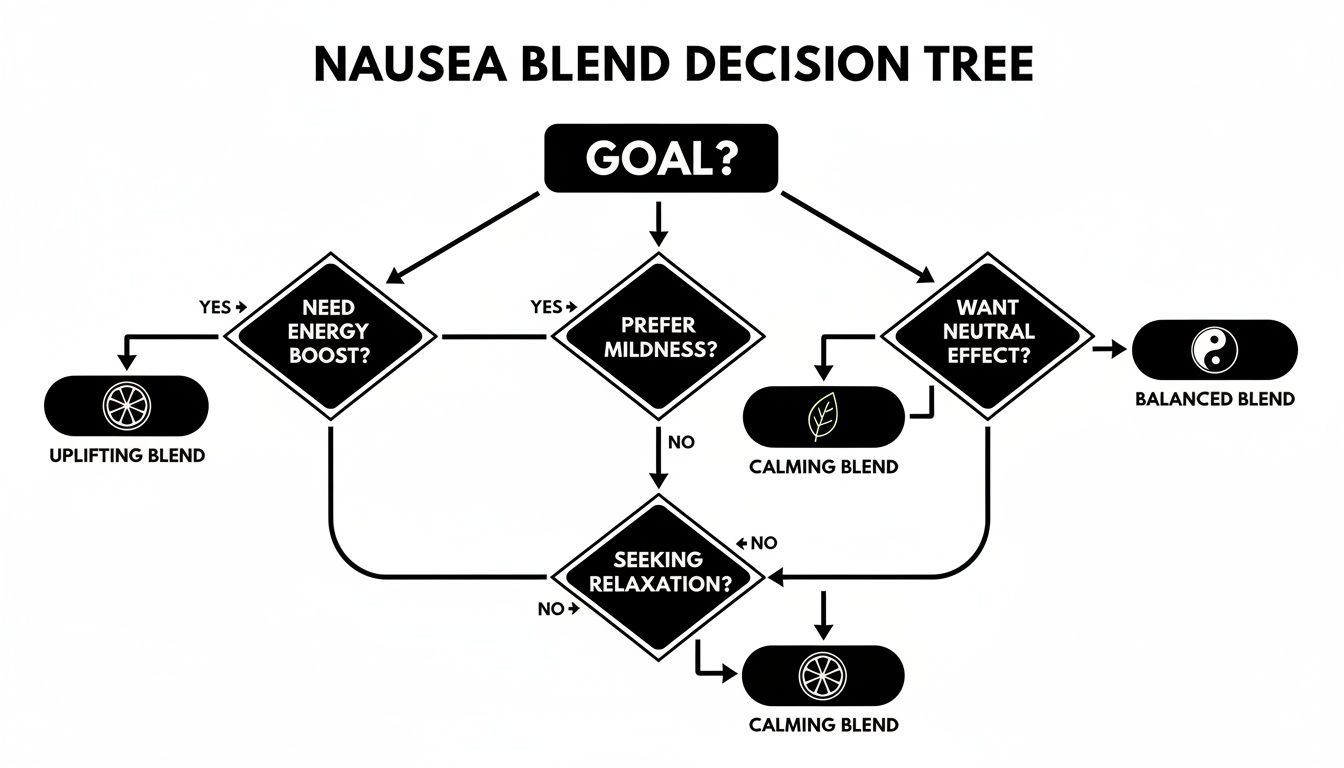
Starting with a clear objective, such as "Uplifting," directs the formulator toward specific terpene choices, like prioritizing citrus-forward isolates.
To fine-tune a sativa-dominant profile, consider adding specific isolates:
- Alpha-Pinene: Amplifies fresh, herbal complexity.
- Beta-Caryophyllene: Adds a subtle, spicy mid-note for depth without sedation.
- Terpinolene: Introduces a complex floral and herbal layer that complements citrus and pine.
This is the process of engineering a precise, targeted experience. While strain history is interesting, modern formulators achieve superior consistency by focusing on key chemical building blocks. Analyzing the composition of classic sativa profiles can provide valuable insights for developing proprietary blends.
Hybrid Profiles For Versatile All-Day Application
Hybrid profiles represent the middle ground, offering a balanced solution that avoids strong stimulation or sedation. This makes them ideal for general-use products designed to provide relief at any time of day. The objective is to achieve equilibrium between bright top notes and grounding base notes.
The key to a successful hybrid is harmony. While Limonene and Pinene are present, they are balanced by a significant concentration of Myrcene. This foundational terpene adds a mellow, earthy character that smooths the blend's sharper aromatic edges.
The core differentiator is balance. While a sativa profile is engineered for a peak energetic effect, a hybrid profile is designed for functional consistency. It provides effective nausea relief with a milder, more rounded experiential arc, minimizing the risk of over-stimulation.
A profile inspired by Blue Dream is a perfect model, skillfully weaving sweet, fruity notes with an earthy Myrcene foundation. This creates a product with broad market appeal, catering to consumers seeking reliable relief without a pronounced energizing or sedating effect. Mastering both sativa-dominant and hybrid approaches allows for the development of a comprehensive product line that addresses the full spectrum of consumer needs for nausea management.
Your Guide to Vape Cartridge Formulation
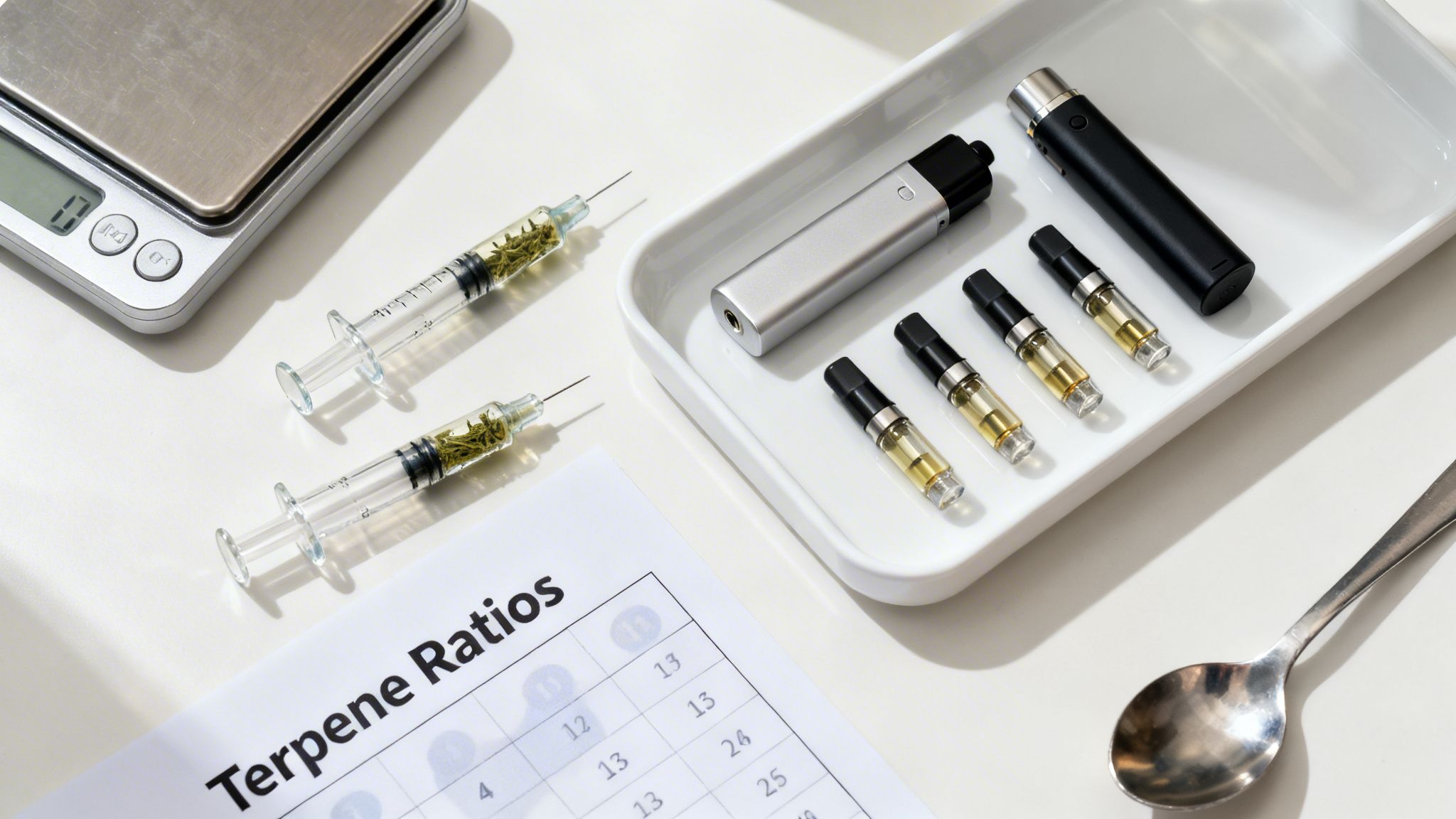
Translating a well-designed terpene profile into a finished vape cartridge is a matter of technical precision. Whether you are formulating an indica or sativa-dominant blend for nausea, the product's success hinges on mastering the details: terpene ratios, mixing procedures, and hardware selection.
These factors define the blend's efficacy, stability, flavor expression, and overall quality. Nailing these technical points is what transforms a simple mixture into an engineered solution and builds brand credibility.
Determining Optimal Terpene Ratios
Establishing the correct terpene concentration is a critical formulation decision. The goal is to find the optimal balance: a rich, functional flavor profile that is neither harsh nor unstable.
For most cannabis distillates, the ideal terpene concentration is between 5% and 8% by weight. This range provides sufficient aromatic intensity for a premium sensory experience while maintaining a viscosity suitable for most vape hardware.
Concentrations below 5% typically result in a bland, weak flavor. Exceeding 8% risks a harsh throat hit and potential hardware issues such as leaking or clogging.
Precision is paramount. A digital scale accurate to at least two decimal places (0.01g) is essential for maintaining batch consistency. Our online terpene mixing calculator is a valuable tool for ensuring accurate ratios without manual calculation.
Best Practices for Mixing and Homogenization
Simply stirring terpenes into distillate at room temperature is ineffective due to the oil's high viscosity. The key is to use gentle, controlled heat to reduce viscosity, allowing for complete and even integration of the terpenes.
Heating the Distillate: Gently warm the distillate to 100-120°F (38-49°C). A magnetic hotplate stirrer is ideal for this process, as it provides simultaneous heating and agitation. Avoid excessive heat, which can degrade cannabinoids and volatilize terpenes.
Introducing Terpenes: Once the distillate is fluid, slowly add the pre-measured terpene blend while maintaining constant stirring. Gradual addition promotes smooth integration.
Ensuring Homogenization: Continue stirring for several minutes after all terpenes have been added to achieve a perfectly uniform solution with no visible oil swirls.
A fully homogenized blend ensures consistent flavor and effect from the first draw to the last and prevents "hot spots" of high terpene concentration. This is a non-negotiable quality control step that directly impacts user experience and safety.
After mixing, allow the blend to rest for 24 hours. This steeping period enables the terpenes and cannabinoids to fully meld, resulting in a smoother, more cohesive flavor profile.
Hardware Considerations and Final Testing
A superior formulation can be compromised by inferior hardware. The choice of cartridge, particularly its coil technology and intake hole size, is critical to the end-user experience.
- Ceramic Coils: These are the industry standard for delivering clean, pure flavor without the burnt taste associated with older wick-and-wire coils. They are excellent for preserving the nuanced notes of a complex terpene profile.
- Intake Hole Size: The viscosity of the final oil dictates the appropriate intake hole size. Thicker oils require larger apertures to ensure proper wicking and prevent dry hits. A 2.0mm aperture is a reliable choice for most standard distillate-terpene blends.
Finally, third-party testing is mandatory. Before market release, every batch must be rigorously tested for potency, purity, and safety. A comprehensive Certificate of Analysis (COA) verifies cannabinoid content and confirms the absence of contaminants like pesticides, heavy metals, and residual solvents.
This final step is the cornerstone of a trustworthy brand. For complete transparency, you can review our safety data sheets to see our commitment to quality and compliance.
Answering Your Top Formulation Questions
Even with a robust plan, technical challenges will arise during product development. Addressing common questions about formulating for nausea can help ensure your final product is effective, stable, and commercially successful.
This section covers the selection of terpene isolates, ideal cannabinoid ratios, and the impact of starting materials on the formulation process.
Which Terpene Isolates Are Most Critical for a Sativa Nausea Blend?
When engineering a sativa-dominant blend from scratch, Limonene is the essential starting point. As a top note, it provides the bright, uplifting citrus aroma characteristic of sativas. This aromatic quality can help counteract the mental fatigue that often accompanies nausea.
Following Limonene, Alpha-Pinene and Beta-Pinene should be incorporated to add fresh, herbal complexity, preventing the blend from becoming one-dimensional. To enhance the anti-nausea effects, a moderate inclusion of Beta-Caryophyllene is recommended. It adds a spicy, grounding base note and contributes functional value through its interaction with CB2 receptors, without inducing sedation.
What's the Ideal THC to CBD Ratio?
For rapid nausea relief, THC-dominant formulations are demonstrably more effective. A high-THC distillate should serve as the product's foundation.
While CBD has numerous applications, high concentrations can inhibit THC's anti-nausea efficacy. For a product specifically designed for this purpose, minimizing or excluding CBD is often the most direct route to an effective formulation. The focus should be on optimizing the synergy between THC and the selected terpene profile rather than balancing multiple cannabinoids.
The objective is to maximize THC's direct impact on the CB1 receptors that regulate the body's nausea response. Pairing this primary function with a well-designed terpene blend creates a targeted, high-performance product.
How Does My Choice of Concentrate Impact Formulation?
The starting concentrate fundamentally dictates the formulation workflow and presents different opportunities and constraints.
THC Distillate: As a "blank canvas," distillate contains no native terpenes, providing the formulator with complete control over the final profile. 100% of the flavor, aroma, and experiential effects are delivered by the added terpene blend. This is the ideal choice for achieving maximum product consistency.
Live Resin or Rosin: These concentrates possess their own complex, native terpene profiles. The formulator's role shifts from creation to enhancement. For example, adding Limonene isolate can brighten an earthy profile, while adding Beta-Caryophyllene can boost its functional properties. This approach yields a richer, more complex aroma but presents challenges in maintaining perfect batch-to-batch consistency.
The choice depends on brand goals. Distillate offers precision and predictability, while live resin offers an artisanal, full-spectrum experience.
At Gold Coast Terpenes, we provide the lab-verified isolates and strain-inspired blends you need to execute your vision with precision. Whether you are building a profile from scratch or enhancing a live resin, our terpenes ensure clean flavor and consistent results.
Explore our full range of terpene profiles and isolates to perfect your next formulation.