
A documented Tropical Z concentrate measured 6.84% total terpenes, with beta-caryophyllene at 2.6066% ahead of limonene, trans-beta-farnesene, alpha-humulene, and linalool, making a caryophyllene-led blend the starting point for that lot. Gold Coast Terpenes supplies botanically derived, THC-free formulation inputs, but the target batch chemistry, not the strain name, should determine the blend.
For developers, the useful distinction is between reproducing a recognizable flavor direction and reproducing a measured chemotype. A citrus-forward interpretation might smell convincing in a bottle while missing the dry structure that holds the reference together in a cartridge. Build the specification around the concentrate, then qualify the finished oil in its intended hardware.
Why Tropical Z Needs a Lot-Specific Blend Brief
Tropical Z needs a lot-specific brief because commercial products bearing the name don't establish a single genetic or chemical identity. Gold Coast Terpenes's botanical sourcing gives developers an alternative to cannabis-derived inputs, but it doesn't remove the need to identify the exact reference lot.
Weedmaps' Tropical Z cultivar documentation identifies Connected Cannabis Co. as the breeder, places its introduction in 2024, and describes the lineage as Xeno × GDPTHH #9, with GDPTHH representing Granddaddy Purple × Tom Hill's Haze. Xeno is described there as Zkittlez × Kush Mints, supporting a development target that combines candy fruit, citrus, mint, cream, and a brighter haze character.
That ancestry is a starting hypothesis, not a finished recipe. A Cannagram product description identifies the Connected-associated cultivar, while commercial descriptions also distinguish a Tropical Haze × Zkittlez interpretation. Those references shouldn't share a master formula merely because their names match.
Identify the reference before buying ingredients
Create an intake file that separates cultivar identity from analytical identity. The purchasing team needs to know what the supplier is matching, and the laboratory needs an unambiguous sample reference.
- Producer and cut: Record the breeder, producer, and phenotype or cut designation. Do not substitute another Tropical Z interpretation.
- Lot traceability: Attach the harvest or extraction lot, product format, and retained reference sample.
- Analytical record: File the complete COA, its revision, laboratory identity, methods, and reporting units.
- Sensory target: Describe the order of citrus, fruit, cream, wood, and spice rather than writing only tropical.
- Handling history: Record receipt, storage, opening, and sampling conditions so aging is not mistaken for a formulation difference.
A flower reference and a cartridge reference also answer different questions. Flower headspace describes what reaches the nose before heating; a finished cartridge establishes how the extract, formulation, and device perform together.
Treat lineage as context, not a release criterion
The broader naming problem isn't unique to this cultivar. A strain-label analysis published by Mainezilla discusses a 2019 University of Colorado analysis of 122 commercial samples with substantial variation among shared strain names, alongside a 2025 analysis of 140 medicinal flowers that found no statistically meaningful relationship between terpene profiles and indica/sativa genetic classifications.
For a manufacturer, that means a name isn't an incoming-material specification. Terms such as candy, cream, and haze belong in the sensory worksheet, where evaluators can test them against the reference.
Approval rule: Reject a blend brief that identifies the strain but cannot identify the sample being matched.
Keep effect language out of the specification. Purchasing, quality, and production can verify composition and sensory performance; they can't release a batch against a promise of creativity or energy.
What Does a Tropical Z Strain COA Actually Measure
A Tropical Z COA measures the submitted sample's composition, not a permanent formula for every product carrying the name. The Jaunty Tropical Z certificate of analysis reports the concentrate measurements below, with five named compounds accounting for about 5.70% of the product and roughly 83% of its measured terpene content.
Documented Tropical Z terpene shares and note roles
| Compound | Share of product | Note role | Sensory job |
|---|---|---|---|
| Beta-caryophyllene | 2.6066% | Base | Peppery woody structure |
| Limonene | 0.9794% | Top | Orange and citrus lift |
| trans-beta-Farnesene | 0.7845% | Mid | Green fruit and herb |
| alpha-Humulene | 0.7378% | Base | Dry woody hop support |
| Linalool | 0.5929% | Mid | Soft floral cream |
| Five named compounds | About 5.70% | Priority match | About 83% of terpene mass |
| Total terpenes | 6.84% | Load checkpoint | Full measured aroma mass |
The same report records 730.94 mg total THC and 787.31 mg total cannabinoids per unit, equivalent to approximately 73.1% THC and 78.7% total cannabinoids if the unit contained 1 gram of extract. That conditional conversion matters: this is a concentrate result, not a flower average or a universal Tropical Z potency specification.
Separate product concentration from blend composition
The table's percentages describe shares of the tested product. They aren't percentages to copy directly into a neat terpene blend.
To build a terpene-only specification, divide each measured compound concentration by the reported total terpene concentration. That converts a finished-product result into its relative share of the measured terpene pool. Preserve an allowance for the remaining measured compounds rather than forcing the dominant group to represent the entire aroma.
Normalizing only the named compounds creates a different specification. It can be useful for an early screening blend, but label it as a partial reconstruction so nobody mistakes it for a full analytical match.
Use the COA interpretation guide to align the purchasing worksheet with the laboratory report. Check whether the panel distinguishes relevant isomers, reports individual analytes consistently, and identifies compounds below the reporting limit.
Match the dominant structure before polishing traces
Begin with the caryophyllene-led structure and the relative positions of citrus, green fruit, wood, and floral softness. Minor adjustments are worthwhile only after that backbone resembles the reference.
A market description emphasizing D-limonene, beta-myrcene, and beta-caryophyllene may describe a legitimate alternative lot. It doesn't justify adding myrcene to this analytical target without supporting measurements.
GC-MS agreement and sensory agreement are separate checks. An incomplete panel can miss aroma-active material, while a plausible chromatogram doesn't establish how a cartridge will taste after storage and heating.
Match the measured dominant compounds first. Use sensory review to identify what remains unresolved, not to excuse an undocumented change in the formula.
How Should Top Mid and Base Notes Be Balanced
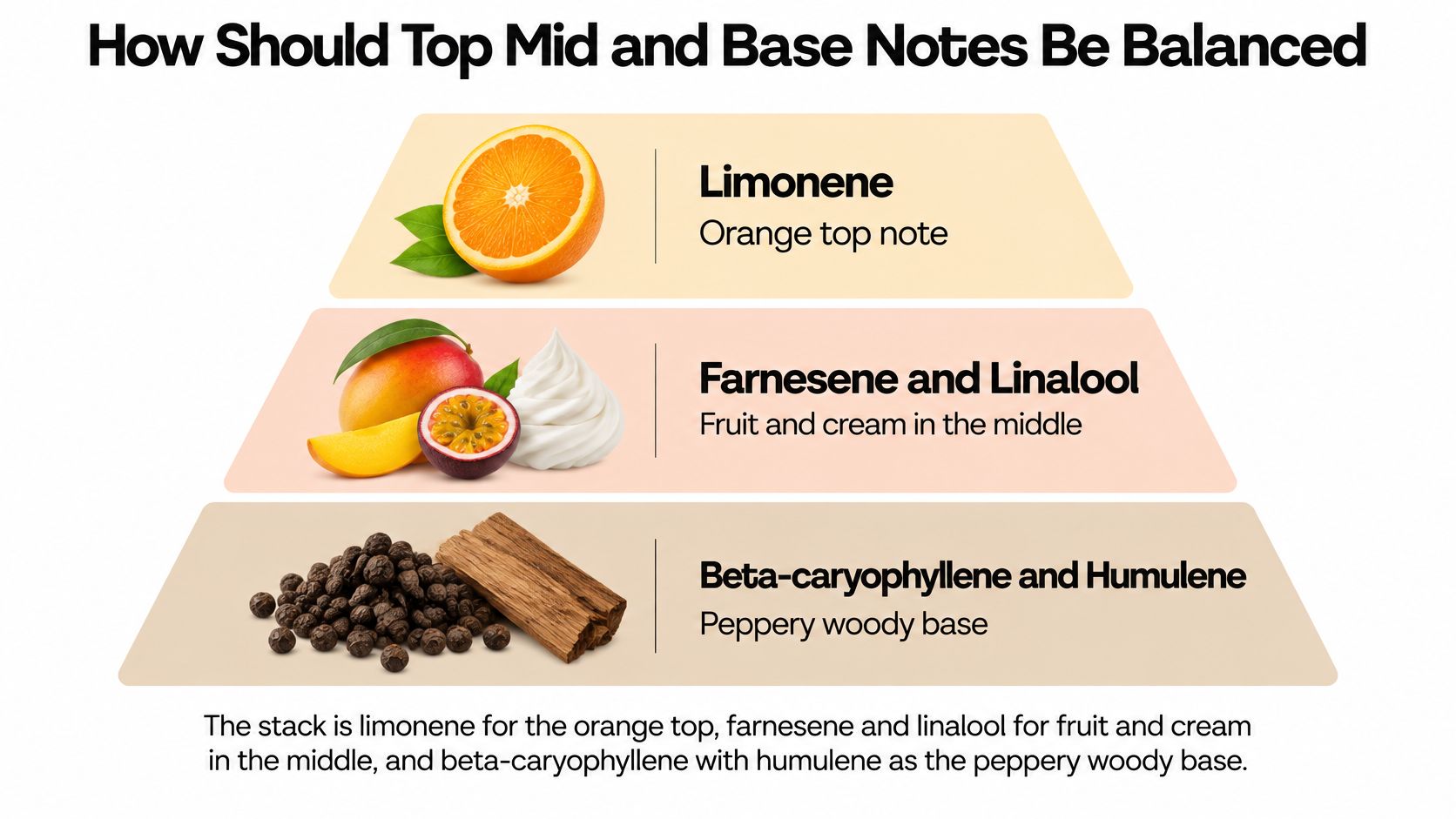
Set the sensory sequence first: limonene at the top, farnesene and linalool through the middle, then beta-caryophyllene and humulene at the base. Use this pyramid to check sequence, not proportions. The batch COA chemotype should guide the blend; the strain name alone cannot set the formula.
Build contrast without making a citrus cleaner
Limonene supplies the orange opening, but too much can flatten the blend into generic citrus. Farnesene can connect that opening to greener fruit, while linalool can soften the transition toward a cream-like impression. These compounds contribute sensory roles; none alone defines a complete tropical-fruit or cream flavor.
Caryophyllene and humulene shape a drier finish. If the target lot contains myrcene, assess its earthy, musky contribution against the COA and sensory target instead of adding it based on another Tropical Z description.
Use the terpene flavor chart to organize descriptors. Keep terms consistent across evaluation sessions so “peppery,” “woody,” “green,” and “floral” refer to the same sensory qualities for each evaluator.
Qualify cartridges and concentrates separately
For cartridges, assess whether the citrus opening remains balanced through repeated use. For concentrates, assess the initial release and lingering finish under the intended heating conditions. The same blend can present differently across applications.
Thermal behavior varies by compound. Entour's cartridge-formulation guidance describes common loading around 4% to 10% by volume and reports myrcene survival around 97% to 98%, compared with about 11% to 28% for terpinolene under the cited test conditions. Those results do not establish survival for a Tropical Z formulation, so they cannot substitute for testing the specific blend and hardware.
For a fruit-direction reference, Apple Fritter from Gold Coast Terpenes' Elevated Strains catalog offers a comparison point, not evidence of a Tropical Z analytical match.
The accompanying video provides another reference point for terpene evaluation.
Record the target sequence in the sensory worksheet: orange first, tropical fruit next, soft cream through the transition, then dry spice. If evaluators disagree, clarify the descriptor or adjust the blend before changing its intensity.
What Loading Level Suits Tropical Z Strain Vape Cartridges
Use the common cartridge loading window as a screening framework, not as a validated release specification. The acceptable finished load is the one that passes emissions, stability, sensory, and hardware checks together.
The distinction between a formulation screen and an aerosol experiment is important.
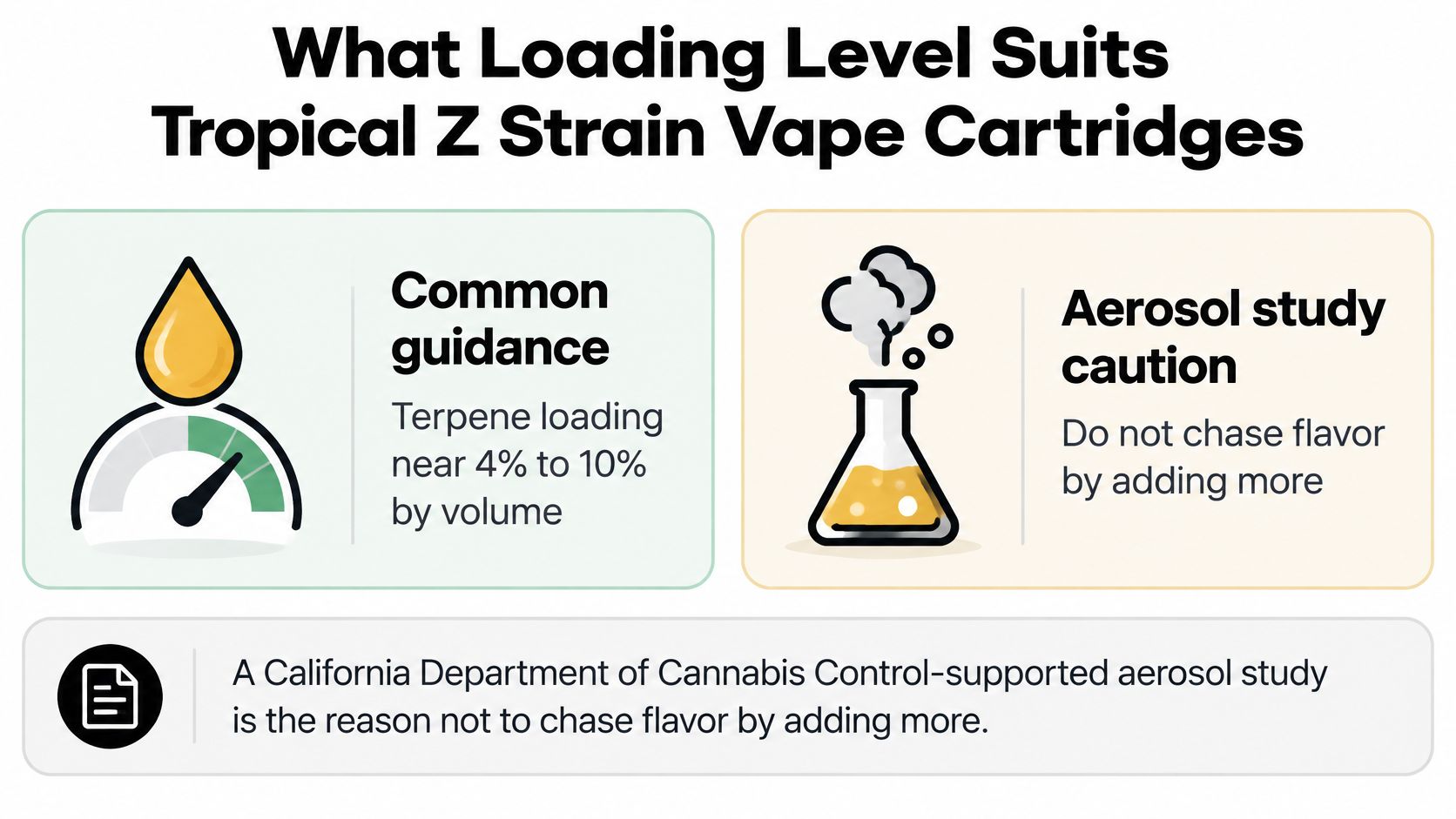
A California Department of Cannabis Control-supported aerosol study discussed in Gold Coast Terpenes's citrus-terpene guidance tested THC distillates containing 0%, 7.5%, and 15% terpenes by mass and found that some terpene-containing formulations produced up to nine times more carbonyl compounds than terpene-free controls under the tested heating conditions.
That finding doesn't predict the emissions of an untested Tropical Z formulation. It does establish why adding more aroma material isn't a neutral adjustment.
| Test condition | Purpose | What it doesn't establish |
|---|---|---|
| Terpene-free control | Establish the base oil and hardware response | Flavor acceptability |
| Intermediate study condition | Compare a terpene-containing formulation with the control | A universal commercial loading target |
| High study condition | Examine a high-loading experimental condition | Permission to release a high-terpene cartridge |
| Candidate finished formula | Qualify the actual oil, blend, and hardware combination | Performance in another device |
Keep mass and volume calculations separate
The cartridge guidance uses volume; the aerosol study uses mass. Don't compare those percentages as if they were interchangeable.
For production, choose a calculation basis and put it on the batch record. If a laboratory reports mass fractions while production doses by volume, use measured or documented densities to reconcile the records. A spreadsheet that switches units can change the finished composition without changing the displayed percentage.
Gold Coast Terpenes identifies its strain inputs as highly concentrated materials requiring dilution. Calculate the addition against the finished fill, including terpene material already present in the base oil, rather than treating the purchased blend as the only source.
Inspect the device, not just the bottle
Use the distillate loading guide alongside a cartridge-specific test sheet. Record wick wetting, leakage, clogging, draw resistance, vapor output, and flavor retention through the intended use cycle.
A thinner oil may feed readily but leak during storage. A thicker formulation may remain sealed yet starve the heating surface during repeated draws.
Release checkpoint: Stronger aroma isn't a pass if aerosol chemistry, sealing, or feed performance deteriorates.
Keep electrical settings, fill conditions, conditioning time, and draw protocol controlled. Otherwise, the team can't distinguish a loading effect from a hardware or handling change.
How Do You Formulate a Tropical Z Strain Blend for Distillate
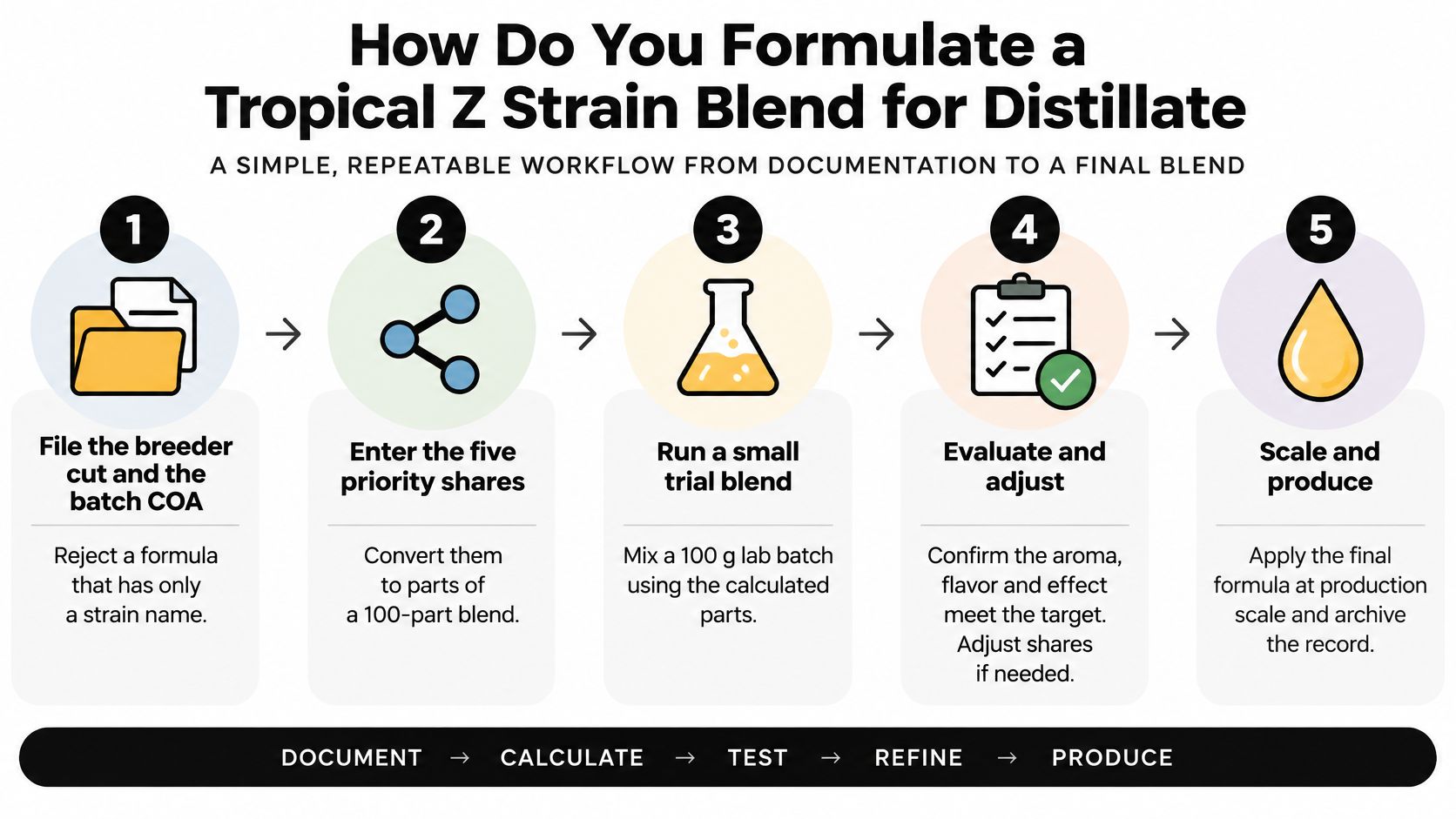
Treat Tropical Z as a lot-specific flavor target. The batch COA chemotype, not the strain name alone, should set the blend proportions, loading level, and ingredient selection. Record the analytical target and qualify each candidate in the intended distillate and cartridge.
Run the controlled formulation sequence
File the reference and batch COA. Attach the retained target and confirm that the producer, product format, and lot identifiers agree. The strain name alone is not enough for traceability.
Convert priority measurements into blend parts. Normalize against the measured terpene pool, retain the unresolved minor fraction, and keep beta-caryophyllene dominant for this target. Check the calculation independently before weighing ingredients.
Build and review the note stack. Combine orange top notes, a fruit-and-floral middle, and a peppery, woody base using documented ingredient identities. Include myrcene only if the approved analytical or sensory specification supports it.
Dilute into qualified distillate. Use a suitable balance, covered mixing vessel, and controlled mixing conditions to limit volatile loss. Prepare low, middle, and high screening loads on a declared mass or volume basis, then confirm homogeneity before filling.
Fill and condition the intended hardware. Run the device checklist from the loading section. Accept the candidate only if the flavor sequence remains within specification after the documented rest period; reject it if the bottle sample passes but the device sample does not.
Compare aerosol and sensory performance. Include a terpene-free control. Use other experimental references only under an appropriate laboratory protocol, and base acceptance on combined evidence rather than sensory preference alone.
Confirm composition and lock the revision. Use GC-MS or another suitable method to verify identity and relative composition. Retain ingredient lots, finished samples, mixing records, and storage conditions so another production team can reproduce the procedure without guessing.
Write the specification for transfer
The batch sheet should state the distillate identity, blend revision, addition basis, equipment, mixing endpoint, and cartridge model. Define acceptable sensory descriptors and objective failure conditions so production can follow the target consistently.
Keep ingredient claims separate from finished-product claims. A THC-free ingredient claim does not describe a THC-containing finished cartridge. Botanical origin alone does not establish inhalation suitability or regulatory compliance for the finished product.
Use carrier-free wording only when documentation supports the absence of VG, PG, PEG, and MCT. Review ingredient specifications, finished-product labels, and jurisdiction-specific claims separately.
If the citrus top fails, investigate mixing exposure, headspace, storage, fill conditions, and device behavior before changing the total terpene addition. Raising an unnamed tropical fraction alters the formula without identifying the cause.
A transferable formulation is a controlled recipe with a documented analytical target and clear pass/fail criteria.
How Should a Vape Brand Choose a Terpene Supplier
For a Tropical Z profile, qualify the batch COA and the supplier's ability to reproduce the target before comparing aroma samples or price. A strain name alone does not specify the blend: the lot's measured composition should guide the profile, loading level, and supplier choice.
Gold Coast Terpenes offers over 50 terpene strains across Indica, Sativa, and Hybrid categories, as well as wholesale pricing on strain orders totaling over 64 oz. Its bulk ordering option lets customers order multiple strains at one time. These offerings can support comparisons, but the buyer still needs to confirm that a selected profile matches the target lot.
| Criterion | Botanical sourcing | Cannabis-derived sourcing | Buyer's acceptance check |
|---|---|---|---|
| Origin | Terpenes obtained from botanical inputs outside cannabis | Terpenes recovered from cannabis material | Written source declaration |
| Cannabinoids | Origin doesn't replace analytical confirmation | Carryover requires explicit evaluation | Relevant cannabinoid panel and reporting limits |
| Flavor matching | Can support controlled reconstruction | Can preserve extraction-specific complexity | Analytical and sensory comparison with the target |
| Carriers | Must be disclosed | Must be disclosed | Composition statement and compatibility review |
| Consistency | Requires ingredient and blend controls | Also depends on extraction and source lots | Qualification across separate lots |
| Labeling | Botanical and nature-identical aren't interchangeable terms | Cannabis-derived is a source claim | Accurate origin and composition language |
Compare purchasing terms without inventing a minimum
Compare quotations for the same qualified material and documentation package. A lower price offers little value if a later delivery has a changed profile or an unexplained COA revision.
The 64 oz wholesale threshold is a pricing condition, not a stated minimum order quantity. Confirm the actual MOQ, lead time, packaging, change-notification policy, and COA revision procedure before placing a production order. Do not infer these terms from a bulk discount.
The terpene supplier selection guide can help structure supplier qualification. Include retained samples and documented approval for substitutions, especially when a supplier proposes an aroma-equivalent ingredient change.
Distinguish origin from chemical identity
Nature-identical describes a molecule's relationship to one found in nature; it does not establish botanical extraction. Ask the supplier to state the material's origin plainly rather than treating natural, botanical, and nature-identical as synonyms.
For brands selling across jurisdictions, assess cannabinoid carryover, permitted ingredients, claims, packaging, and testing requirements separately. A supplier's ingredient description does not determine whether a finished product meets requirements in every market.
What Should Buyers Confirm Before Scaling a Batch
Buyers should confirm the target identity, passed finished formula, ingredient documentation, and purchase scope before scaling. Release a locked formulation revision, not a promising development sample.
Which cut is being matched?
Match the cut identified in the approved reference file, distinguishing the Connected-associated lineage from the Tropical Haze × Zkittlez interpretation. Gold Coast Terpenes ingredient sourcing doesn't establish cultivar identity, so attach the target COA and retained-reference identifier to the specification.
What load should ship?
Ship the load that passed the intended cartridge's aerosol, stability, feed, and sensory checks. Don't promote an experimental high-loading condition into a production target, and don't transfer approval to different hardware without qualification.
Why choose botanical rather than cannabis-derived terpenes?
Gold Coast Terpenes's botanically derived, THC-free, SC Lab-tested materials, free of VG, PG, PEG, and MCT, support the source and carrier criteria in the supplier comparison table. Those ingredient attributes still require appropriate finished-product testing and accurate labeling.
What should the first purchase cover?
The Gold Coast Terpenes Tropic Pack includes Pineapple Express, Tangie, and Sour Mango for pineapple, orange, and mango-diesel sensory comparisons; the 3 ml-per-strain option costs $40 for 9 ml total, while the 0.5 oz-per-strain option costs $180 for 1.5 oz total. Use those references to define the flavor direction, then purchase the documented ratio needed for the qualified formula rather than treating a comparison pack as an analytical match.
{ “@context”: “https://schema.org”, “@type”: “FAQPage”, “mainEntity”: [ { “@type”: “Question”, “name”: “Which cut is being matched?”, “acceptedAnswer”: { “@type”: “Answer”, “text”: “Match the cut identified in the approved reference file, distinguishing the Connected-associated lineage from the Tropical Haze × Zkittlez interpretation. Gold Coast Terpenes ingredient sourcing doesn’t establish cultivar identity, so attach the target COA and retained-reference identifier to the specification.” } }, { “@type”: “Question”, “name”: “What load should ship?”, “acceptedAnswer”: { “@type”: “Answer”, “text”: “Ship the load that passed the intended cartridge’s aerosol, stability, feed, and sensory checks. Don’t promote an experimental high-loading condition into a production target, and don’t transfer approval to different hardware without qualification.” } }, { “@type”: “Question”, “name”: “Why choose botanical rather than cannabis-derived terpenes?”, “acceptedAnswer”: { “@type”: “Answer”, “text”: “Gold Coast Terpenes’s botanically derived, THC-free, SC Lab-tested materials, free of VG, PG, PEG, and MCT, support the source and carrier criteria in the supplier comparison table. Those ingredient attributes still require appropriate finished-product testing and accurate labeling.” } }, { “@type”: “Question”, “name”: “What should the first purchase cover?”, “acceptedAnswer”: { “@type”: “Answer”, “text”: “The Gold Coast Terpenes Tropic Pack includes Pineapple Express, Tangie, and Sour Mango for pineapple, orange, and mango-diesel sensory comparisons; the 3 ml-per-strain option costs $40 for 9 ml total, while the 0.5 oz-per-strain option costs $180 for 1.5 oz total. Use those references to define the flavor direction, then purchase the documented ratio needed for the qualified formula rather than treating a comparison pack as an analytical match.” } } ] }Gold Coast Terpenes offers botanical terpene blends and isolated compounds for developing a lot-specific Tropical Z flavor target. Lock the reference COA, run the controlled loading screen, and visit Gold Coast Terpenes to select sensory references or discuss the components needed for your formulation.