
A cartridge lot can smell convincingly like Cannalope Haze in the bottle, then lose its fruit and herbal character on the first puff. That gap makes the chosen flower batch a better flavor reference than a strain name alone, since published batches do not share one fixed profile.
Gold Coast Terpenes offers strain-specific terpene blends, including botanical profiles for product formulation. For a Cannalope Haze cart, document the batch used as the sensory target and assess the finished blend in the intended hardware. Keep that flavor reconstruction separate from claims about flower potency or effects. A familiar strain label cannot guarantee either a matching aroma or a matching experience.
What Terpene Ratios Should a Cannalope Haze Cart Target
A Cannalope Haze cart should target a citrus-pine opening, a soft fruit-herbal middle, and a restrained pepper-wood finish, unless the reference certificate supports a different balance. Gold Coast Terpenes supplies botanical blends, so use the flower certificate as the reconstruction target rather than treating botanical origin as evidence of a flavor match.
Start with proportions, not cartridge percentages
The following ranges are proposed bench-development windows, not measured strain constants or established inhalation-safety limits. They describe shares of the terpene blend, not shares of the finished cartridge fill.
Starting Cannalope Haze strain-inspired terpene blend
| Note role | Lead compounds | Share of terpene blend | Sensory job |
|---|---|---|---|
| Top | Limonene and alpha-pinene | 55–60% | Melon-citrus brightness and pine |
| Top support | Beta-pinene | 8–12% | Sharper pine, less candy sweetness |
| Optional top | Valencene | 0–10% | Orange-citrus when the COA shows it |
| Mid | Beta-myrcene | 16–21% | Soft tropical fruit and herbal body |
| Base | Beta-caryophyllene | 6–8% | Peppery spice that lasts past the first puff |
| Base | Humulene | 3–6% | Hoppy, woody depth |
| Accent | Linalool | 2–4% | Light floral lift |
Don't combine every upper endpoint. Select a coherent balance, then normalize the selected ingredients to the whole blend. Increasing valencene, for example, requires reducing another fraction rather than adding orange character on top of an already complete formula.
The distinction between pinene and alpha-pinene also matters. If a commercial listing says only pinene, do not interpret that label as a confirmed alpha-pinene measurement. Request the underlying laboratory report before making an isomer-specific purchasing decision.
One Leafly Cannalope Haze profile reports approximately 1.01% total terpenes, including about 0.25% valencene and 0.14% caryophyllene, while identifying myrcene as a leading compound. That's a useful example of a different target, not permission to add a large valencene fraction to every Cannalope-inspired cart.
Read each layer as a formulation control
Limonene and the pinenes control the opening impression. Use them to distinguish bright citrus and green pine from a generic sweet melon flavor. Too much top-note emphasis can leave the cartridge smelling sharp while the fruit body disappears during use.
Myrcene supplies a softer herbal-fruit middle. It doesn't act as a standalone cantaloupe flavor, and increasing it won't automatically make a blend more authentic. Judge whether it connects the opening citrus to the deeper spice rather than making the concentrate heavier.
Beta-caryophyllene and humulene support the finish. Their job is to keep the reconstruction from becoming a citrus-pine flavor with no depth. Linalool can soften the transition, but an obvious floral note may signal that you've moved away from the selected reference.
Valencene is an optional correction, not a mandatory identity marker. Use it when analytical and sensory evidence support orange-citrus character. Don't introduce it merely because another strain page lists it.
Practical rule: Correct the layer that's wrong. Don't increase total terpene loading to compensate for an incorrect ratio.
Run a normalized aroma-concentrate example
For a hypothetical 100-part aroma concentrate, a development formula could contain:
- Opening layer: 32 parts limonene, 24 parts alpha-pinene, and 10 parts beta-pinene.
- Fruit-herbal body: 18 parts myrcene.
- Lasting base: 7 parts beta-caryophyllene and 4 parts humulene.
- Accents: 3 parts linalool and 2 parts valencene.
This example totals 100 parts of terpene concentrate, not a cartridge percentage. It's a formulation exercise, not a published Cannalope Haze laboratory result.
In sensory evaluation, expect the citrus-pine components and valencene to dominate the initial impression, myrcene to support the middle, and caryophyllene and humulene to contribute the deeper finish. Actual delivery depends on the oil matrix, hardware, and operating conditions, so don't treat that sequence as a precise evaporation schedule.
If the reference certificate is myrcene-led, increase the body while reducing the citrus fraction. Stacking a strong myrcene layer onto an unchanged citrus-heavy blend usually creates a different profile rather than a closer match.
Isolated compounds are useful for these single-layer adjustments. Gold Coast Terpenes's strain catalog, terpene education, and mixing calculator can support the workflow, but none substitutes for a locked reference certificate and a tested cartridge.
Before production, approve the ingredient identities, normalized ratios, sensory endpoint, and change-control procedure together. Otherwise, procurement can buy chemically acceptable ingredients that produce the wrong aroma.
Which Lab Batches Should Set the Flavor Spec
One identified batch should set the flavor specification, not a strain-name average. Choose the certificate that represents the product you're trying to reproduce, then retain its analytical report and a suitable sensory reference.
Compare actual lot snapshots
The Massachusetts flower listings report 2.70% and 2.28% total terpenes, a difference of 0.42 percentage points, with the individual concentrations shown below. The March 2025 Malta indoor sample reports 1.10% total terpenes and the cannabinoid and terpene values in its row.
A separate high-THCA product record lists 27.010% THCA, 23.933% calculated total THC, and 27.574% total cannabinoids. Because that linked product record isn't unambiguously a Cannalope Haze flower reference, it shouldn't establish this cultivar's flavor specification.
Cannalope Haze lot snapshots formulators can cite
| Sample | Total terpenes | Leading terpenes | Cannabinoid note |
|---|---|---|---|
| Massachusetts flower A | 2.70% | Limonene 0.78%, pinene 0.78%, myrcene 0.55%, beta-pinene 0.31%, caryophyllene 0.15%, linalool 0.09% | Not the potency anchor |
| Massachusetts flower B | 2.28% | Limonene 0.65%, pinene 0.65%, myrcene 0.36%, beta-pinene 0.27%, caryophyllene 0.15%, humulene 0.09%, linalool 0.08% | Terpene total is 0.42 points below flower A |
| Malta indoor sample, March 2025 | 1.10% | Limonene 0.04%, myrcene 0.08%, terpinolene 0.00% | 14.15% total THC, 0.40% CBD, 0.44% CBG |
| Separate high-THCA lab result | Not reported in that record | Limonene, terpinolene, myrcene, and pinene named as aroma compounds | 27.010% THCA, 23.933% calculated total THC, 27.574% total cannabinoids |
The Massachusetts examples support a citrus-pine reconstruction with a myrcene middle. The Malta sample doesn't support assuming the same dominant structure, and its reported absence of terpinolene makes a terpinolene-led reconstruction inappropriate for that particular reference.
An aroma compound named in descriptive copy isn't equivalent to a quantified laboratory peak. Keep those evidence types in separate fields in the purchasing file.
Write an acceptance specification the buyer can use
A workable specification identifies the reference lot, analytical method, reporting units, compound names, and sensory endpoint. It also distinguishes a missing measurement from a measured nondetect.
For an initial development exercise, you could propose a relative tolerance of plus or minus 20% on the leading three terpenes. That's a hypothetical acceptance window to validate with the laboratory and sensory team, not an established Cannalope Haze standard.
- Identity control: Require the actual lot number and report, not an undated marketing card.
- Analytical control: Confirm whether the laboratory separates pinene isomers and how it reports nondetects.
- Sensory control: Define acceptable citrus, melon-herbal, pine, and pepper intensity in the intended cartridge.
- Change control: Requalify a replacement reference lot rather than letting procurement substitute by cultivar name.
Potency doesn't resolve an aroma mismatch. A botanical reconstruction can reproduce selected ratios, but it doesn't turn the finished fill into the source flower or reproduce its complete chemistry.
What Does the Haze Lineage Mean for Flavor
Use Cannalope Haze lineage to set sensory descriptors for evaluation, then let the selected flower batch determine the flavor target. The strain name helps organize a tasting brief, while the batch's measured profile anchors the formula.
The Cannalope Haze lineage record describes development by DNA Genetics in the early 2000s, combining Haze Brothers' Original Haze with a Mexican landrace sativa. The record's 90–95% sativa classification is breeder or strain-profile terminology, not a standardized laboratory measurement.
The record associates Original Haze with 1960s California breeding and reported tropical ancestry from Mexico, Colombia, Thailand, and India. Accounts describe the Mexican parent as Oaxaca, Michoacán, or a broader Mexican landrace. Treat those details as lineage context, not as a chemical specification for a current flower batch.
Turn ancestry into evaluation language
Use the lineage to guide sensory checks:
- Cannalope identity: Assess sweet cantaloupe or tropical-melon character without assuming candy-like sweetness.
- Haze direction: Check for spice and incense-like depth as possible descriptors.
- Mexican landrace direction: Assess whether citrus-herbal brightness appears in the selected lot.
These prompts help structure evaluation; they do not prescribe ingredients. If the reference lacks an incense-like finish, leave that note out of the reconstruction rather than adding it to match the ancestry narrative.
The Ghost Train Haze flavor discussion offers another example of Haze-associated sensory language. Use it for comparison, not as a substitute for the Cannalope Haze batch under evaluation.
Lineage can guide what the sensory team looks for. Procurement decisions should follow the chosen batch's profile and the agreed specification.
Flowering time and yield do not define a flavor specification. A sativa classification also does not establish a promised energetic or focused effect. Keep sensory reconstruction separate from claims about flower potency or effects.
Botanical or Cannabis-Derived Terpenes for Cart SKUs
Choose botanical or cannabis-derived terpenes according to the SKU's sourcing, cannabinoid, and labeling requirements. Source material alone doesn't establish flavor accuracy, inhalation suitability, or regulatory acceptance.
Gold Coast Terpenes makes 100% botanically derived, THC-free blends. That source choice can suit projects that must avoid introducing cannabinoids, but the manufacturer still needs ingredient documentation and finished-product verification.
Botanical blend vs cannabis-derived terpene for cart SKUs
| Factor | Botanical blend (Gold Coast Terpenes) | Cannabis-derived terpene |
|---|---|---|
| Source material | Plant botanicals, not cannabis | Extracted from cannabis material |
| Cannabinoid carryover | THC-free blends; verify the lot documentation | Establish residual cannabinoids from the supplier process and COA |
| Flavor matching | Rebuilt from ratios on a chosen certificate | Establish the match from the source-lot COA and sensory assessment |
| Minimum order quantity | Confirm the order minimum at quote | Confirm the order minimum at quote |
| Loading ceiling | Same inhaled cap where a rule applies | Same inhaled cap where a rule applies |
Compare documentation before price
A botanical reconstruction offers control over selected ingredient ratios. A cannabis-derived fraction may preserve a broader source-lot aroma, but it also requires scrutiny of residual cannabinoids, processing history, and lot consistency.
Neither route eliminates qualification work. The botanical versus cannabis-derived terpene guide is useful for framing the sourcing decision, but the purchase order should specify what the supplier must deliver.
Ask for the current certificate, ingredient-origin statement, relevant contaminant testing, storage conditions, and intended-use documentation. Confirm the minimum order, packaging, and substitution policy before approving a production purchase.
Keep origin claims precise
Botanical and nature-identical aren't interchangeable descriptions. A molecule can have the same chemical identity while coming from a different production route, so request an origin statement instead of inferring provenance from a compound name.
For cannabis-derived material, don't assume the fraction is cannabinoid-free because the seller calls it terpenes. For botanical material, don't assume a food-use statement demonstrates suitability for inhalation.
Record added terpenes by weight in the manufacturing file, and have compliance review the required consumer-label wording for each market. A universal instruction to print the same percentage declaration everywhere would overlook jurisdiction-specific labeling requirements.
The purchasing rule is straightforward: source follows the SKU requirements, while release follows analytical and hardware qualification. A favorable source story can't compensate for an unacceptable finished cartridge.
How Much Terpene Loading Is Safe in Distillate
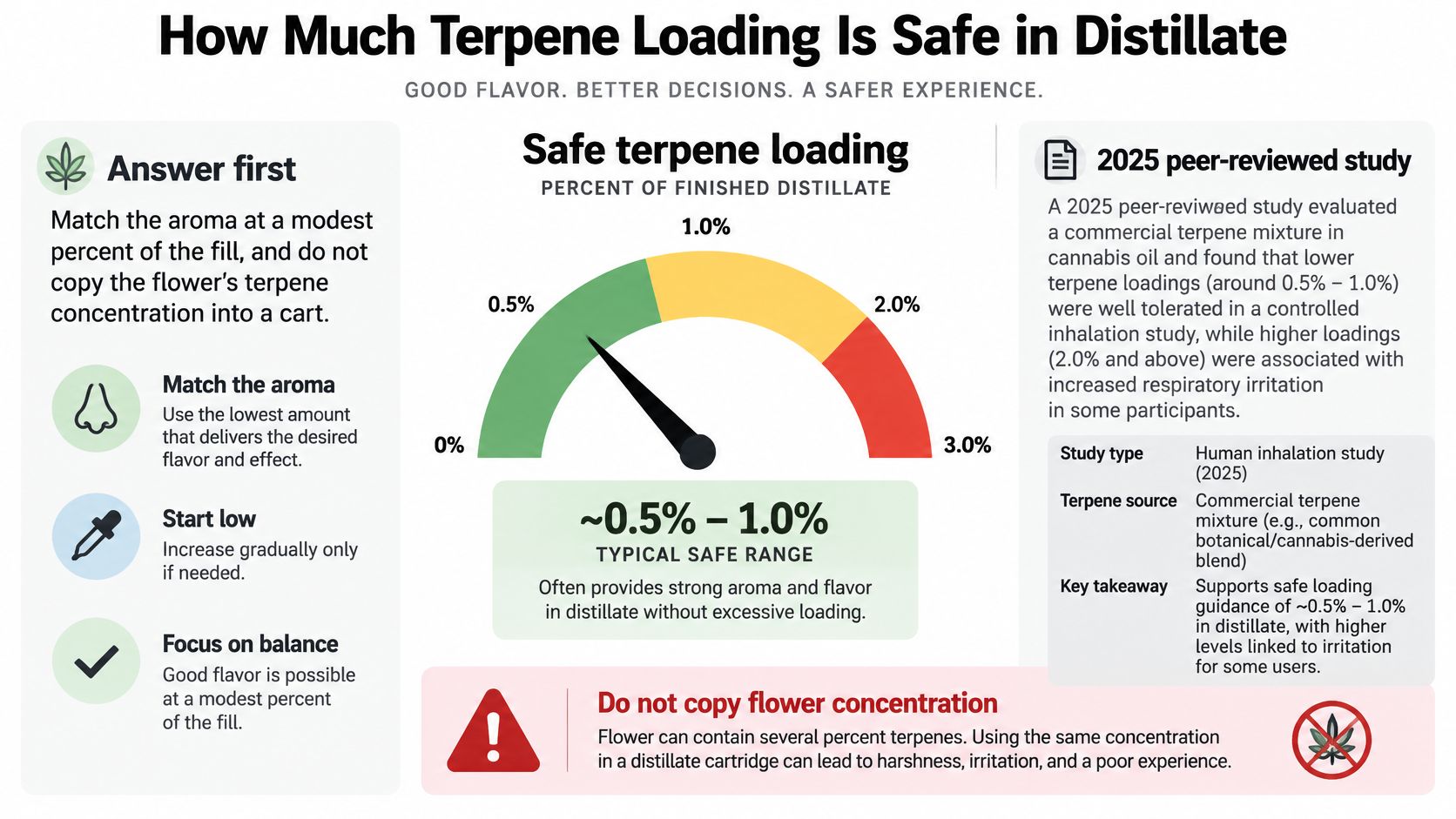
There is no universal terpene loading percentage established as safe for every distillate and cartridge. A 4–8% by-weight band and a 5% first pilot can serve as formulation examples, not as toxicological clearance. Keep those values distinct from the flavor target: Cannalope Haze is a batch-anchored sensory profile, not a guarantee of flower potency or cartridge effects.
The visual below summarizes loading considerations. Its use of “safe” does not establish a universally safe concentration.
Separate an experimental dose from a legal ceiling
A 2025 peer-reviewed study in ACS ES&T Air found that adding a commercial terpene mixture at 7.5% and 15% by mass to delta-8 and delta-10 THC distillates increased carbonyl emissions by as much as ninefold. The authors attributed the increase to terpene oxidation. A stronger aroma, therefore, is not automatically a better formulation.
The findings apply to the mixtures and operating conditions tested. They do not establish a safe threshold for every delta-9 product or show that lower loading is harmless. Treat any pilot range as a development input, then assess the finished product and its operating conditions.
The section's regulatory summary does not identify an official New York document that supports its specific ceiling and variance figures, so those numbers should not guide release decisions. Check the current official requirements for the relevant market and document the applicable limit before production.
Release control: A legal maximum is a compliance boundary, not a recommended dose or an inhalation-safety guarantee.
Control oxidation and hardware together
Limit unnecessary heat exposure, repeated opening, and oxygen-containing headspace. Use compatible, tightly closed containers and controlled storage. Increasing the terpene fraction to restore a faded top note can change the formulation without addressing storage-related aroma loss.
Gold Coast Terpenes describes its blends as free of VG, PG, PEG, and MCT. That ingredient information does not establish the safety of the finished aerosol.
Record the hardware model, operating settings, oil handling, and sensory changes during development. The distillate loading guide can help with dose calculations, while analytical and emissions testing should address the actual finished system.
Keep flavor claims sensory. Descriptions such as energetic or focused do not provide controlled clinical evidence for a reconstructed cartridge.
How to Formulate the Blend into a Cartridge
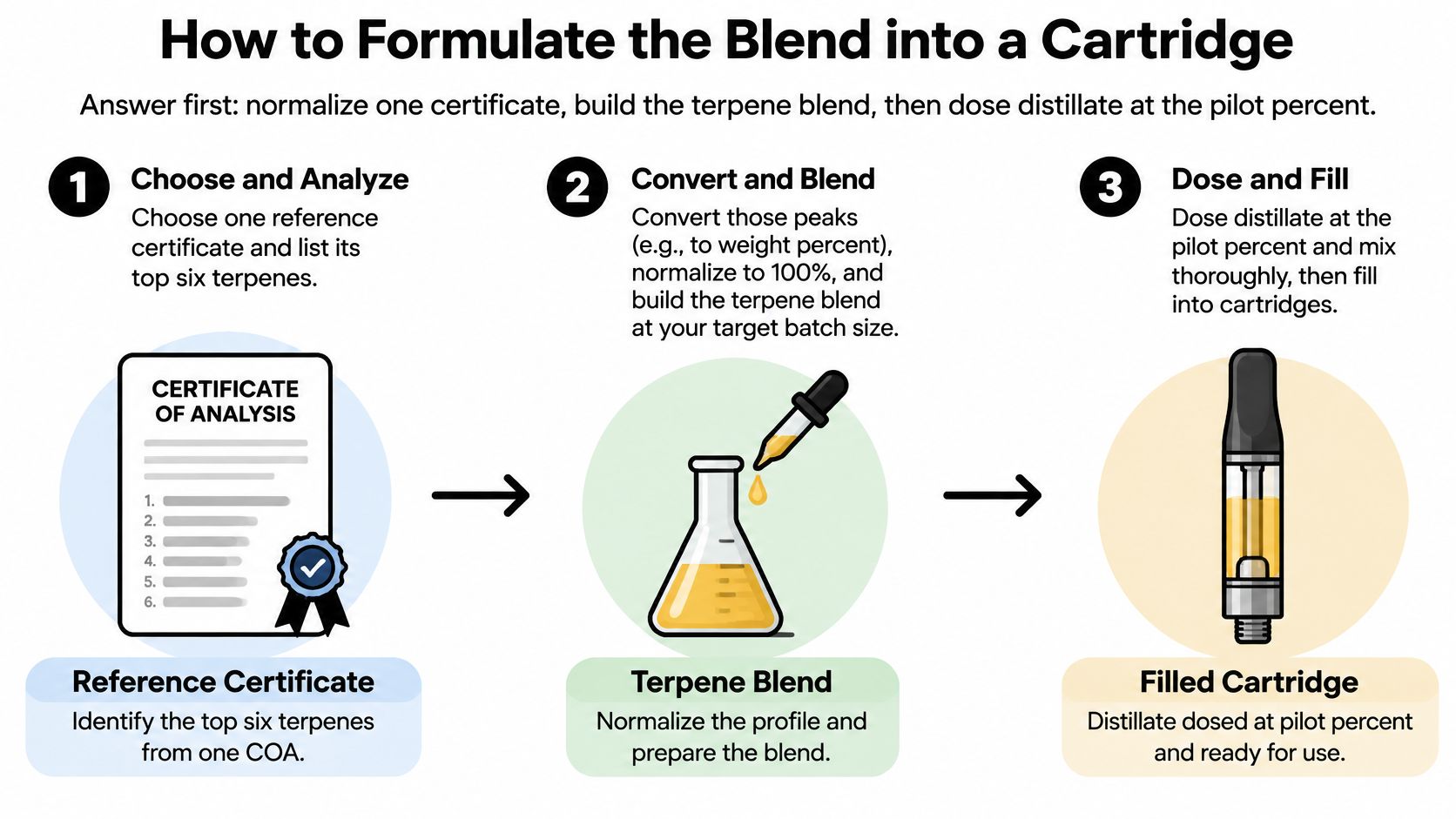
Normalize a selected certificate, prepare the aroma blend, and then calculate its addition to the finished oil by mass. Keep aroma-concentrate composition and cartridge loading in separate worksheet fields so an operator can't confuse them.
Use this workflow as a process outline, with the written batch record controlling the actual work.
Build the pilot with a control at every step
Choose the reference certificate. Identify the leading six reported terpenes as a practical worksheet starting point, and retain the full panel. The failure point is selecting only convenient peaks while ignoring an important measured compound.
Normalize the aroma measurements. Divide each selected terpene concentration by the selected-terpene subtotal to calculate its share of that reduced reconstruction. If you normalize to the full measured total instead, preserve the unrepresented remainder rather than assigning it to a favorite ingredient.
Prepare the aroma concentrate. Start with a citrus-forward strain-inspired base only if its certificate is compatible with the target. Trim the pine, fruit-herbal, or orange layer individually, and record every addition by mass.
Calculate the finished-fill dose. For a hypothetical 5% pilot, a 100 g finished batch contains 5 g terpene blend and 95 g base oil, assuming the base contributes no terpenes. Use the Gold Coast Terpenes mixing calculator with the terpene formulation resource to check the calculation, and include native terpenes when calculating total loading.
Mix and assess compatibility. Use controlled handling appropriate to the base oil and ingredient documentation, then inspect homogeneity and record viscosity. Don't assume a winterized distillate is ready for filling without checking its certificate and process history.
Fill test cartridges and compare delivery. In a hypothetical evaluation, compare the first puff with the third under the same operating protocol. A matching bottle aroma with a harsh or hollow aerosol isn't an acceptable flavor match.
Retain and review the pilot. File the oil certificate, terpene lot identifiers, ingredient masses, hardware details, and a retained cartridge. A hypothetical 30-day odor check is a useful development checkpoint, but it isn't a validated shelf-life study.
Change one variable before repeating
If the opening is too pine-heavy, adjust the pine fraction while holding total loading and hardware constant. If the cartridge loses body, assess the middle layer before adding more concentrate.
Botanical versus cannabis-derived sourcing remains a material-selection decision at this stage. Both need a finished-product acceptance specification, and neither permits bypassing the strictest applicable inhaled-product limit.
- Approve flavor deliberately: Stop when the defined melon, citrus, herbal, and pepper balance matches the chosen reference.
- Approve production separately: Release only after the required analytical, compatibility, compliance, and stability work.
- Reject identity shortcuts: Don't strengthen a product name to compensate for a weak sensory match.
What Should Buyers Ask Before Ordering a Cannalope Haze Blend
Set the purchase specification around a defined flavor target, batch reference, and qualification plan. A strain name alone cannot establish the blend's aroma, composition, or finished-product performance.
Should the blend be botanical or cannabis-derived?
Specify the source and ingredient-origin requirements for the SKU, then request a certificate for the proposed blend. Gold Coast Terpenes offers 100% natural, THC-free terpene blends; assess the chosen product against your formulation and documentation requirements.
What percentage should go into distillate?
Set the pilot dose using the formulation guidance and qualification criteria established earlier in development. Record the terpene amount by weight, check the applicable inhaled-product limit, and qualify the finished oil and hardware before release.
Can one jar match every Cannalope Haze lot?
Use a chosen batch or documented sensory reference as the target. Ask the supplier for lot-specific documentation and define how deviations will be assessed; the strain name alone does not specify a consistent chemical profile.
What are the minimums and wholesale terms?
Confirm the minimum order and quote before purchasing. Gold Coast Terpenes allows multiple strains in bulk orders and offers wholesale pricing on strain orders totaling over 64oz. Its 50+ strains span Indica, Sativa, and Hybrid categories; request product-specific information for the Cannalope-inspired target.
What should the label say?
Describe the product as a strain-inspired blend when that accurately reflects its ingredients and origin. Record added terpenes by weight, follow the market’s required label declarations, and avoid claims of flower identity, medical benefit, or guaranteed effects.
For a catalog reference, Elevated Strains leads to an Apple Fritter flavor page, not a documented Cannalope Haze match. Treat catalog comparisons as exploratory, and keep the approved sensory reference and purchasing specification tied to the selected batch.
Gold Coast Terpenes offers terpene blends, isolated compounds, and formulation tools for developers creating batch-anchored flavor profiles. Use its mixing calculator to plan comparisons, and consider a small multi-strain order before committing to bulk. Approve the Cannalope Haze-inspired SKU only after the retained-cartridge check and required finished-product qualification.