
One published Wedding Cake live-sauce profile lists β-caryophyllene at 4.26%, with humulene, limonene, myrcene, and linalool far behind, according to the Raw Garden Wedding Cake product page. Another lot sold under the same name may show a different leading compound, so the cultivar name alone cannot define a reliable terpene recipe.
Gold Coast Terpenes offers strain-specific terpene profiles and isolated compounds for formulation. Treat Wedding Cookies as a sensory hierarchy to specify and test, then lock the target by lot. That approach accounts for conflicting lab fingerprints instead of assuming one stable profile.
How Should a Wedding Cookies Terpene Profile for Formulating Be Specified?
A usable Wedding Cookies specification names the sensory target, alias, blend hierarchy, total loading, source type, and lot documentation. The strain name alone leaves too much room for variation in purchasing, label review, and scale-up. Treat it as a product direction, then define the measurable profile that suppliers and production teams can match.
Gold Coast Terpenes offers THC-free terpene blends made without VG, PG, PEG, or MCT. State the source and carrier basis in the product brief before bench formulation begins. If the source changes, review the assay, labeling path, and cost model against the revised specification.
Three names, one sensory idea
The profile may appear under Wedding Cake, Pink Cookies, and Triangle Mints #23. Record the aliases used by your team and suppliers, then map them to one internal target. That prevents quotes for different materials from being treated as like-for-like because their names sound related.
Record the lineage as well, so the brief makes clear which reference material informs the formulation. The strain was widely believed to descend from Girl Scout Cookies and Cherry Pie. Breeder JBeezy of Seed Junky Genetics identified it as phenotype #23 of Triangle Mints, which traces to Triangle Kush crossed with Animal Mints, according to the Leafly Wedding Cake strain page. The phenotype took the Wedding Cake name from its creamy, vanilla-like dessert aroma. If your reference follows the Triangle Mints account, don't base the formula on the older lineage story.
Practical rule: Put the breeder lineage, phenotype number, and aliases on the first page of the brief. Purchasing needs a clear mapping before comparing quotes or COAs.
What the spec sheet must carry
Wedding Cake has broad market recognition. In Leafly's 2019 Strain of the Year coverage, Leafly reported that it appeared on more than 10,000 store menus across legal markets and held the platform's most-visited strain-page position from 2021 through 2023. Leafly named it Strain of the Year in December 2019 and reported average THC near 21%, with limonene, beta-caryophyllene, and myrcene as typical terpene markers. Those markers are useful orientation, not a fixed recipe for a terpene blend.
For a strain-inspired blend intended for distillate or vape cartridges, specify the target in operational terms:
- Alias list: Wedding Cookies, Wedding Cake, Pink Cookies, and Triangle Mints #23, mapped to one internal SKU target.
- Target hierarchy: Name the lead compound, the supporting compounds, and which minor notes are required or optional. This turns a sensory direction into a profile that can be checked against the lot COA.
- Total terpene loading: State the target range in the finished oil separately from the undiluted blend ratio. Mixing those values makes the specification ambiguous at the bench.
- Source declaration: Identify botanical or cannabis-derived terpenes, using the wording intended for label review.
- Lot documentation: Identify the lot number and governing COA, along with the retain and retest rules for acceptance.
Leave consumer-reported effect percentages out of the formulation brief. They describe reviewer impressions, not controlled formulation data, and do not set a blend target. Indica, sativa, and hybrid labels also don't reliably predict chemistry. Brand teams can track market demand, while formulation decisions should follow the measured panel and the intended sensory hierarchy.
Add a rejection rule before placing a volume order. Define which shift in the lead compounds fails acceptance, such as pepper notes leading when the target calls for a myrcene-led dessert profile. Specify whether a missing minor terpene is a failure or a documented deviation. A clear rule gives purchasing and quality teams the same basis for accepting or rejecting a lot.
Why Can Published Wedding Cake Lab Results Not Be Averaged?
Published Wedding Cake panels describe different materials and use different denominators. A strain name points to a sensory family, not one stable terpene recipe. Choose a reference hierarchy for the material you are formulating, and record its measurement basis before comparing lots.
Wedding Cake lab fingerprints formulators see
| Reference | Lead compound | Next compounds | Other measured notes | How to read the number |
|---|---|---|---|---|
| Rosin-infused material report | beta-caryophyllene 0.728% | delta-limonene 0.239%; beta-myrcene 0.201% | alpha-humulene 0.182%; linalool 0.124%; fenchol; alpha-terpineol; alpha-pinene; alpha-bisabolol | Percent by mass of the material, as reported in the Grow Sciences Wedding Cake rosin-infused pre-roll laboratory report |
| Live-sauce profile | beta-caryophyllene 4.26% | alpha-humulene 1.59%; limonene 1.24% | myrcene 0.93%; linalool 0.642%; beta-pinene; fenchol; terpineol; geraniol; borneol | Concentrate-style profile; use its reported basis when comparing values |
| Terpene-fraction COA | myrcene 35.19% of the fraction | limonene 11.22%; cis-nerolidol 3.15% | beta-pinene 2.73%; terpinolene 1.14%; linalool 0.56% | Share of the terpene fraction; total quantified terpenes 73.49%, as reported in the Wedding Cake strain terpene profile resource |
Averaging creates a profile no lot ever had
Before comparing panels, normalize each one to a common basis. For a whole-material result, divide each reported terpene value by the total material mass represented by that result. For a fraction result, retain the fraction denominator and compare its compound shares only with other fraction-based results. If a report does not give enough information to convert its values, keep it separate rather than estimating a conversion.
Averaging a rosin material panel, a concentrate panel, and a terpene-fraction panel can produce a lead compound that none of the references supports. That synthetic average can also set acceptance limits that reject suitable lots or pass lots with the wrong sensory hierarchy.
Compare the order and balance of compounds within each panel. Caryophyllene-forward references emphasize pepper and wood; the cited fraction reference is myrcene-led, with herbal and fruity character. Citrus appears as a supporting note in these patterns. A limonene-led blend therefore shifts the intended sensory direction rather than reconciling the two fingerprints.
A strain name can point to a flavor family. It cannot specify the denominator for QC.
How to use conflicting panels at the bench
Match the reference to the product format, then hold that basis consistent through formulation and lot review. For a cart intended to resemble a rich concentrate profile, use the live-sauce hierarchy as the sensory reference. For a terpene fraction intended for dilution, use the fraction COA to guide internal proportions.
Keep minor compounds only when they support the target lot. Fenchol, terpineol, pinene, bisabolol, geraniol, and borneol occur in some of these profiles, but including every trace note can add cost and pull the blend away from its target. Recheck the finished material after winterization, heat exposure, oxygen contact, and storage, because volatile balance can shift during processing.
What Strain-Inspired Terpene Blend Ratios Should Formulators Start With?
A useful starting point is a 100-part terpene fraction with explicit values for each compound. The two profiles below are working targets, not a single recipe dictated by the Wedding Cookies name. Use the crust-led framework for pepper-forward references and the cake-led framework for the myrcene-forward terpene fraction reported by Fern Valley Farms.
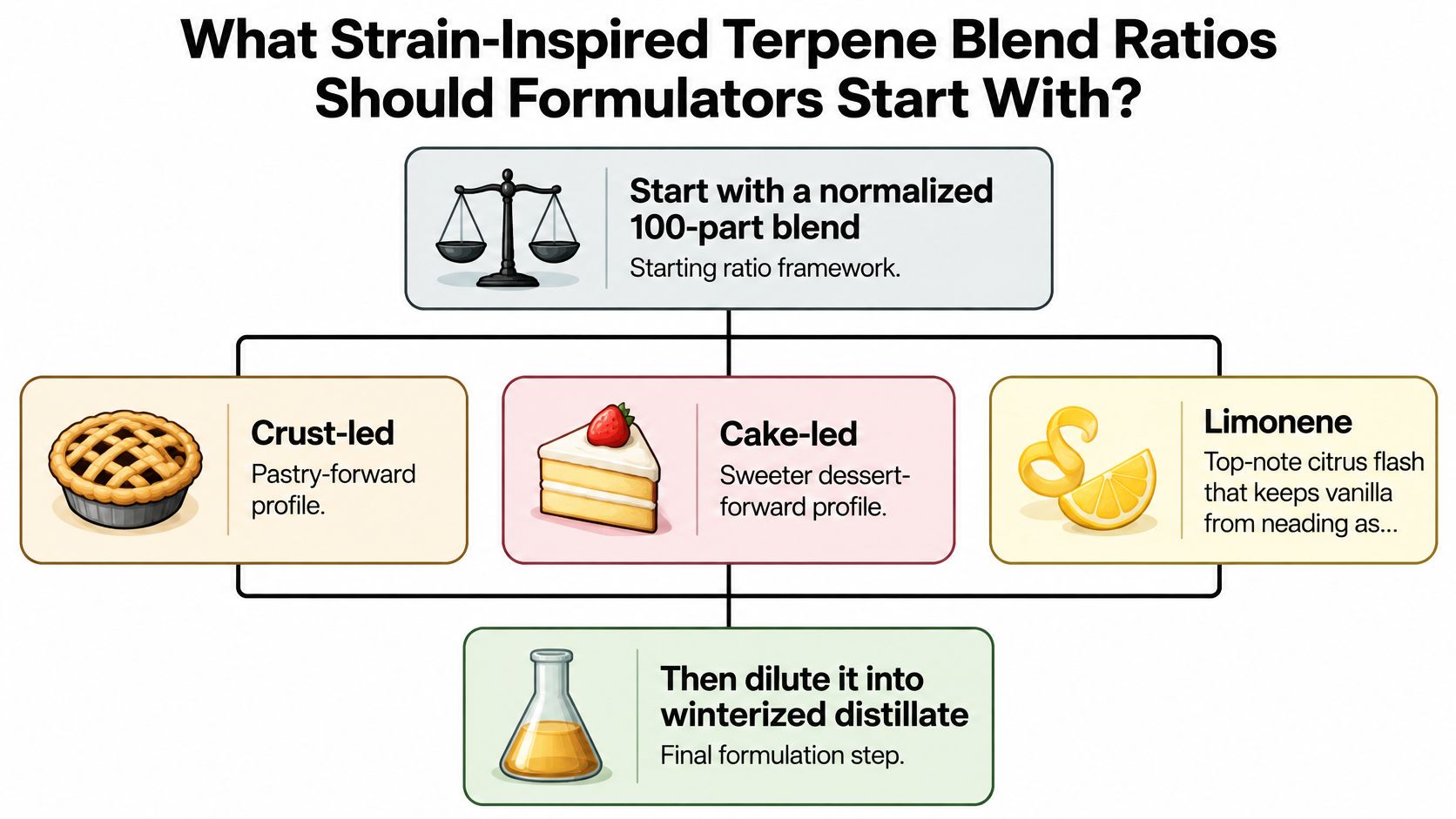
Normalized Wedding Cookies starting fractions, parts per 100
| Compound | Crust-led starting point | Cake-led starting point |
|---|---|---|
| Limonene | 12 | 11 |
| Myrcene | 25 | 35 |
| Beta-caryophyllene | 30 | 20 |
| Linalool | 10 | 8 |
| Humulene | 8 | 6 |
| Other supporting compounds | 15 | 20 |
| Total | 100 | 100 |
The cake-led myrcene and limonene values follow the Wedding Cake terpene COA from Fern Valley Farms, which reports myrcene at 35.19% of the terpene fraction and limonene at 11.22%. The remaining cake-led values are practical starting allocations, not COA measurements. The crust-led values are also a working formulation framework, rather than a specific COA profile. The diagram shows the two patterns; the table makes them testable at the bench.
These are terpene-fraction proportions, not flower percentages or finished-oil loading. Set the final loading separately according to the hardware, oil viscosity, and safety review. The COA's total quantified terpenes were 73.49%, so its reported composition should not be mistaken for a complete 100-part recipe.
Set each layer by its function
Limonene provides the initial citrus note and can keep vanilla-style sweetness from tasting flat. Too much can make the first inhale sharp. Pinene is optional because it appears in some lots, and adding it without a target can shift the blend toward pine.
Myrcene forms the herbal-fruity middle. Linalool, fenchol, and terpineol can support that layer with floral spice, but too much of them can make the profile read as floral rather than dessert-like.
Beta-caryophyllene supplies the peppery base. Humulene adds hop character and bitterness, so keep it in proportion to the softer notes. Cis-nerolidol or bisabolol can contribute to a woody finish when those compounds appear in the chosen reference.
The practical check is whether the citrus, middle, and base remain in balance after mixing. If limonene dominates the first inhale, reduce it. If the finish turns mostly pepper and wood, reassess the base rather than adding more sweet or floral notes by default.
The short video below can help when comparing how a small ratio adjustment affects mixing.
Verification order
- Choose the target: Select crust-led or cake-led and record the COA or profile it follows.
- Mix the fraction: Set the selected compounds to 100 parts and check the arithmetic with the mixing ratios calculator.
- Dilute to the approved loading: Keep the terpene fraction separate from the finished-oil loading decision.
- Record the oil COA: Check whether the intended hierarchy remains after mixing and storage.
- Test in the intended cartridge: Confirm the sensory result in the actual device.
- Adjust one layer at a time: Change the note that is out of balance, then retest.
How Heat Strips a Wedding Cookies Cart
After a cart heats, the aroma can shift from cake-like to peppery and woody as volatile terpenes leave the oil faster than cannabinoids. Formulators should treat Wedding Cookies as a sensory hierarchy that can change in the device, not a fixed recipe guaranteed by the strain name.
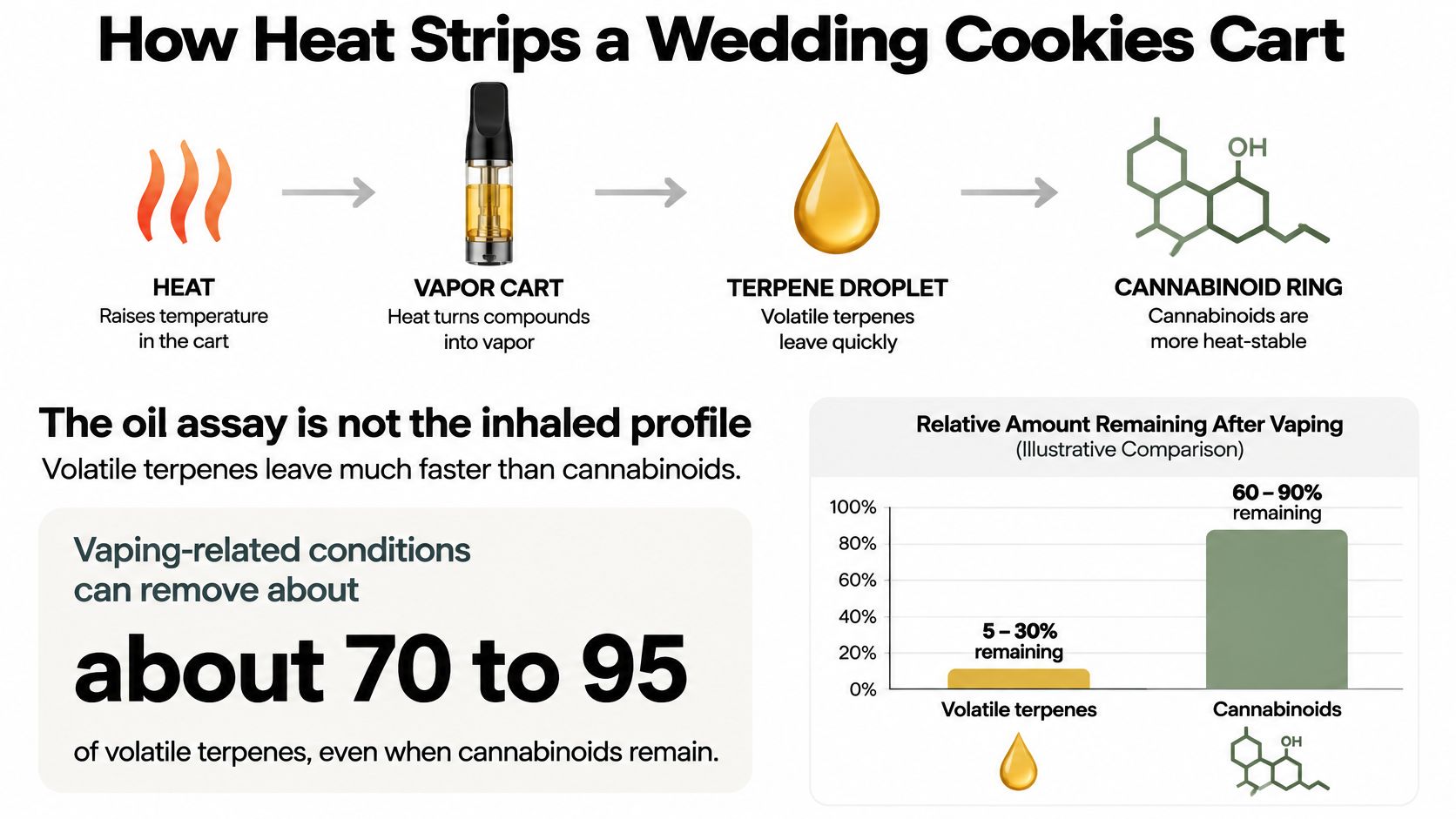
A peer-reviewed review of terpene vaporization reports losses of approximately 70 to 95% for volatile terpenes under vaping-related conditions. At 180°C, estimated vaporization rates relative to THC were about 23 times higher for bisabolol, 380 times higher for β-caryophyllene, 2,200 times higher for linalool, and more than 3,500 times higher for β-myrcene, according to the same review.
Relative vaporization versus THC at 180°C
| Compound | Estimated rate versus THC | Role in this profile | Formulation consequence |
|---|---|---|---|
| beta-myrcene | more than 3,500 times | Herbal-fruity mid | Most likely to vanish from the aerosol |
| linalool | about 2,200 times | Floral softness | Cream note collapses if it is the only floral |
| beta-caryophyllene | about 380 times | Pepper base | More likely to remain and dominate the puff |
| bisabolol | about 23 times | Woody floral base | Most persistent comparator in this set |
| Volatile terpenes as a class | about 70 to 95% loss under vaping-related conditions | Whole aroma | Oil assay cannot be the label target |
Which Wedding Cookies notes go first
Myrcene and linalool can carry much of the creamy, floral middle, but their volatility makes that layer vulnerable during heating. Caryophyllene is also volatile, though much less so in this comparison, leaving pepper more likely to dominate the puff. Bisabolol is the most persistent compound in this set and can help the finish hold.
Adding limonene to replace a missing middle risks producing sharp citrus up front, followed by pepper, without the cake-like body between them. Reinforce the missing middle with compounds that support it, then check whether the device temperature is stripping them faster than the wick can deliver fresh oil. A terpene boiling point guide can help compare which layers are more vulnerable to heat.
The carbonyl check belongs in the same workflow
Flavor survival is only one heat concern. A University of California study submitted to California regulators found increased carbonyl formation when cannabis terpenes were heated in aerosol systems, with increases reported as high as ninefold under tested conditions. A flavor-accurate blend is not automatically suitable for aerosol use.
Set device power and temperature first. Then assess the aerosol by trapping it or conducting a sensory check, compare the result with the oil COA, and quantify degradation where the lab panel allows. Adjust top, middle, and base notes according to the aerosol result. If the hardware is driving the change, revise operating parameters before scale-up.
Bench warning: Tasting unheated oil does not tell you how the product performs in a cart.
How Should a Vape Brand Choose a Botanical or Cannabis-Derived Terpene Source?
Choose the source against the product's assay, flavor target, and supply requirements. Cannabis-derived fractions can affect the cannabinoid assay and regulatory path. Botanical blends provide a way to add aroma without contributing cannabinoids, which can suit a distillate or cartridge program with a set cannabinoid profile.
Gold Coast Terpenes offers THC-free terpene blends without VG, PG, PEG, or MCT, alongside over 50 strains across Indica, Sativa, and Hybrid categories. For any supplier, request the lot documentation and confirm the blend's composition before adding it to a formulation. Heated-device testing still matters because the aerosol profile can differ from the oil's aroma.
Botanical blend vs cannabis-derived fraction for a vape spec
| Factor | Botanical blend (Gold Coast Terpenes) | Cannabis-derived fraction |
|---|---|---|
| Source | Botanical, THC-free | Cannabis-derived |
| Carrier additives | No VG, PG, PEG, or MCT | Confirm each additive on the supplier spec sheet |
| Effect on cannabinoid assay | No cannabinoid contribution | Can move the cannabinoid assay |
| Wholesale price break | Strain orders over 64 oz | Confirm the price break in the written quote |
| Lot documentation | Request the lot COA | Require a lot COA before comparing price |
Compare documents, not adjectives
Request the same documents from each supplier before comparing quotes: source declaration, full ingredient statement, lot COA, safety documents, and approved label language. If a document omits a field, ask for the detail in writing before accepting the blend into the specification.
Label the source accurately as botanical, nature-identical, or cannabis-derived, according to the actual inputs and jurisdiction. Include total terpene loading and the lot number linked to its COA. If Wedding Cookies appears on the front panel, keep the supporting source and lot records tied to that product.
Source also shapes flavor-matching control. A botanical strain-inspired blend can be adjusted isolate by isolate when a formulation needs more crust or less citrus. A cannabis-derived fraction arrives with its own terpene hierarchy, so the practical controls are loading level and blending with other lots. Neither source guarantees a particular Wedding Cookies fingerprint. The better fit is the one that supports the assay, label, and supply plan consistently.
Use the CDT vs BDT comparison guide to compare the source options before issuing a purchase order. Confirm volume only after the bench ratio passes aerosol review. Wholesale pricing is available on strain orders totaling over 64 oz, but a larger order will not correct a blend whose sensory hierarchy misses the target.
Catalog breadth can help when developing a dessert line rather than a single SKU. Gold Coast Terpenes offers over 50 strains from Indica, Sativa, and Hybrid categories, including Strains made by the Master Terpologists to bring out fruity and flavorful nuances. The flavor hybrid Elevated Strains page provides an example of a listing to review alongside documentation requests. Confirm MOQs, lead times, and bulk terms in writing for the specific blend you plan to scale.
What Should a Buyer Confirm Before Ordering a Wedding Cookies Terpene Run?
Before placing a volume order, get the commercial terms and product claims in writing. A clear purchase specification should identify the selected profile, order quantity, expected fulfillment timing, and any documentation supplied with the lot.
What minimum order quantity and lead time apply?
Ask for the minimum order quantity and estimated lead time for the exact strain profile and size you plan to buy. Do not assume terms carry over from another SKU. Gold Coast Terpenes offers bulk ordering for multiple strains, and wholesale pricing is available on strain orders totaling over 64oz. Confirm the applicable terms before scheduling production.
What claims can the blend support?
Keep product language tied to the terpene blend's sensory profile. A strain-inspired blend may be described by its flavor direction, but the strain name alone does not establish potency, medical outcomes, or the composition of another producer's flower. Match each claim to the product documentation and the evidence your finished product can support.
Which label language should be approved?
Review the ingredient declaration and strain wording before artwork is finalized. Confirm that the label accurately describes the terpene product and does not imply that a strain name guarantees a particular effect or cannabinoid content. Gold Coast Terpenes offers 50+ strains of terpenes from Indica, Sativa and Hybrid categories, so identify the specific profile on the order and keep its product records with the label approval.
Use a short written checklist: profile and quantity, minimum order and lead time, available lot documentation, and approved label wording. This keeps purchasing details distinct from formulation decisions and reduces ambiguity when the same product is reordered.
Gold Coast Terpenes offers terpene blends for formulators developing distillate and cartridge products. Buyers can review its strain catalog and confirm ordering terms for the specific product directly at Gold Coast Terpenes.