
The most popular shortcut for a Durban Skunk-inspired blend is also the least reliable: copying a strain name and choosing one dominant terpene won't reproduce a batch. Gold Coast Terpenes offers over 50 terpene profiles across Indica, Sativa, and Hybrid categories, but a product name still can't replace a batch-specific chemical specification.
For vape, extract, and product developers, the workable target is a measured fingerprint: nine terpene analytes, a separate sulfur control, and acceptance limits verified after filling. Keep every target percentage blank until it's taken from the certificate of analysis (COA) for the reference batch. That's how you build a reproducible terpene profile for a Durban Skunk strain-inspired blend without implying that the name proves a fixed chemotype.
Which Terpenes Define a Durban Skunk Profile for Formulation
A useful Durban Skunk formulation target is a measured ratio of nine terpenes, not a universal cultivar recipe. Set the target percentages from one reference batch's COA, then verify the finished blend against that fingerprint.
| Role | Compounds to Measure | Aroma Direction | COA target |
|---|---|---|---|
| Top notes | Limonene, alpha-pinene, beta-pinene, terpinolene | Citrus and pine lift | Copy each compound's measured percentage from the reference-batch COA. |
| Mid notes | Linalool, beta-caryophyllene | Floral and spicy body | Copy each compound's measured percentage from the reference-batch COA. |
| Base notes | Beta-myrcene, alpha-humulene, caryophyllene oxide | Earthy, herbal depth | Copy each compound's measured percentage from the reference-batch COA. |
| Sulfur accent, separate control | 3-methyl-2-butene-1-thiol (321MBT) | Skunky character | Record separately; set a target only if an approved trial establishes one. |
| Specification fields | Total terpene concentration; dominant percentages; minor presence; batch number; GC-MS or GC-FID | Verification before blending | Record every field for the reference and source batches. |
The COA column is intentionally blank of made-up numbers. Fill it only with measured values from the reference batch, including total terpene concentration, dominant-terpene percentages, minor-terpene presence, batch number, and the GC-MS or GC-FID verification method. A strain label isn't a substitute for those fields. Cannabis strain names can fail to predict chemistry, and terpene-only principal-component analysis has separated samples into clusters with beta-myrcene, gamma-terpinene, or limonene as the dominant marker, as described in published cannabis chemovar research.
Build the terpene chord by note
Use the top notes to shape the first impression. Limonene, alpha-pinene, beta-pinene, and terpinolene give the blend its citrus-and-pine lift; they're also the notes most likely to shift during handling because lighter aromatics can dissipate quickly. Don't raise one top-note isolate just to make the sample smell stronger at first sniff. A sharp opening can overpower the reference rather than match it.
Linalool and beta-caryophyllene form the middle of the chord, adding floral and spicy body. Beta-myrcene, alpha-humulene, and caryophyllene oxide give the base its earthy, herbal finish. The practical objective is to match the measured relationship among all nine analytes, not to make every note equally prominent. In a large flower dataset, nine terpenes explained 86% of observed terpene-profile variation, supporting a multi-analyte target instead of a single-isolate shortcut (cannabis profiling research).
Keep the sulfur accent on its own line
A terpene blend can match citrus, pine, floral, and herbal notes and still miss the skunky character. Research using two-dimensional gas chromatography and sulfur chemiluminescence identified 3-methyl-2-butene-1-thiol, or 321MBT, as the primary odorant associated with cannabis's characteristic skunky aroma. It's a prenylated volatile sulfur compound, so don't fold it into the terpene ratio or assume a terpene-only profile can recreate it (sulfur-odorant research).
Keep 321MBT as a separate control, and evaluate it only in a distinct trial where its use is legal and toxicologically appropriate. The same research found that these sulfur compounds rise substantially during the final weeks of flowering, peak during curing, and decline after approximately one week of storage. Record the age and curing conditions of any flower reference; otherwise, a difference in sample history can be mistaken for a formulation error.
What the Durban Skunk Name Guarantees in a Formulation Brief
The name guarantees no fixed chemotype, so it can't set your terpene percentages or prove a finished product matches a particular flower. Early selected Durban material could finish in roughly 60 days, while many equatorial sativas were associated with flowering periods exceeding 100 days, a commercially meaningful difference of about 40 days or more (Durban genetics history).
That flowering profile helps explain why Durban genetics became useful to breeders. But the history doesn't turn the name into a chemical specification. Durban Skunk is commonly discussed in relation to Durban Poison, a South African landrace associated with Durban and the wider KwaZulu-Natal region. Accounts describe South African seed material reaching the United States in the 1970s, followed by selection and stabilization; improved genetics had entered the Dutch seed trade by the mid-1980s. The historical record remains unsettled over which breeders handled each stage and whether modern lines all descend from one original population (the documented Durban Poison timeline).
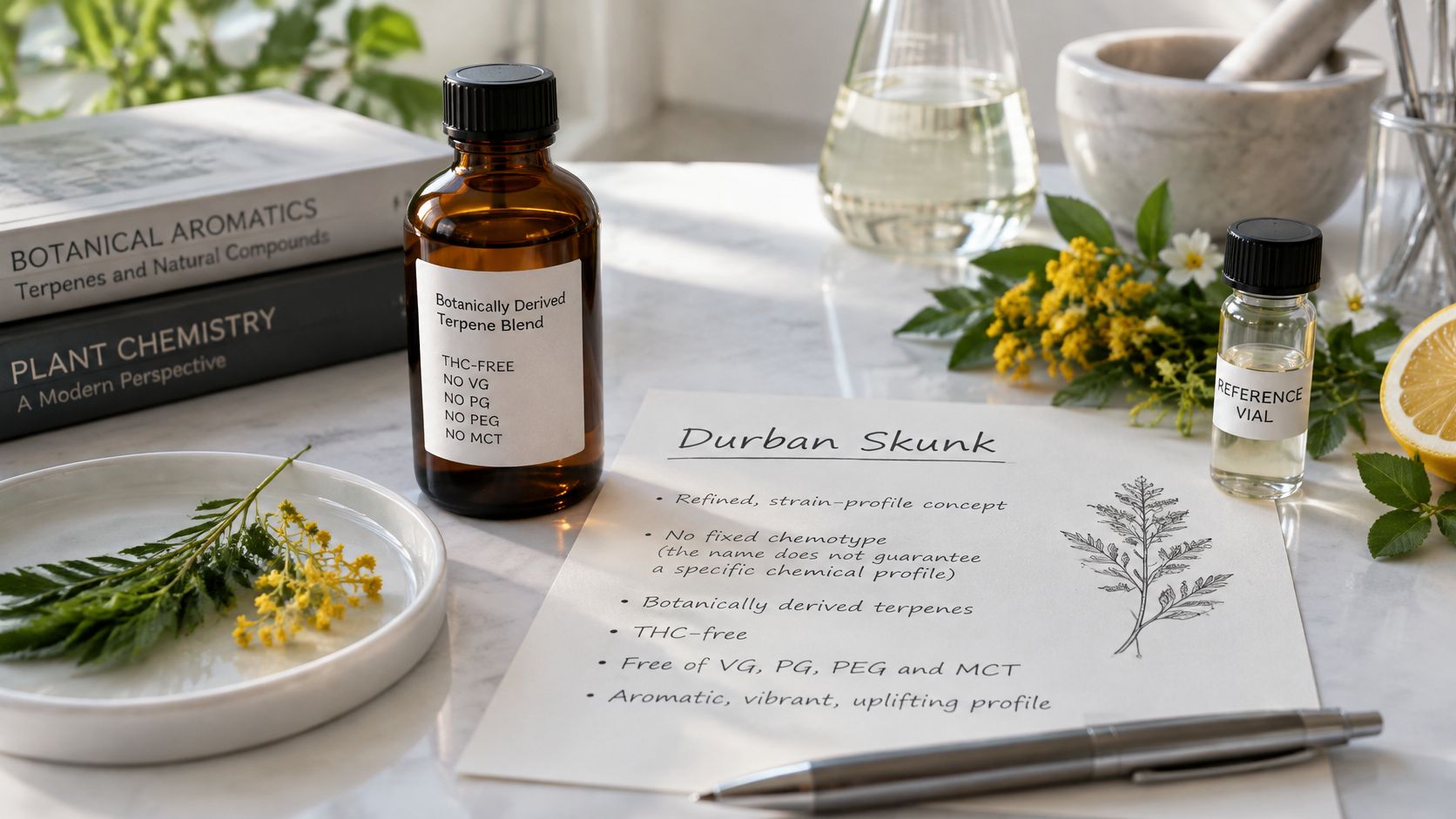
A contemporary product bearing the name might represent a selected, stabilized, or hybridized descendant, rather than an untouched landrace. Treat the label as a reference for the profile you want to investigate, not proof of a particular lineage or aroma ratio. For a starting reference, compare the available Durban profile with your own batch COA and sensory target.
If you're assessing a flavor-first accent alongside the Durban direction, Elevated Strains provides a separate product reference. Keep that comparison distinct from evidence about Durban genetics or the chemistry of a particular Durban Skunk batch.
Cartridge and Distillate Limits to Test Before Release
A cartridge can pass a liquid-blend check and still fail as an aerosol system. Set market-specific limits, then test the filled product in its intended hardware.
| Check | Reference value | Why it matters for a Durban Skunk blend |
|---|---|---|
| Total terpene ceiling for inhaled products in New York | 10% | Caps the blend load before formulation. |
| Permitted terpene variance in New York | 15% | Sets the stated batch-drift allowance for that rule. |
| Terpene additions in the UC Davis aerosol study | 0% and 7.5% | Shows that aerosol mass alone can't confirm flavor delivery. |
| Analytes to confirm by GC | Nine terpenes listed in the profile table | Anchors the blend to measured ratios. |
| COA for each source batch | Required on every lot | Preserves traceability for replication. |
New York's inhaled-product rules state a 10% total-terpene ceiling and a 15% permitted variance (New York rule coverage). Treat these as market-specific limits, not evidence that a formula will perform well. The UC Davis aerosol study tested terpene additions of 0% and 7.5% to THC distillate and found no significant effect on aerosol mass production (the UC Davis aerosol study). Output mass alone cannot confirm flavor delivery, thermal stability, or exposure. Pair output measurements with terpene recovery, coil-temperature testing, sensory evaluation, and degradation-product analysis.
Test the material, not just the recipe
Build a bill of materials that distinguishes the intended terpene blend from carriers, diluents, and hardware-derived contaminants. Analysis of cannabis vape-oil liquids and vapors identified more than 100 terpenes and natural extracts, 19 cannabinoids, and potential additives including vitamin E acetate, polyethylene glycols, and medium-chain triglycerides (analysis of cannabis vape-oil constituents). Use identity testing and contaminant screening to assess the actual formulation.
For each source lot, retain its COA and record the blend loading, viscosity, hardware, voltage or power range, and analytical acceptance criteria. Test both liquid and aerosol where applicable. Use a quality-control and testing resource to organize batch records, while basing release on the product's test results.
Release checklist
- Loading: Record the terpene percentage and calculation.
- Viscosity: Measure or document the target for the chosen cartridge system.
- Hardware and power: Identify the cartridge and voltage or power range used for evaluation.
- Materials: List all ingredients and specify prohibited diluents.
- Traceability: Retain batch numbers and source COAs.
- Post-fill testing: Re-test the filled product against defined acceptance criteria.
How to Build a Durban Skunk Strain Blend Step by Step
A Durban Skunk label does not supply a measured formula. Build the blend from a reference sample and its analytical data, then set release targets from results rather than from the strain name.
Collect and check the COAs. Obtain the reference sample's certificate and certificates for each terpene source. Match batch numbers and confirm the stated analytical method. Without useful chromatographic data for the reference, use it for sensory comparison only; it cannot establish analyte targets.
Set the nine-analyte profile from measurements. Record the measured shares for alpha-pinene, beta-pinene, beta-myrcene, limonene, terpinolene, linalool, beta-caryophyllene, alpha-humulene, and caryophyllene oxide. Group the results into top, mid, and base aroma notes to guide interpretation, not to fill gaps with guessed ratios. Leave the COA target fields blank until the blend has been measured.
Calculate the proposed terpene load. Set the trial amount against the applicable market requirements and your product specification. Keep any comparison test distinct from a production target; a test condition does not establish a generally suitable load.
Make a small trial with controlled handling. Weigh each component and record the addition order and handling conditions. Limit unnecessary heat and air exposure, since processing and storage can shift terpene and phytocannabinoid profiles.
Evaluate 321MBT separately. Treat it as a sulfur control, not one of the nine terpene analytes or a substitute for the strain profile. Assess it only after confirming suitability for the intended product, and record the reference sample's age and curing history.
Document the carrier or diluent. Use only the ingredient specified in the formulation and record its identity and amount. This keeps changes in aroma or viscosity traceable to the actual formulation.
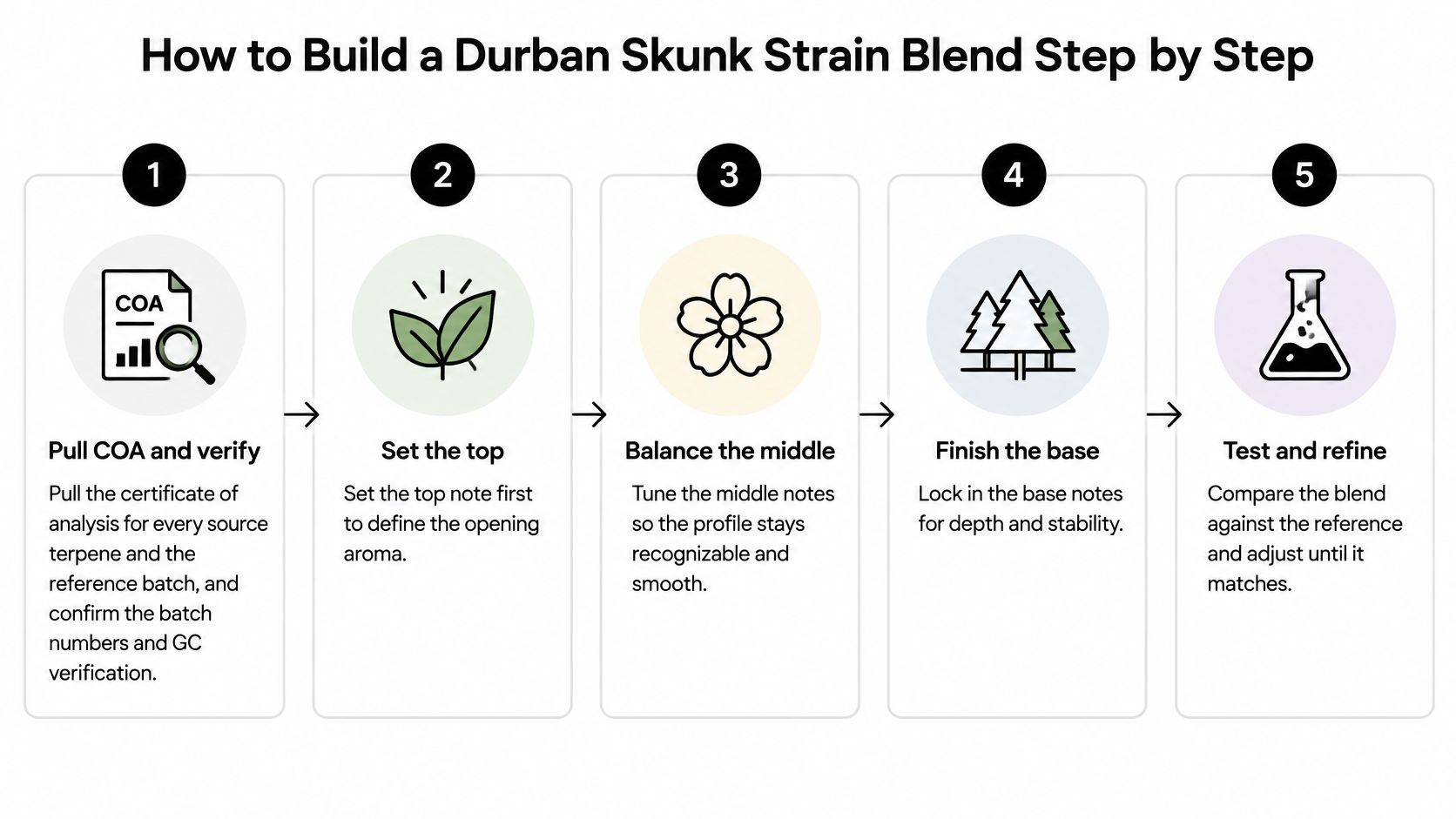
Profiling work supports using a measured set of analytes to describe a flower profile, while processing and storage can shift that profile. For the arithmetic, copy the nine measured shares from the reference COA and scale them to the chosen test load. The terpene-blend formulation resource can support the formulation workflow; leave each COA target blank until measurement establishes it.
How to Choose a Terpene Supplier for Vape Brands
For a Durban Skunk-inspired blend, the strain name is a starting label, not a chemical specification. Compare suppliers using lot documentation, ingredient statements, and testing that matches the intended cartridge or distillate application.
| Criterion | Botanical terpenes | Cannabis-derived terpenes |
|---|---|---|
| Plant source | Botanically derived, not cannabis-derived | Derived from cannabis flower or extract |
| Label wording | Botanical or nature-identical, as stated on the certificate | Cannabis-derived, as stated on the certificate |
| Evidence to request | Batch COA and identity test | Batch COA and identity test |
These categories describe different source materials. Check that the certificate and label identify the source accurately, and confirm that the wording complies with the rules for the finished inhaled product.
Apply the same checks to every quote
- Match each COA to its lot. The batch number on the certificate should match the material received.
- Check the nine-analyte panel. Confirm that it reports alpha-pinene, beta-pinene, beta-myrcene, limonene, terpinolene, linalool, beta-caryophyllene, alpha-humulene, and caryophyllene oxide. Leave target values blank until the reference and blend have been measured.
- Get ingredient statements in writing. Confirm whether the material is THC-free and identify any excluded carriers or diluents. Gold Coast Terpenes describes its terpenes as THC-free and free of VG, PG, PEG, and MCT; evaluate any formulation against its own lot documentation.
- Request application-specific testing. Ask for the applicable testing record and confirm that it supports the intended cartridge use. A general certificate does not establish suitability for every formulation.
- Compare the supplier's documents and terms. Review how batches are identified, what testing is supplied, and whether the available documentation supports your production requirements. A terpene supplier comparison guide can help organize that review.
Keep the bill of materials clear about the terpene blend, carriers, and any other additives. For vape oil, assess the liquid and aerosol where applicable, using identity records, concentration data, and contaminant screening.
What Must Still Match After Filling and Storage
A blend can match its target on paper and shift during filling or storage. Compare the finished cartridge with the reference using the same analytical method and sensory criteria.
Compare filled samples side by side
| Comparison point | Reference sample | Filled product |
|---|---|---|
| Analytical profile | Record the measured analytes and results. | Test the finished product using the same method and compare results against the documented acceptance ranges. |
| Aroma and flavor | Note the target's defining sensory characteristics. | Assess the filled product against those characteristics under consistent conditions. |
| Sample history | Record age and curing conditions. | Record filling and storage conditions so any change can be interpreted in context. |
Log source-material preparation, solvent choice, and storage time alongside the COA and mixing conditions. These details help explain differences between the reference and finished product. Test after filling and again after the storage interval that reflects actual distribution conditions.
Approve the lot only when its analytical results fall within the established ranges and its sensory profile meets the target. Keep the comparison and pass-or-fail decision in the release record.
Durban Skunk Formulation Questions Answered
A strain name cannot replace a release specification. For a Durban Skunk-inspired blend, keep the nine-analyte profile as the measured specification, with COA targets blank until the blend has been tested. Treat 321MBT as a separate sulfur control, not as an assumed part of the profile.
What belongs on the nine-analyte COA?
List each analyte, its measured concentration, the batch identifier, and the analytical method. Leave target fields blank until results establish values; the name “Durban Skunk” does not supply them.
How should 321MBT appear in the formulation record?
Keep it outside the nine-analyte blend specification and document it as a separate sulfur-control trial. Do not include it in a production formula unless the trial has cleared the applicable legal and toxicological review.
Does “botanical” mean cannabis-derived?
No. Record the source and the supplier's exact material description. Botanical, nature-identical, and cannabis-derived describe different things, so the wording alone does not establish origin or composition.
Gold Coast Terpenes offers strain-specific terpene profiles and isolated compounds for formulation. Compare product documentation with the analytes and batch requirements for your trial, then visit Gold Coast Terpenes to explore available options.