
A buyer has dropped a Tigers Blood flavor brief on your desk. The request sounds simple, sweet berry on top, creamy body in the middle, and a spicy OG-style finish, but there's no single cultivar specification you can trust as a production target. Gold Coast Terpenes, a supplier of 100% natural, THC-free terpene blends, gives formulators a botanical route to rebuild that sensory profile without tying every reorder to an inconsistent strain label.
For vape brands, extractors, and cannabis product developers, the useful question isn't “What is the one true Tigers Blood strain?” It's how do you reproduce the expected flavor in distillate, live resin, and cartridge hardware while keeping the batch record, labeling, and sensory target under control?
Why the Tigers Blood Strain Profile Matters in Formulation
The Tigers Blood strain profile matters because the name usually communicates a flavor expectation more reliably than it communicates fixed genetics. Buyers often expect a dessert-like opening associated with strawberry, watermelon, and coconut, followed by a kush-style earthy or peppery base. Weedmaps describes Tiger's Blood as an indica or indica-dominant OG Kush phenotype and connects the name with a shaved-ice flavor built around strawberry, watermelon, and coconut.
That creates a practical formulation problem. Fruit-forward top notes can become muted after dilution, while heavier spicy and earthy notes can dominate the finish. A distillate cart needs both layers to remain legible, but the terpene blend also has to suit the oil's viscosity, hardware, heating profile, and regulatory requirements.
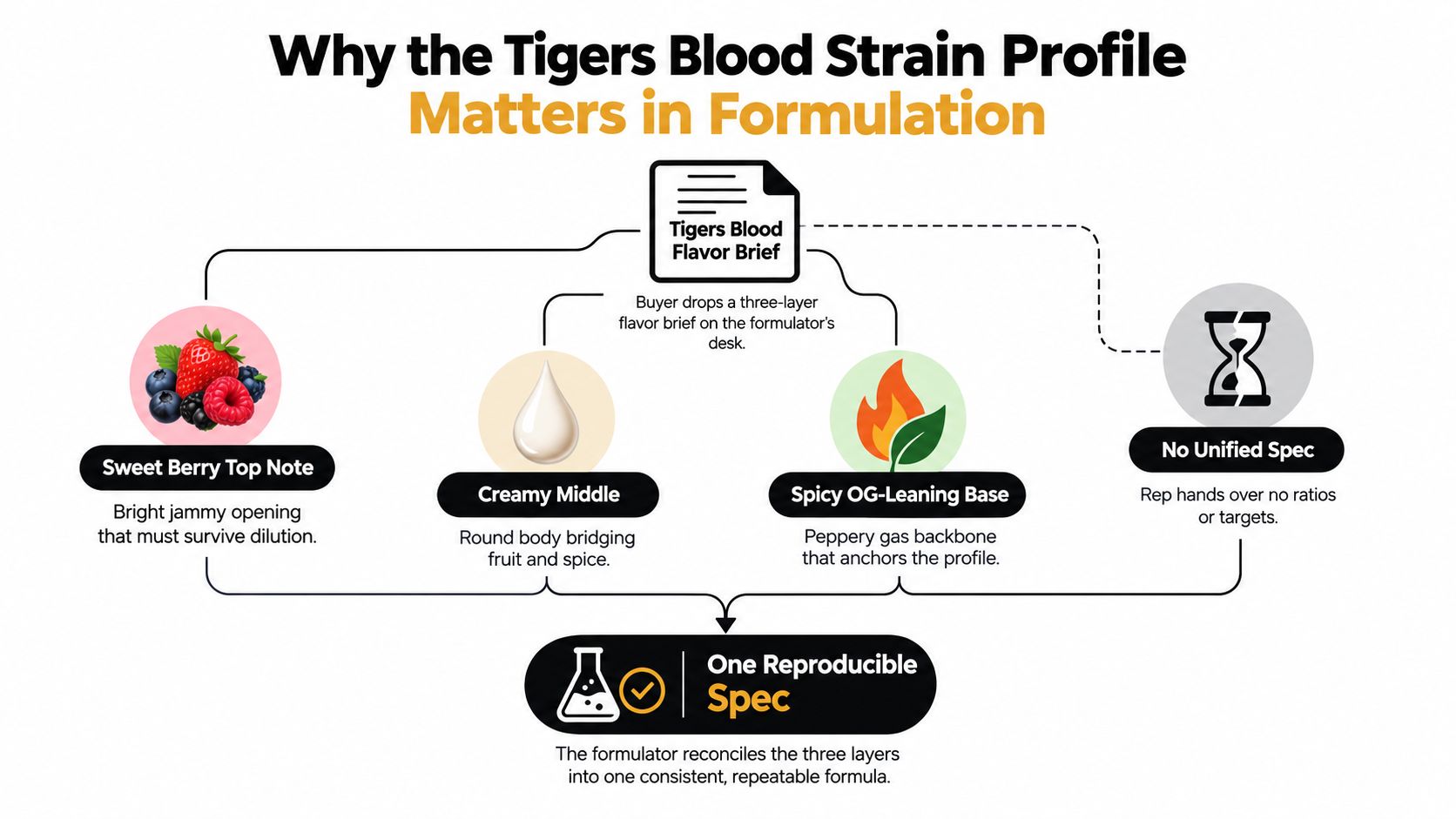
Start with a sensory brief, not a strain name
I'd turn the buyer's request into three checkpoints:
- Opening: bright, sweet berry and watermelon-style fruit.
- Middle: rounded sweetness with a soft, creamy impression.
- Finish: peppery, earthy, slightly gassy OG character.
The strain name becomes a reference label, not the specification. Record the desired aroma at opening, mid-palate, and finish, then define which notes must survive dilution and which notes should remain background support.
A useful primer is this guide to what terpenes do in cannabis, especially when a team needs to translate sensory language into individual aromatic materials. Gold Coast Terpenes botanical blends can support that translation with repeatable input materials, but they reproduce flavor and aroma, not a cultivar's claimed effects or a particular plant's complete chemistry.
Practical rule: Treat Tigers Blood as a sensory target with documented inputs. Don't build a production specification around an unverified strain name alone.
Tigers Blood Lineage and Why It Reads as a Flavor Label
Tigers Blood is best handled as a reused market label rather than a globally fixed genetic standard. One listing identifies it as an OG Kush phenotype, another describes a Virgin Seeds version crossed from Purple Kush and Stardawg, and another market interpretation attributes the name to Gas Drip and Maui True Blood. These claims describe materially different starting points, so lineage alone can't tell a formulator what the finished cart will taste like.
Lazy River Products documents the conflicting parentage and notes that different producers can use the Tigers Blood name for different genetics. That variation matters during procurement. Two suppliers can sell material under the same name while delivering different terpene ratios, different dominant notes, and different performance after extraction or distillation.
Tigers Blood Lineage Claims Compared
| Lineage Claim | Reported Parents | Typical Aroma Position | Reliability for Formulation |
|---|---|---|---|
| OG Kush phenotype | OG Kush lineage | Earthy, kush-like, peppery, and fruit-leaning | Useful as a sensory reference, not a complete specification |
| Virgin Seeds interpretation | Purple Kush and Stardawg | Dessert fruit with a heavier hybrid backbone | Relevant to one named version only |
| Separate market interpretation | Gas Drip and Maui True Blood | Brand-specific fruit, sweet, and hybrid notes | Requires a lot-specific sensory and laboratory review |
The naming crossover also reflects mainstream flavor culture. The shaved-ice association gives the label immediate consumer recognition, but it doesn't establish a botanical identity. For product development, that's an advantage if the team accepts the brief as flavor architecture rather than treating it as a certificate of parentage.
The workable approach is to freeze a sensory reference, document the terpene inputs, and approve each incoming lot against the same target. Gold Coast Terpenes fits that workflow as an input supplier because its catalog includes strain-inspired profiles and isolated compounds, allowing a team to choose a premade direction or tune the profile from individual materials.
Dominant Terpenes Behind the Sweet Berry and Spicy Base
Caryophyllene, myrcene, and limonene form the most useful starting cast for a Tigers Blood-inspired profile. Caryophyllene supplies peppery depth, myrcene adds musky body, and limonene provides lift that keeps the fruit character from becoming flat. Leafly identifies caryophyllene, myrcene, and limonene among the commonly reported dominant terpenes for Tiger's Blood, with some listings also showing humulene and pinene.
Assign each material a job
Beta-caryophyllene belongs in the base. Its peppery, warm character helps carry the OG-style impression through distillate, where delicate fruit notes can disappear quickly. Too much, however, can turn a dessert brief harsh or overly dry.
Myrcene supports the middle and lower mid-notes. It contributes body and a musky fruit quality, helping the blend feel fuller rather than like a thin candy aroma. Myrcene is a useful bridge between berry sweetness and the earthy side of the profile. More detail on its formulation role appears in this myrcene terpene guide.
Limonene works as the lift. It brings a bright citrus edge that can make berry and watermelon notes read more clearly on the first inhale. It shouldn't be allowed to turn the profile into a generic lemon flavor, so the amount should be judged against the peppery base and the finished oil.
Humulene and pinene can reinforce the OG direction. Humulene contributes a woody, herbal counterweight, while pinene can add a fresh evergreen edge in small supporting roles. The objective isn't to make the cart smell like a terpene isolate. It's to keep the fruit layer connected to an herbal, kush-leaning finish.
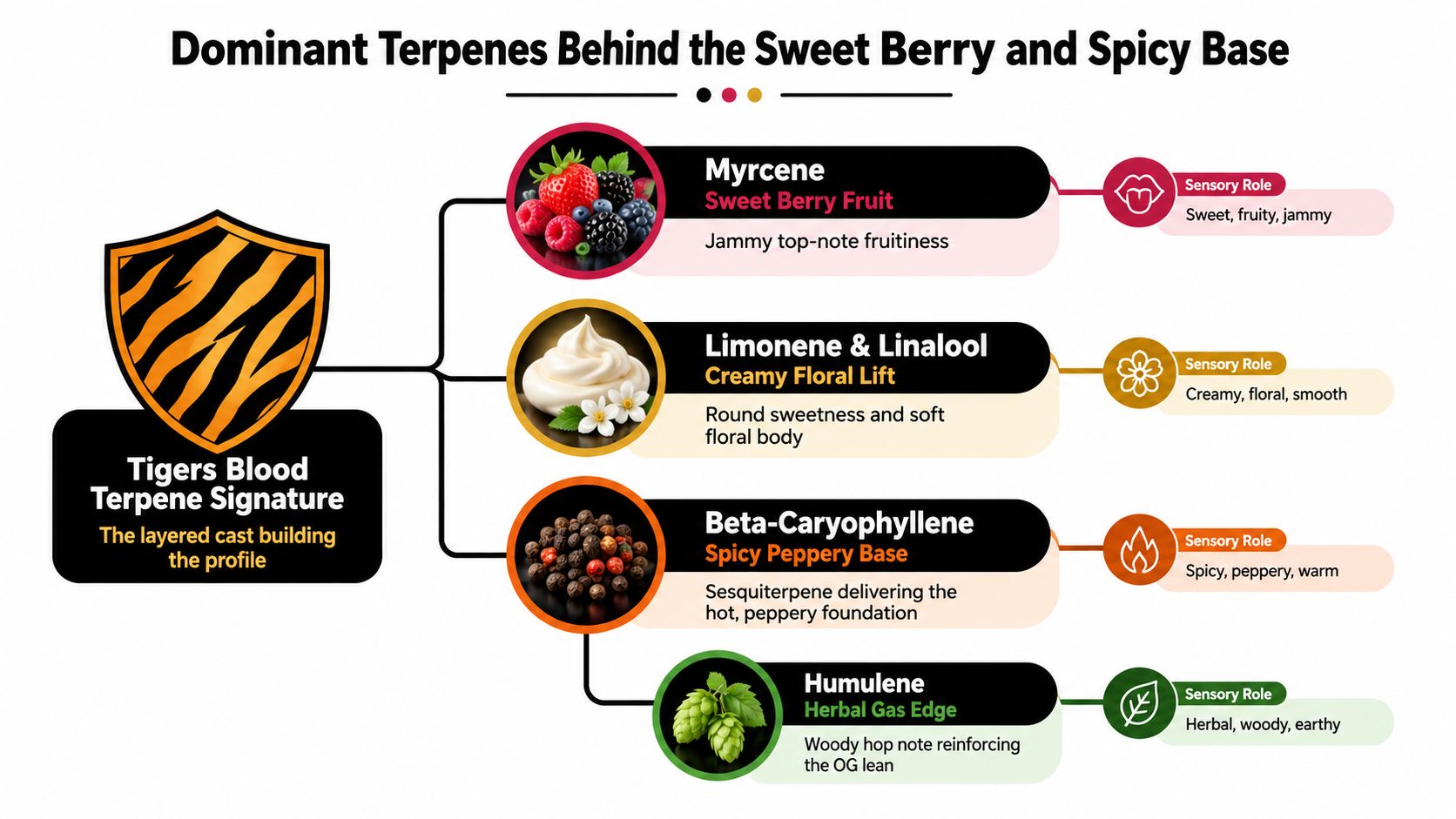
A strong blend should open sweet, develop a rounded body, and finish with pepper and earth. If the opening smells impressive but the finish disappears, the base needs more structure. If the pepper arrives immediately and buries the fruit, reduce the heavy base materials before adding more flavoring.
Reading the Total Terpene Range Across Lab-Linked Listings
Published terpene values for Tigers Blood vary enough that one laboratory result shouldn't become a universal formulation target. Reported retail batches have been listed around 0.86% to 1.38% total terpenes, while some Ontario coverage cites lots around 1.8% to 2.6% by weight. Ashario reports the broader retail and Ontario ranges and connects higher total terpene content with stronger aroma and flavor carry.
An independent database-style listing reports a batch near 1.01% total terpenes, reinforcing the point that phenotype, cultivation, curing, storage, and sampling can change the result. AskGrowers presents the approximately 1.01% figure alongside the broader range reported for other batches.
Total Terpene Content Across Tigers Blood Lab Listings
| Sample Type | Reported Total Terpene % | Sample Size | Recommended Cart Load % |
|---|---|---|---|
| Retail batch listing | 0.86% to 1.38% | Individual retail batches | Establish through bench testing and hardware review |
| Independent database listing | Around 1.01% | Reported batch value | Use as a reference point, not a universal target |
| Ontario lots cited in coverage | 1.8% to 2.6% | Market-specific lots | Confirm viscosity, harshness, and coil behavior before use |
These numbers describe plant or product samples, not a guaranteed cart formula. A formulator should choose a load based on aroma intensity, oil behavior, hardware, and compliance documentation. Total terpene content is useful for comparing incoming references, but it doesn't tell you whether the ratio produces the right berry-to-spice balance.
Starter Blend Recipe for Tigers Blood-Style Vape and Distillate
A reproducible starter blend should use three sensory tiers, fruit at the top, rounded body in the middle, and caryophyllene-led spice at the base. The exact load should be established against the target oil and cartridge system rather than copied from a strain database.
Build the blend in sensory order
Start with a sweet berry or fruit-forward botanical blend as the opening layer. Then add limonene carefully, using it to brighten the fruit rather than create a citrus-dominant profile. Myrcene can provide body, while a softer floral material may be evaluated only if the mid-note feels too narrow.
For the base, use beta-caryophyllene as the principal spicy anchor, with humulene or pinene as supporting materials when the OG impression needs more herbal definition. Avoid adding every available isolate at once. A crowded formula makes it difficult to identify which material caused bitterness, harshness, haze, or an unwanted medicinal note.
Use Gold Coast Terpenes' distillate mixing guide for the handling workflow, then document every addition by mass, lot number, and supplier. A product such as Elevated Strains Apple Fritter can serve as a separate flavor reference when a team is comparing dessert-forward profiles, but it shouldn't be treated as a Tigers Blood specification.
Distillate and live resin need different decisions
Warm the distillate gently until it flows consistently, but don't use aggressive heat as a substitute for proper mixing. Add the terpene blend gradually, mix until uniform, and evaluate the aroma after the oil has rested. A steeped sample can reveal integration that a shake-and-vape sample won't, while an immediate sample is useful for detecting harshness or an overpowering isolate.
Live resin usually carries more native aroma than neutral distillate. It may tolerate a lighter flavor intervention, and the correct approach is often to add the botanical blend as a correction layer rather than rebuilding the entire profile. Gold Coast Terpenes' isolated beta-caryophyllene, limonene, myrcene, and related materials can be evaluated individually when the live resin already supplies part of the expected character.
The formulation record should include:
- Sensory target: berry opening, rounded middle, spicy OG finish.
- Input record: material identity, lot, mass, and supplier documentation.
- Oil behavior: flow, haze, separation, and cart fill performance.
- Release decision: aroma match, label review, and hardware approval.
Botanical Versus Cannabis-Derived Terpenes for This Profile
Botanical-derived terpenes are usually easier to standardize for a Tigers Blood-inspired cart, while cannabis-derived terpenes can offer a closer connection to a specific extraction lot. The better choice depends on whether the priority is repeatable flavor, cultivar authenticity, supply-chain positioning, or a combination of those factors.
Gold Coast Terpenes supplies botanical, THC-free materials that can be used to tune aroma without adding cannabis extract to the terpene component. That makes botanical inputs practical for brands that need a repeatable flavor system across production runs. The label still needs to reflect the actual ingredients and comply with the rules of the intended market. Botanical terpenes don't legally reproduce strain-specific effects, and they shouldn't be marketed as doing so.
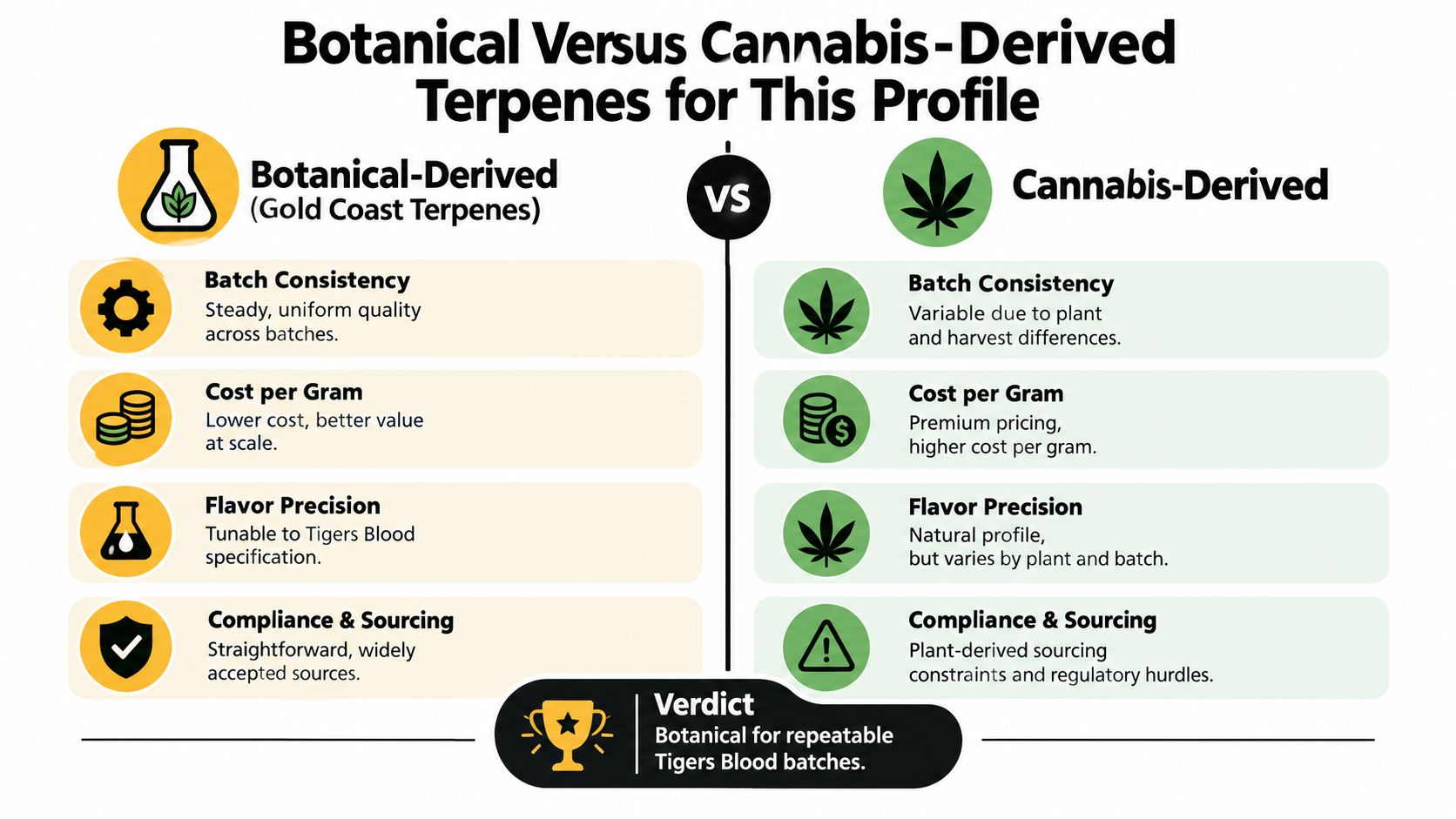
Compare the inputs by production priority
| Criterion | Botanical-derived blend | Cannabis-derived terpene fraction |
|---|---|---|
| Batch consistency | More controllable when the recipe and lots are documented | Can vary with cultivar, harvest, extraction, and storage |
| Flavor precision | Individual isolates allow targeted adjustment | Native complexity may be harder to reproduce exactly |
| Compliance | Requires accurate botanical ingredient and product labeling | May involve cannabis-derived sourcing and market restrictions |
| Scale | Suitable for planned repeat orders when documentation is available | Dependent on consistent plant material and extraction supply |
The comparison of cannabis-derived and botanical-derived terpenes is useful when procurement, regulatory, and sensory teams need the same decision framework. For Tigers Blood, choose botanical inputs when the buyer wants a stable flavor label. Choose cannabis-derived material when the product brief specifically depends on the character of a defined extract lot and the market permits that sourcing model.
QA Checklist for Batch Consistency and Sensory Verification
Sensory QA should approve a Tigers Blood-style cart against a frozen reference, not against memory. The strongest process combines aroma review, lot documentation, oil-behavior checks, and laboratory confirmation of the blend's dominant chemistry.
Before blending
Smell the incoming botanical blend beside the approved reference. Look for the expected sweet berry or watermelon direction first, then assess whether the middle feels rounded and whether the caryophyllene-led finish provides enough pepper and earth without becoming abrasive.
Record every lot number and retain the supplier's documentation for each input. Gold Coast Terpenes provides lab-verified, THC-free botanical terpene products according to the publisher information, but the finished product still needs its own release process and market-specific compliance review.
Use a controlled bench sequence:
- Reference comparison: Evaluate the neat blend and the blend in the intended oil.
- Load study: Test low, middle, and high candidate loads rather than approving one concentration blindly.
- Hardware review: Check draw behavior, coil response, leakage risk, and residue.
- Rested sample: Re-evaluate after the oil has had time to integrate.
- Laboratory confirmation: Use GC-MS or the applicable analytical method to confirm the dominant ratio and screen for unexpected materials.
Release criteria
A good aroma match can still fail if the oil hazes, separates, or becomes too thick for the cartridge. Inspect the finished batch visually, then compare viscosity and fill behavior with the previously approved strain-inspired product.
Release standard: Sign off only when the aroma, oil behavior, documentation, and label description all describe the same product.
Avoid using the strain name as the sole acceptance criterion. A cart that carries the Tigers Blood label but lacks the approved berry-to-spice relationship is a flavor mismatch, even if its input material came from cannabis flower sold under that name.
Sourcing, MOQs, and Common Buyer Questions
Procurement should begin with a sample and documentation review, then move to a repeatable purchase specification. Don't approve a supplier solely because its catalog uses the Tigers Blood name. Ask for the blend identity, ingredient disclosure, lot-specific documentation, intended application guidance, and the smallest practical bench quantity.
Gold Coast Terpenes offers strain-specific botanical blends, isolated compounds, safety documents, a mixing calculator, and bulk programs according to the publisher information. Exact MOQs, lead times, sample formats, custom-ratio options, and pricing should be confirmed directly because they can vary by product, order size, destination, and current inventory.
Tigers Blood Blend SKUs and Sourcing Reference
| Product Type | Typical MOQ | Use Case |
|---|---|---|
| Ready-made strain-inspired blend | Confirm with supplier | Fast sensory screening and pilot batches |
| Isolated beta-caryophyllene | Confirm with supplier | Building or reinforcing the spicy base |
| Isolated limonene | Confirm with supplier | Adding bright lift to the fruit opening |
| Isolated myrcene | Confirm with supplier | Adding body and musky fruit depth |
| Humulene or pinene isolate | Confirm with supplier | Supporting the herbal OG direction |
| Custom ratio request | Confirm feasibility with supplier | Matching an approved internal reference |
Questions buyers should ask
Are the terpenes suitable for legal vape markets? Ask the supplier for current product documentation and verify the finished formulation against the jurisdiction where it will be sold. “Botanical” alone doesn't replace a complete compliance review.
Do COAs match every lot? Request lot-specific documentation and match the lot on the certificate to the container and batch record. A generic document shouldn't be treated as proof for every incoming shipment.
Can the supplier provide a custom ratio? Some suppliers can discuss custom blending, while others may offer only catalog profiles and isolates. Send a sensory target and an ingredient brief before assuming a custom request is available.
How should a buyer move from testing to production? Request samples, screen the blend in the intended oil, test the hardware, approve the documentation, and issue a production PO tied to the accepted formula and lot requirements. Gold Coast Terpenes can be evaluated as one botanical input source in that workflow, alongside any supplier that can meet the same technical and compliance standards.
Frequently Asked Questions
Can a Tigers Blood terpene profile be replicated without cannabis-derived terpenes?
Yes, a botanical blend can reproduce the expected fruit, creamy, earthy, and peppery aroma direction. It won't reproduce strain-specific effects or prove genetic identity, so the product should be positioned as Tigers Blood-inspired flavor rather than as a chemically identical cultivar extract.
Which terpenes should lead a Tigers Blood blend?
Start by evaluating beta-caryophyllene, myrcene, and limonene, because those are commonly reported in the profile and provide useful base, body, and lift roles. Humulene and pinene can support the herbal direction when the finished blend needs more OG-style structure.
Should a formulator use a single strain database percentage?
No. Reported batches range from 0.86% to 1.38% in some retail listings and from 1.8% to 2.6% in other market coverage, so the figures are better treated as reference observations than as a universal target. The published range variation is documented in Ashario's Tigers Blood terpene review, which should be consulted only alongside the actual lot documentation.
Are botanical terpenes easier to scale for vape brands?
They can be easier to standardize because the formulator can specify the blend and individual inputs rather than relying entirely on the chemistry of each cannabis harvest. Gold Coast Terpenes' botanical catalog and isolated compounds can support that approach, subject to the buyer's own compliance and hardware validation.
What should be tested before approving a Tigers Blood cart?
Evaluate aroma against a retained reference, oil uniformity, viscosity, haze, hardware performance, label accuracy, and lot documentation. The approved record should identify the formula and acceptance criteria clearly enough for another production run to be compared against it.
Gold Coast Terpenes offers botanical strain-inspired blends and isolated compounds that can help product teams build a repeatable Tigers Blood-style profile for distillate and vape cartridges. Review the available formulation inputs and documentation at Gold Coast Terpenes, then request the materials and lot information that fit your bench-testing and production requirements.