
A gummy batch is cooling, the depositor is ready, and you're holding a strain-inspired blend trying to decide whether to add it now or wait. Gold Coast Terpenes, a Redondo Beach, CA supplier, makes 100% botanically derived terpene blends, not cannabis-derived, and that distinction matters when you're building Terpenes in Edibles for repeatable flavor. Get timing, matrix, and validation right from the start, and the finished piece tastes like the profile you briefed. Get them wrong, and no label claim fixes a flat batch.
Setting Up an Edible Terpene Program From Day One
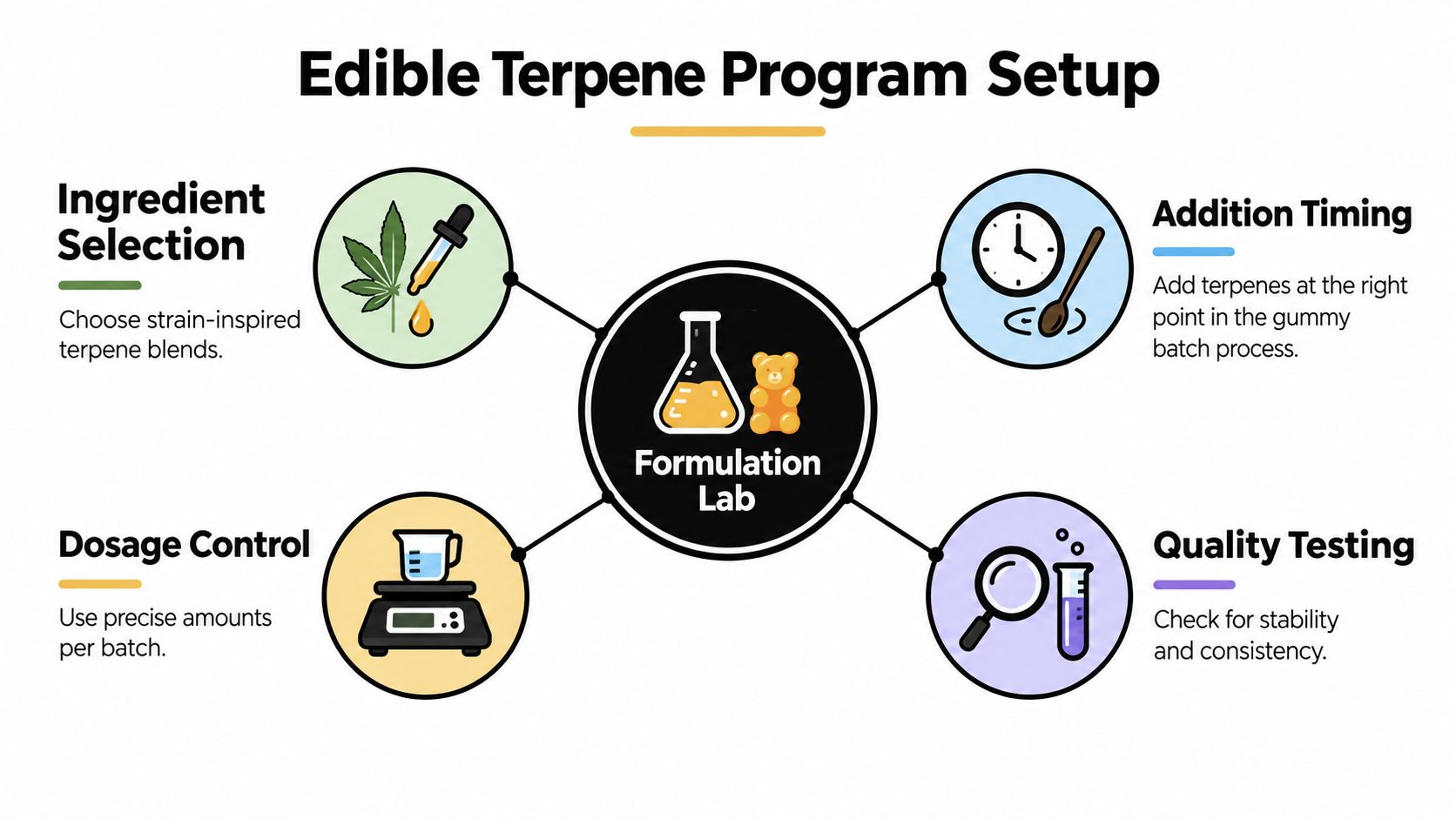
Set up Terpenes in Edibles as a process variable, not a late flavor addition, and define the sensory target before you choose a blend. That means mapping product format, heat exposure, fat phase, and package to terpene profile selection on day one.
Gold Coast Terpenes offers 37 Strains and 40 Elevated Strains, plus isolates for fine-tuning, so formulators can separate botanical from nature-identical labeling decisions early. With a strain-inspired terpene blend, the question isn't only which aroma you want. It's where those compounds will partition and whether they'll still be present after depositing, cooling, and storage.
Use this setup map to align ingredients, timing, and testing before production starts.
Three Engineering Realities to Plan Around
- Volatility: Light compounds leave first during heating, mixing, and open handling, which shifts the balance you measured in the vial.
- Heat and oxygen exposure: Both change aroma over time, so addition point and closed handling matter as much as selection.
- Matrix partitioning: Gelatin, pectin, chocolate fat, and baked crumb hold and release terpenes differently, even at the same input amount.
Cannabis contains approximately 150 identified terpenes, while research has concentrated on a smaller subset including pinene, beta-caryophyllene, myrcene, and humulene, as summarized in a 2023 pharmacohistory review of cannabis constituents. That gap is your guardrail. Build for verified sensory consistency, not for unproven functional promises tied to a strain name.
Start by writing a one-page brief covering target profile, edible matrix, cannabinoid carrier, addition point, package format, and finished-product testing. Document MOQs, supplier documentation, and batch records before you scale. A formulator who treats the blend as decoration usually chases lost top notes later. A formulator who treats it as engineering can diagnose whether a problem came from selection, heat, mixing, or packaging.
Practical rule: If your batch sheet doesn't record addition temperature, mixing time, and package type, you don't have a terpene program yet. You have a flavor experiment.
Top, Mid, and Base Notes in Edible Flavor Design
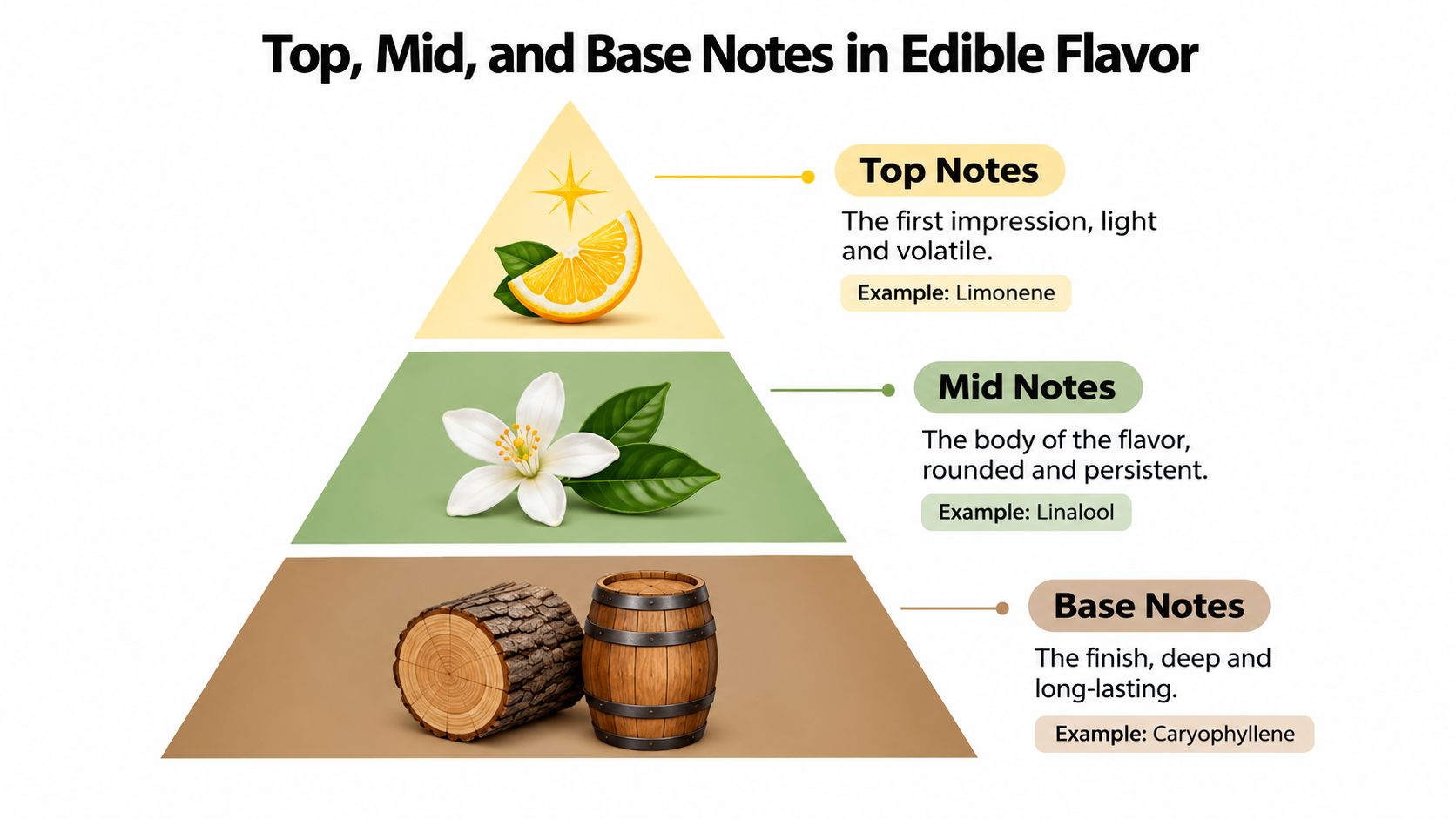
Build a terpene profile for an edible in layers, because the first bite, mid-palate, and finish don't come from the same compounds. Top notes create first impression, mid notes give body, and base notes carry the finish after sweetness and fat clear.
This pyramid shows how those layers stack in a finished edible.
How the Layers Work in Practice
Use bright top notes such as limonene and pinene for citrus or pine lift in profiles like Blue Dream or Green Crack. They're also the easiest to lose, so a citrus-driven gummy can smell correct in the kettle and taste dull after setting.
Mid notes such as myrcene and linalool shape roundness and soften harsh edges in profiles like Forbidden Fruit. Base notes such as beta-caryophyllene and humulene anchor OG Kush style profiles with spice and wood character that persists longer in fat. For a detailed cross-reference, consult the Gold Coast Terpenes flavor chart for note families during briefing and panel review.
Watch how note balance changes when a blend moves from oil into a food matrix in this demonstration.
Chocolate illustrates the trade-off clearly. Cocoa fat can mute bright citrus while extending spicy, resinous base notes, so replicating flavor of a cultivar in chocolate usually requires rebalancing, not copying the vape ratio. Gold Coast Terpenes' Elevated Strains line selectively enhances rarer compounds, which can help dessert and fruit-forward SKUs where mid and base definition gets buried by sugar.
Don't brief a panel with vague words alone. Record which compound family should lead, which should support, and what the finish should leave behind. That shared language lets production, QA, and brand owners judge the same target when a supplier lot changes or a matrix changes. It's also how you choose between a complete strain-inspired terpene blend and a blend plus isolate adjustment for cannabis product formulation.
Stability, Retention, and Why Terpenes Disappear
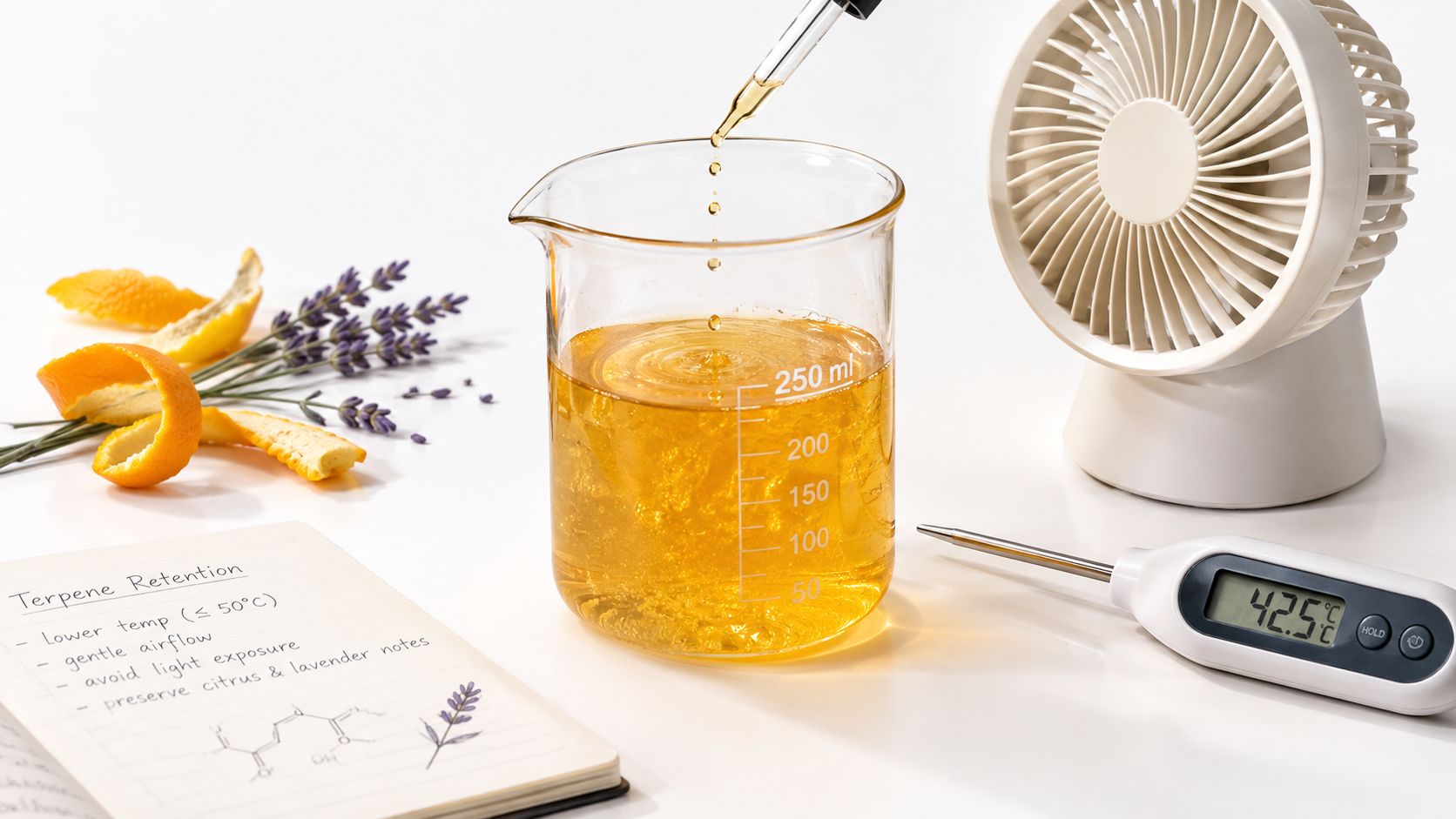
Terpenes disappear mainly through evaporation, heat, oxygen contact, and matrix partitioning, and you can't manage that loss by calculating input dose alone. You have to measure finished-product concentration after processing and again near the end of shelf life.
This image shows the kind of retention testing that separates a guess from a validated result.
Why Monoterpenes Need Different Handling
Monoterpenes such as limonene, myrcene, and pinene are generally more prone to evaporative loss during heating than higher-molecular-weight sesquiterpenes such as beta-caryophyllene and humulene, according to research on terpene stability and retention in food processing. Add a monoterpene-heavy blend early in a hot cook and you'll often keep the base while losing the identity of the profile. Add it later during controlled cooling and retention improves, but mixing window and viscosity become tighter.
That trade-off differs by matrix. A gummy mass exposes a large hot surface and then sets, an oil drop keeps terpenes in a lipid phase, and a baked good drives volatiles off while crumb structure forms. The same strain-inspired terpene blend therefore can't be judged across formats without matrix-specific validation. Review the Gold Coast Terpenes guide to terpene degradation pathways when you're setting acceptance criteria for post-process testing.
Build a stability program around temperature-time exposure, oxygen, and package barrier. Sample the finished edible after processing, retain packaged units, and compare end-of-shelf-life samples against the original sensory target. Include headspace, light exposure, and storage temperature in the protocol, not just time.
Measure what's in the piece the consumer eats, not what went into the kettle.
Gold Coast Terpenes, a supplier of SC Lab-tested, THC-free blends free of VG, PG, PEG, and MCT, documents its profiles so formulators can compare a retained sample to a defined input. That documentation doesn't replace your stability work. It gives you a stable reference point for deciding whether loss came from process, package, or an unrealistic addition point.
Bioavailability, Onset, and What Inhalation Data Cannot Tell You
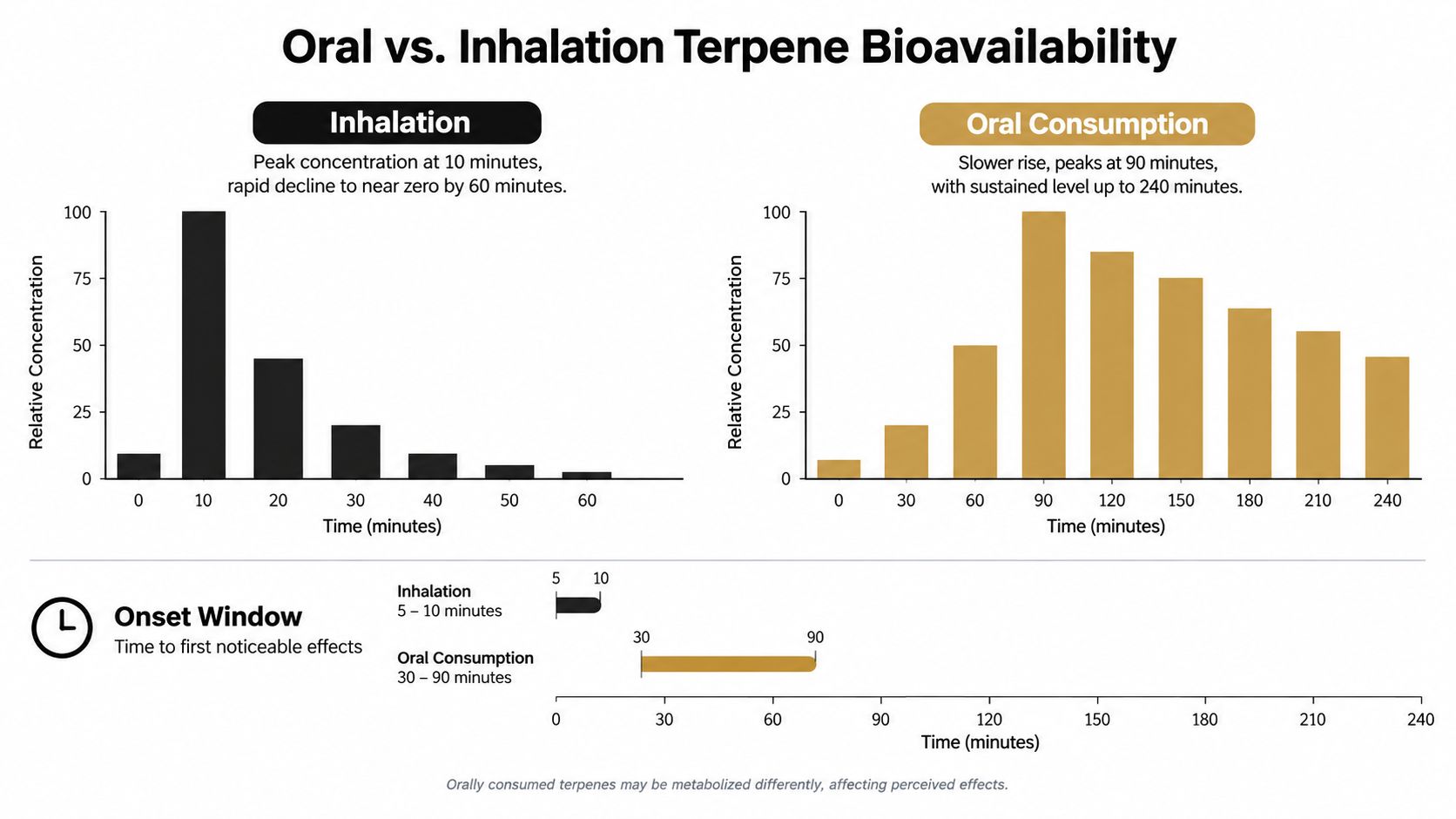
Inhalation data can't predict an edible experience because swallowed compounds face digestion, intestinal absorption, and hepatic first-pass metabolism before they reach circulation. Flavor perception in the mouth is far more predictable than any systemic claim you might want to attach to Terpenes in Edibles.
Use this comparison to frame internal discussions about onset and exposure.
Oral Timing Is Not Immediate
Orally consumed terpenes can become bioavailable within approximately 0.5 hours, with blood concentrations commonly peaking between 2 and 4 hours, as reported in a review of terpene pharmacokinetics and manufacturing safety. That timing reflects digestion and conversion into more water-soluble metabolites in the gastrointestinal tract and liver. It also means detectable absorption and peak exposure aren't the same event.
Cannabinoids show why formulation matters. Published reviews report oral bioavailability of approximately 4–12% for THC and 13–19% for CBD, with THC at roughly 10–20% when dissolved in sesame oil, according to a review of oral cannabinoid delivery and lipid transport. Those figures don't establish equivalent terpene absorption. They show that food, lipid carrier, dose, and individual physiology can change exposure in the same product category.
Human pharmacokinetic research has detected myrcene, alpha-pinene, and beta-pinene in plasma after ingestion, and oral linalool has been investigated with a human pharmacokinetic method, as noted in a consumer-facing terpene guide summarizing oral evidence. Detection isn't proof of a meaningful effect at a typical edible concentration. Which molecule, dose, metabolite, and formulation produce measurable exposure remains the relevant question.
Gold Coast Terpenes positions its 100% botanically derived profiles around sensory reproducibility, which is the defensible claim for a formulator. Don't copy a terpene formulation for vape cartridges or a terpene formulation for distillate into a gummy and assume the consumer outcome transfers. Assess the complete cannabinoid-terpene matrix, validate the finished serving, and keep onset guidance conservative because identical labeled amounts can produce different exposure profiles across consumers.
Formulating Gummies, Chocolates, and Baked Goods Step by Step
Formulating Terpenes in Edibles works when you match addition point, homogenization, and carrier to each matrix instead of using one procedure for every SKU. The workflow below is a formulation guide for development trials, with finished-product testing built into each format.
Edible Matrix Compatibility Snapshot
| Matrix | Recommended Addition Point | Primary Loss Driver | Homogenization Tip |
|---|---|---|---|
| Gummies | During controlled cooling before depositing | Heat and open mixing | Pre-blend with the cannabinoid carrier, then mix until uniform without whipping in air |
| Chocolates | After conching, during controlled tempering work | Prolonged heat and aeration | Disperse through the fat phase with lecithin already equilibrated |
| Baked goods | Late in batter for short bakes, or post-bake application | Oven heat and surface area | Validate crumb and surface separately because distribution can differ |
Gummies, Then Chocolate
For gelatin or pectin gummies, cook and clarify the base first, add acid-sensitive components in your established sequence, then introduce the strain-inspired terpene blend during cooling when the mass is still fluid enough to mix evenly. Sample from more than one location before depositing. If the top notes read correctly in the kettle but not after setting, review hold time and surface exposure before increasing the blend.
Health Canada requires cannabinoids and terpenes to be uniformly distributed throughout a cannabis extract, per its composition requirements for cannabis products, and that uniformity principle is a useful QA model even outside extracts. Record component weights, mixing conditions, and sampling locations for every trial.
For chocolate, don't ask terpenes to survive unnecessary conching. Add them after the main flavor development work, keep tempering controlled, and check the snap and melt after the blend is dispersed in the fat phase. Precise temper control matters here, and the DBakerAid™ tempering advice is a useful practical reference for avoiding heat abuse while you protect volatile notes.
For baked goods, shorter exposure and lower surface loss are your friends. Dense formats generally protect aroma better than thin, high-surface items, and post-bake sprays or fillings can preserve a profile that a full bake would flatten. Review the Gold Coast Terpenes overview of food-grade terpenes when you're checking documentation for a food application.
Gold Coast Terpenes supplies SC Lab-tested, THC-free blends free of VG, PG, PEG, and MCT, which helps formulators control the carrier instead of inheriting one. Finish each trial with a simple bill of materials, addition point, mixing record, retained sample, and sensory panel against a frozen or otherwise protected reference. When brands buy terpenes for production, that record is what turns a good bench sample into a repeatable SKU across bulk terpenes purchases.
Dosing, Labeling, and Redose Risk for Terpene-Containing Edibles
Dose and label Terpenes in Edibles by identity and amount per serving, not by strain name alone, and warn consumers clearly about delayed onset. A total blend percentage in the kettle doesn't tell a consumer, regulator, or QA manager what remains in one finished piece.
What a Defensible Label File Contains
- Terpene identity: Name the principal compounds in the terpene profile for the finished serving, not only the marketing profile name.
- Amount per serving: Distinguish total blend input from milligrams consumed, then confirm the finished value by testing.
- Evidence basis: State whether a claim rests on sensory positioning, formulation experience, or human evidence. Don't blend those categories.
- Onset instruction: Use plain language that tells the consumer to wait before taking another serving.
Oral cannabis effects can begin after roughly 30–90 minutes, peak around 2–6 hours, and last 4–12 hours, while oral THC bioavailability is cited at approximately 6–10% in a review of edible cannabis pharmacokinetics and delivery. Lipid formulation and meal context can change exposure, so two products with the same labeled THC amount aren't automatically equivalent in use.
That variability creates the redose problem. A consumer tastes citrus immediately, feels little systemic effect early, and takes another serving before the first peaks. Your serving design should anticipate that behavior with clear serving demarcation, conservative wait guidance, and package copy that doesn't imply a named profile guarantees a predictable physiological outcome.
Label discipline: Treat strain-specific effects after ingestion as a sensory and formulation hypothesis, not a promised result.
Gold Coast Terpenes provides profile documentation and SC Lab testing information that formulators can use in their label files, but your finished-product test remains the source of truth. Set a pragmatic sensory floor through panel work, verify it at the end of shelf life, and avoid medical claims. That's how you choose a supplier for cannabis product formulation: by documentation quality, batch consistency, and willingness to separate flavor accuracy from unsupported functional language when you buy terpenes.
Storage, Packaging, and Shelf-Life Validation
Protect Terpenes in Edibles after production with low oxygen permeability packaging, limited headspace, and protection from heat and light. A profile that passes at release can still drift in a warm warehouse or a permeable pouch.
Design the stability study before you approve the package. Test packaged units at release and at planned intervals through the intended shelf life, and interpret drift as both a flavor signal and a label-accuracy signal. Include warehouse and refrigerated conditions if both appear in your supply chain, because a single accelerated condition won't explain every real distribution path.
Nitrogen flushing or vacuum sealing can reduce oxygen contact where the format allows it, but seal integrity and film selection still need validation. Material choices also affect sustainability claims, and these eco packaging tips for home cooks offer a useful starting point for smaller brands balancing barrier needs with waste reduction. Don't choose a compostable or lightweight structure until you've confirmed it holds aroma for the full shelf life.
Use practical storage guidance on the consumer package, and keep it visible. Store in a cool, dark place isn't enough if your product is sensitive to repeated temperature cycling during delivery. Your QA file should connect storage condition, package, and terpene result so a complaint about weak flavor can be traced to a variable.
For incoming concentrates and retained blends, follow the Gold Coast Terpenes guidance on how to store terpenes and apply the same discipline to finished goods. Gold Coast Terpenes can help formulators rebuild a blend target after documented losses, but only if your data show where the loss occurred. Without post-process and end-of-life samples, you're guessing at a correction and risking an overshot profile in the next batch.
That's the difference between botanical vs. cannabis-derived terpenes in practice. Source matters, but documented consistency, package performance, and finished-product validation matter more when you're deciding how to choose a terpene supplier.
FAQ Block for Terpenes in Edibles
Quick Reference for Terpenes in Edibles
| Question Topic | Practical Answer | Primary Constraint |
|---|---|---|
| Botanical vs. cannabis-derived | Botanical blends offer repeatable sourcing and documentation | Finished-product validation |
| Starting a gummy trial | Start conservatively, add late, test the set piece | Heat and volatility |
| Fine-tuning | Adjust with isolates after panel review | Note balance in the matrix |
How do Gold Coast Terpenes blends differ from cannabis-derived terpenes? Gold Coast Terpenes makes 100% botanically derived, THC-free blends, not cannabis-derived extracts. That supports consistent formulating work across batches when you validate the finished edible.
What's a reasonable starting approach in gummies? Start with a conservative load, add during cooling, and panel the set gummy rather than the hot mass. Use the Mixing Calculator and retained samples to adjust systematically.
Which isolates help with fine-tuning? Limonene, myrcene, and beta-caryophyllene isolates let you correct top, mid, or base balance without replacing the whole profile. Gold Coast Terpenes documents these options alongside its strain profiles.
Can a vape profile move directly into an edible? No, not without rebalancing and testing in the food matrix. Heat, fat, sugar, and first-pass metabolism change both flavor and exposure.
Gold Coast Terpenes offers 100% botanically derived, SC Lab-tested, THC-free strain profiles, flavor concentrates, isolates, and a Mixing Calculator for teams building consistent Terpenes in Edibles across gummies, chocolates, and baked goods. Bring your matrix, addition point, and stability target, then visit Gold Coast Terpenes to select profiles and documentation for your next formulation trial.