
A batch can meet potency and paperwork requirements, yet still open with a flat aroma or perform differently in the jar than it does in a cartridge. For product developers, spray on terps isn't a quick sensory flourish. It's a controlled ingredient-addition decision that affects flavor consistency, formulation, testing, and compliance. Gold Coast Terpenes is a Redondo Beach, California supplier of 100% botanically derived terpene blends, not cannabis-derived blends, a distinction formulators should document rather than leave to interpretation.
The practical starting point is to decide where the terpenes are going, then weigh, mix, and test the finished product for its intended use. Stronger aroma isn't proof of better flavor, even distribution, or inhalation safety.
What Spray On Terps Actually Are in a Formulation Lab
Spray-on terpenes are a metered dosing step, not a finishing flourish. In production, the phrase can mean surface application to flower, blending into distillate or concentrate, or adding a blend before filling cartridge hardware. Those methods produce different distributions, so don't treat them as interchangeable.
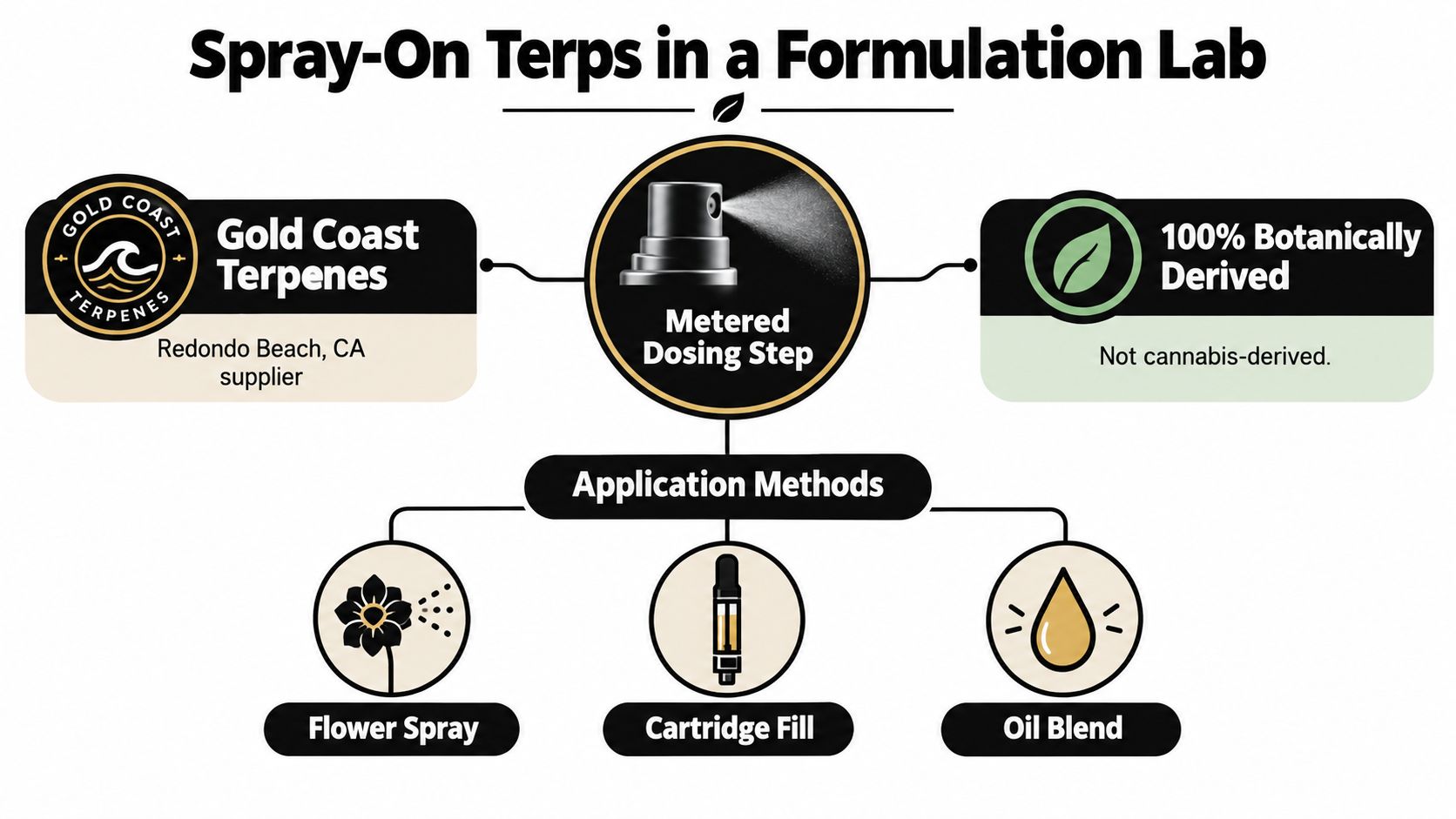
Gold Coast Terpenes' botanical sourcing is a useful example of why supplier identity and ingredient origin belong on the batch record. Botanical and cannabis-derived profiles aren't the same sourcing category, and New York's guidance for vaporized or inhaled adult-use products permits botanically derived terpenes while prohibiting synthetic terpenes. That state guidance also sets a 10% ceiling for total terpene content in the finished product, a formulation control rather than an aroma target (New York's requirements for flavored vaporized or inhaled products).
Three application modes, three different jobs
A surface spray places terpenes on flower. It can shift the first impression, but surface coverage can vary, and the treatment doesn't make the flower's interior equivalent to a homogeneous oil blend.
For distillate or sauce, the aim is incorporation throughout the base. That requires controlled addition and mixing, not a surface mist. For cartridge production, the formulation must also work in the hardware, where oil viscosity and the device's operating conditions affect performance.
Build the profile around sensory roles
Think in top, mid, and base notes when designing a strain-inspired terpene blend. Limonene and pinene can provide bright top notes; myrcene and linalool can contribute mid-profile character; beta-caryophyllene and humulene can add weight to the base. These roles help explain why a profile's overall balance matters more than maximizing one aroma.
New York, New Jersey, and Nevada all use 10% as an important reference point for inhaled or vaporized products, although rules vary by jurisdiction. New Jersey's testing guidance and Nevada's guidance also describe a 10% ceiling; Nevada notes that terpenes aren't currently classified by the U.S. FDA Inactive Ingredient Database as safe for inhalation. Treat that ceiling as a regulatory and manufacturing boundary, not a target to hit.
Setting Up a Weighted Dosing Workflow
Dose by mass, then verify the blend; don't rely on drops or a visually estimated spray. A published concentrate-vaping model found that a 9:1 THC-to-terpene ratio, equivalent to 10% terpene by mass, produced practical viscosity for vaporization. Higher terpene loading made the material too fluid and increased leakage risk, so the result is an engineering benchmark, not a universal safety limit (published concentrate-vaping model).
Calculate before adding
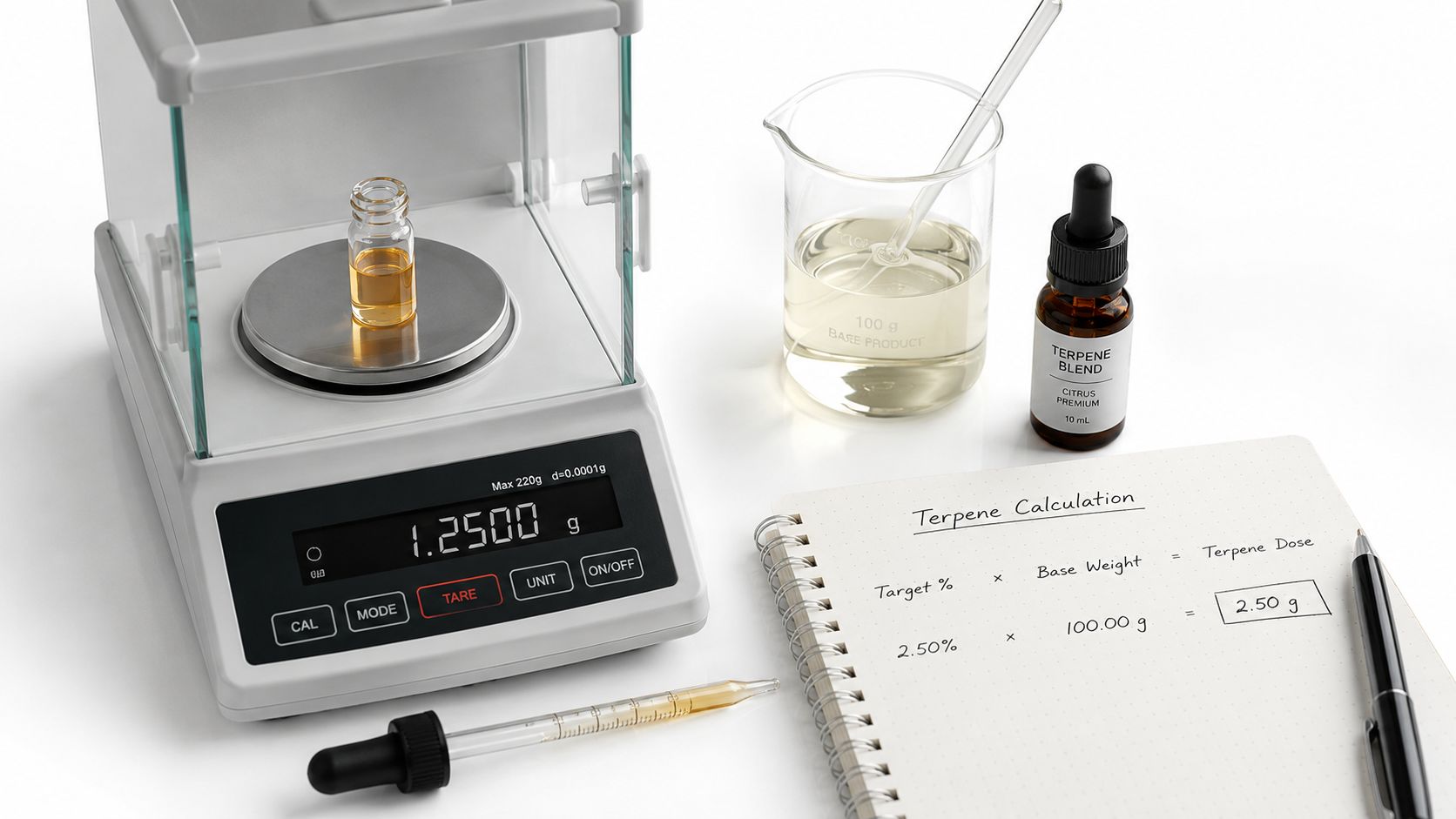
Start with the base material's measured mass and your chosen target. For a 10-gram pilot, a 10% terpene fraction of the finished blend means the terpene mass is calculated against the final total, not added as 10% of the starting base. Let the terpene mass be x: x / (10 + x) = 0.10, so x is approximately 1.11 grams. This is a calculation example, not a recommendation to formulate at that level; your product, device, testing plan, and applicable rules determine the appropriate target.
Use a calibrated analytical balance for mass and a micro-pipette only where a validated transfer method calls for volume measurement. Droppers and kitchen measuring cups don't provide reliable control for small, concentrated additions. If a blend is too small to weigh accurately at the planned scale, prepare a measured dilution, record its composition, and calculate the terpene contribution from that dilution.
Mix in a closed vessel and check the result
Weigh the base, calculate the addition, then transfer the terpene blend slowly into a closed vessel. Mix until visually uniform, but don't mistake appearance for proof of homogeneity. Take replicate samples from different parts of the batch and compare the finished profile before filling. Record lot numbers, temperatures, weights, and any dilution.
Closed handling helps limit volatile losses compared with open mixing. It also makes the process easier to reproduce across shifts. Gold Coast Terpenes offers isolates such as limonene, myrcene, and beta-caryophyllene, as well as full profiles; whichever input you choose, document its identity and lot. For tighter bench records, use a precision measurement workflow for terpene dosing.
Matching Application Method to Product Type
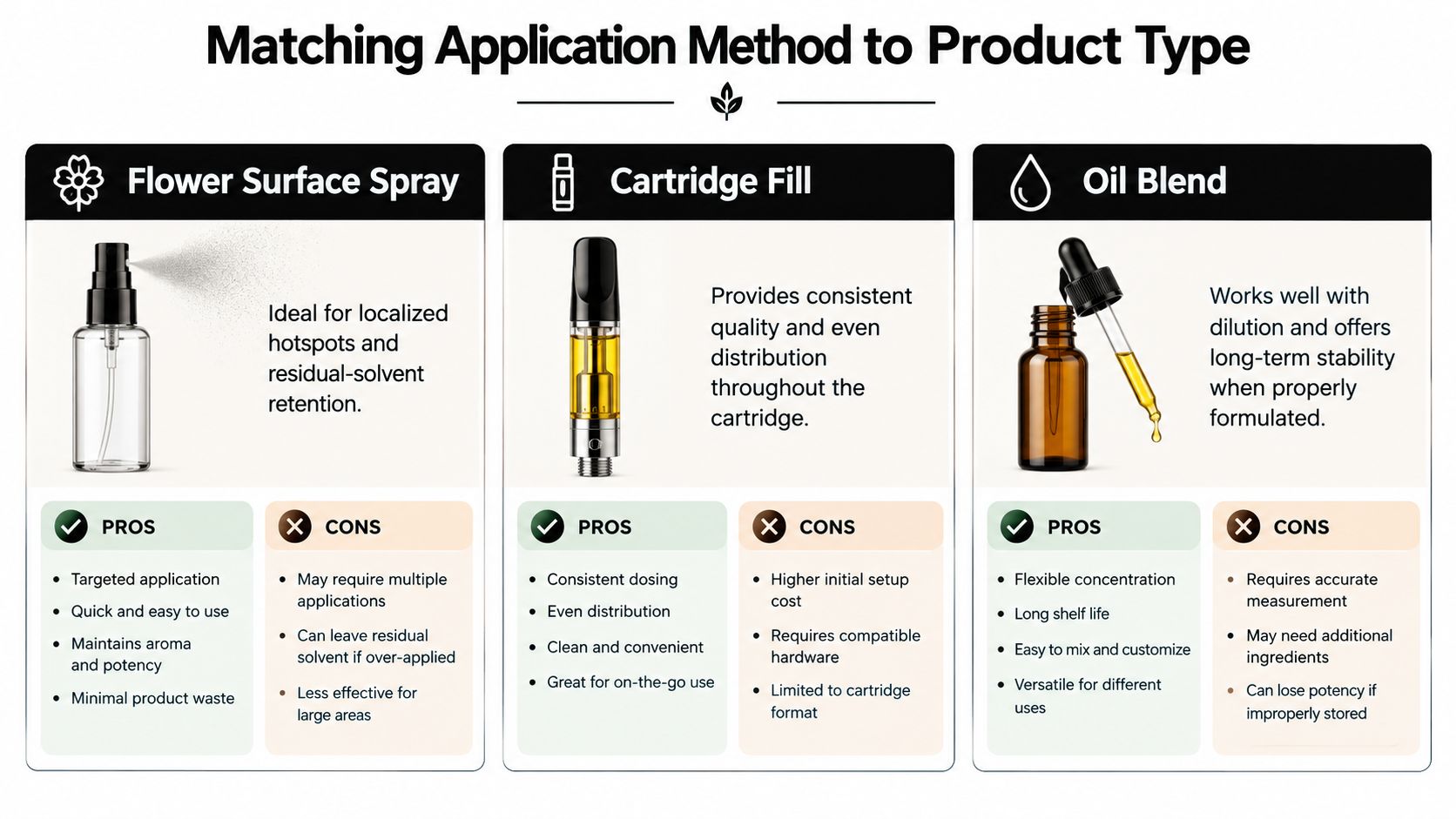
Choose the application method based on the product matrix and test plan, not on which sample smells strongest in the room. Flower surface spray, concentrate blending, and cartridge loading each create distinct coverage and exposure questions.
Flower surface spray
A fine-mist applicator or suitable tumbler can help distribute a measured application more evenly than a hand sprayer aimed at isolated buds. Even then, flower structure creates a hotspot risk: exterior surfaces can receive more terpene than sheltered areas. If a carrier is used, assess residual-solvent retention and test the finished material under the applicable rules. Don't approve a batch based only on the jar-opening aroma.
Distillate and concentrate blending
For oils, closed-vessel blending is the more direct route to a uniform product. Room-temperature mixing and mixing in a heated vessel aren't equivalent: heat can affect volatility and terpene stability, while insufficient mixing can leave composition uneven. Set a documented process for temperature, mixing, and sampling instead of assuming that a clear blend is homogeneous.
Cartridge filling
A cartridge formula has to suit the device. Coil resistance, wattage, and oil viscosity affect how the blend moves through the hardware and heats during use. A terpene ceiling doesn't tell you whether a particular cartridge will perform consistently unless you also define and test the atomizer conditions.
The relevant question is therefore not “Which method makes the loudest aroma?” It's “Which method gives this SKU the distribution and performance the lab can verify?” The 10% benchmark only becomes meaningful as a product control when formulation, device, and testing conditions are considered together.
For a visual overview of flower spraying, cartridge filling, and oil blending, see the application-method comparison video.
Why More Terps Is Usually a Quality Problem
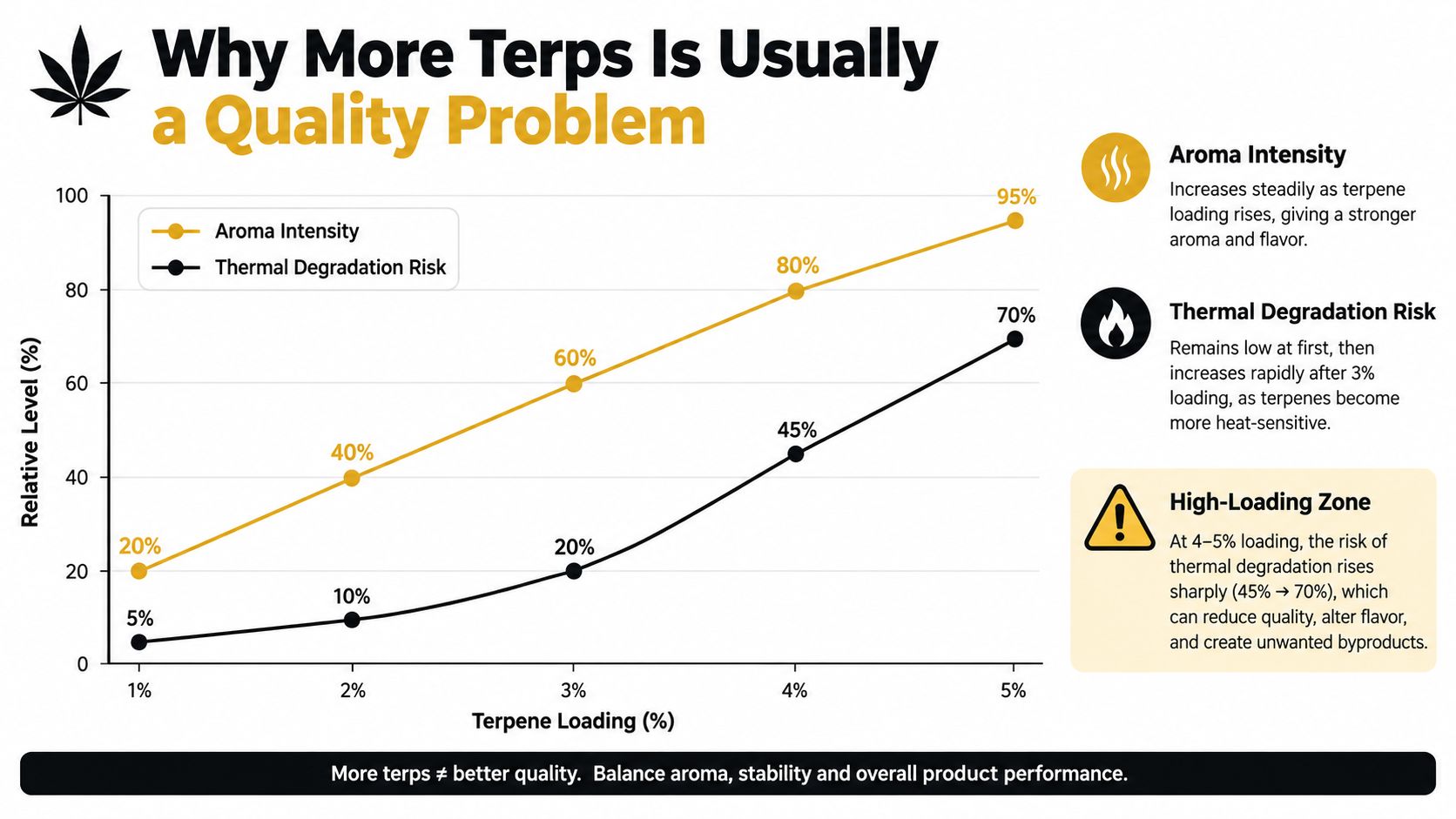
A buyer opens the jar and gets a sharp citrus blast; two weeks later the same cart tastes harsh at the coil. That gap is the core problem: loud aroma can mask a formulation that is chemically less stable once heated.
Aroma and thermal behavior are separate measures
Sensory intensity is measured before the coil sees the liquid. Aerosol chemistry is measured after. In controlled aerosol testing, terpene mixtures added at 7.5% and 15% by mass increased carbonyl formation by as much as ninefold, even though aerosol mass did not significantly change (research on terpene-containing cannabis aerosols).
Thermal stability also changes by molecule, not by “terpenes” as a class. Across 100 to 200 °C, unchanged parent material ranged from 97 to 98% for myrcene down to 11 to 28% for terpinolene (research on terpene thermal degradation). A blend built for top-note impact can therefore lose a different fraction of each compound once the cartridge warms.
That is why copying a loading from a louder SKU is weak process control. Commercial products are often pushed above native flower levels, and excessive concentration shows up first as bite, bitterness, throat irritation, and a finish customers describe as chemical. For a deeper look at irritation and sensory side effects at higher loadings, review the terpene side-effects guide.
Bench rule: Start at the lowest concentration that meets the sensory brief, then test the blend in the intended device.
Treat 10% as a manufacturing control point, not a flavor target. If a batch needs more terpene to smell finished, check the inputs and the process before raising the dose: incoming COA, hold time, fill temperature, and the aerosol produced from the actual hardware. Gold Coast Terpenes supplies lab-verified, THC-free inputs; keep the certificate of analysis with the batch record so the team is verifying material identity and composition rather than trusting the label.
A Practical QC Checklist Before You Fill Any Cart
A blend can look clean in the vessel and still fail in the cart. Separation during a hold, a viscosity shift at fill temperature, or carbonyl formation inside a hot-running coil are all release failures that a visual check will not catch. Run the formulation through a defined sequence before committing to a production fill.
A release sequence for formulation teams
Check the vessel and hold conditions. Confirm that the blend remained sealed during mixing and holding, and record the time and temperature. If the formulation sat before filling, use samples that reflect the actual hold period rather than only the fresh mix.
Sample for homogeneity. Take replicate samples from different locations in the vessel and compare their terpene profiles. A single draw can miss a local concentration hotspot, and a hotspot near the fill line becomes a run of carts that test outside the spec you wrote.
Confirm composition. Use GC-MS or an appropriate laboratory method to compare the finished blend with the intended profile. New Jersey's 2025 guidance sets a detailed reporting model for individual terpenes, including alpha-pinene, beta-caryophyllene, beta-myrcene, d-limonene, ocimene, terpinolene, alpha-humulene, beta-pinene, and linalool, expressed as percentages and in milligrams per gram or milligrams per milliliter. An industry committee review of terpene limits, referenced earlier in this article, summarizes that reporting model.
Measure viscosity at relevant temperatures. Check room-temperature behavior and fill-temperature behavior. A blend that handles well on the bench may not fill or wick the same way under production conditions.
Screen emissions in the intended hardware. Test carbonyls and other volatile degradation products at the device settings the product is designed to use. Sensory QC and safety QC diverge at this step: a blend can pass every taste check and still generate degradation products that only appear in the aerosol. A neat ingredient's boiling point doesn't reproduce the temperature and conditions of a finished device.
Test the finished blend, confirm its distribution and emissions, then fill the cart.
Tie each check to a failure mode through a documented quality-assurance process: uneven coverage on flower, under-mixed distillate, or degradation in a hot-running cartridge. When a batch fails, the checklist points to the variable worth pulling first.
Curing, Storage, and Holding the 10% Target
The bench-sheet percentage isn't necessarily the percentage that remains in the finished product. Headspace, container material, storage temperature, and time before filling can affect a volatile blend, so keep the batch sealed and document its storage conditions.
Choose containers based on your validated process. Amber glass can limit light exposure, while stainless steel or HDPE may suit particular production and handling needs; don't assume one container type preserves every profile equally. A nitrogen blanket may be part of a controlled procedure, but validate its effect on your specific blend rather than treating it as a substitute for sealed storage and testing.
Keep records tied to the finished product
Don't add an arbitrary “make-up” amount to compensate for evaporation. The actual loss depends on the blend and handling conditions, and an unmeasured correction can push a product beyond its intended composition. Instead, minimize open handling, control the time between blending and filling, and confirm the finished profile analytically.
New York guidance requires the terpene profile to identify the three terpenes present at the highest concentration, state their percentage of the product's total terpene content, and list every added terpene exceeding 0.2% of the product's total volume. If the profile isn't printed on the package, the guidance also requires instructions for accessing it (New York packaging and labeling guidance). Those disclosure records can help a brand link the label to its batch composition and storage history.
Gold Coast Terpenes' site includes a Mixing Calculator and storage guidance that formulators can use as references alongside their own validated procedures. The terpene storage guide can support a consistent recordkeeping approach. A target only stays meaningful when the team tracks what was weighed, how it was held, and what the finished analysis shows.
Putting It Together and Sourcing the Right Blend
Start procurement with a documented profile and a test plan, not a flavor name alone. Gold Coast Terpenes lists more than 50 profiles, including its 37 Strains lineup and 40 Elevated Strains; the supplier describes its inputs as SC Lab-tested and free of VG, PG, PEG, and MCT. Treat those as supplier-provided product details to verify against the documentation relevant to your formulation.
For a strain-inspired terpene blend or a profile such as Elevated Strains Apple Fritter, compare the composition with your internal sensory standard instead of assuming that a name guarantees a match.
| Application Method | Typical Load | Primary QC Risk |
|---|---|---|
| Flower surface spray | Set by the validated product and process; don't assume a universal load | Uneven surface coverage and local hotspots |
| Distillate or concentrate blend | Set by the finished formulation target | Incomplete mixing or volatility loss |
| Cartridge fill | Set by the formulation, jurisdiction, and device testing | Viscosity and emissions under operating conditions |
Before standardizing a repeat SKU, pull the certificate of analysis for the input, run a bench trial against the brand's internal standard, and document the supplier and lot. For ongoing production, compare the available wholesale or bulk options against the volume and continuity your process requires.
Gold Coast Terpenes offers botanical terpene blends, strain-inspired profiles, isolates, and formulation resources for teams developing products for distillate and vape cartridges. Review the relevant documentation, test a measured blend in your own formulation and device, and visit Gold Coast Terpenes to explore its sourcing and formulation resources.