
Botanical derived terpenes are plant-sourced aroma compounds, not cannabis-derived compounds; Gold Coast Terpenes supplies 100% botanically derived blends to formulators worldwide. For vape and concentrate developers, though, plant origin alone doesn't establish consistency, regulatory fit, or suitability for a finished inhaled product.
A terpene blend can recreate a target aroma, but it can also shift in storage or behave differently when heated in a cartridge. The practical purchasing question isn't whether a label says “botanical.” It's whether sourcing, batch documentation, formulation work, and finished-product testing support the use you have in mind.
What Botanical Derived Terpenes Actually Are
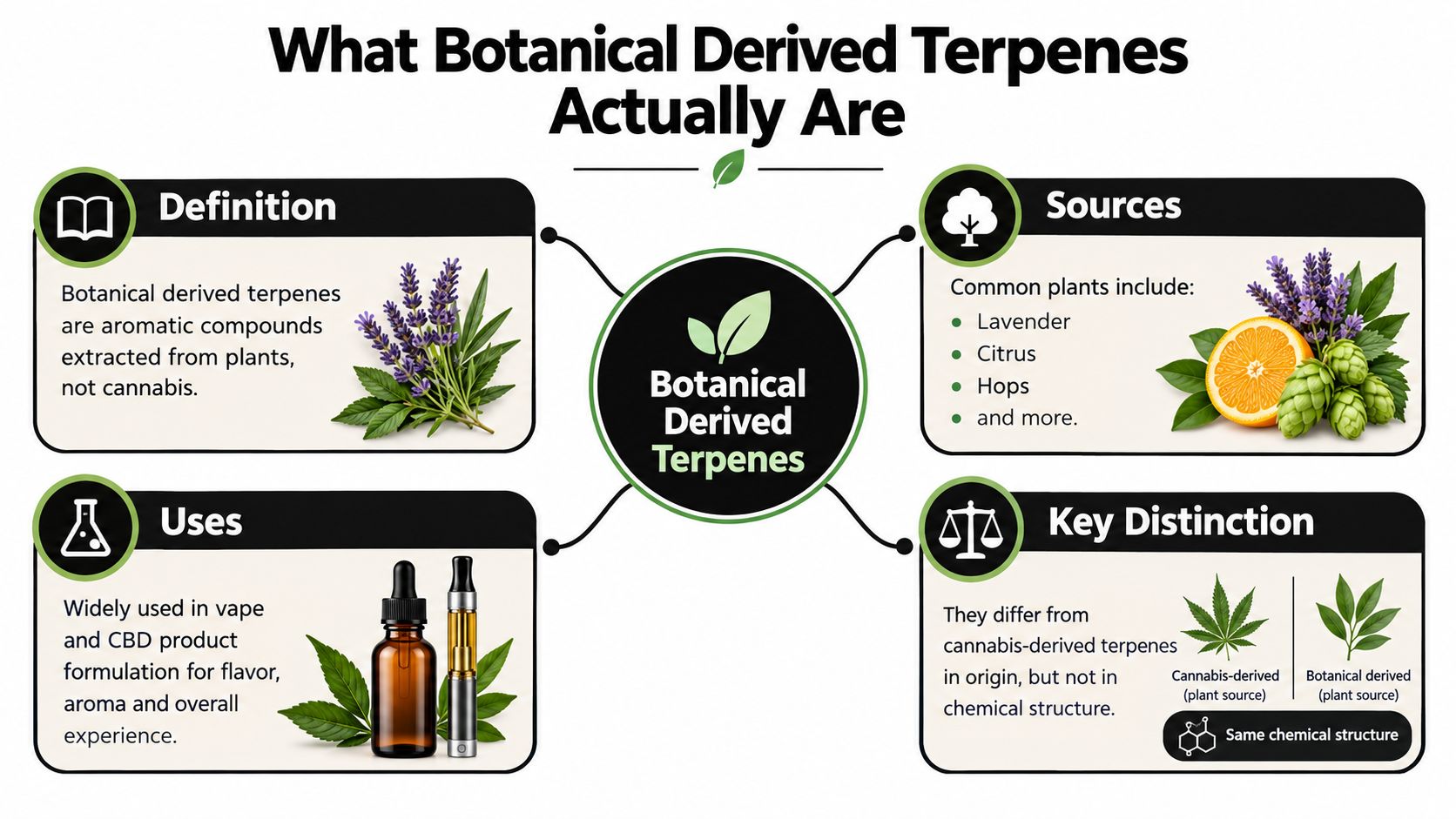
Botanical derived terpenes are aroma compounds sourced from plants other than cannabis and used as formulation ingredients. They aren't extracted from cannabis flower, hemp, or cannabis distillate. Gold Coast Terpenes, based in Redondo Beach, California, describes its catalog as 100% botanically derived and lists 37 Strains and 40 Enhanced Strains for product developers to consider.
Read the source claim, then verify the chemistry
A botanical-source declaration tells you where the ingredients came from. It doesn't, by itself, establish that a blend matches a target aroma, has a particular purity, or is appropriate at a given concentration for inhalation. Likewise, “nature-identical” generally describes a compound made to match a naturally occurring molecule, while “synthetic” describes a chemically produced ingredient. Those terms aren't substitutes for a composition record or analytical results. Ask suppliers to clarify how they use each term and to document the actual ingredients.
The distinction matters because the same named terpene can occur in different plant sources, while a finished blend may combine multiple isolated compounds. Limonene, myrcene, pinene, and beta-caryophyllene are distinct molecules within a much larger family of plant products. Their source doesn't make them interchangeable as a blend: composition and relative amounts shape the aroma.
For procurement, don't treat botanical origin as automatic proof of legal acceptance. Rules differ by jurisdiction and product type, so confirm the relevant requirements for the intended market and application. A source statement can help support an ingredient declaration, but it won't replace the records a buyer or regulator may need.
Explain the label to a buyer
A clear supplier conversation should cover source, ingredient identity, batch documentation, and intended use. For a wider look at how product categories and intended applications differ, Pink Smoke Shop's overview of non-nicotine e-cigs offers adjacent context for readers comparing inhalable product formats. It doesn't establish terpene compliance, so keep the supplier's technical documentation and your own market review central to the decision.
How Plants Produce the Terpene Palette You Formulate With
Plants build terpenes from two five-carbon precursors, then enzymes rearrange those building blocks into different molecular families. That chemistry helps explain why botanical sourcing offers formulators a broad palette rather than one generic aroma ingredient.
Plant terpenoids ultimately trace back to isopentenyl diphosphate and dimethylallyl diphosphate. Terpene-synthase enzymes combine and rearrange these precursors to produce monoterpenes, sesquiterpenes, diterpenes, and larger molecules. Other enzymes can then add oxygen-containing groups and make further modifications. A review reports that more than 30,000 individual terpenoids had been identified by the time of its publication, with at least half synthesized by plants (review of plant terpenoid diversity and biosynthesis).
This is why a formulator doesn't replicate a strain-inspired aroma by selecting one prominent molecule and stopping there. The work is in choosing compounds and ratios that create the intended balance. A bright citrus top note, a green or herbal middle, and a deeper woody or spicy base can be designed from distinct constituents, but the final blend still needs to be assessed in the intended oil and device.
A strain-inspired botanical blend is a controlled selection of compounds from a vast natural chemical library, not a generic fragrance category.
Plant terpene research has moved from studying aromatic oils to characterizing biosynthetic pathways. In 2000, researchers identified a complementary DNA clone that encoded a multiproduct monoterpene synthase; in 2003, studies linked terpene biosynthesis with floral terpene emission in Arabidopsis and produced metabolically engineered transgenic lines (review of plant terpenoid research milestones). Those milestones illustrate the biochemical foundation behind modern profiling and pathway research, not a guarantee that every commercial blend will be consistent.
For formulators who want a plain-language account of the plant chemistry, Gold Coast Terpenes' guide to terpene biosynthesis is a useful companion to supplier discussions.
Sourcing and Producing Botanical Derived Terpenes
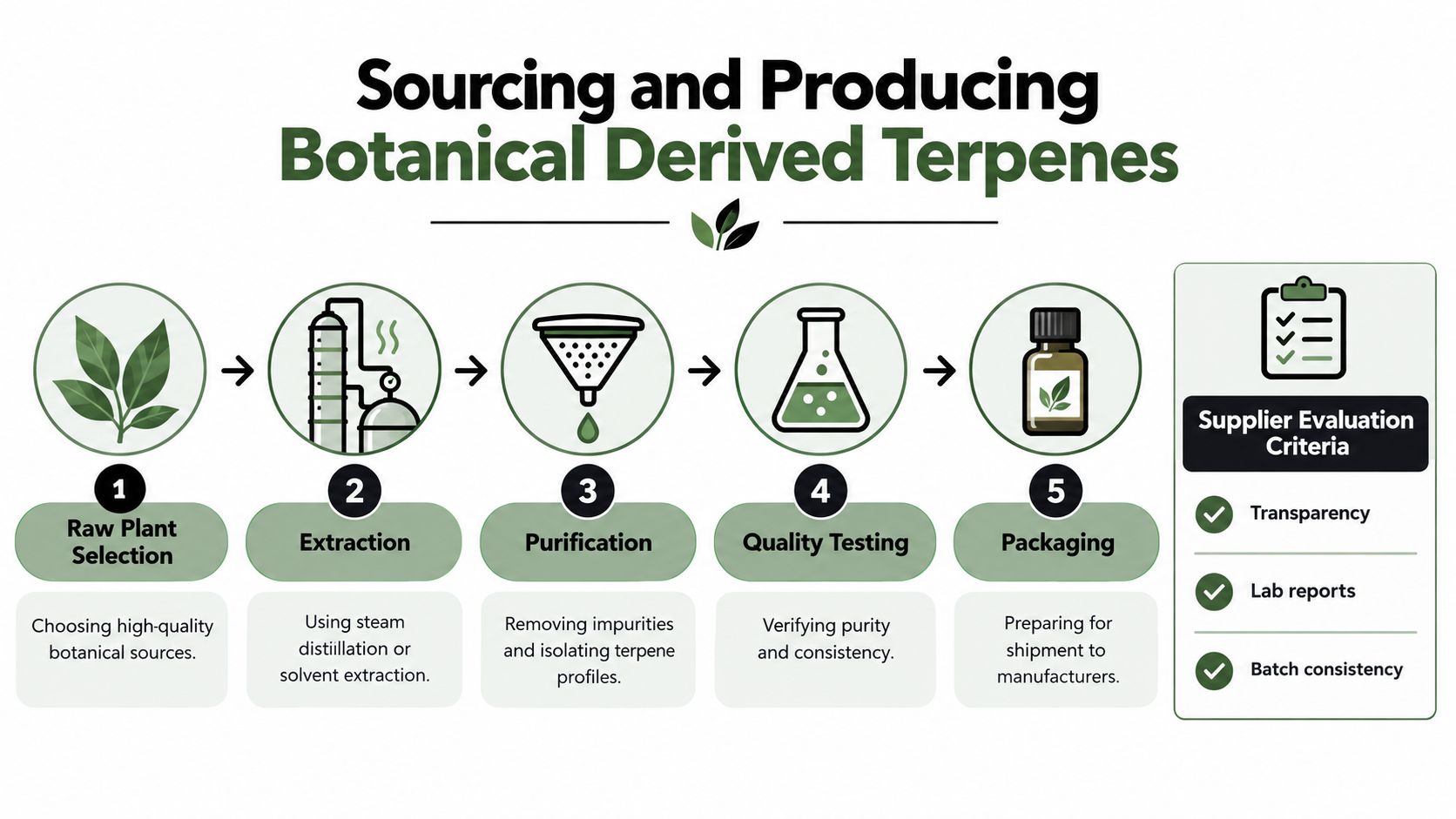
Evaluate a botanical terpene supplier by its extraction controls and batch data, not by aroma alone. A repeatable ingredient needs a defined path from plant material to analytical verification.
Follow the material through production
Processing starts with plant material and a suitable extraction route, such as solvent extraction or distillation. Cell disruption helps release compounds from the plant matrix. Further separation removes interfering constituents, which can include phenolics and aldehydes, before the resulting material is evaluated for its intended role.
Gas chromatography is suited to profiling volatile terpenes, and GC–MS can help identify and quantify compounds in a complex sample. Use glass sampleware rather than plastic for this work: plastics can leach extractable compounds that interfere with chromatography and contaminate analytical equipment. A supplier's process description should make clear how samples are handled and what the test measures.
Read the COA as a batch record
A useful certificate of analysis should connect the sample to a specific batch and show identity markers, quantitative ranges, and impurity screening. Don't rely on a supplier's product name, a general aroma description, or a single headline result. For a working specification, consider:
- Composition: major-compound percentages and total terpene content.
- Contaminants: residual-solvent limits and impurity screening relevant to the process.
- Condition: oxidation markers and a chromatographic fingerprint that can be compared across batches.
The same plant name doesn't promise the same composition. Cultivar, growing conditions, harvest timing, extraction method, and storage history can all affect the profile. Standardized blends made from verified botanical isolates can help manage that variation, provided the blend itself is documented and checked.
For a deeper explanation of extraction choices, see Gold Coast Terpenes' terpene extraction resource. For teams managing supplier records and production workflows, SIX ERP's overview of manufacturing capabilities provides relevant context on organizing manufacturing information.
Botanical vs Cannabis Derived Terpenes for Formulation
Choose between botanical and cannabis-derived terpenes by matching the source to the product's flavor target, consistency needs, regulatory context, and base oil. Neither source label guarantees a complete aroma profile or suitability for every application.
| Criterion | Botanical Derived | Cannabis Derived |
|---|---|---|
| Flavor | Can be composed from selected plant-derived compounds to target a profile. | May retain a complex mixture from the cannabis source, depending on extraction and handling. |
| Consistency | A verified isolate blend can be specified and checked by its composition. | Source material and processing can affect the resulting profile. |
| Regulatory fit | May avoid cannabis-derived ingredients, but acceptance depends on jurisdiction and product rules. | Can face additional restrictions where cannabis-derived ingredients are regulated. |
| Formulation | Can be used as a defined blend in distillate or other bases, subject to compatibility and testing. | May bring a broader plant-derived mixture, requiring its own characterization and compatibility work. |
Choose for the manufacturing constraint
Botanical-derived blends can suit brands that prioritize a defined ingredient source and repeatable batch fingerprinting. They can also be useful when a formulation needs to avoid introducing cannabis-derived material. Don't overstate that advantage: botanical sourcing doesn't itself prove legal acceptance, THC status, inhalation safety, or flavor accuracy. Verify those points against documentation and the rules for each destination market.
Cannabis-derived material may appeal to brands seeking an ingredient sourced directly from cannabis. But the source can bring regulatory complexity and variation, and extraction can influence which compounds remain. Buyers should assess actual composition and finished-product performance rather than assume the label guarantees a faithful match to flower.
For a product example within the Elevated Strains catalog, Apple Fritter identifies a named flavor profile, but its name alone isn't evidence of composition, analytical results, or regulatory status. Request and review the relevant technical documentation for any candidate ingredient.
Gold Coast Terpenes' catalog includes 37 Strains and 40 Enhanced Strains, and the company describes its blends as botanical and THC-free. A buyer should still confirm the specific batch records, intended use, and market requirements before selecting a supplier or releasing a finished product.
Loading Botanical Derived Terpenes Into Distillate and Carts
Terpene loading is a formulation variable that affects viscosity, sensory intensity, and aerosol behavior. Treat published compositions as reference points for development, not as a universal batch specification.
Commercial cannabis concentrates commonly contain 60–90% cannabinoids and approximately 5–15% terpenoids or added flavors by weight, with other compounds making up the balance (review of cannabis concentrate composition). That range shows why terpene addition belongs on the batch sheet as a material decision. The right loading depends on the base, target profile, device, and applicable product requirements.
A published cannabis-vaping study used a 9:1 THC-to-terpene ratio as a practical model because it produced a material that was neither excessively viscous nor overly fluid. The researchers tested myrcene, linalool, limonene, and a commercial terpene mixture; the ratio is a research benchmark, not a ready-made production specification (study of terpene-containing cannabis vape formulations).
Develop against the oil and device
Start with a small, documented formulation trial. Record the starting oil, blend identity, loading, mixing conditions, and observed viscosity. Then check whether the resulting oil feeds and performs as intended in the selected cartridge hardware. A blend that smells accurate in a vial may not deliver the same sensory impression after mixing or aerosolization.
Research on THC–beta-myrcene mixtures found that increasing the mass percentage of beta-myrcene correlated with less degradation of the starting material and a product distribution consistent with lower aerosolization temperature (research on THC–beta-myrcene mixtures). That finding reinforces a practical point: terpene selection can influence more than aroma. It's a reason to test the actual formulation, not a basis for assuming a particular device will perform safely or consistently.
Pair sensory matching with cartridge hardware testing, draw-cycle testing, and analytical evaluation of emissions. Don't treat the blend as flavor-only.
For repeat work, preserve the batch record and test the formulation again when changing the oil, blend, or hardware. Gold Coast Terpenes' guide to mixing distillate with terpenes can help organize ratio trials, but final specifications belong to the manufacturer's validated process.
Storage, Oxidation, and Inhalation Safety Beyond the Natural Label
A “100% botanical” claim describes source, not inhalation safety. Formulators need to account for degradation during storage and evaluate the finished product under its intended conditions of use.
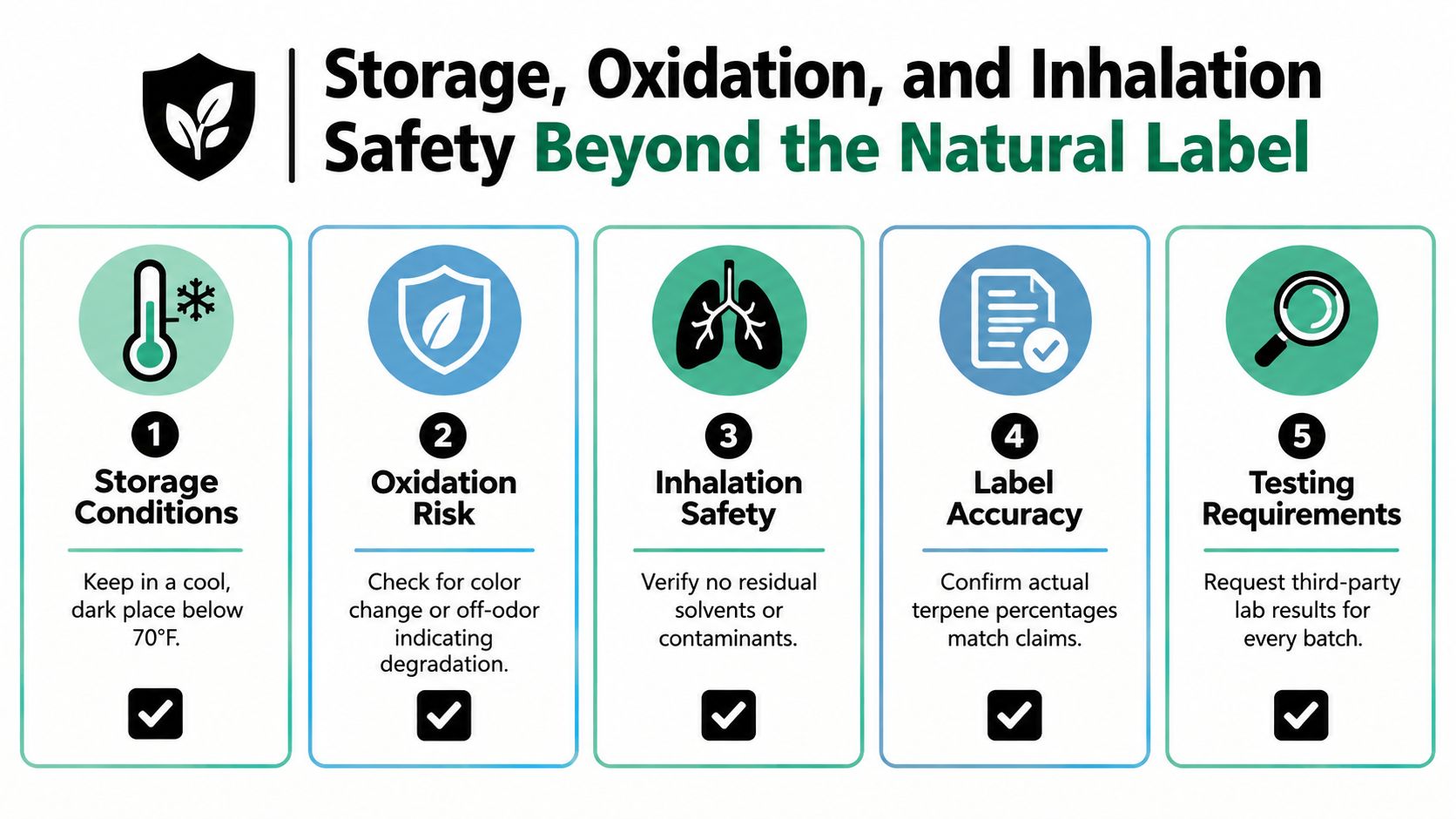
Unformulated essential-oil mixtures can change through volatilization, oxidation, photolysis, and heat exposure. These processes may reduce potency or create altered oxidation products. Amber glass, reduced oxygen exposure or inert-gas headspace, cool storage, and antioxidant or encapsulation strategies can help limit degradation. For production, document filling and storage conditions, protect material from light, and use periodic GC–MS checks when stability matters (review of terpene stability and inhalation considerations).
A 2025 analytical study found that terpenes can degrade at different rates despite structural similarities, and identified p-cymene as a major aging product (analytical study of terpene degradation). A separate review of terpene-containing vape oils reports loadings of 10–20% by weight and estimated aerosols of roughly 2,500–5,000 ppm total terpenes. It also describes comparatively high free-radical levels for linalool, dipentene, and citral in an in-vitro analysis of flavored electronic nicotine aerosols (review of terpenes in cannabis vaping products). Those observations don't establish a universal risk threshold, but they do make concentration and aerosol testing relevant formulation questions.
Separate raw-material review from finished-product evaluation
Inhaled volatile compounds can reach airway and alveolar surfaces, and reviews report respiratory concerns for some flavoring and essential-oil constituents at sufficiently high exposures. A raw-material COA doesn't show what a specific blend will produce when heated in a particular cartridge. Assess concentration, aerosol-generation temperature, device design, impurity formation, and intended route of administration.
Gold Coast Terpenes describes its ingredients as lab-verified and SC Lab-tested. Those claims can inform supplier review, but manufacturers should confirm what each test covers and conduct finished-product testing appropriate to their formulation and market. Reassess after material changes, including a different blend, oil viscosity, or hardware configuration.
Buying and Scaling Botanical Terpenes From Sample to Production
Move from sample to production by fixing the profile, recording the formulation, and confirming the purchasing tier with the supplier. A small trial can reveal sensory and handling issues, but a production decision also needs documentation, repeatable specifications, and a clear commercial path.
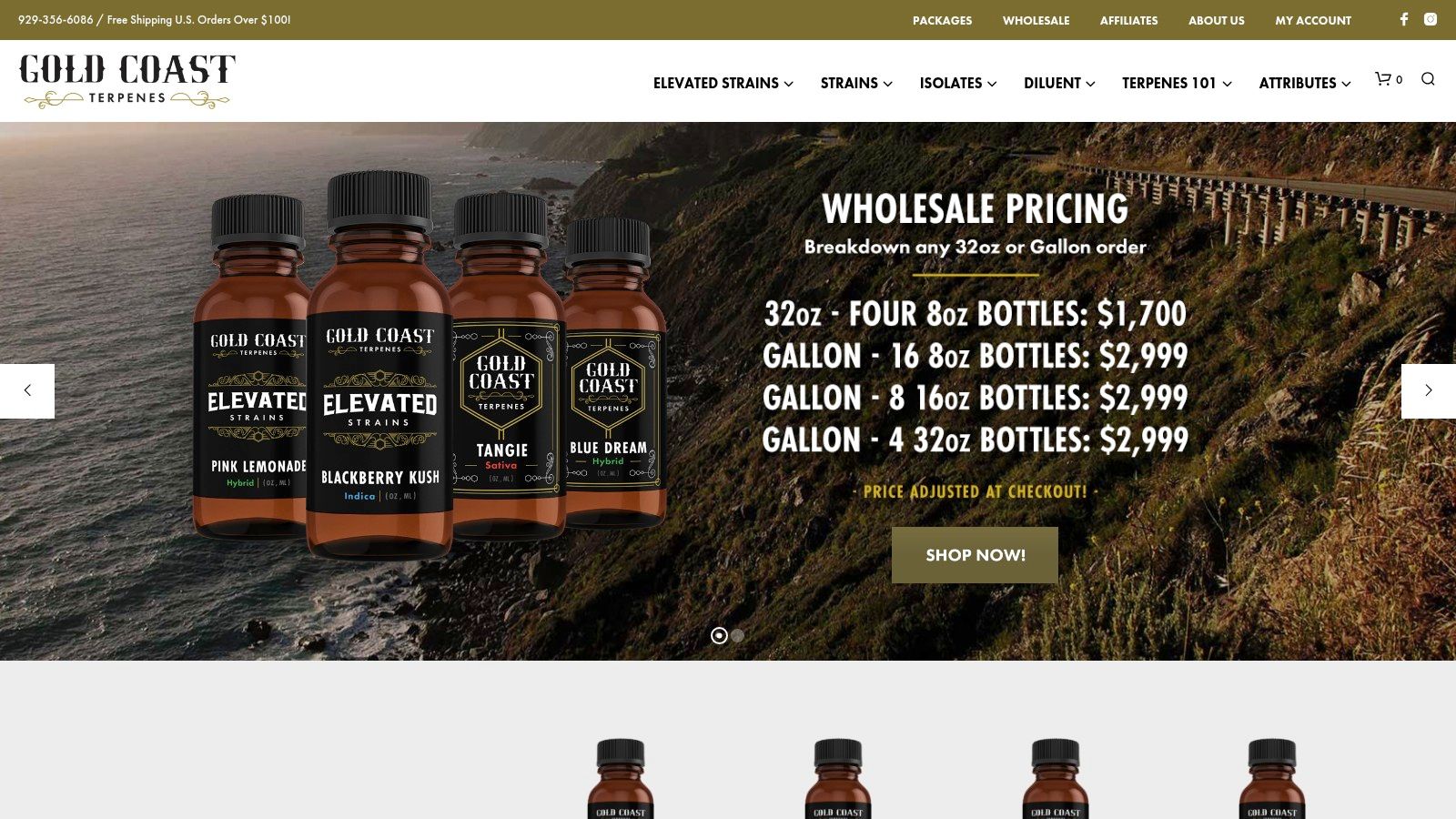
Gold Coast Terpenes lists individual strains, curated packs, isolates, and diluents, alongside wholesale, affiliate, and bulk programs. The company describes its terpene products as THC-free and free of VG, PG, PEG, and MCT, and says they're SC Lab-tested. Treat those as supplier claims to verify against the current product documentation and your intended application.
Make the first purchase useful
Choose a sample based on the target aroma and base oil, then record the lot, blend, loading, mixing conditions, and test results. Use a repeatable mixing worksheet rather than relying on a remembered ratio. Gold Coast Terpenes provides a Mixing Calculator, Terpenes 101, safety documents, and state information; these resources can support development, but they don't replace your own quality controls or jurisdictional review.
The company states that U.S. shipping is free on orders over $100 and that discounts apply to orders exceeding 64 oz. Confirm current terms, eligibility, and shipping details before placing a purchase order. Teams planning recurring production can use the wholesale terpene information page as a starting point for discussing order size and supply needs.
Before scaling, define acceptance criteria for aroma, composition, viscosity, and stability. Keep the supplier's batch documentation with your internal production records, and establish how you'll assess replacement lots. A purchasing threshold doesn't replace technical qualification: approve the ingredient and the finished formulation separately.
Questions Formulators Ask Before They Buy
A supplier conversation should resolve profile fit, starting formulation work, and documentation before a production order. These answers are practical starting points, not substitutes for product-specific testing or regulatory review.
Can botanical blends reproduce a recognizable strain-style profile?
They can be formulated to target a recognizable aroma profile, but the strain name alone doesn't prove a chemical match. Compare the blend's GC–MS documentation and sensory performance with your target, then evaluate it in the actual base oil and device.
What do the enhanced fruit-and-dessert profiles add to a formulation?
These profiles concentrate rarer compounds such as certain esters and lactones that read as pastry or tropical-fruit notes at low loadings, so bench-trial them at the lower end of your ratio range before scaling. 24k Gold Punch is one named flavor in the catalog; assess any candidate profile against your own target and product testing criteria.
What terpene percentage should a distillate cart start with?
Use a controlled bench trial rather than adopting a single percentage across all oils and cartridges. Published composition ranges and research-model ratios can help frame development, but viscosity, sensory intensity, hardware behavior, and finished-cartridge emissions testing should set the final specification.
What records should a buyer request?
Request a batch-specific COA, SDS, ingredient or source declaration, and records that support identity, composition, and impurity review. Match the COA to the lot number on the container you received, and file it with your own formulation and finished-product test records so you can defend the ingredient choice during a supplier audit or jurisdictional review.
Gold Coast Terpenes offers botanical blend profiles, isolates, formulation tools, and supplier documentation for teams developing distillate and cartridge products. Review the technical details against your target profile and finished-product requirements, then visit Gold Coast Terpenes to identify a blend for your next formulation trial.