
A formulator has a target flavor in mind, a batch of distillate on the bench, and a terpene spray ready to apply. Gold Coast Terpenes is a Redondo Beach, California supplier of 100% botanically derived, THC-free terpene blends, but a botanical source doesn't make dosing automatic or determine how a finished product will perform when heated. How to use terp spray for a commercial formulation starts with identifying the end product, measuring by mass, and validating the result in the intended hardware.
The spray step is a controllable point in the process. A measured addition can shift aroma and viscosity; poor mixing, oxidation, or an unsuitable ratio can affect stability and aerosol composition. Treat the blend as a formulation ingredient with its own identity, batch records, and safety documentation, not as a shortcut for correcting a base oil that's out of specification.
What Terp Spray Does in a Formulation Lab
A spray can change more than the aroma in a vial. In a formulation lab, it delivers a measured terpene blend to a material, where the addition can affect sensory character, compatibility, and the aerosol produced by heated hardware. For a vape formulation, define the flavor target, then test whether the blend behaves as intended in the cartridge and heating system. Gold Coast Terpenes lists 37 Strains and 40 Elevated Strains, and identifies its blends as SC Lab-tested and free of VG, PG, PEG, and MCT. These facts can inform supplier screening, but finished-product testing remains necessary.
Start with the profile, not the bottle
A strain-inspired blend gives developers a reference profile. Aroma comes from components with different sensory roles: top notes tend to create the first, volatile impression; mid notes shape the blend's central character; and base notes add weight and persistence. Record the intended character and the compounds or blend components selected to pursue it. Because top notes are the most volatile fraction, use a covered equilibration period after mixing to limit their loss and protect the compounds that define first impression. A familiar label name does not replace a composition record or sensory comparison.
The carrier and exposure route also matter. Terpenes are volatile organic compounds, and natural origin does not establish that a substance is harmless or suitable at every concentration. A Canadian government assessment modeled an air-spray scenario containing 2% bay oil. It estimated adult systemic daily exposure at 8.48 × 10^-6 mg/kg body weight per day and lifetime-average daily exposure at 6.41 × 10^-6 mg/kg/day (Canadian assessment of the phenylpropanoids and aldehydes group). Those estimates distinguish the ingredient concentration in a product from the amount absorbed by a person. Application method, droplets, room conditions, contact time, and route all affect exposure.
Bench rule: Define the spray's purpose before opening it. A blend and application method suited to one use should not be assumed suitable for a cartridge, non-inhaled coating, or aroma test.
For product developers, the practical test extends beyond bottle aroma. Measure whether the addition remains uniform, check how it behaves in the target material and hardware, and assess whether the desired sensory character holds through processing and storage. Heated use also warrants attention to aerosol composition and oxidation, which cannot be judged by smell alone.
Matching Your Spray Plan to the End Product
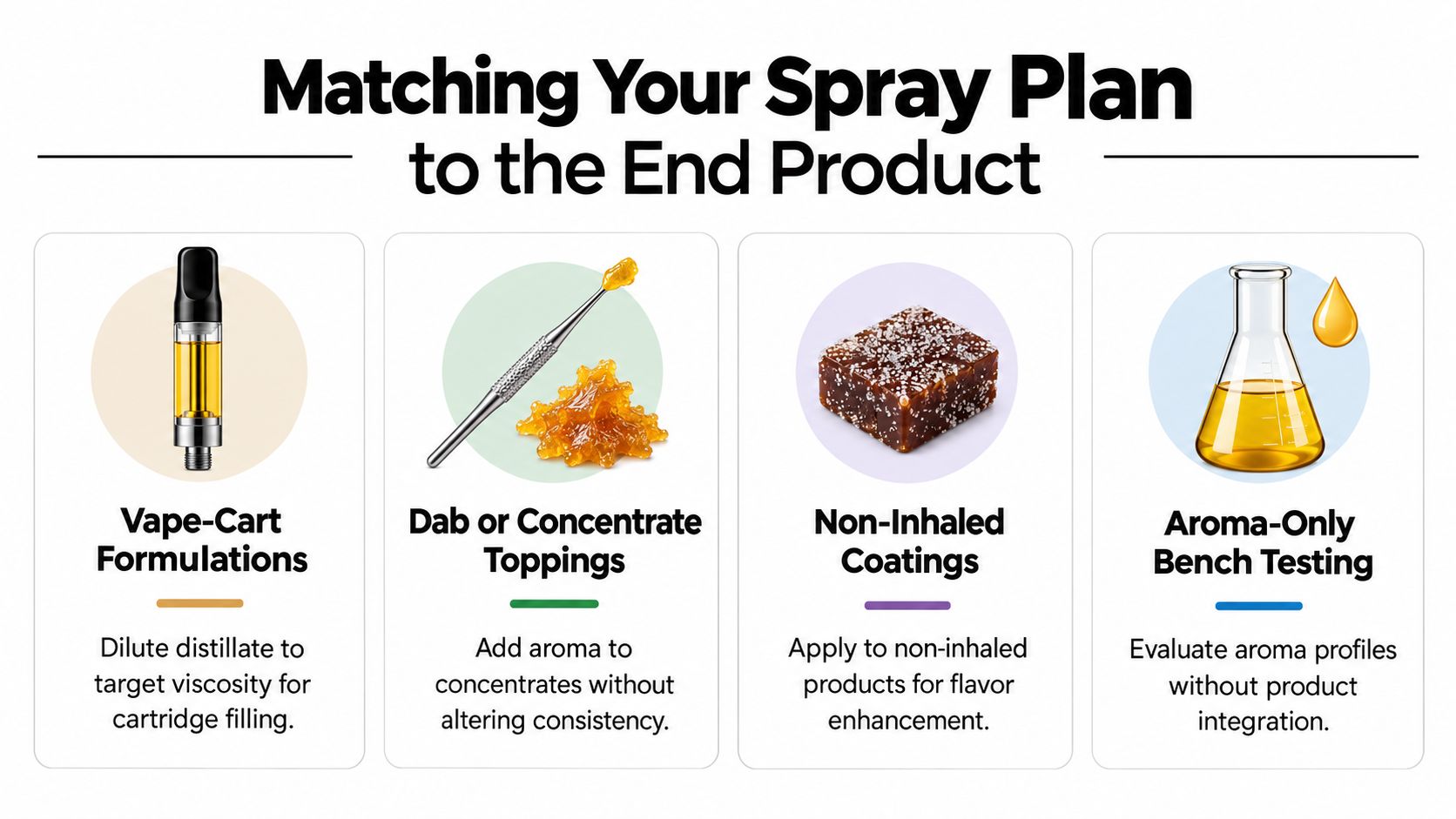
A spray intended for a cartridge needs different checks from one used for a coating or aroma comparison. First classify the project as an inhalable formulation, a non-inhaled coating, a topping, or an aroma-only test. That choice sets the measurement method, carrier compatibility, ventilation needs, and validation required. Terp spray is a concentrated aromatic formulation, not something to inhale directly.
Separate the use cases
Vape-cart formulations need a mass-based ratio, careful mixing, and testing in the intended device. Oil viscosity, aerosol output, leakage, and emissions can vary by hardware. A strong aroma in a vial does not establish that the heated aerosol will have the same composition or suitable performance. Validate the blend in the finished device.
Dab or concentrate toppings may change aroma without being designed for cartridge use. Set the intended route and material-compatibility requirements, then record the application and assess the resulting material. Do not assume a cartridge ratio applies.
For non-inhaled coatings, control the deposited amount and let volatile carriers evaporate in a ventilated area before further handling. Keep spray away from faces and airways. Aroma-only bench testing can compare profiles, but it does not establish a suitable dose or validate a finished product.
As noted earlier, product concentration and absorbed dose are not interchangeable. Application volume, droplet behavior, room size, contact time, and route all affect exposure.
Choose the carrier for the material and route
An ethanol-based system and a water-based system are not interchangeable by default. Solubility and release depend on the terpene blend, carrier, and any surfactants or water-miscible solvents. Match the carrier to the route: alcohol-based carriers can evaporate from non-inhaled coatings, while any carrier entering an inhalable oil must be evaluated in the finished aerosol.
The 2005 terpene application study used controlled terpene solutions and a carrier-only comparison on alfalfa pellets, offering a practical process lesson: document concentration, application amount, and carrier controls for each use case.
Building a Controlled Bench Workflow
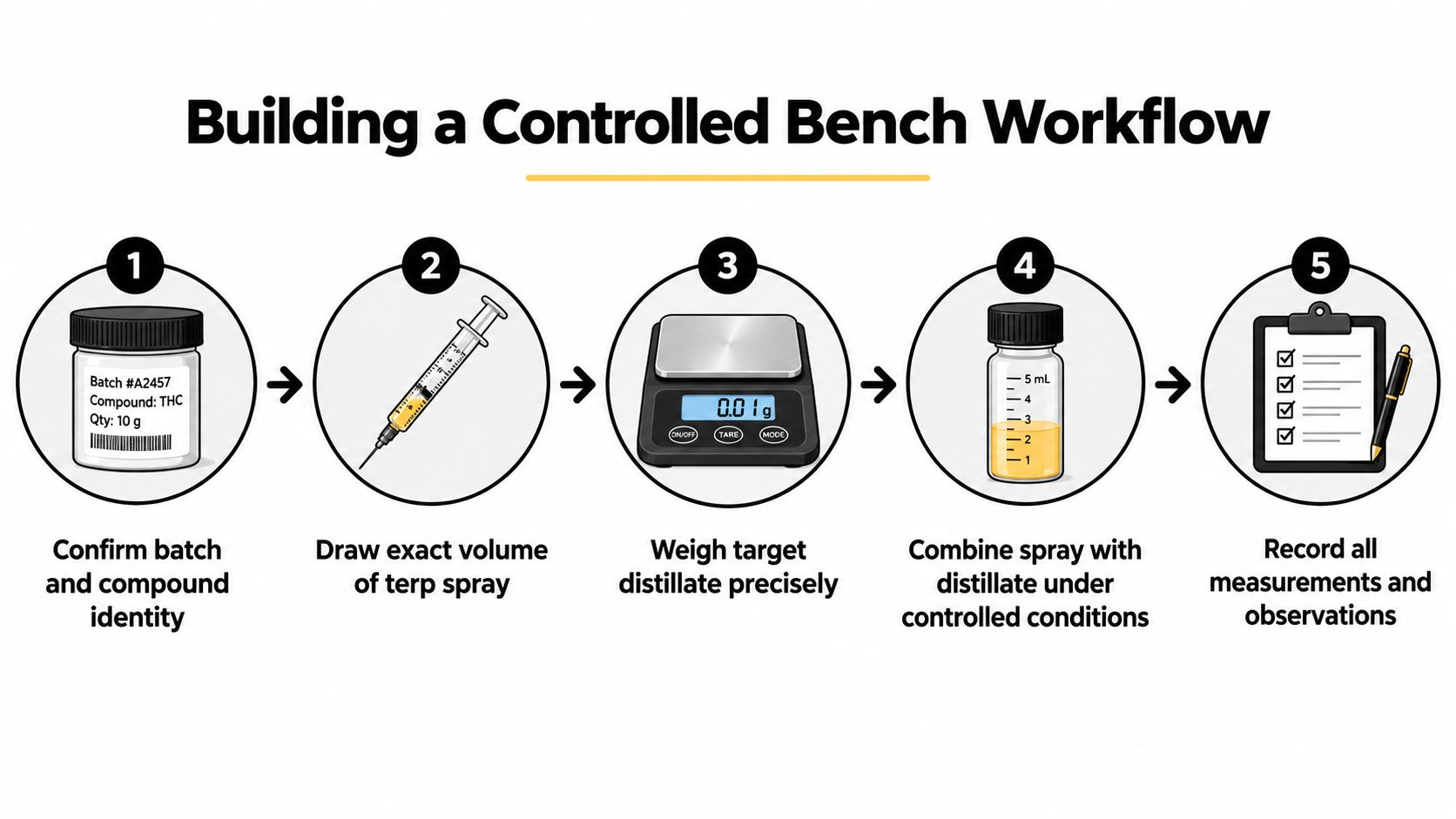
A repeatable workflow uses a known batch, a mass-based calculation, controlled dispensing, and a documented homogeneity check. Set up a calibrated syringe or metering sprayer, a suitable scale, the target material, and the batch record before dispensing. A scale reading to 0.01 g can support small-batch work when its capacity and performance suit the batch, but the instrument must be appropriate to the target mass.
Use a document-ready sequence
- Confirm identity. Record the base material, terpene blend or isolate, lot numbers, and intended application.
- Weigh the base. Record the actual mass of distillate or concentrate before adding anything.
- Calculate the target. Work from the intended terpene fraction by mass, not drop count or an assumed volume conversion.
- Dose incrementally. Use a calibrated syringe or metering sprayer and record each addition.
- Mix under controlled conditions. Keep the vessel closed when practical, mix until the blend appears uniform, and allow a covered equilibration period before assessing or filling.
A drop count is an unreliable dosing method because drop size changes with the dispenser and liquid. Visual estimates make batch-to-batch comparison difficult and can lead to overdosing, harsh flavor, instability, or inhalation concerns. The point isn't to make the process complicated; it's to make the addition reproducible.
Carrier selection also belongs in the batch record. Ethanol or another carrier must suit the target material and intended route. Don't assume a water-based spray will behave like an alcohol-based one, or that a carrier suitable for aroma testing belongs in an inhalable oil.
After mixing, verify uniformity before filling. For a cartridge formulation, the full batch should meet defined checks for viscosity, fill weight, potency, terpene profile, and device performance. Gold Coast Terpenes provides a terpene mixing guide that can sit alongside a company's controlled worksheet; a calculator or guide can support the arithmetic, but the operator still owns the batch record and validation.
Choosing a Starting Ratio That Matches Your Hardware
A published concentrate-vaping study used a 9:1 cannabinoid-to-terpene ratio, equivalent to 10% terpene by mass relative to the cannabinoid portion, as a practical experimental formulation. Treat it as a screening benchmark, not a universal production specification: the right result depends on the concentrate and hardware, and the finished product must be validated (cannabis concentrate vaping study).
Screen for performance, then test the device
Too much terpene can make oil too fluid and contribute to cartridge leakage. Too little may leave it too viscous for consistent delivery. Neither issue can be resolved from aroma alone. Screen viscosity first, then check fill behavior and leakage with the actual cartridge, coil, and battery combination.
| Application | Starting Terpene % by Mass | Validation Step | Common Failure If Ignored |
|---|---|---|---|
| Vape-cart formulation | 10% benchmark relative to cannabinoid mass, not a universal target | Check viscosity, leak rate, potency, and emissions in intended hardware | Leakage, inconsistent delivery, or unvalidated aerosol |
| Dab or concentrate topping | No universal percentage established | Confirm application consistency and assess the finished material for its intended use | Uneven aroma or changed consistency |
| Non-inhaled coating | No universal percentage established | Weigh the target before and after application and assess uniformity | Over-application or uneven coverage |
| Aroma-only bench test | No product dose implied | Keep the test separate from product integration | Mistaking a sensory test for a formulation specification |
The benchmark ratio is only one variable. Research on heated myrcene, linalool, limonene, and commercial terpene mixtures has identified thermal transformation products including methacrolein, benzene, aldehydes, and acids. A separate in-vitro study found that toxicity varied with mixture composition, including the proportion of limonene in a comparison mixture (study of terpene and diluent mixtures). That's why a total terpene percentage cannot, by itself, establish the performance or safety of a blend.
For profile matching, use a defined target and evaluate the finished formulation rather than increasing the addition until the aroma seems strong enough. A product page such as 24k gold punch can serve as a named profile reference, but product naming alone doesn't document composition or prove a match.
Gold Coast Terpenes also publishes a distillate addition guide. Use any starting model as a trial condition, then record the actual ratio and test viscosity, leakage, potency, and emissions before scaling.
Spray Technique, Storage, and Batch Records
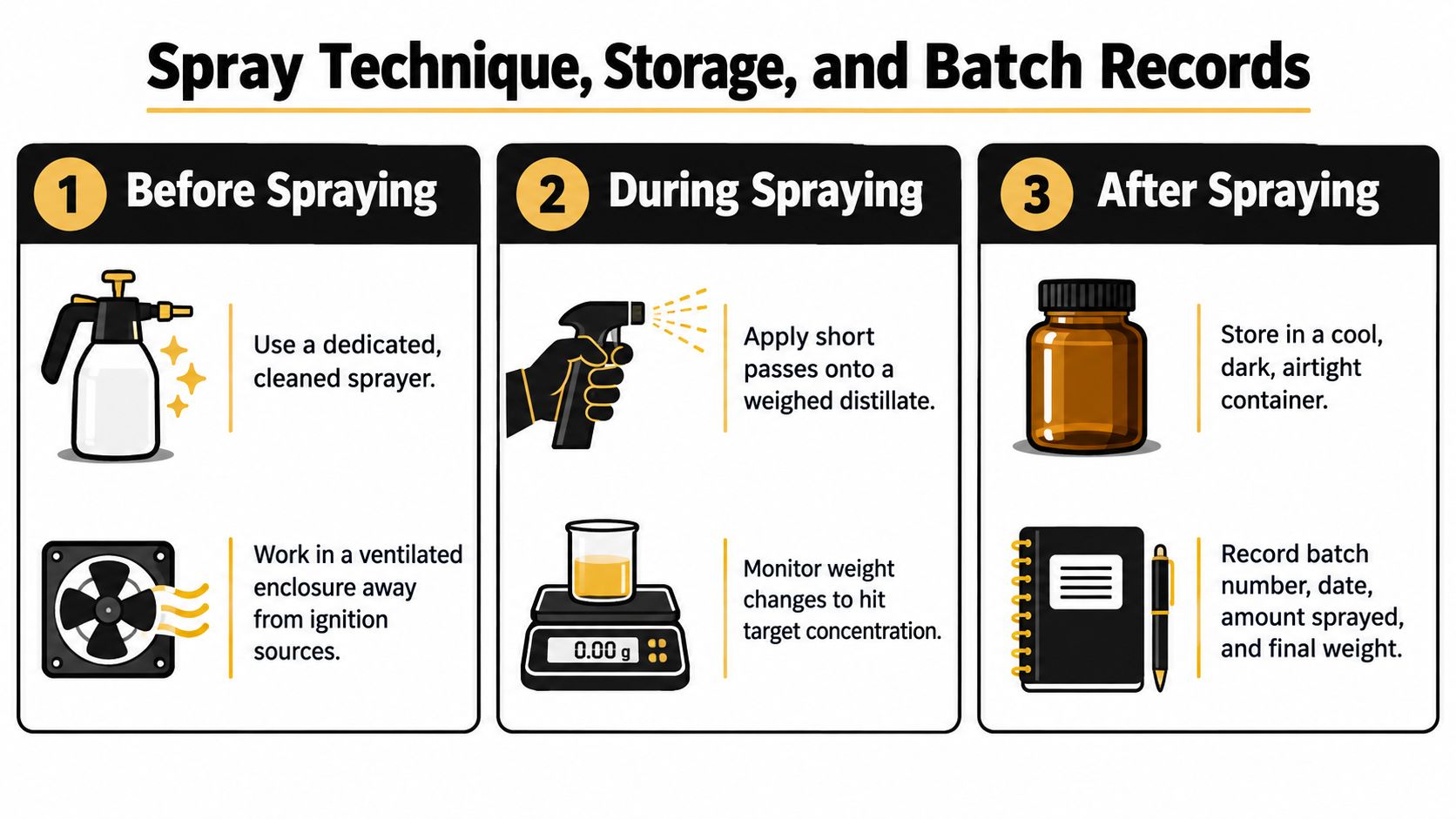
A controlled spray pass starts with a clean dedicated sprayer and a weighed target, then ends with a sealed container and a complete record. Apply only enough to uniformly coat the intended material, keep the spray away from the face and airways, and work in a well-ventilated area away from ignition sources.
Apply and verify the deposited mass
Use a sprayer dedicated to the formulation and clean it according to a documented procedure. Spray in short passes onto a weighed target instead of holding the trigger in one place. Reweigh the material or its container after application to estimate deposited mass, then compare replicate samples for relative uniformity using an appropriate analytical terpene assay when available.
The odor immediately after application isn't a reliable measure of dose or success. Keep the material sealed after application to limit volatile loss, and don't use uncontrolled heat to thin oil or accelerate evaporation. Heat can change the formulation and add another uncontrolled variable.
Store for stability and maintain a usable record
Use a tightly sealed, light-protective container with minimal unnecessary headspace, and control exposure to heat and light. Reassess the aroma or analytical profile after storage rather than assuming it remains unchanged. A controlled chamber study found greater cytotoxic potential for aged emissions than for fresh emissions, reinforcing the need to limit avoidable air exposure and evaluate the finished product under relevant conditions (study of aged terpene-containing emissions).
Keep a record of the terpene identity and lot, base-material lot, concentration or dilution ratio, spray mass, mixing time, evaporation period, container, and observations. Retain the current certificate of analysis and safety documentation alongside the batch record. Gold Coast Terpenes offers a terpene storage guide for storage practices, while the manufacturer's own shelf-life and stability criteria should govern release decisions.
Why Stronger Aroma Is Not Safer Performance
A stronger-smelling blend doesn't establish better flavor delivery or safer aerosol performance. The relevant test is the final formulation in its intended hardware, because heating can alter what reaches the aerosol. “Natural,” “botanical,” and “strain-inspired” describe a source or profile idea, not an emissions result.
Test the aerosol, not just the liquid
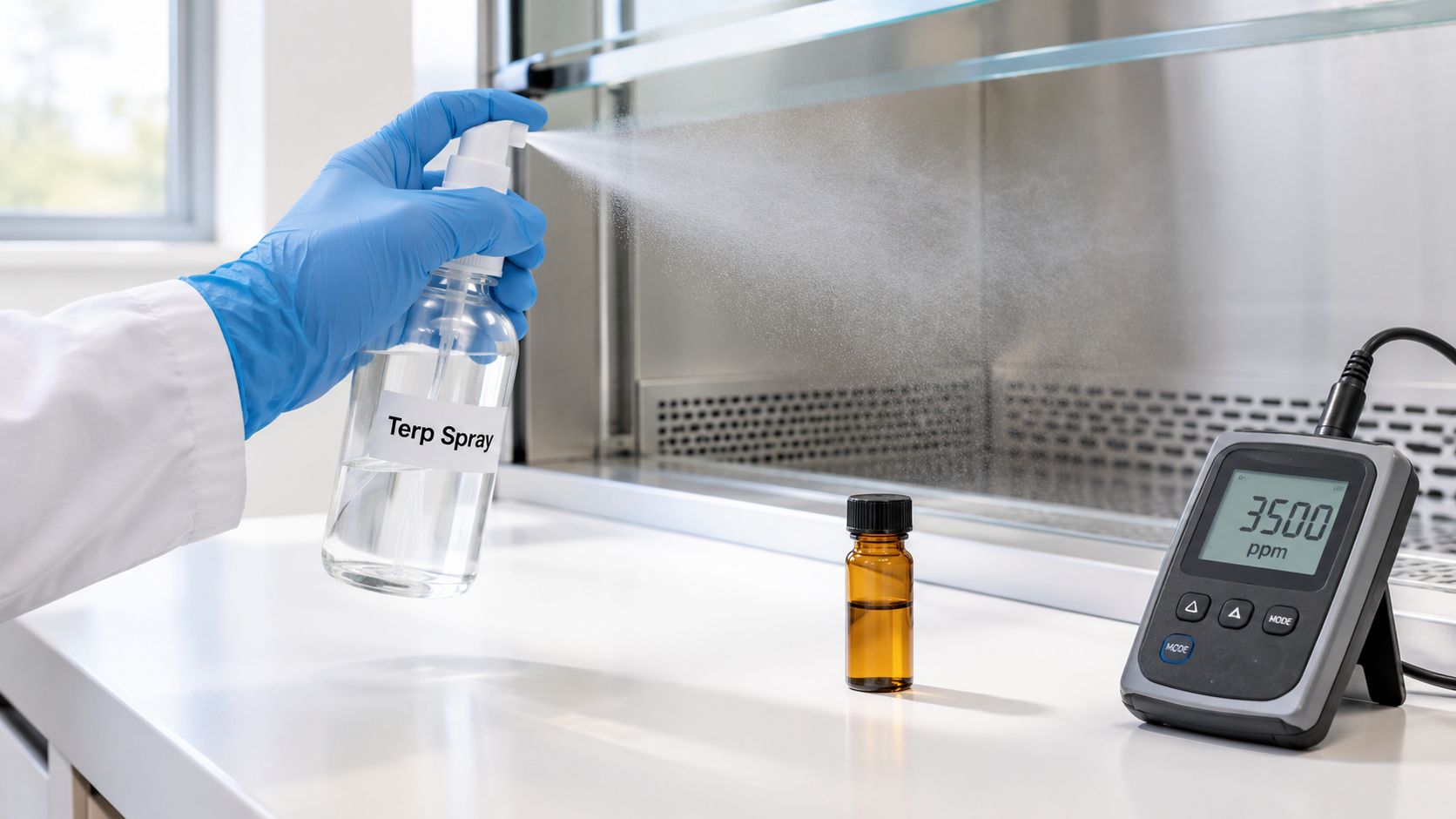
A review of cannabis-oil vaping describes commercial products containing roughly 10–20% terpenes by weight and aerosol concentrations around 2,500–5,000 ppm, with much lower airborne concentrations associated with sensory irritation, airflow limitation, and inflammatory responses in experimental contexts (cannabis vaping review). Those figures are not a formulation target. They show why aroma intensity alone can't serve as a safety measure.
The same review discusses terpene reactions with indoor air pollutants. Limonene reactions can generate formaldehyde and ultrafine particles, so minimize unnecessary aerosolization and ventilate application areas. A vapor's composition can also differ from the liquid blend: studies found fewer terpene types in aerosol than in vapor at higher heating temperatures, consistent with thermal degradation or reaction.
Practical rule: Validate at the operating conditions the product will actually encounter. A bottle test can't stand in for a hardware-specific emissions run.
Gold Coast Terpenes identifies its blends as SC Lab-tested, but supplier testing doesn't replace formulation-specific testing. Assess the finished product at the intended device settings and use the resulting data to inform the allowable formulation range. The practical guide to terpene safety for vaping is useful background, not a substitute for toxicology, stability, and emissions review for a commercial product.
Troubleshooting Common Spray and Cart Failures
Diagnose the failure before changing the terpene dose. A spray won't fix a base oil that's unstable, contaminated, or outside specification. Distillate should already be winterized, decarbed, and within the company's acceptance criteria before terpene addition.
Match the symptom to a test
| Symptom | Likely causes | Confirm with | Corrective action |
|---|---|---|---|
| Leaking cartridge | Excessive terpene loading, low viscosity, hardware mismatch | Viscosity check and leak-rate test | Reassess the ratio and retest with the intended hardware |
| Harsh or acrid aerosol | Excessive loading, oxidation, or thermal transformation | Terpene assay and emissions run | Review the blend and processing conditions; test a revised formulation |
| Faded aroma after storage | Volatile loss, poor sealing, or oxidation | Compare retained sample with fresh material or assay | Improve container closure and storage controls, then reassess stability |
| Clogs or burnt taste | High viscosity, inconsistent mixture, unstable base oil, or device mismatch | Homogeneity check, viscosity check, and device test | Correct the base or compatibility issue before changing the terpene dose |
Don't troubleshoot by adding more aroma on top of an unexplained defect. A published analysis of twelve California cartridge samples collected between September 2018 and December 2019 identified potential additives including vitamin E acetate, polyethylene glycols, and medium-chain triglycerides; separate research also found that heating and aerosolizing cannabis oils can produce additional compounds (analysis of cannabis cartridge samples). Screen the carrier and base formulation, not only the terpene blend.
For a flavor-matching exercise, a named profile such as Elevated Strains can be recorded as the sensory reference. The batch record should still identify the actual blend, ratios, and test results used to evaluate that target.
Bench checklist
- Confirm the base oil is within specification.
- Identify and record the terpene blend and lot.
- Select the use case and intended route.
- Calculate the addition by mass.
- Use a calibrated dispensing tool, not drop counting.
- Apply in controlled passes and mix under closed conditions.
- Record spray mass, mixing time, and equilibration period.
- Seal and store the batch with limited exposure to air, heat, and light.
- Check homogeneity, viscosity, potency, and leak performance as applicable.
- Validate emissions in the intended hardware before release.
Before purchasing, request current certificates of analysis, safety data sheets, SC Lab test results, and clear botanical-versus-nature-identical labeling. Confirm whether the blend is free of VG, PG, PEG, and MCT if those exclusions matter to the product specification, and ask about bulk programs, minimum order quantities, and packaging requirements. Wholesale packaging and consumer-facing claims must follow the rules in each sales jurisdiction; retain batch records and current supplier documentation to support compliance review.
Frequently asked questions
Can I use any carrier with terp spray?
No. Carrier compatibility depends on the terpene blend, target material, and intended route; water-based and alcohol-based systems aren't automatically interchangeable. Confirm suitability against the supplier's technical and safety documentation before formulation.
How do I balance top, mid, and base notes?
Define the target sensory profile first, then compare the blend's composition and aroma with that reference. Don't assume that a strain-inspired name or a stronger first impression proves a close match; assess the mixed and stored product.
How can I verify a strain-inspired terpene blend matches a target flavor profile?
Use a defined sensory reference and document the sample, blend identity, application ratio, and evaluation conditions. For a commercial product, pair sensory comparison with an appropriate terpene profile assay and test the finished formulation.
What should I ask a terpene supplier before ordering bulk?
Ask for the current certificate of analysis, safety data sheet, test documentation, ingredient identity, and botanical-versus-nature-identical labeling. Confirm bulk minimums, packaging, carrier details, and whether the documentation applies to the exact lot being purchased.
Does wholesale terpene packaging need to be child-resistant?
Packaging requirements depend on the product and jurisdiction. Check the applicable local rules before sale, and make packaging, warnings, and product information part of the compliance review rather than assuming one format works everywhere.
How should I compare botanical and cannabis-derived terpenes?
Compare the declared source, composition, documentation, and suitability for the target formulation. Source alone doesn't establish aerosol safety or flavor accuracy, so validate the final blend in its intended product and hardware.
Gold Coast Terpenes supplies botanically derived, THC-free terpene blends and strain-inspired profiles, along with formulation and storage resources relevant to controlled product development. Review the blend documentation and formulation options at Gold Coast Terpenes before selecting a profile for your next bench trial.