
Your batch is clean, the cartridge viscosity is in range, and the flavor still doesn't match the reference profile after filling. In many facilities, the problem isn't the blend sheet. It's the fractionation step, where reflux, vacuum stability, thermal exposure, and contamination control determine which aromatic compounds survive into the finished formulation.
Gold Coast Terpenes supplies 100% natural, THC-free terpene blends, while a terpene distillation kit provides the hardware for recovering, separating, and refining volatile fractions before they enter a vape or distillate formula. The distinction matters to product developers comparing a strain-inspired terpene blend, botanical isolates, and fractions recovered from raw botanical material.
What Is a Terpene Distillation Kit
A terpene distillation kit is a fractional distillation system that uses controlled heat and vacuum to recover and purify volatile aromatic compounds from plant material or extracts. It matters when a formulator needs repeatable fractionation, cleaner cuts, and closer flavor matching than simple bulk extraction can provide.
The kit separates compounds according to differences in boiling behavior. Reduced pressure lowers the temperature needed for vaporization, helping operators work within narrower thermal windows and limit unnecessary exposure to heat. That makes the equipment relevant to replicating the flavor of a reference profile, isolating individual notes, and preparing fractions for cannabis product formulation.
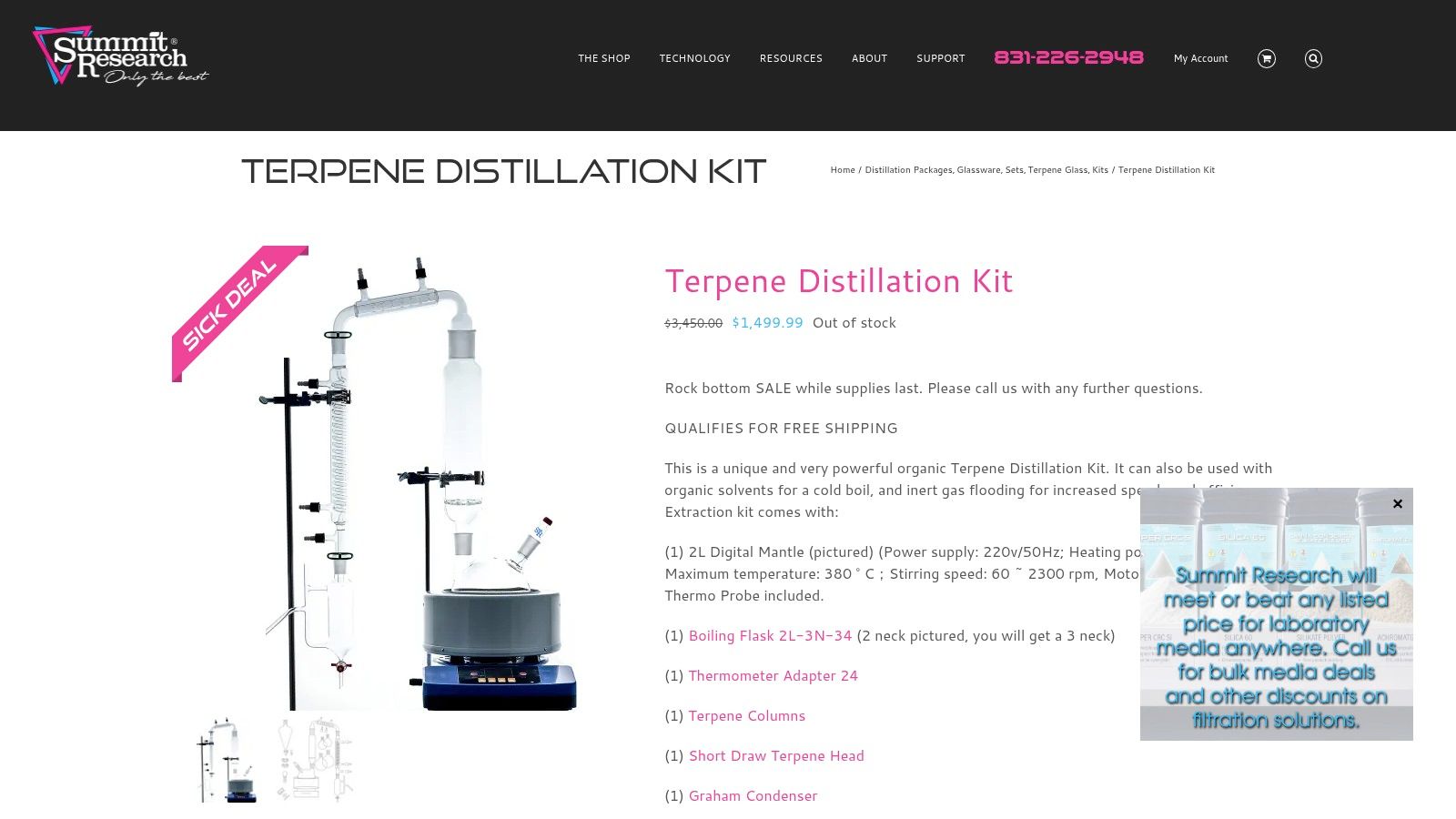
A basic extraction setup may recover a broad aromatic fraction. It won't necessarily give you the control required to distinguish lighter top notes from heavier, more persistent compounds. A properly configured kit adds a boiling flask, heated mantle, fractionation columns, a short-path head, condenser, receiving flasks, and phase-separation hardware so the operator can collect material in controlled cuts.
The hardware doesn't create a finished flavor profile by itself. The operator still has to decide which fractions to retain, how much reflux to use, how to manage vacuum changes, and whether the recovered material is clean enough for formulation. Those decisions determine whether the result is a coherent terpene profile for vape cartridges or a harsh, unstable mixture.
For formulators who want the broader technical background, this overview of terpene extraction techniques provides useful context. In practice, the kit is best viewed as a precision separation tool, not an accessory for merely heating botanical oil.
Understanding Standard Components and Throughput
A standard lab-grade kit typically features a 2 L digital heating mantle, a 380 °C maximum temperature, a 60–2300 rpm stirring range, and a 40 W motor, paired with columns, a short-path head, and condensers for controlled fractionation. Those specifications describe a system designed to manage heat transfer and separation, not merely warm a vessel. (Summit Research)
Why the mantle and stirrer matter
The mantle supplies controlled heat around the flask rather than concentrating energy at one point. The stirrer keeps the feed moving, reducing localized overheating that can darken material or drive off the most volatile compounds before the vacuum and condenser train are ready.
The broad temperature range gives the operator room to work with different botanical inputs, but the maximum temperature isn't a target operating point. Delicate aromatic fractions generally benefit from the lowest effective thermal exposure, especially when the objective is flavor fidelity rather than rapid evaporation.
The stirrer's range is equally important. Low speeds can support gentle mixing, while higher speeds help maintain uniformity as viscosity changes. The 40 W motor supplies the mechanical input needed to keep the contents moving through a controlled run, but speed should be selected against the feed, not treated as a fixed recipe.
What the separation hardware contributes
The column increases contact between rising vapor and returning condensate. That repeated contact, known as reflux, can sharpen fraction boundaries, but excessive reflux reduces collection speed and may keep valuable volatile material in the system longer than necessary.
The short-path head shortens the route from evaporation surface to condenser. A Graham condenser provides a large cooled surface for vapor recovery, while multiple receiving flasks let the operator collect separate cuts instead of combining everything into one receiver.
An oil-water separator becomes useful when condensed material contains distinct phases. It helps isolate an aromatic oil phase from water without relying on improvised decanting, which can increase transfer loss and contamination risk.
Practical rule: Buy the complete vapor path, receiving train, seals, and phase-separation components as a system. A powerful mantle can't compensate for poor condensation or an unstable vacuum connection.
The PTFE components and multiple receiving flasks also support lower-contamination handling during repeated collection. Gold Coast Terpenes' guide to terpene isolation is a useful companion when deciding whether your workflow needs broad recovery or narrower isolated fractions.
Comparing Thermal Windows and Vacuum Requirements
Terpene fractions and heavier terpeneoid fractions don't share the same operating window. Process data reports terpene recovery at 67–70 °C and 2.64 kPa, while terpeneoid separation occurred at 84–96 °C as pressure dropped from 0.66 to 0.33 kPa. (Process study)
The practical lesson is that temperature can't be selected independently from pressure. If the vacuum level drifts, the effective boiling behavior changes, and a cut that looked clean on paper can broaden, overlap another fraction, or lose volatile material through the pump and trap train.
Thermal and vacuum parameters for fraction isolation
| Fraction type | Temperature range | Vacuum pressure |
|---|---|---|
| Terpene fraction | 67–70 °C | 2.64 kPa |
| Terpeneoid fraction | 84–96 °C | 0.66 to 0.33 kPa |
The lighter fraction is usually where flavor fidelity is won or lost. Top-note compounds can provide the first aromatic impression, but they can also be the easiest to strip prematurely if the feed is heated aggressively before the condenser and receiving train are stable.
Heavier terpeneoid fractions require a different balance. Higher thermal exposure can help move the material, yet it also increases the need for stable vacuum, accurate temperature measurement, and disciplined residence-time control. A deeper vacuum may support separation at a lower effective boiling point, but leaks, pump limitations, and condensable loading can quickly undermine the expected result.
Reflux ratio is a quality decision
Higher reflux generally improves contact between vapor and liquid, which can sharpen separation. The trade-off is reduced net collection and longer exposure inside the heated system. Lower reflux can increase throughput, but it may combine neighboring compounds and make the finished blend harder to reproduce.
For a strain-inspired terpene blend, the best cut isn't automatically the purest cut. A highly narrow fraction may lack the supporting notes that give a profile depth. The operator should compare analytical results with sensory fidelity, viscosity, and stability rather than chasing maximum separation at every stage.
Contamination control belongs in the same conversation. Residual solvent, water, degraded oil, dirty receiving flasks, and incompatible seals can all distort the output. A practical reference on why solvent purity matters in research reinforces a principle that applies here too, input cleanliness affects the credibility of the final result.
Use this guide to factors affecting terpene boiling points and temperatures when building a run sheet. Record pressure and temperature together, monitor the transition between cuts, and don't assume a mantle setting represents the actual material temperature.
Operational Safety and Best Practices
Low-boiling compounds aren't automatically low-risk. Concentrated terpenes can be volatile and irritating, while reduced-pressure operation introduces hazards involving implosion, leaks, bumping, superheating, overpressure, and uncontrolled venting. (Safety guidance)
Pre-run checks prevent expensive failures
Inspect every glass component before assembly. Look for chips, star cracks, scratches, and stress marks around joints. A small defect can become a break under vacuum or thermal cycling.
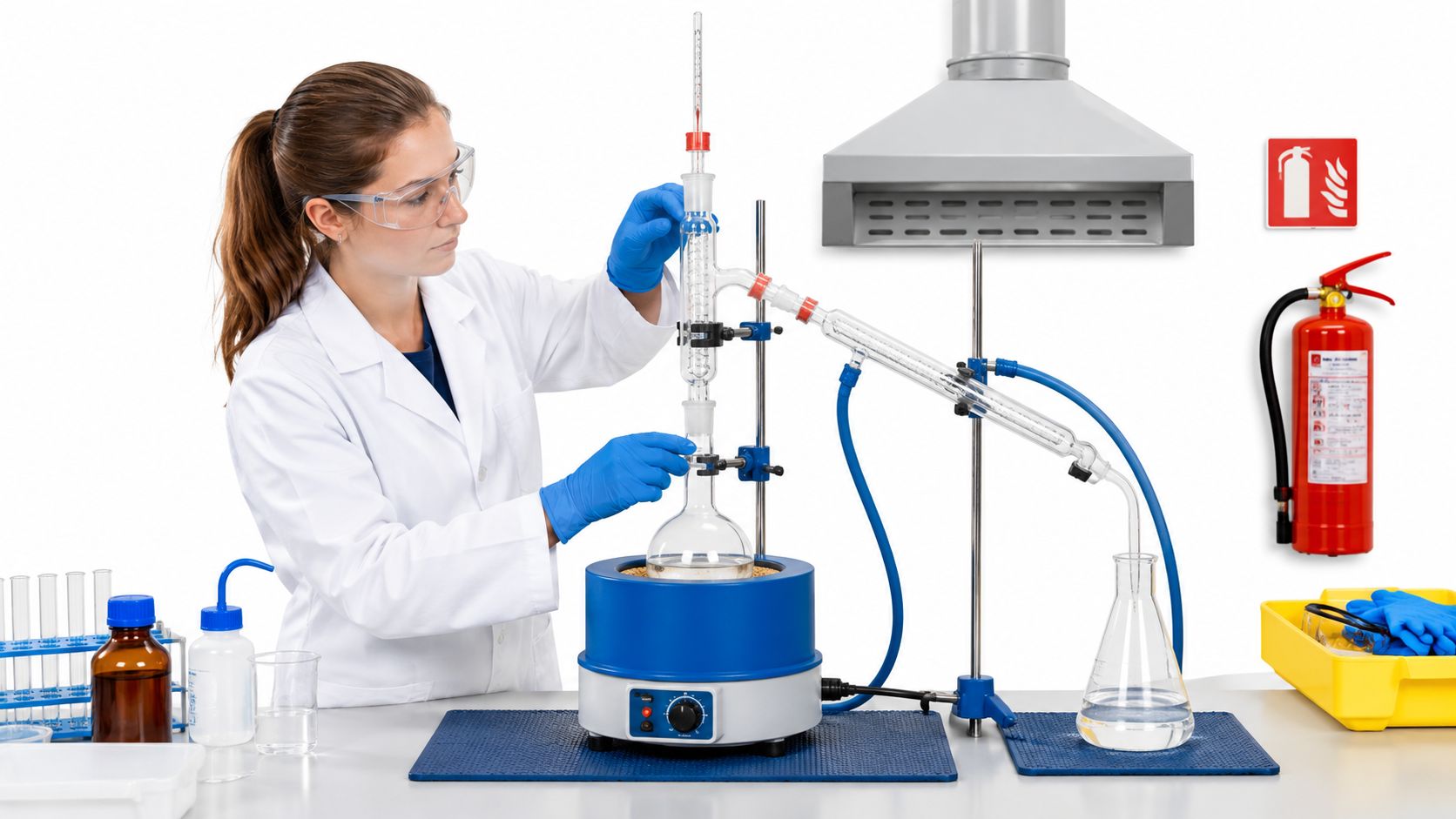
Verify that the vacuum pump is suitable for the expected vapor load and that traps are clean and ready. Check hoses, clamps, seals, receiving flasks, condenser connections, and the temperature and pressure instruments before loading material.
Run the equipment in a functioning fume hood with appropriate PPE, including eye protection, gloves selected for the chemicals involved, and suitable laboratory clothing. Keep the area free of ignition sources and make sure operators understand the system's emergency isolation and venting procedure.
Control the run, don't chase it
Start with stable stirring and gradual heat. Watch temperature and vacuum continuously rather than relying on a preset mantle value. If pressure rises unexpectedly, pause the process and identify whether the cause is a leak, vapor overload, trap saturation, pump trouble, or a blocked line.
Never open the apparatus while it's under vacuum. Vent slowly and deliberately after the system has cooled as required by the equipment's operating procedure. Rapid venting can cause bumping, splashing, or an abrupt pressure change across hot glass.
A safe run is one where the operator can explain the pressure trend, temperature trend, receiver change, and shutdown condition before opening the system.
Manufacturers should also document hazards through a formal process assessment. This manufacturing risk assessment resource can help teams structure that review around equipment, operators, materials, and procedures.
Keep current SDS documents accessible for every feed and formulation ingredient. This guide to the importance of safety data sheets is useful when preparing operator training and batch documentation.
Integrating Distilled Terpenes into Formulation
A cartridge can look uniform in the tank and still perform poorly after filling. Terpene loading affects viscosity, flavor intensity, aerosol behavior, and hardware compatibility, so set it by weight and verify it against the distillate and cartridge system. Vape formulations commonly use 3–7%, while ceramic-coil cartridges are often positioned around 8–12% by weight, with 10% described as a commercial sweet spot. (Distillate formulation guide)
The workable level depends on the distillate, hardware, target sensory intensity, and compliance requirements for the finished product. Higher loading can thin the formulation too far, alter aerosol behavior, overpower the intended profile, or produce an unpleasant result. Flavor fidelity comes from matching the profile and thermal behavior, not merely adding more aromatic material.
A controlled blending workflow
Measure viscosity at 25 °C before making adjustments. This creates a defined reference point instead of relying on how the oil looks while sitting on a hot plate. (Integration guidance)
Warm the distillate to 60–65 °C, then add the terpene fraction slowly over 30–60 seconds. Continue mixing for 15–20 minutes, or until visible streaking disappears. Cool the batch while stirring before filling.
The sequence limits local concentration spikes and improves uniformity. It also gives the operator time to catch separation, haze, unexpected color change, or an aroma shift before the material reaches cartridges. Record the starting viscosity, addition order, blend time, and final appearance so a successful batch can be reproduced.
Build the profile by role
A stable flavor brief assigns each compound a function. Top notes create the first impression, mid notes form the center, and base notes provide depth and persistence. (Terpene flavor guide)
A flavor-matching exercise might use limonene as a top note at approximately 1.5–3.0% of total terpene content, beta-caryophyllene as a mid note at approximately 0.5–1.2%, and myrcene as a base note at approximately 2.0–4.5%. (Terpene reference)
These percentages describe the terpene portion, not necessarily the complete cartridge formula. Keep that distinction in the batch record. Otherwise, operators may confuse a compound's share of the terpene blend with the blend's loading in the distillate.
Botanical and cannabis-derived sources create different development constraints. Botanical ingredients can provide consistent, identifiable inputs. Cannabis-derived material may track more closely with a specific extract, but it can bring greater variability and added labeling or compliance work. Supplier documentation should cover ingredient identity, batch information, safety data, and applicable testing.
When assessing best terpene suppliers for vape brands, ask about botanical versus nature-identical labeling, isolated compounds, strain-specific profiles, MOQs, bulk availability, lead times, and support for pilot and production work. Gold Coast Terpenes offers strain-specific blends, isolates such as limonene, myrcene, and beta-caryophyllene, formulation education, and a mixing calculator for distillate development. The Purified Air Duct Cleaning oil guide concerns essential oils in air purification, not cartridge formulation. Treat aroma products as unsuitable for inhalation unless their identity, intended use, and testing support that application.
How to Choose the Right Kit for Your Goals
Choose the kit by separation objective, feed condition, and required throughput, not by mantle size alone. For R&D and strain replication, prioritize precise temperature control, stable stirring, clean receiving hardware, and dependable vacuum measurement. For production, confirm that the full vapor path, condenser, traps, cleaning process, and operator workflow can support the intended schedule.
A 2 L system can be appropriate for development, fraction screening, and controlled pilot work. It may also suit a smaller manufacturer whose formulation volume is limited, but the vessel capacity alone doesn't establish real throughput. Heat transfer, feed composition, reflux strategy, receiver changes, condenser performance, and operator handling all affect productive output.
Match the configuration to the job
| Goal | Priorities | Common trade-off |
|---|---|---|
| Profile development | Precise temperature control, stable stirring, easy fraction collection | Lower collection speed while testing cuts |
| Isolate-specific work | Clean materials, narrow thermal control, reliable vacuum measurement | More attention to contamination and cut boundaries |
| Vape formulation support | Repeatable fractions, easy sampling, compatible receiving train | Added documentation and release testing |
| Higher-volume production | Robust condenser, trap capacity, maintenance access, repeatable controls | Greater capital and facility requirements |
The most useful buying question is, “What does the kit let the operator control?” A high maximum temperature has limited value if the system can't hold a stable pressure. A fast stirrer has limited value if the receiving train combines fractions. A low price has limited value if replacement glassware, seals, or pumps are difficult to source.
Ask suppliers for written information on component materials, vacuum capability, temperature measurement, condenser design, receiving volume, spare parts, cleaning access, and documentation. Request a clear statement of what is included and what must be purchased separately.
Treat the kit as part of the quality system
The equipment should fit your labeling and compliance program. Keep botanical and cannabis-derived inputs distinct in records, verify whether ingredients are labeled as botanical or nature-identical, and maintain batch documentation for every recovered fraction and purchased blend. Product developers should also define acceptance criteria for aroma, appearance, viscosity, contamination, and identity before production begins.
For teams comparing terpene distillation kits for cannabis product formulation, the strongest choice is the one that produces repeatable fractions without forcing operators to improvise around unstable vacuum, poor condensation, or difficult cleaning. Use the kit for controlled separation, then use verified formulation inputs and documented blending procedures to build the finished profile.
Gold Coast Terpenes offers strain-specific terpene blends, isolated compounds, formulation resources, safety documents, and a mixing calculator that can support vape and distillate development. Visit Gold Coast Terpenes to compare botanical blend options and choose inputs that fit your next formulation trial.
Frequently asked questions
What does a terpene distillation kit do?
A terpene distillation kit uses controlled heat and vacuum to separate volatile aromatic fractions according to their boiling behavior. It can support recovery, purification, fraction screening, and the development of strain-inspired terpene blends.
Is a terpene distillation kit the same as a basic extraction system?
No. Extraction generally recovers a broader mixture, while distillation adds controlled vaporization, condensation, and fraction collection. Gold Coast Terpenes supplies finished botanical blends and isolates, whereas a distillation kit is process hardware for handling raw or recovered material.
What should vape brands check when choosing a terpene supplier?
Check whether the supplier clearly identifies botanical, cannabis-derived, or nature-identical inputs, and request batch documentation, SDS files, testing information, MOQs, and production lead times. Gold Coast Terpenes offers strain-specific blends, isolates, formulation education, and a mixing calculator for distillate workflows.
What terpene loading should a cartridge formulator test first?
Reported vape-specific loading commonly falls between 3–7%, while ceramic-coil cartridge formulations are often evaluated around 8–12% by weight, with 10% cited as a commercial sweet spot. Treat those figures as development ranges, then validate viscosity, hardware performance, sensory balance, and applicable compliance requirements. (Formulation guide)
Why do reflux ratio and vacuum stability matter?
Reflux affects how sharply compounds separate, while vacuum stability affects the temperature at which they vaporize. If either variable drifts, the operator may collect overlapping fractions or lose volatile material before it reaches the receiver.
Can recovered terpenes go directly into a vape cartridge?
Not automatically. The fraction should be evaluated for identity, contamination, stability, and suitability for the intended formulation, then blended under controlled conditions and documented according to the manufacturer's quality and compliance procedures.