
The popular advice is to treat terpenes in orange oil as a ready-made citrus flavor and add them directly to distillate. That approach is too blunt for commercial formulation. Orange oil is a limonene-dense feedstock, and the small secondary fraction, the oxidation state, the labeling pathway, and the cartridge hardware determine whether the finished profile reads as fresh citrus or harsh cleaner.
Gold Coast Terpenes, a Redondo Beach, CA supplier, offers 100% botanically derived terpene blends rather than cannabis-derived terpenes, including isolated compounds for controlled formulation. That distinction matters when a vape brand needs a repeatable strain-inspired terpene blend, not just an orange aroma.
The Reality of Limonene Dominance in Orange Oil
Orange oil isn't a balanced terpene orchestra. It's an overwhelmingly limonene-rich material, so formulators should treat it as a concentrated citrus top-note base rather than a complete strain profile.
Orange oil is a narrow chemical foundation
PubChem reports that sweet and bitter orange oils contain more than 90% terpene hydrocarbons, mainly (+)-limonene, and that orange peel oil contains limonene at approximately 90% to 95% by weight (PubChem's sweet orange oil compound record). That composition explains the immediate association with orange peel, but it also limits what raw orange oil can accomplish on its own.
A formulator who assumes the material contains a broad, evenly distributed terpene spectrum will usually overestimate its ability to reproduce a complex cannabis aroma. The dominant limonene fraction supplies brightness, sharp citrus, and sweetness. It doesn't automatically supply the resinous, floral, herbal, woody, or dessert-like notes that distinguish one citrus-forward cultivar from another.
The practical implication is simple. Use orange oil as a starting architecture, then decide whether the target requires isolated minor terpenes or a prebuilt profile designed for cannabis product formulation. Gold Coast Terpenes' d-limonene formulation resource is useful when evaluating limonene as a functional formulation component rather than treating it as a generic flavor label.
Why the dominant fraction changes the blending strategy
Limonene's concentration creates both control and risk. It gives a recognizable citrus signature with very little material, but small changes in the balance of supporting compounds can noticeably change the sensory result. A blend that contains too much limonene can smell thin, piercing, or solvent-like, especially after heating in a cartridge.
Published work also shows that orange oil isn't compositionally fixed. Cultivar, fruit maturity, and extraction method influence the volatile fraction, so a specification based only on the phrase “orange oil” is incomplete. Buyers should request a lot-specific certificate of analysis and identify whether they're purchasing a raw oil, a fractionated orange terpene stream, or a precision blend built around isolated compounds.
Practical rule: Treat raw orange oil as a variable botanical input. Treat a defined limonene isolate and documented minor-terpene additions as formulation controls.
For distillate and vape cartridges, this distinction affects batch matching, sensory release, and shelf-life investigations. Orange oil can be valuable, but it shouldn't be mistaken for a finished strain profile.
How Minor Terpenes Shape Citrus Flavor Profiles
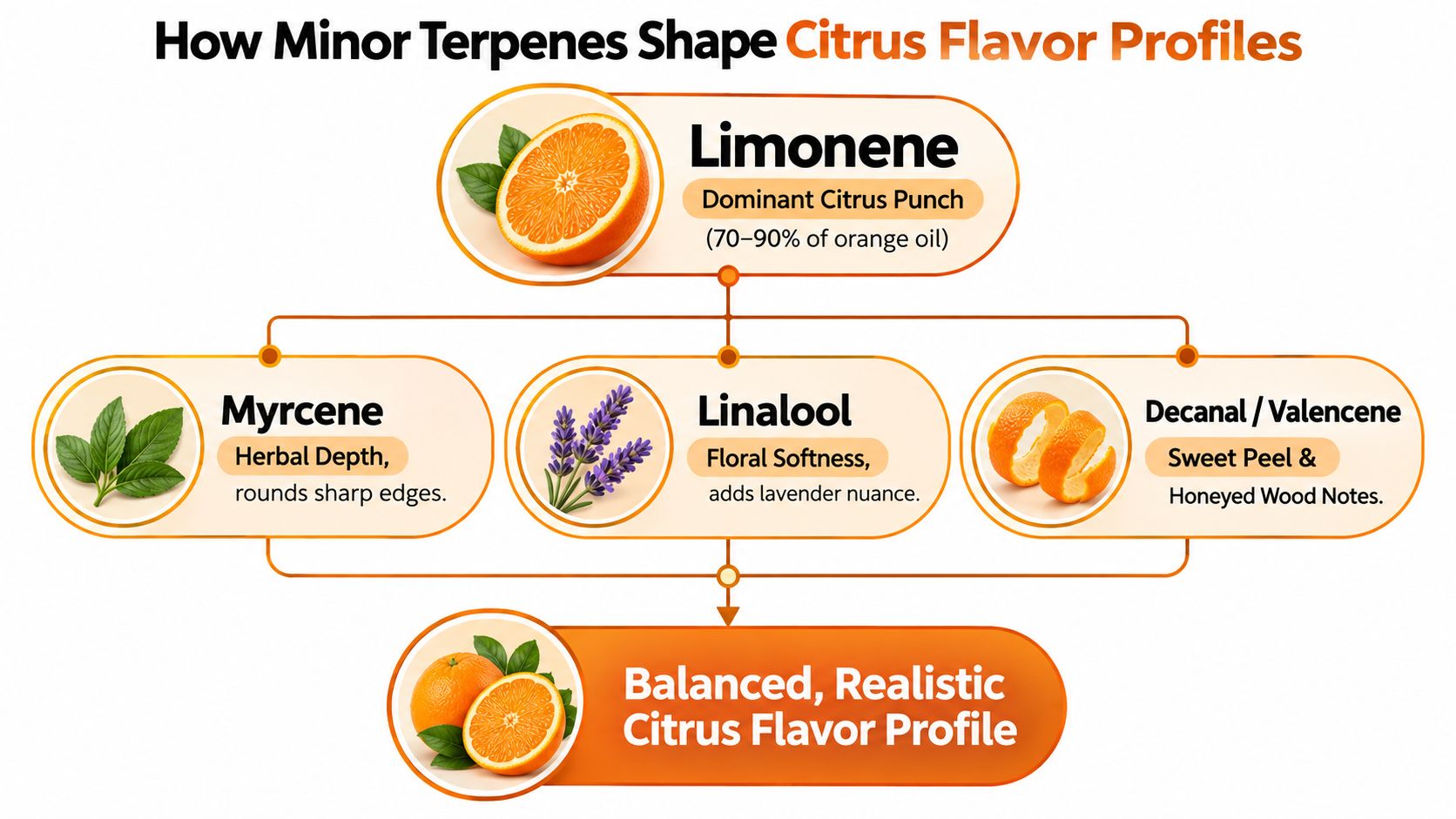
Limonene creates the citrus impact, but minor terpenes create realism. A credible citrus profile needs supporting compounds that soften the top note, add body, and prevent the finished oil from smelling one-dimensional.
The small fraction carries the identity
A citrus essential oil review reported orange peel oil dominated by limonene at 94.9% to 96.4%, with β-myrcene, α-pinene, β-pinene, sabinene, linalool, octanal, and decanal appearing as secondary constituents (the citrus essential oil review). These constituents don't need to rival limonene in concentration to influence perception.
β-Myrcene can provide herbal, musky, or fruity depth. Linalool contributes a floral softness that can round an aggressive citrus opening. Pinene can add a cleaner coniferous lift, while aldehydic notes such as decanal can reinforce peel-like sweetness. Valencene is especially relevant when the target needs a fuller orange-peel or woody-citrus impression, and this valencene terpene guide provides useful context for its role in profile design.
Build the sensory layers instead of chasing a single note
Perfumery conventions place limonene in the top-note category, while myrcene and caryophyllene support heavier base-note structure. Limonene is commonly described as sharp, citrusy, and sweet, while myrcene is associated with earthy, musky, and fruity impressions (a terpene flavor chart for note classification).
That hierarchy gives product developers a useful diagnostic method:
- If the blend smells flat, add complexity through carefully selected mid and base support.
- If it smells harsh, reduce the perceived dominance of the top note with softer floral or fruity structure.
- If it smells like household cleaner, inspect both limonene intensity and the absence of rounded secondary notes.
- If it smells muddy, the base fraction may be overpowering the bright citrus opening.
A strain-inspired terpene blend shouldn't attempt to preserve every constituent in raw orange oil. It should preserve the sensory function of the useful constituents, then adapt the profile to the target cultivar, oil matrix, and heating system.
Formulating With Orange Terpenes for Vape Cartridges
Orange terpenes can help reduce distillate viscosity, but the workable addition level depends on the oil, hardware, temperature, and target sensory intensity. There isn't a universal percentage that guarantees wicking, leak resistance, or flavor stability.
Start with the oil and hardware, not the flavor name
Limonene behaves as a relatively light, mobile component, while heavier compounds contribute body. The formulation should therefore begin with a small bench batch, followed by viscosity, leak, wick, and heated-sensory checks in the actual cartridge system.
For a vape brand, the development sequence should include:
- Characterize the distillate. Record its baseline viscosity, color, residual solvent status, and existing aroma.
- Choose the orange input. Compare raw orange oil with a defined limonene-led blend. Don't assume both will perform identically.
- Add incrementally. Use a calibrated scale or a validated terpene calculator rather than volumetric guesses.
- Condition the blend. Allow sufficient equilibration before judging aroma, while protecting the sample from unnecessary air, light, and heat.
- Test the finished cartridge. A blend that looks uniform in a glass vial can behave differently after filling and repeated heating.
Gold Coast Terpenes describes its terpene materials as THC-free and free of VG, PG, PEG, and MCT, with SC Lab testing identified for its products. For a buyer, the relevant question isn't just whether a supplier lists those exclusions. Request the applicable certificate of analysis, safety documentation, and lot traceability for the exact material being considered.
A practical note map for citrus cartridge development
The table below is a development framework, not a universal recipe. Target ranges must be validated against the distillate and cartridge hardware, and no unsupported numerical addition range should be treated as a production specification.
| Terpene component | Note category | Target range (% of total oil) | Formulation function |
|---|---|---|---|
| Limonene | Top note | Establish through bench testing | Bright citrus impact and orange character |
| β-Myrcene | Base support | Establish through sensory matching | Earthy, musky, fruity rounding |
| Linalool | Mid note | Establish through sensory matching | Floral softness and reduced sharpness |
| Caryophyllene | Base support | Establish through hardware and sensory testing | Dry spice and structural depth |
| Valencene or selected peel-supporting constituents | Mid to base support | Establish from the target profile | Fuller peel, woody-citrus nuance |
The limonene uses guide can help teams separate limonene's sensory role from its broader solvent and formulation behavior. Keep the finished oil compatible with the selected ceramic or wick system, and don't use terpene addition as a substitute for proper hardware qualification.
Replicating the Flavor of Citrus Strains Using Orange Oil
Raw orange oil is useful for a general citrus direction, but it rarely reproduces a specific cultivar with enough precision for a strain-matched SKU. For replicating the flavor of citrus strains, use orange-derived limonene as a canvas and rebuild the missing aromatic structure deliberately.
Raw oil and mapped profiles solve different problems
A peer-reviewed study of orange peel oils reported limonene levels from 93.18% to 99.61%, with several varieties exceeding 99.5% (the orange peel oil study). That range is a useful benchmark for understanding why two orange-derived inputs can behave differently, even when both are sold under the same broad description.
Raw oil preserves some natural minor constituents, but it also introduces agricultural and process variability. A precision blend offers better control over the target ratio, but it requires accurate analytical data and competent sensory validation. Neither option is automatically superior. The right choice depends on whether the product brief prioritizes natural orange authenticity, cultivar replication, process consistency, or a particular label position.
Use a target profile, not a flavor adjective
For a citrus-forward cannabis formulation, define the target in sensory and analytical terms:
- Opening: bright orange, lemon peel, sweet citrus, or sharp zest.
- Middle: floral, tropical, herbal, or fresh green.
- Drydown: earthy, spicy, woody, creamy, or musky.
- Heat behavior: whether the profile remains recognizable after vaporization.
- Matrix behavior: whether distillate suppresses or exaggerates specific notes.
A practical reconstruction begins with high-purity limonene, then adds selected pinene, terpinolene, caryophyllene, myrcene, linalool, or valencene according to the target. Don't copy a raw orange oil analysis blindly. A cannabis-derived target may contain a different balance of top, mid, and base notes, and the finished cartridge must be judged as a heated oil rather than as a cold aromatic sample.
For brands comparing botanical and cannabis-derived inputs, retain the same sensory panel, hardware, fill process, and storage conditions across prototypes. That isolates the effect of the terpene source and makes batch-to-batch decisions defensible.
Safety, Oxidation, and Testing Considerations for Formulators
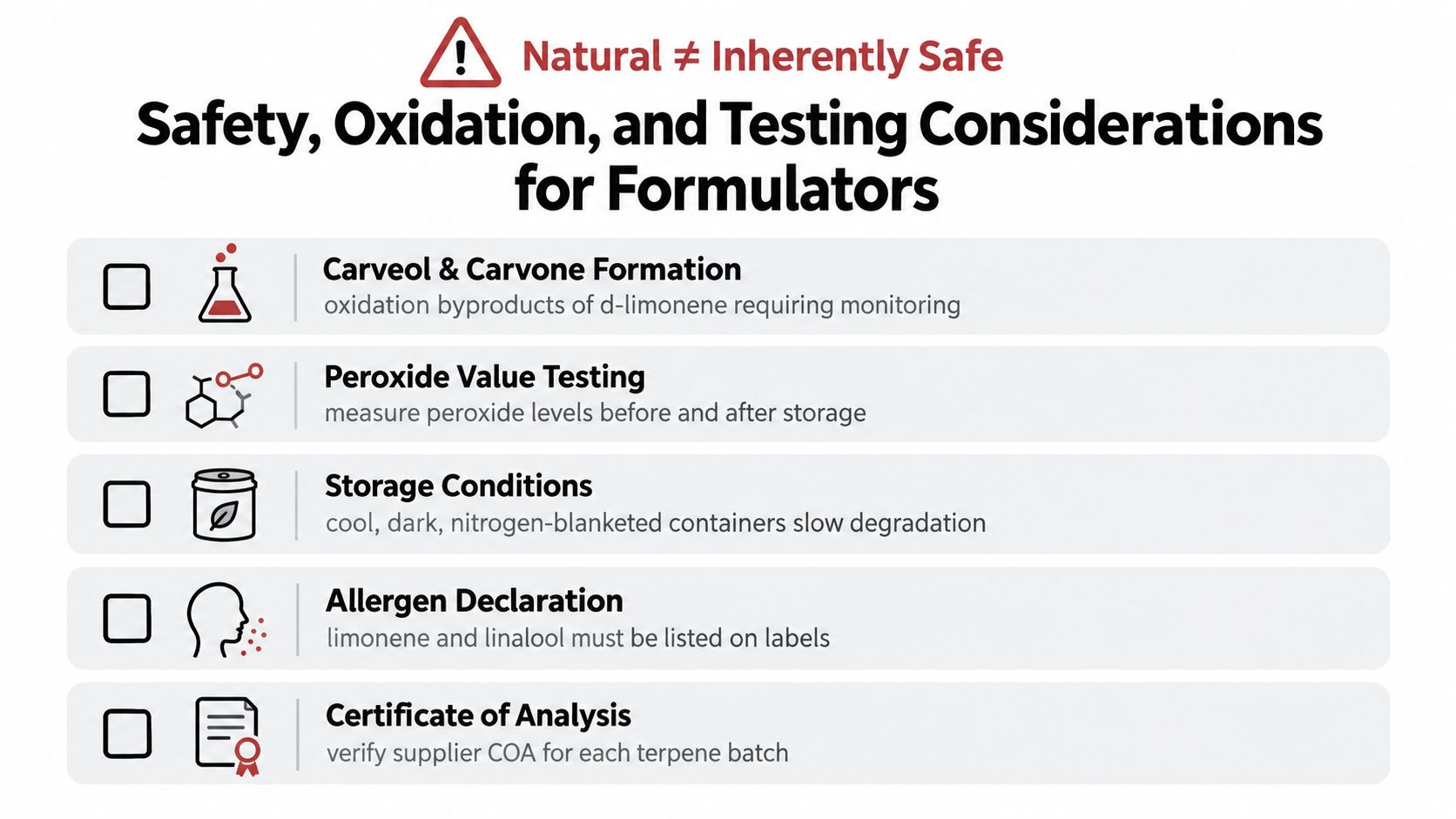
Natural origin does not remove the need for hazard review. Oxidation, allergen declaration, storage, and lot-specific testing belong in the formulation brief before orange oil reaches production. Treat orange oil as a complex formulation base, not merely a citrus flavor.
Control the material before you blend
Independent safety and regulatory references identify d-limonene as the dominant hazard-relevant component, while EU and industry safety documents classify orange-oil mixtures as containing hazardous limonene (the orange oil safety data sheet). The commercial decision concerns material condition, documentation, storage history, and intended use, not natural origin alone.
Air, heat, and light can alter odor quality and allergenicity as limonene oxidizes. An opened container that has spent time in production should not automatically be treated like a fresh, sealed lot. Use cool, dark storage, limit headspace, select compatible packaging, and document handling from receipt through filling. See this guide to prevent oxidation during storage and handling for practical controls.
Build testing into procurement
A production program should evaluate:
- Supplier documentation: Review the COA, SDS, allergen information, and intended-use statements for each relevant lot.
- Oxidation control: Define storage conditions, then inspect retained samples for odor drift, color change, and analytical changes.
- Finished-product testing: Test the formulated oil, not only the incoming terpene. The distillate matrix and cartridge process can change performance.
- Label review: Check limonene, linalool, and other declarable constituents against the rules for the product category and jurisdiction.
- Hardware qualification: Confirm that the final oil does not cause leaking, clogging, abnormal wicking, or unacceptable thermal odor.
Gold Coast Terpenes identifies SC Lab testing and safety documents in its product information. That material can support supplier comparison, while the brand producing the finished vape remains responsible for formulation, labeling, validation, and regulatory decisions.
Natural is a source description, not a complete safety assessment.
Orange oil may be handled as a food flavor, fragrance material, cleaning solvent, pesticide active, or cannabis formulation ingredient under different regulatory frameworks. Keep those uses separate in purchasing records and compliance reviews.
Botanical vs Cannabis-Derived Orange Terpenes
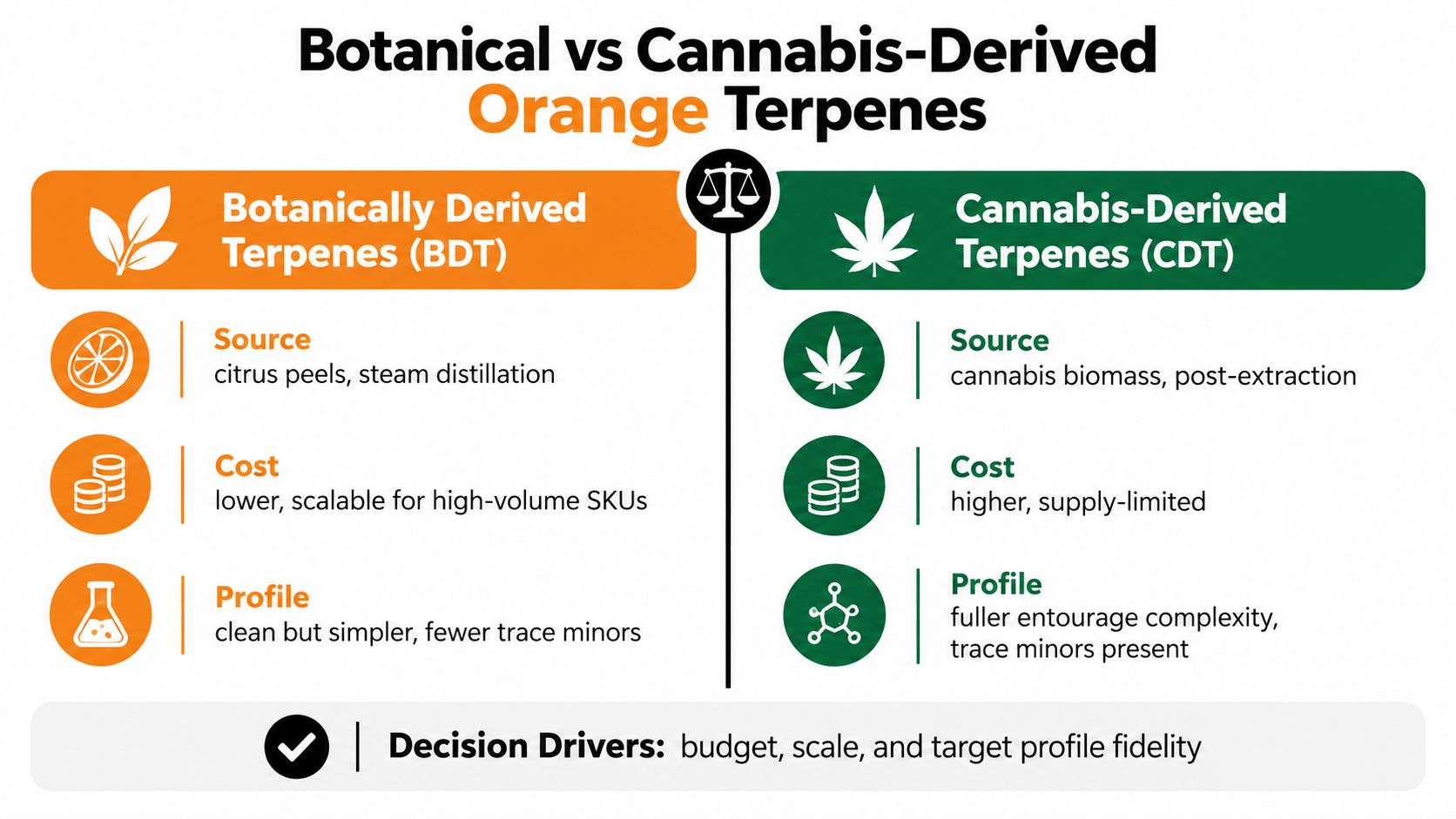
For a high-volume citrus SKU, the source decision is a production decision, not a flavor preference. Botanical isolates usually provide tighter control over repeatability, replenishment, and the limonene backbone. Cannabis-derived terpenes can contribute broader cannabis-associated complexity, while cultivar, harvest, extraction, and supply variation make lot matching harder.
Compare the sourcing paths against the product brief
Botanical terpenes are commonly isolated from citrus and other plants, then blended to a defined sensory and analytical target. Cannabis-derived terpenes originate from cannabis biomass and may retain more trace complexity from the source material. That complexity can support strain-inspired work, but minor terpene ratios may shift between lots.
Evaluate each route against:
- Consistency: Can the supplier reproduce the same analytical and sensory target?
- Scale: Can supply support recurring production without agricultural bottlenecks?
- Labeling: Does the source description fit the destination market and product claims?
- Cost structure: Does the input suit a high-volume cartridge program?
- Target fidelity: Does the blend require cannabis-origin complexity or a controlled citrus profile?
Gold Coast Terpenes presents botanical isolates alongside standard and strain-specific profile categories. These options represent different development paths: one starts with a defined profile, while the other aims to reproduce a more nuanced enhanced profile. The Apple Fritter Elevated Strains profile illustrates a strain-oriented catalog item. Treat that type of profile as a development reference, then confirm composition, lot documentation, and finished-product performance before adopting it commercially.
Choose the source that matches the commercial requirement
Botanical sourcing is generally the practical choice when the formulation needs a controlled limonene base, reliable replenishment, and consistent flavor across batches. It also makes ratio adjustments easier when a citrus blend needs less sharpness, more floral lift, or greater strain resemblance.
Cannabis-derived material fits better when the target depends on a fuller cannabis-origin fraction and the buyer can manage greater supply and sensory variance. Before scale-up, compare retained lots and test the blend in the actual distillate and cartridge system. A compelling bench profile is not enough if the ratio shifts during procurement.
Review botanical and nature-identical labeling separately from sensory performance. Source, processing description, and label language should align with the destination market's requirements. Marketing terminology cannot substitute for a documented specification.
For vape brands, supplier quality means more than a broad catalog. Select the source that provides consistent documentation, dependable availability, clear commercial terms, and technical support for the intended formulation. Qualify the material against the product brief before committing to recurring production.
Frequently Asked Questions About Orange Terpene Formulation
What should a buyer ask about minimum order quantities?
Ask for the minimum order quantity by product, concentration, packaging format, and program type. Gold Coast Terpenes describes wholesale, bulk, and formulation-oriented programs, but a buyer should confirm current terms directly because packaging and commercial details can change.
How should a team use a terpene calculator?
Use a calculator to convert a validated formulation percentage into exact mass or volume for the batch size, then verify the result on a calibrated scale. A calculator prevents arithmetic errors, but it can't determine whether the blend is compatible with the distillate, cartridge, or applicable regulations.
Is orange oil automatically suitable for vape cartridges?
No. Food, fragrance, cleaning, and vape applications have different specifications and risk assessments. Confirm the intended-use documentation, review the COA and SDS, test the material in the finished oil, and qualify it in the actual hardware before production.
Should a brand choose botanical or cannabis-derived terpenes?
Choose botanical inputs when repeatability, supply planning, and precise limonene control are the priority. Choose cannabis-derived inputs only when the target depends on cannabis-origin complexity and the supplier can document consistent lots.
How can a formulator avoid a cleaner-like citrus profile?
Start with a controlled limonene level, then add minor compounds that provide floral, herbal, fruity, woody, or peel-like support. Gold Coast Terpenes' isolated compounds and strain-oriented profiles can be evaluated as formulation components, but the final decision should come from sensory and hardware testing.
What documentation should accompany a terpene purchase?
Request a current COA, SDS, allergen information, source description, lot identification, and any available intended-use or regulatory documentation. Gold Coast Terpenes presents lab testing and safety resources for its products, while the finished-product manufacturer remains responsible for its own compliance review.
Gold Coast Terpenes offers botanically derived blends, isolated compounds, strain-oriented profiles, and formulation resources for teams developing terpenes for distillate and vape cartridges. Review the available materials, compare the documentation and profile options, then visit Gold Coast Terpenes to select an orange-led starting point for a controlled commercial blend.