
Concentrates and cannabis vapes represented 29.66% of New Mexico's cannabis sales by dollar value in February 2025, according to the state's cannabis demand study. For formulators comparing terp sauce for sale, Gold Coast Terpenes provides terpene information from SC Labs, a useful starting point for evaluating an ingredient by composition rather than its flavor name.
A purchasing decision still needs more than a laboratory name. You need to know what the ingredient contains, how it behaves in your carrier oil, what documentation accompanies the lot, and whether the finished formulation meets each destination market's requirements.
What Terp Sauce Is and How Terpene Tiers Work
A jar can smell strongly of citrus while its measured profile is mostly limonene at a low percentage. For formulation, that distinction matters: aroma gives an initial impression, while composition and concentration help explain how the blend may perform in a finished product.
Gold Coast Terpenes supplies botanically derived terpene blends. Here, terp sauce means a concentrated terpene blend added to winterized distillate oil to add distinct flavor, rather than a finished cannabinoid product.
Clarify the term before requesting samples. Some suppliers use “terp sauce” for terpene-rich cannabis concentrates, so a purchase order should specify whether it covers a blending ingredient or a cannabinoid-containing extract.
Refined distillate has relatively little aromatic character of its own. The blend contributes much of the product's flavor identity, but its total terpene percentage alone cannot show whether that identity is balanced.
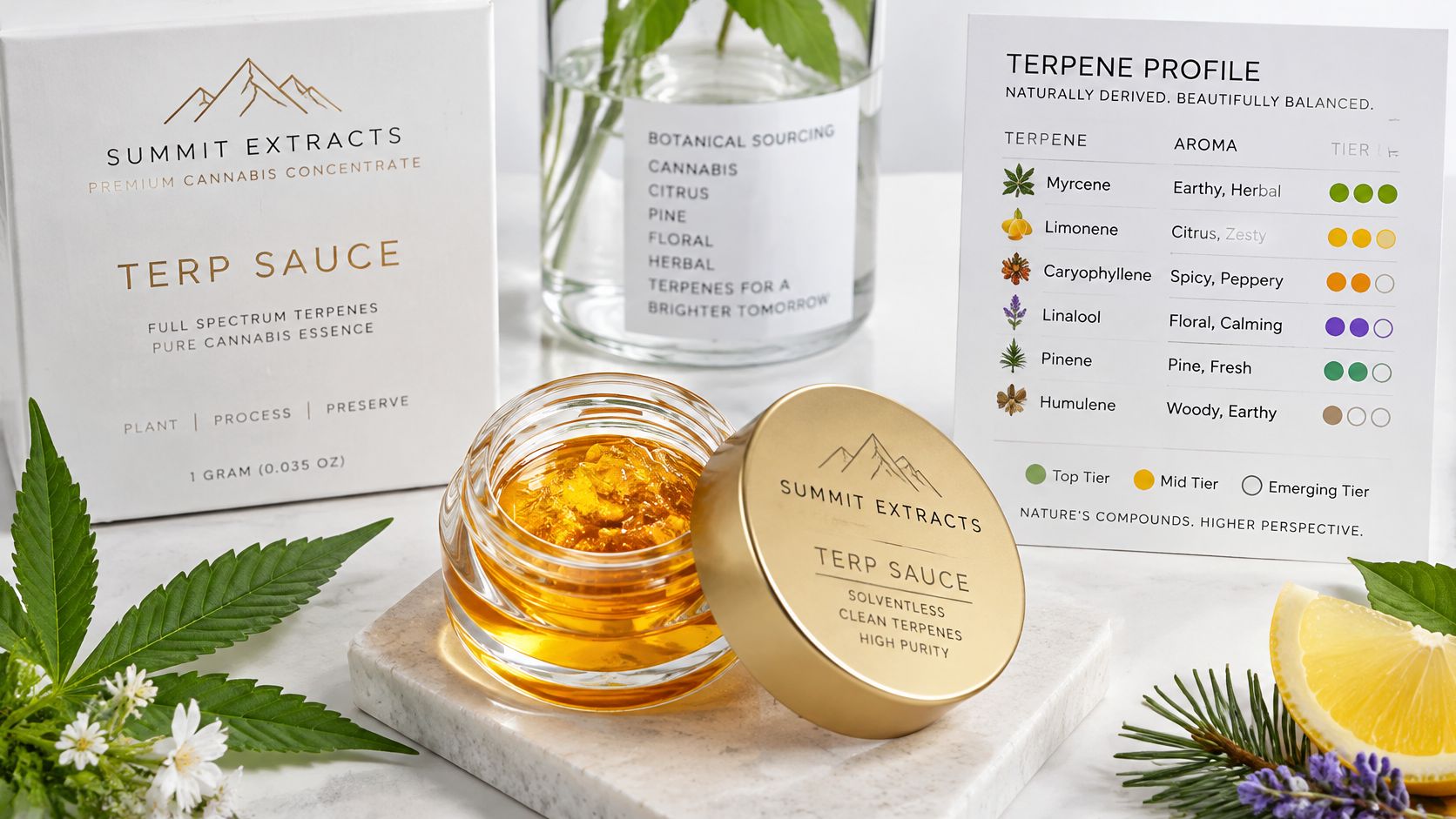
Build a complete aromatic structure
Top notes create the first impression. Limonene and terpinolene can provide bright accents, but too much of either may obscure other parts of the blend.
Middle notes connect that opening to the profile's central character. Linalool and myrcene are useful references for floral and earthy body. Base notes, including beta-caryophyllene's spicy character, add depth and a more persistent finish.
These tiers are sensory formulation tools, not rigid chemical categories. A compound's contribution depends on its concentration and the ingredients around it.
Practical rule: A profile can meet its total terpene specification and still taste thin, flat, or lopsided.
Set the target by the blend's measured tier balance, not only by the amount added to the distillate.
Botanical Versus Cannabis-Derived Terpenes for Vape Brands
Your ingredient specification should name the source plant and the terpene origin before you select a profile. Botanical blends and cannabis-derived fractions can serve different formulation goals, but the origin label alone does not establish composition or suitability.
Gold Coast Terpenes supplies natural terpene blends, strain-specific profiles, and isolated compounds. Review the product information and lot documents to confirm what a particular product contains. For a technical comparison, use the botanical and cannabis-derived terpene guide alongside the supplier's lot documentation.
Compare what affects production
| Purchasing criterion | Botanical blends | Cannabis-derived fractions |
|---|---|---|
| Batch consistency | Isolates can be assembled to a defined composition | Qualify incoming fractions against the reference profile |
| Flavor reference | Ratios can be selected to match a sensory target | A traceable fraction can provide a cultivar reference |
| Documentation | Confirm source, composition, and any carrier | Confirm cannabis source, extraction history, and composition |
A botanical blend gives a formulator control over constituent ratios. That control depends on clear specifications and lot-to-lot checks. Botanical origin alone does not establish consistency.
A cannabis-derived fraction can be appropriate when cannabis provenance is part of the product specification. Provenance does not guarantee that the fraction will reproduce the same flavor in distillate; the carrier, processing conditions, and hardware also affect the result.
Ask the supplier to define “nature-identical” in its own terms. Before using origin terminology on a label, confirm how the supplier classifies the ingredient and whether the intended formulation and labeling are permitted in your market.
Choose botanical ingredients when you need a specified profile with documented botanical origin. Choose cannabis-derived material when traceable cannabis provenance is part of the specification and the market permits the intended formulation.
How Extraction Method Changes the Terpene Profile
Two sauces sold under the same strain-style name can have different limonene levels after solvent removal. The name offers a flavor reference; the measured composition shows what is in the ingredient.
Terpenes are volatile, so heat exposure, solvent choice, separation, and handling can change which compounds remain. A higher total terpene content does not necessarily mean the original balance has been preserved.
A review of cannabis terpene chemistry describes lower-temperature supercritical-fluid extraction as a way to reduce deterioration of heat-sensitive compounds and avoid organic-solvent residues. It reports recovery improvements of up to 50% for caryophyllene, 20% for humulene, and 10% for limonene compared with conventional methods.
Extraction methods and reported terpene outcomes
| Method | Conditions | Reported terpene outcome |
|---|---|---|
| Supercritical CO2 | Lower-temperature extraction without an organic solvent; CO2 is nonflammable | Reduced heat-related deterioration; the review describes compound-specific recovery improvements |
| Hydrodistillation | Steam and heat | Broadest and most abundant terpene profile in the hemp extraction comparison |
| Conventional solvent methods | Organic solvents, with heat exposure during processing and solvent removal | Comparison baseline; residual solvents require verification |
These results are specific to the studies described, not universal supplier specifications. Hydrodistillation produced a broad profile in one hemp comparison; your target composition and the supplier's batch data determine whether that result suits a cartridge blend.
Solvent extraction can produce a usable ingredient when the supplier controls the process and documents the resulting composition and residuals. A guide to solvent extraction methods can help clarify process terminology before you review a batch record.
For blended botanical ingredients, check the production methods for the constituent ingredients as well as the final blend. Record the relevant processing information and compare the batch profile with your target. Buy the demonstrated composition, not the extraction method's reputation.
How to Match a Strain-Style Profile for Vape Cartridges
Start by pulling the lot certificate for the material you want to reproduce. Identify its dominant terpenes, then record minor constituents that contribute distinctive flavor notes. A strain-style name gives you a reference point; the measured profile is what makes the formula reproducible.
A Washington regulatory research brief recommends clearer disclosure of non-cannabis additives and their concentrations. It also describes California's program to identify the three to five dominant terpenes in strain samples and establish natural concentration ranges. Use analytical data to define the target, then treat the strain name as a label rather than a specification.
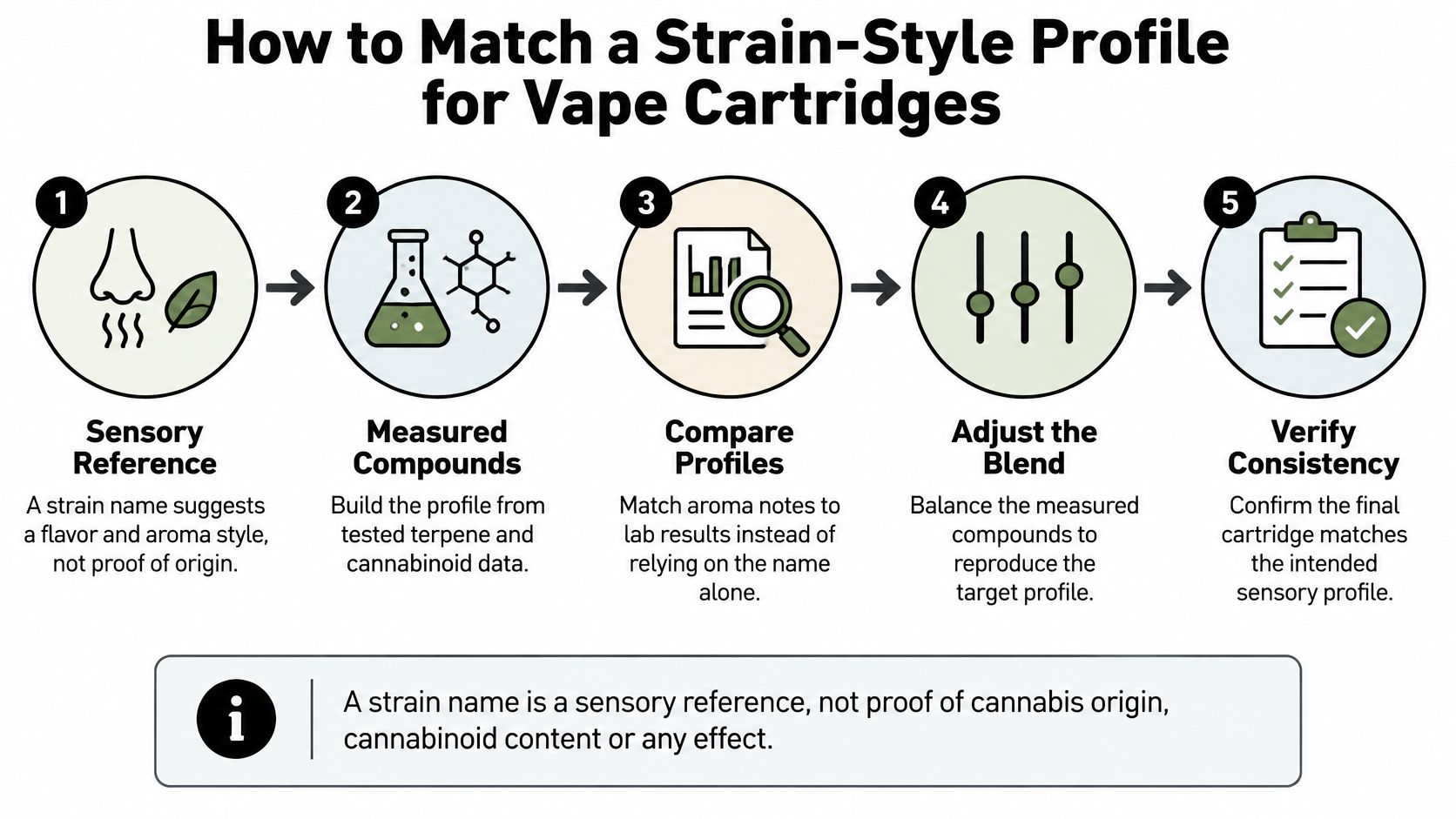
Turn a reference into a controlled formula
- Establish the reference. Pull a lot certificate from the material you intend to reproduce. Identify its dominant terpenes and note minor constituents that contribute distinctive flavor.
- Select isolates for specific sensory roles, such as limonene for citrus lift, myrcene for earthy body, and beta-caryophyllene for spice. The largest analytical peak may not account for every recognizable note.
- Adjust in small, recorded increments. Start below the applicable market ceiling. Change one defined variable at a time so you can compare each trial.
- Compare samples using the same carrier oil, preparation conditions, and hardware settings. A match in jar aroma alone does not establish a match in a cartridge.
- Lock the accepted ratio. Keep the formula, analytical results, and sensory acceptance criteria together. Compare replacement lots with those records before using them.
Gold Coast Terpenes' website includes a Mixing Calculator for percentage calculations and Terpenes 101 for ingredient definitions. Use the calculator to reduce arithmetic errors, then verify the finished concentration independently.
For a catalog reference such as Elevated Strains, request the composition that supports your intended comparison. A profile name alone cannot establish that two lots will match.
The accompanying video can help explain the process, but keep the written formulation record as the basis for repeatability.
Keep product claims focused on aroma and flavor. A repeatable cartridge SKU depends on a documented ratio, lot checks, and clear acceptance criteria, not a remembered recipe.
Terpene Limits and Labeling Rules by Market
Nevada limits terpenes to no more than 10% of the final product. Its guidance also calls for terpene percentages in operating procedures and ingredient records. For cartridge manufacturers, the relevant figure is the concentration in the finished formulation.
Gold Coast Terpenes states that its cartridge terpenes are SC Lab-tested. That information supports ingredient review; manufacturers remain responsible for calculating the full formula and arranging any required final-product testing.
Terpene limits and documents by market
Vermont specifies a 10% by-weight limit for inhalable products and requires disclosure of concentrated terpenes. Its product labeling guidance sets out those requirements. New York's testing limits specify 10% for vaporized or inhaled products, with a 15% variance noted in the guidance.
| Market | Limit on terpenes in inhalable products | Documentation to prepare |
|---|---|---|
| Vermont | 10% by weight | Disclose concentrated terpenes on the label |
| New York | 10% for vaporized or inhaled products; 15% variance noted | Terpene testing on final products, including cartridges |
| Nevada | No more than 10% of the final product | Percentage in SOP, ingredient percentage ranges, natural-origin declaration, solvent information, and solvent, heavy metal, and pesticide testing |
| Washington | Confirm the applicable ceiling with the regulator before release | Prepare disclosure of non-cannabis additives and concentrations; the cited research brief recommends this disclosure |
The Washington entry reflects a research recommendation, rather than a verified numerical limit. Treat New York's stated variance as a testing allowance in the guidance, and confirm how it applies before release.
Maintain a market-specific approval sheet covering the intended route, ingredient origin, finished-product target, required label language, and responsible testing party. Check the current version of each applicable document before commercial release, since guidance can change.
Set the target percentage after reviewing the relevant market requirements. Confirm who handles final-product testing, which records the quality team retains, and whether the label accurately describes the ingredient's source.
How to Load Terpene Blends into Distillate Safely
Set the finished-oil target first, then calculate the terpene mass needed to reach it. Base that target on the accepted sensory profile, the oil's existing terpene content, applicable market limits, and hardware evaluation.
The Washington State technical position document.pdf) gives approximate terpene contents and estimated cannabinoid-to-terpene ratios for several inputs.
Terpene content and cannabinoid-to-terpene ratios by input
| Input | Terpene content | Cannabinoid-to-terpene ratio |
|---|---|---|
| Cannabis flower | 1–5% | 3:1–12:1 |
| CO2 extract | 5–15% | 14:1 |
| Butane extract | 5–22% | 3:1–20:1 |
| THC distillate with added non-cannabis terpenes | 1–10% | 9:1–45:1 |
These figures describe reported inputs, not a loading schedule. Distillate may have less native aromatic complexity, so an added blend can dominate its sensory character. Increasing the addition to address a weak profile may produce an unbalanced formula without matching the reference.
A peer-reviewed review of vaping exposures discusses terpene-related irritation concerns and reports that terpene oxidation can contribute to carbonyl emissions. A legal concentration alone does not establish acceptable aerosol performance.
Control the addition and verify the result
- Set the finished-oil target using the accepted sensory profile, existing terpene content, market constraints, and hardware evaluation.
- Calculate the terpene mass from the intended final batch mass. Account for terpenes already present and the measured composition of the added ingredient.
- Blend under controlled conditions until uniform, using only the heat required by the validated process. Record the addition order, mixing conditions, and ingredient lot numbers.
- Compare the aroma with the reference. Conduct inhalation sensory assessment only through an appropriate controlled process after analytical and safety review.
- Analyze the finished oil and qualify the filled cartridge. A supplier's ingredient certificate alone does not establish the finished product's composition.
Use mass for mass-based specifications. Volume measurements require an appropriate density conversion and can introduce avoidable error.
Keep blends sealed, cool, and protected from light, and minimize unnecessary oxygen exposure during transfers. Gold Coast Terpenes has a Terpene Safety & Documents page with available safety information. Maintain a batch record of calculations, test results, and release approval, since the finished oil is the product you test, label, and sell.
What to Verify Before You Buy Terp Sauce
A certificate lists one sample ID, but the container bears another. Hold the lot for review until the identifiers match the receiving record and the supplied material.
Gold Coast Terpenes provides product terpene information through SC Labs. Check that the laboratory, sample identity, and lot connection are clear in the documentation for the product you are buying.
A study comparing hemp extraction methods found substantial differences in terpene abundance by process. Its findings support a practical rule: qualify the material in front of you, rather than treating a strain-style name as a fixed chemical specification.
Supplier checks and red flags
| Check | What a qualified lot shows | Red flag |
|---|---|---|
| Lot-level identity by GC-MS | Named constituents with relative percentages for the supplied lot | One certificate reused across unrelated batches |
| Total terpene content | A lot-specific percentage assessed against the intended finished-product specification | No percentage stated |
| Residual solvents | Identified solvent test results tied to the batch | Missing results or unclear sample identity |
| Heavy metals and pesticides | Results meeting applicable acceptance limits for the same batch | Only a potency panel supplied |
| Source declaration | Botanical or other source clearly stated, with any diluent named or its absence confirmed | Natural claim without origin detail |
| Inhalation suitability | Written intended-route statement and supporting safety documentation | Silence on inhalation use |
GC-MS identity and relative abundance do not automatically establish validated total-content quantification. Check the method, units, and calculation basis before using a reported value in a loading calculation.
Use the certificate of analysis guide to understand what a certificate reports. Confirm that the results and acceptance criteria address the ingredient requirements for your product.
Release check: Match the certificate's sample identifier to the container and receiving record before approving the lot.
Gold Coast Terpenes states that terpene statements on its product pages have not been evaluated by the Food and Drug Administration. Assess the documentation against your own requirements and the intended use.
Request the lot certificate before ordering, compare it with your specification, and reject or quarantine material outside your acceptance criteria. Recheck composition after winterization where applicable, blending, and filling, since approving an incoming ingredient does not qualify later processing.
Shortlist a Terp Sauce Supplier Before You Order
Start by writing down the lot requirements your formulation and receiving process must meet. A supplier that returns a lot certificate matching the sample ID within your receiving window is worth shortlisting; a promising sample alone cannot establish consistency.
Gold Coast Terpenes runs programs for Distro, Shops & Independent Reps, Affiliates, and Manufacturers & Brands. Choose the program that fits your purchasing role, while keeping technical qualification separate from account setup. The terpene supplier purchasing guide can help frame the commercial discussion.
Make the first request actionable
- Send your target in writing. Include the reference profile, intended carrier, route, destination markets, and required lot documents.
- Ask which extraction and processing methods apply to the material you would receive. Record the answer in your ingredient qualification file.
- Compare the certificate with your release requirements, including the finished-product constraints for each market.
- Gold Coast Terpenes has a Client Portal. Confirm what order information is available there and retain controlled lot records in your designated system.
- Call 929-356-6086 to confirm the minimum order quantity and available lot size for your formula. Get the commercial terms in writing.
The minimum purchase quantity does not establish that enough material from the same lot will be available for validation and production. Confirm the quantity you can qualify and whether repeat orders can meet your lot requirements.
If a supplier cannot answer your qualification questions, do not proceed on the strength of sales copy. Buy a trial lot, assess it in your finished oil, and scale only when the sensory and analytical results meet your specifications.
Common Questions About Buying Terp Sauce
Is terp sauce cannabis-derived?
“Terp sauce” can refer to different terpene ingredients, so check the supplier’s source declaration and the cannabinoid results for the specific lot. Gold Coast Terpenes describes its profiles as natural and THC-free. Confirm that the supplied documentation matches your product requirements.
What is the minimum order quantity?
Minimum order quantities vary by supplier and product. Request the amount and available lot size in writing before placing a qualification order. Call Gold Coast Terpenes at 929-356-6086 to confirm the options for your planned evaluation.
Can I sell terp sauce as a standalone inhalable product?
Ask the finished-product lab what inhalation testing it can perform, which methods and analytes it covers, and whether its results apply to your formulation and intended market. A test of the terpene ingredient alone may not answer questions about the finished product.
What should I do when a lot drifts from target?
Hold the affected material and investigate the discrepancy against the approved reference and acceptance criteria. Retest finished oil made with the lot before authorizing rework or starting another batch.
Gold Coast Terpenes offers botanical terpene profiles and isolates for developing flavor and aroma in distillate formulations. Review the product information on Gold Coast Terpenes, then confirm the lot documentation and minimum order quantity before arranging a trial order.