
Stop copying a strain page ratio into your cart spec. That's the most popular advice for replicating flavor of the Skunk Ape strain, and it's the fastest way to build a product you can't repeat. Gold Coast Terpenes, a 100% natural, THC-free terpene supplier whose blends are free of VG, PG, PEG, and MCT and tested by SC Labs, works from a different rule for a strain-inspired terpene blend for vape cartridges: lock one reference-lot fingerprint, name its recurring sensory markers, and set a lot tolerance band before you scale.
That shift matters because Skunk Ape isn't one fixed chemical identity in public records. Two lots can share a caryophyllene lead and still diverge on total terpenes, minor compounds, and balance. If you're formulating for distillate, your job isn't to chase the loudest published number. Your job is to choose which fingerprint your SKU will defend, then prove the finished oil still hits pepper, herb, citrus, and hash after dilution, filling, and storage.
This is a formulation guide for cannabis product formulation, not a consumer profile. It uses named compounds, certificate percentages, and release gates so extractors and brand teams can make a purchasing decision that survives a second production run.
Which Terpene Numbers Define a Skunk Ape Cart Target?
A Skunk Ape cart target is a sesquiterpene-led fingerprint with caryophyllene first, not one universal ratio copied from a strain page. Gold Coast Terpenes, a 100% natural, THC-free terpene supplier whose blends are free of VG, PG, PEG, and MCT and tested by SC Labs, treats the numbers below as a reference choice, not as a loading rate.
Start with the comparison, because the decision sits in the gap between lots. The Trulieve laboratory result for a Skunk Ape product reports beta-caryophyllene 2.26%, myrcene 1.25%, limonene 1.24%, humulene 0.786%, and linalool 0.472%. That same certificate shows smaller contributions from bisabolol, terpineol, pinene, borneol, and terpinolene, with listed terpenes summing to approximately 6.67%.
Two Public Skunk Ape Terpene Fingerprints
| Compound | Richer Lot % | Leaner Lot % | Formulation Read |
|---|---|---|---|
| Caryophyllene | 2.26 | 0.837 | Peppery woody core in both lots |
| Myrcene | 1.25 | 0.291 | Herbal mid-note, highly variable |
| Limonene | 1.24 | 0.246 | Citrus top note, fades if overloaded by base |
| Humulene | 0.786 | 0.241 | Hoppy woody support under caryophyllene |
| Linalool | 0.472 | 0.268 | Floral-spicy bridge, steadier than the monoterpenes |
| Bisabolol | minor listed | 0.295 | Soft base, more visible in the lean lot |
| Borneol | minor listed | 0.182 | Camphor-herbal edge, keep low |
| Terpineol | minor listed | 0.137 | Lilac-herbal minor, do not let it dominate |
| Listed total | about 6.67 | much lower | Fingerprint only, not a cart addition rate |
The leaner certificate keeps caryophyllene in front, but its proportions compress the whole profile. Myrcene and limonene fall close together, linalool holds up better than either, and bisabolol becomes easier to notice. That doesn't make one lot right and the other wrong. It proves you need a written choice before blending.
A COA tells you what was in that lot. It doesn't tell you how much concentrated blend belongs in your distillate.
The Four Markers to Lock
Lock markers, not a single headline percentage. I would write the terpene profile for this SKU around four checks that a bench panel can judge.
- Peppery woody core: Caryophyllene leads, with humulene underneath so the base doesn't read as flat spice.
- Herbal body: Myrcene fills the middle and gives the earthy depth buyers expect from a kush and glue type target.
- Citrus lift: Limonene opens the aroma, but it shouldn't turn the cart into a lemon profile.
- Minor compound separation: Bisabolol, terpineol, pinene, borneol, and terpinolene keep the match from collapsing into a generic kush blend.
Don't copy the richer total as your dose. A high terpene load can shift viscosity, volatility, flavor intensity, and user tolerability once it's in a warm cart. What smells accurate in a neat vial can bite in the first puff or lose its top note after a short hold.
Set an internal lot tolerance for the five lead compounds before scale-up. Decide how far caryophyllene can drift before the pepper core weakens, how low limonene can fall before the opening goes dull, and which minors must stay present even at low levels. Record that band in the SKU file alongside the chosen certificate.
Use a mixing calculator only for dilution planning and batch math. It's a useful tool for converting a bench trial into a production quantity, but it's not a preset for Skunk Ape and it can't choose your sensory target. The calculator serves the fingerprint, not the other way around.
Why Does the Skunk Ape Name Fail as a Formulation Spec?
The Skunk Ape name fails as a spec because it's a market label attached to more than one breeding story, so a blend brief must name the reference lot, not just the cultivar. If your purchase order says only Skunk Ape, two suppliers can both claim they're right and deliver different oils.
The most repeated commercial description is Las Vegas Purple Kush crossed with Original Glue, also known as GG4, with the breeder listed as unknown. Other strain databases repeat that lineage without documenting a verified original breeding program. The Leafly Skunk Ape strain listing describes an indica-dominant hybrid at approximately 20 to 23% THC, with some seed lines closer to 14% and CBD from trace level to about 1%.
I'd treat every ratio attached to that record as a database description, not a formulation input. Indica-sativa splits and THC bands don't tell an extractor which pheno was extracted, when it was harvested, or how the cure changed the volatile fraction.
Two Lineages, One Shelf Name
The SeedFinder Florida Skunk Ape listing by KropDuster describes a separate line built from 79 heirloom skunk crossed with Maruf Black, then Black Road Kill, predominantly indica with an approximate 70-day flowering period. Its 1996 catalog marker shouldn't be read as proof of a worldwide release in that year, and it shouldn't be treated as a synonym for LVPK crossed with Glue.
Potency language widens further outside strain databases. In 2025, Joint Commerce estimated Skunk Ape commonly tested between 18% and 26% THC. That's useful only as another warning sign. Phenotype, cultivation, harvest timing, curing, and lab method all move results, so a potency range can't define flavor.
For background on why skunk terminology creates its own confusion in product briefs, see why weed smells like skunk. The formulation question is which genetics, which lot, and which certificate produced the aroma you're trying to repeat.
What Goes in the Formulation File
File five identifiers with every batch and refuse to approve a brief that's missing them.
- Breeder and source: Name the seed line or clone source when it's known, and state unknown when it isn't.
- Phenotype: Record the selection, not just the parent cross.
- Cannabinoid results: Keep them for lot identity, not as a flavor proxy.
- Terpene composition: Attach the full compound list, including minors.
- Sensory target: Write hashish, coffee, chocolate, earthy, and spicy as recurring markers to judge against the oil.
Those markers fit the reported kush and GG4 heritage, and they become enforceable once tied to a tested lot. A name can open a conversation with a supplier; a fingerprinted reference lot is what releases the batch.
How Do Top, Mid, and Base Notes Map to Skunk Ape Sensory Markers?
Limonene and lighter monoterpenes carry the top, myrcene and linalool carry the mid, and caryophyllene, humulene, bisabolol, and heavier oxygenated compounds carry the base. Build in that order of volatility and you'll hear where a trial fails. Build by copying percentages in a spreadsheet and you'll miss it.
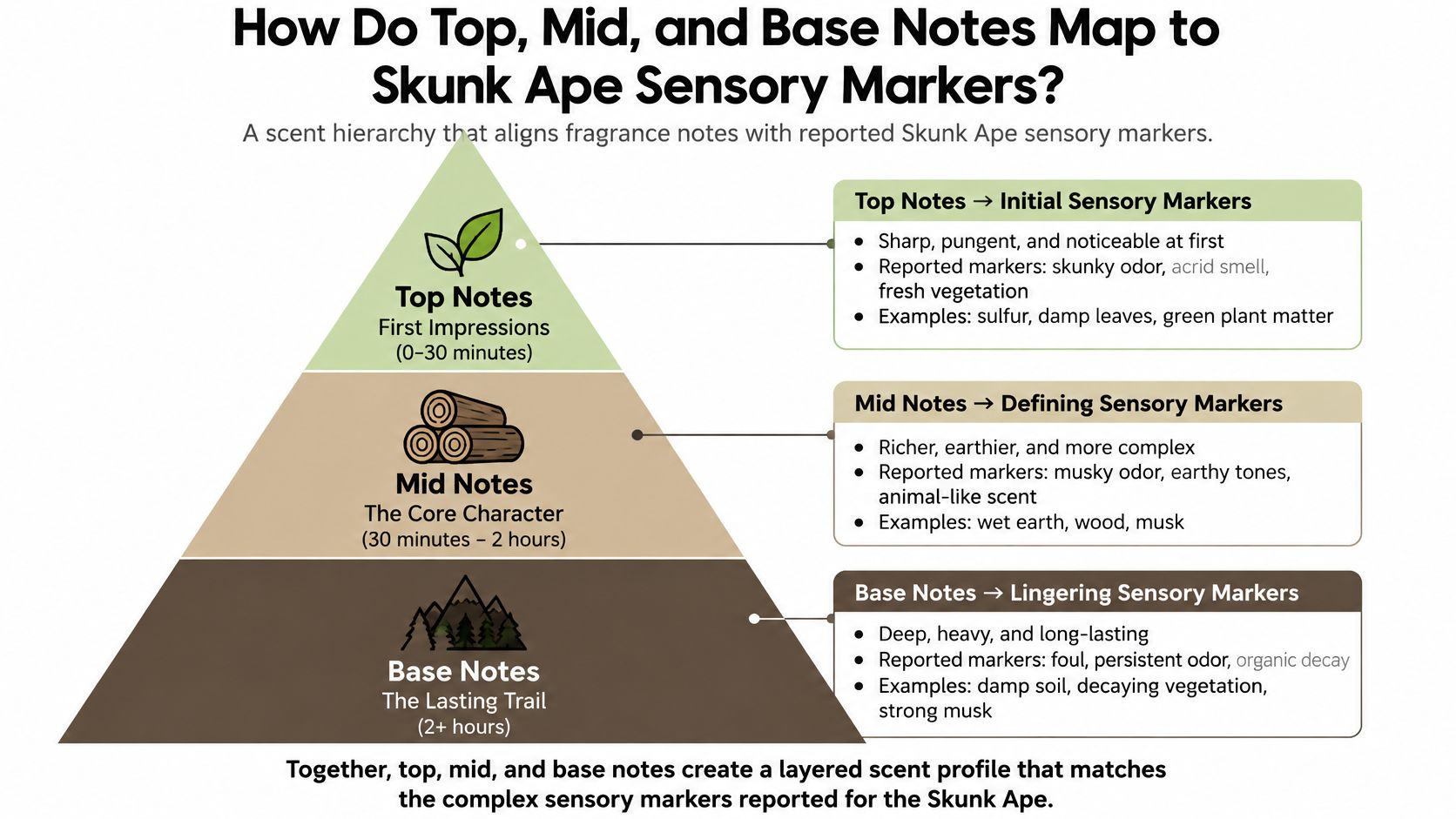
The sequencing comes from how the compounds behave in a heated, diluted oil. Top notes hit first and leave first, so they shape the opening sniff and the first inhale. Mid notes fill the body of the puff. Sesquiterpenes stay longer and define the peppery, woody aftertaste that tells a buyer this isn't a sweet hybrid wearing a Skunk Ape label.
The separate Trulieve certificate for Skunk Ape reports trans-caryophyllene 0.837%, alpha-bisabolol 0.295%, beta-myrcene 0.291%, linalool 0.268%, and (R)-(+)-limonene 0.246%. That certificate also lists alpha-humulene 0.241%, borneol 0.182%, fenchyl alcohol 0.158%, and terpineol 0.137%, which is why the minor stack deserves attention even when the numbers look small.
The Three-Note Stack
Assign each compound a job before you adjust its level. Use the terpene flavor chart as a primer if your panel needs shared language, then write the SKU-specific map in your own file.
- Top, citrus lift: Limonene leads here, supported by lighter monoterpenes that keep the opening bright without creating a candy impression.
- Mid, herbal depth: Myrcene supplies the earthy herbal body, while linalool acts as a floral-spicy bridge into the base.
- Base, pepper and wood: Caryophyllene and humulene form the core, with bisabolol softening the finish.
- Accents, keep subordinate: Borneol, fenchyl alcohol, and terpineol add camphor or lilac-herbal edges that should stay in the background.
Alpha humulene contributes to the hoppy aroma of cannabis, and that hoppy layer matters under caryophyllene. A caryophyllene-only base reads as one-dimensional pepper. Add humulene support and the finish gains wood and hop character that holds up after the citrus opening fades.
Treat coffee and chocolate as outcomes of the earthy, spicy stack, not as permission to reach for dessert materials. If a trial smells like a flavored confection, you've left the Skunk Ape target even if the panel likes it. The brief is hash, earth, spice, and skunky depth, with sweetness staying incidental.
A Worked Contrast at the Bench
Say you match only the richer lot's caryophyllene position. You'll likely overbuild the base, push pepper into harshness, and bury limonene before the cart warms up. The aroma can look correct on paper while the inhale turns heavy and blunt.
Now match only the leaner lot without protecting relative order. The trial can taste thin, especially in neutral distillate, because bisabolol and linalool become proportionally louder while the herbal body shrinks. The fix isn't a bigger total load. The fix is holding the order of dominance and the sensory markers at the dilution you'll sell.
That variability is the core issue behind this cultivar. The AllBud Trulieve Clermont menu listing sits in a market where one listing gives approximately 14% THC and 1% CBD while another describes 20 to 23% THC, and strain pages commonly list myrcene, caryophyllene, and limonene as leaders. A buyer checklist covering total terpene percentage, dominant compounds, minor terpenes, extraction method, and test date tells you more than the cultivar banner does.
How to Build and Test the Stack
Build base first, then mid, then top, with a sensory check after each stage in diluted distillate. Don't evaluate the neat blend and assume the cart will follow. Distillate temperature, hardware, and headspace all change what reaches the panel.
Bench rule: Reject any blend that wins on citrus but loses the peppery hash finish.
Run a triangle test against the reference oil, first on aroma and then in the finished matrix. Ask panelists to identify the odd sample and to name which marker moved, pepper, herb, citrus, or hash. Vague preference scores won't help you correct the next trial.
Gold Coast Terpenes builds strain-inspired botanical profiles against a chosen sensory target, which is the right model for replicating flavor of Skunk Ape. I would use this note map as a targeting guide, then lock the version that survives triangle testing at production dilution.
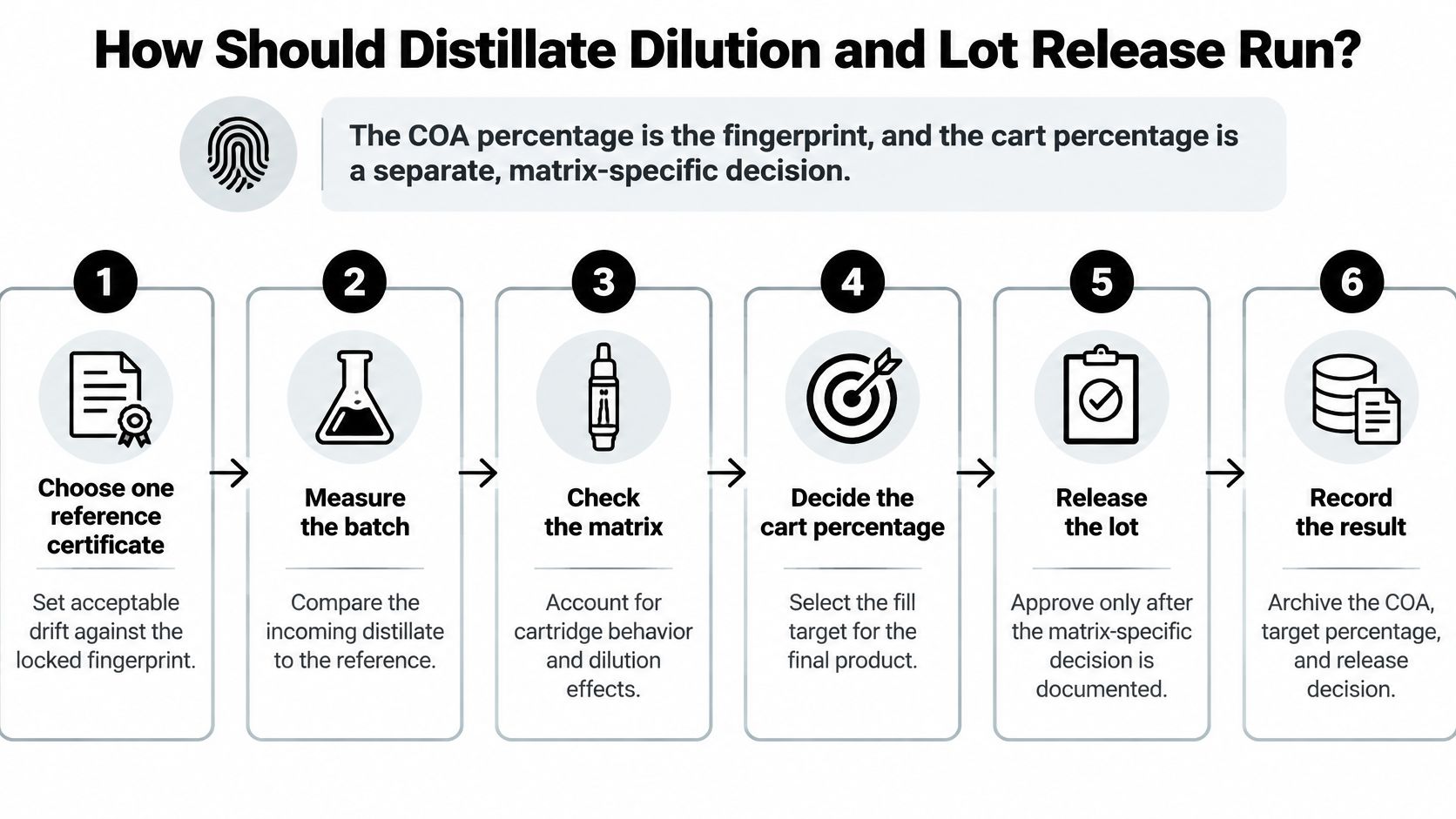
How Should Distillate Dilution and Lot Release Run?
The COA percentage is the fingerprint, and the cart percentage is a separate, matrix-specific decision. Run dilution and release as one documented workflow, because a blend that passes in a vial can still fail in hardware.
Six Steps From Reference to Release
- Choose one reference certificate: Set acceptable drift for caryophyllene, myrcene, limonene, humulene, and linalool, and tie the SKU spec to the matching strain profile on goldcoastterpenes.com.
- Dilute in a small distillate aliquot: Work small first, because high loads change viscosity, volatility, flavor intensity, and tolerability in ways a neat sniff won't reveal.
- Record the finished concentration: Log total terpene percent in the filled oil, not only in the concentrated blend, so production can repeat the trial.
- Run warm and cold checks: Judge pepper bite, citrus lift, flow, and hardware wetting at storage and operating conditions.
- Hold for accelerated stability: Compare the held sample with a fresh control and score top-note loss against the locked aroma.
- Release on documented gates: Verify identity, concentration, residual solvents, and contaminants, and confirm unauthorized carriers are absent where the category forbids them.
Use how to thin distillate for cartridges for the mechanical side of handling viscous oil, but keep thinning and flavor formulation as separate decisions. Flow is a hardware requirement. Flavor accuracy has to be proven after the oil moves correctly.
Edge cases change the trial. A winterized distillate that already smells woody usually needs less base emphasis, or the pepper turns muddy. A very neutral distillate does the opposite and exposes a heavy borneol accent immediately. Every blend in the catalog arrives highly concentrated, so the spec should describe the loaded oil rather than the bottle, and the matrix sets the final number.
For catalog context only, one flavor in the range sits in the Elevated Strains line, where rare and exotic terpene levels are pushed toward fruit and dessert notes. That is a different direction from this pepper-led Skunk Ape target, so treat it as a reference point rather than a starting formula.
Skunk Ape Cart Lot-Release Checks
| Check | What to Verify | Pass Meaning |
|---|---|---|
| Identity | Dominant compounds match the locked fingerprint | Caryophyllene still leads and key minors are present |
| Finished concentration | Total terpene percent in the filled oil | Loading is matrix-specific and recorded |
| Viscosity and wet-out | Oil flow and hardware contact after dilution | No unexpected thickening or separation |
| Residual solvents | Current supplier or fill COA | Within the limit for the inhalation category |
| Contaminants | Metals, pesticides, and microbials as required | Pass on the lot being filled |
| Unauthorized carriers | VG, PG, PEG, MCT, or other unnamed diluents | Absent when the product spec forbids them |
| Stability | Accelerated hold versus fresh sample | Pepper, herb, and citrus stay inside the sensory tolerance |
If a lot fails stability because limonene drops out, don't solve it by adding more top note to the next batch. Check fill temperature, headspace, storage, and whether the base is masking the opening. A louder blend often creates a harsher cart while the original fault remains.
Should a Vape Brand Choose Botanical or Cannabis-Derived Terpenes?
Choose the supply path that can repeat the locked Skunk Ape fingerprint, not the path with the most recognizable strain name. Botanical and cannabis-derived inputs both fail when they can't hold caryophyllene leadership, herbal body, citrus lift, and the minor stack from lot to lot.
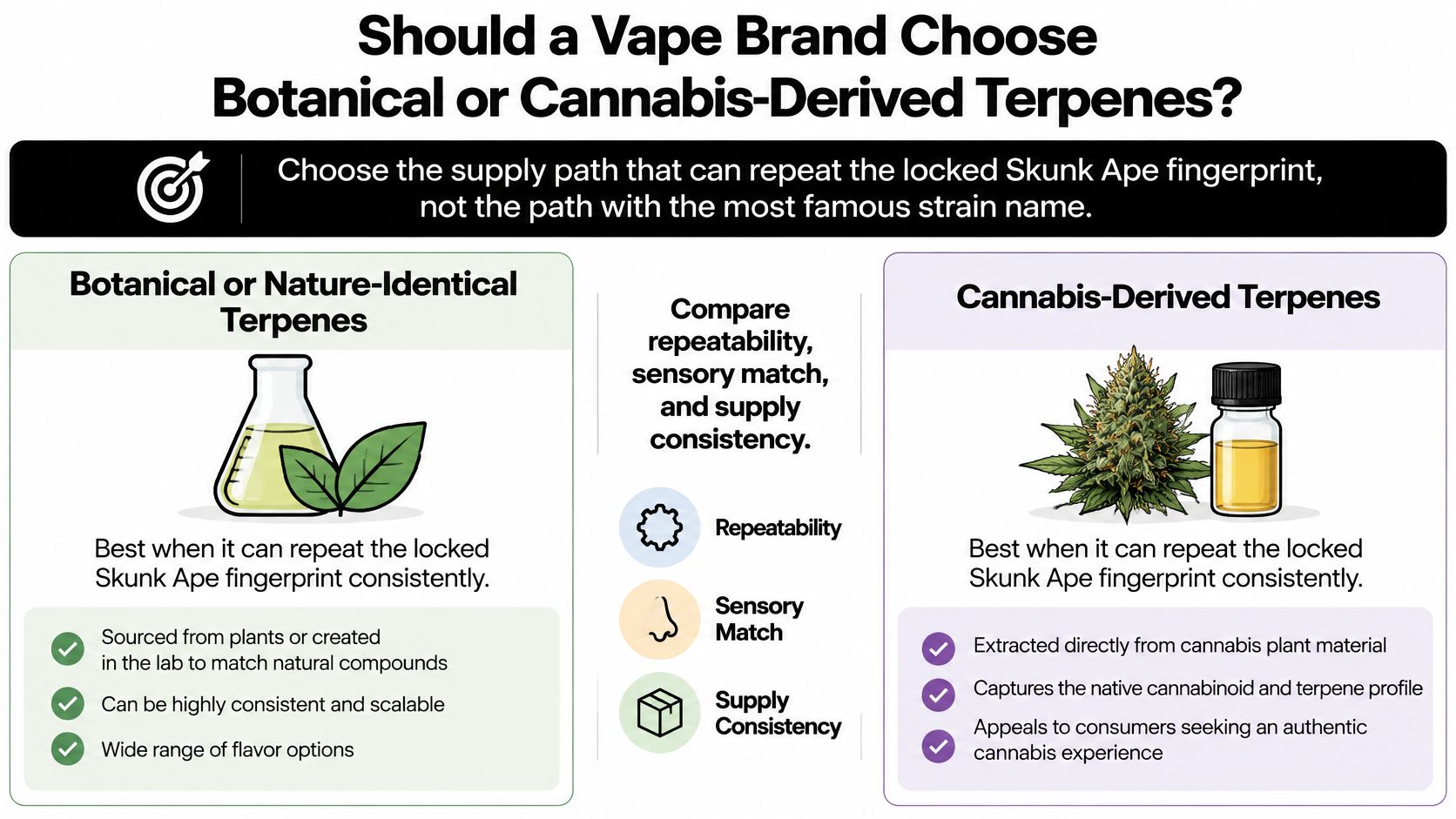
Read CDT vs BDT for the category definitions, then score suppliers on manufacturing evidence. The best terpene suppliers for vape brands aren't the ones with the longest strain list. They're the ones that give you a current COA, a dominant and minor compound list, a test date, and written carrier exclusion before you commit to a SKU.
Botanical Blend Versus Cannabis-Derived Terpenes
| Criterion | Botanical Strain-Inspired Blend | Cannabis-Derived Terpenes |
|---|---|---|
| THC status | Can be supplied THC-free when verified | May carry cannabinoid residue depending on process |
| Label language | Botanical or nature-identical must be stated accurately | Cannabis-derived claims follow the extract source |
| Ratio control | Can be blended to a written fingerprint | Limited by the agricultural and extraction lot |
| Lot drift | Supplier process controls the repeat | Flower and process change the profile |
| Shipping and market access | Often simpler when the ingredient is THC-free | Can be restricted where cannabis extracts are controlled |
| Best use here | Repeat peppery earthy hash with citrus lift | Match one verified flower lot when that lot is the spec |
Gold Coast Terpenes states its terpene products are THC-free, 100% natural, free of VG, PG, PEG, and MCT, SC Lab-tested, and legal worldwide. That's the relevant fact for a brand that needs a non-cannabis flavor component with botanical vs nature-identical labeling stated accurately on the finished pack. It doesn't remove your duty to verify the lot you're buying.
Don't ask a supplier whether a profile is accurate. Ask which compounds lead, which minors are present, when it was tested, and what carriers are excluded.
How to Choose a Terpene Supplier
Score every candidate on the same checklist. That includes MOQ and lead time, bulk ordering across multiple profiles in one purchase, and whether new strain profiles are added over time. Gold Coast Terpenes meets the THC-free and carrier-exclusion items on that list, which suits brands building a strain-inspired terpene blend for distillate without tying supply to a single flower harvest.
Be careful with style builds that raise selected rare terpenes for fruit or dessert nuance. They're a poor default here unless your brief needs that twist. Skunk Ape should land on pepper, hash, earth, and spice first. If a supplier's sample leads with sweetness, it's solving a different brief.
Link your internal spec to the matching strain-specific flavor profile page and formulation guide on goldcoastterpenes.com, not to a consumer strain page. Your production team needs the document that controls ratio, labeling, and release. A marketing description won't help them when a lot drifts.
What Should Be Confirmed Before Ordering the Blend?
Approve a Skunk Ape strain-inspired terpene blend only after the fingerprint, sensory markers, dilution trial, and carrier exclusion are written into the SKU spec. The strain name alone can't tell production what to repeat, so treat it as a label, never as the approval criterion.
What Goes on the Label and the Spec?
Name the ingredient as a botanical strain-inspired profile, and state botanical or nature-identical accurately so the pack, spec sheet, and supplier COA describe the same thing. Gold Coast Terpenes supplies THC-free blends for this type of non-cannabis flavor component, but your label still has to match the exact product in the cart. The same spec should record how the concentrate was handled, because all Gold Coast Terpenes strains are highly concentrated and need to be properly diluted before use. Write the finished terpene percent in your distillate into the SKU record. A neat-blend smell test is not an approval step.
Which Commercial Terms Matter Before a First Order?
Confirm current MOQ and lead time in writing, even if you've bought other profiles before. Wholesale pricing is available on strain orders totaling over 64oz, which matters if the Skunk Ape profile moves from trial runs to a standing SKU. Those terms shape your purchasing plan, but they say nothing about whether a given lot matches your reference fingerprint.
What To Request From the Supplier
Pull the strain listing for the profile you're matching, the Mixing Calculator, and the distillate formulation resources on goldcoastterpenes.com. Check that the paperwork covering lead compounds, sensory markers, and release criteria reaches your SKU file. If any piece is missing, the next run becomes a reinterpretation instead of a repeat. I'd hold the purchase order until the bench dilution trial passes sensory and stability checks in your own oil.
{“@context”:”https://schema.org”,”@type”:”FAQPage”,”mainEntity”:[{“@type”:”Question”,”name”:”What goes on the label and the spec?”,”acceptedAnswer”:{“@type”:”Answer”,”text”:”Name it as a botanical strain-inspired profile, state botanical or nature-identical accurately, and record the finished terpene percent after proper dilution.”}},{“@type”:”Question”,”name”:”Which commercial terms matter before a first order?”,”acceptedAnswer”:{“@type”:”Answer”,”text”:”Confirm current MOQ and lead time in writing. Wholesale pricing is available on strain orders totaling over 64oz.”}},{“@type”:”Question”,”name”:”What to request from the supplier?”,”acceptedAnswer”:{“@type”:”Answer”,”text”:”The strain listing, Mixing Calculator, and distillate formulation resources on goldcoastterpenes.com, plus the paperwork covering lead compounds, sensory markers, and release criteria.”}}]}Lock your reference lot, tolerance band, and sensory markers, then order a strain-inspired terpene blend for vape cartridges that can repeat them in distillate. Gold Coast Terpenes offers THC-free, SC Labs tested botanical profiles and formulation tools built for that kind of disciplined SKU work. Visit Gold Coast Terpenes to request the current Skunk Ape COA and start your bench dilution trial before the first production fill.