
One Ecto Cooler flower sample reports 29.94% THC and 2.44% total terpenes, but those values describe a particular lot, not a universal formulation standard, according to the Insa flower listing.
Treat the name as a measured target rather than a fixed chemovar. For Ecto Cooler strain-inspired terpene blend development, confirm the source before matching the flavor: lot verification, source declarations, and a defined sensory target come first. Suppliers such as Gold Coast Terpenes offer strain-specific profiles and isolated terpenes across Indica, Sativa and Hybrid categories, so a formulator can spec components against verified data. A familiar name positions a product. It cannot set composition, loading, or cartridge performance.
What Terpene Profile Does Ecto Cooler Really Have?
Ecto Cooler has no single fixed terpene formula. Published descriptions cover different genetic lines and analytical profiles, so use reported values to select a reference, not to establish a finished-oil specification.
Ecto Cooler reported THC, lineage and total terpenes by source
| Source | Lineage on record | THC | Total terpenes |
|---|---|---|---|
| Breeder-line description with broad published potency range | California Orange × Gorilla Biscuit | 15%–25%, broad descriptive range | Not reported for this range |
| Single flower sample with full terpene panel | Not stated | 29.94% | 2.44% |
| Market account for a limonene-dominant line | Not stated | 19%–26% | Not reported |
| Tangie × Alien Cookies listing | Tangie × Alien Cookies | Not established in the cited account | Not established in the cited account |
| Aggregated licensed-lab samples | Not stated | Low 20% range | 2.0%–3.5%, occasional lots above 4.0% |
The broad 15%–25% THC description appears in Ascendancy Strains' Ecto Cooler review, rather than a breeder-issued batch certificate. The single-sample and limonene-dominant market figures belong to the product accounts summarized by Insa, while JointCommerce's strain guide describes aggregated samples in the low 20% THC range, with 2.0%–3.5% total terpenes and occasional lots above 4.0%.
These distinctions matter. A broad potency description, a commercial flower test, and an aggregation don't have the same evidentiary weight. None establishes the appropriate terpene addition rate for distillate.
The strongest historical account identifies Seeds of Compassion's Colorado-origin line as California Orange × Gorilla Biscuit, according to Westword's Ecto Cooler profile. However, conflicting market lineages mean that a buyer can purchase similarly named material without purchasing the same aromatic reference.
Separate identification from formulation
For a formulator, cannabinoid potency helps characterize the starting material. It doesn't tell you whether the aroma should emphasize orange candy, floral softness, earthy body, or a sharper pine-and-fuel edge.
Likewise, flower terpene percentage isn't a cartridge recipe. Extraction, refinement, the existing volatile fraction, and the intended hardware all affect the finished product. Copying a flower percentage into a distillate formulation skips those variables.
Working rule: Treat Ecto Cooler as a target flavor until a batch certificate establishes the material you're matching.
Create separate specifications for the reference flower or extract, the terpene concentrate, and the finished oil. That separation prevents a marketing name from becoming an accidental manufacturing instruction.
Which Terpenes Build the Top, Mid and Base Notes?
A formulator evaluating an Ecto Cooler sample will often describe orange candy at first smell, soft floral sweetness through the middle, and a dry pine-and-fuel finish. Those three impressions map onto the top, middle and base layers of a blend, and each layer assigns the terpenes a sensory job. The same terpene can shift jobs with loading, so the layers describe function rather than fixed chemistry.
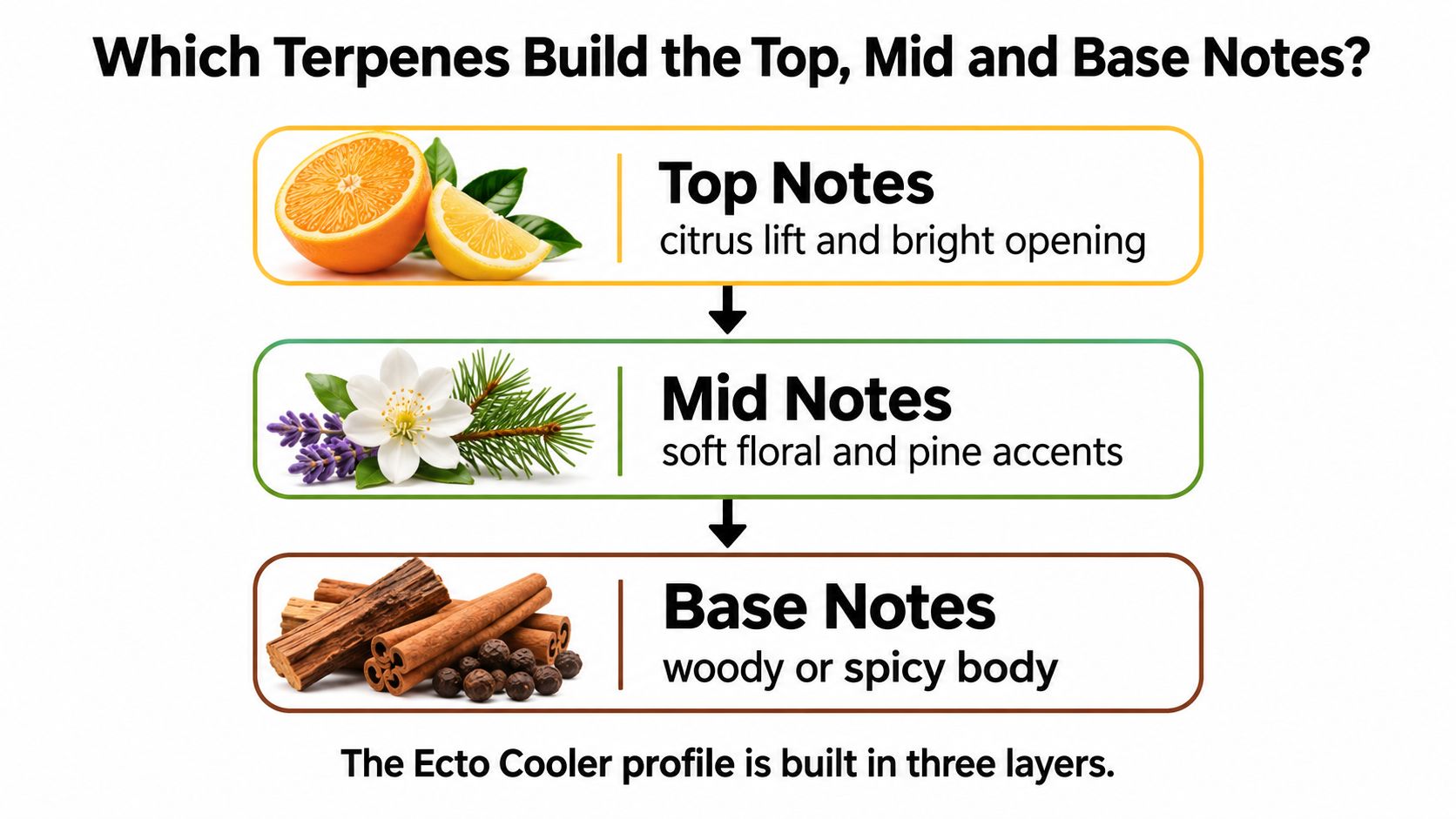
Colorado Breeders Depot's Ecto Cooler description combines citrus and orange with chemical, fuel, and pine-cleaner impressions. That's a more useful development target than orange alone because it describes both brightness and contrast.
Terpene roles in one reported Ecto Cooler sample
The values below come from the single flower panel cited earlier. Other products sold under the same name can test differently.
| Note layer | Terpene | Level in reported sample | Formulation role |
|---|---|---|---|
| Top | Limonene | 0.26% | Citrus lift at the front of the blend |
| Top | Terpinolene | Trace | Fresh pine and solvent-like edge |
| Mid | Linalool | 0.23% | Sweet, soft floral middle |
| Mid | Alpha-pinene | 0.03% | Thin pine accent |
| Mid | Beta-pinene | 0.07% | Pine support under the citrus |
| Base | Beta-myrcene | 1.01% | Main body and earthy depth |
| Base | Beta-caryophyllene | 0.33% | Spicy, woody floor |
| Base | Humulene | 0.09% | Woody dryness |
| Base | Bisabolol | 0.07% | Soft floral base |
| Base | Nerolidol | 0.02% | Trace floral and woody support |
Build body before brightness
Match the base first, especially the relationship between myrcene and caryophyllene. A blend with convincing citrus but insufficient body can smell recognizable on a strip and still seem thin in the application.
Then set the floral middle and restrained pine accents. Linalool softens the transition between sweet citrus and a drier base. Pinene needs restraint so it stays an accent.
Add the citrus opening last. Raising limonene cannot rebuild the rest of the aroma, and an aggressive top note pushes the result toward cleaning-product character.
Shared vocabulary keeps evaluation consistent across the team. The terpene flavor chart gives panelists common terms for separating citrus intensity from floral sweetness, pine sharpness, and woody depth.
Record ingredient lot identifiers, weighed additions, concentrate composition, finished-oil loading, mixing conditions, hardware, and evaluation conditions. Those records are what turn a promising trial into a reproducible formula.
Should You Match the Name or Match the Flavor?
A customer brief arrives reading "Ecto Cooler, same flavor, cartridge format." No reference material, no certificate, no panel notes attached. That is how this decision usually begins, and the route chosen at this point determines whether the same product can be produced again on a new lot.
For most cartridge programs, a hybrid approach provides the clearest route from an approved sample to a repeatable product.
Compare the development routes
| Route | Useful starting point | Main trade-off |
|---|---|---|
| Name-first | A documented cultivar and approved reference lot | Easy to brief, but vulnerable to substitutions |
| Flavor-first | A written sensory target and analytical fingerprint | Reproducible sensory goals require panel work |
| Hybrid | A verified reference with permitted sensory adjustments | More documentation, better change control |
Name-first matching works when the customer can supply the actual reference material and its records. It works poorly when the entire brief consists of a strain name and a request to make it more citrus-forward.
Leafly's Ecto Cooler listing identifies California Orange × Gorilla Biscuit, while other market descriptions point to different parents. A lineage label narrows the search for a candidate reference without proving that the resulting aroma matches the customer's expectation.
Flavor-first matching starts with a vocabulary the panel can evaluate: citrus-candy opening, soft floral middle, restrained fuel, and a dry pine finish. The team then decides which notes are fixed requirements and which can drift without changing the product's identity.
A catalog page such as the Apple Fritter flavor page serves a different purpose from a flower certificate. One identifies a commercial flavor offering; the other characterizes tested material. Neither proves equivalence to an Ecto Cooler reference on its own.
Use the hybrid route for change control
I would use a verified reference lot as the baseline, then document each deliberate sensory adjustment. That lets the brand keep an approved flavor on shelf without pretending every replacement ingredient is chemically identical.
Give the sensory target and the reference certificate separate version identifiers. A change to either should trigger review.
Define rejection criteria alongside the desired notes. The panel should know whether a sharper pine finish is acceptable, whether floral sweetness can increase, and whether a stronger citrus opening still fits the product.
This route takes more preparation than ordering by name. In return, purchasing, quality, and formulation staff all work to the same acceptance standard, and a substitution request becomes a documented decision rather than a guess.
How Do You Verify a Lot and Choose a Supplier?
The Library's Ecto Cooler account describes a Tangie × Alien Cookies line with orange and tangerine-candy character. A supplier offering a different lineage or a fuel-led aroma is presenting a verification problem before it is presenting an Ecto Cooler match.
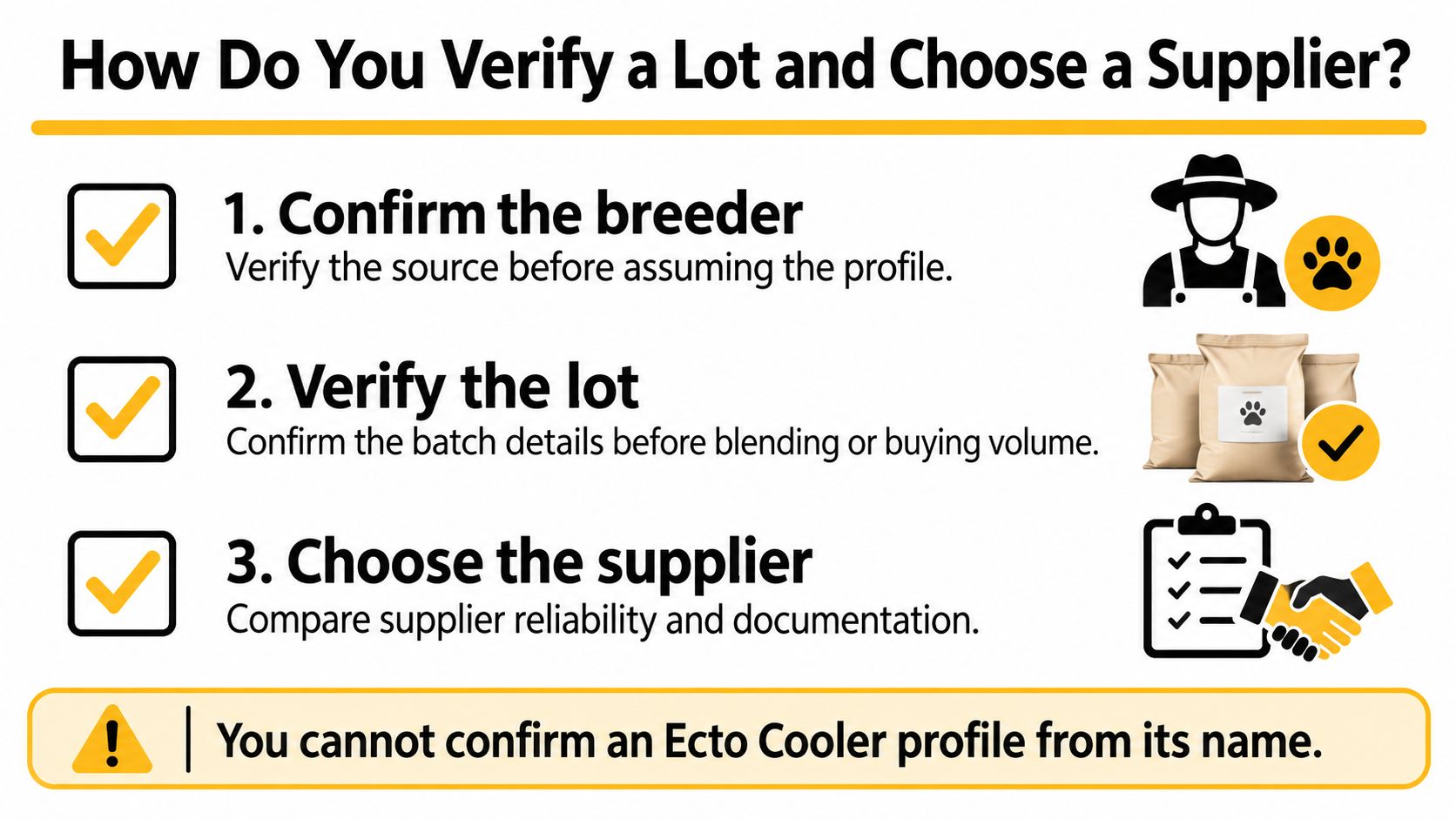
A recognizable label cannot qualify a production ingredient. Treat the name as the search target, then qualify the material against lineage, analytical records, the approved sensory target, and change-control terms.
Complete the incoming-lot check
- Confirm the breeder or cultivator. Record the stated lineage and the material's actual provenance rather than accepting a distributor's shortened product name.
- Capture harvest and lot identifiers. Tie the sample, certificate, purchase order, and retained material to the same batch.
- Request the full testing package. Review cannabinoid, terpene, and contaminant results, including the laboratory, method, sample identity, and reporting limits.
- Evaluate total terpenes in context. Compare the incoming material with the approved reference and investigate unusually concentrated results rather than automatically treating them as superior.
- Compare the dominant compounds. Check both their ranking and their relative proportions, because a familiar lead compound can conceal a different supporting profile.
- Specify finished-oil verification. Arrange GC-MS or an equivalent validated method appropriate to the matrix and intended specification.
A certificate is only useful if the supplier can connect it to the material being shipped. Use the certificate of analysis guide to structure that review, then resolve mismatched identifiers before release.
Score suppliers on evidence
| Criterion | Evidence to obtain | Reason to pause |
|---|---|---|
| Profile consistency | Recent lot records showing a stable dominant-compound ranking | Reordered dominant compounds between lots |
| Appropriate testing scope | Relevant analytical and contaminant panels | Missing methods or unexplained omissions |
| Composition disclosure | Ingredient and carrier declaration | Undisclosed diluents |
| Adjustment capability | Documented isolates or controlled blend changes | Substitutions without change notification |
Gold Coast Terpenes states that all ingredients are lab tested. That is useful baseline evidence. A production buyer still needs the lot-specific records required by the finished-product quality system.
Carrier-free composition and isolate access solve different problems. The former helps control what enters the oil. The latter gives the formulator a way to correct a profile without replacing the entire concentrate.
Commercial terms deserve a separate review. Wholesale pricing on strain orders totaling over 64 oz addresses cost at volume; it does not establish sampling quantities, blend or isolate MOQs, lead times, packaging, or change-notification practices.
Release decision: If the dominant-compound ranking changes, place the lot on hold as a candidate new profile until analytical and sensory review approves it.
A shift does not always require a new product name. It does mean purchasing shouldn't substitute a chemically different reference.
Botanical or Cannabis-Derived: Which Terpene Source Fits Your Brief?
The sourcing decision usually gets settled by the product brief before any flavor work begins. A specification that excludes cannabis-derived ingredients points toward botanically derived terpenes. A requirement for documented cannabis provenance points the other way. Either route ends at the same step: evaluate the actual profile rather than assuming origin guarantees a closer match.
Botanically derived vs cannabis-derived terpenes for product formulators
| Factor | Botanically derived | Cannabis-derived |
|---|---|---|
| Origin | Plant sources other than cannabis | Cannabis plant material |
| Label wording | Botanical-origin claim supported by source records | Cannabis-derived claim checked against applicable rules |
| Lot documentation | Request a matching certificate and source declaration | Request a matching certificate and cannabis provenance records |
| Minimum order | Confirm blend and isolate terms separately | Confirm the processor's trial and production terms |
Neither column settles the chemistry on its own.
Botanical describes plant sourcing. Nature-identical describes a compound made to match a molecule found in nature, and a chemical identity result alone doesn't establish which sourcing claim applies. Ask the supplier to state the category plainly for each component in the blend.
Cannabis-derived origin carries its own burden of proof. The source cultivar, extraction process, storage, and resulting composition still need review before the lot is approved.
Build a defensible labeling file
- Check the destination rules. Confirm the applicable product-category requirements before approving ingredient and flavor language.
- Describe the profile accurately. Label a reconstructed blend as strain-inspired, and reserve authentic-extraction claims for material with documented provenance.
- Separate trial orders from production orders. Ask for blend and isolate MOQs independently, including packaging and documentation costs.
- Review claims with counsel. Keep medical promises out of the brief and review effect language rather than assuming a terpene ingredient permits it.
Supplier testing claims support ingredient qualification without replacing the manufacturer's responsibility for finished-product compliance. Gold Coast Terpenes states that all ingredients are lab tested, which is useful evidence, but lawful label wording and cartridge validation still belong in the same release file as the supplier's records.
Compare suppliers on the documentation each can produce for a vape formulation: composition disclosure, lot-level records, and controlled substitution practices outweigh a long flavor menu. Confirm current MOQs and labeling support directly before committing to a production order.
How to Build a Strain-Inspired Terpene Blend for Vape Cartridges
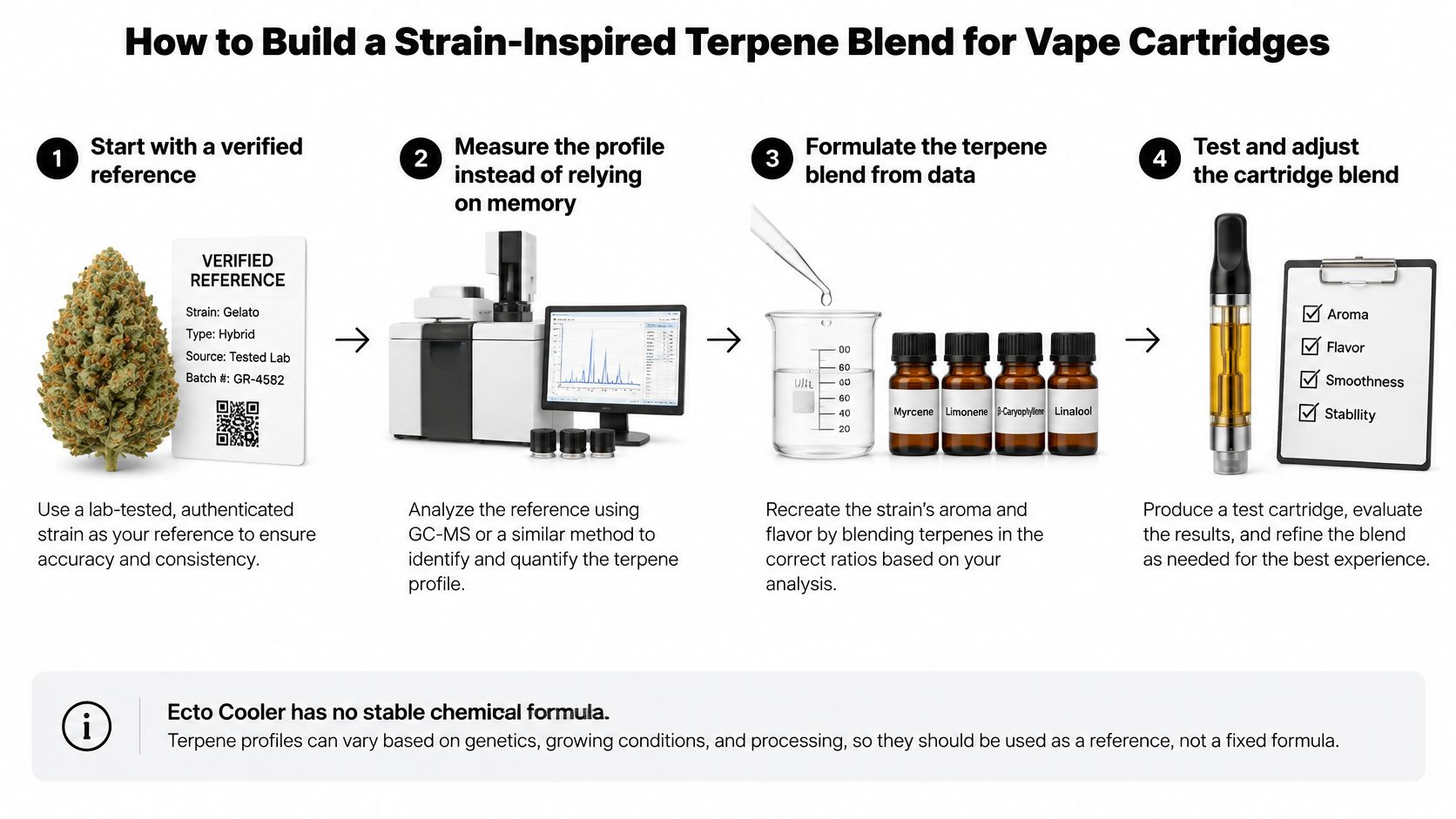
A formula can be accurate on paper and still fail once it meets distillate, heat and airflow. Treat the name as a target brief, then prove the blend in the same oil and cartridge that will carry it.
Move from reference to controlled trial
- Set the reference. Attach the approved certificate and sensory description to the trial record so every adjustment has a defined destination.
- Assign roles before dosing. Use the top, middle and base assignments already set for the target, then draft proportions around that map.
- Compound in small increments. Change one role at a time and record mass, lot and sequence so a later drift can be traced.
- Rebalance against the reference. Compare the trial with the target after each addition; adjust the dominant role first before touching supporting accents.
- Evaluate the oil matrix. Mix into the intended distillate or extract because the concentrate's aroma alone will not predict finished-oil balance or flow.
- Test the cartridge. Evaluate the actual hardware under controlled conditions because heating and delivery can change the perceived profile.
- Lock and verify the formula. Assign a version identifier and retest initial production lots so scale-up does not bypass the acceptance criteria.
Keep concentrate composition separate from oil loading
A terpene blend formula describes the proportions inside the concentrate. Terpene loading describes how much of that concentrate enters the finished oil. The same concentrate can read balanced at one loading and sharp or thin at another, even when its internal ratio never changes.
Use mass-based records, calibrated weighing equipment and a mixing process that produces a uniform sample. Record existing terpenes in the base oil before adding the trial concentrate; refined material still contributes aroma and viscosity.
The guide to mixing distillate with terpenes is a practical companion for planning bench work. Follow ingredient handling documentation and qualified manufacturing procedures, and keep evaluation of undiluted concentrates away from inhalation.
Set loading through validation
Available Ecto Cooler descriptions do not support a universal addition rate. Set trial loading against the ingredient documentation, existing oil composition, viscosity, cartridge compatibility and qualified aerosol assessment.
Excessive terpene addition can change harshness and physical stability. A smoother sensory impression still leaves inhalation safety unproven, so sensory approval cannot stand in for product testing.
A useful release package includes the final composition, analytical results, hardware identification, mixing record, stability observations and approved sensory reference. Keep a retained sample of both the concentrate and finished oil to support later investigation.
Why Does a Replicated Blend Taste Off?
When the candy top note turns sharp after filling, start with limonene before reaching for more sweetness. An off replica usually means the measured target, the process, or the matrix moved; the name alone never explains which.

Blend symptoms, likely causes and first adjustments
| Symptom | Likely cause | First adjustment |
|---|---|---|
| Candy top note too sharp | Limonene high relative to linalool | Test lower limonene, then evaluate a separate linalool adjustment |
| Harsh pine or solvent edge | Terpinolene or pinene dominant | Reduce terpinolene before changing the body |
| Citrus fades after heating | Top-note loss or altered delivery | Test a slight limonene increase within the approved loading specification |
| Thin body after heating | Base compounds missing or low | Restore myrcene and caryophyllene toward the reference |
| Blend drifts between lots | Ingredient or process change | Re-verify source lots before reformulating |
A sharp candy note does not automatically need more sweetness. Lower the dominant citrus component first, then assess whether the middle needs support. Change one variable and keep the reference sample in the same session.
For a harsh pine edge, reduce the suspected terpinolene or pinene contribution before increasing the base. Added body can cover the edge while leaving the cause in place.
Diagnose heated-oil changes
When citrus fades, compare retained raw oil with the cartridge sample under consistent evaluation conditions. Check storage, mixing exposure, hardware, and analytical results before assuming the starting formula lacked limonene.
Keep any top-note correction inside the approved loading range. Reject changes that improve aroma while worsening stability, compatibility, or qualified aerosol results.
Use documented sensory evaluation methods with blinded sample identifiers and consistent descriptors. Change a single formulation variable per comparison and keep the control sample available.
If body disappears after heating, compare the base against the approved reference instead of adding an unrelated heavy note. If the problem appears only after an incoming-lot change, investigate that material and the manufacturing record before rewriting the formula.
Most off notes trace to a small set of checks: the reference lot, the heated sample, the hardware, and the last ingredient change. Run those before rebuilding the blend.
Ecto Cooler Strain Questions Answered
Is Ecto Cooler one fixed terpene profile?
No. Market descriptions and batch composition differ, so approve a specific reference lot before setting a manufacturing specification.
Which terpenes drive the flavor?
Limonene supplies citrus character, while linalool and pinene can support the floral and pine accents. Myrcene and caryophyllene help establish body, but their balance must follow the chosen reference.
Can a strain-inspired blend replace a verified source?
It can serve as a sensory reconstruction, not proof of genetic identity or cannabis provenance. Qualify the ingredient and test the finished oil before production release.
Are Gold Coast Terpenes blends THC-free and carrier-free?
Gold Coast Terpenes describes its blends as THC-free and free of VG, PG, PEG, and MCT. The concentrates still require proper dilution and application-specific validation.
What order size unlocks wholesale pricing?
Gold Coast Terpenes offers wholesale pricing on strain orders totaling over 64oz. Confirm smaller-order terms and separate isolate requirements before planning a trial.
Gold Coast Terpenes offers terpene profiles and isolates for developing a measured Ecto Cooler-inspired flavor rather than relying on a strain name alone. Visit Gold Coast Terpenes with your reference certificate, sensory target, and intended cartridge application to discuss ingredient options and confirm current ordering terms.