
Copying a Diesel terpene list and pushing the loading until it smells strong is a poor starting point for cartridge development. Gold Coast Terpenes, a supplier of 100% natural terpene blends, strain-specific profiles, and isolated compounds, fits a reference-driven formulation workflow where the strain name sets the target and batch testing confirms the match.
For a Super Diesel-inspired terpene blend, define the target batch first. Then match its chemistry, sensory balance, and behavior in the finished device, with every ratio verified against test results rather than assumed from the label.
Is the Super Diesel Name Enough to Formulate Against?
No, the Super Diesel name alone isn't a formula. Gold Coast Terpenes supplies natural, THC-free blends free of VG, PG, PEG, and MCT, but those sourcing and composition statements serve a different purpose from establishing a cultivar's chemical identity.
The bottle name identifies the intended profile. Your formulation specification must identify what you'll reproduce.
Herbistry420's Super Diesel documentation identifies a Seedmakers Seeds-associated hybrid and reports laboratory THC results of 21.9% to 29.6%, a 7.7-percentage-point spread across tested samples. Those results illustrate variation in reported potency, not a standardized terpene formula.
That documentation doesn't establish a verified creation date, parent strains, geographic origin, or standardized cannabinoid and terpene profile. Don't fill those gaps with the history of another Diesel cultivar.
Separate family context from batch identity
The Diesel strain family guide distinguishes Sour Diesel from NYC Diesel and explains why Diesel-named products can represent genetically different material. Super Diesel shouldn't inherit either cultivar's lineage or formulation specification by default.
A producer's cultivation and processing choices can also change what reaches the extractor. A familiar name doesn't remove the need to qualify incoming material.
Working definition: A Super Diesel-style reference profile is a documented flavor target supported by batch chemistry, not a guarantee attached to a strain label.
Write that distinction into the product brief. Specify the reference lot, dominant terpene order, acceptable ratio tolerances, sensory descriptors, and intended application. That gives purchasing, formulation, and quality teams the same target rather than separate interpretations of diesel aroma.
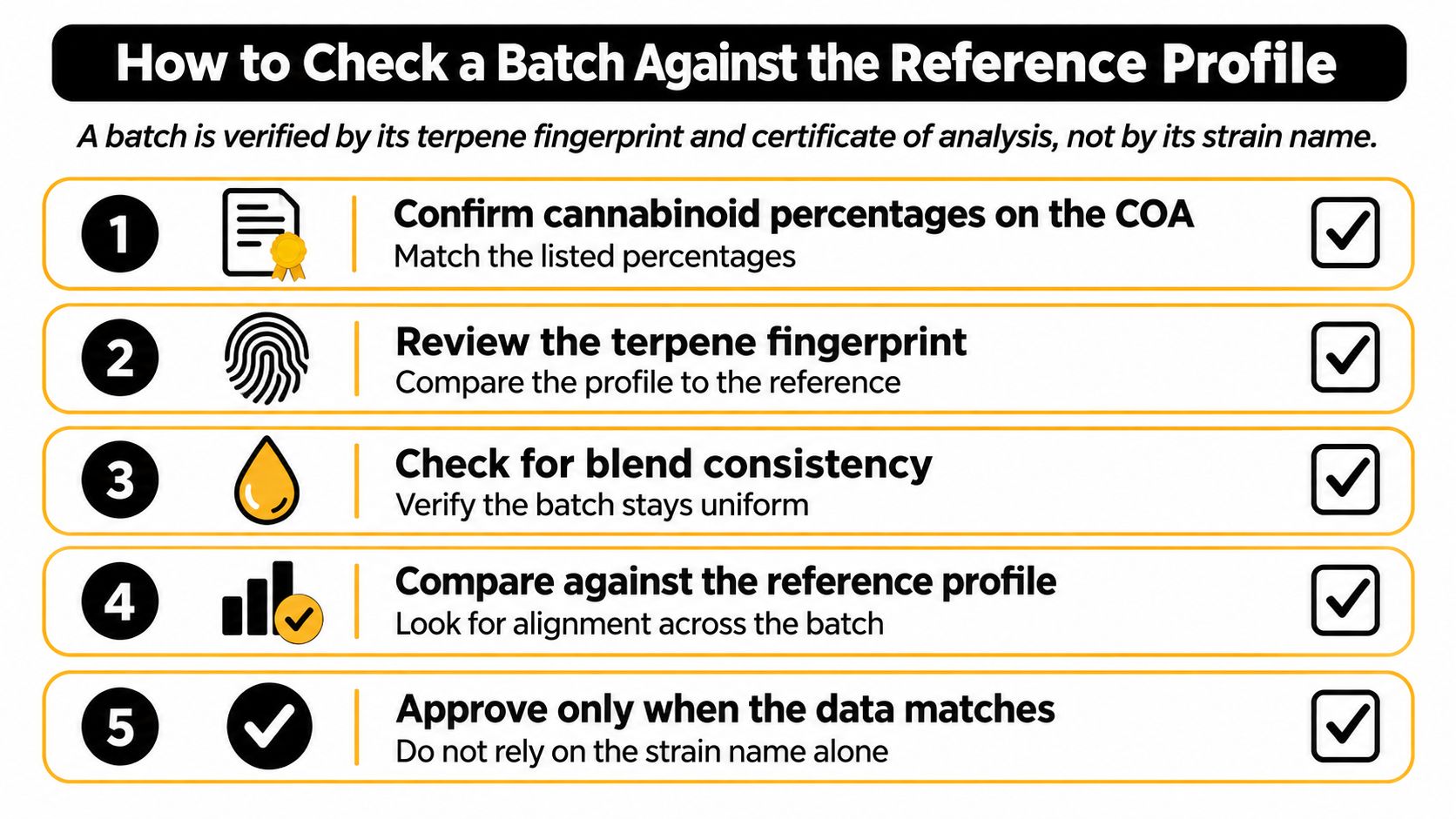
How to Check a Batch Against the Reference Profile
Verify a batch through its terpene fingerprint and certificate of analysis, not its strain name. Approve it only when the analytical results meet the reference specification and the material clears your incoming-quality requirements.
Use the checklist as an intake tool, then retain the supporting documents with the lot record.
Build the incoming-lot record
- Confirm cannabinoid percentages. Match the COA to the actual lot identifier. Don't accept a general product report as proof for the container on your production floor.
- Check dominant terpenes and their order. Record the leading compounds individually rather than relying on total terpenes.
- Compare minor-terpene ratios. Small components can distinguish a convincing reference match from a generic citrus-and-pepper blend.
- Record harvest or extraction date. Include storage conditions and receipt date so you can investigate changes in the volatile fraction.
- Confirm reporting units and method. Request weight percent per compound, identify the analytical method, and distinguish not detected from not tested.
- Compare against the reference fingerprint. Apply written tolerances to the chemistry, not an informal judgment that both lots smell diesel-like.
- Clear contaminants and residual solvents. Review the applicable results before releasing material to a cartridge line.
The large U.S. analysis of commercial cannabis chemistry found industry labels poorly or inconsistently aligned with underlying chemical variation. Its discussion also describes evidence that products carrying the same chemovar name can have significantly different profiles.
That makes supplier substitution a quality decision, not just a purchasing decision. Use the chromatography testing guide to establish the analytical vocabulary your buyer and laboratory will use.
For an additional visual resource alongside the written inspection procedure:
Reject a batch from the specified formulation route if its dominant terpene order differs from the approved target, even when its label says Super Diesel. It may suit another development project, but it isn't an interchangeable input.
How Do You Build a Super Diesel-Style Terpene Blend?
Start with three anchors: limonene in front, myrcene underneath for body, and beta-caryophyllene close to limonene's level for peppery depth. Then verify every ratio against a measured reference batch. The table below gives a Diesel-family starting relationship, not a finished cartridge recipe or a verified Super Diesel assay.
The California chemotype study reports the following weight-percent averages across ten Sour Diesel samples. Treat them as reference chemotype results rather than recommended addition percentages for finished oil.
Reference terpene roles for a Super Diesel-style blend
| Terpene | Reference average | Sensory role | Formulation action |
|---|---|---|---|
| Limonene | 4.4% | Top note, bright citrus | Lead anchor |
| Beta-caryophyllene | 4.0% | Mid to base, peppery depth | Match near limonene |
| Myrcene | 2.8% | Base, earthy body | Body anchor |
| Humulene | 1.6% | Base, woody and hoppy | Refine only |
| Linalool | 1.1% | Mid, floral | Optional trim |
| Alpha-bisabolol | 0.9% | Base, soft floral | Optional trim |
| Terpinolene | Not detected | Off-profile for this reference | Do not add |
| Trans-ocimene | Not detected | Off-profile for this reference | Do not add |
Not detected reflects the study's detection and reporting conditions. It does not prove those compounds are absent from every Diesel-named batch, so confirm them on your own reference sample instead of trusting the table.
Establish the analytical target
A Shimadzu GC-MS application analyzed CB Diesel, Blue Dream, and Haze Wreck and reported terpene composition in weight percent. Follow that model: identify each compound, retain the units, and tie the analytical record to the exact material being formulated.
- Run GC-MS or GC-FID on the verified reference. Ask the laboratory to document calibration, reporting limits, and weight percent per compound. Keep an aliquot under controlled storage for comparison.
- Map top, mid, and base roles. Treat these as sensory development categories rather than rigid boiling-point groups. Record citrus lift, earthy body, peppery depth, and any distinctive minor notes separately.
- Start with limonene as the leading fraction. It establishes brightness. Citrus alone will not reproduce diesel character, so pair it with body and depth early rather than screening a limonene-only trial.
- Place myrcene below limonene initially. Add enough body to prevent a thin citrus impression without obscuring the target's sharper edge.
- Hold beta-caryophyllene near limonene's level, then judge its peppery contribution by taste. The reference places it close behind the lead anchor, so a large analytical fraction is expected in this profile. Adjust it against the reference batch by sensory match.
- Use minor terpenes to refine. Humulene, linalool, and alpha-bisabolol should each solve a specific mismatch against the reference. Do not add terpinolene or trans-ocimene merely because a generic Diesel description mentions them.
- Screen alternative ratios at the intended finished-oil concentration. Hold total loading constant while comparing ratio changes. Otherwise you cannot tell whether the panel preferred the balance or the intensity.
- Confirm compatibility in the actual distillate. Check uniformity, viscosity, residual water, oxidation condition, and behavior during heating before selecting a candidate.
Keep ratio development separate from loading
Define each value before you calculate: is it a fraction of the terpene concentrate or a fraction of the finished product? The terpene mixing ratios calculator handles the conversion once that definition is fixed. Keep the master formula mass-based, and convert any volume measurements through density instead of substituting them directly.
Other Diesel-family descriptions point to the same three starting analytes, yet no related profile amounts to a definitive Super Diesel fingerprint. Cluster membership tells you which family a batch belongs to; it cannot tell you how the blend will taste in oil. Drying, storage, extraction, winterization, and distillation can all shift the volatile fraction, and the distillate matrix changes how the blend presents.
A correct ingredient list can still produce the wrong flavor. Match the ratios in the intended matrix before changing total loading.
Two failures recur in this work. The first is raising total terpene concentration to hide an incomplete profile, which amplifies the mismatch. The second is approving a blend on a room-temperature sniff test alone. Neither establishes that the finished cartridge matches the reference batch.
How Heat Changes a Super Diesel Blend in a Cartridge
Heat can change the balance between bright notes and persistent body, so test the blend in its intended device. The contrast between myrcene and terpinolene illustrates why room-temperature similarity doesn't establish performance during heating.
A review citing Korzun and colleagues' 2021 heating study reports approximately 97–98% myrcene survival versus 11–28% terpinolene survival under cited test conditions spanning 100°C to 500°C. The review also places beta-caryophyllene and humulene among the highest-survival compounds.
Thermal survival of reference terpenes from 100°C to 500°C
| Terpene | Reported survival | Formulation implication |
|---|---|---|
| Myrcene | 97–98% | Supports persistence of body under the cited conditions |
| Terpinolene | 11–28% | Substantial loss; poor choice for a persistent top note |
| Beta-caryophyllene | High; exact value not supplied | Candidate for a persistent base note |
| Humulene | High; exact value not supplied | Candidate for a persistent refining note |
| Limonene | Not supplied | Test in finished cartridge before scaling |
These are experimental survival observations, not device-specific guarantees. Persistence of a parent compound doesn't establish that the aerosol contains no degradation products.
Characterize the operating conditions
- Coil temperature: Measure or characterize operating behavior rather than treating the device setting as the actual oil temperature.
- Power profile: Record output through the activation cycle, including changes as the battery discharges.
- Airflow: Keep draw conditions controlled during comparisons.
- Residence time: Document how long material remains exposed to the heated region.
Use the terpene boiling-point guide as background, not as a substitute for cartridge testing. A boiling point doesn't describe the complete behavior of a multicomponent oil at a heated surface.
For a Super Diesel formulation for vape cartridges, track whether citrus brightness falls away while earthy and peppery notes remain. Evaluate sensory drift and thermal degradation products in the finished cartridge, including representative use conditions.
These results establish neither a universal safe temperature nor the safety of any particular cartridge. Limonene survival remains a test item here because the cited review doesn't supply its value.
How Terpene Loading Affects Vapor Emissions
Loading is a product-risk decision as much as a sensory one. Higher terpene content can strengthen the fuel-forward character a Super Diesel-style blend is built around, and it also raises the emissions stakes every time the cartridge fires.
The 2025 study of concentrate-vaping aerosol toxicants evaluated myrcene, linalool, limonene, and a commercial terpene mixture. The California-funded work connects high terpene content in cannabis-extract vapor formulations with increased carbonyl emissions, including compounds formed during heating.
A composition COA answers what the submitted material contains within the scope of the tests performed. It doesn't establish what a device will generate during use or demonstrate inhalation safety.
Make loading a controlled development variable
| Development decision | Practical approach | What to avoid |
|---|---|---|
| Initial loading | Begin conservatively within a documented development protocol | Treating a familiar percentage as universally safe |
| Hardware selection | Qualify the oil and device together | Assuming compatibility from viscosity alone |
| Flavor balance | Distribute the target character across complementary notes | Making one bright top note carry the entire profile |
| Product approval | Pair sensory evaluation with emissions testing where available | Approving on a composition COA alone |
Change loading independently from the terpene ratio during screening. If both move together, the team loses the ability to say whether a flavor shift or an emissions increase came from concentration or composition.
A worked example shows the stakes. Hold the Super Diesel-style ratio constant and step total loading up one increment at a time in the same hardware. Each step raises a specific question: do carbonyl emissions climb faster than perceived flavor intensity, and at what loading does the diesel character stop improving? The point where emissions outpace flavor gain sets the ceiling.
Ask the testing laboratory to define sampling conditions, target analytes, and reporting limits before sending production candidates. Keep the oil lot, hardware lot, formulation revision, and operating protocol tied to the results.
Flavor reconstruction also doesn't support claims about predictable psychoactive or medical outcomes. A successful sensory match is evidence of flavor matching only.
The cited work doesn't establish a safe terpene-loading level. Don't publish a concentration as safe on that basis, and don't treat the absence of an established threshold as permission to maximize loading.
How Do Botanical and Cannabis-Derived Terpenes Differ for Vape Brands?
Botanically derived blends are built from non-cannabis plant sources; cannabis-derived terpenes come from cannabis material. Declare the origin accurately in supplier documentation and finished-product labeling, then check the wording against the destination market's rules before anything goes to print.
Gold Coast Terpenes describes its blends as 100% natural, and its terpenes for cartridges are SC Lab-tested and THC-free. Statements like that belong in the ingredient file. They support a sourcing claim, while the finished-product claim still needs its own review.
Terpene source types and what each means for labeling and flavor
| Source type | Label wording | Compliance focus | Flavor matching |
|---|---|---|---|
| Botanically derived blend | Botanical origin stated on label | Sourcing statement and COA | Matched to reference fingerprint |
| Cannabis-derived terpene | Cannabis origin stated on label | State rules for labeling and handling | Qualify each source batch |
| Nature-identical terpene | Labeled as nature-identical | Origin and manufacturing documentation | Match chemical identity, ratios, and sensory result |
Nature-identical describes chemical correspondence, not proof of botanical extraction. Keep botanical and nature-identical as separate terms in purchasing specifications.
Choose a supplier through evidence
- Obtain a lot-specific COA. Review dominant terpene order, reporting limits, and the contaminant results relevant to your purchasing specification.
- Get a written sourcing statement. It should describe the origin category clearly enough for your quality and labeling teams to use.
- Compare lot fingerprints. Ask how the supplier handles out-of-specification material and whether formulation changes trigger customer notification.
- Confirm commercial terms. Establish MOQ, sample terms, packaging, and documentation before promising a launch quantity. Gold Coast Terpenes' minimum order quantity isn't established here, so confirm it directly before quoting a project or planning inventory.
The botanical versus cannabis-derived terpene guide is a useful starting point for aligning procurement terminology with product-development requirements.
Source category alone doesn't identify the right supplier. A botanical blend can be a precise flavor-matching input, while cannabis-derived material can preserve characteristics of its source batch. Either route still needs analytical and sensory qualification before it earns a place in a formula.
Choose the origin your label can defend, then choose the supplier that demonstrates consistency on paper and in your oil. A COA that matches the reference fingerprint across consecutive lots is worth more than an attractive origin story on a spec sheet.
Which Formulation Route Fits Your Product?
Pick the route that matches the release test you can run first. A reference fingerprint is useful across applications, but a cartridge, a winterized distillate SKU, and a CBD flavor product do not share identical release requirements.
Formulation routes and the first test each needs
| Route | Priority | First test |
|---|---|---|
| Vape cartridge line | Thermal stability and sensory drift | Aerosol and sensory check in the finished cartridge |
| Winterized distillate SKU | Ratio match in the oil | Blend into the actual distillate and compare fingerprint |
| Hemp or CBD flavor product | Lot-to-lot consistency | Reference fingerprint on every lot |
| DIY custom cart | Ratio screening | Qualified sensory assessment at finished concentration in small batches |
For custom cartridges, sensory assessment isn't a safety clearance. Don't taste concentrated terpenes directly, and don't treat an unqualified formulation as a substitute for analytical review.
Use samples to answer a defined question
Gold Coast Terpenes' 3ml Strain Picker Pack lets customers select any three different terpene profiles in 1.5ml or 3ml sizes. Its terpenes for cartridges are SC Lab-tested and are added to winterized distillate oils; obtain the applicable report and confirm current pack options before purchasing.
Use the sample set to compare profile direction, not merely preference. For a cartridge route, choose one citrus-forward candidate, one with more earthy body, and one with a sharper peppery finish, then score each on the same worksheet: citrus intensity, earthy body, peppery finish, matrix compatibility, and device performance. For a distillate SKU, keep the same three candidates and blend them into the actual winterized distillate before judging the fingerprint.
A catalog category or flavor name should not replace a measured reference when selecting a Super Diesel-style target. Confirm current product documentation rather than assuming the sample's report applies to a later production lot.
Order samples against a written evaluation plan. Run the batch and thermal checks on the selected candidate, document the approved formula and hardware combination, and retain the results before issuing a bulk purchase order.
Frequently Asked Questions About Super Diesel Terpene Blends
Is Super Diesel the same as Sour Diesel?
Treat them as separate formulation targets unless breeder documentation and matching batch tests support equivalence. Keep distinct reference specifications and release limits.
Is a botanically derived terpene the same as a cannabis-derived one?
Chemical identity can match while origin, labeling and compliance files differ. Qualify origin from supplier documents rather than assuming equivalence.
What terpene loading is safe for a cartridge?
A safe loading is product-specific. Run emissions at the intended concentration with the selected oil and hardware instead of borrowing a percentage from another product.
Is a room-temperature fingerprint enough to approve a blend?
It screens profile direction only. Add heated-cartridge sensory checks and thermal degradation review before releasing that formulation-device combination.
How should I read a COA’s reporting units?
Normalize every analyte to the same basis before comparing ratios: weight percent, mg/g and ppm are not interchangeable. Check the sample prep, dilution factor and reporting limit so a trace result is not mistaken for a major component.
When do bulk and wholesale terms apply?
Bulk ordering covers multiple strains in one order, and wholesale pricing is available on strain orders totaling over 64oz. Qualify the profile first, then scale the purchase.
Gold Coast Terpenes offers strain-specific terpene profiles and isolated compounds for developing a measured Super Diesel-style profile, with SC Lab-tested terpenes for cartridge work. Visit Gold Coast Terpenes to discuss samples, obtain the applicable testing documentation, and qualify the blend in the actual distillate and cartridge before ordering bulk material.