
A common shortcut for a juicy red apple terpene profile for vape cartridges is to add more apple-like aroma until the blend seems fruitier. That often makes the result sharper or sweeter, not juicier. Gold Coast Terpenes supplies 100% natural terpene blends, isolates, and more than 50 profiles for cartridges, concentrates, and product formulation, but an apple-like terpene blend still approximates the fruit rather than reproducing its full aroma chemistry.
For cannabis and hemp product developers, the useful question isn't just whether a blend smells like apple in a vial. It's whether the flavor matches a defined sensory target after dilution and heating, and whether the supplier's documentation supports the product brief, batch records, and label review.
Which Terpenes Build a Juicy Red Apple Profile?
Terpenes can suggest the brightness, green edge and depth of a red apple, but they cannot recreate its full aroma. Use each material for a defined role, then judge the combined profile in the finished format.
| Note role | Terpene | Aroma direction | Job in the red apple build |
|---|---|---|---|
| Top | Limonene | Bright, clean citrus | Opens the blend with crisp lift |
| Top | Alpha-Phellandrene | Peppermint with a citrus tone | Adds a green-crisp edge |
| Mid | Nerolidol | Floral, orange-like | Gives the soft fruit body |
| Mid | 3-Carene | Sweet and pungent | Adds sweet, resinous depth |
| Base | Valencene | Citrus-sweet with a woody tone | Anchors the fruit after dilution |
| Base | Beta-Caryophyllene | Spiced and woody | Rounds the base when used lightly |
Let each layer do a different job
Limonene brings brightness; alpha-phellandrene can contribute a green edge. Gold Coast Terpenes describes alpha-phellandrene as peppermint-like with a slight citrus tone, and nerolidol is found in oranges. These aroma directions can help shape a fruit impression, but neither material is an apple substitute.
Nerolidol's floral, orange-like direction can soften a sharp impression, while 3-carene adds sweet, pungent depth. The terpene flavor chart can help compare aroma directions when writing a blend brief.
Valencene's citrus-sweet, woody direction can help anchor the fruit after dilution. Beta-caryophyllene adds a spiced, woody quality, so keep its contribution restrained.
Working rule: Build a coherent fruit impression from complementary aroma directions; use woody and spiced notes sparingly.
Put sourcing in the brief
Gold Coast Terpenes offers lab-tested terpene blends, isolates and formulation components. Record the chosen materials and review the supplier's documentation against the product brief, batch records and labeling requirements. Sensory fit and sourcing documentation are separate checks.
Which Red Apple Reference Should Your Blend Match?
More aroma doesn't necessarily create more juiciness. In a 2026 sensory study, crispness, sweetness, and juiciness had the strongest reported correlations with overall liking, while mealiness correlated negatively; aroma differences between cultivars weren't statistically significant in that sample (the 2026 sensory study). For a formulator, that's a reason to define the texture-associated impression and sweetness-acidity balance before turning up aroma intensity.
| Sensory target | Reference red apple | Terpene hypothesis to test |
|---|---|---|
| Crisp, high acidity, juicy | Honeycrisp-style | Test limonene and alpha-phellandrene in the top layer |
| Mild, floral, soft sweetness | Red Delicious-style | Test nerolidol and 3-carene in the mid layer |
| Tart and aromatic | Pink Lady-style | Test valencene in the base with bright top notes |
| Candy-like red sweetness | Confirm with a trained panel | Test higher mid-note sweetness and confirm the target with a trained panel |
Treat each row as a starting hypothesis for a bench panel, not a claim about a variety's chemical composition. Reference names help teams communicate a sensory direction; they don't mean a terpene blend contains the aroma chemistry of that apple.
Use a consistent selection order: write the sensory target first, choose a reference second, and set a terpene direction third. If the target is a fresh, crisp apple, a confectionery-style sweetness may be the wrong brief even if it makes the vial seem more obviously fruity. A comparison of fruit terpene directions can help teams describe the intended profile without treating “apple” as one universal flavor.
The reference's storage condition matters, too. A 2024 study of Red Delicious and Golden Delicious found that controlled-atmosphere storage reduced titratable acidity by 33% in Red Delicious and 66% in Golden Delicious, and reduced key esters including hexyl acetate and butyl acetate (the 2024 storage study). Ask the panel to record whether its reference fruit was fresh or stored before setting the terpene direction.
A product brief could state: “Target a crisp, high-acidity red-apple impression with bright top notes, a restrained sweet mid, and a recognizable fresh-fruit finish after dilution and heating.”
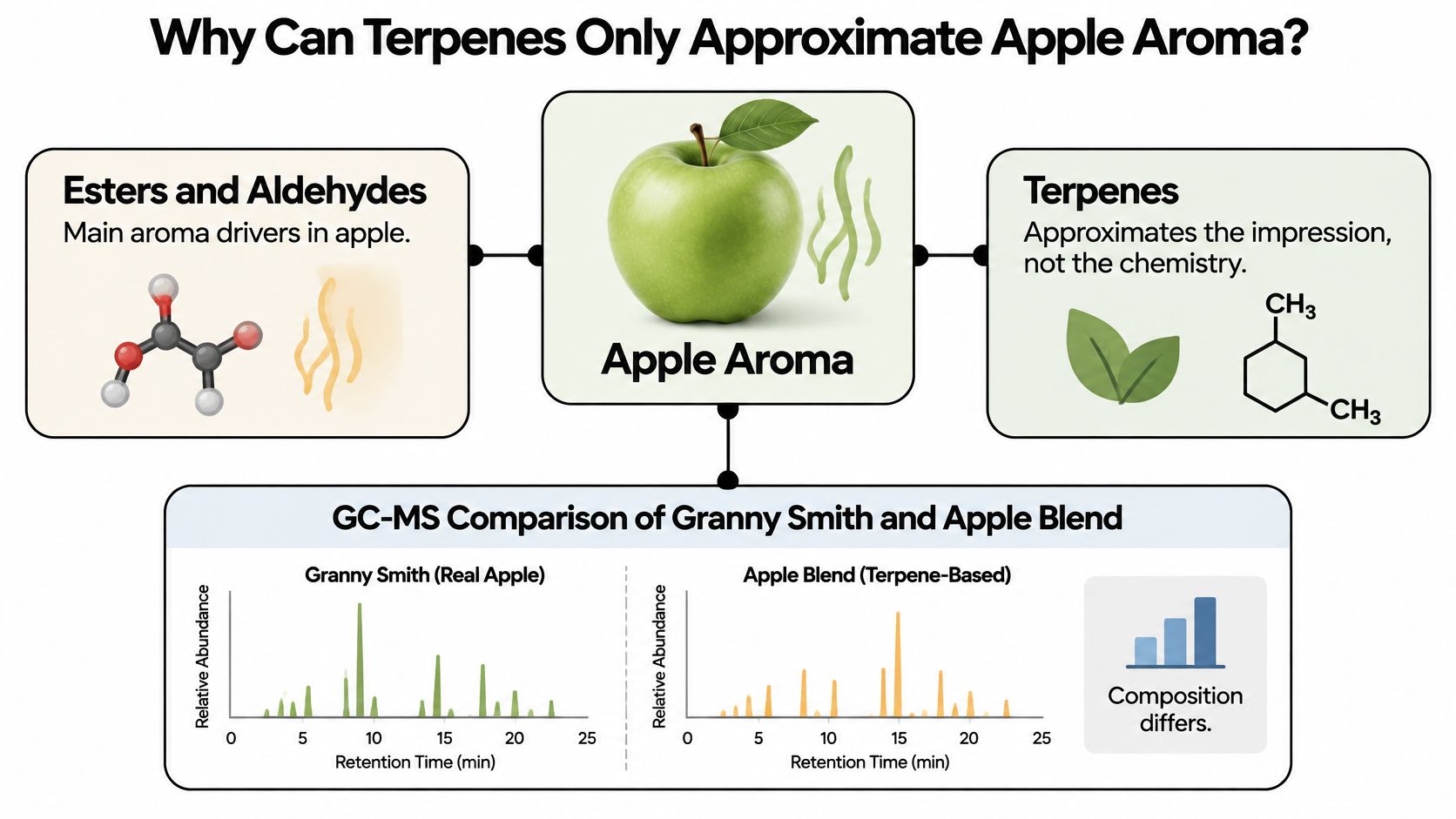
Why Can Terpenes Only Approximate Apple Aroma?
Apple's characteristic aroma comes mainly from esters and aldehydes, not terpenes. A terpene blend can suggest an apple impression, but it cannot reproduce the fruit's full aroma chemistry. In a GC–MS comparison, researchers identified 35 volatile compounds in Granny Smith and Jonagold apples, including only one terpenoid (the comparative GC–MS study).
The profiles differed by cultivar: Granny Smith was dominated by aldehydes, while Jonagold showed a strong ester presence. This contrast helps define the target: a sharper, greener impression or a sweeter, riper one. It does not provide a terpene recipe.
| Cultivar or group | Dominant class | Share of measured volatiles | Formulation direction |
|---|---|---|---|
| Granny Smith | Aldehydes | Aldehydes dominate the measured profile | Crisp green-apple direction |
| Jonagold | Esters | Esters make up more than 60% of measured volatiles | Sweet ripe-apple direction |
| All 35 identified compounds | 1 terpenoid of 35 | One terpenoid among the identified compounds | Terpenes can suggest, but not reproduce, apple identity |
The distinction matters in practice. A blend may suggest apple in a bottle, then shift when heated in a cartridge. Assess the approximation in its final format, since the carrier and hardware can change how the aroma presents.
How Do You Build Top, Mid and Base Notes?
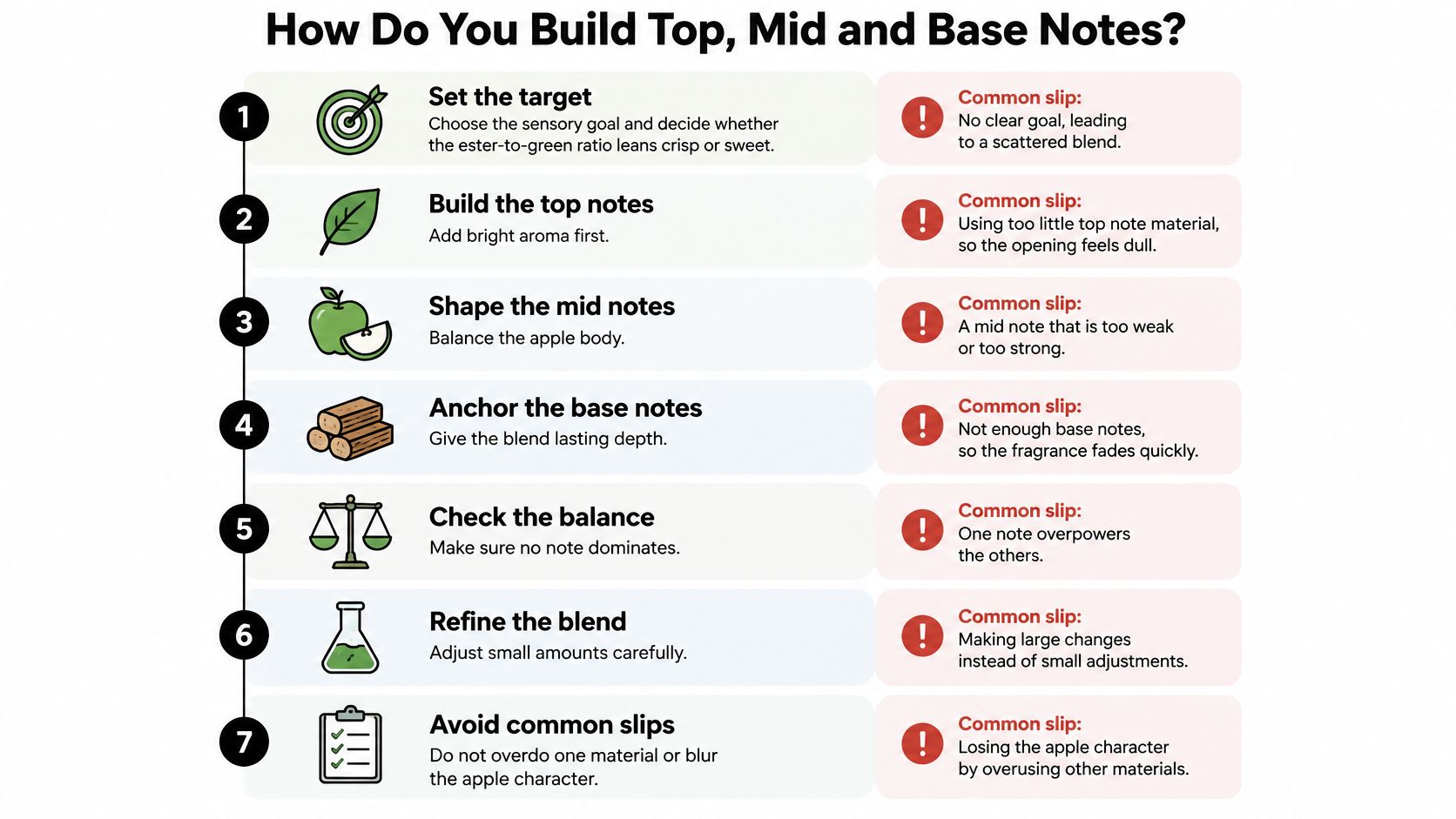
Start with a sensory target, then build and test the blend at its intended dilution. Apple aroma comes mainly from esters and aldehydes, so terpene layers can suggest the impression but cannot reproduce the fruit's aroma exactly. Apple-juice composition is a reference for the target, not a recipe for terpene proportions.
Write the target before blending. Specify whether the brief calls for a crisp, green impression or a sweet, ripe one. This gives each bench sample a clear sensory goal and prevents adjustments from drifting toward generic fruitiness.
Make a small first batch. Use modest amounts of the selected materials and record each contribution by weight or volume. Keep the initial formula simple enough that you can identify which change affects the result.
Adjust one variable at a time. Change a single contribution between samples, then compare them against the written target. If sweetness blurs the crisp impression, reduce that contribution before changing the rest of the blend.
Keep the base restrained. Add supporting materials in small increments and check whether they help the impression last after dilution. If the blend turns heavy or woody, lower the base contribution rather than masking it with more top notes.
Use apple research to set the sensory direction. In red-fleshed ‘Weirouge' apple juices, esters measured 2,150–2,290 µg per 100 mL and represented 31–38% of total volatiles; cultivar and processing affect the measured composition (the ‘Weirouge' juice study). These juice measurements describe the fruit's volatile profile, not a terpene loading or blend ratio.
Dilute before approving a sample. Evaluate each candidate in the intended carrier and under the target cartridge conditions. A vial sample can smell bright, then shift after mixing or heating, so judge the complete formulation in its final format.
Check the lot documentation. Gold Coast Terpenes states that its ingredients are lab tested and that its terpenes for carts are free from additives, VG, PG, PEG, and MCT. Match the relevant documentation to the batch record and review the lot against the approved materials.
Prepare three bench samples at different overall loads while keeping their ratios constant. Choose the sample that best retains the target impression after dilution, not the one that smells strongest in the vial.
How Much Isolate Can a Red Apple Blend Take?
A juicy red apple blend can be overpowered by a small amount of a high-impact material. More aroma doesn't automatically mean more apple, because a compound's odor activity value (OAV) compares its concentration with its odor threshold.
Hexyl acetate illustrates the issue. It's an ester, not a terpene, with a reported odor threshold of 34.9 µg/kg and a fruity, green, sweet character; OAVs reached 97, 269, and 254 in three samples from a compiled table covering four apple cultivars (the apple aroma threshold compilation). A material at a modest concentration can still dominate perception when its threshold is low, so analytical abundance alone isn't a useful blending rule.
Set limits before adding supporting notes
Set inclusion limits for the most potent apple-like materials first, then build the supporting green, floral, and woody notes around them. In a concentrated cartridge system, evaluate both total terpene loading and the ratio of high-impact materials to those supporting notes.
Threshold values aren't available for every terpene in a working palette. Mark missing values as unknown in the formulation sheet, then test them rather than treating an unreported threshold as low risk. Gold Coast Terpenes states that its cartridge terpenes are SC Lab-tested, which lets formulators confirm composition before setting loads.
Use a simple load sequence: test low, middle, and high total loads at the same ratio. Keep the carrier, hardware, sample handling, and scoring method consistent so the panel can judge the effect of load rather than uncontrolled changes. The guide to terpene amounts for distillate can support planning, but the final load decision belongs to the test in the product's intended format.
Which Formats Suit a Juicy Red Apple Blend?
A red-apple profile can shift noticeably between a cartridge, distillate, and concentrate. Test each in its intended format, recording the carrier, load, sample size, panel rating, and lot certificate so results remain comparable.
| Format | What to watch | Practical test |
|---|---|---|
| Cartridges | Heating can mute top notes and change the first impression | Judge the flavor in the intended hardware after heating, not only in the bottle |
| Distillate | Dilution can thin the mid and base layers | Check the top and mid layers after mixing at the target load |
| Concentrates | A heavier load can flatten the fruit impression | Confirm that the red-apple character stays recognizable against the base |
Apple aroma relies heavily on esters and aldehydes, so terpene notes can approximate the impression rather than reproduce it exactly. A blend that reads as juicy in one format may shift under different dilution or heating conditions. Assess the finished formulation in each format instead of carrying one ratio across all three.
Carrier choice also affects what the blend contributes. Gold Coast Terpenes states that its cartridge terpenes are free from additives, VG, PG, PEG, and MCT. Its Terpenes 101 guide and Mixing Calculator can help organize formulation work; record the actual carrier and load used in every test.
How Should You Name, Label and Order the Blend?
Name the SKU only after the bench panel confirms the sensory target. A descriptive name such as “crisp red apple profile” communicates flavor direction without implying that the product contains apple or apple juice.
Use this decision sequence:
- Confirm the sensory target before naming. Have the panel approve the profile in the final format, then choose a name that describes the tested flavor rather than promising a specific fruit ingredient.
- Finalize label language after compliance review. State accurately that the flavor is terpene-based and THC-free where that is true for the product, and check claims against applicable requirements. Keep batch certificates ready for review and use the regulatory compliance checklist as a working reference, not a substitute for qualified compliance advice.
- Order production quantity only after the ratio passes. Start with a sample, run the blend in the intended format, and scale only after the selected ratio is approved. Gold Coast Terpenes says Picker Pack orders ship fresh and ready for blending, and its packages are curated for people getting started or for advanced flavorists.
Gold Coast Terpenes lists Apple Fritter as one of its premium Strains flavors. Treat a catalog profile as a separate reference point, not a substitute for testing the red-apple target you've specified.
Before budgeting, ask the supplier to confirm the minimum order quantity and bulk tier in writing. The available information here doesn't establish those figures, so leave both fields marked unknown in the purchasing sheet until confirmed. Wholesale and bulk programs, along with free U.S. shipping over $100, are ordering details to check against current terms before placing an order.
The first action is to order a sample pack, run the three-ratio test, and assign the SKU name only after the panel approves the result.
Questions Formulators Ask About Juicy Red Apple Blends
Does a juicy red apple terpene blend contain apple?
No, a terpene blend is not the same as apple or apple juice. Gold Coast Terpenes supplies 100% natural terpene blends and isolates, not apple-derived ingredients.
Which terpene should a first blend start with?
Start with Limonene as the top note because it sets a bright first impression for the other layers to support. Keep the initial contribution modest and judge it after dilution.
Does the blend work in distillate?
Test it after dilution in the intended carrier, then evaluate it in the target product format. Gold Coast Terpenes states that its cartridge terpenes are free from VG, PG, PEG, and MCT.
What documents should a brand request?
Request the relevant lab results and lot certificate, then retain them with the batch record. Gold Coast Terpenes states that all ingredients are lab tested and that its cartridge terpenes are SC Lab-tested.
Gold Coast Terpenes offers natural terpene blends, isolates, and formulation resources for building and testing flavor profiles for cartridges, concentrates, and distillate. Define the apple target, compare three loads in your finished format, and visit Gold Coast Terpenes to explore options for your next formulation.