
The popular advice to “start with a good distillate COA” stops too soon. A passing input certificate doesn't establish the composition, consistency, or compliance of the oil after blending and cartridge filling. Gold Coast Terpenes supplies 100% botanically derived terpene blends, a flavor layer that needs its own lot documentation and finished-product checks.
For formulators, the practical job is to track each change from crude extract to finished cartridge. Distillation shifts cannabinoid ratios, heating can change acidic cannabinoids into neutral forms, and added terpenes can affect both flavor and aerosol behavior. A useful quality system treats every stage as a new point to verify, not as a detail covered by the incoming COA.
How Hemp Distillate Is Made, Step by Step
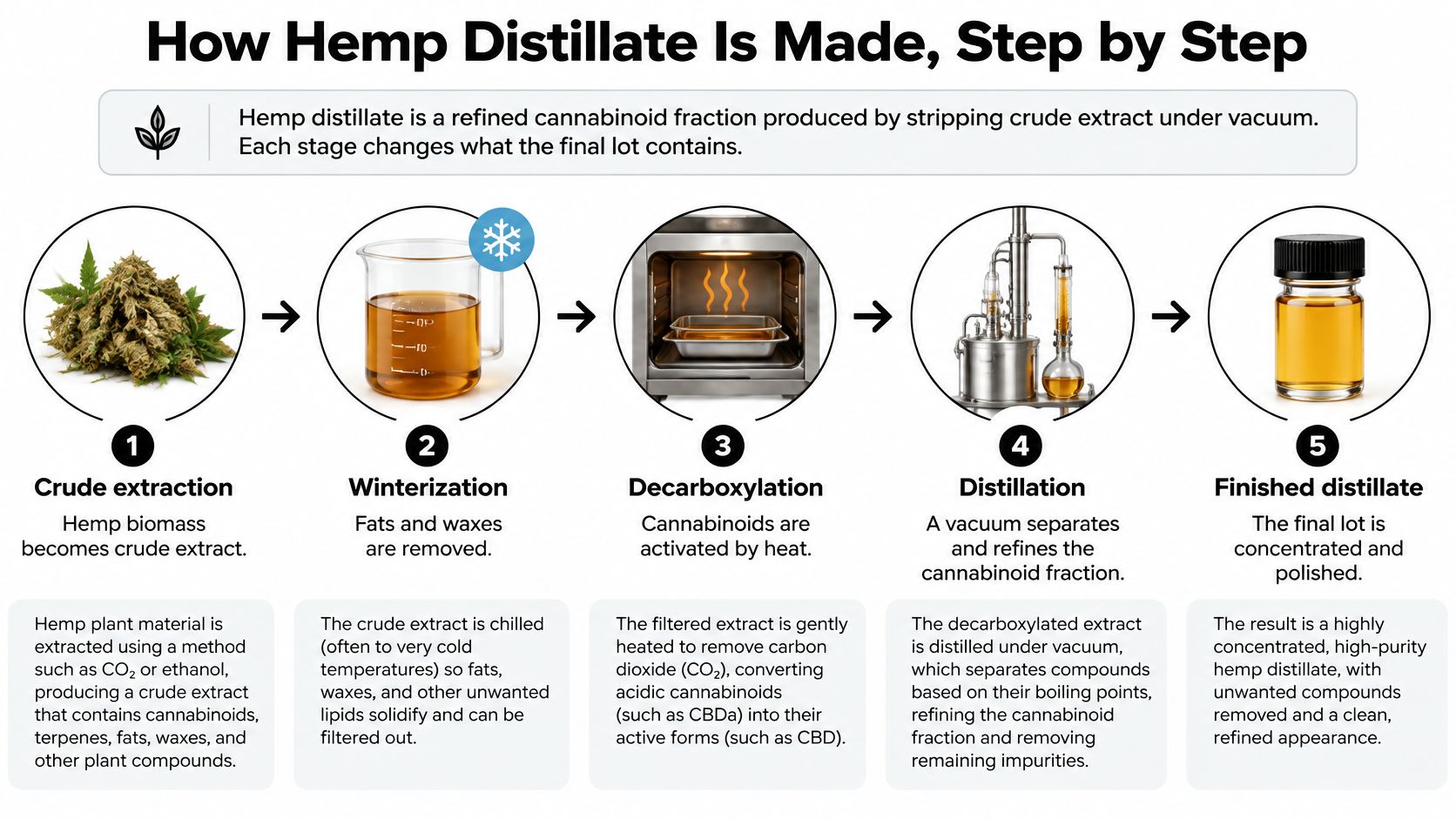
Hemp distillate is a refined cannabinoid fraction produced by stripping crude extract under vacuum, and each production stage changes what the final lot contains. Control temperature, pressure, and residence time at each stage, then test the resulting material rather than assuming the previous test still describes it.
From crude extract to a refined fraction
Crude extraction. Extract dried hemp biomass into crude oil using the selected extraction process. Record the feedstock lot and the extraction conditions, including solvent or method, because inconsistent input material can produce a different crude profile.
Winterization. Chill the crude and filter it to remove waxes and lipids. Control the chilling and filtration process, and record how the material was clarified. This is also a cleanliness checkpoint: in a heated-chamber study, adding only 0.5% lignin, flavonoid, and triterpene compounds tripled the particle-formation rate, as reported in the chamber study on cannabis-concentrate constituents. That finding makes residual non-terpene material relevant to aerosol behavior, not just appearance.
Decarboxylation. Apply controlled heat to convert acidic cannabinoids, including CBDA and THCA, into CBD and THC. Record the heating profile and residence time: too much heat can alter the cannabinoid balance, while reporting only neutral cannabinoids can obscure the feedstock's acidic profile.
Wiped-film stripping. Move the decarboxylated extract through a wiped-film distillation stage under vacuum. In one study, CBD rose from approximately 35.8 wt% to 48.0 wt%, while most terpenes were removed during stripping. Those results come from a specific process, not a guaranteed outcome for every feedstock or machine, as described in the wiped-film molecular-distillation study.
Refining. Adjust vacuum, evaporation temperature, condenser temperature, and residence time to separate and collect the target fraction. In that same study, a refining stage operated at 40 Pa, with a 170 °C evaporation temperature and a 20 °C internal-condenser temperature, and produced a CBD-rich fraction containing 80.19% CBD with 92.66 wt% recovery. These are study-specific operating results, not universal process settings.
Terpene reintroduction. Once the cannabinoid base is specified, add measured terpenes to restore or create the intended flavor. Keep the blend formula, input lots, mixing conditions, and final concentration in the batch record; aroma alone can't confirm a measured composition.
A complete record should connect biomass and crude lots to winterization, decarboxylation, and distillation conditions, then identify the collected fraction and any later additions. Include the test results at each stage, plus the final blend formula and sample references. A guide to solvent-extraction methods can help teams document how their extraction choice affects the material entering refinement.
What Hemp Distillate Compliance Rules Should You Check First?
A hemp distillate's compliance status depends on more than the starting biomass. Distillation can concentrate cannabinoids and change the extract's composition, so check the material at the stage relevant to your product. The Congressional Research Service overview of the 2018 Farm Bill describes the federal hemp definition, including its delta-9 THC threshold of no more than 0.3% by dry weight, and explains the limits of what the law established.
Hemp's treatment under the federal Controlled Substances Act does not mean every hemp-derived product is approved for sale. The U.S. Food and Drug Administration retains authority under the Federal Food, Drug, and Cosmetic Act and related public-health statutes. Labeling, intended use, manufacturing quality, safety, and marketing claims can raise separate compliance questions.
Before launching, confirm the requirements for the product and the market where it will be sold:
- Input and finished-batch COAs: Does the state require documentation for incoming distillate, the finished product, or both?
- Licensing and controls: Do processing or sales require a license, laboratory testing, or specific packaging and labeling controls?
- Claims and labels: Which product descriptions and marketing claims are permitted for the intended product and use?
- Required testing: Which cannabinoid and contaminant tests must be included in batch documentation?
State rules vary and can change, so confirm current requirements with qualified counsel and the relevant regulator. Gold Coast Terpenes describes its products as THC-free and legal worldwide, but that does not determine the legal status of a finished cartridge in a particular market. Keep terpene lot information with the distillate and finished-batch records. For terminology, see this explanation of what “hemp-derived” means.
Which Hemp Distillate Type Fits Your Formulation?
Choose a distillate by its required THC position and cannabinoid profile, then confirm the particular lot with testing. A product name or cultivar label isn't a substitute for a specification.
| Distillate type | Cannabinoid profile | THC status | Best fit |
|---|---|---|---|
| THC-free distillate | CBD-dominant, with minor cannabinoids | THC not detected | Products that must show no THC on the label or in testing |
| Broad-spectrum distillate | Multiple cannabinoids with THC removed | Removed, verified by testing | Blends that need a wider cannabinoid range without THC |
| Full-spectrum distillate | Complete cannabinoid range | Present, within the 0.3% limit | Products sold where full cannabinoid content is the specification |
Cultivar and process both affect the output. In one study, THC in distilled biomass measured 197%, 124%, and 236% of the concentrations in non-distilled biomass across the tested Cherry Wine, Red Bordeaux, and Umpqua cultivars. The same study found CBD concentrations in examined essential-oil fractions ranging from 0.06% to 5.3% across cultivars. Those results are specific to the tested material and methods, not a prediction of what another lot will contain; see the peer-reviewed study of CBD-rich hemp material.
That variation is why a cultivar name alone can't define a formulation input. Set the THC requirement first, define the cannabinoid target next, and then source a lot that meets both. For broad-spectrum material, ask how THC was removed and request the verification results; low-pressure wiped-film distillation alone shouldn't be treated as proof of THC removal.
Once the distillate base is selected, the flavor layer can be matched to it. Gold Coast Terpenes offers blends for cartridges and concentrates, so the useful sourcing question is: For this specific type, can the supplier provide lot-specific cannabinoid results and evidence that the THC status matches the specification?
What Must a Hemp Distillate Spec Sheet Include?
Gold Coast Terpenes supplies 100% botanically derived terpene blends and publishes SC Lab-tested terpene results. For distillate, the incoming certificate is a starting point: it records the material at the tested stage, not necessarily its composition after blending, heating, or cartridge filling.
| Parameter | What to request | Why it matters |
|---|---|---|
| Total THC (delta-9, dry weight) | At or below 0.3% by dry weight | Provides the reported THC level for compliance review |
| Cannabinoid content | Percent by weight for each named cannabinoid | Defines potency and supports label accuracy |
| Acidic vs. neutral cannabinoids | CBDA and THCA reported separately from CBD and THC | Shows measured forms before further heating |
| Terpene content | Total percent and per-compound percent | Helps determine what is present before formulation |
| Residual solvents | Pass result against the target-market limit | Supports safety and compliance review for inhaled products |
| Pesticides, heavy metals, microbials | Full panel for each batch | Checks for contaminants that may enter through the feedstock |
| Diluent and additives | Named ingredients, or confirmation of none | Affects viscosity and cartridge performance |
Read the cannabinoid results together. Heating can convert acidic cannabinoids into neutral forms, so a total CBD figure alone does not show how much CBDA is present. Keep the reported values and the lot's heating conditions with the batch record.
Terpene and additive information matters at the formulation stage. A certificate for the base oil cannot establish what the finished blend contains after terpenes or diluents are added. Use this guide to certificates of analysis to match the report fields to your batch-release requirements.
Resolve missing fields before issuing the purchase order. Then retain the incoming results as the baseline for checks after blending and filling.
How Do Terpenes Shape Flavor in Hemp Distillate?
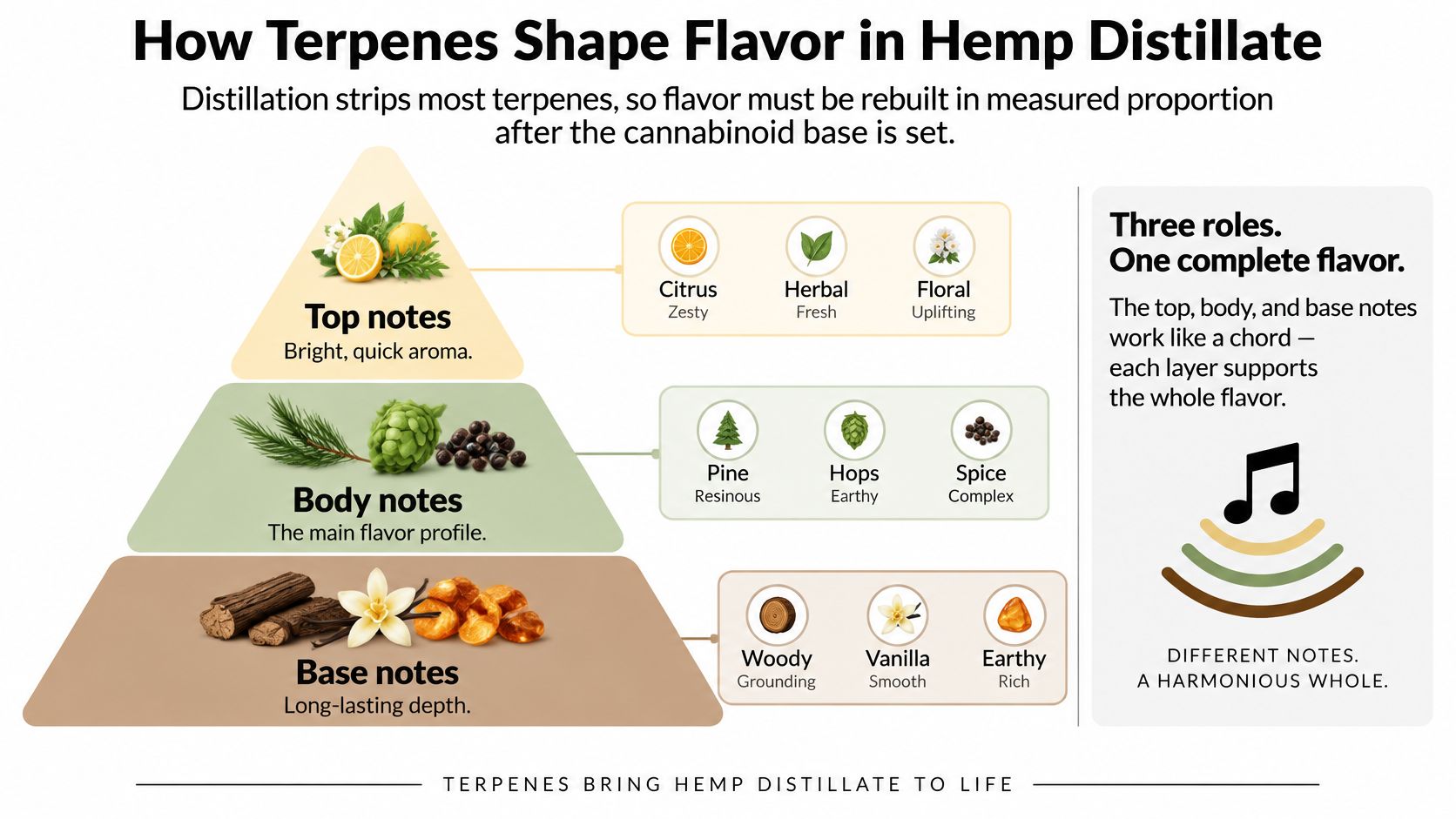
The incoming distillate certificate is only a starting point for flavor work. Distillation removes most terpenes, so formulators add terpenes to winterized distillate oils to give the product a distinct flavor. The finished profile depends on how the blend behaves in the oil and device, not just how it smells in the bottle.
Build a chord, not a single note
Top notes give a blend its bright first impression. Alpha-Pinene, Limonene, and Terpinolene can supply that lift, though their volatility means the aroma may fade sooner than heavier components.
Mid notes carry the profile's body. Linalool can soften and round a blend, while Alpha-Humulene contributes the hoppy aroma associated with cannabis.
Base notes add depth and help anchor the profile. Beta-Caryophyllene and Myrcene can create a fuller, longer-lasting impression. A vivid top note alone may smell appealing, yet fail to reproduce the target flavor in oil.
Match the target, then test the loading
Set a documented flavor target before blending. Preserve its balance of top, mid, and base notes, then build from individual isolates or a ready-made strain-inspired profile. Gold Coast Terpenes offers isolates including Alpha Pinene, Beta Caryophyllene, Limonene, Linalool, Myrcene, and Terpinolene, along with strain profiles such as Blue Dream and OG Kush. This guide to choosing terpenes for distillate can help frame the selection.
More aroma does not necessarily mean a closer flavor match. In a cartridge-focused study, experimental formulations used terpenes at approximately 10%, and added terpenes increased gas-phase products relative to THC alone, according to the cartridge formulation study. Treat that concentration as a study condition, not a universal recipe. Test loading points around the target instead.
A separate THC–myrcene study tested terpene levels up to 14% by mass and found that gas-phase products varied strongly with applied power, according to the study of THC–β-myrcene mixtures and aerosol conditions. Validate the chosen blend at the intended terpene percentage, cartridge resistance, voltage, and puff profile. An unheated sample can taste different from the aerosol produced by the device.
Botanical versus cannabis-derived terpenes is a sourcing choice; it does not replace performance testing. Check that the source, lot documentation, and profile suit the flavor target. Then assess the blend at its intended loading in the oil and hardware planned for sale.
What Should You Retest After Blending and Cartridge Filling?
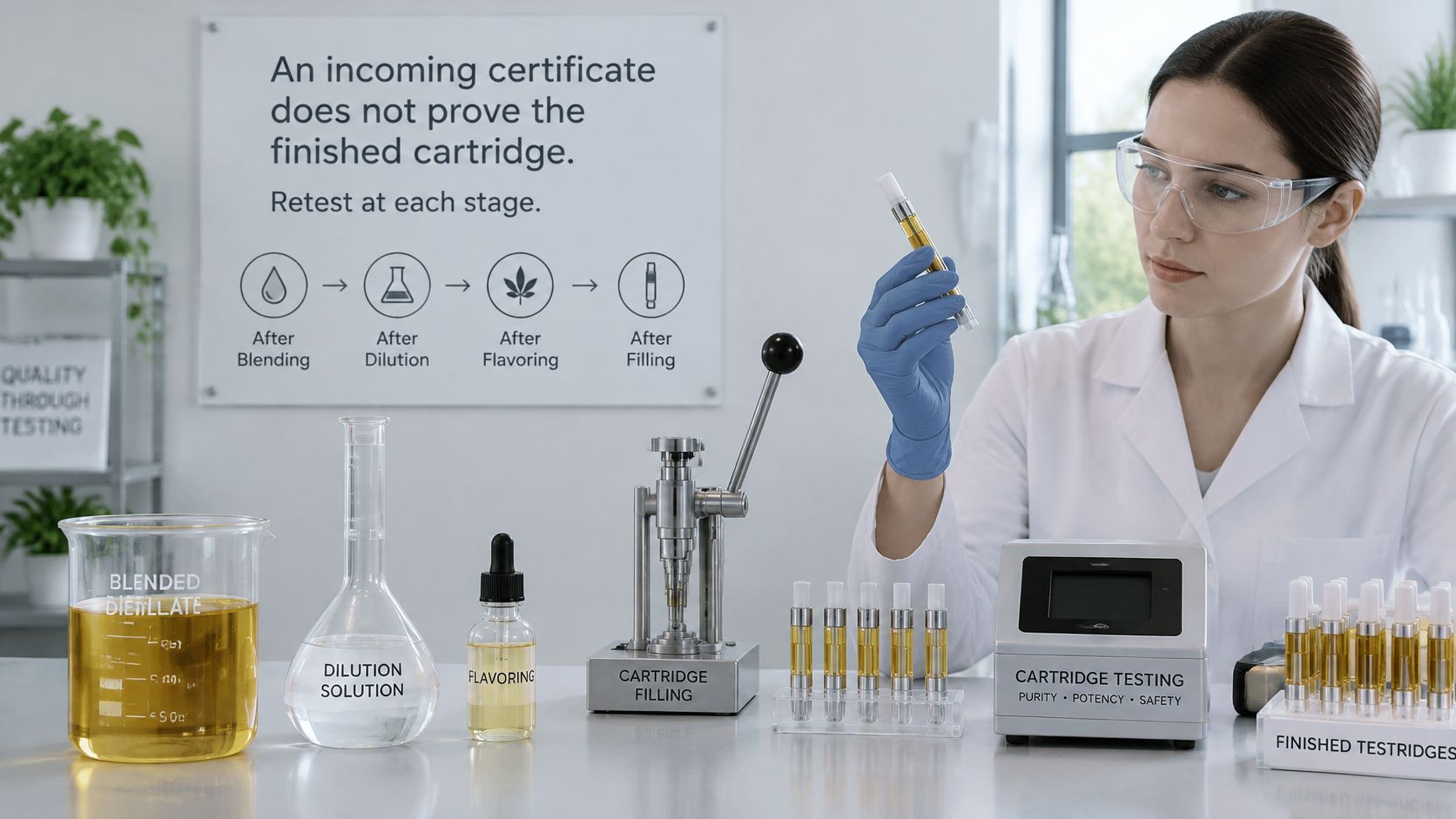
An incoming COA doesn't prove the finished cartridge, so set retest points after blending, dilution, flavoring, and filling. The chain of custody should show which input lots went into each finished batch and what each test confirmed.
| Stage | Tests to run | Why it matters |
|---|---|---|
| Incoming distillate | Re-check against the spec sheet | Confirms the lot still matches what was purchased |
| Blended oil at target terpene load | Recalculate total THC at final dilution; check terpene percentage and homogeneity across sample points | Catches weighing and mixing errors |
| Filled cartridges | Check cannabinoid content per sampled unit, terpene profile after heating, and contaminant spot checks | Confirms the sold product matches the blend tested |
Louisiana's 2026 proposed framework calls for a COA for the distillate or concentrate and a separate COA for each manufactured batch. New York's requirements also include licensing, laboratory testing, and packaging and labeling controls. Those examples are jurisdiction-specific, not universal rules, as set out in the Louisiana proposed framework.
Use a representative sampling process
- Sample across the blended batch. Take material from several points rather than relying on one convenient draw. Compare the results to check whether the blend is uniform.
- Recalculate total THC at final dilution. Use the final formula and confirm the finished oil against its intended specification.
- Confirm cannabinoid identity. Check that the finished oil's measured cannabinoid profile matches the declared formulation.
- Run finished-oil contaminant testing. Include residual solvents, pesticides, heavy metals, and microbials as applicable to the product and market.
- Verify the terpene percentage. Compare the measured result with the blend formula and retain the supplier's lot documents.
- Keep batch records. Link samples, test results, input lots, and filling records to the manufactured batch.
High potency isn't automatically an advantage for production control. When the concentrate is strong, small weighing or mixing errors can cause a meaningful change in the final blend. Gold Coast Terpenes' cartridge terpenes are SC Lab-tested, with product terpene information provided by SC Labs; compare those results with the intended formula before mixing.
Chemical stability and sensory stability aren't the same. An oil may retain its labeled cannabinoid percentage while its aroma, color, or terpene profile shifts. Monoterpenes can undergo thermal oxidation across 100–200 °C, so compare pre- and post-heating composition under the device conditions planned for sale, using the study of terpene oxidation under simulated vaping conditions.
What Should You Confirm Before Ordering Hemp Distillate?
An incoming distillate certificate is a starting point, not proof that the finished cartridge will meet its specification. Before ordering, confirm the lot documents, target-market requirements, formulation inputs, and retest points after blending and filling.
- Request the lot-specific spec sheet and COA. Compare the listed parameters with your purchasing specification. Confirm MOQs and lead times before setting the scale of a formulation trial.
- Check THC status and market requirements. Review the applicable labeling, testing, and licensing rules for each target market before assigning the distillate to a product.
- Choose a terpene profile and loading plan. Select a strain-inspired blend or isolates, record the target loading, and assess how the chosen level affects the finished oil's flavor and aroma.
- Select the diluent deliberately. Gold Coast Terpenes lists Proprietary MCT Oil and PÜR TERP as diluent options. Check that the selected option fits the intended viscosity and flavor.
- Retest after blending, heating, and filling. A room-temperature blend sample does not show how the oil will perform in the cartridge system. Set checks for the stages that can change the finished product.
- Define lot-level records and retesting. Keep input documentation, finished-product test results, and production records linked to each lot.
Gold Coast Terpenes adds new terpene strains each month and runs programs for distributors, shops and independent reps, affiliates, and manufacturers and brands. Manufacturers and brands can review Gold Coast Terpenes' program options through its website when comparing inputs for a formulation trial.
Frequently Asked Questions About Hemp Distillate
Is hemp distillate the same as CBD isolate?
No. Distillate can retain a broader cannabinoid profile and some terpene residue, while CBD isolate is a purified single compound. Choose between them according to the finished product's specification.
Are the terpenes sold by Gold Coast Terpenes made from fresh plants?
Gold Coast Terpenes states that its terpenes are extracted from fresh plants and are free of mixtures, chemicals, and additives. The product documentation should still be checked for the specific lot used in a blend.
Does a passing input certificate mean the cartridge is compliant?
No. The finished oil and cartridge need verification after blending and filling because those steps can affect concentration, homogeneity, and label accuracy. Apply the testing requirements for the product's target market.
How should a vape brand choose a terpene supplier?
Check for documented SC Labs testing, a clear diluent list, a written sample policy, and a supply program that fits the brand's volume. Gold Coast Terpenes provides terpene information through SC Labs and lists its diluent options for formulators.
{ “@context”: “https://schema.org”, “@type”: “FAQPage”, “mainEntity”: [ { “@type”: “Question”, “name”: “Is hemp distillate the same as CBD isolate?”, “acceptedAnswer”: { “@type”: “Answer”, “text”: “No. Distillate can retain a broader cannabinoid profile and some terpene residue, while CBD isolate is a purified single compound. Choose between them according to the finished product’s specification.” } }, { “@type”: “Question”, “name”: “Are the terpenes sold by Gold Coast Terpenes made from fresh plants?”, “acceptedAnswer”: { “@type”: “Answer”, “text”: “Gold Coast Terpenes states that its terpenes are extracted from fresh plants and are free of mixtures, chemicals, and additives. The product documentation should still be checked for the specific lot used in a blend.” } }, { “@type”: “Question”, “name”: “Does a passing input certificate mean the cartridge is compliant?”, “acceptedAnswer”: { “@type”: “Answer”, “text”: “No. The finished oil and cartridge need verification after blending and filling because those steps can affect concentration, homogeneity, and label accuracy. Apply the testing requirements for the product’s target market.” } }, { “@type”: “Question”, “name”: “How should a vape brand choose a terpene supplier?”, “acceptedAnswer”: { “@type”: “Answer”, “text”: “Check for documented SC Labs testing, a clear diluent list, a written sample policy, and a supply program that fits the brand’s volume. Gold Coast Terpenes provides terpene information through SC Labs and lists its diluent options for formulators.” } } ] }Gold Coast Terpenes offers botanically derived terpene blends, isolated compounds, strain-inspired profiles, and formulation resources for teams developing hemp distillate products. Compare profiles and documentation for your next trial by visiting Gold Coast Terpenes.