
One data point reframes every Sour Diesel brief. Under approximately 180°C conditions, beta-myrcene can vaporize at a rate 3,500-fold or more relative to THC, so a blend that smells balanced in the jar doesn't stay balanced in a cartridge. Gold Coast Terpenes, a Redondo Beach, CA supplier, makes 100% botanically derived terpene blends, not cannabis-derived, which is why building a Sour Diesel terpene profile for vape cartridges has to start from measured targets, not lore.
Why the Sour Diesel Terpene Profile Matters in Formulation
Formulators should treat Sour Diesel as a recognizable sensory archetype, not a single locked recipe you can copy from a strain page. That distinction decides whether a strain-inspired terpene blend scales cleanly or drifts every time a new lot lands on the bench.
Gold Coast Terpenes, based in Redondo Beach, CA, supplies 100% botanically derived blends rather than cannabis-derived material, so the specification work begins with compound targets, sensory acceptance criteria, and lot identity. The history explains why. Sour Diesel became one of the defining fuel-aroma cultivars of the pre-legalization U.S. Northeast era, and the name can refer to related but chemically distinct cuts rather than one globally standardized terpene specification, as the Ganjapreneur diesel glossary entry documents.
What Actually Drives Commercial Risk
If you buy against the name alone, you're outsourcing your flavor spec to somebody else's clone, harvest timing, and storage conditions. A defensible brief for replicating flavor of Sour Diesel for distillate defines the target contrast (citrus brightness against earthy body and peppery depth), sets an addition-rate ceiling for the finished oil, and names the analytical method used to verify it.
A strain name is a marketing label. A chemotype with a batch COA is a specification you can release against.
That framing protects margin, repeatability, and label accuracy far better than chasing a supposedly authentic phenotype that nobody can reproduce on schedule.
Dominant Terpenes That Define Sour Diesel
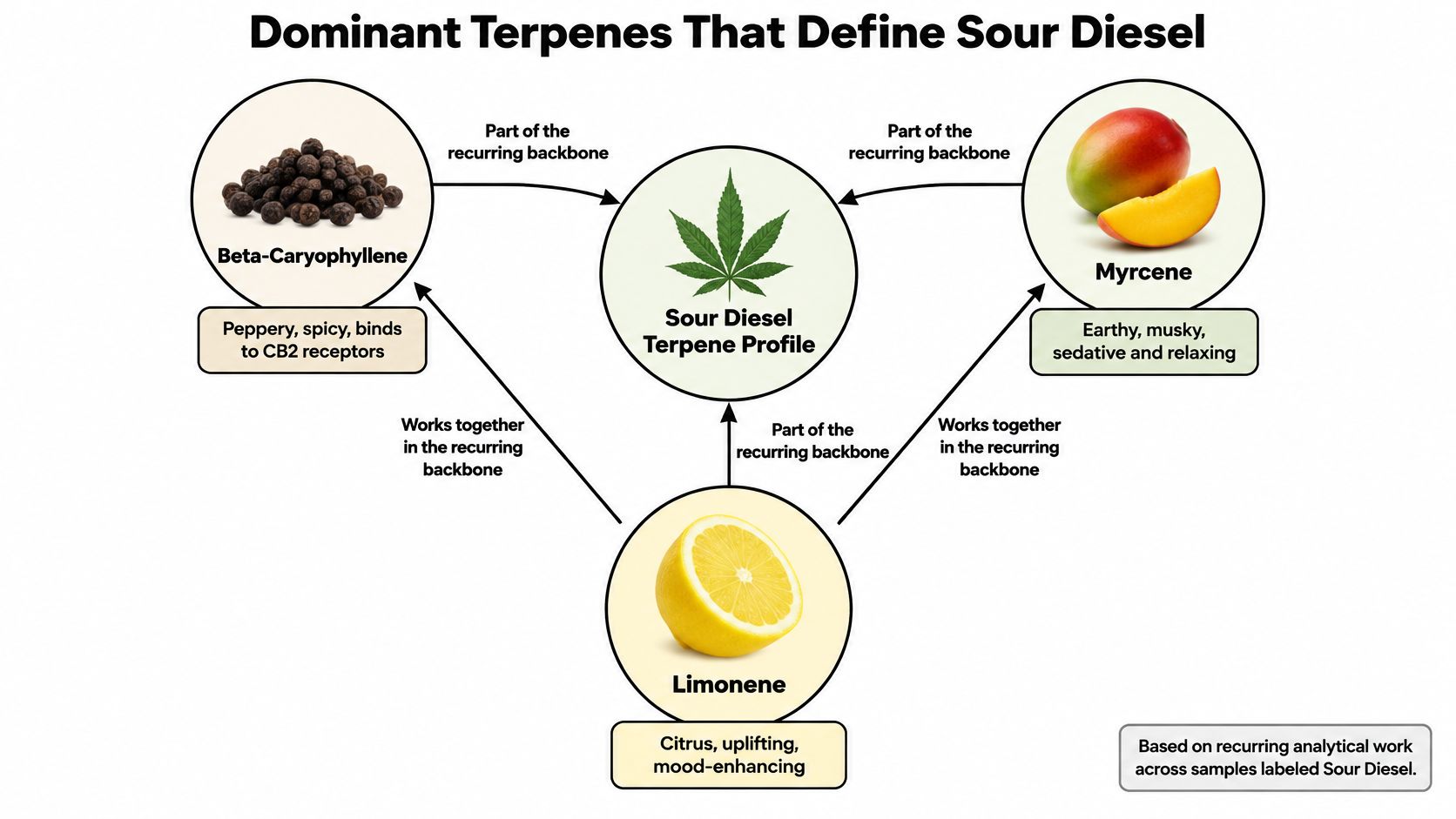
The recurring backbone in samples labeled Sour Diesel is beta-caryophyllene, myrcene, and limonene, with pinene and humulene as secondary contributors. Those five compounds do the structural work, and the ratios between them matter more than the presence of any one isolate.
Reported phenotype-level ranges place beta-caryophyllene at approximately 10-17%, myrcene at 9-20%, limonene at 8-20%, and pinene at 5-22% of the terpene fraction, while broader research has detected at least 26 distinct terpenes across cannabis material, per the PMC review of cannabis terpene variability. Read that correctly. Those percentages describe proportions inside the terpene fraction, not percentages of flower or finished oil.
Why the Ranges Stay Wide
- Clone differences: Related cuts sold under one name don't share identical chemistry.
- Cultivation and harvest: Environment and maturity shift the balance between monoterpenes and sesquiterpenes.
- Processing history: Oxidation and handling strip volatile top notes before the sample reaches the lab.
For a Sour Diesel terpene profile for commercial production, treat those ranges as a design window. Pick a point inside the window, lock it in your specification, and validate it sensorially against your own reference standard.
Top, Mid, and Base Note Roles in the Sour Diesel Profile
Limonene is the top note, myrcene and beta-caryophyllene carry the mid and base weight, and the pinenes add lift and dryness around the edges. Reasoning in note structure lets you fix a blend that's gone flat without blindly raising total load.
Limonene delivers the sharp, sour citrus strike that registers first on the nose and first in the draw. Because it's volatile, it's also the first thing lost to poor headspace control or warm storage, which is why aged blends taste darker and heavier than fresh ones.
Beta-caryophyllene supplies peppery, spicy depth in the middle of the profile. As a larger sesquiterpene it persists longer than the monoterpenes, so a blend that starts balanced can finish caryophyllene-heavy if the top notes deplete during use.
Myrcene anchors the base with earthy, musky body. Without it, limonene and pinene read as thin citrus cleaner rather than fuel. With too much, the citrus contrast collapses and the profile turns dull.
The Compounds Your Panel May Miss
Sulfur-containing volatile compounds, including prenylated thiols identified in cannabis research, may contribute strongly to fuel-like aroma but are not included in many routine terpene panels, which is why a Sour Diesel specification should document the complete volatile-testing method and analyte list, as the Cannigma Sour Diesel profile notes. That gap explains a common bench frustration. Two blends can match on the three headline terpenes and still smell different because the high-impact odorants were never measured.
Reference Analytical Profile for Sour Diesel
A single concrete reference beats a wide range when you're setting a first bench target, provided you treat it as a benchmark rather than a standard. One reported analytical profile measured myrcene at 36.6%, limonene at 19.0%, beta-caryophyllene at 9.0%, alpha-pinene at 4.4%, beta-pinene at 3.7%, selina-3,7(11)-diene at 3.1%, linalool at 2.3%, and alpha-humulene at 2.3% of the terpene fraction, according to the Chew Mondays Sour Diesel analytical breakdown.
Sour Diesel Reference Terpene Profile
| Compound | % of Terpene Fraction | Note Role |
|---|---|---|
| Myrcene | 36.6% | Earthy base, body |
| Limonene | 19.0% | Citrus top, brightness |
| Beta-caryophyllene | 9.0% | Peppery mid, depth |
| Alpha-pinene | 4.4% | Pine lift |
| Beta-pinene | 3.7% | Dry, camphor edge |
| Selina-3,7(11)-diene | 3.1% | Sesquiterpene support |
| Linalool | 2.3% | Soft floral modifier |
| Alpha-humulene | 2.3% | Woody, hoppy mid |
Two lessons fall out of that table. First, this sample is myrcene-led, not caryophyllene-led, so building around caryophyllene alone misreads the structure. Second, the modifiers below the top three aren't decoration. They supply the dryness and complexity that separate a Sour Diesel terpene profile for distillate from a generic citrus-earth blend. Use the table as your starting template, then confirm with your own COA.
Building a Strain-Inspired Sour Diesel Blend for Distillate
A Sour Diesel blend is a sensory target, not a fixed recipe. Cultivar, harvest, storage, and analytical method can shift the terpene profile, so use a batch-specific COA to set a starting point and let repeated sensory checks guide adjustments.
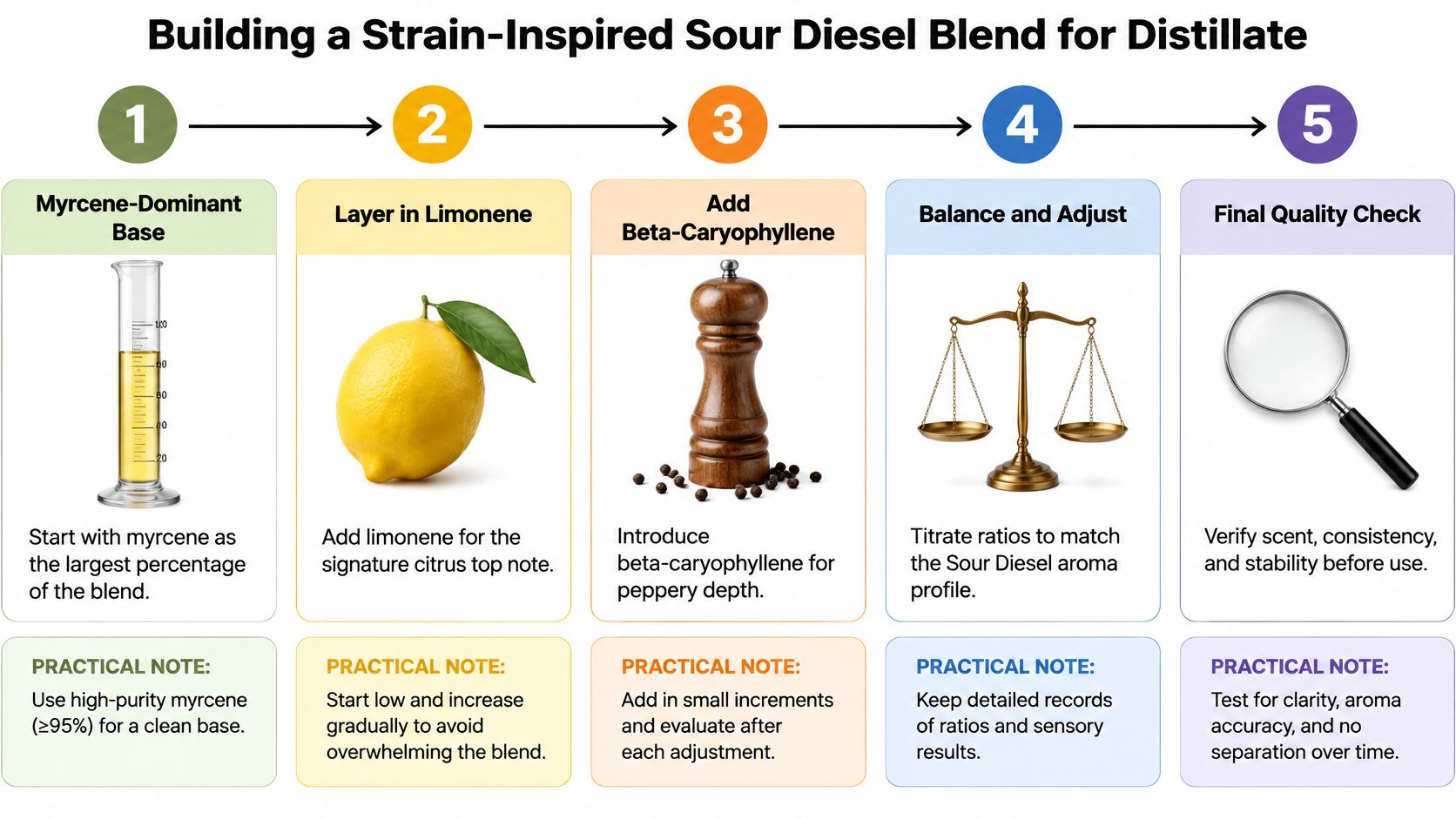
For a distillate trial, build the aromatic structure in measured increments. Start with myrcene for earthy body, then add limonene until the citrus reads as sharp rather than sweet. Beta-caryophyllene can supply a peppery bridge; use pinene and humulene sparingly to shape the dry, woody finish. These are sensory roles, not fixed proportions. Record each addition by weight so the next bench batch can be compared reliably.
Check the blend before and after it enters the oil. GC analysis can confirm the measured composition, while a trained panel can flag whether the sour, citrus, and earthy notes remain in balance. For a cartridge-bound product, assess the aroma again after thermal cycling: a profile that smells accurate in a vial may shift under repeated heating near 250°C as volatile compounds evaporate and oxidation alters the remaining mixture.
Gold Coast Terpenes offers SC Lab-tested, THC-free botanical blends and isolates for this kind of component-by-component trial. Keep the product specification clear about the blend's intended sensory profile and the limits of matching a particular cultivar. Storage conditions, genetics, oxidation, and analytical methods can all affect the result.
Loading Rates and Hardware for Vape Cartridges
At the bench, a Sour Diesel blend can pass a room-temperature viscosity check and still wick poorly once installed. Start with a conservative terpene load, then test the finished oil in the cartridge system it is meant to run in. A cannabis-concentrate study used a 9:1 THC-to-terpene ratio as a practical vaporization model; it also reported leakage concerns at excessive terpene content and detectable ketene-equivalent chemistry at 250°C (cannabis concentrate vaporization study). Treat that ratio as a test point, not a universal recipe.
Hardware compatibility changes the sensory result. A limonene-forward blend can thin as it warms, affecting seals and draw-to-draw delivery. Check the oil at room temperature and after temperature cycling, and confirm that gaskets, diluents, and mouthpiece materials tolerate the formulation over time.
Set up a filled-cartridge trial around the conditions customers use:
- Wicking: Confirm the oil feeds consistently through the installed hardware, rather than relying on a substitute device.
- Leakage: Inspect seals after temperature swings and during storage.
- Voltage: Test at the battery settings customers use in practice, not only the lowest setting.
- Draw consistency: Compare early and later draws for changes in intensity or character.
Reviewing vape cartridge hardware selection alongside blend loading helps identify device-related failures before production. A cartridge that leaks or wicks unevenly will not deliver a consistent profile.
Thermal Stability and the Inhalation Safety Question
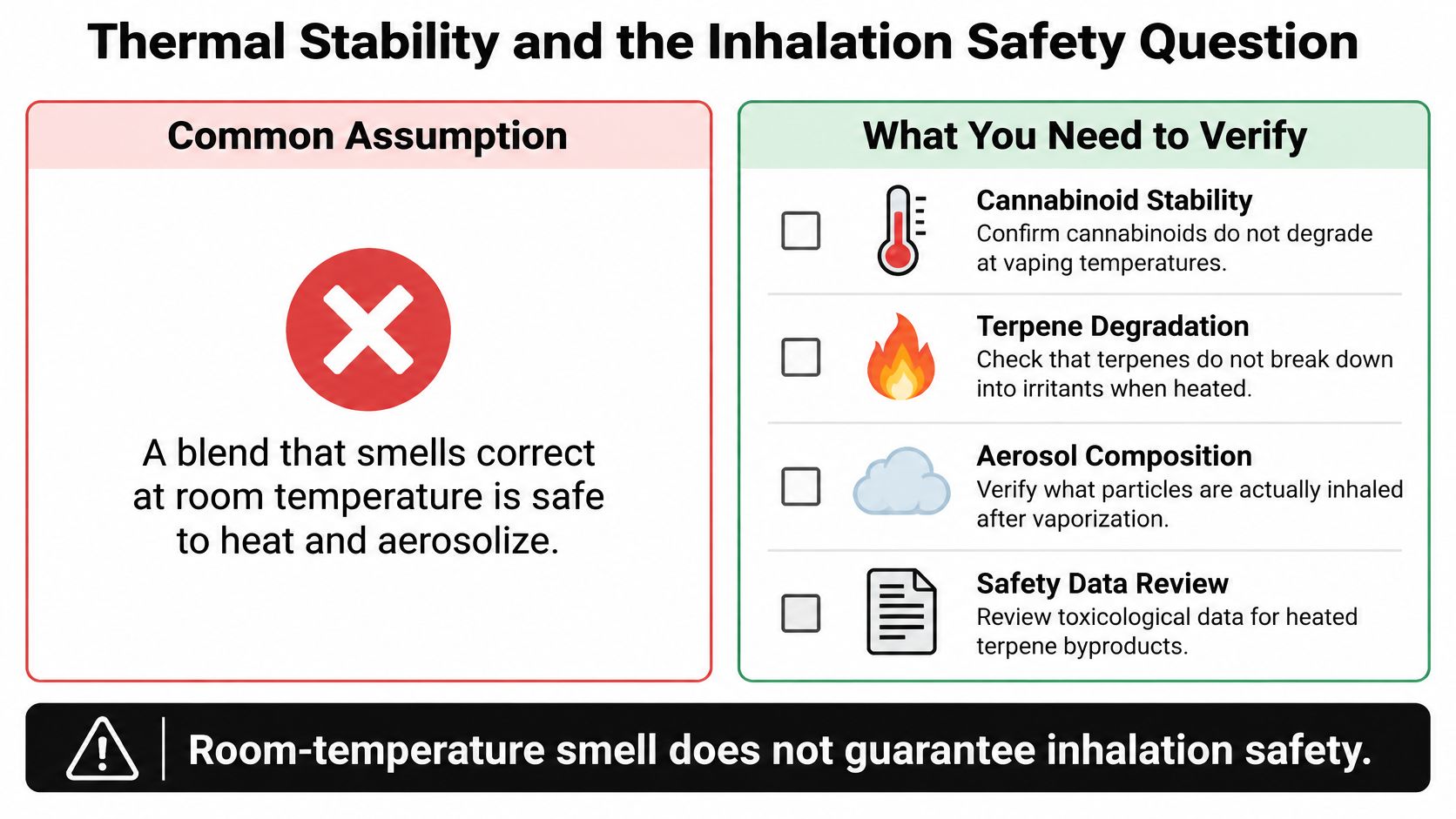
No, a blend that smells correct at room temperature is not automatically safe to heat and aerosolize. That assumption is the weakest link in most DIY and small-brand cartridge programs.
A 2025 Frontiers in Toxicology review states that cannabinoids and terpenes are thermally labile and can react during heating and aerosolization to produce toxic emissions, and terpene-containing formulations increased carbonyl formation by as much as ninefold under tested vaping conditions, as detailed in the Frontiers in Toxicology review on heated cannabis emissions. Those findings don't prove every Sour Diesel formulation carries identical risk. Emissions depend on concentration, hardware temperature, puff duration, oxygen exposure, and the full formulation.
A Finished-Oil Protocol
Use only materials documented for the intended route of administration. Avoid excessive terpene loading, because concentration drives both reaction chemistry and leakage. Test the finished oil rather than relying on the incoming neat blend's paperwork. Evaluate emissions with the actual cartridge and voltage your customers will use.
Bench rule: Natural origin describes where a compound came from. It says nothing about what that compound becomes after repeated heating.
The fuller safety discussion in the guide to whether terpenes are safe to vape is worth adopting as internal policy language, because it separates marketing claims from testable exposure questions.
Botanical vs Cannabis-Derived Terpenes for Vape Brands
Sour Diesel is a sensory archetype, not a fixed terpene recipe. For vape brands, botanical and cannabis-derived inputs can both reproduce parts of the profile, but they differ in sourcing, consistency, and how easily a product fits a given market. Choose against the target specification and distribution needs.
Gold Coast Terpenes, based in Redondo Beach, California, supplies botanically derived blends described as SC Lab-tested, THC-free, and free of VG, PG, PEG, and MCT. These attributes may support particular product and labeling requirements, but brands should confirm that the supplier's current documentation matches their own intended use.
Side by Side for a Spec Sheet
Botanical and nature-identical ingredients can simplify repeatable sourcing when the supplier provides a defined composition and lot-specific specifications. That gives formulation teams a clearer starting point for matching batches, though the finished blend still needs sensory and performance checks in the intended oil and cartridge.
Cannabis-derived ingredients may suit brands seeking cannabis-origin material, but availability and composition can vary with source lots. The chemistry may fit the target profile well; the trade-off is more work to maintain a consistent specification across batches and jurisdictions.
The comparison of cannabis-derived and botanical terpenes outlines sourcing differences. For a strain-inspired blend sold across jurisdictions, assess the actual composition, supplier records, and destination-market requirements before selecting an input route.
Compliance and Documentation for Inhalable Terpene Products
A sour, fuel-forward sensory profile is not evidence of ingredient identity or inhalation suitability. Build the compliance file around the actual blend, its intended use, and the markets where the cartridge will be sold.
Nevada Cannabis Compliance Board guidance sets a maximum terpene content of 10% of the finished product. It also calls for ingredient and natural-origin declarations, manufacturing-solvent information, an SOP listing each ingredient and percentage range, and a COA covering solvents, heavy metals, and pesticides, according to the Nevada CCB terpene guidance document.
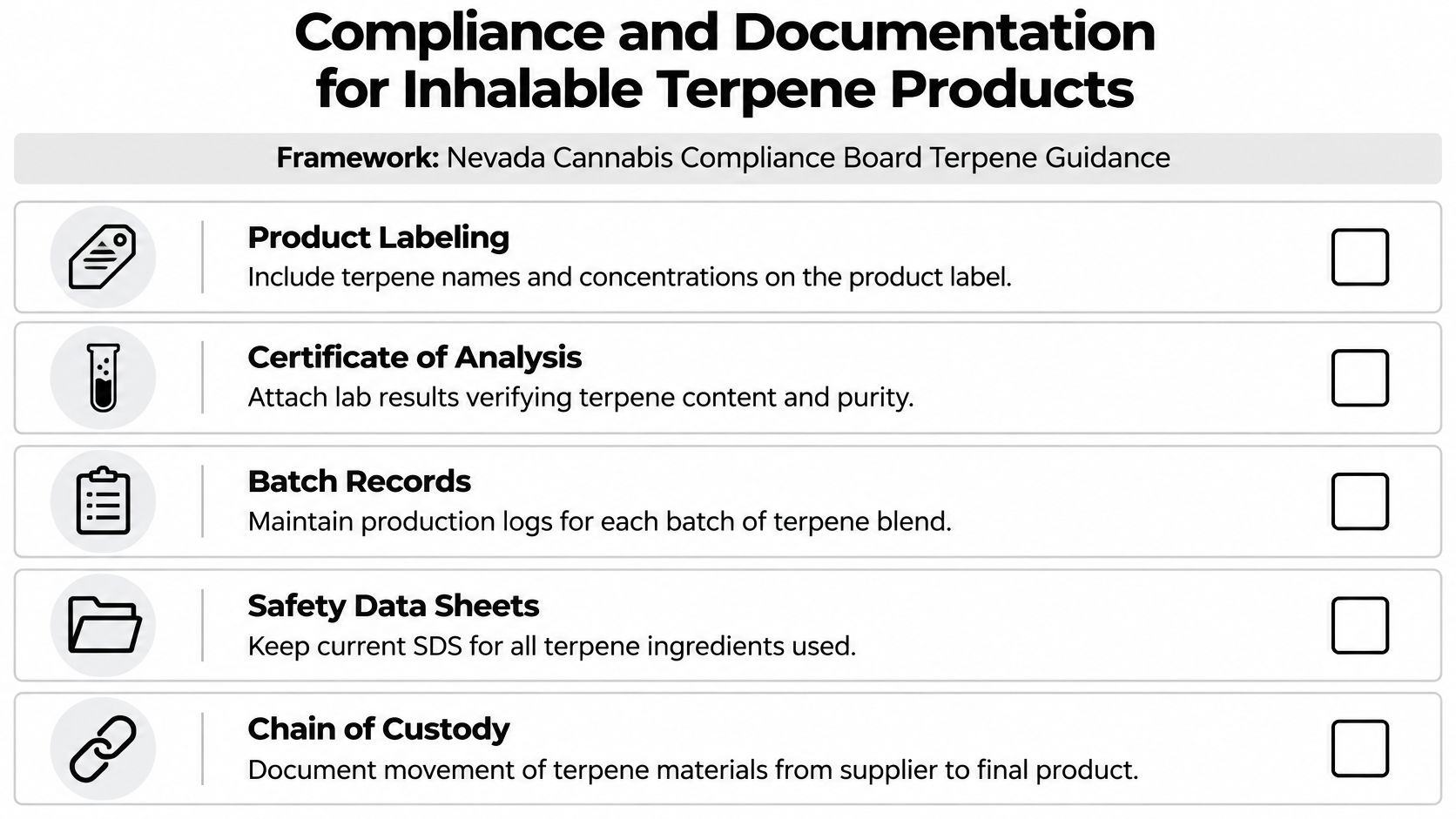
For a Sour Diesel cartridge, keep the records tied to each production lot:
- Ingredient identities, including diluents, with natural-origin status.
- Manufacturing solvents used in supplied blends and in-house processing.
- An SOP recording addition rates, mixing conditions, and hold times.
- A lot-specific COA covering residual solvents, heavy metals, pesticides, and quantitative terpene identity.
- Traceability from supplier lot to finished batch, with retention samples.
The Nevada guidance also notes that terpenes are not generally listed as approved inhalation ingredients in the FDA Inactive Ingredient Database. That makes clear documentation of intended use and supplier specifications particularly important. Align the file with documentation requirements for inhalable terpene products, then check the rules for each destination market. A Nevada specification does not establish compliance elsewhere.
Volatility, Draw Consistency, and Shelf-Life Testing
Volatility skew is the reason a cartridge can taste bright and sour for the first third, then heavy and peppery for the rest. If you don't test draw-to-draw behavior, you'll discover it through customer complaints instead.
Under approximately 180°C vaporization conditions, reported vaporization rates relative to THC were about 3,500-fold or more for beta-myrcene, 2,200-fold for linalool, 380-fold for beta-caryophyllene, and 23-fold for bisabolol, as measured in the PMC study of terpene vaporization rates. The most volatile compounds leave the liquid phase and enter the aerosol disproportionately fast.
Translating That Into a Test Plan
Pull samples at the beginning, middle, and end of device life and compare them sensorially. Run accelerated stability on filled, capped hardware to track flavor drift and oxidation, not just on bulk oil in a jar. Track headspace and storage temperature, because limonene-rich top notes oxidize and the profile darkens with them.
Early puffs being brighter than later puffs isn't a customer perception problem. It's physics showing up in your reviews.
Compensation options include slightly reinforcing the compounds that deplete fastest, selecting lower-temperature hardware, or narrowing the gap between top and base so depletion changes character less dramatically. Whichever route you pick, validate it on finished devices before committing to packaging and shelf-life claims.
Quick-Reference Sour Diesel Formulation Cheat Sheet
Pin this above the bench. It's the whole formulation guide compressed into release decisions.
- Backbone: Beta-caryophyllene, myrcene, and limonene lead, with alpha-pinene, beta-pinene, and humulene as modifiers, consistent with the Weedpedia Sour Diesel chemotype summary.
- Note structure: Limonene for citrus top, beta-caryophyllene for peppery depth, myrcene for earthy body.
- Starting reference: A myrcene-led profile works as a bench template, validated against your own COA rather than copied as a universal standard.
- Load benchmark: The 9:1 THC-to-terpene ratio is the practical viscosity anchor for cartridge work.
- Ceiling: The cited Nevada framework caps terpenes at 10% of the finished product, so set jurisdiction-specific limits.
- Hardware: Check viscosity, wicking, and leakage after thermal cycling in the actual device.
- Safety: Test finished oil and emissions at real voltages, because neat-blend paperwork isn't enough.
- Stability: Run accelerated aging for flavor drift and oxidation, and check draw-to-draw consistency.
- Documentation: Keep ingredient declarations, solvent disclosure, SOP ranges, lot COAs, and traceability together.
Gold Coast Terpenes pairs its strain-specific profile with a Mixing Calculator and wholesale support, so the jump from bench ratio to production batch is mostly arithmetic, not guesswork.
Frequently Asked Questions for Sour Diesel Terpene Formulators
How Much Sour Diesel Terpene Should Go Into a Distillate Cartridge
Start near the 9:1 THC-to-terpene benchmark and adjust for your hardware, since excessive terpene content can cause leakage and thinner oil. Stay at or below the finished-product ceiling in your destination market, and confirm the result with emissions and sensory testing on filled devices.
Is Matching Room-Temperature Aroma Enough to Release a Batch
No. Cannabinoids and terpenes are thermally labile, and terpene-containing formulations increased carbonyl formation by as much as ninefold under tested vaping conditions. Gold Coast Terpenes recommends testing the finished oil in the actual cartridge and voltage, not just smelling the neat blend.
What's the Difference Between Botanical and Cannabis-Derived Sour Diesel Terpenes
Botanical blends are built from non-cannabis plant sources with defined ingredient lists, which simplifies labeling and cross-state distribution. Cannabis-derived material reflects a specific harvest and carries more supply and regulatory friction. Gold Coast Terpenes supplies 100% botanically derived, THC-free blends for brands that need that documentation profile.
How Should a Vape Brand Choose a Terpene Supplier
Ask for lot-level COAs, natural-origin declarations, manufacturing-solvent disclosure, and MOQ terms that fit your production cadence. A serious supplier also provides SDS access, ratio documentation, and technical help with terpenes for distillate. Treat missing paperwork as a disqualifier, not a minor gap.
Can a Three-Terpene Blend Reproduce Authentic Sour Diesel
It can approximate the citrus, earth, and pepper contrast, but it won't reproduce every phenotype. Sulfur-containing volatiles and minor modifiers contribute to fuel character and often sit outside routine panels. Use the three-compound structure as a framework, then refine with pinene, humulene, and sensory validation.
Does Gold Coast Terpenes Support Bulk and Wholesale Orders
Yes. Gold Coast Terpenes offers wholesale and bulk programs alongside strain-specific profiles and isolates, which helps brands scale a bench blend without re-sourcing inputs. That continuity matters when a Sour Diesel SKU moves from pilot runs to repeat production.
If you're building a Sour Diesel SKU that has to taste identical from the first production run to the fiftieth, you need documented botanical inputs, lot-level testing, and ratios you can hold. Gold Coast Terpenes supplies SC Lab-tested, THC-free strain profiles and isolates with the paperwork your quality team will ask for anyway. Visit Gold Coast Terpenes to source the Sour Diesel profile, run your numbers through the Mixing Calculator, and set up wholesale volumes for your next cartridge launch.