
A Permanent Marker-inspired terpene blend is best built as a caryophyllene-forward, limonene-bright profile, then validated against the actual flower or oil COA, not a universal percentage copied from a strain page. Gold Coast Terpenes supplies 100% botanically derived terpene blends, including strain-inspired profiles and individual isolates.
A vape brand lead has a Permanent Marker cartridge on the agenda for the next product review, and the marketing team has already settled on the name. The formulation question is harder: which batch's Permanent Marker should the flavor resemble? For product developers, the name is a useful sensory direction, not a chemical specification. The practical route is to set a target, compare it with the relevant lot COA, and test the blend in the intended oil and hardware.
Why are formulators targeting the Permanent Marker strain?
Permanent Marker's commercial appeal rests on a distinctive mix of dessert sweetness, candy, gas, and sharp, solvent-like notes. Those traits make it a useful sensory target for vape formulation, but they don't amount to a fixed recipe: phenotype and batch chemistry can shift the terpene profile substantially.
The cultivar has a documented modern breeding history. Seed Junky Genetics' JBeezy worked on it from 2019 through 2021, combining a Biscotti S1 with a backcrossed Sherb Bx1 male, then crossing selected offspring with a Jealousy F2 male. Doja Exclusive released its commercial form in 2022, according to Leafly's account of Permanent Marker's development. That history helps explain its contemporary dessert-and-gas character, but it doesn't guarantee that every lot expresses the same aroma.
For a brand developing a cartridge, the distinction matters. A profile that leans too sweet can lose the sharp edge buyers associate with the name; a blend built mostly around gas can flatten the candy and creamy character. Neither outcome is fixed by printing the strain name on the label. The formulator has to translate the intended experience into measured ingredients and then check the finished oil.
Working rule: Treat the strain name as a brief for sensory development. Treat the current COA as the reference for chemical matching.
That approach also helps teams make better decisions about sourcing, labeling, and production scale. Decide whether the product should match a specific flower lot or evoke a broader Permanent Marker-inspired flavor, then document the target so the next batch can be evaluated against the same standard. The sections below lay out the lineage, compare reported COAs, and provide a measured route for blending and validation.
How does the lineage shape the aroma?
The reported genetic formula, (Biscotti S1 × Sherb Bx1) × Jealousy F2, connects Permanent Marker to contemporary dessert, candy, and fuel-associated cannabis families. For a formulator, lineage is a helpful way to think about the flavor's balance, but it can't replace sensory evaluation or batch data.
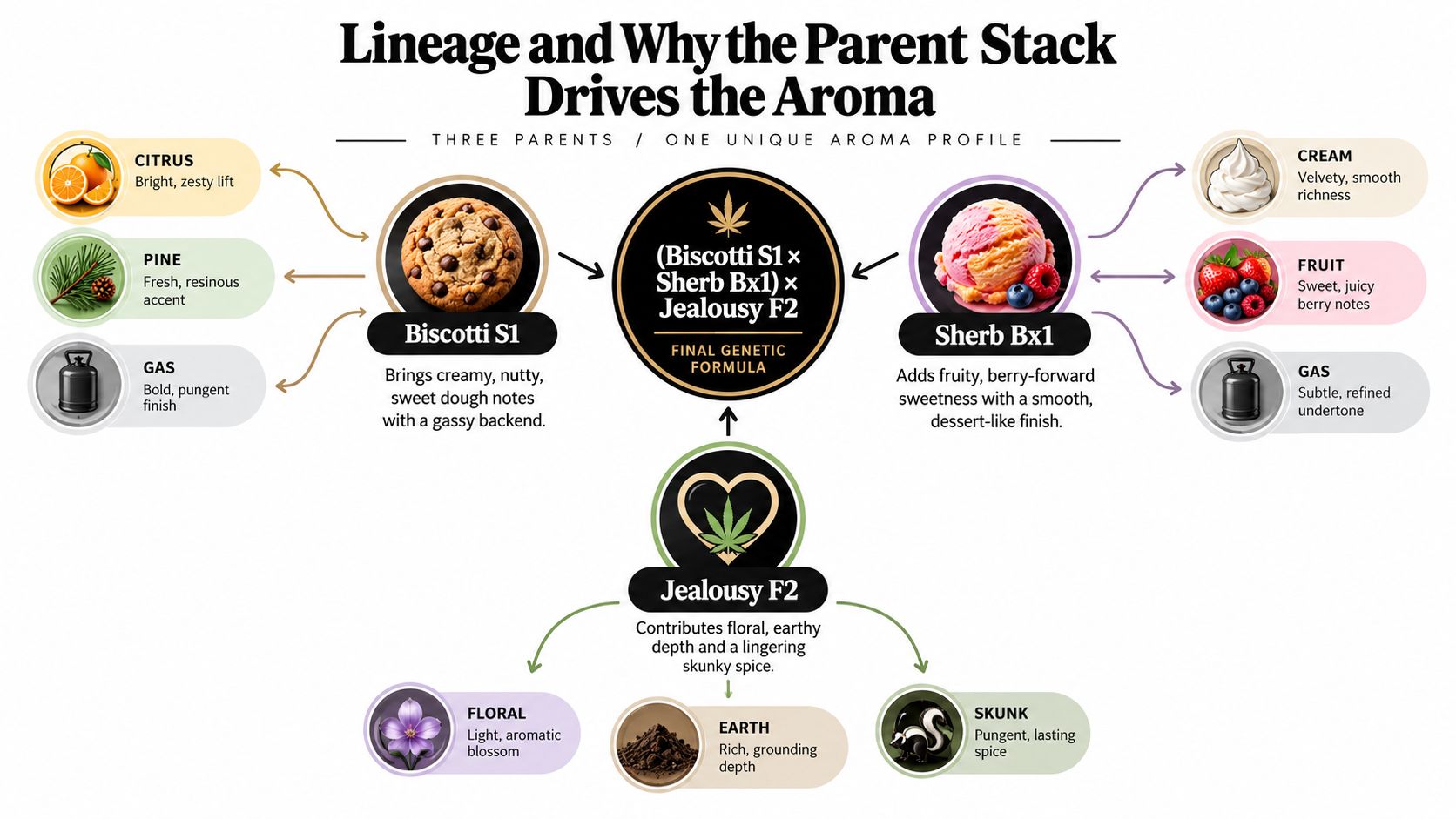
The breeding formula tells you how the lines were combined, not which exact volatile compounds will dominate a given batch. Sensory descriptions commonly connect Biscotti with sweet, baked, earthy notes, Sherbet-derived genetics with creamy or candy-like qualities, and Jealousy with a sharper fuel-and-fruit direction. Treat those as useful hypotheses for a flavor brief, not guaranteed chemical contributions from each parent.
Translate lineage into a flavor brief
A practical starting point is to identify the qualities the finished SKU needs to preserve. The sweet, doughy side can supply body; creamy and candy-like notes can soften the center; and a sharper gas or solvent-like impression can provide the contrast that keeps the blend from reading as generic dessert flavor.
This is why a Permanent Marker-inspired blend shouldn't chase either pole alone. Too much sweetness risks masking the sharper character, while an aggressively fuel-forward profile may underplay the softer, dessert-like finish. A formulator can use the parent stack as a sensory map, then tune actual compounds against flower or oil data.
Gold Coast Terpenes offers stock profiles mapped to strain families alongside isolates, which can serve as starting materials when building or adjusting a blend. The useful shortcut isn't assuming that a parent name predicts a precise ratio. It's having components available to make measured changes after evaluating the target batch.
What do Permanent Marker COAs actually show?
Pull three Permanent Marker COAs from different sources and the terpene rankings won't line up. β-Caryophyllene leads one panel, limonene climbs in another, and farnesene tops a third while going unlisted elsewhere. That spread is the finding: Permanent Marker behaves as a sensory target that drifts between lots, not as a fixed fingerprint you can copy off a strain page.
| Compound | Indoor flower COA (%) | Outdoor sample (%) | Distillate batch (%) |
|---|---|---|---|
| β-Caryophyllene | 0.6397 | 0.968 | 0.362 |
| Limonene | 0.1484 | 0.580 | 0.666 |
| Farnesene | Not listed among the reported values | Not listed among the reported values | 1.048 |
| α-Humulene | 0.2097 | 0.211 | Not listed among the reported values |
| Linalool | 0.0954 | 0.191 | Not listed among the reported values |
The comparison draws on reported measurements from Plant Werks' Permanent Marker batch data, an outdoor-grown sample report, and a separate indoor COA listing. "Not listed" means the referenced summary didn't report a value for that compound. Treat it as missing data, not proof of absence.
A separate traceable flower COA reported 1.93% total terpenes by weight, with β-caryophyllene at 1.85%, limonene at 1.37%, linalool at 0.49%, α-pinene at 0.39%, and β-myrcene at 0.13% in the measured Permanent Marker flower profile. No single rank order repeats across these reports. A blend built to one "canonical" profile can land wide of the lot a cartridge is meant to match.
Use the lot, not the average
Pick the target before touching a ratio. Matching a specific flower lot, an oil input, and a broader sensory brief are three different jobs, and each demands its own reference COA. Confirm sample identity, pull the current cannabinoid and terpene panel, and record which qualities the finished SKU has to preserve. That decision drives every loading choice downstream.
For reading individual panels and spotting what a report does and doesn't establish, this guide to reading terpene lab reports covers the fundamentals. When rank orders shift between samples, the formulator decides which characteristics to keep, then verifies the finished product delivers them.
How can you build a Permanent Marker-inspired blend architecture?
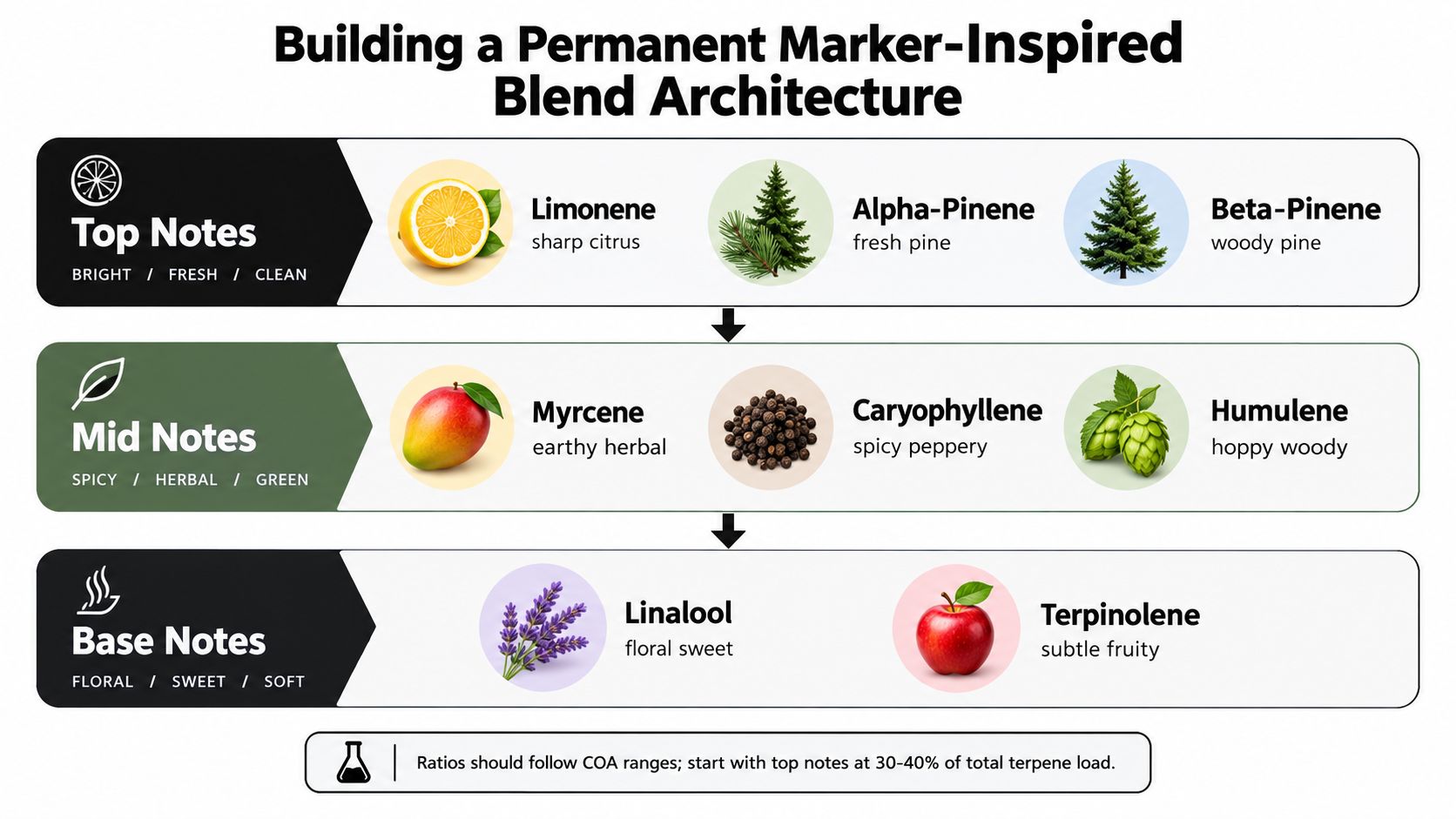
A Permanent Marker-inspired blend is a sensory target, not a fixed terpene recipe. Build it in layers, then adjust each layer against the target lot's COA and a sensory reference. Limonene can add citrus brightness, pinene a sharper pine impression, and β-caryophyllene peppery depth. Supporting compounds can shape herbal, floral, or woody notes.
Give each layer a sensory job
Top notes: Use limonene to lift the opening with citrus-like brightness. α-Pinene and β-pinene can add sharper or woodier facets. Treat these as formulation options, not guaranteed features of every lot.
Mid notes: β-Caryophyllene can anchor a spicy or peppery profile. Humulene or farnesene may add woody or green facets, depending on the target COA and sensory evaluation. A farnesene-forward sample calls for a different balance than one led by caryophyllene.
Base notes: Consider linalool, myrcene, and terpineol for floral, earthy, or softer supporting qualities. Include them only when the target data and blind sensory trials support their role.
The sample results vary considerably. One batch listed 30.516% THCA and 2.887% total terpenes, with farnesene at 1.048%, limonene at 0.666%, and β-caryophyllene at 0.362%. In the outdoor sample measurements detailed in the COA comparison table above, β-caryophyllene measured 0.968%, limonene 0.580%, humulene 0.211%, terpineol 0.206%, and linalool 0.191%. These are sample-specific readings, not universal formulation targets.
Adjust ratios by evidence
Avoid setting a fixed ratio unless the product specification calls for one. If the target COA and sensory panel point to a caryophyllene-forward character, build around that impression and use other compounds as supporting notes. If another compound leads in the target lot, let that evidence guide the balance.
Gold Coast Terpenes lists isolates including Limonene, Beta-Caryophyllene, Myrcene, Linalool, and Alpha-Pinene. These provide options for controlled adjustments. Its terpene blend resource can inform early combination trials.
How do you load the blend into distillate without stressing hardware?
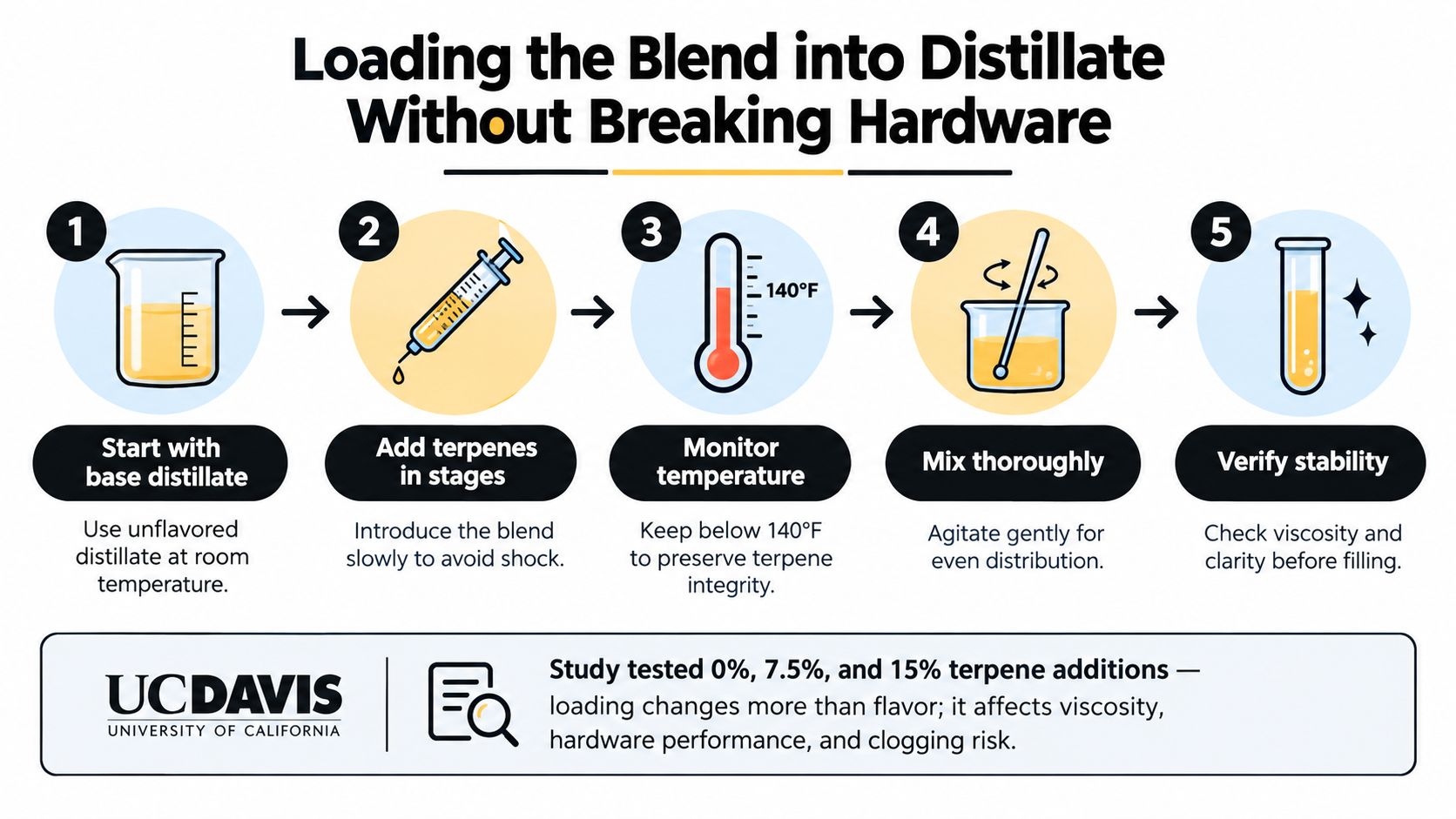
Use a staged formulation trial and change one variable at a time. A University of California, Davis study evaluated terpene-containing THC distillates at 0%, 7.5%, and 15% by weight, and found that terpene loading changes aerosol composition during heating, not only perceived flavor (UC Davis study on terpene-containing distillates).
Run a controlled loading trial
Start with an unflavored distillate control, then compare the study's 7.5% and 15% terpene-loading levels as test points, not as automatic production recommendations. Hold the distillate lot, hardware, and heating conditions constant, and vary only the total terpene addition. This isolates the effect of loading more effectively than changing the oil, blend, and cartridge together.
At each point, assess the sensory result and the finished oil's viscosity and stability. Then evaluate aerosol behavior in the intended hardware. A blend that smells accurate in a vial may not perform the same way after heating, so a flavor decision alone isn't enough to approve a cartridge.
Practical rule: Keep the comparison controlled. If the hardware or oil changes between samples, the team can't confidently attribute the result to terpene loading.
Gold Coast Terpenes publishes formulation resources including Terpenes 101 and a Mixing Calculator. Those can help with early planning, but the finished formulation still needs product-specific testing. For cartridge-oriented considerations, consult this vape cartridge resource and document the oil, loading, hardware, and evaluation results together.
Should you choose botanical or cannabis-derived terpenes?
A strain-inspired SKU needs a defined sensory target, not a promise that every input will reproduce one Permanent Marker flower lot. Botanical and cannabis-derived terpenes can both serve that target. Botanical inputs let formulators assemble a profile from selected compounds; cannabis-derived inputs may reflect a particular cannabis volatile profile. Either way, assess the actual material and finished blend.
As noted in the COA comparison section, an outdoor Permanent Marker sample showed a profile that differed from other reported samples. That variation matters at procurement: a cannabis-derived input tied to one lot may not match another. Botanical components offer control over selected notes, though blending them still takes sensory evaluation and batch-specific testing.
Compare the sourcing decision against the SKU
| Decision factor | Botanical inputs | Cannabis-derived inputs |
|---|---|---|
| Sensory target | Build the desired character from selected compounds | May reflect a specific cannabis-derived volatile profile |
| Batch matching | Requires careful blending and testing | Still requires lot-specific COA review |
| Procurement review | Check composition, documentation, and intended use | Check composition, documentation, supply, and applicable rules |
| Labeling | Verify ingredient descriptions against the formulation and local requirements | Confirm requirements for the relevant jurisdiction and product |
Gold Coast Terpenes describes its blends as 100% botanically derived and its terpene products as THC-free, SC Lab-tested, and free of VG, PG, PEG, and MCT. Its catalog includes Blue Dream, OG Kush, Forbidden Fruit, and a range of enhanced flavor profiles such as Apple Fritter. For sourcing terminology and trade-offs, see its botanical versus cannabis-derived terpene guide.
For product-positioning context, Class A Media's Kush Queen case study shows how a cannabis business and its products can be presented. It does not replace supplier qualification, lab documentation, or a review of labeling rules in the markets where a product will be sold.
Is Permanent Marker always myrcene-led?
No. Some public descriptions list myrcene first, but measured COAs from several Permanent Marker samples show caryophyllene ahead of myrcene, and one reported flower profile places β-myrcene at just 0.13% of total terpene weight.
Leafly's Permanent Marker profile lists myrcene first, followed by limonene and caryophyllene. That ordering is one reported description, not a universal formulation specification. Measured batches can tell a different story, including the caryophyllene-forward flower COA cited above.
Don't let a database order dictate the blend
A myrcene-heavy formulation may read earthier and muskier than the target, particularly when the intended product should have a more pronounced pepper-and-citrus direction. If the available flower or oil COA shows caryophyllene leading, making myrcene the headline ingredient risks pulling the result away from that batch.
Use myrcene as a supporting option when the COA or sensory panel calls for it. Build the profile around the compounds that dominate the actual reference material, then adjust minor notes to reach the intended aroma. That's a more reliable path to flavor accuracy than treating a strain-page terpene list as a fixed recipe.
What should a formulator check before shipping a Permanent Marker SKU?
Before approving a Permanent Marker-inspired cartridge, concentrate, or distillate product, confirm the lot data, intended sensory target, blend behavior, sourcing, and labeling. The release decision should be based on the product the customer will receive, not the assumptions attached to the strain name.
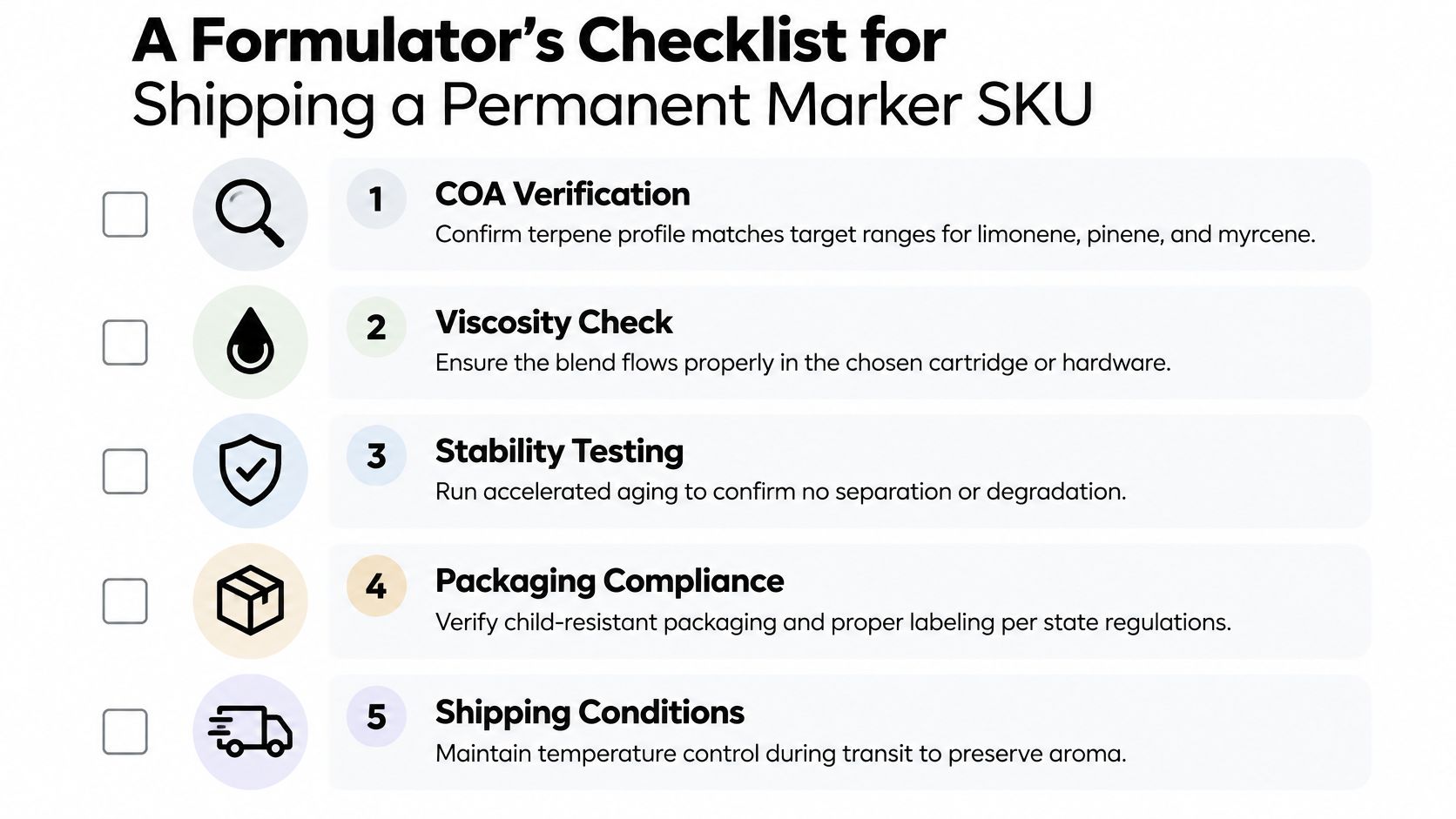
Before release, verify:
- COA match: Record the reference flower or oil lot, its measured terpene profile, and the sensory traits the blend is intended to reproduce.
- Blend architecture: Confirm that the top, mid, and base notes reflect that reference, rather than a generic strain description.
- Loading and hardware: Keep the distillate and hardware consistent during trials, assess the chosen loading level, and check the finished oil's viscosity and stability.
- Sourcing and documentation: Review supplier documentation and confirm that the ingredient description and finished-product label meet applicable requirements.
- Commercial terms and tools: Gold Coast Terpenes lists wholesale, bulk, and affiliate programs, free U.S. shipping over $100, and discounts on orders exceeding 64 oz. The supplier also publishes Terpenes 101 and a Mixing Calculator; confirm current purchasing terms and relevant compliance requirements directly before placing a production order.
Formulator FAQs
How do I validate a Permanent Marker blend against flower?
Compare the current flower COA with the blend's measured composition, then evaluate both against the intended sensory target. Gold Coast Terpenes offers terpene blends and isolates that can be used as formulation inputs, but the finished product still needs lot-specific validation.
What terpene loading should I start with?
Use a controlled trial rather than treating one percentage as the universal answer. The UC Davis study tested 0%, 7.5%, and 15% by weight, which provide comparison points for internal evaluation, not a substitute for product-specific testing.
Does the Permanent Marker name determine whether a SKU is for daytime or evening use?
No. A strain label or terpene profile alone can't establish a product's appropriate use or predict an individual response. Keep product positioning factual and check the relevant rules for claims and labeling.
How should I handle phenotype drift between lots?
Review the new lot's COA and sensory characteristics against the approved target, then adjust the blend only when the data and evaluation justify it. Gold Coast Terpenes' isolate options can support targeted changes, but each finished lot should be rechecked before release.
For Permanent Marker-inspired development, Gold Coast Terpenes offers strain-inspired blends and individual terpene isolates that can support measured, COA-led formulation. Review the available components and formulation resources at Gold Coast Terpenes before setting up your next blend trial.