
A new SKU lands on your bench. The brief sounds simple: match Paris Breath closely enough that the first pull reads as sweet and floral, the middle stays earthy, and the finish carries that dense wood and diesel signature instead of collapsing into generic “OG-like” vapor. Then the hard part shows up. Distillate strips away context, hardware reshapes volatility, and a terpene blend that smells right in the bottle can taste flat once it's heated.
That's why the Paris Breath strain is a formulation problem, not a naming exercise. In vape and concentrate development, this profile sits in the category of cultivars that punish shortcuts. If you overbuild the bright layer, the product loses its grounded body. If you lean too hard into base notes, the result gets muddy and one-dimensional. Precision matters most when the target profile looks familiar on paper but behaves differently in finished goods.
Introduction Why Paris Breath Is a Formulation Challenge
Commercial teams usually run into Paris Breath at the point where sensory expectations are already set. Sales wants a premium indica-leaning profile. Product wants a recognizable cultivar story. Manufacturing wants something stable in carts and repeatable across lots. Those goals don't conflict, but they do force discipline.
Paris Breath isn't difficult because it is loud. It's difficult because it is layered. The profile combines sweet, earthy, floral, diesel, wood, pine, and citrus characteristics, which means the formulator has to build vertical structure rather than chase a single dominant note. In practice, that rules out generic “gas” blends and many all-purpose kush-style systems.
Where replication usually fails
Most misses come from one of three decisions:
- Using a premix blindly: A ready-made blend may smell close in cold evaluation but still miss the heated expression inside a cartridge.
- Overcorrecting with citrus: Brightening the opening can help the first inhale, but too much lift makes the profile feel detached from its heavier body.
- Ignoring the matrix: The same terpene blend won't express identically in different extract bases or hardware formats.
A better approach is to start with the cultivar identity, then convert that identity into sensory roles, then pressure-test the profile in the actual delivery system.
Practical rule: If a strain-inspired terpene blend smells complete only in the bottle, it probably won't stay complete in a cart.
For teams working on replicating high-terpene strains in manufactured products, the key isn't adding complexity for its own sake. It's deciding which notes must lead, which notes must support, and which notes should stay restrained. That's the difference between a Paris Breath-inspired SKU and a cartridge that reads like Paris Breath under heat. A useful reference point on that broader challenge appears in this guide to replicating high-terpene strains.
Deconstructing the Paris Breath Genetic and Chemical Profile
Paris Breath starts with lineage, and lineage matters because it frames what the market expects from the finished aroma. It is a cross between Paris OG and Grateful Breath, bred by Gage Green Genetics, and it sits firmly in the indica-dominant category. In formulation terms, that means the aromatic target should feel grounded and dense rather than sharp or airy.

Genetic context that affects formulation
The parentage gives useful clues. Paris OG contributes a familiar kush-direction backbone, while Grateful Breath pushes the profile toward heavier, more saturated body notes. That combination is why formulators often miss the mark when they build Paris Breath as a simple citrus-earth system. The deeper finish is not optional.
The cannabinoid framework also shapes how the profile is typically paired in commercial products. According to this Paris Breath cultivar breakdown, Paris Breath is a high-THC indica cultivar that typically contains 22–28% total THC by weight, with CBD at 0.05% to 0.6% and CBG at 0.3% to 1.2%. That same source notes that legal-market certificates of analysis place it in the potent category.
Why the cannabinoid context still matters
Terpenes drive flavor, but they don't act in a vacuum. A profile associated with a high-THC, low-CBD flower type generally performs best when the finished product avoids tasting thin or overly perfumed. Formulators working with neutral distillate often need to restore not just top-note identity, but also the perception of mass.
That doesn't mean recreating flower exactly. It means respecting the cultivar's botanical logic.
| Profile element | Paris Breath reference point | Formulation implication |
|---|---|---|
| Genetics | Paris OG × Grateful Breath | Build for dense body and a grounded finish |
| THC context | 22–28% total THC | Avoid overly delicate terpene architecture |
| CBD context | 0.05% to 0.6% | Don't expect CBD-associated softness to carry the profile |
| CBG context | 0.3% to 1.2% | Minor cannabinoids may influence how the profile is paired in full products |
The best Paris Breath formulations don't try to smell “complex.” They try to smell inevitable, with each note arriving in the order the cultivar suggests.
For teams refining a terpene profile for cannabis product formulation, it helps to review the underlying material behavior rather than only the branding language. A solid refresher is this overview on the chemistry of terpenes.
Sensory Analysis Translating Aroma into Formulation Targets
The Paris Breath profile becomes easier to build once the aroma is broken into top, middle, and base notes. Without that structure, formulators tend to chase descriptors one by one and end up with a blend that contains the right words but the wrong order of perception.
The known sensory description is specific enough to support a practical note map. The aroma combines sweet, earthy, and floral notes with undertones of diesel, wood, pine, and citrus, matching the flavor character, according to the Weedmaps product listing for Paris Breath. That same source notes that parent strain Paris OG is known for THC levels surpassing 19% and is cultivated primarily in Southern California and Michigan.
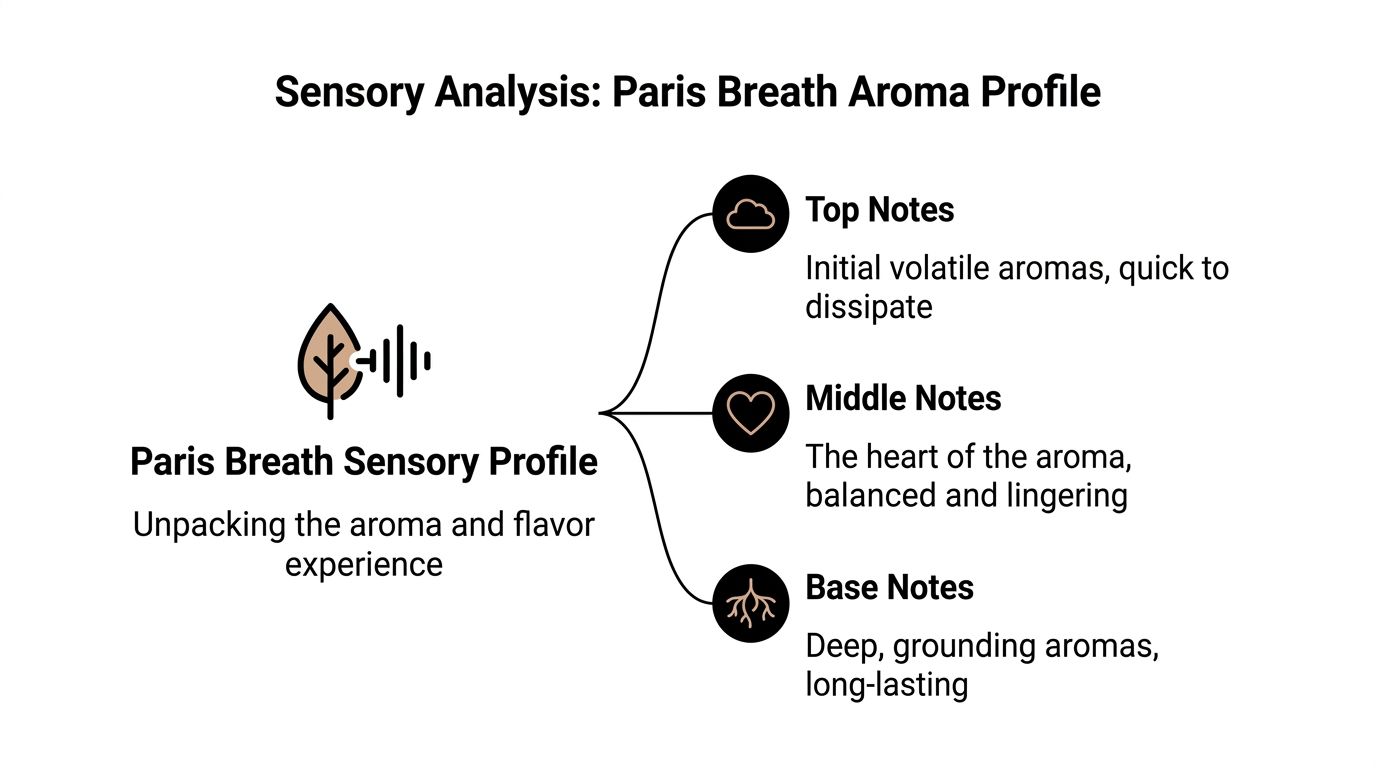
Top notes that open the profile
The opening should present citrus and sweet floral lift. This layer needs enough volatility to announce itself quickly, but not so much that it dominates the first second and disappears into a generic lemon note. In strain-inspired systems, this is often where formulators overreach.
Think of the top as a signal, not the whole message.
- Citrus brightness: Supports recognition and gives the blend initial definition.
- Sweet floral nuance: Softens the opening and keeps the profile from reading too dry.
- Controlled intensity: The top layer should invite the middle forward, not compete with it.
Middle notes that create identity
The middle is the primary body of Paris Breath. Here, earthy and woody character should settle in and stay coherent under heat. If the middle is weak, the product may smell acceptable in a jar but taste hollow in a cartridge.
A good middle note structure does two jobs at once. It connects the bright opening to the heavier finish, and it provides most of the recognizable cultivar weight.
Bench note: When the earthy center is underbuilt, operators often add more diesel to compensate. That usually makes the profile harsher, not truer.
Base notes that hold the finish
The base should carry diesel and pine, with wood reinforcing persistence. These notes shouldn't hit first. They should emerge after the opening and remain on the palate or vapor trail long enough to make the profile feel complete.
For practical replication, treat the Paris Breath base as an anchor system:
- Diesel gives edge and strain-specific seriousness.
- Pine sharpens the tail without turning the profile green or astringent.
- Wood keeps the finish broad and integrated.
That note hierarchy matters for any team replicating flavor of Paris Breath for vape cartridges. If the sequence is wrong, the blend may still smell pleasant, but it won't read as Paris Breath in use.
The Paris Breath Terpene Blueprint Ratios and Key Isolates
Once the sensory map is clear, the formulation task becomes simpler. Paris Breath is anchored by limonene, myrcene, and beta-caryophyllene, and the known quantitative ranges are strong enough to build a practical blueprint around. In well-grown batches, the terpene stack includes limonene at 0.3–0.9%, myrcene at 0.4–1.2%, beta-caryophyllene at 0.2–0.8%, with total terpene content reaching 1.8–3.2% by weight according to the source cited earlier in the chemical profile discussion.
Core ratios and what they do
This profile works because the dominant terpenes divide labor cleanly. Limonene gives lift, myrcene supplies the soft earthy body, and beta-caryophyllene adds a peppered, woody, diesel-adjacent finish. Remove one, and the profile loses its shape.
| Terpene | Typical Range (%) | Aromatic Contribution (Note) | Formulation Role |
|---|---|---|---|
| Limonene | 0.3–0.9% | Citrus, bright top note | Opens the profile and prevents heaviness from becoming dull |
| Myrcene | 0.4–1.2% | Sweet, earthy body note | Builds the central mass and cultivar softness |
| Beta-caryophyllene | 0.2–0.8% | Peppery, woody, diesel-like finish | Grounds the blend and extends the finish |
| Total terpene content | 1.8–3.2% | Full aromatic intensity | Signals a profile that should feel expressive, not timid |
How to use the blueprint in formulation work
Don't read these ranges as a finished cartridge formula. Read them as a relative hierarchy for the strain-inspired terpene blend. In other words, myrcene should feel structurally important, limonene should lead but not dominate, and beta-caryophyllene should tighten the lower half of the profile.
A practical mixing workflow usually starts by asking three questions:
- Is the opening too bright? Pull limonene back before adding more middle notes.
- Is the body too soft or generic? Rebuild around myrcene rather than forcing sweetness.
- Is the finish thin? Beta-caryophyllene often fixes structure more cleanly than adding more pine-like character.
The mistake isn't choosing the wrong major terpene. The mistake is asking one terpene to do the job of three.
Formulators who want a cleaner visual reference for balancing major and minor contributors often keep a note wheel or chart nearby during bench work. This terpene chart PDF is useful for that kind of side-by-side evaluation.
Formulating with Paris Breath Terpenes for Distillate
Distillate gives you a blank carrier, but that blankness is deceptive. It doesn't preserve the cultivar naturally. It forces you to rebuild the experience from the aromatic system upward. For Paris Breath, the goal isn't maximum saturation. The goal is correct ordering of perception under heat.
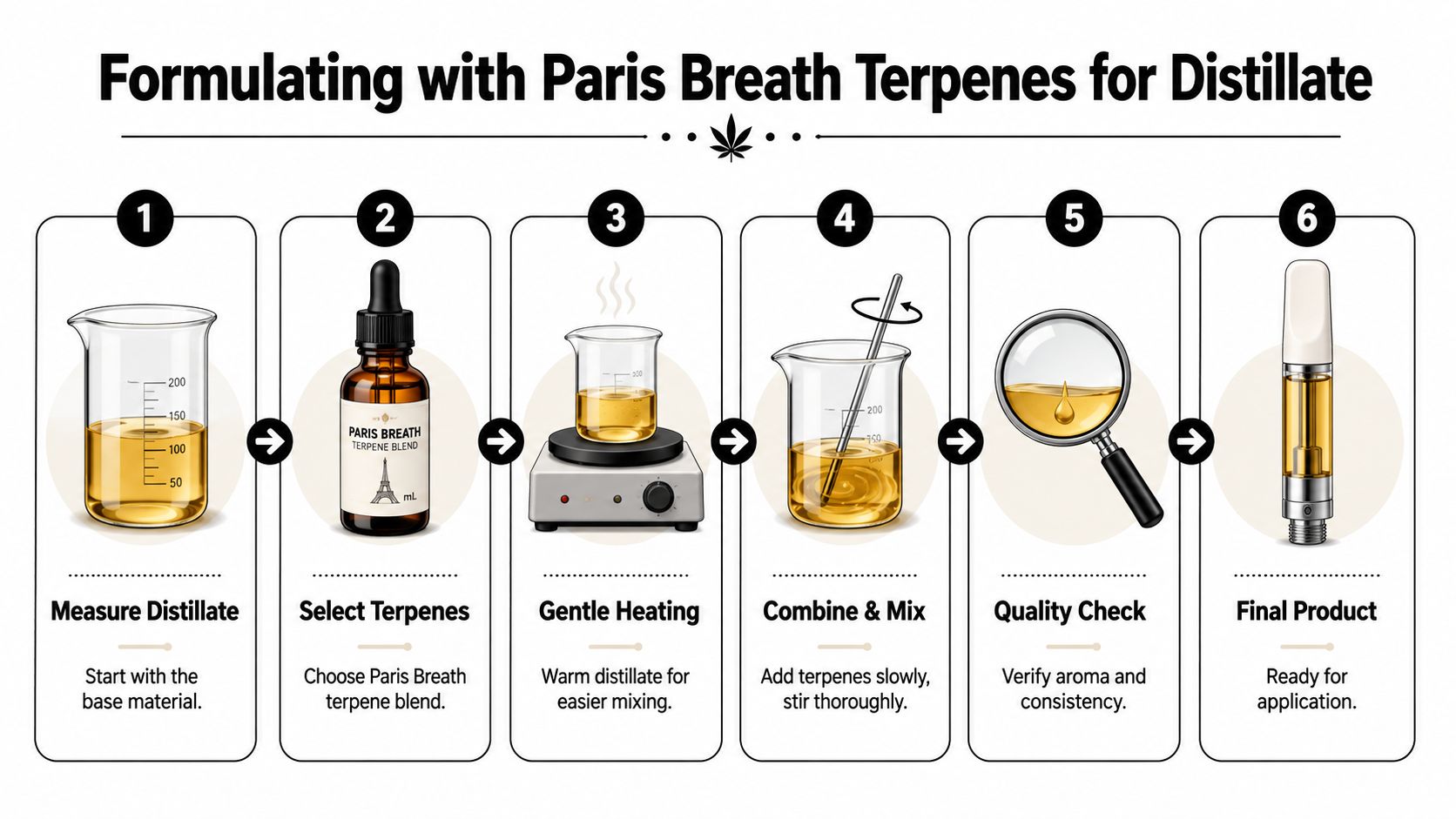
Building the blend into a neutral base
Start with a small pilot batch and evaluate in the actual hardware you intend to sell. Paris Breath can smell balanced in open-air glass and still skew too bright or too dry once the atomizer heats it. The fix usually isn't adding more total terpenes. It's rebalancing where the expression lands in the first pull and the aftertaste.
A sound operational sequence looks like this:
- Warm the distillate gently until it flows and accepts incorporation without aggressive shear.
- Add the terpene blend slowly while mixing thoroughly to improve homogeneity.
- Allow the blend to settle before sensory evaluation so transient volatility doesn't mislead the panel.
- Test in target hardware rather than approving from bottle aroma alone.
The demonstration below is useful as a process reference before moving into a production run.
What works and what usually doesn't
Paris Breath responds best to restraint in two places. First, don't force sweetness to make the profile more “commercial.” The cultivar already has sweetness, but it sits inside an earthy frame. Second, don't overbuild the pine-diesel finish too early. If the base arrives before the center has developed, the cartridge tastes sharp and disconnected.
Here are the trade-offs that matter most in practice:
- More limonene: Better first impression, but too much turns the profile into generic citrus-kush.
- More myrcene: Stronger body, but excess can blur detail and flatten the finish.
- More beta-caryophyllene: Better structure and persistence, but overuse can make the blend read peppery rather than woody-diesel.
Stability and manufacturing judgment
For a commercial distillate SKU, stability isn't just chemical. It's sensory. A blend can remain physically mixed and still drift in how it presents once filled and stored. That's why a prefill approval isn't enough. Pull filled units back for recheck after they've sat under normal packaging conditions.
Manufacturing advice: Approve the profile only after evaluating bottle aroma, fresh fill behavior, and settled cartridge performance.
Avoid low-quality shortcut ingredients that mute expression or create an artificial mouthfeel. A Paris Breath profile needs a clean terpene presentation to keep the sweet-earthy center intact. Teams dialing in a formulation guide for distillate often benefit from reviewing application-specific recommendations such as this resource on the best terpenes for distillate.
Sourcing and Replicating with Gold Coast Terpenes
Once the target profile is defined, execution depends on the supply side's ability to support repeatable replication. Projects often encounter delays at this point. A benchmark formula may work at bench scale, but if the underlying terpene inputs shift from lot to lot, the finished SKU starts wandering.
For teams working on a strain-inspired terpene blend for cannabis product formulation, Gold Coast Terpenes is a practical source to evaluate because the catalog is built around strain-specific profiles and isolated compounds used in cartridges and concentrates. That matters when you need both a ready starting point and the option to fine-tune around it.
Where a supplier adds value
A useful supplier for Paris Breath replication should support two workflows.
The first is the fast-track workflow. You start with a strain-specific blend that already aligns with the cultivar's expected note structure, then make minor adjustments during pilot work.
The second is the precision workflow. You begin with a base profile, then tune key isolates like Limonene, Myrcene, or Beta-Caryophyllene to match your hardware, extract base, or market preference.
That flexibility matters because not every Paris Breath SKU should taste identical. A cartridge line may need a brighter opening than a concentrate application, while still staying faithful to the cultivar architecture.
What to look for before you buy
Use these criteria when evaluating a terpene supplier for Paris Breath replication:
- Strain specificity: The profile should be designed to read as Paris Breath, not a broad indica approximation.
- Isolate availability: You should be able to correct the opening, body, or finish without rebuilding the entire blend.
- Formulation support: Educational resources and technical references make pilot work faster and less wasteful.
- Documentation readiness: The vendor should be able to support a professional QC workflow.
A supplier becomes useful when they reduce iteration cycles without forcing you into a one-size-fits-all flavor system. For commercial teams, that's more valuable than a broad menu alone.
Quality Control and Commercial Scale-Up Considerations
A common assumption in strain replication is that once the pilot batch tastes right, scale-up is mostly a purchasing exercise. It isn't. Scale exposes every weak assumption in the formula, the process, and the source material. Paris Breath is especially unforgiving because its success depends on note order and cohesion, not on one oversized flavor cue.
Batch consistency needs more than a recipe
A written formula won't protect your SKU if incoming terpene lots vary in expression, if mixing conditions shift, or if finished carts mute the top layer during storage. Operators need a repeatable approval standard that covers raw input review, in-process checks, and post-fill sensory confirmation.
At minimum, QC teams should lock down:
- Incoming review: Confirm terpene identity and documentation before the material hits production.
- In-process control: Watch for complete incorporation and a consistent sensory read before filling.
- Finished-goods evaluation: Recheck filled units after they've settled in packaging.
- Retention samples: Keep reference units so future lots can be compared against an approved standard.
COAs matter, but they aren't the whole story
Certificates of Analysis are essential, especially for terpene inputs and final products. They support identity, purity, and lot-level accountability. But a COA won't tell you whether your Paris Breath profile still opens sweet-floral, lands earthy, and finishes with the right wood-diesel balance in your chosen hardware.
That's why high-functioning manufacturers pair analytical verification with controlled sensory review. The documents tell you what arrived. The bench tells you how it behaves.
If your team can't describe the approved sensory target in operational language, scale-up will turn every lot into a new debate.
Supplier reliability is a brand issue
Once a product is in market, inconsistency stops being a lab problem and becomes a customer-facing problem. The brand owns every drift in flavor, every batch that tastes flatter than the last, and every SKU that no longer matches its own positioning.
For Paris Breath, the right scale-up discipline is simple to state and hard to fake. Lock the profile. Validate the process. Recheck filled goods. Keep reference samples. Buy from suppliers who can support the same profile repeatedly, not just once.
Gold Coast Terpenes is a strong option for formulators building Paris Breath-inspired carts, concentrates, and distillate SKUs. Their catalog includes strain-specific blends, individual isolates, and practical formulation resources that help teams move from pilot work to repeatable production. Explore Gold Coast Terpenes if you need a reliable starting point for strain replication or tighter control over flavor architecture in commercial products.