
A lot of failed batches start the same way. The distillate is warm, the terpene bottle is cold, someone reaches for a syringe instead of a scale, and the mix looks fine for a few minutes. Then the cartridge leaks, the flavor lands wrong, or the batch separates after filling.
That's why learning how to mix distillate with terpenes isn't a flavor exercise. It's a formulation discipline. If you want repeatable viscosity, accurate strain replication, and stable hardware performance, you need a controlled process from prep through QA.
Beyond Flavor The Goal of Professional Terpene Formulation
In a production setting, terpenes do more than make distillate smell better. They shape viscosity, define the aromatic structure of the product, and determine whether a formulation behaves properly in the intended hardware. For brands building carts, concentrates, or other cannabis product formulation programs, the target is consistency, not novelty.
A good terpene profile also has to read correctly in layers. The first impression comes from top notes, the body comes from mid notes, and the linger comes from base notes. If those layers are out of balance, the result feels flat or artificial even when the raw ingredients are clean.
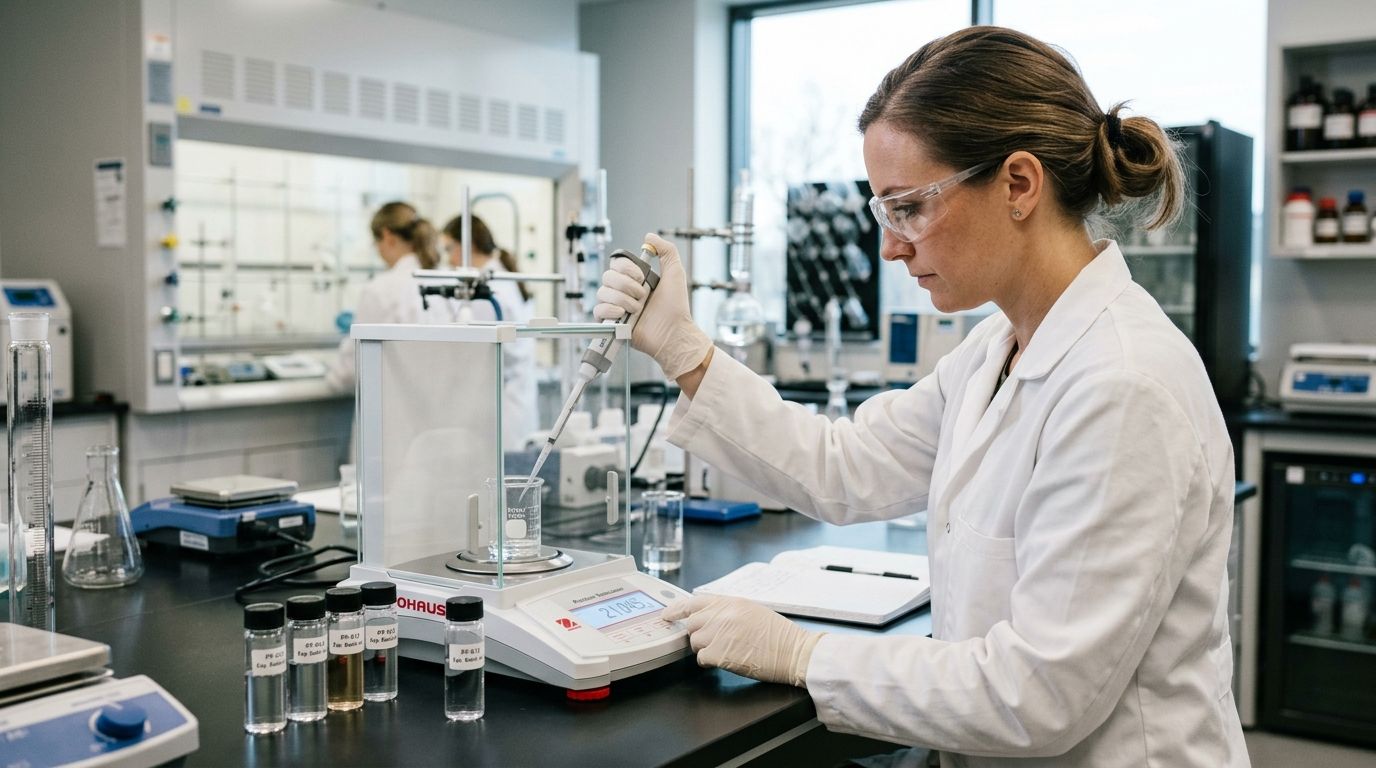
Terpene architecture controls identity
When you're building a strain-inspired terpene blend for distillate, the profile has to be structured, not improvised. In a reference framework for replicating an authentic OG Kush style profile, primary terpenes like Myrcene and Limonene must constitute 40% or more of the total profile, secondary terpenes such as β-Caryophyllene should sit at 10–20%, and tertiary accents like linalool and humulene should stay under 5% so they add nuance without taking over, as outlined in the terpene profile reference for strain replication.
That matters because each layer does a different job:
- Top notes carry lift and first aroma impact. These are often bright and volatile.
- Mid notes make the profile recognizable. They hold the main character together.
- Base notes anchor the finish and keep the profile from disappearing on the back end.
Practical rule: If the profile smells impressive in the bottle but weakens into a generic finish in vapor, the architecture is usually wrong, not just the ratio.
Formulation has to match the end use
A profile built for a vape cartridge won't always behave the same way in another delivery system. The same terpene blend that feels balanced in one application can become too sharp, too soft, or too thin in another. Formulators who treat all additions as simple flavoring usually end up chasing corrections later.
For teams developing terpene profiles for distillate, the better approach is to define three things first. Target hardware. Target sensory direction. Target operating range for the finished oil.
That's also why resources like this guide to best terpenes for distillate are useful. They help anchor terpene selection to application instead of strain-name guesswork.
Essential Equipment and Safety Protocols for Formulation
The easiest way to ruin a good formula is to run it with poor tools. Mixing distillate and terpenes requires heat control, accurate weighing, clean glassware, and a mixing method that produces true homogeneity. Manual stirring can make a blend look uniform on the surface while leaving concentration differences throughout the batch.
Use equipment that solves a specific problem
A proper setup for formulating terpenes for vape cartridges should include:
- A calibrated digital scale: Weight-based dosing is the only reliable way to hit the same formula every time.
- Glass beakers or other compatible lab vessels: Glass handles heat well and makes visual inspection easier.
- A magnetic stirrer and stir bar: This gives controlled, continuous mixing across the full vessel.
- A hot plate with stable temperature control: You need a narrow thermal window, not approximate warmth.
- Pipettes or glass syringes: These help transfer terpenes cleanly after weighing.
- Nitrile gloves and safety glasses: Terpenes are concentrated aromatic compounds. Direct skin contact and eye exposure are avoidable process failures.
- Good ventilation: Even a clean formulation room needs proper air movement during handling.
The magnetic stirrer matters more than many new technicians expect. A stir bar creates a consistent vortex and keeps the terpene addition moving through the warmed distillate instead of pooling on the vessel wall.
Sanitation isn't separate from performance
Pre-mixing discipline starts before heat is applied. For homogeneity in distillate-terpene blends, technical guidance calls for 60–65°C (140–149°F) mixing with medium-speed magnetic stirring for 15–20 minutes. The same guidance also states that refrigerated materials should return to room temperature for 2–3 hours, and tools should be sanitized with 95% ethanol to reduce contamination that can contribute to hardware clogging, according to this distillate and terpene mixing protocol.
That prep work affects product quality directly. Cold terpene bottles throw off handling and measurement. Dirty tools introduce particulates and residues. Poor sanitation doesn't always show up in the beaker. It often shows up later in fills, clogs, or unstable aroma.
Clean tools protect more than compliance. They protect repeatability.
For regulated manufacturing, the documentation side matters too. Every technician should understand the handling profile of the materials in front of them, especially when working with concentrated aroma compounds. A practical starting point is this overview of why safety data sheets matter in terpene handling.
What experienced labs don't skip
Three habits separate stable batches from unpredictable ones:
- Equilibrate materials before use. Don't pull terpenes from cold storage and add them immediately.
- Sanitize every contact surface. Beakers, stir bars, pipettes, and transfer tools all count.
- Confirm your setup before weighing. Once terpenes are on the bench, delays create avoidable exposure and handling error.
Labs that keep these steps routine usually spend less time diagnosing failures later.
Mastering Ratios and Weight-Based Calculations
Most mixing problems don't start with terpene quality. They start with measurement. New technicians often ask for a simple milliliter-to-milliliter shortcut, but that shortcut is exactly what causes batch drift.
When you're learning how to mix distillate with terpenes for distillate, the first rule is simple. Measure by weight, not by volume.
Why weight beats volume in real production
A documented source of batch failure is the difference between temperature-corrected volume measurements and weight-based precision. Terpenes are volatile, and their density shifts with temperature, which can create up to a 10% volumetric error when the terpene is cold and the distillate is hot. In practice, a nominal 10% by volume batch may land at 8% or 12% by weight, as described in this mixing and filling guidance for vape cart formulation.
That's not a minor lab nuisance. It changes flavor intensity, viscosity, and hardware behavior.
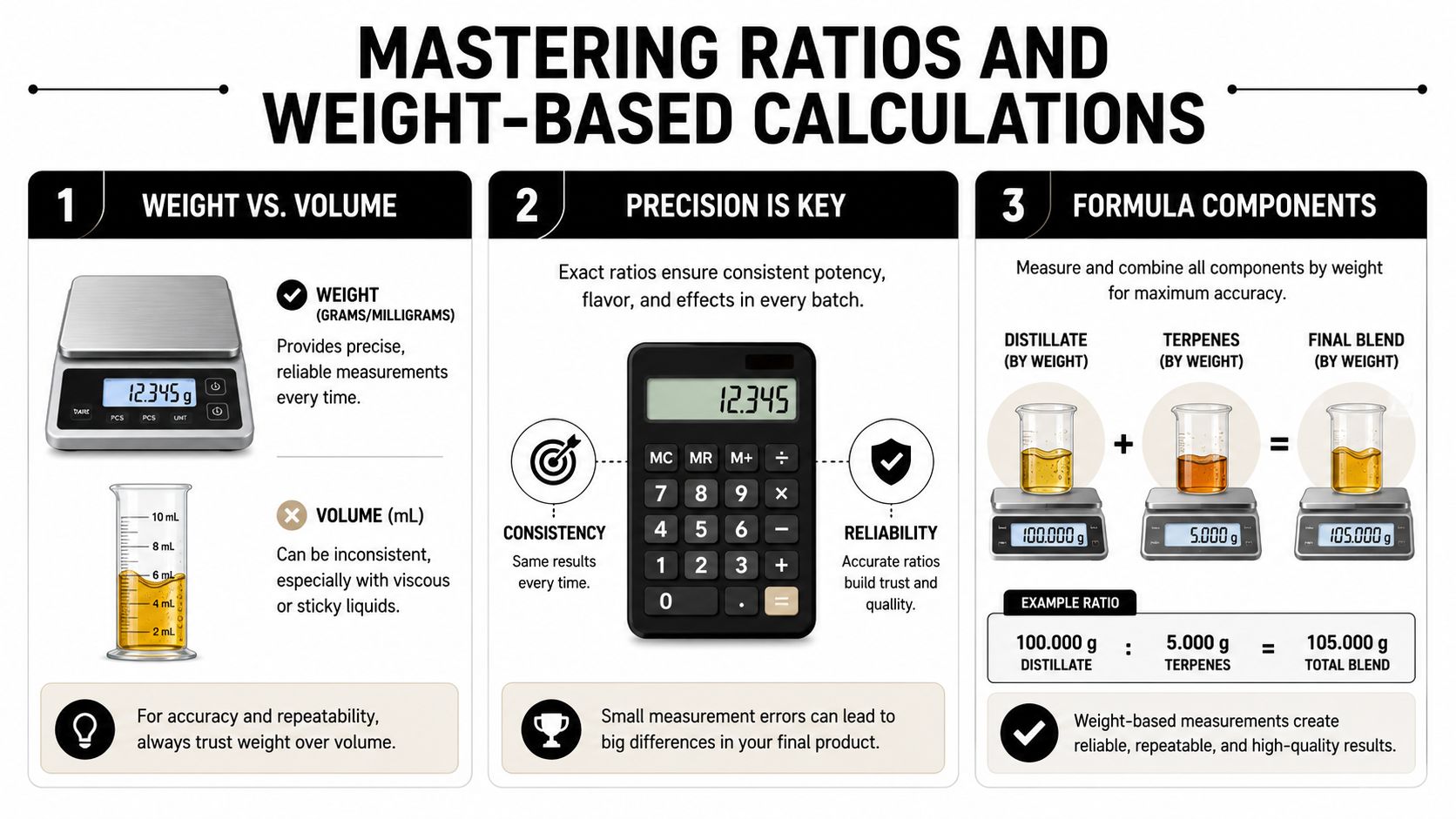
If you weigh the terpene fraction and the distillate fraction directly, you remove that variable. The formula becomes repeatable across operators, rooms, and batch sizes.
Recommended ratios by product type
The industry-standard mixing ratio for reintroducing terpenes to refined distillate for vape cartridges typically falls between 5% and 10% by weight. Lower ranges are used for other applications, including 1–3% for tinctures and 0.5–2% for topicals. Cartridge hardware also changes the usable range. Ceramic cell cartridges generally tolerate 8–12%, while cotton wick systems perform best at 5–8%. Starting with 1–2% is a common first-pass protocol when developing a new formula, and exceeding 10% diluent in the finished solution can compromise stability.
Here's the working table I'd give a new lab technician.
| Product Type | Hardware Type | Recommended Terpene % (by weight) |
|---|---|---|
| Vape cartridges | Standard cartridge systems | 5–10% |
| Vape cartridges | Ceramic cell cartridges | 8–12% |
| Vape cartridges | Cotton wick systems | 5–8% |
| Tinctures | N/A | 1–3% |
| Topicals | N/A | 0.5–2% |
What those numbers mean in practice
Ratios are not just about taste. They control the trade-off between aromatic accuracy and flow behavior.
- Lower additions: Safer for preserving body and avoiding over-flavoring, but they can under-deliver on sensory impact.
- Higher additions: Useful when hardware can tolerate more thinning, but they increase the risk of leakage or instability.
- Mid-range additions: Often the best place to build a first production candidate because they leave room for refinement.
A common mistake is treating a strong profile as a reason to ignore the math. It isn't. Potent terpene systems still need exact dosing.
The batch doesn't care what the target was in your head. It only reflects what went on the scale.
Weight-based calculation discipline
For batch work, calculate terpene mass from total finished batch weight, not from an estimated volume in a warm beaker. Weigh the empty vessel, tare it, add the distillate, record the mass, then add the terpene fraction by weight.
When operators skip direct weighing and rely on line marks, transfer estimates, or syringe volume, they introduce avoidable variation. That's why a purpose-built mixing ratios calculator for terpene formulation is useful in production environments. It supports the process you can replicate, not the one you hope averages out.
The Critical Role of Temperature and Mixing Technique
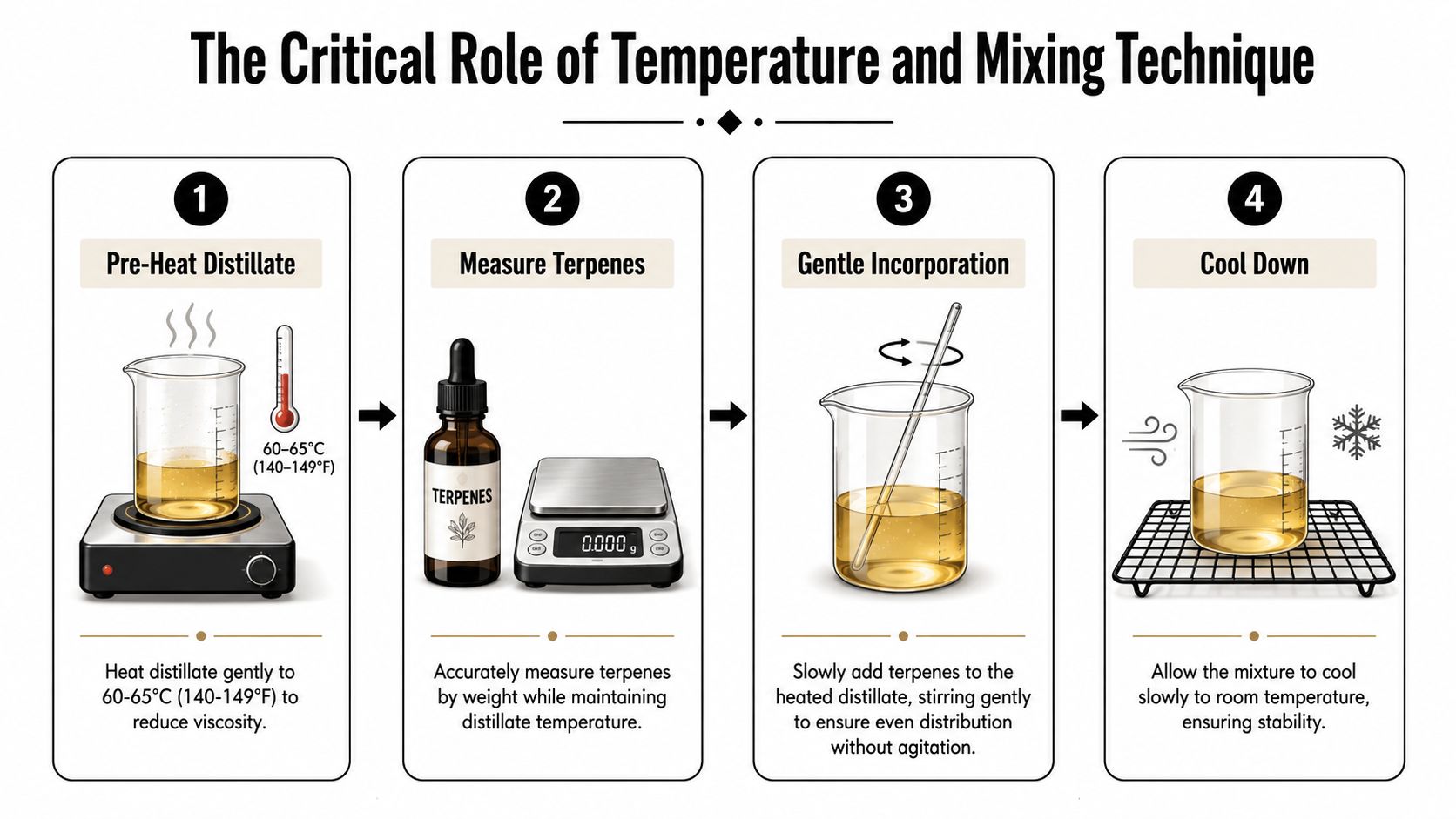
A clean formula can still fail if the mixing sequence is wrong. Temperature is the main control point. Too cool, and the distillate stays resistant and uneven. Too hot, and you start damaging the volatile fraction you're trying to preserve.
Hold the correct thermal window
To prevent volatilization of monoterpenes while still achieving homogeneity, distillate should be heated to 140–150°F (60–65°C) before terpene addition. That range reduces viscosity enough for effective blending while remaining below terpene flash points of 160–180°F (71–82°C), as explained in this boiling-point and handling reference for terpenes and supported by this temperature guidance for terpene integration.
That range is narrow for a reason. You're balancing fluidity against terpene retention.
The mixing sequence that works
I train new technicians to treat the sequence as fixed:
- Warm the distillate first. Don't add terpenes into cold or semi-soft material.
- Confirm the temperature is stable. Not rising fast, not drifting downward.
- Start magnetic stirring. You want a steady vortex, not aggressive splashing.
- Add pre-weighed terpenes slowly into the vortex. The standard guidance is a slow addition over 30–60 seconds.
- Maintain mixing until the blend is fully integrated. Don't stop as soon as it looks uniform at the top.
- Cool in a controlled way before final transfer or fill.
This video is a useful visual reference for handling and integration:
Why slow addition matters
If you dump the terpene fraction in one shot, part of it can sit on the vessel wall or form localized pockets before the distillate catches up. Those pockets become concentration hot spots. Even if the batch later looks clear, the initial dispersion was poor.
Adding into the vortex fixes that. The moving center pulls the terpene fraction into the body of the distillate immediately, which makes the rest of the mixing time productive instead of corrective.
Add terpenes to motion, not to still oil.
Signs the technique is wrong
You can usually identify a poor mix before you ever fill hardware:
- Streaking in the vessel: The terpene fraction hasn't integrated fully.
- Strong aroma burst at the start, then flattening: Heat or exposure likely stripped the volatile top end.
- Unexpectedly thin body: The ratio or temperature handling pushed the blend too far.
- Inconsistent pull performance later: The formulation may have looked blended but wasn't fully homogeneous.
Good mixing is quiet, controlled, and boring. That's what you want. Production problems usually come from improvisation.
Formulation Examples with Gold Coast Terpenes Profiles
Examples are where ratio, hardware fit, and profile design come together. In both of the scenarios below, the process stays the same. Weigh everything, warm the distillate properly, and mix under controlled conditions. What changes is the profile goal.
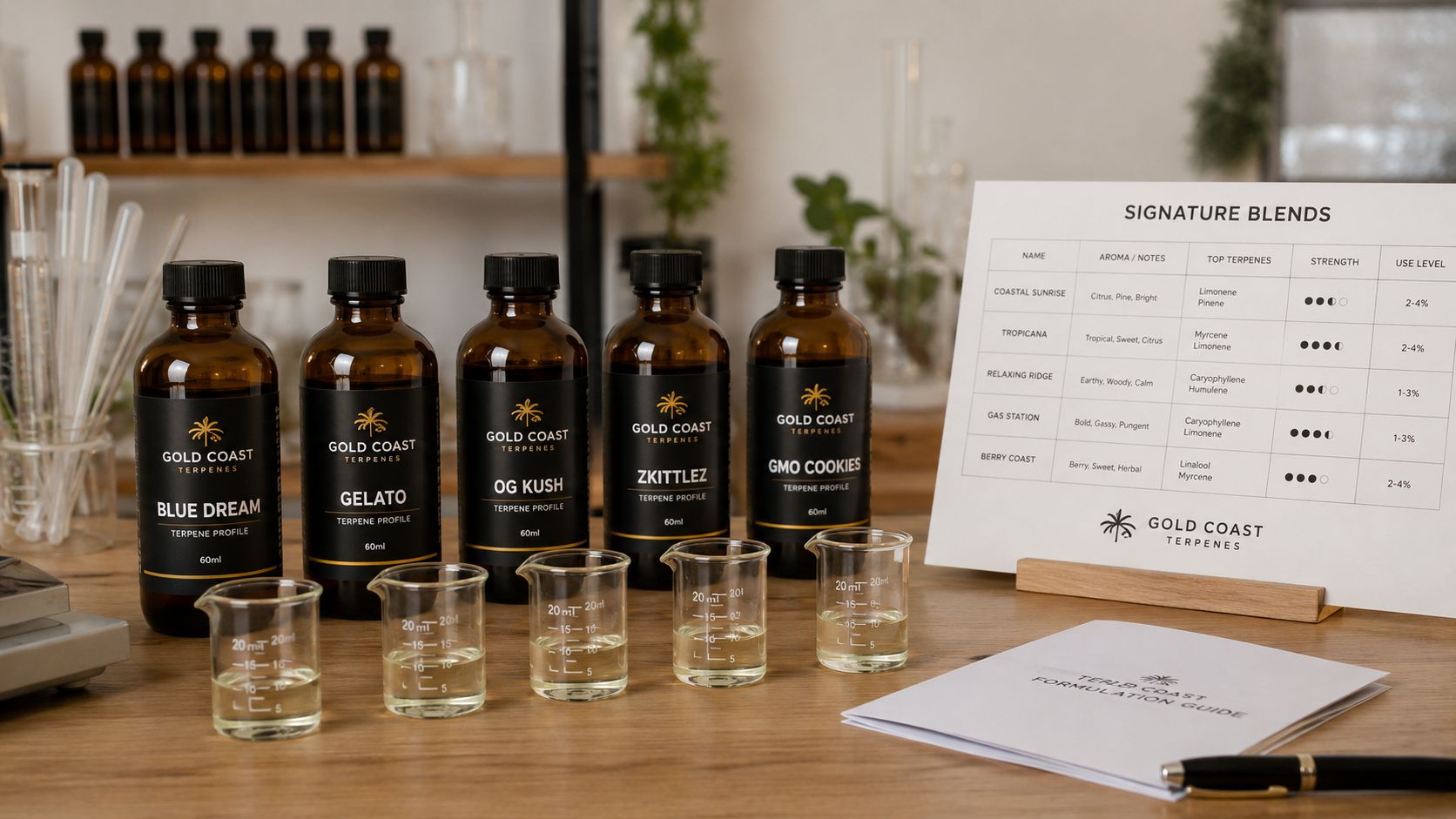
Example one Blue Dream inspired profile for vape cartridges
For a classic terpene profile for vape cartridges, a Blue Dream-inspired blend is a practical benchmark because it needs brightness, body, and a clean finish without going candy-sweet.
For standard ceramic cartridge development, benchmark data places the ideal terpene concentration for distillate formulations at 5% to 7% by weight, with 6% widely cited as the balance point for flavor intensity and viscosity stability in standard ceramic cell cartridges, according to this distillate terpene formulation guide.
For a 100 g finished batch targeting 6% by weight:
- Distillate: 94 g
- Blue Dream-inspired terpene blend: 6 g
That's a clean development batch because the math is easy to audit and the ratio aligns with a widely used ceramic target. If the profile feels too restrained in sensory testing, adjust with another weighed trial. Don't make the correction by eye.
Example two Forbidden Fruit style blend with Limonene isolate
A second scenario is a premium concentrate line where the base profile is fruit-forward but the brief calls for more lift. In that case, a Forbidden Fruit style base can be pushed with a Limonene isolate addition to sharpen the top note.
For a 100 g finished batch targeting 5% by weight total terpenes:
- Distillate: 95 g
- Total terpene phase: 5 g
Inside that terpene phase, the formulator can rebalance the profile by allocating more of the terpene fraction to the citrus-lift component and less to the softer base expression. The exact split depends on the target sensory direction, but the important point is procedural. The isolate belongs inside the pre-calculated terpene phase, not as an extra addition after the main ratio has already been set.
What these examples show
These two formulas solve different problems.
- Blue Dream style cart build: Prioritizes broad hardware compatibility and balanced flavor.
- Forbidden Fruit modification: Prioritizes flavor direction and profile refinement inside a fixed total terpene load.
That distinction matters. New formulators often change total terpene percentage when what they need to change is profile composition. If the batch already has the right viscosity but the aroma is wrong, don't thin it further just to chase flavor.
Troubleshooting and Quality Assurance for Formulators
Most formulation failures get blamed on the terpene blend. Usually, the process is the problem.
Diagnose the failure before remaking the batch
If a blend separates after mixing, ask whether the operator held temperature and mixing long enough. If a cartridge leaks, question whether the formula was pushed too thin for the hardware. If the flavor feels muted or oddly flat, review heat exposure and handling time before you question the profile itself.
A few direct checks help:
- Separation after rest: Look first at mixing integrity and process control.
- Leaking in hardware: Review whether the terpene load exceeded what the cartridge style can tolerate.
- Uneven flavor between fills: Check weighing records, not just the master formula.
- Harsh or stripped aroma: Audit temperature exposure during integration and transfer.
Many “bad terpene” complaints are really bad batch records.
Quality rules that protect production
Professional formulation also means using the right raw materials. 100% pure terpenes free of PG, VG, PEG, and MCT are the accepted standard for safety and legal compliance, and keeping diluents at no more than 10% of the finished solution is a hard rule for avoiding potency loss and hardware failure.
For batch release, reserve a retention sample and review it after a short stability hold before committing the entire lot to fill. Sensory review matters too. If the aroma opening, body, and finish don't match the intended profile, correct the formula on paper and on the scale, not with improvised additions in the vessel.
If you're building repeatable terpene profiles for distillate, strain-inspired blends for vape cartridges, or custom inputs for cannabis product formulation, Gold Coast Terpenes offers the kind of components and formulation resources that make disciplined process work easier. Their catalog includes strain-specific blends, isolates such as Limonene and Myrcene, and practical tools for teams that need flavor accuracy, compliance-friendly materials, and consistent batch performance.